In Massachusetts, residential proximity to a nuclear power plant (NPP) was associated with significantly increased cancer incidence, with risk declining by distance, according to a new study led by Harvard T.H. Chan School of Public Health.
The study was published Dec. 17 in Environmental Health. It was conducted by researchers in the Department of Environmental Health, including corresponding author Yazan Alwadi, PhD student, and senior author Petros Koutrakis, professor of environmental sciences.
Despite widespread—and potentially expanding—reliance on nuclear power in the U.S., epidemiologic research investigating the health impacts of NPPs remains limited. Meanwhile, the results of studies conducted internationally vary significantly. To broaden the evidence base, the researchers assessed proximity of Massachusetts zip codes to nuclear power plants and 2000-2018 cancer incidence data collected by the Massachusetts Cancer Registry. They controlled for confounders such as air pollution and sociodemographic factors.
The researchers estimated that about 20,600 cancer cases in the state—roughly 3.3% of all the cases included in the study—were attributable to living near an NPP, with risk declining sharply beyond roughly 30 kilometers from a facility. The risk of developing cancer attributable to living near an NPP generally increased with age.
According to the researchers, the findings highlight the importance of acknowledging and addressing nuclear energy’s health impacts, particularly at a time when its expansion is being promoted as a solution to climate change.
Ultranationalist Israeli politicians, including National Security Minister Itamar Ben-Gvir, wore golden noose-shaped lapel pins to a meeting on Monday in order to show their “commitment” to advancing a widely condemned bill to mandate the death penalty for “terrorists” who kill Israelis.
The pins resemble the yellow ribbon pins that Israeli leaders have worn throughout their genocide to to acknowledge the Israeli captives held in Gaza.
Ben-Gvir boasted about the pins, worn by members of his Otzma Yehudit party, saying that they show the politicians’ “commitment to the demand for the death penalty for terrorists.”
The politicians were attending a hearing on a bill advancing through the Israeli Knesset that would ensure that those who kill Israelis “with the aim of harming the State of Israel” would be given the death penalty. Critics have noted that the bill is worded in such a way that it would effectively exclusively target Palestinians, in the latest instance of Israeli politicians advancing policies to further entrench Israel’s apartheid.
Ben-Gvir boasted that the nooses are “one of the options by which the law will enforce a death penalty for terrorists.” He seemed to relish in the idea of the death penalty, saying, “of course, there is the option of the gallows, the electric chair, and there is also the option of lethal injection,” Israeli media reported.
The bill, which passed a first reading last month, has been roundly condemned by human rights experts.
“Knesset members should be working to abolish the death penalty, not broadening its application. The death penalty is the ultimate cruel, inhuman, and degrading punishment, and an irreversible denial of the right to life. It should not be imposed in any circumstances, let alone weaponized as a blatantly discriminatory tool of state-sanctioned killing, domination and oppression,” said Erika Guevara Rosas, Amnesty International’s Research, Advocacy, Policy and Campaigns director.
The bill comes amid “a drastic increase in the number of unlawful killings of Palestinians, including acts that amount to extrajudicial executions” since October 2023 and “a climate of incitement to violence against Palestinians as evidenced by the surge in state-backed settler attacks in the occupied West Bank,” Guevara Rosas said.
Indeed, Ben-Gvir also boasted about the deaths of Palestinians in Israeli custody under his watch. According to Israeli media, 110 Palestinians have died under his prison policies in the past two and a half years — a “record high,” Israeli outlet Walla reported. This is compared to 187 Palestinian detainees recorded killed in Israeli prisons between 1967 and 2007. The true toll may be far higher, as Israel obscures statistics on Palestinian prisoners and captives.
“This morning, I saw that it was published that under Itamar Ben-Gvir, 110 terrorists have died. They said there has never been anything like this since the state’s founding,” Ben Gvir boasted, while also denying that his policies were related to the killings.
Last month, the Israeli Medical Association said that its doctors would not participate in the executions, as that would force them to go back on their oath as doctors. “Our knowledge must not be used for purposes that do not promote health and welfare,” a representative of the group said.
Ben-Gvir claimed on Monday, however, that since that statement, “I have received a hundred calls from doctors saying, ‘Itamar, just tell me when.’”
In May, President Trump sat in the Oval Office flanked by executives from America’s nuclear power industry.
“It’s a hot industry. It’s a brilliant industry,” the president said from behind the Resolute desk.
It’s also an industry that’s having a moment. Billions of dollars in capital are currently flowing into dozens of companies chasing new kinds of nuclear technologies. These are small modular designs that can potentially be mass produced in the hundreds or even thousands. Their proponents say these advanced designs promise to deliver megawatts of power safely and cheaply.
But there’s a problem, Joseph Dominguez, the CEO of Constellation Energy, told the president.
New nuclear plants keep getting caught up in safety regulations.
“Mr. President, you know this because you’re the best at building things,” Dominguez, whose company runs about a quarter of America’s existing nuclear reactors, said. “Delay in regulations and permitting will absolutely kill you. Because if you can’t get the plant on, you can’t get the revenue.”
Now, a new Trump administration program is sidestepping the regulatory system that’s overseen the nuclear industry for half a century. The program will fast-track construction of new and untested reactor designs built by private firms, with an explicit goal of having at least three nuclear test reactors up and running by the United States’ 250th birthday, July 4, 2026.
If that goal is met, it will be without the direct oversight of America’s primary nuclear regulator. Since the 1970s, safety for commercial reactors has been the purview of the Nuclear Regulatory Commission. But the NRC is only consulting on the new Reactor Pilot Program, which is being run by the Department of Energy’s Office of Nuclear Energy……………………………………………………………………………………………………
Sites across the country will host new reactor designs
The new pilot program may be an unproven regulatory path run by an agency with limited experience in the commercial sector, but supporters say it’s energizing an industry that’s been moribund for decades.
“This is exactly what we need to do,” said Isaiah Taylor, founder and CEO of Valar Atomics, a small nuclear startup headquartered in Hawthorne, Calif. “We need to make nuclear great again.”
Valar and other companies plan to build smaller reactors than those currently used in the nuclear industry, and that makes a Chernobyl or Fukushima-type accident impossible, noted Nick Touran, an independent nuclear consultant. “The overall worst-case scenario is definitely less when you’re a smaller reactor,” he said.
Critics, however, worry that the tight July 4 deadline, political pressure and a lack of transparency are all compromising safety. Even a “small” release of radioactive material could cause damage to people and the environment around the test sites.
“This is not normal, and this is not OK, and this is not going to lead to success,” warned Allison Macfarlane, a professor at the University of British Columbia who served as chairman of the NRC under President Barack Obama. “This is how to have an accident.”
AI’s need for speed
……………………………………………………………………………………………………………. Right from the start it was clear that, unlike the slow and deliberate safety culture that has dominated nuclear power for decades, this new program would be all about speed.
…………officials responsible for overseeing safety would do “whatever we need to ensure that the government is not stopping you from reaching [nuclear] criticality on or before July 4, 2026.”
A new regulator
Before the executive order, the Energy Department did not regulate the safety of commercial nuclear reactors. That job fell to another body: the Nuclear Regulatory Commission.
The commission was set up in 1975 by Congress as an independent safety watchdog, said Allison Macfarlane, the former NRC chair. Part of the reason the NRC was formed was because the predecessor to the DOE, known as the Atomic Energy Commission, oversaw both safety and promotion of nuclear power at the same time.
“This was a very strong conflict of interest,” Macfarlane said.
But in recent years, companies, particularly those trying to build new kinds of reactors, had become frustrated with the NRC, Macfarlane said. “The promoters of these small modular reactors were becoming very vociferous about the NRC being the problem,” she said.
In 2022, the NRC rejected a combined license application for Oklo, a new nuclear startup. Oklo had submitted an application to build and operate its small reactor, called the Aurora powerhouse. But the NRC denied the application because it contained “significant information gaps in its description of Aurora’s potential accidents as well as its classification of safety systems and components.”
Oklo was told it could resubmit its application to the NRC, but it never did.
Then at the May signing of the executive order, Oklo’s CEO Jacob DeWitte appeared behind President Trump applauding the new reactor program at DOE.
“Changing the permitting dynamics is going to help things move faster,” DeWitte said to the president. “It’s never been more exciting.”
Oklo had another connection to the Energy Department — the secretary of energy, Chris Wright, was a member of Oklo’s board of directors until he took the helm at the DOE. Wright stepped down following his confirmation in February.
In August, a little over a month after that initial meeting between industry executives and the DOE, the Office of Nuclear Energy announced the 11 advanced reactor projects had been selected for the Reactor Pilot Program. Three of Oklo’s reactors were part of the new pilot program, including a test version of the reactor design rejected by the NRC…………………………………………………………………………………………………………
Valar’s design looks far different from the reactors that are running today. It will use a special type of fuel together with a high-temperature gas to generate heat and electricity. Taylor said gathering real data will speed development and increase safety over the long-term….
(Valar is also party to a lawsuit against the NRC arguing the commission does not have the authority to regulate small reactors. In his interview, Taylor told NPR the company intends to file for an NRC license “when we’re ready.”)
………………………………………………….. critics question whether the pilot program will really produce safe nuclear reactors.
The July 4, 2026, deadline puts enormous pressure on the program, said Heidy Khlaaf, the chief AI scientist at the AI Now Institute, which recently published a report warning that AI development could undermine nuclear safety.
“I think these manufactured timelines are actually incredibly concerning,” Khlaaf said. “There’s no timeline for assessing a new design and making sure it’s safe, especially something we haven’t seen before.”
Then there’s the question of public transparency. The NRC makes many of the documents around its decisions available publicly. It also frequently allows the public to comment as well, added Edwin Lyman, director of nuclear power safety at the nonprofit Union of Concerned Scientists. The new pilot program is far more opaque and “is really an attempt to subvert the laws and regulations that go around commercial nuclear power,” he said.
While many of the test reactors are small and tout themselves as inherently safer than existing nuclear power plants, they are still capable of leaking radiation in an accident, Lyman noted. “If they are located closer to populated areas, if there aren’t any provisions for offsite radiological emergency planning … then you are potentially putting the public at greater risk, even if the reactors are small,” he said.
Perhaps most worrying, said former NRC Chair Macfarlane, is how the DOE’s safety assessment might be used to build more small reactors across the country, once the pilot reactors are built.
………………………………………..Macfarlane is unconvinced. She said relying on the hasty DOE analysis for the construction of potentially dozens or even hundreds of small reactors around the U.S. is the real risk.
The same dynamic is at play in the Caribbean once again, according to Assange, as the Nobel Committee crowns a Venezuelan politician best known for her unhinged appeals for foreign military intervention and her dedication of her Nobel victory to US President Donald Trump.
By awarding its peace prize to Trump’s favorite Venezuelan opposition figure, pro-war coup plotter Maria Corina Machado, the Nobel Committee contravened the principles enshrined in its founding documents, as well as Swedish law, Julian Assange alleged in an explosive brief reviewed by The Grayzone.
The Swedish government violated its own laws by awarding the Nobel Peace Prize to Venezuelan opposition figure Maria Corina Machado, according to an explosive legal brief filed by Julian Assange, the Wikileaks co-founder and former political prisoner who was hounded across the globe, confined in harsh conditions, and subjected to physical and psychological torment over the course of a decade by the US and its allies.
The Nobel committee’s decision to award Machado the Peace Prize — and the 11 million Swedish Kroner ($1.18 million USD) reward which accompanies it — means that “there is a real risk that funds derived from Nobel’s endowment have been or will be… diverted from their charitable purpose to facilitate aggression, crimes against humanity, and war crimes,” Assange stated.
The Wikileaks founder pointed to the “ample public statements… showing that the U.S. government and María Corina Machado have exploited the authority of the prize to provide them with a casus moralis for war,” adding that the explicitly stated purpose of the war sought by Machado and her wealthy Latin American backers would be “installing her by force in order to plunder $1.7 trillion in Venezuelan oil and other resources.”
The Nobel Foundation stands accused of a number of violations of Swedish criminal law, including breach of trust, misappropriation and gross misappropriation, conspiracy, crimes against international law, as well as financing of aggression, facilitation of war crimes and crimes against humanity, and breaching Sweden’s stated obligations under the Rome Statute, to which Stockholm says it is “deeply committed.”
Under Swedish law, “Alfred Nobel’s endowment for peace cannot be spent on the promotion of war,” Assange noted. “Nor can it be used as a tool in foreign military intervention. Venezuela, whatever the status of its political system, is no exception.”
By granting Nobel funds to Machado, Assange argues that the Committee is effectively financing “a conspiracy to murder civilians, to violate national sovereignty using military force…” By refusing to end payments, “they flagrantly violate Nobel’s will and clearly cross the threshold into criminality,” he alleged. The Wikileaks co-founder seeks the “immediate freezing of all remaining funds and a full criminal investigation” into Committee members who awarded the prize.
The Nobel Prizes were established in 1901 according to Swedish inventor Alfred Nobel’s last will and testament, which was later incorporated into the Swedish and Norwegian legal systems. The Peace Prize, which is meant to be bestowed on the figure who has contributed most to “fraternity between nations,” the “abolition or reduction of standing armies,” and “the holding and promotion of peace congresses,” has served as a cornerstone of Scandinavian soft power ever since.
Since its inception, however, the prize was marred by controversy due to the violent legacy of its recipients, and the political ambitions of its Norwegian sponsors. In the case of one of the Prize’s first winners, US President Theodore Roosevelt, the Norwegian Nobel Committee was criticized at the time for overlooking the American statesman’s naked warmongering in Latin America in order to curry favor with the nascent US empire. The New York Times sardonically observed that “a broad smile illuminated the face of the globe when the prize was awarded … to the most warlike citizen of these United States.”
The same dynamic is at play in the Caribbean once again, according to Assange, as the Nobel Committee crowns a Venezuelan politician best known for her unhinged appeals for foreign military intervention and her dedication of her Nobel victory to US President Donald Trump.
As Assange explained, Trump’s massive buildup of US military forces off the coast of Venezuela “has already committed undeniable war crimes, including the lethal targeting of civilian boats and survivors at sea, which has killed at least 95 people.”
“The Office of the United Nations High Commissioner for Human Rights labeled these U.S. coastal strikes against civilian boats “extrajudicial executions,” the Wikileaks co-founder wrote. And the “principal architect of this aggression” was none other than Trump’s Secretary of State Marco Rubio, who “nominated María Corina Machado for the peace prize.”
Norwegian Nobel judges tied to influential Venezuelan regime change lobbyist
The awarding of the Nobel Peace Prize to a figure as clearly unqualified as Machado – and in apparent violation of Swedish law – raised questions about whether the Committee had been influenced by powerful outside interests. Machado’s nomination for the prize by the US Secretary of State had an undeniable impact on the decision, as the Nobel ceremony serves as a central channel of Norwegian soft power. But inside Oslo, a political powerbroker determined to return to power in his family’s native Venezuela may have also played a role in swinging votes for Machado. ………………………………………………………………………………………………………………………………..
The odds of Machado winning surged from 3.75% to 72.8% just hours before the Nobel Committee officially informed Machado of her victory. One unusually prescient bettor won $65,000 gambling on the Venezuelan opposition figure. “It seems we have been prey to a criminal actor who wants to earn money on our information,” said Kristian Berg Harpviken, the head of the Nobel Institute.
Months later, The Nobel committee still has yet to conclude its investigation into the corruption scandal. As of publication, the committee did not respond to a request for comment by The Grayzone.
For what promotes itself as the world’s premiere peacemaking institution, it may be too late to undo the damage wrought by giving the Nobel Prize to an avowed champion of violent regime change.
YES, of course the Stop Hinkley event you publicised (Letters, December 13) was Christmas humour, but it does concern us that significant facts are being ignored about the outdated Hinkley Point C new (old) nuclear power plant being built on our precious Severn estuary when climate change predictions suggest that the Hinkley coastline will be inundated and flooding will occur across Somerset.
How will this be safe when HPC radioactive waste will be too hot to move and will have to reside on the fragile coastline for over 200 years?
It seems that there are not enough skilled workers to complete the HPC job which has had design problems, despite supposedly learning from the mistakes at Olkiluoto, in Finland, Flammanville, in France, and Taishan, in China.
The original workforce of 8,000 has now had to increase to 15,000, and still the start-up date is up in the clouds. The costs have escalated from £18 billion to current predicted costs of £46 billion and rising.
How is the country going to pay for this and all the other pie in the sky so-called new nuclear builds that roll off the tongues of the fast turnover of politicians that have been involved?
So far it has taken 10 Prime Ministers, starting with Thatcher, to partially build HPC. Their legacy is a big mistake that nobody has the courage to say we shouldn’t have started this, it’s a runaway train on which nobody has figured out how to apply the brakes.
HPC is finished. HPC will never be needed, I believe, other than for a building site training programme.
Not one of those Prime Ministers will be accountable for the toxic high level radioactive waste that will be lurking on the Severn estuary coastline far into the future for our children’s children to pay for and deal with.
The level of radioactivity of the waste will be in total around 80% of the radioactivity level currently of Sellafield. This fact alone will mean that Hinkley will be the Sellafield of the South.
Hinkley’s design is currently in the news due to its intention of destroying more of our precious Severn estuary fish and marine life in its massive cooling water intakes, which will suck in an Olympic-sized swimming pool of water every 20 seconds.
EDF is faltering over its requirement to protect the fish with an acoustic fish deterrent. Even so, this technology may save some of the fish, but the eggs and fry will pass into the cooling system and be destroyed by the heat and chemicals, which will then be pumped back out into the estuary.
The technology of nuclear power belongs to the last century and is wasteful of energy. The steam process results in two thirds of the heat energy being pumped out into the estuary warming the sea.
Stop Hinkley continues to hold EDF to account, and we will be watching, and we will be back for the next predicted finish date of 2027 with our HPC Christmas turkey to cook.
Region known as ‘world’s refrigerator’ is heating up as much as four times as quickly as global average, Noaa experts say
The Arctic endured a year of record heat and shrunken sea ice as the world’s northern latitudes continue a rapid shift to becoming rainier and less ice-bound due to the climate crisis, scientists have reported.
From October 2024 to September 2025, temperatures across the entire Arctic region were the hottest in 125 years of modern record keeping, the US National Oceanic and Atmospheric Administration (Noaa) said, with the last 10 years being the 10 warmest on record in the Arctic.
Introduction: ‘Nuclear plants should be built closer to urban areas and should be allowed to harm the local environment’ so concluded The Times, 24 November 2025 on reporting on the findings of the Nuclear Regulatory Taskforce in its final report to the UK Government. This recommendation made to Ministers flew in the face of accepted policy, the Semi-Urban Population Density Criteria. that building new nuclear plants near towns and cities should be banned because of the risk posed to large numbers of people in the event of an accident involving radioactive materials.
Many of the other 46 recommendations made by the NRTs were equally disquieting, representing a manifesto of deregulation – a ‘radical reset’ – in the vain hope that this will spark a renaissance in the nuclear industry, with new nuclear plants thrown up more quickly and more cheaply.
The outcome of the inquiry was effectively predetermined in line with a press release from the Office of the Prime Minister issued 6 February 2025. This appeared to mirror the front pages of vituperative pro-nuclear newspapers, with Prime Minister Starmer speaking of his determination to ‘slash red tape to get Britain building [new nuclear power stations] – as part of his Plan for Change ‘with the government ‘ripping up archaic rules and saying no to the NIMBYS to prioritise growth’.
The press release announced that the Prime Minister was establishing a Nuclear Regulatory Taskforce charged with making this vision a reality which will ‘report directly to the PM’. i Although supposedly independent, three of the five taskforce members had clear links to the nuclear industry (Andrew Sherry is former chief scientist at the National Nuclear Laboratory, Dame Sue Ion has held various posts in UK nuclear industry bodies, and Mark Bassett is a member of the InternationalNuclear Safety Advisory Group), handy for a body charged with identifying the means to sideline Britain’s ‘overly bureaucratic’ nuclear regulations.
Cynics – like this author – might postulate that the findings were largely pre-written at the outset and that the real purpose of the taskforce was to seek to justify them.
In working upon this justification, the taskforce, reinforced by intermittent but consistent statements from Government Ministers, nuclear trades unions, and industry lobbyists, has sought to trash regulators as overzealous, and their regulations as disproportionate, and campaigners and members of the public who oppose nuclear development as NIMBYS and BLOCKERS, with their recourse to legal remedies seen as irksome……………………………………………………………………………………………………………………………………………………https://www.nuclearpolicy.info/wp/wp-content/uploads/2025/12/A445-NB331-Rushing-to-Deregulation-Dec-2025.pdf
Elon Musk’s solar business, anchored by the 2016 Tesla-SolarCity merger, now operates under Tesla Energy, offering solar panels, Solar Roof systems, and battery storage to promote renewable home energy solutions.
After recently making headlines for his comments on womanhood, Elon Musk has once again stirred the internet, this time with a blunt take on the future of clean energy. The Tesla and SpaceX CEO has taken a jab at nuclear power, calling it inefficient compared to solar energy.
In a viral post on X, Musk dismissed the global obsession with building nuclear fusion reactors on Earth, calling the idea “super dumb.” He argued that instead of chasing complex nuclear solutions, humanity should focus on harnessing solar energy, the very source that powers our entire planet naturally.
He argued that humanity is ignoring the most powerful fusion reactor already available, the Sun.
“The Sun is an enormous, free fusion reactor in the sky. It’s super dumb to make tiny fusion reactors on Earth,” Musk wrote on X. He added, “Even if you burned four Jupiters, the Sun would still account for nearly 100% of all power ever produced in the solar system. Stop wasting money on puny little reactors – unless you’re openly admitting they’re just science experiments.”
At the heart of Musk’s argument is the idea that solar power is vastly underused. He views it as the most abundant, clean, and logical alternative to fossil fuels. His blunt remarks, telling governments and companies to quit investing in miniature fusion projects unless they’re labelled as experimental, quickly gained massive attention online, sparking fresh discussions on the direction of global energy policy…………….
The earth has moved under our feet, and our massive security gamble is crumbling, but the government pretends nothing has happened, writes Michael Pascoe.
Tits on a bull, the Joint Standing Committee on Foreign Affairs, Defence and Trade and the Parliamentary Joint Committee on Intelligence and Security, all same same. The former committee is a random mix of odds and sods – even Ralph Babet – as could be assembled, the latter stacked with fans of last century’s security stories, devotees of Pax Americana, fed and watered by the local and American security establishment
“to think no further than their outdated Anglosphere prejudices.“
This was the year the earth moved for Australia’s security, while our timid government kept its head under the pillows, desperately hoping it would not have to face up to the changes and challenges, praying its political strategy of copying coalition policy would help keep it safe at the polls. What’s Labor’s main security concern? How it looks in khaki on election day.
Can the opposition come up with a more pro-American defence spokesman than Richard Marles? No. Labor remains safe on the security right flank that was traditionally Liberal high ground.
With the Albanese/Marles/Wong government devoted to exerting discipline, quashing dissent and going all the way with Donald J, Australia’s national security future goes unexamined while its current blueprint burns.
Strategic failure
We have proven ourselves to be rich in the greatest strategic failure: lacking imagination. Our defence establishment – politicians, spooks, bureaucrats, military, salespeople, foreign agents – could not imagine the change that has been foisted on them, could not conceive any future for Australia other than one embedded in the American military armpit,
can’t grasp that the game has irreversibly changed.
Now, as America changes faster than anyone dared guess, we pursue the path of failure that comes from not believing what is happening. Having explicitly bet our strategic future on America always protecting us, that that is our only hope for survival, it is too painful for the establishment to face up to America withdrawing, to being proven wrong.
Australia Deputy Sheriff
There have been rare and largely ignored voices forecasting what is happening under Trump. A decade ago, Geoff Raby warned of the US eventually withdrawing from Western Pacific domination, leaving Deputy Dawg Australia an orphaned shag on a rock. Hugh White, more recently, has made the case that America is in retreat to its core interests.
That has now been spelt out in the Trump administration’s National Security Statement and by its “Secretary for War” Pete Hegseth. America is to be about the Americas, with Europe left to itself, or Russia, and China’s military rise acknowledged and accepted in Asia.
A new reality
Crikey’s Bernard Keane summarised the new reality ($) while highlighting local mainstream media’s failure to examine it, citing a speech last weekend in which Hegseth said the quiet bits out loud:
“Our interests in the Indo-Pacific are significant, but also scoped and reasonable … this includes the ability for us, along with allies, to be postured strongly enough in the Indo-Pacific to balance China’s growing power.
“President Trump and this administration seek a stable peace, fair trade and respectful relations with China…this involves respecting the historic military buildup they are undertaking.”
Keane concluded Hegseth had said the unthinkable: the US aims merely to be present in the Pacific, not to dominate it. It merely seeks to balance China’s power, not defeat it. And it “respects” China’s military build-up.
“Imagine the absolute uproar from the media — and not just from News Corp — if Anthony Albanese had talked about ‘respecting’ China’s military build-up,” Keane posited.
Like the US blatantly committing war crimes and now piracy off the Venezuelan coast, America’s declared security strategy is an embarrassment Australia doesn’t want to see. This is the America which preferences Russia over Europe.
Not “just a phase”
The optimistic view within the defence establishment clinging to American coattails is that Trump, too, will pass and everything will get back to just the way it was.
It won’t. That’s not the way it happens when the world changes. Much of MAGA will prove sticky even if the Democrats reclaim the White House and Congress.
“Having given ground, it’s very difficult to reclaim it.
Not much of Trump 1.0 was overturned by Biden. The tax cuts and Chinese tariffs remained. The domestic chaos created by Trump will be more than enough for a Democrat administration to wrestle with, if there is a Democrat administration next.
America is set for so many problems by 2028, China’s role in Asia won’t register.
In little ol’ Australia, we’ll watch the cricket and slumber through summer. Prime Minister Albanese’s interview on the final Insiders program for 2025 was typical, being purely domestic. A minister’s expensive airfares was a major issue, American war crimes and the national strategic statement Russia applauded didn’t rate a mention.
And with an iron grip on Labor Party members and an irrelevant opposition, Albanese/Marles/Wong will continue to treat the somnambulant Australian public with contempt, refusing to be open about our AUKUS fantasy,
“refusing to risk a public inquiry,
refusing to tell us what more the US is demanding of its South Pacific vassal.
Oh well, we can concentrate on the cricket, ignore our complicity in piracy and war crimes and just keep handing over the billion-dollar cheque
Michael Pascoe is an independent journalist and commentator with five decades of experience here and abroad in print, broadcast and online journalism. His book, The Summertime of Our Dreams, is published by Ultimo Press.
NESO report says net zero will make energy cheaper within 25 years Energy Live News 11th Dec 2025
Britain could halve its energy spending by 2050 as decarbonisation cuts costs and shields the economy from fossil fuel shocks.
That is the headline finding from NESO’s new analysis of the Future Energy Scenarios 2025 which lays out three illustrative routes to net zero and the price tags attached.
NESO says energy-related costs fall in every pathway dropping from roughly 10% of GDP today to around 5-6% by mid-century even as demand rises due to population growth, economic expansion and power-hungry data centres.
The reason is simple. Spending shifts from imported fossil fuels to homegrown renewables, stronger networks and efficient electric heating which cut operating costs and create local jobs.
Missile defense, as the term implies, is defending against enemy missiles carrying an explosive payload. The origin of these anti-missile systems dates back to the Cold War space race between the U.S. and the Soviet Union, an era when intercontinental ballistic missiles could be deployed in space to launch satellites to orbit or travel thousands of miles carrying nuclear weapons. Missile defense systems were deployed by both superpowers in the 1960s, but proved to be technically infeasible and prohibitively expensive. They were ultimately abandoned.
Feasibility and cost notwithstanding, the U.S. military and weapons contractors succeeded in pursuing these systems during the Ronald Reagan and George W. Bush administrations. Now, Donald Trump has launched the ambitious Golden Dome project, yet another missile defense program based on technologies and space-based interceptors proven to be unworkable.
In this webinar, we will hear three experts discuss the technical and policy aspects of Golden Dome.
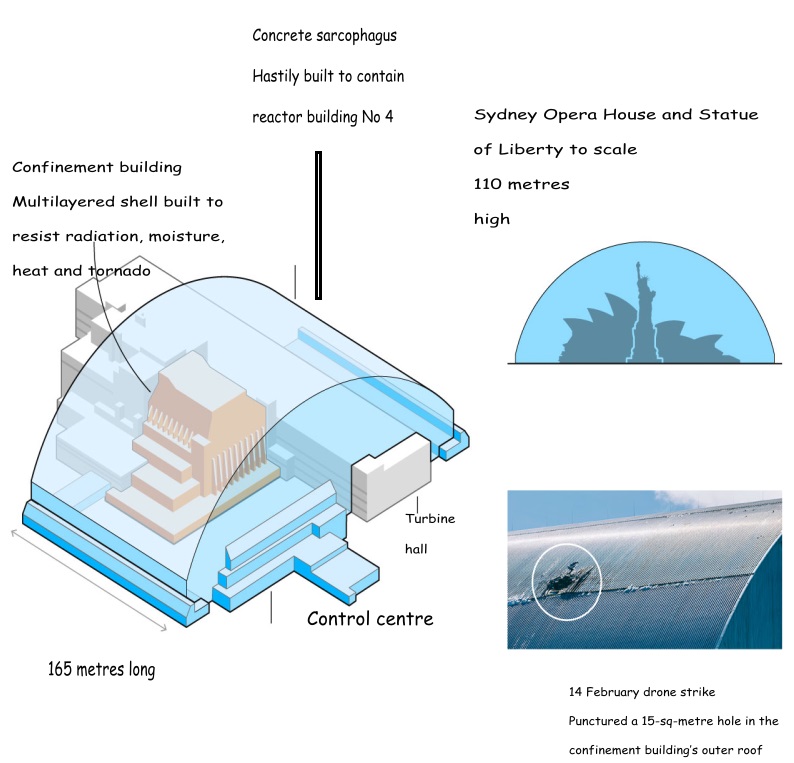
The dome built over the remains of the Chernobyl disaster has been damaged, raising fears it may no longer be able to contain radioactive material.
Officially known as the New Safe Confinement (NSC), the at least $2 billion protective shield was constructed over Reactor 4, which caused the world’s worst nuclear disaster in 1986.
The United Nations‘ International Atomic Energy Agency (IAEA), a nuclear watchdog, revealed this month that the NSC was severely damaged in a Russian drone strike in February.
The IAEA team conducted a safety assessment earlier this month, finding the dome had lost its primary safety functions, including confinement capability.
IAEA director general Rafael Mariano Grossi said: ‘Limited temporary repairs have been carried out on the roof, but timely and comprehensive restoration remains essential to prevent further degradation and ensure long-term nuclear safety.’
The inspection brought some relief, confirming that the dome’s main structure and monitoring systems remain intact.
But beneath the damaged shelter lies massive quantities of radioactive material from the 1986 disaster, making the site a ticking time bomb.
The IAEA has urged urgent repairs and upgrades to Chernobyl’s protective shelter, calling for better humidity control, advanced corrosion monitoring, and a high-tech automatic system to keep the radioactive reactor remains under control.
The damaged dome is the latest of several such expert missions since September last year, when the substations became increasingly affected by the military conflict.
‘These substations are essential for nuclear safety and security. They are absolutely indispensable for providing the electricity all nuclear power plants need for reactor cooling and other safety systems,’ Grossi said
‘They are also needed to distribute the electricity that they produce to households and industry.’
In 2026, with support from the European Bank for Reconstruction and Development (EBRD), the Chornobyl site will undertake additional temporary repairs to support the re-establishment of the NSC’s confinement function, paving the way for full restoration once the conflict ends.
At the UK-France Summit in July 2025, Prime Minister Keir Starmer and President Emmanuel Macron affirmed their commitment to strengthening the UK-France nuclear relationship. They signed the Northwood Declaration, which established the UK-France Nuclear Steering Group in order to provide political direction and coordinate bilateral work across nuclear policy, capability and operations.
On 10 December, the Nuclear Steering Group met for the first time in Paris, jointly chaired by senior officials from the UK Cabinet Office and the Presidency of the French Republic.
They were accompanied by senior military personnel and officials from defence and foreign ministries to discuss Euro-Atlantic security issues and coordination of their respective independent deterrents. They discussed their approach to strengthening deterrence in Europe and confirmed their ambition for bilateral co-operation on nuclear deterrence.
They also observed Operation POKER which was the first time foreign officials were given access to this demonstration of France’s strategic nuclear airborne component.










 nuclear-news