Nuclear flashpoints to fallout

New Internationalist, 1 January 2026, Amy Hall
Could the threat of nuclear war be closer than ever? Amy Hall explores how we got here and the pathways out of the crisis.
If you want to get a nuclear-powered submarine refitted, repaired or refuelled in Britain, there is only one place to go – Devonport dockyard in Plymouth, the biggest naval base in Western Europe.
Running across more than six kilometres of waterfront, the dockyard has been part of the landscape for generations. It dominates the western edge of the South West England city, encased by high fenced walls, security cameras and warning signs about police dogs and potential arrest for ‘unauthorized activity’.
The main refit and maintenance area is owned and operated by British defence company Babcock International, which in 2024 made $1,273 million in revenue from nuclear weapons work. In 2025, it celebrated a 51 per cent surge in profit.
But Plymouth itself has not seen the same boost. ‘Most of the money generated goes out of the city,’ says local campaigner Tony Staunton, who is also the vice chair of the Campaign For Nuclear Disarmament (CND). Authorities say that Devonport generates around 10 per cent of Plymouth’s income, but neighbourhoods next to the dockyard remain among the poorest five per cent in the country.
Devonport doesn’t just work on operational nuclear submarines, it is also a ‘graveyard’ for retired ones. Twelve out of the 16 decommissioned submarines at Devonport are still carrying their fuel – effectively a stockpile of nuclear waste.
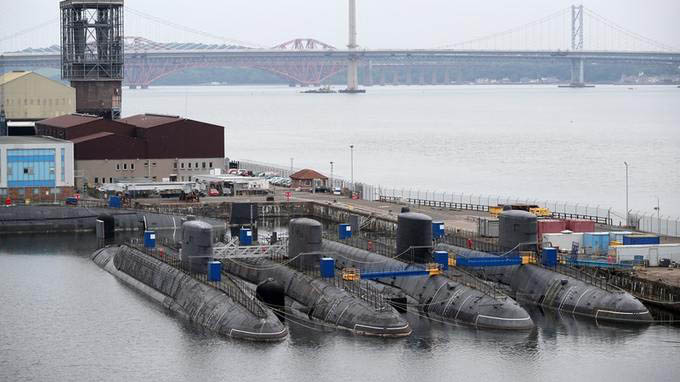
Over the last 30 years, at least 10 serious radioactive leaks have been documented at Devonport, and chemicals like plutonium, americium and tritium have been found on the Plymouth coastline, including at a wildlife reserve close to the dockyard. Staunton says he has met former dockworkers with cancer who are convinced that their illnesses date back to the time they worked at Devonport, but a ‘culture of secrecy’ about any negative impact of the docks pervades over this military city.
Local authorities have taken steps to prepare for a serious radiation leak at the dockyard, which is within a residential area. An investigation by Declassified UK found that in 2018 the Ministry of Defence distributed 60,900 iodine tablets to schools, emergency services and healthcare settings in local areas.
Nuclear-powered submarines are not only able to carry warheads; they are an essential part of the nuclear warfare infrastructure. And, as the British government jumps with both feet into the nuclear arms race, Devonport is key. The facility is set to receive £4.4 billion (just over $5 billion) in government investment over the next 10 years.
In 2024 the UK spent a larger percentage of its military budget (13 per cent) on nuclear weapons than any other country. The 2025 Strategic Defence Review described them as ‘the bedrock of the UK’s defence and the cornerstone of its commitment to NATO and global security’.
The race is on
As the world becomes more insecure, nuclear-armed states are reaffirming commitments to the most destructive weapons humans have developed. During the first six months of 2025, five nuclear-armed countries were engaged in military hostilities or outright war. And, after decades of decline, the trend of more retired nuclear warheads being dismantled than new ones being deployed looks set to be reversed.
Nearly all of the nine nuclear-armed states (US, Russia, Britain, France, China, Israel, India, Pakistan, North Korea) have been busy modernizing and growing their arsenal. Over the past five years global spending on nuclear weapons increased by just over 32 per cent, with the US and UK’s spending rising by 45 and 43 per cent respectively between 2019 and 2023. One year of global nuclear weapons spending could feed 45 million people in danger of famine for 13 years.
Meanwhile, nuclear-armed states are dialling up confrontational rhetoric. The threat posed by nuclear weapons was one of the factors leading the Bulletin of the Atomic Scientists to reset their ‘Doomsday Clock’ to 89 seconds to midnight in 2025 – the closest it has been in its 78-year history. ‘Continuing on the current path is a form of madness,’ the scientists’ statement said. ‘The United States, China and Russia have the prime responsibility to pull the world back from the brink.’…………………………………………………….New START – the last remaining agreement limiting Russian and US deployed nuclear warheads – expires in 2026 unless renewed………………………………………………………………………………
Experts warn that states are becoming increasingly secretive about their nuclear weapons. Israel is perhaps one of the least transparent, maintaining a policy of nuclear ambiguity despite widely accepted evidence that it began developing nukes shortly after its founding in 1948. Israel has collaborated with several other countries’ nuclear programmes, including that of apartheid South Africa during the 1970s and 1980s, ‘conditioned by a perceived common threat in the rise of post-colonial nationalism that drew the two states together’.
You’ve got a nuclear-armed state that is carrying out a genocide, breaching international law – completely outside of any kind of international norms,’ says Bolt. ‘When you look at what Israel is capable of doing, why would it not use its nuclear weapons? If a country can get away with carrying out a genocide in full view, then what’s the next taboo?’
The myth of deterrent
They’re for our own protection. That’s how nuclear weapons are framed by the governments and arms companies that depend on them. They are said to deter attacks – the threat of annihilation is what will save us. And if a potential political leader refuses to say they will press the ‘nuclear button’ they are considered ‘weak’…………………………
Challenging this is essential. And there is plenty of evidence that the endgame will be catastrophic………………………………………………….
Building the movement
‘Countries that have nuclear weapons still continue to integrate them into their security doctrines,’ explains Sanders-Zakre. They ‘see them as essential tools of security, and that makes it very difficult to go from simply reducing numbers to zero.’……..
Overall, the world has far fewer nuclear weapons today than in the mid-1980s, largely due to the anti-nuclear movement that emerged following World War Two and resurged during the Cold War.
People power has won key treaties and agreements to limit the testing and development of nuclear weapons, from international ones like the 1963 Partial Test Ban Treaty to regional examples like the Treaty of Tlatelolco which established a nuclear-weapon-free Latin America and Caribbean.
While disarmament was not achieved, these mass movements certainly succeeded in slowing the race.
One of the most debated international agreements is the Nuclear Non-Proliferation Treaty (NPT), which came into force in 1970, focused on limiting the spread of nuclear weapons. Five countries – Britain, the US, Russia, China and France – already had nuclear weapons at the time. The NPT is criticised for its focus on non-proliferation over disarmament, entrenching the power of those five states. ‘Though presented as steps to disarmament, their over-riding purpose was to safeguard the interests of the major nuclear possessors,’ wrote activist and disarmament expert Rebecca Johnson in 2016.
Today, as the British government itself admits, ‘the future of strategic arms control … does not look promising’. But civil society has got behind the Treaty on the Prohibition of Nuclear Weapons (TPNW) which makes acquiring, proliferating, deploying, testing, transferring, using and threatening to use nukes illegal.
‘TPNW is really significant,’ explains Sanders-Zakre. A nuclear-armed state joining it must agree to a time-bound programme for eliminating its arsenal. https://newint.org/arms/2025/nuclear-flashpoints-fallout
No comments yet.
1 This Month


18 March Webinar @ 1 PM EST: An Assessment of SMR Projects: The Case of Canada
register for the zoom:
https://us02web.zoom.us/webinar/register/WN_o8BIIOUvQ2ONJR1nta65DQ#/registration


of the week – STOP SMALL MODULAR REACTORS IN CANADA
To see nuclear-related stories in greater depth and intensity – go to https://nuclearinformation.wordpress.com
-
Archives
- March 2026 (129)
- February 2026 (268)
- January 2026 (308)
- December 2025 (358)
- November 2025 (359)
- October 2025 (376)
- September 2025 (258)
- August 2025 (319)
- July 2025 (230)
- June 2025 (348)
- May 2025 (261)
- April 2025 (305)
-
Categories
- 1
- 1 NUCLEAR ISSUES
- business and costs
- climate change
- culture and arts
- ENERGY
- environment
- health
- history
- indigenous issues
- Legal
- marketing of nuclear
- media
- opposition to nuclear
- PERSONAL STORIES
- politics
- politics international
- Religion and ethics
- safety
- secrets,lies and civil liberties
- spinbuster
- technology
- Uranium
- wastes
- weapons and war
- Women
- 2 WORLD
- ACTION
- AFRICA
- Atrocities
- AUSTRALIA
- Christina's notes
- Christina's themes
- culture and arts
- Events
- Fuk 2022
- Fuk 2023
- Fukushima 2017
- Fukushima 2018
- fukushima 2019
- Fukushima 2020
- Fukushima 2021
- general
- global warming
- Humour (God we need it)
- Nuclear
- RARE EARTHS
- Reference
- resources – print
- Resources -audiovicual
- Weekly Newsletter
- World
- World Nuclear
- YouTube
-
RSS
Entries RSS
Comments RSS
 nuclear-news
Leave a comment