Fire at Windscale piles
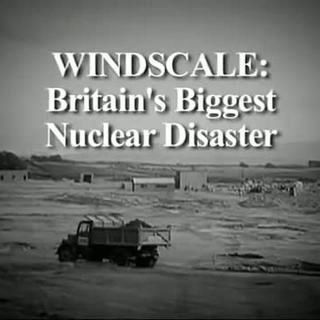
Does Britain Really Ned Nuclear Power? by Ian Fairlea, beyondnuclearinternational
“…………………………………………………………….In 1957, a major fire occurred at Windscale nuclear site (what is now known as Sellafield). The effects of the Windscale fire were hushed up at the time but it is now recognised as one of the world’s worst nuclear accidents. An official statement in 1957 said: ‘There was not a large amount of radiation released. The amount was not hazardous and in fact it was carried out to sea by the wind.’ The truth, kept hidden for over thirty years, was that a large quantity of hazardous radioactivity was blown east and south east, across most of England.
After years of accidents and leaks, several of them serious, and regular cover-up attempts by both the management and government, it was decided to change the plant’s name in 1981 to Sellafield, presumably in the hope that the public would forget about Windscale and the accident.
When, in 1983, Greenpeace divers discovered highly radioactive waste being discharged into the sea through a pipeline at Sellafield and tried to block it, British Nuclear Fuels Ltd (BNFL), who then operated the site, repeatedly took Greenpeace to the High Court to try to stop them and to sequestrate its assets. The first generation of British Magnox nuclear power stations were all secretly designed with the dual purpose of plutonium and electricity production in mind.
Some people think that because plutonium is no longer needed by the UK to make weapons as it already has huge stocks of weapons grade plutonium, there no longer is any connection between nuclear weapons and nuclear energy. This is incorrect: they remain inextricably linked. For example:
- All the processes at the front of the nuclear fuel cycle, i.e. uranium ore mining, uranium ore milling, uranium ore refining, and U-235 enrichment are still used for both power and military purposes.
- The UK factory at Capenhurst that makes nuclear fuel for reactors also makes nuclear fuel for nuclear (Trident and hunter-killer) submarines.
- Nuclear reactors are used to create tritium (the radioactive isotope of hydrogen) necessary for nuclear weapons.
………………………………………………………………………………………………… https://beyondnuclearinternational.org/2025/12/14/does-britain-really-need-nuclear-power/
No comments yet.
1 This Month


18 March Webinar @ 1 PM EST: An Assessment of SMR Projects: The Case of Canada
register for the zoom:
https://us02web.zoom.us/webinar/register/WN_o8BIIOUvQ2ONJR1nta65DQ#/registration


of the week – STOP SMALL MODULAR REACTORS IN CANADA
To see nuclear-related stories in greater depth and intensity – go to https://nuclearinformation.wordpress.com
-
Archives
- March 2026 (129)
- February 2026 (268)
- January 2026 (308)
- December 2025 (358)
- November 2025 (359)
- October 2025 (376)
- September 2025 (258)
- August 2025 (319)
- July 2025 (230)
- June 2025 (348)
- May 2025 (261)
- April 2025 (305)
-
Categories
- 1
- 1 NUCLEAR ISSUES
- business and costs
- climate change
- culture and arts
- ENERGY
- environment
- health
- history
- indigenous issues
- Legal
- marketing of nuclear
- media
- opposition to nuclear
- PERSONAL STORIES
- politics
- politics international
- Religion and ethics
- safety
- secrets,lies and civil liberties
- spinbuster
- technology
- Uranium
- wastes
- weapons and war
- Women
- 2 WORLD
- ACTION
- AFRICA
- Atrocities
- AUSTRALIA
- Christina's notes
- Christina's themes
- culture and arts
- Events
- Fuk 2022
- Fuk 2023
- Fukushima 2017
- Fukushima 2018
- fukushima 2019
- Fukushima 2020
- Fukushima 2021
- general
- global warming
- Humour (God we need it)
- Nuclear
- RARE EARTHS
- Reference
- resources – print
- Resources -audiovicual
- Weekly Newsletter
- World
- World Nuclear
- YouTube
-
RSS
Entries RSS
Comments RSS
 nuclear-news
Leave a comment