Israel Apologists Hasten To Use Bondi Shooting To Attack Anti-Genocide Activists
Caitlin Johnstone, Dec 15, 2025, https://www.caitlinjohnst.one/p/israel-apologists-hasten-to-use-bondi?utm_source=post-email-title&publication_id=82124&post_id=181641440&utm_campaign=email-post-title&isFreemail=true&r=1ise1&triedRedirect=true&utm_medium=email
Two shooters attacked a Jewish Hanukkah celebration at Bondi Beach on Sunday, killing fifteen people and injuring dozens of others. Police report that the shooters were a father and his son; the father was killed by police, and the son was captured.
The shooters appear to have been Muslim, but, much to the inconvenience of those who would like to use this incident to fan the flames of western Islamophobic hysteria, the man who selflessly risked his life to disarm one of them was also a Muslim father of two named Ahmed al-Ahmed.
As usual we’re seeing a lot of speculation about false flags and psyops regarding this incident, but I prefer to hang back from such commentary until I’ve seen some solid evidence.
I do have some thoughts about the public discourse we are seeing about the shooting right now, though.
Point 1: Obviously it is evil to massacre civilians for being Jewish.
Point 2: Obviously Israel’s massacring of civilians must continue to be opposed, and will continue to be opposed.
Today the worst people in the world are trying to pretend Point 1 and Point 2 are contradictory.
It’s so gross watching the tail-wagging excitement of Israel supporters in response to this shooting. They’re so happy they have another rhetorical weapon with which to bludgeon pro-Palestine voices into silence. They can barely contain their glee.
Benjamin Netanyahu immediately scrambled to hold a press conference proclaiming that the attack was the result of Australia taking some steps toward the recognition of a Palestinian state.
New York Times warmonger Bret Stephens penned an article titled “Bondi Beach Is What ‘Globalize the Intifada’ Looks Like,” arguing that the shooters “were taking to heart slogans like ‘resistance is justified,’ and ‘by any means necessary,’ which have become ubiquitous at anti-Israel rallies the world over.”
Iraq-raping war propagandist David Frum wrote a similar article for The Atlantic titled “The Intifada Comes to Bondi Beach,” saying the beach “has been repeatedly targeted by pro-Palestinian demonstrators” and denouncing the fact that “Many in the western world have interpreted post-October 7 anti-Israel actions within the framework of free speech.”
The virulently Islamophobic Australian senator Pauline Hanson swiftly slapped together a statement claiming that “the weekly anti-semitic protests across our nation” and “our obnoxious universities” were “warning signs” that such an attack was coming.
Sky News hastened to give a platform to Israeli Deputy Minister of Foreign Affairs Sharren Haskel in an interview where she declared that “this is what it means” to allow protesters to chant “globalize the intifada”, saying that “if you let that continue and run in your streets” you are inviting further terrorist attacks. Haskel has previously called pro-Palestine protesters in Australia “useful idiots” for Hamas.
Political dynasty princeling Chris Cuomo took to Twitter to assert that people who’ve been accusing Israel of genocide helped “fuel the hatred on bondi beach.”
The Jewish Chronicle’s Stephen Pollard tweeted a video of pro-Palestine protesters in Birmingham with the caption “It you deny the connection between this and what happened at Bondi Beach you are part of the problem.”
A viral tweet from Australian right wing social media personality Kobie Thatcher features a video of a pro-Palestine protest with the caption “This was Sydney, Australia just 6 months ago. These scenes should have been an urgent warning.”
Opposition Leader Sussan Ley has used the attack to demand that Prime Minister Albanese shove through the authoritarian speech suppression plan put forward by Australia’s “antisemitism envoy” Jillian Segal earlier this year, arguing that “We have seen public landmarks turned into symbols of antisemitic hate. We have seen campuses occupied and Jewish students made to feel afraid.”
From the earliest moments after this attack Israel apologists have taken it as a given that it was an act of terrorism in response to Israel’s genocidal atrocities in Gaza, but then framing the people peacefully protesting those atrocities as the problem.
They’re openly acknowledging that the genocide is violently radicalizing people, but instead of coming to the obvious conclusion that Israel should therefore not commit genocide, they’re citing it as evidence that people should stop protesting the genocide.
What to do with Britain’s radioactive waste?

by Ian Fairlea, beyondnuclearinternational .
“………………………………………………………………………………… Radioactive nuclear waste is produced by all nuclear activities. For example, uranium mining produces a great deal of waste in the form of ore spoil like all mining. Since uranium is radioactive, so are its ore wastes. So also are all the processes of refining the ore, enriching the uranium, turning it into fuel for reactors, transportation, burning it in nuclear power stations, processing the used fuel, and its handling and storage. They all create more nuclear waste.
The reason is that everything that comes into contact with radioactive materials, including the containers in which they are stored or moved and even the buildings in which they are handled, become contaminated with radioactivity or are activated by radiation
All radioactive waste is dangerous to human life as exposure to it can cause leukaemia and other cancers. It is usually categorised as low, intermediate or high-level waste. As the radioactivity level increases, so does the danger. Extremely high levels of radioactivity can kill anyone coming into contact with it – or just getting too close to it – within a matter of days or weeks.
Radioactive materials slowly lose their radioactivity and so can become in theory safe to handle but in most cases this is a very slow process. Plutonium-239, for instance, has a half-life of over 24,000 years which means it will remain lethal for over 240,000 years. Other radio-isotopes remain radioactive for millions or even billions of years.
The safe, long-term storage of nuclear waste is a problem that is reaching crisis point for both the civil nuclear industry and for the military.
During the Cold War years of the 1950s and 1960s, the development of the British atomic bomb was seen as a matter of urgency. Dealing with the mess caused by the production, operating and even testing of nuclear weapons was something to be worried about later, if at all.
For example, the Ministry of Defence does not really have a proper solution for dealing with the highly radioactive hulls of decommissioned nuclear submarines, apart from storing them for many decades. As a result, 19 nuclear-powered retired submarines are still waiting to be dismantled, with more expected each year. Yet Britain goes on building these submarines.
This callous disregard for the future has spilled over to the nuclear power industry. For example, at Dounreay, in the north of Scotland, nuclear waste and scrap from the experimental reactor and reprocessing plants were simply tipped down a disused shaft for over 20 years. No proper records of what was dumped were kept and eventually, in 1977, an explosion showered the area with radioactive debris. In April 1998, it was finally announced that excavation and safe removal of the debris had cost £355 million.
The problems of long term, secure storage of nuclear waste are unsolved and growing more acute year by year. Earlier attempts by the nuclear industry to get rid of it by dumping it in the sea were stopped by environmental direct action, trades union protests and now by law.
All details concerning military nuclear waste are regarded as official secrets. However, large and growing quantities of radioactive waste exist at the Rosyth and Devonport dockyards and in particular at the Aldermaston and Burghfield Atomic Weapons Establishments.
One feature of Aldermaston and Sellafield in particular is that they are old sites, and have grown up in an unplanned, haphazard way. New buildings are fitted in between old, sometimes abandoned, buildings. Some areas and buildings are sealed off and polluted by radioactivity. Local streams, and in the case of Sellafield the sea shore, are polluted. The demolition of old radioactive buildings is a delicate, slow and dangerous process. In the circumstances it is hardly surprising that the amount of nuclear waste can only be estimated.
Civil intermediate level solid waste is mainly stored at Sellafield awaiting a decision on a national storage facility.
Military intermediate level solid waste is stored where it is created: dockyards, AWE plants etc. Both civil and military high level solid waste is generally moved to Sellafield for temporary storage.
The major problems are with the long-term storage of intermediate and in particular high-level wastes. Since these are very dangerous and very long-lived, any storage facility has to be very secure (i.e. well-guarded) and safer over a longer period – some tens of thousands of years – than anything yet designed and built by humanity.
Because of this very long time scale, it can never be sealed up and forgotten. Containers corrode with time. There are earth movements. Water seeps through rocks. The waste will have to be stored in such a form that it cannot be stolen and misused and in such a way that it can be inspected and if necessary retrieved and moved.
Plans to dig a trial deep storage facility under the Sellafield site were thrown out in 1997. Geological evidence suggested that the local rock is too fissured and liable to be affected by water seepage.
This threw all the nuclear industry’s plans into confusion. Instead of having a storage site ready by 2010, the date has been put back more or less indefinitely. No alternative site has even been identified.
Apart from the technical, geological problems, few communities seek a huge, long-term nuclear waste storage site in their neighbourhood. Indeed the original choice of Sellafield was as much political as technical. With most local jobs depending on nuclear industry already, there would have been less local opposition than elsewhere.
Nuclear waste is a problem that the nuclear industry has failed to consider seriously for over sixty years but one that can no longer be put off for future generations to cope with.
The effects of any nuclear accidents, such as those at Chernobyl in 1986 and Fukushima in 2011, are also very long-lasting and will affect future generations. The problems of nuclear waste are nowhere near solution. The history of the nuclear industry does not inspire confidence………………………………………………………. https://beyondnuclearinternational.org/2025/12/14/does-britain-really-need-nuclear-power/
Sizewell C — the last of its kind
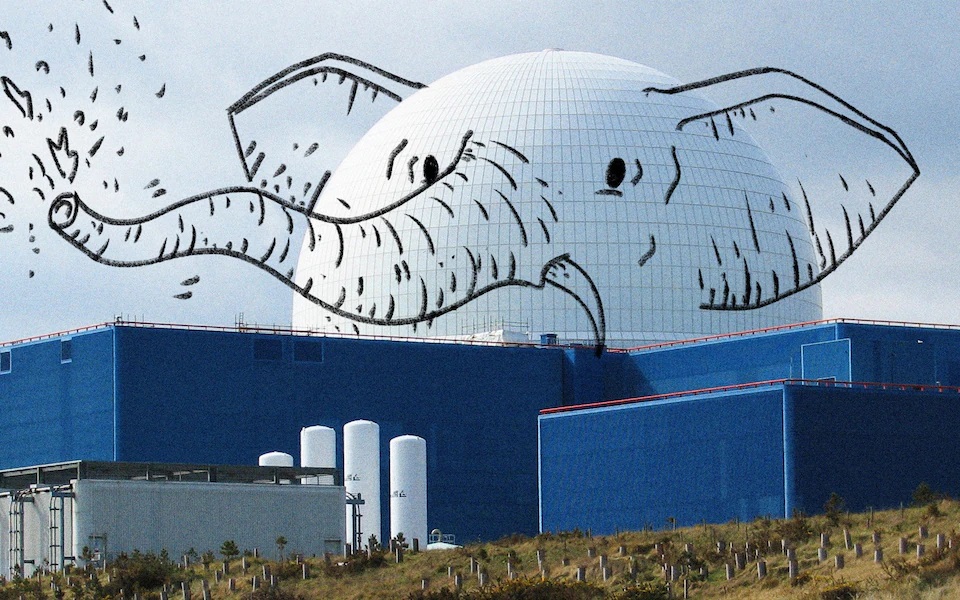
The deal to build the Sizewell C, two reactors using the European Pressurised Reactor (EPR) design, using the Regulated Asset Base (RAB) finance model was inevitably a bad one for the UK public. It gives guaranteed profits to investors by placing the risks on consumers while the EPR has an unenviable record of huge cost and time overruns. It requires consumers to pay the finance charges in the construction period – of the same order as the construction cost – as a surcharge on their bills. However, the additional subsidies and risk removal that were necessary to persuade private investors to take stakes are shocking.
The new finance deal for Sizewell C
RAB financing deal, developed from 2018, was announced in 2021 and legislated for in 2021-2022 when Kwasi Kwarteng was Secretary of State for Business, Energy and Industrial Strategy (BEIS) and completed under Ed Miliband at the Department for Energy Security and Net Zero (DESNZ) in July 2025. The Regulated Asset Base (RAB) finance model for nuclear power plants was sold to the public on the basis that it would provide cheaper power than using the fixed power price financial model under which the Hinkley Point C reactors1 are being built.
It was claimed the model would bring in new sources of investment, particularly institutional investors such as pension funds. The power price reduction would be achieved if the public shared the economic risks with the investors and offered limited subsidies and guarantees. Reducing the risk borne by investors would reduce the cost of capital, a major element in the cost of power from a nuclear power plant, and hence the price of electricity. The subsidies were portrayed not so much as paying costs that would be expected to have been borne by investors, as is normal for subsidies, but as giving the investors guarantees they were not at risk from the consequences of low-probability, high-consequence events and from volatile wholesale electricity market prices.
After five years of effort by government to complete the deal, a Final Investment Decision (FID) for Sizewell C was finally taken on July 22, 2025. The contracts were finalised on November 4, 20252. The largest investor is the UK government (44.9%). The other investors are the Canadian pension fund, La Caisse (20%), Centrica (15%), EDF (12.5%) and Amber Infrastructure (7.6%). Amber Infrastructure is acting on behalf of the UK’s Nuclear Liabilities Fund, NLF, (4.6%), arguably public funds, and International Public Partnerships Limited 3.0%. So only 23% of the investment will come from institutional investors, 27.5% from energy companies and about half (if we include the NLF) from public sources.
An analysis of the Sizewell C deal shows that balance of risks is one-sided with the risks falling almost entirely on taxpayers and consumers, with minimal penalties and generous incentives offered to investors. The subsidies offered are far more extensive than those acknowledged by government and represent large amounts of public money being given to the private investors for no public return. The price of power from Sizewell C is unknown and will vary unpredictably from year to year, but there can be little confidence the RAB model will produce a lower power price than Hinkley Point C even if the cost of the subsidies is not factored in. The incentives required to bring in private investors are so expensive and risky to consumers that the model should not be repeated, and, like the Hinkley Point C deal, it ought to be a one-off, not a door-opener for new nuclear investments.
The Risk/Reward balance
The plan to use the Hinkley Point C finance model for Sizewell C was abandoned by EDF in 2018. This was because it was not willing to accept the financial risks it had signed up to for Hinkley by agreeing a fixed power purchase price with all construction cost and time risks falling on itself. Costs have escalated dramatically at Hinkley since the deal was signed in 2016, by up to 90% but cannot be passed through to the power purchase price: and this commitment led to EDF writing off €12.9bn of its investment in Hinkley Point C in 20233.
The investors in the Sizewell project frequently talk about the project being ‘derisked’4 by which they mean not that the risk has been reduced, but that it falls on others………………………………………………………………………………………………………………………………………..
Subsidies…………………………………………………………………………………………………………………………… “The acknowledgement that ‘Difference’ payments will be substantial demonstrates that it is expected that consumers will be forced to buy power from Sizewell C that will cost more than alternatives in the market.”
…………………………………………………………………………………………….. Will the power be cheaper than for Hinkley?……………………………………………………………………….
Is the Sizewell deal repeatable?………………………………………………………………………………. If the deal proves not to be repeatable, the huge amount of government time and cost that has gone into completing the deal will, as with Hinkley Point C, have been a costly diversion of more than a decade from pursuing the cheaper, quicker and more reliable ways of meeting the government’s promises of net zero…………………………………………………………………………………………………………………………………….Is Sizewell the last large reactor for the UK?…………………………………………………………………………………
Endnotes -……… [copious] https://policybrief.org/briefs/sizewell-c-the-last-of-its-kind/
Could armed robots be the future of nuclear site security?
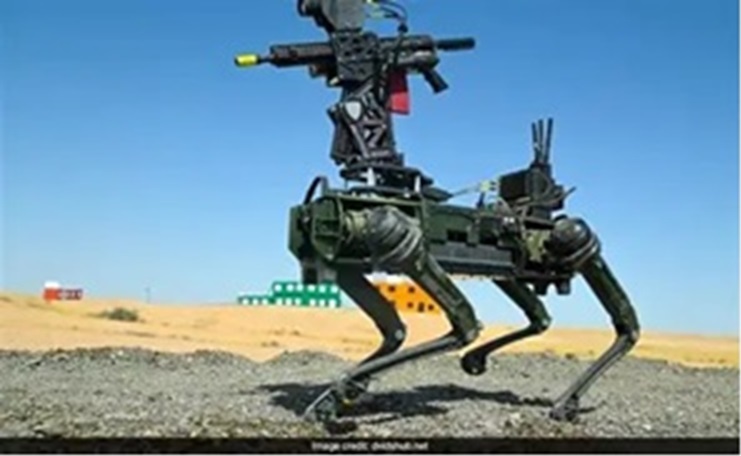
experiments to test the military potential of near-identical quadrupeds being carried out by the US armed forces, with Spot’s cousin converted into an armed platform by the addition of an artificial intelligence-enabled gun turret
16th October 2024, https://www.nuclearpolicy.info/news/spot-to-robocop-could-armed-robots-be-the-future-of-nuclear-site-security/
Robots are becoming increasingly employed in decommissioning operations at Sellafield and Dounreay. Whilst the UK/Ireland Nuclear Free Local Authorities welcome their use in hazardous environments which are too radioactive and otherwise contaminated for human operators, we have concerns that in the long-term their use might expand into on-site security.
The Atomic Energy Authority Special Constable Act 1976 first permitted the United Kingdom Atomic Energy Authority to raise an armed private police force. In 2005, the UKAEA Constabulary was replaced by the Civil Nuclear Constabulary. CNC officers are routinely armed with sub machine guns and authorised to use deadly force – in extremis – whilst guarding nuclear facilities, but also whilst engaged in hot pursuit outside.
However last month, seemingly to counter possible threats from sabotage or terrorism and the greater incidence of climate change protests, the Energy Secretary Ed Miliband instructed the CNC to redeploy officers from their traditional duties to protecting coastal gas plants with effect from April 2025[i]. It is likely that this role may further expand to cover oil depots.
In 2021, the NFLAs objected to planned legislation to widen the CNC’s remit to guarding non-nuclear sites. In our response to a consultation, we said that the ‘CNC’s role should continue to be explicitly confined to policing nuclear sites and facilities’ and that ‘protection of critical national infrastructure should be carried out by an adequately funded democratically controlled local police force’ rather than an unaccountable paramilitary police force.
If CNC numbers at nuclear sites are diluted, there could be pressure to employ robots on security duties in their stead, and in the long-term it is not inconceivable that they may even become armed and autonomous.
The ‘poster child’ of the robots is the quadruped first developed by Boston Dynamics in the United States, affectionately known as Spot the Dog. This variant is now routinely used in decommissioning operations in environments that are unsafe for human operators. The robot uses a specialist scanning system to create a 3D moveable image of its environment, allowing engineers to carry out remote inspections in support of clean-up operations[ii].
Spot can though operate entirely autonomously. Last month, it was reported that such a robot had completed a 35-day autonomous operation to inspect the UK Atomic Energy Authority’s Joint European Torus (JET) facility. Tasks successfully completed included ‘mapping the facility, taking sensor readings, avoiding obstacles and personnel involved in the decommissioning process, and collecting essential data on JET’s environment and overall status twice a day. The robot also knew when to dock and undock with its charging station, to ensure it could complete the task without humans having to intervene’.[iii]
So far, so benign, but a disturbing report appeared around the same time about experiments to test the military potential of near-identical quadrupeds being carried out by the US armed forces, with Spot’s cousin converted into an armed platform by the addition of an artificial intelligence-enabled gun turret to participate in exercises in Saudi Arabia. The flexible turret enabled ground fire, but also aerial fire against drones, which are also an increasing threat to civil nuclear facilities. The article in Military.Com records that robot dogs have already been engaged by the US Defence Department in several roles, including ‘boosting perimeter security at sensitive installations’, a task in which they excel as they can ‘patrol’ ‘without need to rest’.[iv]
The NFLAs cannot help thinking that in a dystopian nuclear future, in which the CNC increasingly overstretched and renamed the Civil Infrastructure Constabulary to reflect its ever-expanded role in providing armed protection to a wide range of critical sites, security forces might engage a force of armed Robocops to supplement the dwindling number of armed human officers, each charged with patrolling the perimeters of civil nuclear facilities, and granted autonomous decision-making to engage trespassers, protestors, and drones with deadly force.
The concept of Spot the Dog becoming SWAT the Dog, however unlikely, is truly terrifying.
Concerns about so-called killer robots animated the world community late last year. The Stop Killer Robots campaign, founded in October 2012, continues to work for a new international law to regulate autonomy in weapons systems. The coalition of over 250 civil society organisations in 70 countries successfully lobbied states to adopt the first ever resolution on autonomous weapons at the United Nations on December 22, 2023. 152 countries supported General Assembly Resolution 78/241 which acknowledged the ‘serious challenges and concerns’ raised by ‘new technological applications in the military domain, including those related to artificial intelligence and autonomy in weapons systems.’
Stop Killer Robots was recently awarded Archivio Disarmo’s Golden Dove for Peace Award at a ceremony in Rome on Saturday, 12 October. The award is given to an international figure or organisation which has made ‘a significant contribution to the cause of peace’.
More details of the campaign can be found at https://www.stopkillerrobots.org/
Trump’s Monroe Doctrine 2.0 Outlines Imperial Intentions for Latin America.

The National Security Strategy condemns U.S. foreign policy since the end of the Cold War. It champions the U.S. economy and military and says that the United States “must be preeminent” in the Americas and around the world. If there is one overarching principle it is the concept of “peace through strength.”
The administration’s National Security Strategy signals a return to more outwardly interventionist policies.
By Michael Fox , Truthout, December 12, 2025
n Wednesday, December 10, Donald Trump announced that the United States had seized a tanker in the Caribbean carrying more than 1.6 million barrels of Venezuelan crude oil.
“Large tanker, very large, largest one ever, actually, and other things are happening,” Trump told the press.
The seizure is only the latest move in a long build-up of U.S. military action in the Caribbean and increasing U.S. threats against Venezuela and its President Nicolas Maduro.
Trump — without evidence — says Maduro is the head of an international terrorist group running drugs into the United States. He has called Maduro’s days numbered.
Over the last three months, the United States has hit at least 22 alleged “drug boats” in the Caribbean and Pacific, killing more than 80 people. The campaign is the first unilateral lethal action the U.S. military has undertaken in Latin America since the 1980s.
The United States has now amassed the largest military buildup in the Caribbean in decades, including the world’s largest warship, the U.S. aircraft carrier USS Gerald R. Ford. Fifteen thousand U.S. troops are stationed in the region, on the ready.
Responding to news of the tanker seizure, Democratic Senator Chris Coons told NewsNation that he is “gravely concerned that [Trump] is sleepwalking us into a war with Venezuela.”
Even Congress has been shocked by how the administration has conducted the boat strikes. But a new document offers insight into the thought process behind Trump’s threats and actions in the region.
The United States has now amassed the largest military buildup in the Caribbean in decades, including the world’s largest warship, the U.S. aircraft carrier USS Gerald R. Ford. Fifteen thousand U.S. troops are stationed in the region, on the ready.
Responding to news of the tanker seizure, Democratic Senator Chris Coons told NewsNation that he is “gravely concerned that [Trump] is sleepwalking us into a war with Venezuela.”
Even Congress has been shocked by how the administration has conducted the boat strikes. But a new document offers insight into the thought process behind Trump’s threats and actions in the region.
The National Security Strategy condemns U.S. foreign policy since the end of the Cold War. It champions the U.S. economy and military and says that the United States “must be preeminent” in the Americas and around the world. If there is one overarching principle it is the concept of “peace through strength.”
“Strength is the best deterrent. Countries or other actors sufficiently deterred from threatening American interests will not do so,” it reads. “The United States must maintain the strongest economy, develop the most advanced technologies, bolster our society’s cultural health, and field the world’s most capable military.”
Front and center is the Western Hemisphere. It’s the first region mentioned in the document — China isn’t mentioned until page 23. The priority and focus on the Americas clearly marks a shift away from U.S. attention elsewhere around the world.
One detail in the document stands out more than any other — a reference to a new “Trump Corollary” to the Monroe Doctrine. This is made twice — first it’s included top among the overall policy goals and then again in the section on the Western Hemisphere.
The term “corollary” may seem like an odd choice to describe Trump’s embrace of the foreign policy position, but it is actually a clear historical nod to a moment when the Monroe Doctrine was used to justify widespread U.S. military actions in the region.
Now, analysts believe this is the direction we are headed again.
The Roosevelt Corollary
When U.S. President James Monroe issued his state of the union address on December 2, 1823, it included in it an articulation of a foreign policy position that would come to be known as the Monroe Doctrine.
Essentially, the doctrine was a message to European countries following the independence of most of the countries of the Americas: Foreign powers had no right to interfere in the politics of the newly independent nations of the Western Hemisphere.
But by the beginning of the 20th century, the United States had grown in prominence, power and ambition. President Theodore Roosevelt’s 1904 “Roosevelt Corollary” vastly reinterpreted the Monroe Doctrine, essentially turning it into a tool to justify U.S. intervention across the region.
……………………………………………………………………………………..the Trump Corollary reads as a veiled threat against countries who might be unwilling to bend to U.S. interests.
“We will assert and enforce a “Trump Corollary” to the Monroe Doctrine,” the National Security Strategy document states. “We want to ensure that the Western Hemisphere remains reasonably stable and well-governed enough to prevent and discourage mass migration to the United States; we want a Hemisphere whose governments cooperate with us against narco-terrorists, cartels, and other transnational criminal organizations; we want a Hemisphere that remains free of hostile foreign incursion or ownership of key assets, and that supports critical supply chains; and we want to ensure our continued access to key strategic locations.”
Analysts say the Trump administration’s visible actions toward Latin America in recent months — the seizure of the oil tanker, the boat attacks, threats of war with Venezuela, intervention into Honduran elections, tariffs on Brazil — all fit into this rubric.
…………………………………………………………………………………………Like the Roosevelt Corollary, which, following 1904, would be used for years to justify intervention after intervention across the region, the new National Security Strategy is a means of justifying the policies, threats, and attacks Trump may unleash across the region.
………………………………………………………………………………………………………………………Gone are the past U.S. pretexts of spreading democracy, or standing for the good of humanity, or civilization building……………………………………………………………………………. https://truthout.org/articles/trumps-monroe-doctrine-2-0-outlines-imperial-intentions-for-latin-america/?utm_source=Truthout&utm_campaign=e71842d601-EMAIL_CAMPAIGN_2025_12_12_07_18_COPY_01&utm_medium=email&utm_term=0_bbb541a1db-62fed5671d-650192793
FBI Labels Antifa a Major Terror Threat, but Lawmakers Say Evidence Is Lacking as Trump’s Obsession Distracts From Far-Right Extremism

December 12, 2025, Joshua Scheer, https://scheerpost.com/2025/12/12/fbi-labels-antifa-a-major-terror-threat-but-lawmakers-say-evidence-is-lacking-as-trumps-obsession-distracts-from-far-right-extremism/
At a recent House Homeland Security Committee hearing, FBI official Michael Glasheen — operations director of the Bureau’s National Security Branch — described the anti-fascist movement antifa as one of the most significant domestic terrorism threats facing the United States, echoing a Trump executive order that designated antifa as a domestic terrorist organization.
But when lawmakers pressed him for specifics, Glasheen struggled to provide concrete evidence about where antifa is organized, how many members it has, or how its activities are tracked. He repeatedly described the situation as “fluid” and emphasized that investigations are ongoing. The exchange underscored deep partisan divisions in Congress over how domestic threats are identified, and raised broader questions about how law enforcement defines and responds to politically motivated violence — particularly given that antifa lacks formal leadership, structure or membership rolls.
Despite the lack of clear data, Glasheen maintained that antifa remains the agency’s “primary concern” and “the most immediate violent threat that we’re facing.”
Democratic Rep. Bennie Thompson challenged those claims directly: “Where in the United States does antifa exist? What does that mean?” he asked. “We’re trying to get information. You said antifa is a terrorist organization. Tell us, as a committee, how did you come to that? Do they exist? How many members do they have in the United States as of right now?”
“Well, that’s very fluid,” Glasheen said.
“Sir, I just want you to tell us — if you said antifa is the No. 1 domestic terrorist organization operating in the United States, I just need to know where they are … how many people have you identified with the FBI that antifa is made of,” Thompson asked.
“Sir, you wouldn’t come to this committee to say something that you can’t prove,” Thompson said to Glasheen. “I know you wouldn’t do that. But you did.
Trump’s obsession with antifa is well-known, even though the evidence has long shown that the more significant threat comes from right-wing–aligned groups rather than activists who identify as anti-fascist. It’s not hard to understand why this president fixates on antifa, but the disconnect between his rhetoric and documented threats has been clear for years. The Intercept’s reporting — based on leaked documents from 2020 — “But while the White House beat the drum for a crackdown on a leaderless movement on the left, law enforcement offices across the country were sharing detailed reports of far-right extremists seeking to attack the protesters and police during the country’s historic demonstrations, a trove of newly leaked documents reveals.”
So there is a threat, just not from the group Trump focuses on. What this designation does, however, is clearly silence critics of his administration, using the “terror” label as a tool — especially if he can find a way to tie someone to foreign support
Because U.S. law does not criminalize membership in domestic terror groups, experts warn that the Trump administration could attempt to target American citizens under existing laws that apply to foreign organizations. Shayana Kadidal, an attorney at the Center for Constitutional Rights, told The Intercept that regulations allow the government to link domestic groups to foreign entities already designated as terrorist organizations, potentially creating legal obstacles for ordinary Americans. Kadidal highlighted past cases in which U.S. citizens were branded “specially designated terrorists” for alleged ties to foreign groups, which severely restricted their ability to conduct normal financial transactions.
Civil liberties advocates also caution that Supreme Court precedent allows individuals to be charged with providing “material support” to foreign terrorist organizations based on speech acts alone — a pathway the administration could exploit. One immediate consequence of this approach is the “chilling effect,” where protesters may hesitate to participate due to legal uncertainty, effectively discouraging civic engagement and dissent.
In the larger context of extremism, the focus on hunting antifa is largely a red herring, distracting from the far more serious threat posed by right-wing and white supremacist groups. We turn to Luke Baumgartner, a research fellow with George Washington University’s Program on Extremism discussing what the we are all taking about, from an interview on PBS :
“I would classify it more as a political scapegoat, honestly. There have been incidents of political violence linked to far left extremists in the U.S. in recent years, but the overwhelming majority of the data points towards far right extremism being a much more serious threat to national security.”
He continued, noting that any protest by the left — whether it’s No Kings or Black Lives Matter — is immediately labeled “antifa.” This represents a clear abuse of Trump’s power in his broader effort to crush the left and silence groups that challenge his warped worldview.
Trump did this with Black Lives Matter back in 2020 with the violent clearing of peaceful Black Lives Matter protesters from Lafayette Square — simply so he could stage a photo op. It remains one of the clearest demonstrations of state power being used to suppress constitutional rights in modern American history.
That wasn’t an anomaly, but part of a longstanding pattern in which protests are met with force, intimidation, and the machinery of government turned against them. Now, feeling more empowered than ever, the president appears to be attempting the same tactics under the guise of combating “terrorism,” despite evidence showing that left-wing movements are far less likely to pose the threats he claims to be targeting.
Needless to say, I’m glad that Bennie Thompson is still around and holding the line, but more action is needed to challenge what amounts to a high level of evil by some and foolishness by others and the belief that there is a real threat when, in reality, there is “no there there,” and that any supposed danger is merely a smokescreen.
THE EUROPEANS: BLIND TO REALITY, DEAF TO ALL WARNINGS & HEADED FOR DISASTER
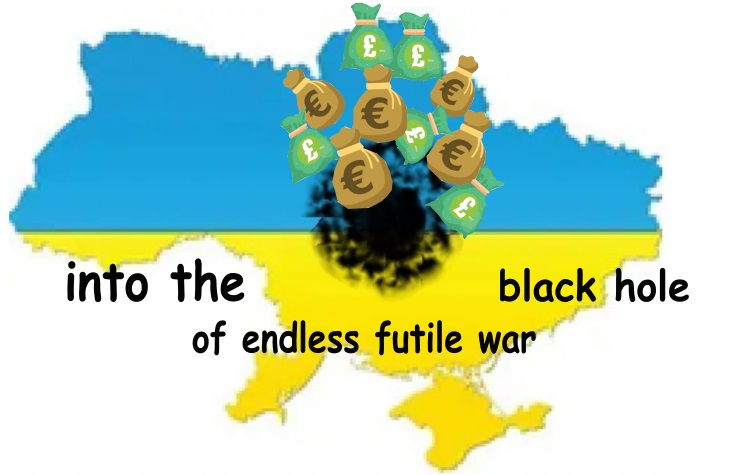
Will Merz, Macron and Starmer finally open their eyes on Ukraine before their war juggernaut hits the wall of hard reality? Can the future EVER forgive them for their endlessly fatal delaying tactics?
Aearnur, Dec 13, 2025, https://aearnur.substack.com/p/the-europeans-blind-to-reality-deaf?utm_source=post-email-title&publication_id=312403&post_id=181444169&utm_campaign=email-post-title&isFreemail=true&r=ln98x&triedRedirect=true&utm_medium=email
When one side cannot reconcile themselves to a relationship being over and refuses to accept this reality an entirely different scenario presents itself to one where both sides agree to part. Someone determined to pursue the relationship at all costs will blindly employ ever more radical measures, measures that worsen an already bad situation, toward potentially dangerous, even fatal levels.
The current crop of European leaders, primarily those of Germany, France and the UK cannot reconcile themselves to the fact of the Ukrainian regime losing the conflict with Russia. They cannot bear this reality and, until the last 24 hours have appeared ready to take ever more ultimately self-harming measures in an utterly futile quest to create an unattainable reality from pure fantasy.
Without the sanctions upon Russia working, without Russia’s trading partners turning their backs upon it, without the West’s so-called gamechanger weapons being effective and without NATO becoming directly involved, the Ukrainian regime in Kiev and its western sponsors were ALWAYS going to lose this conflict. Everything the West tried has failed. Everything the West could now try (which is extremely little) would also fail. Since the USA finally grasped the reality on the ground of the conflict in Ukraine the big question was then always going to be just how long the suicidally deluded Europeans would continue to futilely escalate matters. How long would the Europeans delay while Ukraine lost more men and more land before they finally bowed to reality and convinced the Kiev regime to settle?
Over the next few days we may finally see the Europeans finally accepting the inevitable. Their delay in doing this by not lending their pressure along with that of the U.S. on Zelensky has already cost tens of thousands, arguably hundreds of thousands of Ukrainian lives. By late-2023 it had become clear that Russia would prevail. Nothing on anything remotely approaching a fundamental level was working against an unassailable Russian ability to fight, destroy resistance or attacks from the enemy and to advance. The political, media, financial and military might of the West had completely failed. This was obvious to anyone who knew anything about the comparison of Russian material resources, manpower availability and industrial capacity to that of Ukraine and indeed by comparison with those of the entire collective west.
The inability of western politicians to confront the realities described above has brought them into massive disrepute across the global majority while at the same time vastly enhancing the status of the Russian nation and its endlessly insightful president.
The incompetence, general self-willed blindness and recklessness of western political elites over the question of Ukraine will go down in history as the conclusive ending of a multi-generational blight upon the world. Being unable to extricate themselves from unearned, self-awarded levels of entitlement led them to sacrifice at least a million Ukrainians on the alter of their overweening arrogance.
And for this they will never be forgiven.
Submarines in for repairs at Rosyth could contain nuclear weapons
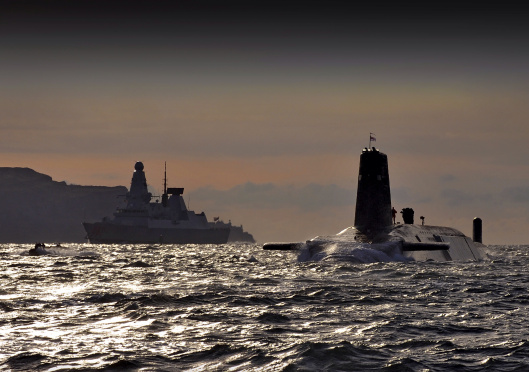
Dunfermline Press, 11th December, By Clare Buchanan, Local Democracy Reporter – Clackmannanshire and Fife
The Ministry of Defence says it will not reveal if nuclear weapons will be aboard submarines being repaired at Rosyth in future, and confirmed residents would be given potassium iodate tablets to block radiation in the event of an emergency.
The revelations came as members of Fife Council’s South and West Fife area committee were given an update on plans for Rosyth to be the temporary repair base for the UK’s new fleet of nuclear deterrent submarines.
While it was explained that “non-nuclear” repairs would be carried out from the dockyard when required, some vessels at the Fife yard could be carrying nuclear weapons – but an MoD spokesperson told councillors that they would not reveal whether or not they were.
Rosyth has been earmarked as a temporary contingent for the UK Government’s Dreadnought class of submarines – the first of which is expected to launch towards the end of the decade.
The proposals also include setting up an emergency planning zone, which could stretch more than a kilometre and includes a residential area…………………………………………………………………………………………………………………………………….When probed, Mr Brown also told councillors that policy would mean there would be no confirmation of if nuclear weapons were on board.
“My position is we do not comment on the condition of the boat whether it is armed or not,” he added…………………………………
Rosyth councillor Andrew Verrachia welcomed the plans…………………….“I don’t want to think about the public being frightened. If any more communication can be put out to the wider public because the last thing anyone wants is frightened, worried members of the public. This should be a good news story.”
Committee convener David Barratt was less pleased with the plans.
“Morally, and as a CND member, I find the existence of nuclear weapons abhorrent,” he said………… https://www.dunfermlinepress.com/news/25689904.submarines-repairs-rosyth-contain-nuclear-weapons/
American-owned consortium assumes control of Canada’s premier nuclear research facility.

THE GLOBE AND MAIL, Matthew McClearn, 12 Dec 25
An American-owned consortium has assumed responsibility for managing Canada’s premier nuclear research facility, Chalk River Laboratories, along with cleaning up the federal government’s sizable inventory of radioactive waste spread across the country.
After a three-month delay, Nuclear Laboratory Partners of Canada Inc. formally took control on Thursday of the organization that runs Chalk River, known as Canadian Nuclear Laboratories.
CNL manages the assets and liabilities of a federal Crown corporation called Atomic Energy of Canada Ltd. under an arrangement Ottawa describes as a “government-owned, contractor-operated” model………………………………………………….
Earlier this year, AECL said the consortium’s contract is worth about $1.2-billion annually. It has been called the federal government’s largest contract at the moment, although key federal authorities – including the Treasury Board Secretariat, Auditor-General and AECL – have been unwilling or unable to confirm that. The term of the contract will be six years but it can be extended for up to another 14 years.
The consortium’s American ownership has provoked controversy. Since assuming office, Prime Minister Mark Carney has espoused a Buy Canadian policy – a key part of his government’s response to mounting conflict with its dominant trading partner, the United States.
Corey Tochor, a Conservative member of Parliament for Saskatoon-University, accused AECL of “selling out our nuclear secrets” to American interests, during the first of three scheduled hearings held before the House of Commons standing committee on natural resources to examine the consortium’s American ownership.
“What we have real deep concerns [about] is that we’re letting a foreign country manage our medical isotopes,” Mr. Tochor said.
Earlier this month, Conservative MP Cheryl Gallant from Renfrew-Nipissing-Pembroke characterized the awarded contract as an “elbows-down” approach that left Americans in control of Canadian intellectual property…………………………………………………………….
The American-owned consortium is led by a large nuclear specialty manufacturer focused on military equipment and nuclear fuel called BWX Technologies Inc…………………………………..
The U.S.-led consortium takes over from another partnership known as Canadian National Energy Alliance, which held the contract for a decade. Its members recently included Montreal-based AtkinsRéalis Group Inc. and two American companies, Jacobs Engineering Group Inc. and Fluor Corp………………………….
The American consortium was declared the winner of a competitive procurement process in June and had originally been scheduled to take over in September. The transfer was delayed pending a review by the Competition Bureau, which is responsible for enforcing federal antitrust rules. Late last month the Competition Bureau issued a “no-action letter” confirming it will not oppose the contract, which allowed the transfer to proceed. https://www.theglobeandmail.com/business/article-nuclear-laboratory-partners-chalk-river-laboratories-cnl-atomic-energy/
Climateflation: the food system in crisis

Jonathon Porritt 11th Dec 2025
Someday soon, our mainstream media is going to blow the gaff on today’s self-appointed tribunes of the people who, often in the very same speech, will inveigh against the ever-rising cost of living (and the scourge of food inflation in particular) while robustly asserting that climate change is a myth—a middle-class obsession that imposes outrageous costs on working families.
I can’t say I much like the word, but the portmanteau ‘climateflation’ should provide a bit of a heads-up for these loathsome hypocrites. Food prices have been rising for all sorts of different reasons, and it’s not easy to attribute a particular percentage of these rises to the impact of climate change on food crops and supply chains. But figures of anywhere between 10% and 20% have been cited, with specific reference to extreme heat reducing crop yields around the world (all crops have their own heat tolerance limit), as well as the growing frequency of floods and droughts.
Major food retailers in both Europe and the US are much more exercised about the way this is translating into price rises for fruit and veg in particular, although the language they use often steers clear of pinning it explicitly on climate change. How about this for a classic euphemism from the British Retail Consortium: “seasonal food inflation driven by weather”!
……………………………………………. climateflation is already with us, with an average temperature increase of around 1.5°C since the Industrial Revolution. No surprise then that projections for future impacts (with average temperature increases of 2°C+) are getting truly scary. The European Central Bank looked at potential impacts by 2035, causing food prices in Europe to rise by between 1% and 3% every year, adding 0.3% to 1.2% to whatever the rate of inflation might be in any one year.
The reprehensible get-out for politicians is that even the most sophisticated climate models are still not much cop when it comes to projecting extreme weather events, let alone the movement of pathogens (pests and diseases) as the weather goes on getting warmer. It’s always after the event that the true scale of the damage becomes clear—as with the killer bacteria ‘xylella fastidiosa’ that has been ravaging Italy’s olives over the last decade, resulting in significant hikes in the price of olive oil. The prices of both chocolate and coffee have been similarly affected by different climate-induced factors.
All that’s bad enough, but we should be thanking our lucky stars we don’t live in one of the many countries directly affected by retreating glaciers. A report from UNESCO in March this year (the World Water Development Report) confirmed that the food and water supplies of around 2 billion people will be affected over the next two or three decades by what is now the fastest rate of glacier melting on record. We’re not just talking about food inflation here—we’re talking about life and death for hundreds of millions of people…………………………………………………………………….
The cruellest response to all this that we hear from the politicians is that farmers must ‘adapt.’ But there’s really not a lot the individual farmer can do as once-reliable weather patterns go berserk, as warmer temperatures steadily reduce moisture in the soil, and as demand for irrigation water steadily rises—even as food retailers remain as greedy and inflexible as ever.
So is that it then? Just factor in the inevitability of worsening climate inflation and invest in more food banks for those already struggling with the cost of food? Absolutely not! In fact, there are four big things the UK government needs to be focusing on right now:
- Get really serious about food security. (Professor Tim Lang’s report earlier this year (“Just In Case”) written for the National Preparedness Commission, provides the clearest possible warning of the vulnerability of the UK’s food system to external shocks).
- Regulate the hell out of all those companies profiting so handsomely from the sale of ultra-processed food.
- Encourage consumers to eat less meat.
- Reduce food waste — both at the farm gate (particularly in poorer countries) and post-consumer.
Uncomfortably, that means acknowledging that Big Ag (that drives or benefits from each of these meta-impacts on our health and the environment) poses as great a threat to the well-being of people and to our prospects as a species as Big Oil. Which is why you won’t find many politicians venturing into this increasingly controversial territory. https://jonathonporritt.com/climateflation-food-system-crisis/
Building energy resilience in an uncertain world

Satisfying the demand for energy via a resilient system is important, but the system can be made even less vulnerable by reducing that demand. As the Green Alliance report notes, “the most secure unit of energy is the unit that does not need to be consumed”.
Cutting demand is emerging as one of the most powerful and overlooked options for strengthening energy security.
Lucy Colback. Ft. Dec 12 2025
In a world of polarised politics and with a shift from globalisation to national self-interest, energy resilience is a growing concern for governments. Securing stable supply requires managing considerations such as where a country’s fuel is sourced, how energy is stored and distributed, and how the system is protected from attack.
…………………………………………………………………………………………………………. Ensuring a stable and resilient fuel and energy mix and reliable infrastructure secure against cyber and physical attacks, as well as climate-related events, are all factors that need to be addressed when building a system that can withstand shocks.
Diversification of sources
…………………………………………………………………………………………………At the very least, the bloc’s overall supply picture now looks more diversified.
Fuel
The global mix of energy sources is changing as governments and industry seek to reduce their reliance on fossil fuels and slow the effects of climate change. ……………………………………………………………………………………………………………………………………………..
the [nuclear] sector must overcome multiple challenges, including workforce shortages, complex construction that can lead to cost overruns and delays and public opposition over safety concerns.
Infrastructure challenges
………………………………………………………………………………………………………………….“If you can implement smart demand reduction, not just draconian consumption limits, but market structures that allow people to turn their thermostat down at times of peak load, or agglomerate these so-called distributed energy resources in smart ways, you can really take the edge off energy security challenges while maintaining affordability for consumers.”
Cyber challenges and physical attacks……………………………………………………………….
Demand side policies
Satisfying the demand for energy via a resilient system is important, but the system can be made even less vulnerable by reducing that demand. As the Green Alliance report notes, “the most secure unit of energy is the unit that does not need to be consumed
A joint UK Energy Demand Research Centre and UK Energy Research Centre report focuses solely on demand side measures not as a reactive solution to crises but a proactive part of any energy security strategy. It says that one-off subsidies such as the £51bn it cost in 2022-23 to fill holes in household budgets created by rising energy prices would have been better spent on insulating the nation against future shocks by implementing longer-term energy demand reduction policies. This does not mean absolute demand side reduction for its own sake without the consideration of growth. With the right strategy in place, economic activity need not be sacrificed to achieve lower energy consumption, it says.
Marie Claire Brisbois, an interdisciplinary researcher into power, politics and influence in energy, water and climate governance at University College London and an author of the report, says that “people become more secure as nationally we need less energy”. While implementing such policies might be a problem for energy companies, moving individuals from a state of energy poverty to energy security is “surely better for the nation” as a whole. Resistance seems to come from lobbying and pressure industries, says Brisbois, who believes that this frequently waters down solutions “so obvious as to be absurd”, such as better insulation, heat pumps and solar panels installed as standard for new homes.
Governments could take other measures, too, for instance discouraging the use of SUVs in cities such as London which were not designed for large vehicles. “Why aren’t we doing this?” asks Brisbois. “I’m not sure. Paris is taxing large vehicles so it’s not unprecedented. However, regulating size does limit choice in markets that are supposed to be ‘free’ and I’m sure car lobbies are active in pushing back against this.”
Consumers might be open to simple policies universally implemented, such as improved household appliance efficiency. An ongoing study run by the Energy Demand Research Centre and the charity Involve is investigating citizens’ receptiveness to a suite of demand side policies, including using more public transport rather than their own cars — an approach more people might countenance if they could trust the government to provide reliable and safe services. Such measures would reduce energy consumption at the household level while boosting economic productivity and employment, says Brisbois, noting this is corroborated by a recent paper in ScienceDirect. She also says that a four-day workweek for intellectual jobs would improve energy efficiency and has been proven to increase productivity
These would augment existing measures such as the electrification of the heat and transport sectors, which have already delivered relative demand reduction given their better fuel efficiency than fossil driven equivalents. Other consumer side policies such as distributed clean energy — solar generation on people’s homes, for instance — have been around in many places for two decades, alleviating the pressure on national networks and infrastructure.
A further plank is to implement demand side response, encouraging consumers to vary their electricity consumption to smooth out high and low demand periods or to install on-site storage, such as batteries, to redistribute energy proactively from trough to peak hours. Majkut at the CSIS says: “Digital tools — you could even extend this into artificial intelligence — provide us the ability to build energy resilience on the demand side as we think about the sort of market structures and traditional energy security tools we need on the supply side.”
Conclusion
………………………………………………………………………………………. .
Majkut says: “The demand spike in the power sector and the thin excess capacity in our electricity grid is definitely a reliability issue and could really challenge our tools for resilience. If we manage demand growth poorly, or if we close resources too quickly, we could have a lot more disruption than we have now.”
1 This Month

of the week – Shut Down Drone Warfare!


Tell the Ukrainian Government to Drop Prosecution of Peace Activist Yurii Sheliazhenko

Petition to revoke the licensing of the Near Surface Nuclear Disposal Facility (NSDF) at Chalk River. https://www.ourcommons.ca/petitions/en/Petition/Details?Petition=e-7247
To see nuclear-related stories in greater depth and intensity – go to https://nuclearinformation.wordpress.com
-
Archives
- April 2026 (7)
- March 2026 (251)
- February 2026 (268)
- January 2026 (308)
- December 2025 (358)
- November 2025 (359)
- October 2025 (376)
- September 2025 (257)
- August 2025 (319)
- July 2025 (230)
- June 2025 (348)
- May 2025 (261)
-
Categories
- 1
- 1 NUCLEAR ISSUES
- business and costs
- climate change
- culture and arts
- ENERGY
- environment
- health
- history
- indigenous issues
- Legal
- marketing of nuclear
- media
- opposition to nuclear
- PERSONAL STORIES
- politics
- politics international
- Religion and ethics
- safety
- secrets,lies and civil liberties
- spinbuster
- technology
- Uranium
- wastes
- weapons and war
- Women
- 2 WORLD
- ACTION
- AFRICA
- Atrocities
- AUSTRALIA
- Christina's notes
- Christina's themes
- culture and arts
- Events
- Fuk 2022
- Fuk 2023
- Fukushima 2017
- Fukushima 2018
- fukushima 2019
- Fukushima 2020
- Fukushima 2021
- general
- global warming
- Humour (God we need it)
- Nuclear
- RARE EARTHS
- Reference
- resources – print
- Resources -audiovicual
- Weekly Newsletter
- World
- World Nuclear
- YouTube
-
RSS
Entries RSS
Comments RSS
 nuclear-news