Tony Blair’s digital ID dream, brought to you by Keir Starmer
Why is Britain’s PM set on introducing such a wildly unpopular policy as digital ID? Parliament debated the issue last night after a petition against the policy was signed by three million people. It’s a policy that has done the improbable job of uniting Nigel Farage, Jeremy Corbyn, Boris Johnson and Zack Polanski in opposition to the idea. In today’s column, Carole Cadwalladr joins the dots between Starmer’s policy and the Tony Blair Institute – and argues that the whole thing is a “techno-authoritarian’s wet dream”.
If Keir Starmer’s digital ID is the question, Tony Blair is the answer
The government’s wildly unpopular new policy is backed by Britain’s wildly unpopular former PM. It’s also a techno-authoritarian’s wet dream, argues Carole Cadwalladr
We live in polarising times. Britain is a nation united only by the occasional sporting fixture and intermittent bursts of outrage at the BBC. Yet somehow, Keir Starmer has achieved the impossible: he has announced new legislation so wildly unpopular that it has hit a mythical political g-spot, uniting not only Nigel Farage and Jeremy Corbyn, but even more miraculously, it’s brought together Jeremy Corbyn and Zarah Sultana.
The issue at stake is digital ID. And if it has so far passed you by, it’s not because you’ve failed to pay attention, it’s because digital ID is a political ghost, a phantom that appeared from nowhere and now looks set to haunt what remains of Starmer’s credibility.
This is a policy that wasn’t in the Labour Party’s manifesto, that no party faithful campaigned for and that no voters were told about on the doorstep. Instead, after some brief ground softening by pet journalists in friendly newspapers, it appeared out of almost nowhere in late September.
Last week, the Office of Budget Responsibility calculated that it would cost £1.8bn over the next three years (a figure rejected by the government, who also couldn’t point to any savings). And yesterday evening, parliament debated the issue, not because the government had tabled it but because it had no choice: it had been forced to hold a ‘Westminster Hall’ debate, triggered by a petition signed by nearly three million people.
The obvious question is why? Why is Starmer pinning his political reputation on such a manifestly unpopular policy? When he announced it, he claimed it would stop illegal immigration by putting an end to illegal work, an argument so hopeless that even he’s abandoned it (people who employ illegal immigrants being the least obvious demographic to abide by any new rules).
Instead he’s tweeted a series of increasingly desperate reasons, all of which have been comprehensively ratioed (ie comments vastly outnumbering shares) and community noted (fact-checked by users).
I wish there was a more complicated reason behind Starmer’s kamikaze moves. But there’s a perfectly straightforward explanation behind all of this: Tony Blair.
The Nerve has mapped the political landscape to illustrate who’s for digital ID and who’s against it. And what our research shows is a web of influence that radiates out from Tony Blair’s Institute for Global Change. In the ‘for’ camp is a grab bag of people who are mostly associated with Blair. And against it…is everyone else.
The pro-Digital ID list includes William Hague who authors reports, for which he’s presumably being paid, with Tony Blair for TBI, including one on Digital ID – a report forgot to mention in his tweet claiming the concept is simply ‘common sense’.
There are also historic allies like Peter Mandelson and those in Blair’s grace and favour, including various Labour proteges in key cabinet positions, Peter Kyle, Wes Streeting and publications that include the Times and the Observer.
This list of those against includes not just Farage, Corbyn and Sultana but also Zack Polanski, Ed Davey and Boris Johnson.
The fight has only just begun, but digital ID is already shaping up to resemble less a policy than a suicide vest Tony Blair has strapped to Starmer’s back.
Digital ID is Blair’s pet policy. Cut it in half and you’ll find the letters T-O-N-Y running through the middle. It’s lodged deep in Blair’s political psyche – his obsession with a national ID card goes back to the 90s – but it’s also now the basis for a technology that is a surveillance capitalist’s wet dream.
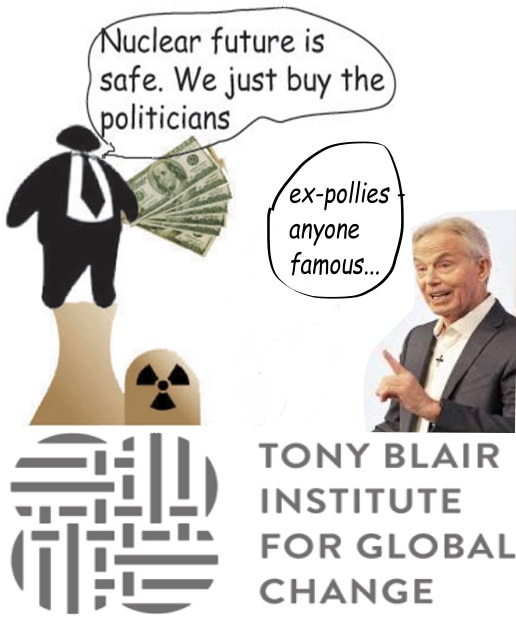
“The £260m Larry Ellison has put into Tony Blair’s institute is an extraordinary amount of money. It dwarves the budget and expenditure of other UK think tanks“
And while it may look like a 90s throwback, it cleaves closely to the 21st century business goals of Blair’s billionaire patron. That billionaire patron is Larry Ellison, the man who’s backed Blair’s ‘Institute for Global Change’ to the tune of £260m.
We chose to launch the Nerve with an investigation into Starmer, Blair and Ellison because if Larry Ellison is the eminence grise behind Blair, Blair is the eminence grise behind Starmer.
Ellison, the founder of Oracle, has emerged as one of the most powerful of the broligarchs, close to both Trump and Netanyahu. He’s poised to take over American TikTok with Rupert Murdoch, while his son has bought Paramount and installed a right-wing commentator as the head of CBS News. He’s also the most powerful man in Britain that most people have never heard of.
The £260m he’s put into Tony Blair’s institute is an extraordinary amount of money by British standards. It dwarves the budget and expenditure of other UK think tanks. Digital ID is only the latest policy that’s been incubated in the steel and glass central London offices that seemingly operate a revolving door between TBI and the Starmer government, all closely align with Ellison’s.
Nor is TBI Ellison’s only UK venture. He’s also funded the Ellison Institute of Technology, a research institute at Oxford University that includes the life sciences, and a nationwide centralised database that incorporates health and other data that could have huge research possibilities.
Data is the raw fuel of AI foundation models and our personal data, the most intimate facts about us, is the most valuable data of all. (Especially to a man like Ellison who’s obsessed with ageing and is funding health research that he hopes will extend human life, including importantly his own.) Some of the worst companies on the planet will seek to exploit that data and digital ID is an irreversible step: a genie that once out of the bottle, is never going back.
It’s the techno-authoritarian possibilities of a centralised database that’s alarmed both the libertarian wing of the Conservative and Reform parties, spearheaded by David Davis, but also tech and press freedom organisations, including the Electronic Freedom Foundation, Open Rights Group, Big Brother Watch and Article 19. It’s not hyperbole to say that creating a centralised database is what the Stasi would do because it is exactly what they did.
One doesn’t have to speculate about Ellison’s views on mass data collection and what it means for surveillance: he’s already said all the quiet parts out loud. “Every police officer is going to be supervised at all times,” he has said. “And if there’s a problem, AI will report that problem and report it to the appropriate person. Citizens will be on their best behaviour because we are constantly recording and reporting everything that’s going on.”
Tony Blair is an undeclared lobbyist. Ellison is his client. And TBI is an influencing machine whose tentacles spread across both the political and media establishments: if you read any article about digital ID that doesn’t include the Blair/Ellison connection, ask yourself why.
Carole Cadwalladr is an award-winning investigative journalist and co-founder of the Nerve, a new platform for fearless, independent journalism.
No comments yet.
1 This Month

of the week – Shut Down Drone Warfare!


Tell the Ukrainian Government to Drop Prosecution of Peace Activist Yurii Sheliazhenko

Petition to revoke the licensing of the Near Surface Nuclear Disposal Facility (NSDF) at Chalk River. https://www.ourcommons.ca/petitions/en/Petition/Details?Petition=e-7247
To see nuclear-related stories in greater depth and intensity – go to https://nuclearinformation.wordpress.com
-
Archives
- April 2026 (44)
- March 2026 (251)
- February 2026 (268)
- January 2026 (308)
- December 2025 (358)
- November 2025 (359)
- October 2025 (376)
- September 2025 (257)
- August 2025 (319)
- July 2025 (230)
- June 2025 (348)
- May 2025 (261)
-
Categories
- 1
- 1 NUCLEAR ISSUES
- business and costs
- climate change
- culture and arts
- ENERGY
- environment
- health
- history
- indigenous issues
- Legal
- marketing of nuclear
- media
- opposition to nuclear
- PERSONAL STORIES
- politics
- politics international
- Religion and ethics
- safety
- secrets,lies and civil liberties
- spinbuster
- technology
- Uranium
- wastes
- weapons and war
- Women
- 2 WORLD
- ACTION
- AFRICA
- Atrocities
- AUSTRALIA
- Christina's notes
- Christina's themes
- culture and arts
- Events
- Fuk 2022
- Fuk 2023
- Fukushima 2017
- Fukushima 2018
- fukushima 2019
- Fukushima 2020
- Fukushima 2021
- general
- global warming
- Humour (God we need it)
- Nuclear
- RARE EARTHS
- Reference
- resources – print
- Resources -audiovicual
- Weekly Newsletter
- World
- World Nuclear
- YouTube
-
RSS
Entries RSS
Comments RSS
 nuclear-news
Leave a comment