The ‘Nuclearity’ of the Marshall Islands, and the Threat of US Testing
By Bea Paduano
ICAN Australia and Bea Paduano, Dec 09, 2025, https://icanaustralia.substack.com/p/the-nuclearity-of-the-marshall-islands?utm_source=post-email-title&publication_id=6291617&post_id=181019673&utm_campaign=email-post-title&isFreemail=true&r=1ise1&triedRedirect=true&utm_medium=email
This article explores how nuclearity exposes unequal power, why some lives are protected, and others sacrificed, and how these dynamics still matter today as talk of renewed US nuclear testing re-enters global politics. To avoid repeating the devastation imposed on the Marshall Islands, strong international support for the Treaty on the Prohibition of Nuclear Weapons (TPNW) is crucial.
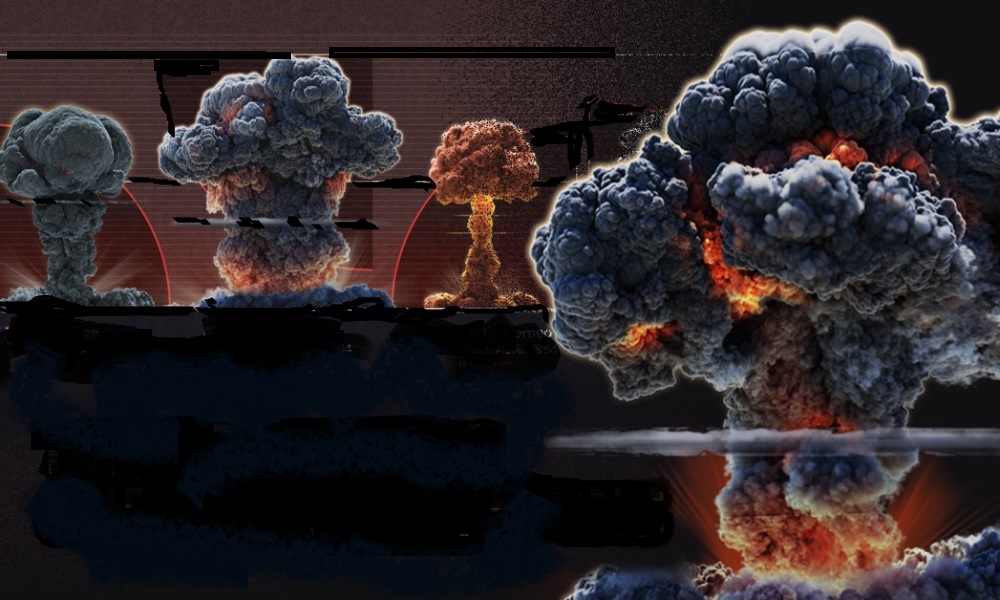
Between 1946 and 1958, the United States tested sixty-seven nuclear weapons in the Republic of the Marshall Islands—turning entire atolls into fallout zones and reshaping life for generations. Seen through Gabrielle Hecht’s lens of nuclearity, which asks who decides what counts as “nuclear”, the Marshall Islands become one of the most nuclear places on Earth—yet they’re rarely recognised as such.
What is Nuclearity?
Historian Hecht describes nuclearity as a “technopolitical spectrum that shifts in time and space” that shapes “the degree to which something counts as ‘nuclear’.”1
In simple terms, nuclearity is a lens that reveals who has the power to declare something nuclear—or to deny it—even in the face of clear harm. Nuclearity isn’t only about radiation; it is shaped by history, geography, politics and power, and by the decisions that determine which harms are acknowledged and which are ignored.2
The Marshall Islands: a Nuclear Frontier
Japan seized the Marshall Islands during World War One to secure a strategic position in the Pacific, occupying them until the United States took control in 1944 during World War Two. After the war, the US turned the islands into a nuclear testing ground, beginning with Bikini and Enewetak in 1946. Over the next twelve years, the United States conducted sixty-seven atmospheric, underwater, and airburst tests that vaporised entire atolls, and exposed the whole country to severe radioactive fallout. The Castle Bravo test—the largest in US history—released an explosive yield equivalent to more than seven thousand Hiroshima bombs.
US officials justified these tests as being “for the good of mankind and to end all wars”.3 In other words, the Marshall Islands became a “display case for flexing military muscle” at the expense of the Marshallese people.4
Health, Identity and Culture
The health impacts of nuclear testing on the Marshall Islands were—and remain—catastrophic. Thyroid and other cancers, blood and metabolic disorders, cataracts, stillbirths, miscarriages, and birth defects have all been recorded and continue to affect Marshallese communities.5 The US Atomic Energy Commission’s Health and Safety Laboratory once described the atoll of Utirik as “by far the most contaminated place in the world.”6
Radioactive fallout poisoned staple foods, led to unexpected deaths, and weakened immune systems—patterns still seen in Marshallese communities today. Due to contamination, traditional foods became unsafe, and people were forced to give up practices that carry memory and meaning.
The damage is also cultural. Marshallese identity is deeply tied to land and water. In her poem Tell Them, Marshallese poet Kathy Jetnil-Kijiner writes, “we are nothing without our islands.”7 Nuclear testing destroyed homelands and forced many Marshallese into exile, severing connections to land, knowledge, and practices tied to fishing, food, and ceremony.8
Colonialism, “Remoteness,” and Power
Colonialism has long shaped understandings of remoteness, helping powerful states distance themselves from responsibility.9 This is evident in the US nuclear testing program in the Marshall Islands, where the construction of “remoteness” positioned the Marshallese at the margins. The US commission concluded that testing should take place overseas and away from US population centres until the health implications could be established.10 The location was chosen by spreading out maps and looking for sites considered remote.11 In his assessment of six nuclear testing sites, Jacobs concludes that it is no coincidence that all sites used were considered “remote.”12
The Marshall Islands were not only seen as geographically distant, but also racially distant, drawing on colonial ideas of eugenics. Eisenbud, Director of the AEC’s Health and Safety Laboratory in New York, justified the testing by claiming the Marshallese people were “more like us than the mice.”13 Their race and classification as “other” helped justify the testing and reveal the colonial underpinnings of the global nuclear order. Those considered racially inferior and physically remote have repeatedly been subjected to the harms of nuclear weapons testing. These colonial legacies maintain power dynamics and legitimise nuclear testing on Marshallese land and people.
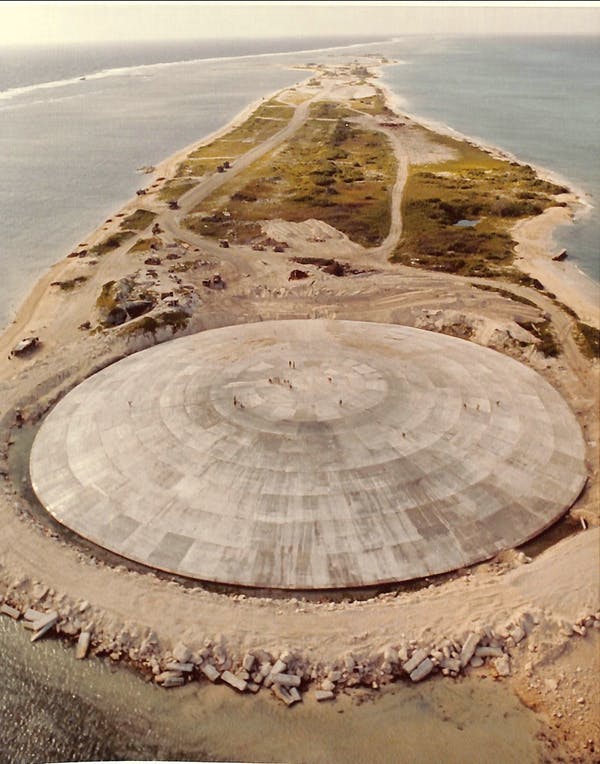
The legacy of this history can be seen in the Runit Dome, the concrete cap covering nuclear waste on Enewetak. As the dome cracks and leaks into the sea, it adds to the already devastating implications of climate change for the Marshall Islands. As sea levels rise, the future of the Marshall Islands remains uncertain.
Who Decides What Counts as ‘Nuclear’?
Hecht’s concept of nuclearity helps explain how authorities can declare certain areas “safe” while people continue to live with radiation and illness.14 Nuclearity does not equate to radioactivity; it is constructed, fluid and changeable, and can be made and unmade by those with the power to define it.
The Bravo test is one example. Communities from Bikini and Enewetak were relocated south before the detonation, yet radioactive fallout still hit the newly inhabited islands. Although the US government claimed that the wind unexpectedly changed, research found that they had six hours’ notice.15 Similar patterns are found in French nuclear testing on the Gambier Islands.16 The US government also imposed arbitrary restrictions such as fishing bans in certain areas of the islands—restrictions that, as Jacobs notes, were not respected by the fish.17 This shows the continued construction of what is considered “nuclear” in specific areas and at specific times, despite ongoing radioactivity.
Kathy Jetnil-Kijiner refers to this denuclearisation in the line: “it’s not radioactive anymore, your illnesses are normal, you’re fine.”18 Despite such claims, the US government restricted visitors from other countries from travelling to the Marshall Islands and restricted the movement of islanders during the tests.19 In this sense, the US government constructed a claim that certain areas would be safe but only for certain individuals, “denuclearising” areas and people despite significant radiation exposure. This draws on Hecht’s concept of nuclearity—that nuclearity “is not the same for everyone, and it is not the same at all moments in time.” 20
Recent US Discussions on Nuclear Testing
These issues are not confined to history. As we watch the current global situation unfold, this article urges us to pay attention to what is considered nuclear and what is not. Donald Trump has suggested that the US should resume nuclear testing to match or surpass other states. Whether this would involve full-scale detonations or ultra-low-yield tests, the political effect is similar: signalling that nuclear threats are back on the table.
Even the discussion of testing changes nuclearity. It designates potential testing sites, shapes perceptions of risk and acceptability, and reinforces harmful colonial power dynamics. Despite no US tests being conducted for decades, and considerable work and commitment to the Comprehensive Nuclear-Test-Ban Treaty (CTBT), this rhetoric threatens the nuclear taboo.
The TPNW, promoted by ICAN, prohibits the testing of nuclear weapons. At the time of writing, seventy-four countries have ratified the treaty. A strong global commitment against testing is needed to confront the harms to health, identity and culture that stretch across past, present and future.
The Marshall Islands illustrate what nuclearity looks like in practice: cancers and contaminated reefs, cracked domes, displaced communities and cultural loss that continues across generations. As talk of renewed nuclear testing returns, we must consider not only where the next “dangerous” place might be, but whose lives will again be treated as expendable.
We cannot allow others to quietly determine what—and who—counts as nuclear.
About the Author
Bea Paduano is a recent graduate of International Relations from the University of Leeds and was a participant in the ICAN-Hiroshima academy 2025 cohort. Her interests include the legacies of social and political injustice, specifically of nuclear testing and migration studies.
References ……………………………………………………………….
No comments yet.
1 This Month


18 March Webinar @ 1 PM EST: An Assessment of SMR Projects: The Case of Canada
register for the zoom:
https://us02web.zoom.us/webinar/register/WN_o8BIIOUvQ2ONJR1nta65DQ#/registration


of the week – STOP SMALL MODULAR REACTORS IN CANADA
To see nuclear-related stories in greater depth and intensity – go to https://nuclearinformation.wordpress.com
-
Archives
- March 2026 (138)
- February 2026 (268)
- January 2026 (308)
- December 2025 (358)
- November 2025 (359)
- October 2025 (376)
- September 2025 (258)
- August 2025 (319)
- July 2025 (230)
- June 2025 (348)
- May 2025 (261)
- April 2025 (305)
-
Categories
- 1
- 1 NUCLEAR ISSUES
- business and costs
- climate change
- culture and arts
- ENERGY
- environment
- health
- history
- indigenous issues
- Legal
- marketing of nuclear
- media
- opposition to nuclear
- PERSONAL STORIES
- politics
- politics international
- Religion and ethics
- safety
- secrets,lies and civil liberties
- spinbuster
- technology
- Uranium
- wastes
- weapons and war
- Women
- 2 WORLD
- ACTION
- AFRICA
- Atrocities
- AUSTRALIA
- Christina's notes
- Christina's themes
- culture and arts
- Events
- Fuk 2022
- Fuk 2023
- Fukushima 2017
- Fukushima 2018
- fukushima 2019
- Fukushima 2020
- Fukushima 2021
- general
- global warming
- Humour (God we need it)
- Nuclear
- RARE EARTHS
- Reference
- resources – print
- Resources -audiovicual
- Weekly Newsletter
- World
- World Nuclear
- YouTube
-
RSS
Entries RSS
Comments RSS
 nuclear-news
Leave a comment