U.S. Military Budget Bill Would Ramp Up Israel Aid to Fill In ‘Gaps’ When Other Countries Impose Embargoes Over Genocide.

“this means the US would explicitly use federal law to step in and supply weapons to Israel whenever other countries cut off arms to halt Israel’s ongoing violations across the region.”
The House Armed Services Committee said in September that the measure “combats antisemitism.”
Stephen Prager, Dec 09, 2025, https://www.commondreams.org/news/us-israel-weapons-gap-ndaa
A little-reported provision of the latest military spending bill would direct the US to create a plan to fill the “gaps” for Israel whenever other nations cut off arms shipments in response to its acts of genocide in Gaza.
As Prem Thakker reported Monday for Zeteo, the measure is “buried” more than 1,000 pages into the more than 3,000-page National Defense Authorization Act (NDAA), which is considered by lawmakers to be “must-pass” legislation and contains a record $901 billion in total spending.
Republicans are shepherding the bill through the US House of Representatives, where—as is the case with most NDAAs—it is expected to pass on Wednesday with Democratic support, even as some conservative budget hardliners refuse to back it, primarily over its $400 million in military assistance to Ukraine.
Since the genocide began following Hamas’ attack on October 7, 2023, the US has provided more than $21.7 billion to Israel, including hundreds of millions that have been supplied through NDAAs.
The new NDAA includes at least another $650 million to Israel, an increase of $45 million from the previous one, even though this is the first such bill to be introduced since the “ceasefire” that went into effect in October. This aid from the Pentagon comes on top of the $3.3 billion already provided through the State Department budget.
But this NDAA also contains an unprecedented measure. It calls for the “continual assessment of [the] impact of international state arms embargoes on Israel and actions to address defense capability gaps.”
The NDAA directs Secretary of Defense Pete Hegseth, Secretary of State Marco Rubio, and Director of National Intelligence Tulsi Gabbard to assess “the scope, nature, and impact on Israel’s defense capabilities of current and emerging arms embargoes, sanctions, restrictions, or limitations imposed by foreign countries or by international organizations,” and “the resulting gaps or vulnerabilities in Israel’s security posture.”
As Drop Site News explains, “this means the US would explicitly use federal law to step in and supply weapons to Israel whenever other countries cut off arms to halt Israel’s ongoing violations across the region.”
“The point of this assistance, to be clear, is to make up for any identified insufficiencies Israel may have due to other countries’ embargoing it as a result of its ongoing genocide in Palestine,” Thakker wrote.
A similar provision appeared in a September version of the NDAA, which the House Armed Services Committee praised because it supposedly “combats antisemitism”—explicitly conflating a bias against Jewish people with weapons embargoes that countries have imposed to stop Israel from continuing its routine, documented human rights violations in Gaza.
Among the nations that have cut off weapons sales to Israel are Japan, Canada, France, Italy, and Spain. Meanwhile, other major backers, such as the United Kingdom and Germany, have imposed partial freezes on certain weaponry.
While official estimates from the Gaza Ministry of Health place the number of dead from Israel’s military campaign at over 70,000, with more than 170,000 wounded, an independent assessment last month from the Max Planck Institute for Demographic Research in Germany and the Center for Demographic Studies in Spain found that the death toll “likely exceeds 100,000.” This finding mirrored several other studies that have projected the true death toll to be much higher than what official estimates show.
Embargoes against Israel have been called for by a group of experts mandated by the United Nations Human Rights Council, including Francesca Albanese, the UN Special Rapporteur on the occupied Palestinian territories. Meanwhile, numerous human rights organizations, including the leading Israeli group B’Tselem, have said Israel’s campaign in Gaza has amounted to genocide.
Trump says Ukraine should hold elections

Sometimes, if only by accident, Trump says something sensible
by Julia Manchester – 12/09/25, https://thehill.com/homenews/administration/5640123-trump-says-ukraine-should-hold-elections/
President Trump said in a new interview that Ukraine should hold elections despite being locked in war with Russia.
“They’re using war not to hold an election. I would think the Ukrainian people should have that choice,” Trump told Politico. “They talk about having a democracy but it gets to the point where it’s not a democracy anymore.”
Ukrainian President Volodymyr Zelensky has come under political pressure in recent weeks over a corruption scandal that implicated top Ukrainian officials. After the country’s watchdogs concluded that $100 million had been embezzled from the energy sector through kickbacks paid by contractors, Zelensky fired two top officials and slapped sanctions on close associates.
Zelensky has not been accused of any wrongdoing but his chief of staff, Andriy Yermak, resigned following an anti-corruption raid on his home last month.
Additionally, Zelensky has found himself and Ukraine on defense as Russia seeks to make advances on Ukrainian territory and Trump administration officials struggle to broker a peace deal between the two countries.
Trump aired his frustrations over Zelensky on Sunday, saying the Ukrainian leader had not read the latest version of the peace proposals that came out of talks between U.S. officials and Russian President Vladimir Putin last week.
Zelensky said Ukraine would not budge from its longstanding opposition to ceding land to Russia after he met with European leaders on Monday.
Trump said in the Politico interview published Tuesday that he believes Russia is in a stronger negotiating position than Ukraine.
“[Zelensky] is going to have to get on the ball and start accepting things,” he said, adding that they are “losing.”
When it all comes crashing down: The aftermath of the AI boom.

Like financial crises of the past, an abrupt end to the AI bubble could inflict considerable economic pain on millions of people worldwide. But the alternative is the prolonging of an AI bubble that is increasingly unsustainable in both the financial and environmental senses, with the winners mainly being some of the wealthiest companies on the planet and their investors.
“Ultimately, for society’s sake, it would be a wonderful thing the faster this thing goes, because very few people are benefiting from it,”
By Jeremy Hsu, December 5, 2025, https://thebulletin.org/2025/12/when-it-all-comes-crashing-down-the-aftermath-of-the-ai-boom/?utm_source=ActiveCampaign&utm_medium=email&utm_content=The%20AI%20boom%20s%20aftermath&utm_campaign=20251207%20Monday%20Newsletter
Silicon Valley and its backers have placed a trillion-dollar bet on the idea that generative AI can transform the global economy and possibly pave the way for artificial general intelligence, systems that can exceed human capabilities. But multiple warning signs indicate that the marketing hype surrounding these investments has vastly overrated what current AI technology can achieve, creating an AI bubble with growing societal costs that everyone will pay for regardless of when and how the bubble bursts.
The history of AI development has been punctuated by boom-and-bust cycles (with the busts called AI winters) in the 1970s and 1980s. But there has never been an AI bubble like the one that began inflating around corporate and investor expectations since OpenAI released ChatGPT in November 2022. Tech companies are now spending between $72 billion and $125 billion per year each on purchasing vast arrays of AI computing chips and constructing massive data centers that can consume as much electricity as entire cities—and private investors continue to pour more money into the tech industry’s AI pursuits, sometimes at the expense of other sectors of the economy.
“What I see as a labor economist is we have starved everything to feed one mouth,” says Ron Hetrick, Principal Economist at Lightcast, a labor market analytics company. “These are now three years that we have foregone development in so many industries as we shove food into a mouth that’s already so full.”
That huge AI bet is increasingly looking like a bubble; it has buoyed both the stock market and a US economy otherwise struggling with rising unemployment, inflation, and the longest government shutdown in history. In September, Deutsche Bank warned that the United States could already be in an economic recession without the tech industry’s AI spending spree and cautioned that such spending cannot continue indefinitely. However it ends, the AI bubble’s most enduring legacy may be the global disruptions from any financial crisis that follows—and the societal costs already incurred from betting so heavily on energy-hungry data centers and AI chips that may suddenly become stranded assets.
Warning signs. Silicon Valley’s focus on developing ever-larger AI models has spurred a buildout of bigger data centers crammed with computing power. The staggering growth in AI compute demand would require tech companies to build $500 billion worth of data centers packed with chips each year—and companies would need to rake in $2 trillion in combined annual revenue to fund that buildout, according to a Bain & Company report. The report also estimates that the tech industry is likely to fall $800 billion short of the required revenue.
That shortfall is less surprising than it might seem. US Census Bureau data show that AI adoption by companies with more than 250 employees may have already peaked and began declining or flattening out this year.
Continue readingCampaigners call for absolute protection for Welsh national parks from nuclear plants.
Nuclear Free Local Authorities and Welsh Anti Nuclear Alliance, 9th December 2025
In response to a consultation by Natural Resources Wales on creating a new Glyndŵr National Park in North East Wales, Welsh anti nuclear groups have joined the Welsh Nuclear Free Local Authorities in calling for the Welsh Government to provide absolute protection for Welsh National Parks and National Landscapes from the threat of new nuclear development.
After indicating they were undecided on the issue, the groups submitted the following collective response:
‘In responding to this consultation on the creation of a new Glyndŵr National Park in North East Wales, we wish to call upon the Welsh Government to provide for absolute protection in law for Welsh National Parks and National Landscapes from the threat of new nuclear development.
The National Parks and Access to the Countryside Act 1949 was passed with all party support. The first ten national parks were designated as such in the 1950s, including three in Wales in the Brecon Beacons, on the Pembrokeshire Coast, and in Snowdonia.
In 1974 a National Parks Policy Review Committee established the Sandford Principle that ‘priority must be given to the conservation of natural beauty’. The Environment Act 1995 established in law that the primary duties of National Park Authorities are ‘conserving and enhancing the natural beauty, wildlife and cultural heritage of the area comprised in the National Park’.
Nuclear development in a National Park is then completely at odds with these objectives. Consequently, we are disappointed that the new UK Government has not directly specified in its new siting policy for nuclear plants (EN-7) that National Parks and National Landscapes will be exempted from development. This despite a precedent having already been set, as the English Lake District has been rightly excluded from consideration as the location of the Geological Disposal Facility.
If the English Lake District is excluded from such development, then surely the Eryri, Bannau Brycheiniog, Afordir Penfro, and Glyndŵr National Parks are worthy of equal consideration?
For without equal protection, the National Parks and National Landscapes in Wales could be aesthetically blighted and radioactively contaminated from future nuclear development.
This is no idle threat as the situation at Trawsfyndd demonstrates……………………………………………………………………………………………..
We believe that Wales has sufficient natural energy resources (wind, sun, wave, tidal, hydro and geothermal) to provide for its own energy needs and notes that the Welsh Government has already embraced a policy to generate all domestic consumed electricity through renewable technologies.
Any new nuclear plants in Wales will be built at English direction, with Westminster money, to generate electricity for England whilst transferring the risk of accident, the resultant contamination of air, land, rivers, and sea, and responsibility for the immediate management of nuclear waste onto the people of Wales……………………………………………………..
9th December 2025
Campaigners call for absolute protection for Welsh national parks from nuclear plants

Joint media release
In response to a consultation by Natural Resources Wales on creating a new Glyndŵr National Park in North East Wales, Welsh anti nuclear groups have joined the Welsh Nuclear Free Local Authorities in calling for the Welsh Government to provide absolute protection for Welsh National Parks and National Landscapes from the threat of new nuclear development.
After indicating they were undecided on the issue, the groups submitted the following collective response:
‘In responding to this consultation on the creation of a new Glyndŵr National Park in North East Wales, we wish to call upon the Welsh Government to provide for absolute protection in law for Welsh National Parks and National Landscapes from the threat of new nuclear development.
The National Parks and Access to the Countryside Act 1949 was passed with all party support. The first ten national parks were designated as such in the 1950s, including three in Wales in the Brecon Beacons, on the Pembrokeshire Coast, and in Snowdonia.
In 1974 a National Parks Policy Review Committee established the Sandford Principle that ‘priority must be given to the conservation of natural beauty’. The Environment Act 1995 established in law that the primary duties of National Park Authorities are ‘conserving and enhancing the natural beauty, wildlife and cultural heritage of the area comprised in the National Park’.
Nuclear development in a National Park is then completely at odds with these objectives. Consequently, we are disappointed that the new UK Government has not directly specified in its new siting policy for nuclear plants (EN-7) that National Parks and National Landscapes will be exempted from development. This despite a precedent having already been set, as the English Lake District has been rightly excluded from consideration as the location of the Geological Disposal Facility.
If the English Lake District is excluded from such development, then surely the Eryri, Bannau Brycheiniog, Afordir Penfro, and Glyndŵr National Parks are worthy of equal consideration?
For without equal protection, the National Parks and National Landscapes in Wales could be aesthetically blighted and radioactively contaminated from future nuclear development.
This is no idle threat as the situation at Trawsfyndd demonstrates.
Trawsfynydd is located at the heart of Eryri, formerly Snowdonia. Eryri is the largest National Park in Wales with the highest mountain in Wales, Yr Wyddfa, and attracts an estimated four million visitors per year. A Magnox nuclear plant was opened at Trawsfynydd in 1968 and operated until the 1990’s. Built in an ugly brutalist style, the plant jars against the marked beauty of the natural environment. The Nuclear Decommissioning Authority is now reducing the height of the structure to make it less obtrusive, but it will still look brooding and completely out-of-place in the park. And the redundant plant has a cooling pond complex that leaks radioactive materials into the soil and the nearby lake, and studies by academic Dr Chris Busby identified a heightened cancer risk amongst the local populace who eat fish caught from the lake.
Despite this historic obscenity, the Welsh Government has been so foolhardy as to establish a company, Cwmni Egino, to reindustrialise this pristine landscape with ‘the deployment of small nuclear reactors to generate electricity and also a medical radioisotope research reactor’, completely undermining the work of the National Park Authority which is dedicated to its preservation. [i]
This is a lunatic concept. New nuclear redevelopment at Trawsfynydd would be wholly inappropriate. It would be hugely damaging to the beauty of the locality; would lead to further radioactive contamination of the lake and the local environment; its operations would always be accompanied by a risk of an accident and the generation of further radioactive waste; be massively detrimental to the peace and quiet enjoyed by residents and visitors; and would dilute the historic dominance of the Welsh language in this area by attracting a non-Welsh speaking migrant workforce. Further any new nuclear development of Eryri must also have a significant impact on visitor numbers, and so the tourist economy.
These factors militate against any such redevelopment at Trawsfynydd and represent a set of reasons why nuclear power and national parks are completely incompatible.
The Senedd passed a unique piece of legislation that militates against nuclear development in national parks: the Wellbeing of Future Generations Act 2015. Public bodies in Wales are expected to pull together in achieving the aspirations outlined in the act, amongst them those for a Resilient Wales, defined as “A nation which maintains and enhances a biodiverse natural environment with healthy functioning ecosystems that support social, economic and ecological resilience and the capacity to adapt to change” and a Healthier Wales defined as “A society in which people’s physical and mental well-being is maximised and in which choices and behaviours that benefit future health are understood.”
Creating a new National Park would certainly move Wales forward towards meeting these objectives, but nuclear with its inevitable damage to the natural environment and to human health will most certainly not.
We believe that Wales has sufficient natural energy resources (wind, sun, wave, tidal, hydro and geothermal) to provide for its own energy needs and notes that the Welsh Government has already embraced a policy to generate all domestic consumed electricity through renewable technologies.
Any new nuclear plants in Wales will be built at English direction, with Westminster money, to generate electricity for England whilst transferring the risk of accident, the resultant contamination of air, land, rivers, and sea, and responsibility for the immediate management of nuclear waste onto the people of Wales.
The Glyndŵr National Park is being named after a beloved Welsh freedom fighter who valiantly resisted English military conquest and the usurpation of Welsh sovereignty. In responding to this consultation, we are calling upon the Welsh Government to invoke the spirit of Glyndŵr and use the occasion of the new park’s creation to make clear to Westminster that they will resist to the utmost any attempt to impose nuclear development in any National Park in Wales, including at Trawsfynydd, and in his spirit they should also disestablish Cwmni Egino, which is working in contravention of this policy.
To do otherwise would convey the impression that Wales remains a rank colonial possession, rather than a nation in its own right, whose beautiful National Parks remain vulnerable to exploitation for nuclear development of the most egregious kind…………………….https://www.nuclearpolicy.info/news/campaigners-call-for-absolute-protection-for-welsh-national-parks-from-nuclear-plants/
‘Genocide is not an Oakland value:’ inside Oakland’s grassroots campaign to end military shipments to Israel
Oakland International Airport has become a key hub for transporting military cargo to Israel during the Gaza genocide. Now, over 30 groups and thousands of Oakland residents have come together in the Oakland People’s Arms Embargo to stop it.
Mondoweiss, By Joseph Mogul December 8, 2025
Talia Rose starts their shift at Oakland International Airport (OAK) at 3:00 a.m., unloading same-day packages from UPS planes. Across the tarmac, they watch FedEx planes come and go. “I never had any idea what the hell is on those planes besides big metal containers that carry packages,” Rose said.
But that would change in August, when Rose attended a local organizing forum where a member of the Palestinian Youth Movement (PYM) presented a soon-to-be-public report titled “Exposing Oakland’s Military Cargo Shipments to Israel.”
The report—published by PYM, Arab Resource and Organizing Center (AROC), and U.S. Palestinian Community Network (USPCN)—details FedEx’s routine shipments of F-35 Lockheed Martin fighter jet components to Israel’s Nevatim Airbase. The report describes OAK as a “dependable conduit for critical military technologies,” concluding “beyond a reasonable doubt that military cargo being shipped out of OAK has been used by the Israeli Air Force to carry out airstrikes and commit genocide in Gaza.”
Learning about OAK’s role in facilitating genocide disturbed Rose. “After reading the report, knowing there’s a minimum of three [shipments] a week going through the airport that have F-35 parts, it’s a feeling of overwhelming anxiety,” they said. “I’m right there, you know? I’m across a tarmac from it. It feels like I should be able to do something.”
With the launch of the Oakland People’s Arms Embargo campaign, Rose and thousands of Oaklanders would find what they could do.
The campaign was launched shortly before the People’s Conference for Palestine, a weekend-long event aimed at strengthening the movement, where PYM called for a shift towards local arms embargoes. Their theory was that a strong campaign would need the trifecta of a mass local base, organized workers, and progressive elected officials. Oakland has all three.
A central node of the weapons supply chain
Voulette Mansour, a PYM-Bay Area organizer whose grandparents were displaced during the 1948 Nakba, attended the People’s Conference. Behind the scenes, Mansour and PYM had been preparing for the campaign launch for months, eagerly anticipating this moment. “We had been doing a lot of background work on the research and preparing to launch the report,” Mansour said.
Through research infrastructure developed by PYM’s Mask off Maersk campaign—which targeted the largest maritime carrier of U.S. military cargo (including F-35 components) to Israel—PYM uncovered OAK’s role in the F-35 supply chain. “We were shocked that Oakland popped up on the map, not just as a blip, but as a central node,” said Mansour, “When we found this out, we were disgusted that this was happening in our city, but we also saw it as an opportunity.”
The “Exposing Oakland’s Military Cargo Shipments to Israel” report confirmed multiple shipments every week for over a year, making OAK the second most important logistical hub in the U.S. F-35 supply chain to Israel, behind Fort Worth.
The F-35 fighter jet is considered the crown jewel of the Israeli Air Force; Israel has its own modified version, called the F-35I, which is retrofitted specifically for Israeli weapons systems. Each jet costs around $100 million (subsidized by U.S. taxpayers in the form of federal weapons contracts) and can carry up to 18,000 pounds of munitions. Lockheed Martin is the primary manufacturer of the F-35, but over 1,900 contractors are involved in supplying various components, creating a vast and intricate global supply chain that the U.S. Defense Logistics Agency (DLA) is responsible for coordinating. ……………………………………………………………………………………………………………………………………………
That wave is swelling. On November 22, PYM launched a new global campaign, the People’s Embargo for Palestine, by creating an international arms embargo ecosystem through the coordination of research and strategies across local campaigns.
This is the next phase of our struggle,” said Mansour. “We raise the ceiling of our struggle through pushing for an arms embargo.” https://mondoweiss.net/2025/12/genocide-is-not-an-oakland-value-inside-oaklands-grassroots-campaign-to-end-military-shipments-to-israel/
U.S. Nuclear Fusion Industry Asks for Federal Help

By Irina Slav – Dec 09, 2025, https://oilprice.com/Latest-Energy-News/World-News/US-Fusion-Industry-Asks-for-Federal-Help.html
The nascent nuclear fusion industry in the United States has asked the Trump administration for billions in financial support in order to advance the technology, which is seen as one of the most promising for the future—but also one of the most challenging.
“Now is the time for the U.S. to make a significant investment, and that means over a billion dollars per year in annual appropriations and a one-time infrastructure investment,” the chief executive of the Fusion Industry Association, Andrew Holland, said this week, as quoted by Reuters. “If they ask for it, we are confident Congress would pass it,” he added, following a meeting between industry representatives and officials from the Department of Energy.
Reuters noted in its report that the Trump administration had just canceled several billion dollars in subsidies for the wind and solar industries. Presumably, some of that money could be redirected towards nuclear fusion. The Department of Energy even set up an Office of Fusion earlier this year as it shut down the wind and solar offices.
Nuclear fusion has long been considered the answer to zero-emission by-product-free energy generation. However, no one has cracked the nuclear fusion code yet because of the challenges associated with the environment in which the process could take place.
Nuclear fusion research and development have gained momentum in recent years after several momentous breakthroughs and achievements. The global race to overcome the engineering challenges to achieving zero-emission power from a nuclear reaction without risking disaster and radiation has heated up.
Earlier this year, the International Thermonuclear Experimental Reactor (ITER), a multinational endeavor to build a system to experiment with nuclear fusion, completed the world’s most powerful electromagnetic system in a landmark moment for fusion research.
There is still a long way to go before nuclear fusion becomes commercially viable; One of the main challenges remains the ratio between input energy and output energy, with the former currently exceeding the latter.
Renewables deliver nearly two thirds of power fed to grid in Germany, not including self-consumption

Nearly two thirds of all electricity fed into Germany’s public grid
between July and September 2025 came from renewable power sources, the
country’s statistical office Destatis said, based on preliminary data.
With 98.3 billion kilowatt-hours (kWh), wind turbines, solar panels and
other renewables contributed 64.1 percent to the electricity mix, up from
63.5 percent in the same period last year. Total renewable power production
rose three percent compared to the third quarter of 2024, while total
electricity production increased by two percent. A robust expansion of
renewable power sources led to record output levels for a third quarter:
Wind power production increased by more than ten percent compared to the
third quarter of 2024, reaching a share of over one quarter (26.8%) of the
power mix, while solar PV output rose 3.2 percent to a share of 24.1
percent.
Renew Economy 9th Dec 2025,
https://reneweconomy.com.au/renewables-deliver-nearly-two-thirds-of-power-fed-to-grid-in-germany-not-including-self-consumption/
Japan pulls out of Vietnam nuclear project, complicating Hanoi’s power plans
Japan has dropped out of plans to build a major nuclear power plant in
Vietnam because the time frame is too tight, Japanese ambassador Naoki Ito told Reuters, potentially complicating Vietnam’s long-term strategy to
avoid new power shortages.
Vietnam, home to large manufacturing operations for multinationals including Samsung and Apple, has faced major power blackouts as demand from its huge industrial sector and expanding middle class often outpaces supplies, strained by increasingly frequent extreme weather, such as droughts and typhoons.
“The Japanese side is not in a position to implement the Ninh Thuan 2 project,” the ambassador to Vietnam said, referring to a plant with a planned capacity of 2 to 3.2 gigawatts. The project is part of Vietnam’s strategy to boost power generation capacity.
Asahi Shimbun 8th Dec 2025, https://www.asahi.com/ajw/articles/16208469
The Colby Review, AUKUS and Lopsided Commitments

9 December 2025 Dr Binoy Kampmark, https://theaimn.net/the-colby-review-aukus-and-lopsided-commitments/
In one of his many cutting observations about the fallibility of politicians, H. L. Mencken had this to say about the practical sort: “It is his business to convince the mob (a) that it is confronted by some grave danger, some dreadful menace to its peace and security, and (b) that he can save it.” Regarding Australia’s often provincial politicians, that grave danger remains the Yellow Peril, albeit it one garbed in communist party colours, while the quackery they continue to practise involves the notion the United States will act as shield bearer and saviour in any future conflict.
The AUKUS trilateral security pact between Australia, the United Kingdom and the United States has turned the first of these countries into an expectant vassal state, mindful of security guarantees it does not need from a power that can, and would at a moment’s notice, abandon it. But more dangerously, the expectation here is that Canberra, awaiting Virginia Class (SSN-774) nuclear-powered submarines from the US, will offer unconditional succour, resources and promises to the projection of Washington’s power in the Indo-Pacific. Without any guarantee of such submarines, Australian money is underwriting US submarine production, which remains consistently tardy. (Currently, 1.3 boats are being produced annually, when 2.3 are needed.)
The 2023 National Defense Authorization Act makes it irrefutably clear that Congress shall be notified that any transfer of boats “will not degrade the United States underseas capabilities.” Pursuing AUKUS still entailed “sufficient submarine production and maintenance investments” on the part of the US to meet undersea capabilities, with Australia advancing “appropriate funds and support for the additional capacity required to meet the requirements” along with Canberra’s “capability to host and fully operate the vessels authorized to be transferred.”
This true steal for US diplomacy, and sad tribute to Homo boobiens on the part of the Australians, has continued with the review of AUKUS conducted by Undersecretary of Defense Policy Eldridge Colby. The review is not available for public eyes, but Colby had previously released smoke signals that the AUKUS pact would only “lead to more submarines collectively in 10, 15, 20 years, which is way beyond the window of maximum danger, which is really this decade.”

The Australian Defence Minister Richard Marles told reporters on December 4 that the review had been received. “We’re working through the AUKUS review, and we very much thank the United States for providing it to us.” (Surely that’s the least they could have done.) He had identified unwavering support for the pact. Pentagon spokesman Sean Parnell also released a statement to the media expressing enthusiasm. “Consistent with President Trump’s guidance that AUKUS should move ‘full steam ahead,’ the review identified opportunities to put AUKUS on the strongest possible footing.” No doubt opportunities have been identified, but these are likely to be consistent with the lopsided arrangements Australia has had with the US to date.
Australia has so far provided A$1.6 billion in funding to the US submarine base, with the promise of more. What remains unclear is how much of this is also going into training Australian personnel to operate and maintain the vessels. “There’s a schedule of payments to be made,” explained Australian Prime Minister Anthony Albanese in July. “We have an agreement with the United States as well as with the United Kingdom. It is about increasing their capacity, their industrial capacity.” As part of such arrangements, “we have Australians on the ground, learning those skills.”
The joint fact sheet on the 2025 Australia-US Ministerial Consultations (AUSMIN), held between US Secretary of State Marco Rubio, US Secretary of War Pete Hegseth and their Australian counterparts Penny Wong and Marles in Washington, makes one reference to AUKUS and nothing in terms of substance to Colby’s recommendations. There is, however, this bit of unpardonable gibberish: “In line with President Trump and Prime Minister Albanese’s direction to move ‘full steam ahead’ on AUKUS, the [ministers] recognised the work underway to deliver priority infrastructure works and workforce uplift plan in support of an enhanced trilateral submarine industrial base.”
Given such statements, it is hard to see what opportunities identified in the Colby report could possibly be advantageous to Australia, a mere annexure of the US imperium. There is bound to be continued pressure on Australia to increase its defence spending. There are also unaddressed concerns about how sovereign the SSNs in Australian hands are going to be when and if they ever make it across the Pacific. In a conflict involving the United States, notably in the Indo-Pacific, Canberra will be expected to rush in with that mindless enthusiasm that has seen Australian soldiers die in theatres they would struggle to name for causes they could barely articulate.
Even the confident opinion of Joe Courtney, a Democrat member of the House Armed Services Committee and representative of Groton, Connecticut (the “Submarine Capital of the World”), should be viewed warily. “The statutory authority enacted by Congress in 2023 will remain intact, including the sale of three Virginia-class submarines starting in 2032,”comes his beaming assessment. The Colby review “correctly determined that there are critical deadlines that all three countries have to meet. Therefore, maintaining disciplined adherence to schedule is paramount.” That degree of discipline and adherence to schedules is unlikely to be an equal one. It is bound to favour, first and foremost, Washington’s own single perspective.
The ‘Nuclearity’ of the Marshall Islands, and the Threat of US Testing
By Bea Paduano
ICAN Australia and Bea Paduano, Dec 09, 2025, https://icanaustralia.substack.com/p/the-nuclearity-of-the-marshall-islands?utm_source=post-email-title&publication_id=6291617&post_id=181019673&utm_campaign=email-post-title&isFreemail=true&r=1ise1&triedRedirect=true&utm_medium=email
This article explores how nuclearity exposes unequal power, why some lives are protected, and others sacrificed, and how these dynamics still matter today as talk of renewed US nuclear testing re-enters global politics. To avoid repeating the devastation imposed on the Marshall Islands, strong international support for the Treaty on the Prohibition of Nuclear Weapons (TPNW) is crucial.
Between 1946 and 1958, the United States tested sixty-seven nuclear weapons in the Republic of the Marshall Islands—turning entire atolls into fallout zones and reshaping life for generations. Seen through Gabrielle Hecht’s lens of nuclearity, which asks who decides what counts as “nuclear”, the Marshall Islands become one of the most nuclear places on Earth—yet they’re rarely recognised as such.
What is Nuclearity?
Historian Hecht describes nuclearity as a “technopolitical spectrum that shifts in time and space” that shapes “the degree to which something counts as ‘nuclear’.”1
In simple terms, nuclearity is a lens that reveals who has the power to declare something nuclear—or to deny it—even in the face of clear harm. Nuclearity isn’t only about radiation; it is shaped by history, geography, politics and power, and by the decisions that determine which harms are acknowledged and which are ignored.2
The Marshall Islands: a Nuclear Frontier
Japan seized the Marshall Islands during World War One to secure a strategic position in the Pacific, occupying them until the United States took control in 1944 during World War Two. After the war, the US turned the islands into a nuclear testing ground, beginning with Bikini and Enewetak in 1946. Over the next twelve years, the United States conducted sixty-seven atmospheric, underwater, and airburst tests that vaporised entire atolls, and exposed the whole country to severe radioactive fallout. The Castle Bravo test—the largest in US history—released an explosive yield equivalent to more than seven thousand Hiroshima bombs.
US officials justified these tests as being “for the good of mankind and to end all wars”.3 In other words, the Marshall Islands became a “display case for flexing military muscle” at the expense of the Marshallese people.4
Health, Identity and Culture
The health impacts of nuclear testing on the Marshall Islands were—and remain—catastrophic. Thyroid and other cancers, blood and metabolic disorders, cataracts, stillbirths, miscarriages, and birth defects have all been recorded and continue to affect Marshallese communities.5 The US Atomic Energy Commission’s Health and Safety Laboratory once described the atoll of Utirik as “by far the most contaminated place in the world.”6
Radioactive fallout poisoned staple foods, led to unexpected deaths, and weakened immune systems—patterns still seen in Marshallese communities today. Due to contamination, traditional foods became unsafe, and people were forced to give up practices that carry memory and meaning.
The damage is also cultural. Marshallese identity is deeply tied to land and water. In her poem Tell Them, Marshallese poet Kathy Jetnil-Kijiner writes, “we are nothing without our islands.”7 Nuclear testing destroyed homelands and forced many Marshallese into exile, severing connections to land, knowledge, and practices tied to fishing, food, and ceremony.8
Colonialism, “Remoteness,” and Power
Colonialism has long shaped understandings of remoteness, helping powerful states distance themselves from responsibility.9 This is evident in the US nuclear testing program in the Marshall Islands, where the construction of “remoteness” positioned the Marshallese at the margins. The US commission concluded that testing should take place overseas and away from US population centres until the health implications could be established.10 The location was chosen by spreading out maps and looking for sites considered remote.11 In his assessment of six nuclear testing sites, Jacobs concludes that it is no coincidence that all sites used were considered “remote.”12
The Marshall Islands were not only seen as geographically distant, but also racially distant, drawing on colonial ideas of eugenics. Eisenbud, Director of the AEC’s Health and Safety Laboratory in New York, justified the testing by claiming the Marshallese people were “more like us than the mice.”13 Their race and classification as “other” helped justify the testing and reveal the colonial underpinnings of the global nuclear order. Those considered racially inferior and physically remote have repeatedly been subjected to the harms of nuclear weapons testing. These colonial legacies maintain power dynamics and legitimise nuclear testing on Marshallese land and people.
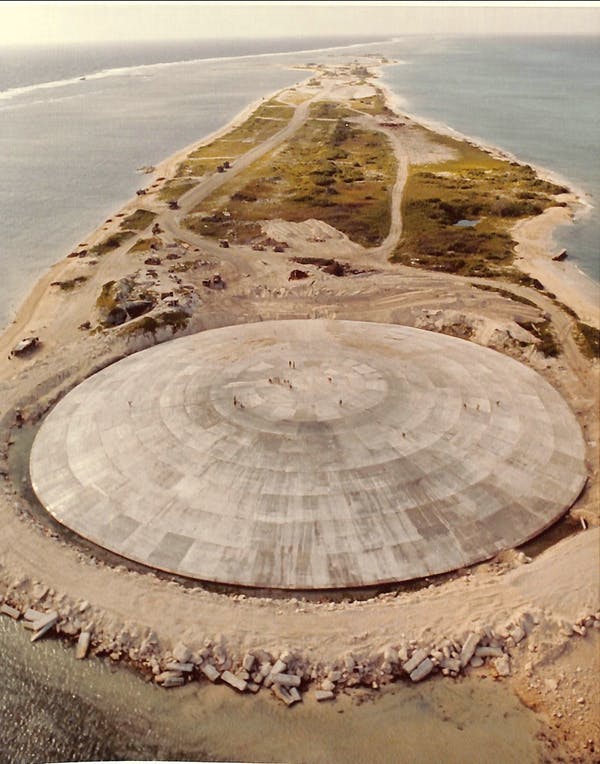
The legacy of this history can be seen in the Runit Dome, the concrete cap covering nuclear waste on Enewetak. As the dome cracks and leaks into the sea, it adds to the already devastating implications of climate change for the Marshall Islands. As sea levels rise, the future of the Marshall Islands remains uncertain.
Who Decides What Counts as ‘Nuclear’?
Hecht’s concept of nuclearity helps explain how authorities can declare certain areas “safe” while people continue to live with radiation and illness.14 Nuclearity does not equate to radioactivity; it is constructed, fluid and changeable, and can be made and unmade by those with the power to define it.
The Bravo test is one example. Communities from Bikini and Enewetak were relocated south before the detonation, yet radioactive fallout still hit the newly inhabited islands. Although the US government claimed that the wind unexpectedly changed, research found that they had six hours’ notice.15 Similar patterns are found in French nuclear testing on the Gambier Islands.16 The US government also imposed arbitrary restrictions such as fishing bans in certain areas of the islands—restrictions that, as Jacobs notes, were not respected by the fish.17 This shows the continued construction of what is considered “nuclear” in specific areas and at specific times, despite ongoing radioactivity.
Kathy Jetnil-Kijiner refers to this denuclearisation in the line: “it’s not radioactive anymore, your illnesses are normal, you’re fine.”18 Despite such claims, the US government restricted visitors from other countries from travelling to the Marshall Islands and restricted the movement of islanders during the tests.19 In this sense, the US government constructed a claim that certain areas would be safe but only for certain individuals, “denuclearising” areas and people despite significant radiation exposure. This draws on Hecht’s concept of nuclearity—that nuclearity “is not the same for everyone, and it is not the same at all moments in time.” 20
Recent US Discussions on Nuclear Testing
These issues are not confined to history. As we watch the current global situation unfold, this article urges us to pay attention to what is considered nuclear and what is not. Donald Trump has suggested that the US should resume nuclear testing to match or surpass other states. Whether this would involve full-scale detonations or ultra-low-yield tests, the political effect is similar: signalling that nuclear threats are back on the table.
Even the discussion of testing changes nuclearity. It designates potential testing sites, shapes perceptions of risk and acceptability, and reinforces harmful colonial power dynamics. Despite no US tests being conducted for decades, and considerable work and commitment to the Comprehensive Nuclear-Test-Ban Treaty (CTBT), this rhetoric threatens the nuclear taboo.
The TPNW, promoted by ICAN, prohibits the testing of nuclear weapons. At the time of writing, seventy-four countries have ratified the treaty. A strong global commitment against testing is needed to confront the harms to health, identity and culture that stretch across past, present and future.
The Marshall Islands illustrate what nuclearity looks like in practice: cancers and contaminated reefs, cracked domes, displaced communities and cultural loss that continues across generations. As talk of renewed nuclear testing returns, we must consider not only where the next “dangerous” place might be, but whose lives will again be treated as expendable.
We cannot allow others to quietly determine what—and who—counts as nuclear.
About the Author
Bea Paduano is a recent graduate of International Relations from the University of Leeds and was a participant in the ICAN-Hiroshima academy 2025 cohort. Her interests include the legacies of social and political injustice, specifically of nuclear testing and migration studies.
References ……………………………………………………………….
Israel firm Elbit to help build Trump’s Golden Dome

Pentagon taps more than 1,000 companies that could work on Golden Dome
Defense News, By Stephen Losey, Dec 4, 2025
Companies such as BAE Systems, Booz Allen Hamilton, L3Harris and General Atomics are among the more than 1,000 firms the Pentagon has selected to potentially work on its Golden Dome missile defense shield program, or other projects.
The Missile Defense Agency on Tuesday announced the first phase of staggered awards under its Scalable Homeland Innovative Enterprise Layered Defense, or SHIELD, contract is going to 1,014 qualifying offerors. The indefinite-delivery, indefinite-quantity contract could be worth up to $151 billion over a decade, MDA said in its contract announcement………
Elbit America, the U.S.-based sector of Israeli firm Elbit Systems, is also on the list of potential contractors. Elbit Systems is a key contractor for Israel’s Iron Dome missile defense system, which inspired President Donald Trump to order the Pentagon to create its own Golden Dome system.
In the Pentagon’s Tuesday contract announcement, the department said SHIELD will allow MDA and other Defense Department organizations to rapidly compete orders under one flexible enterprise vehicle…….https://www.defensenews.com/air/2025/12/03/pentagon-taps-more-than-1000-companies-that-could-work-on-golden-dome/?utm_source=sailthru&utm_medium=email&utm_campaign=c4-overmatch
China’s New Underwater Drones Could Blindside the U.S. Navy

1945, By Reuben Johnson, 10 Dec 25
Key Points and Summary – China is quietly opening a new front in undersea warfare. Beijing’s latest AI-enabled underwater drones can execute zero-radius turns, recharge at submerged stations, datalink with each other, and reportedly operate below 90 decibels—making them extremely hard to detect.
-Designed to block shipping lanes, threaten warships, and autonomously target and attack, these systems fit neatly into China’s broader effort to keep U.S. and allied navies away from Taiwan.
China continues to make progress in drone technology—especially in aerial combat designs.
Their vehicles are similar to those being developed in the West, such as Collaborative Combat Aircraft or “loyal wingman” programs.
On Sept. 3, observers in Beijing were able to get a glance at one of China’s latest military innovations—a platform that could cause headaches for the U.S. and its allies.
The new design is for an unmanned underwater drone system controlled by what is described as advanced AI capabilities.
This new technology developed for the People’s Liberation Army Navy (PLAN) could be a disruptive development and a ground-breaking capability in anti-submarine warfare.
The new underwater drones are purportedly capable of zero-radius turns and can operate in almost any maritime environment.
They are also promoted as being difficult to detect by modern sonar and other underwater sensor networks, since any noise they generate during operations is below 90 decibels.
According to a recent report by the South China Morning Post, the PLAN’s newest unmanned systems do not have to operate as solo platforms—they will datalink and coordinate with each other to carry out a host of different missions.
These would include blocking shipping lanes, threatening naval vessels at sea, and launching attacks on seaborne targets.
Detection Impossible
China’s new underwater drone systems are reportedly also capable of long-endurance missions, as they can recharge batteries at underwater stations.
Since they will operate in an almost self-aware mode using AI, they will be able to autonomously identify a target, develop a firing solution, and attack any platform they deem a threat.
The endurance capability, ability to operate without a datalink to an operator, and the extreme ranges at which they will be able to strike would all be new advancements in underwater unmanned vehicles.
However, the real worry for adversaries is these undersea drones’ unprecedented ability to evade detection.
As one recent article points out, “this could disrupt the current global maritime security governance.”….. https://www.19fortyfive.com/2025/12/chinas-new-underwater-drones-could-blindside-the-u-s-navy/
Manufactured Narratives: A Century of Distortion and Dispossession in Palestine
9 December 2025 Andrew Klein, https://theaimn.net/manufactured-narratives-a-century-of-distortion-and-dispossession-in-palestine/
A recent report criticising Palestinian schoolbooks has revived a persistent narrative: that Palestinian culture inherently teaches hatred. This framing is not merely inaccurate; it is the latest tool in a century-long campaign to obscure a foundational truth – the establishment of Israel was predicated on the deliberate, violent dispossession of the Palestinian people, known as the Nakba (Catastrophe)¹. To understand the present conflict, one must confront the history of broken promises, calculated ethnic cleansing, and the sustained narrative warfare that has enabled ongoing oppression.
The Foundational Act: The Nakba and Systematic Dispossession
The Nakba (1947-1949) was not a tragic byproduct of war but a deliberate political project of demographic engineering. Following the UN partition plan granting 55% of Palestine to a Jewish state despite Jewish land ownership of only ~7%², Zionist militias executed a coordinated plan.
Mass Expulsion: Approximately 750,000 Palestinians – over half the indigenous population – were expelled from their homes or fled massacres³.
Destruction of Society: Over 500 Palestinian villages and urban neighbourhoods were systematically depopulated and often razed to prevent return⁴.
Massacres as Policy: Dozens of massacres terrorised the population into flight. Key examples include:
- Deir Yassin (April 1948): Over 110 Palestinians were killed by Irgun and Lehi militias⁵.
- Lydda (July 1948): Israeli forces killed an estimated 200 people and expelled 60,000-70,000 in a “death march”⁶.
- Tantura (May 1948): Dozens to hundreds of civilians were killed by the Alexandroni Brigade⁷.
Israeli historian Ilan Pappé terms this process “ethnic cleansing”⁸. By 1949, Israel controlled 78% of historic Palestine, creating a refugee population denied their legal right of return – a direct consequence of foundational violence that continues today³.
The Colonial Blueprint: Broken Promises and Zionist Ambition
The Nakba’s roots lie in colonial politics and political Zionism. As noted in the prompt, critical betrayals set the stage:
- The McMahon-Hussein Correspondence (1915-16): Britain promised Arab independence in exchange for revolt against the Ottomans – a promise later broken⁹.
- The Balfour Declaration (1917): In a colonial act, Britain promised “a national home for the Jewish people” in Palestine, dismissing the indigenous Arab majority as “existing non-Jewish communities”¹⁰.
- The British Mandate (1922-1948): Britain facilitated Zionist immigration and land acquisition, suppressing Arab resistance and fostering a “dual society” that marginalised Palestinians¹¹.
This period established the core dynamic: a colonial-backed settler movement facing indigenous resistance, falsely framed as a clash between two equal national movements.
Weaponising Narrative: From Greenhouses to Textbooks
Distorting history shapes perception and shifts blame. A prime example is the Gaza greenhouses narrative after Israel’s 2005 disengagement.
The propagated story was that Palestinians looted and destroyed valuable greenhouses left for them¹². The documented reality is different:
- Israeli settlers destroyed roughly half the greenhouses before departing¹³.
- The remaining greenhouses were purchased for $14 million by international donors for Palestinian use¹³.
- Palestinian entrepreneurs successfully revived the project, exporting produce by late 2005¹³.
- The project was then strangled by Israeli border closures. The critical Karni crossing was shut for months, preventing export and collapsing the enterprise¹³.
This lie – painting Palestinians as inherently self-destructive – serves to absolve Israel of responsibility for its siege’s economic devastation and to dehumanise Palestinians as incapable of peace¹².
This context is essential for the current textbook debate. While groups like IMPACT-se document concerning content, such analysis is often decontextualised¹⁴. It ignores the living curriculum of military occupation, home demolitions, and trauma that Palestinian children endure daily. Framing the teaching of historical resistance as “incitement” deflects from the occupation’s role as the primary teacher of resentment, misleadingly treating a symptom as the root cause¹⁴.
Gaza: The Continuation of the Nakba
The current assault on Gaza is widely seen as a continuation and intensification of the Nakba¹⁵.
- Scale of Destruction: With over 64,000 killed, widespread displacement, and systematic destruction of civilian infrastructure, the assault aligns with acts prohibited under the Genocide Convention¹⁶.
- Evidence of Intent: Statements by Israeli officials dehumanising Palestinians and invoking genocidal biblical rhetoric have been cited by the International Court of Justice (ICJ) as “plausible” evidence of genocidal intent¹⁷.
- Manufactured Consent: Media hesitancy to accurately describe the violence functions to sanitise the reality for international audiences. As Gaza-based journalist Rami Abou Jamous notes, the intent is clear: “They are not hiding it.”¹⁸
The propaganda that once blamed Palestinians for losing their land now blames them for their own societal destruction, all while displacement continues.
Conclusion: Confronting the Core to Break the Cycle
The Palestinian-Israeli conflict is a land conflict resolved through demographic engineering and sustained by narrative control. From “a land without a people” to blaming Palestinian curricula, the pattern is the denial of Palestinian sovereignty, identity, and victimhood.
Palestinian resistance to erasure is criminalised, and their history of trauma is reframed as incitement. Until the international community confronts the original and ongoing sin of the Nakba and advances a justice-based solution acknowledging Palestinian rights, this cycle will persist. The debate over textbooks is a distraction from the real-time erasure it seeks to obscure..
References…………………………………………………………………….
Zelensky ‘systematically sabotaged’ Ukraine anti-corruption efforts: Report
Close associates of Zelensky recently fled to Israel amid allegations of a $100 million corruption scheme
News Desk, DEC 6, 2025, https://thecradle.co/articles/zelensky-systematically-sabotaged-ukraine-anti-corruption-efforts
Over the past four years, the Ukrainian government “systematically sabotaged” oversight of the country’s state-owned companies and weapons procurement processes, “allowing graft to flourish,” a New York Times (NYT) investigation published on 6 December has revealed.
The investigation details how the government of Volodymyr Zelensky sidelined outside experts from the US and EU serving on advisory boards responsible for monitoring spending, appointing executives, and preventing corruption.
“President Volodymyr Zelensky’s administration has stacked boards with loyalists, left seats empty, or stalled them from being set up at all. Leaders in Kiev even rewrote company charters to limit oversight, keeping the government in control and allowing hundreds of millions of dollars to be spent without outsiders poking around,” the NYT report says.
The investigation was published amid a corruption scandal centering on close associates of the Ukrainian president.
Anti-corruption authorities have accused members of Zelensky’s inner circle of embezzling $100 million from the state-owned nuclear power company, Energoatom.
“Mr. Zelensky’s administration has blamed Energoatom’s supervisory board for failing to stop the corruption. But it was Mr. Zelensky’s government itself that neutered Energoatom’s supervisory board,” the NYT writes.
The investigation also found that Zelensky sidelined the supervisory boards of the state-owned electricity company Ukrenergo and Ukraine’s Defense Procurement Agency.
European leaders have justified funneling billions of dollars in taxpayer funds to Ukraine despite knowledge of the systematic corruption and theft plaguing the country.
“We do care about good governance, but we have to accept that risk,” said Christian Syse, the special envoy to Ukraine from Norway.
“Because it’s war. Because it’s in our own interest to help Ukraine financially. Because Ukraine is defending Europe from Russian attacks,” he added.
Zelensky’s chief of staff, Andriy Yermak, resigned late last month amid the Energoatom corruption scandal and just hours after police raided his home.
Ukrainska Pravda reported that he had left for Israel, of which he is a citizen, just hours before the raid.
Yermak is widely considered the second-most-powerful official in the country, with influence over domestic politics, military issues, and foreign policy, Axios noted.
Businessman Timur Mindich, who co-founded the entertainment company Kvartal 95 with Zelensky, allegedly led the embezzlement scheme.
Mindich also escaped to Israel, where he enjoys citizenship, hours before a separate raid on his luxury apartment by police from the National Anti-Corruption Bureau of Ukraine (NABU).
“Timur had an apartment with golden toilets that was in the same building as Zelensky’s,” a former Ukrainian government official told Fox News.
Report: Small Modular Distractors: Why a European SMR strategy hinders the energy transition

09/12/2025, https://caneurope.org/small-modular-distractors/
Click on image [on original] to download the report
“Our investigation demonstrates why betting on small modular reactors would be a costly mistake for Europe. These projects would be slow to construct, with long delays, over budget, a poor economic fit for our power system needs, and would produce toxic radioactive waste for which we do not have a solution. Many projects would likely not materialise and jeopardise our electricity supply. Distorting funding away from more realistic, lower-cost solutions such as renewables, storage, and demand side solutions risks derailing the energy transition, keeping our emissions and energy prices high.” – Thomas Lewis, Author and Energy Policy Coordinator at CAN Europe
An EU Small Modular Strategy is a distraction
Small modular reactors are not a viable solution to decarbonising our energy system and supporting a transition to net zero. The technology has not been demonstrated at any sort of scale, with great unknowns when it comes to design.
CAN Europe’s latest report details how SMR projects have been shown to be significantly delayed compared to initial estimates, are slower to construct than traditional nuclear, consistently over budget, more expensive than renewables, not economically fit to provide flexibility, not very small, deter funding away from realistic renewable solutions, produce more waste than traditional nuclear, and citizens have little trust in their governments to implement plans fairly. They are also planned under the assumption that the governments would take responsibility and invest in enabling infrastructure such as grids and nuclear storage facilities.
An EU SMR Strategy, as well as national plans to pursue SMRs, risks diverting attention, resources, and political momentum away from the proven solutions needed for a fast, fair, and effective energy transition. While the following recommendations aim to minimise the potential negative impacts of SMR-related initiatives, it is important to underline that only a transition pathway without new nuclear capacity can deliver the speed, cost-effectiveness, and system resilience required for Europe’s decarbonisation.
Diagrams and graphs within the report can be downloaded below: [ on original]
1 This Month
5 March -Online – Reversing nuclearization:
From nuclear weapons in Belarus and NATO host countries to a European-Nuclear-Weapon Free Zone
11am-12:30pm Eastern Time USA / 5pm-6:30pm CET

of the week – Advocating for a
nuclear free beach – https://www.samuellawrencefoundation.org/
The Samuel Lawrence Foundation advocates for a Nuclear Waste Free Beach at San Onofre, join us and take action!

10 March A LIVE WEBINAR THE REAL EFFECTS OF NUCLEAR POWER
What the Industry Isn’t Telling Us
1:00 PM Mountain, 2 pm Central, 3 pm Eastern. Live on the Keepers of the Water Facebook page

18 March Webinar @ 1 PM EST: An Assessment of SMR Projects: The Case of Canada
register for the zoom:
https://us02web.zoom.us/webinar/register/WN_o8BIIOUvQ2ONJR1nta65DQ#/registration

of the week – STOP SMALL MODULAR REACTORS IN CANADA
To see nuclear-related stories in greater depth and intensity – go to https://nuclearinformation.wordpress.com
-
Archives
- March 2026 (37)
- February 2026 (268)
- January 2026 (308)
- December 2025 (358)
- November 2025 (359)
- October 2025 (376)
- September 2025 (258)
- August 2025 (319)
- July 2025 (230)
- June 2025 (348)
- May 2025 (261)
- April 2025 (305)
-
Categories
- 1
- 1 NUCLEAR ISSUES
- business and costs
- climate change
- culture and arts
- ENERGY
- environment
- health
- history
- indigenous issues
- Legal
- marketing of nuclear
- media
- opposition to nuclear
- PERSONAL STORIES
- politics
- politics international
- Religion and ethics
- safety
- secrets,lies and civil liberties
- spinbuster
- technology
- Uranium
- wastes
- weapons and war
- Women
- 2 WORLD
- ACTION
- AFRICA
- Atrocities
- AUSTRALIA
- Christina's notes
- Christina's themes
- culture and arts
- Events
- Fuk 2022
- Fuk 2023
- Fukushima 2017
- Fukushima 2018
- fukushima 2019
- Fukushima 2020
- Fukushima 2021
- general
- global warming
- Humour (God we need it)
- Nuclear
- RARE EARTHS
- Reference
- resources – print
- Resources -audiovicual
- Weekly Newsletter
- World
- World Nuclear
- YouTube
-
RSS
Entries RSS
Comments RSS
 nuclear-news