Nuclear power will never be “beneficial”.

by beyondnuclearinternational, https://beyondnuclearinternational.org/2025/12/07/nuclear-power-will-never-be-beneficial/
Abandoning radiation protection will further endanger vulnerable populations, writes Cindy Folkers
As its name suggests, the Nuclear Regulatory Commission (NRC) was created to regulate the nuclear power industry in order to protect people and the environment from the inherent dangers of that technology. As much as the NRC is currently failing to fully meet this mission, recent political maneuvers to curtail its influence threaten public health and safety even further.
A May 23 executive order from President Trump will now transform the stated mission of NRC from safety regulator to industry enabler, and in fact, NRC mission wording has been changed to say that nuclear power “benefits” society, despite the evidence to the contrary given the often serious health impacts of all nuclear power-related operations. This mission shift has sparked alarm among experts and safety advocates who argue that abandoning core principles of radiation protection will further endanger communities, sacrifice vulnerable populations, and increase the nuclear industry’s grip on energy policy.
The slate of executive orders issued by President Trump on May 23 are designed to “fast-track everything nuclear.” Beyond Nuclear has already highlighted the many concerns posed by these orders. For example, EO 14300 – titled Ordering the Reform of the Nuclear Regulatory Commission – will weaken radiation exposure standards, posing grave risks to public health from nuclear technology.
Among the decades of hard-won protections this executive order undermines is the scientifically supported foundation that there is no safe level of radiation exposure. The changes threaten not just U.S. regulatory integrity but global public health and environmental safety.
Section 5(b) of EO 14300 is particularly alarming. It calls on the NRC to adopt “science-based radiation limits” and demands the NRC reconsider its longstanding reliance on the Linear No Threshold (LNT) model. But in effect, this request contradicts itself.
The LNT model targeted for “reconsideration” is the scientific basis for radiation protection standards worldwide and rests on two principles:
1. Linear risk — the risk of disease rises proportionally with the radiation dose.
2. No threshold — there is no dose so low that it poses zero risk.
The NRC distorts the first principle by claiming that lower doses are less “effective” at damaging health than higher doses, despite studies supporting a linear model.
The NRC has ignored the second principle by allowing exposures in the first place – since all nuclear power operations release radioactivity – while also minimizing and even dismissing the damage this has done to health, all in service of ensuring the nuclear power industry’s continued existence.
Such allowance also keeps nuclear power in the forefront of energy choices, despite being one of the most expensive forms of energy when including upfront capital costs.
Trump’s EO demands that the NRC find a radiation exposure threshold deemed “safe,” essentially ignoring science to further suit industry needs, rather than adhering to the scientific consensus that no such threshold exists.
But this request has put the NRC in an untenable position for two reasons. First, the NRC itself reaffirmed use of the LNT model in 2022. Second, contemporary health research has confirmed that LNT already underestimates cancer risk at lower doses in about half of cases.
These findings are particularly striking because they were based on studies of nuclear workers, a part of the adult population and predominantly male that research has shown are at less risk from radiation exposure. Therefore, these studies do not adequately reflect the heightened vulnerabilities of women, children, and pregnancy to cancer or other radiation-associated diseases.
Exposures that may appear statistically small for adult male workers can translate into devastating risks for others. By discarding LNT, regulators would not only further ignore these findings but also codify a system that accepts — even demands — more sacrificial victims of radiation exposure.
By undermining LNT, the executive order provides industry with a regulatory green light: higher allowable exposures, fewer safety restrictions, and a streamlined licensing process for new reactors, including small modular nuclear reactors. The scientific implication is clear, and by extension so are the policy implications: every exposure, however small, carries some risk of harm. And even though the NRC tacitly recognizes this by using LNT, it still allows radiation exposures because if it didn’t, the nuclear power and weapons industry couldn’t exist.
Even more chilling is the NRC’s stated interpretation of the EO: “This EO provides the NRC with a great opportunity to rethink its radiation protection regulatory framework to…safely enable the nation’s use of nuclear power.” But the NRC’s history with regulation shows a willingness to stretch and redefine what is “safe”, and to muddle that definition with concepts such as “permissible” and “reasonable” that form the basis of the concept of ALARA or “as low as reasonably achievable.”
Industry has a much larger say than members of the public in what constitutes reasonable, achievable, or safe. In fact, historically, such distortion of the LNT model was necessary for the nuclear power industry to continue.
We already know that any radiation exposure poses a risk, and that women, children, (girls more so) and pregnancies are more at risk than the reference man used as the basis for U.S. radiation standards. To pretend that some radiation exposure is safe is already promoting a lie. In truth, there should be no allowable exposure.
The consequences of loosening radiation protections are far-reaching. Ionizing radiation is a proven cause of cancer, genetic mutations, infertility, birth defects, and developmental harm. The impacts are not confined to immediate exposures but ripple through generations with cancers occurring in the exposed and future offspring.
Furthermore, the effects of radiation are not abstract: they manifest in communities near uranium mines, uranium enrichment plants, nuclear reactors, and radioactive waste dumps. For these populations, exposure is not a distant risk but a daily reality.
A very small radiation dose to a pregnant woman doubles her risk of having a leukemic child and living near nuclear power facilities doubles the risk of leukemia in children. Abandoning the LNT model is tantamount to legitimizing their suffering as the price of nuclear expansion.
A mistake with wind or solar may cause a temporary power loss, unlike a mistake with nuclear which has led to meltdowns with cascading catastrophic and never-ending impacts that can render entire regions uninhabitable for centuries. Scientific evidence associates exposure to radiation from catastrophic releases with increases in birth defects, spontaneous abortions, stillbirths, mental and developmental disorders, heart defects, respiratory illness, and cancers – particularly in children. This fundamental incompatibility with human fallibility means nuclear power is not aligned with who we are as human beings. A catastrophic release of radioisotopes from nuclear power leaves behind hazards that persist for millennia.
The current trajectory of US nuclear policy represents a profound betrayal of public trust. By reorienting the NRC toward the false assumption that nuclear power is “beneficial” and that nuclear power can be enabled by further eroding the Linear No Threshold model, the Trump administration’s executive order prioritizes industry expansion, and economic and security interests over human health.
Cindy Folkers is the Radiation and Health Hazard Specialist at Beyond Nuclear.
Britain’s nuclear submarine fleet ‘no longer fit for purpose’.
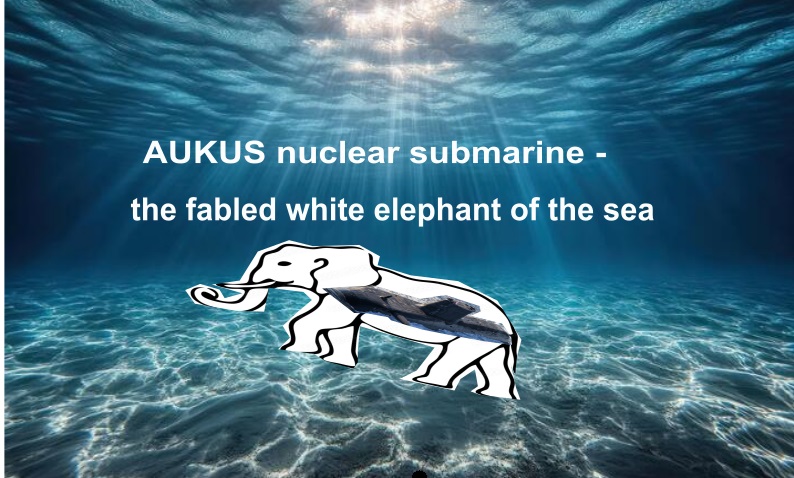
The admiral, who led the Trident value for money review in 2010, called for Britain to pull out of the multi-billion “Aukus” defence deal with America and Australia to build 12 new nuclear submarines.
SSN-Aukus is a submarine which is not going to deliver what the UK or Australia needs in terms of capability or timescale. “Performance across all aspects of the
programme continues to get worse in every dimension.”
Former Navy chief calls for ‘radical’ action to revive programme after catastrophic failures.
Tom Cotterill, Defence Editor, 06 December 2025
Britain is “no longer capable” of running a nuclear submarine programme after “catastrophic” failures pushed it to the brink, a former Navy chief has warned. In an extraordinary critique, Rear Admiral Philip Mathias said the UK’s “silent service” was facing an “unprecedented” situation that it was “highly unlikely” to recover from without a “radical” intervention. The former director of nuclear policy at the Ministry of Defence (MoD) said delays in building new attack boats had reached record levels and had driven up the duration of patrols for crews from 70 days during the Cold War to more than 200 now.
This had led to the “shockingly low availability” of submarines to “counter the Russian threat in the North Atlantic”, the retired submarine commander warned. The admiral, who led the Trident value for money review in 2010, called for Britain to pull out of the multi-billion “Aukus” defence deal with America and Australia to build 12 new nuclear submarines.
“The UK is no longer capable of managing a nuclear submarine
programme,” he said. “Dreadnought is late, Astute class submarine delivery is getting later, there is a massive backlog in Astute class maintenance and refitting, which continues to get worse, and SSN-Aukus is a submarine which is not going to deliver what the UK or Australia needs in terms of capability or timescale. “Performance across all aspects of the
programme continues to get worse in every dimension.”
He added: “This is an unprecedented situation in the nuclear submarine age. It is a catastrophic failure of succession and leadership planning.” The Navy’s fleet of Astute submarines is already facing significant problems, with many having been stuck in port for years. Out of the seven planned, only
six are in service.
He also criticised the role of industry giants for
delays to programmes. He added not a single of the UK’s 23 decommissioned nuclear boats had been dismantled since the first, HMS Dreadnought, left service in 1980. “This is an utter disgrace and brings into question whether Britain is responsible enough to own nuclear submarines,” the admiral said.
Telegraph 6th Dec 2025,
https://www.telegraph.co.uk/news/2025/12/06/britains-nuclear-submarine-fleet-no-longer-fit-for-purpose/
Britain’s “borrowed bombs”

The extreme expense — at least £60 million per plane plus the costs of parts and maintenance — will be a burden on British taxpayers already suffering from cuts to social services.
“reflects a long-standing trend by the UK government to prioritising trans-Atlantic politics over genuine military needs“…………… “an opportunity to appease Trump “
by beyondnuclearinternational, https://beyondnuclearinternational.org/2025/12/07/britains-borrowed-bombs/
New reports shows UK purchase of US nuclear-capable aircraft is political grandstanding with little practical application, writes Linda Pentz Gunter
When the UK government announced its intention last June to purchase 12 F-35A nuclear capable Lightning II Joint Strike Fighter aircraft from the US by 2033 and join NATO’s ‘dual capable aircraft nuclear mission’, it described the decision as the “biggest strengthening of the UK’s nuclear posture in a generation”.
But a new study released on November 11 by two British watchdog groups, Nukewatch UK and Nuclear Information Service, argues that the purchase of the planes will incur massive costs to the British taxpayer while not actually being militarily necessary or advantageous.
The report, “Smoke andMirrors”, concludes that “the government’s decision is based principally on providing political ‘smoke and mirrors’ to distract attention from questions relating to the US-Europe relationship within NATO rather than developing a must-have military capability.”
The purchase of the F35As “serves more as a diplomatic gesture than a military imperative,” the study said, designed to placate US president Donald Trump’s gripes about a perceived lack of financial commitment from NATO partners.
The UK decision to participate in the NATO nuclear sharing mission “is being driven forward by the nuclear lobby within government itself, and raises questions about whether the decision was driven by strategic necessity or political expediency,” the study authors wrote.
The 12 F-35As are far too few to constitute a credible deterrent, according to experts, in large part because the plane’s track record already indicates that all 12 will rarely be in service at the same time.
“On the basis of current performance, at any one time at best only 8 aircraft would be available to take part in a nuclear strike — and possibly even fewer. It is possible that not all of these aircraft would penetrate enemy air defences to reach their targets,” the study said.
The planes are expected to be stationed at RAF Marham in Norfolk. However, as the study noted, this is actually too far away for F35As to reach any meaningful targets inside Russia, for example, as “the maximum distance the aircraft can travel from its base to complete its mission and return without refuelling is 1,000 km,” (about 683 miles).
The F-35A will carry the American B61 nuclear gravity bomb, the only plane in the F-35 class able to do so. The current RAF fleet of F-35Bs and the Eurofighter Typhoon, are not nuclear-capable so the purchase “potentially gives the RAF a nuclear strike capability using this weapon” the Smoke and Mirrors report said.
Further, since the B61 is an American bomb, any deployment will remain under full US control, “rendering the operation entirely dependent on American permission,” the study said.
According to Nukewatch UK, those bombs were already delivered in July to RAF Lakenheath in Suffolk — in reality a US Air Force base despite its name. This would mark the first stationing of US nuclear weapons on UK soil since 2008.
Establishing the programme will also be costly, lengthy and complicated and is unlikely to reach fruition for many years, the study said, due to the many complex steps that will need to be taken before the UK can join the NATO nuclear sharing programme.
The extreme expense — at least £60 million per plane plus the costs of parts and maintenance — will be a burden on British taxpayers already suffering from cuts to social services, the report pointed out. “At a time when public services are struggling to meet demands, there is little public appetite for more military spending,” wrote the report’s authors. “An expensive nuclear weapon system that will not be available for nearly a quarter of a century is a low priority, even on the UK military’s wish list – if, indeed, such a capability is even needed.”
The purchase may also burden the UK military by depriving it of other resources, including the next tranche of F-35Bs. An analysis by Navy Lookout, which delivers independent Royal Navy news and analysis, concluded that a shortfall in F-35Bs could be problematic, “as F-35As cannot operate from carriers and contribute nothing to their strike power,” it said.
The Navy Lookout analysis also argued against using RAF Marham for the planes, given the base “will need expensive refurbishment and regeneration” and recommended Lakenheath instead.
The Smoke and Mirrors study endeavors to extract the reality from the opaque government announcement, made on June 24 on the eve of the NATO Summit at The Hague. After “stripping away all the verbiage,” the study authors concluded that the statement lacked “even basic information such as when the aircraft are intended to be delivered and when their nuclear capability is intended to be operational.”
Even without delays, the report said, “it will be years, rather than months, before they are available for operation.”
The report also points out that the UK’s own 2025 Strategic Defence Review published on June 2, does not include a recommendation to purchase F-35As equipped for US B61 bombs and instead advises a detailed study on such an option. “The fact that it’s not there indicates that we weren’t terribly enthusiastic about it,” the SDR’s lead reviewer, Lord Robertson, a former Defence Secretary and a former Secretary General of NATO, told the report authors.
Despite this, the Starmer cabinet enthusiastically threw its support behind the proposal in what Robertson described as “a decision independent of the Review.” The report authors also point out that “the decision to join the NATO mission appears to have been made before the SDR was even published.”
Continue readingAll French nuclear power plants are releasing tritium, according to Criirad.

December 5, 2025 , https://reporterre.net/Toutes-les-centrales-nucleaires-francaises-ont-rejete-du-tritium-selon-la-Criirad
All French nuclear power plants are releasing tritium. This is the finding of the Independent Research and Information Commission on Radioactivity (CRIIRAD), which issued a warning on December 3rd about uncontrolled releases.
Between 2015 and 2024, 16 power plants recorded levels exceeding 10 Bq/l in groundwater, some exceeding 1,000 Bq/l such as Bugey, Gravelines and Tricastin, the association details.
The three other power plants (Golfech, Nogent-sur-Seine, Paluel) experienced similar episodes before or after this period, notably Nogent-sur-Seine on January 17, 2025.
Criirad emphasizes that no power plant has been able to guarantee the permanent protection of groundwater and that any massive discharge would quickly affect the aquatic environment.
According to the Sortir du nucléaire network , the toxicity of tritium has been underestimated, particularly when it is absorbed by the body, where it then enters the DNA of cells.
US Military Blows Up Another Boat in Latin America Amid Scrutiny of Bombing Campaign.
SOUTHCOM claimed the strike killed four ‘narco-terrorists,’ a term used to justify the extrajudicial executions at sea
by Dave DeCamp | December 4, 2025, https://news.antiwar.com/2025/12/04/us-military-blows-up-another-boat-in-latin-america-amid-scrutiny-of-bombing-campaign/
The US military blew up another boat in the waters of Latin America on Wednesday, an attack that comes amid growing congressional scrutiny of the bombing campaign.
US Southern Command said in a statement on X that its forces conducted a “lethal kinetic strike” on a vessel in the Eastern Pacific Ocean. The command claimed, without providing any evidence, that the boat was carrying “illicit narcotics.”
SOUTHCOM said the strike killed four male “narcoterrorists,” a term used to justify the extrajudicial executions at sea. The Pentagon has previously admitted to Congress that it doesn’t know the identities of all the people it has killed in the boat strikes.
According to numbers released by the Trump administration, the attack brings the total number of people killed in the bombing campaign to 87 and marks the 22nd strike and 23rd boat that has been destroyed. Eleven of the boats have been struck in the Caribbean near Venezuela, where the bombing campaign started, and 12 have been hit in the Eastern Pacific.
The strike came after a small group of US lawmakers saw the video of the September 2 boat bombing, the opening salvo of the campaign, which involved multiple strikes to kill survivors.
“What I saw in that room is one of the most troubling scenes I’ve ever seen in my time in public service,” Rep. Jim Himes (D-CT) told The Intercept. “You have two individuals in clear distress without any means of locomotion with a destroyed vessel who were killed by the United States.”
Members of Congress intend to investigate the strike to see if a war crime was committed, though the entire bombing campaign is clearly illegal under US and international law. The Trump administration has also continued its military buildup in the Caribbean and its push toward war with Venezuela to oust President Nicolas Maduro.
Reeves’ £150 cut in UK’s energy bills will be nuked by Sizewell costs, ex-Labour donor claims
Dale Vince’s claims over the impact of paying for Sizewell C on energy bills is one of a number of hidden costs which could see consumers pay higher bills – instead of £150 less
David Maddox, Political Editor
Rachel Reeves’ pledge to take £150 off household energy bills could be wiped out because of the costs of nuclear energy, hidden green levies andnew levies being introduced by the energy regulator, it has been claimed.
In her Budget last week, the chancellor promised to take £150 off
household bills by scrapping the Energy Company Obligation (ECO) scheme.
But former Labour donor and green entrepreneur Dale Vince has now claimed that the impact of paying for building nuclear energy capacity will largely wipe out the £150 because of the £1bn cost in the first year and ongoing costs for nuclear power.
Independent 7th Dec 2025, https://www.independent.co.uk/news/uk/politics/reeves-energy-bill-discount-nuclear-power-budget-b2878907.html
Nuclear (in)flexibility, nearly 100% electricity from solar PV and offshore wind surge!
David Toke, Dec 08, 2025
I keep hearing claims, most recently from the British Government, about how nuclear power can be used flexibly to help balance fluctuating wind and solar. But in reality in most situations around the world nuclear is inflexible and its operation simply pushes wind and solar off the grid. Also, according to a report from Ember, cheaper batteries and proliferating solar can lead to solar on its own cheaply providing all electricity demand for 97-99 per cent of the time in the sunnier parts of the world. Meanwhile back in the UK offshore wind is now surpassing generation from natural gas according to the Energy and Climate Intelligence Unit (ECIU).
Tales of SMRs nuclear (in)flexibility
Looking around the world, it is very difficult to find any examples of nuclear power being flexible. The main example quoted is France. However, France has some close connections with the rest of the European continent. These differ for example, to the connections to the UK and the continent.
Unlike the UK, the French electricity system operator has no choice but to order the scaling down of some French nuclear plant. This is to cope with inflows of wind and solar across its borders that they cannot stop. In Britain where the inflows can be better controlled, as elsewhere, nuclear operators would prefer not to be flexible. Instead, wind and solar power get turned off and the renewable sources are blamed for energy that is really being wasted by inflexible nuclear operations! A study of Scotland, where a lot of wind power is constrained because of a lack of grid capacity, found that most wind power would not have been be wasted if there were no nuclear power station s operating in Scotland (see HERE). And, in practice there is no chance of nuclear power plant being flexible in normal operations, whatever people say!
The current UK Government is struggling to mask the fact that it’s so-called new generation of ‘small modular reactors’ (SMRs) is going to cost even more, MW for MW, than the much-overpriced Hinkley C and Sizewell C Nuclear plant. Rolls Royce is leading the charge here with a proposed 470MW (not small!) nuclear reactor. This will come into operation sometime in the next 20 years or so. According to Rolls Royce this development will be ‘equivalent to more than 150 onshore wind turbines’‘ (See HERE) Ah, so that’s the crack! SMRs are now promised to replace wind turbines! That will please the wideley expected future leader, Nigel Farage! Nigel hates windfarms but loves Rolls Royce and nuclear stuff – so patriotic, he claims!
I must say, it’s pretty small fare. I mean the Rolls Royce ‘SMR’ will only replace 150 onshore wind turbines – and at double or probably triple the price of onshore wind in delivered energy! (currently there are over 11000 wind turbines in the UK). Not much of a bargain really for Nigel, there I’m afraid. But really, as with populists the world round, its the headlines that matter, and never mind the facts!
Of course, as with other policies the Government is struggling to compete in messaging with the far-right. In doing so it feels it has to buy into a lot of myths about nuclear power. As one Government minister was made to say recently (presumably by his pro-nuclear civil servants) in an answer to a Parliamentary Question from a Liberal Democrat MP:
‘The next generation of nuclear, including small modular reactors (SMR), offers new possibilities including faster deployment, lower capital costs, and greater flexibility…..Whilst nuclear energy has a unique role to play in delivering stable, low carbon baseload energy, SMRs may be able to serve the electricity grid more flexibly than traditional nuclear, as well as unlock a range of additional applications in energy sectors beyond grid electricity.’ (See HERE)
What unbelievable nonsense! I would never want to be a government minister and have to spout such rubbish! I’ve already suggested that the SMR(s) will take a long time to emerge at eye-watering cost. But flexibility? Why should this happen? It does not happen now with the PWR plant at Sizewell B. So why should it happen with the Rolls Royce ‘SMR’ which is also a PWR? No reason at all!
In fact the Rolls Royce ‘SMR’ it is even less likely to operate flexibly than Sizewell B (which does not). This is because of the likelihood that, as in the case of Hinkley C, Rolls Royce will be offered a so-called ‘baseload’ contract. This means that the nuclear power plant are paid a set price for every MWh they generate – whenever it is generated. It does not matter whether wholesale prices become negative and wind and solar is forced off the system, nuclear continues to generate.
Rolls Royce will no doubt be given such a contract to ensure that the investors get a virtually guaranteed return. Otherwise it will be virtually impossible to attract private investors to give the required facade of part-private finance to the operation. In reality of course the bulk of the money to finance the equity for the plant will come directly from the taxpayer and the consumers will pick up the bill for the inevitable cost overruns.
To cap it all, the SMR(s) will contribute practically nothing to balancing renewables since that will be done by ‘peak’ gas plant (see my blog post HERE).
Almost 100 per cent 24/7 electricity from solar + batteries
Meanwhile solar PV is advancing around the world at several times the pace of new nuclear and fossil fuel power plant. See my earlier blog post HERE and the Figure below. Now, the energy think tank ‘Ember’ (see HERE) conclude that almost 100 per cent electricity can be delivered cheaply in the sunnier parts of the year using solely solar PV and batteries.
In places like Las Vegas and Oman 97-99 per cent of all electricity demand, 24/7 can be provided solely by solar PV for a cost of $104 per MWh. That is exactly the wholesale power price in the UK. It should be recalled that they are talking about just solar PV and batteries, never mind other renewables………………………………………………………………………………… https://davidtoke.substack.com/p/nuclear-inflexibility-nearly-100
The Story They Forgot to Tell: Ten Years of Ukraine’s Corruption and the Media’s Convenient Timeline

The original of this article shows clear examples of mainstream media coverage of corruption, and also gives telling case studies
How the NYT’s latest “exposé” framing collapses when you place Ukraine’s graft in its full post-coup 2014–2024 context — and why MSM remembers corruption only when it fits partisan politics.
Gregor Jankovič, DD Geopolitics, Dec 08, 2025
When the New York Times ran its December investigation into how Kiev “sabotaged oversight” and allowed a $100-million corruption scheme to take root in state energy firms, many readers saw it as a stinging indictment of President Volodymyr Zelensky’s government — and of the geopolitical consequences of a U.S. retreat. That was the intended reading. But placed against a fuller decade-long record, the NYT narrative looks less like an objective accounting and more like a carefully timed political frame: corruption is old and structural in Ukraine, and it has been tolerated, overlooked, and sometimes protected by Western patrons for years — through multiple U.S. administrations. For evidence of this, we need to look back. It was all reported.
The 2014 “reforms” — impressive on paper, weak in practice
After the Maidan coup (2013–14), Kyiv adopted a series of legal reforms and created new institutions, under pressure from Washington and Brussels — the National Anti-Corruption Bureau (NABU), anti-corruption prosecutors (SAP), and a push for “independent” supervisory boards at state companies. Western donors loudly backed these moves and conditioned assistance on these newly formed “watchdog structures”.
These reforms looked impressive on paper.
In reality:
The institutions were funded by the West but controlled through political appointments.- The supervisory boards were symbolic, frequently ignored, or never fully seated.
- Oligarchs shifted from Yanukovych-style control to a networked, distributed corruption model.
- The existing Ukrainian oligarchic network simply adapted to them, rather than collapsed or lose its hold over the national economy.
Even the EU Court of Auditors admitted in 2016:
“No meaningful progress. Political interference everywhere.”
The NYT now pretends these same paper-thin structures were once strong, credible, and functioning — until Trump broke them.
2017–2020: “Under Trump, Corruption Survives” — but Oversight Was Never Real
Trump’s first term did not “destroy” Ukrainian anti-corruption systems. They never worked to begin with.
Throughout these years:
- The EU repeatedly warned of massive political interference in SOEs.
- The IMF froze loan tranches over corruption concerns.
- Poroshenko used “anti-corruption bodies” as political weapons.
- Supervisory boards existed but were powerless and often ignored.
Trump didn’t weaken Ukrainian oversight.
Ukrainian elites never accepted it in the first place.
But acknowledging this would break the New York Times’ morality play — so the paper skips the entire era.
A notorious and in the Western MSM extremely suppressed story from this period was the case of the then ex-vice-president Joe Biden (tied to the Ukrainian energy company Burisma through his son Hunter Biden), related to his demanding for the removal of Prosecutor General Viktor Shokin in 2016:
Two years after leaving office, Joe Biden couldn’t resist the temptation last year to brag to an audience of foreign policy specialists about the time as vice president that he strong-armed Ukraine into firing its top prosecutor.
In his own words, with video cameras rolling, Biden described how he threatened Ukrainian President Petro Poroshenko in March 2016 that the Obama administration would pull $1 billion in U.S. loan guarantees, sending the former Soviet republic toward insolvency, if it didn’t immediately fire Prosecutor General Viktor Shokin.
“I said, ‘You’re not getting the billion.’ I’m going to be leaving here in, I think it was about six hours. I looked at them and said: ‘I’m leaving in six hours. If the prosecutor is not fired, you’re not getting the money,’” Biden recalled telling Poroshenko.
“Well, son of a bitch, he got fired. And they put in place someone who was solid at the time,” Biden told the Council on Foreign Relations event, insisting that President Obama was in on the threat.
The pattern was not unique to one administration: it was a systemic weakness of Ukrainian governance, which Western capitals tolerated because they preferred an obedient Kiev regime to the chaos of an un-governed vacuum – or even worse – an actual autonomous political leadership, acting in Ukraine’s national interest.
The practical effect: major contracts, procurement lines, and State-Owned Enterprises (SOE) budgets remained lucrative targets. (See EU/IMF concerns and internal audits.)
2021–2023: The Biden Years — Oversight Collapses Behind a Wall of Wartime Secrecy
This is the period NYT absolutely cannot afford to discuss honestly.
Under Biden:
- Western weapons deliveries lacked tracking mechanisms;
- The CBS documentary reporting that “only 30% of Western arms reach the front” was pressured into removal;
- The Ukrainian defense ministry’s food, fuel and procurement scandals exploded;
- Wartime laws classified nearly all budgetary and procurement data;
- Local and international NGOs documented the worst transparency regression since 2014;
- EU institutions quietly complained about “political capture” of state companies.
Biden’s approach was simple:
fund Ukraine massively, ask few questions, conceal accountability problems to maintain wartime unity.
The NYT now pretends this era was a model of transparency — but it was precisely the opposite.
The SMO did change incentives. Massive Western assistance flowed; governments were conveniently reluctant to publicly police Kiev for fear of weakening its war effort or Ukrainian morale. Wartime secrecy and emergency procurement rules further reduced transparency.
The most striking example was the CBS Documentary “Arming Ukraine” in 2022 suggesting that a surprisingly low share of Western weapons could be verified at frontline use — here is the original “unredacted” version:
The story raised alarms and was subsequently revised after huge diplomatic pushback – which was, of course, swept under the carpet. CBS exposed major tracking problems and distribution opacity in a wartime logistics nightmare of super-charging the Kiev junta’s military — and it was, “surprisingly”, quietly downplayed.
The bigger point: weapons tracking, procurement integrity, and transparency were problems long before any 2025 scandals surfaced.
The Editor’s note on the redacted CBS Reports story says it all:
Why military aid in Ukraine may not always get to the front lines
………………………………………………………………………………………………………………………………………………………. Conclusion — What honest coverage would look like?
A responsible investigation would do three things simultaneously:
document concrete corruption cases and who profited;
trace the long arc (2014→2024) showing systemic weaknesses and donor complicity;
and evaluate how wartime necessities reshaped incentives and motives for both Kiev and its backers.
The NYT’s piece does the first well — but the rest of the story is too often left out of concrete framing and reduced to jabs at its political “enemy”.
Readers deserve unbiased coverage that resists tidy partisan narratives and accepts complexity:
Ukraine’s corruption is real, longstanding, and enabled as much by it’s Masters foreign policy choices as by local actors’ greed. https://ddgeopolitics.substack.com/p/the-story-they-forgot-to-tell-ten?utm_source=post-email-title&publication_id=1769298&post_id=180977735&utm_campaign=email-post-title&isFreemail=true&r=1ise1&triedRedirect=true&utm_medium=email
The UK wants to unlock a ‘golden age of nuclear’ but faces key challenges in reviving historic lead.

The U.K.’s Nuclear Regulatory Taskforce called for urgent reforms after identifying “systemic failures” in the country’s nuclear framework. It found that fragmented regulation, flawed legislation and weak incentives led the U.K. to fall behind as a nuclear powerhouse.
The government committed to implementing the taskforce’s guidance and is expected to present a plan to do so within three months. There is not, at the moment, a single SMR actively producing electricity under four revenues. They will all come at best in the 30s,” Ludovico Cappelli, portfolio manager of
Listed Infrastructure at Van Lanschot Kempen, told CNBC.
While SMRs are a “game changer” thanks to their ability to power individual factories or small towns, their days of commercial operation are too far away, he said.
From an investment standpoint, “that is still a bit scary,” he added. To secure the large baseloads needed to offset the intermittency of renewables, “we’re still looking at big power stations,” added Paul Jackson, Invesco’s EMEA global market strategist.
CNBC 6th Dec 2025, https://www.cnbc.com/2025/12/06/the-history-of-nuclear-energy-lies-on-british-soil-does-its-future-.html
UK’s Planning & Infrastructure Bill 2 – worse, and by stealth.
I was wondering why there was no PIB2 in the Budget. Now I understand why. It’s far worse (from an environmental perspective) than I could have imagined.
In his speech yesterday, (1/12/25) Starmer said, “in addition to accepting the Fingleton recommendations… I am asking the Business Secretary to apply these lessons across the entire industrial strategy.”
There are some VERY far-reaching proposals within the Fingleton recommendations. These include,
but are not limited to: modifying the Habitat Regulations, – allowing developers to comply with the Habitats Regulations requirements by paying a substantial fixed contribution to Natural England; – reversing Finch; – reversing the LURA’s enhanced protection for National Landscapes; – increasing Aarhus cost caps. Those are just SOME!
Community Planning Alliance 2nd Dec 2025, https://www.linkedin.com/feed/update/urn:li:activity:7401614251934654464/
Severn Estuary Interests Group responds to Nuclear Review (Fingleton Report) challenging misleading environmental narrative
Friday 5 December 2025, https://www.somersetwildlife.org/news/severn-estuary-interests-group-responds-nuclear-review-fingleton-report-challenging-misleading
The Nuclear Review, or Fingleton Report, calls for a radical reset of Britain’s approach to nuclear regulation and potentially to National Strategic Infrastructure Projects as a whole.
The report and surrounding reporting and commentary perpetuates the damaging government narrative that environmental protections are preventing development.
The original government decision was to build a power station on one of the most highly protected ecological sites in the UK and Europe. The Severn Estuary is both a Special Area of Conservation and a Special Protection Area – a globally significant habitat supporting vast populations of migratory fish, internationally important bird species, and diverse invertebrate communities.
The impact of the nuclear power station on these important and vulnerable habitats and species will be immense and will continue for 70 years. HPC will extract the equivalent of one Olympic-sized swimming pool every 12 seconds, force it through the reactor system at high velocity, and then discharge it back into the estuary significantly heated. The idea that these impacts are trivial is pure misinformation.
The data cited in the Nuclear (Fingleton) Report is inaccurate. It is data collected in relation to Hinkley Point B, an older and now decommissioned nuclear power station, and extrapolated for HPC. The designs of these power stations are not the same.
The data ignore fish behaviour in the estuary resulting in assumptions that much lower numbers will be impacted than the reality. The importance of the estuary for fish spawning is largely ignored and juveniles that can’t be counted but will be sucked through the cooling system. The impact on species and habitats will be extremely damaging in a Special Protection Area and Special Area of Conservation.
It is also important to place current claims about cost increases in a proper context. Hinkley Point C was originally expected to be operational in 2017 at a cost of £18 billion. It is now projected for 2031 at a cost of £46 billion. EDF itself has attributed these enormous delays and overruns to inflation, Brexit, Covid, civil-engineering challenges, and an extended electromechanical phase. Given the scale of these industry-driven issues, it is frankly unworthy to mock those seeking to uphold the legal requirement for EDF to install an acoustic fish deterrent on the enormous cooling-water intakes.
The real issue here is the developer’s approach, not the environmental regulations that function to protect nature. EDF devised the mitigation measures themselves, rejecting offers of collaboration from local experts. This, as with the notorious HS2 bat-tunnel debacle – has inflated costs precisely because expert ecological advice was not incorporated early enough. The continuing narrative that environmental safeguards are the “blocker”, or that only “a few individual animals” benefit from mitigation or compensation, is a deliberate and politically convenient distortion of the evidence.
Simon Hunter, CEO of Bristol Avon Rivers Trust said: “When developers fail to consult meaningfully, ignore local expertise, and attempt to sidestep environmental safeguards, costs rise and nature pays the price. Many countries would never have permitted a development of this scale in such a sensitive location in the first place. The situation at HPC is not an indictment of environmental protection, but of poor planning, weak accountability, and a persistent willingness to blame nature for the consequences of human decisions.”
Georgia Dent, CEO of Somerset Wildlife Trust said: “The government seems to have adopted a simple, reductive narrative that nature regulations are blocking development, and this is simply wrong. To reduce destruction of protected and vulnerable marine habitat to the concept of a ‘fish disco’ is deliberately misleading and part of a propaganda drive from government. Nature in the UK is currently in steep decline and the government has legally binding targets for nature’s recovery, and is failing massively in this at the moment. To reduce the hard-won protections that are allowing small, vulnerable populations of species to cling on for dear life is absolutely the wrong direction to take. A failing natural world is a problem not just for environmental organisations but for our health, our wellbeing, our food, our businesses and our economy. There is no choice to be made; in order for us to have developments and economic growth we must protect and restore our natural world. As we have said all along in relation to HPC, how developers interpret and deliver these environmental regulations is something that can improve, especially if they have genuine, meaningful and – most importantly – early collaboration with local experts.”
The Severn Estuary Interests Group, a collaboration of organisations that prioritise the health and resilience of the estuary for nature and people, is able to say based on decades of experience, that the environmental rules and regulations are not the reason EDF have found themselves spending an alleged £700m on fish protection measures. The Fingleton Report and subsequent reporting has failed to acknowledge some important points with regard to the building of Hinkley Point C:
Claims that we can go back to some of old tech for a better future!
End of year gloom- or hope for the future?
December 06, 2025, https://renewextraweekly.blogspot.com/2025/12/end-of-year-gloom-or-hope-for-future.html
The end of the year is seeing some arguably gloomy prognosis emerge about the future- along with claims that we can go back to some of old tech for a better future! Thus the Times ran an editorial (24/11/25) complaining about ‘Ed Miliband’s myopic focus on wind & solar power’, and calling instead for a ‘fleet of traditional gas-fired stations, allowing nuclear to catch up’ and backing more large Sizewell-type standard nuclear plants. Although also (to be modern!) up to ‘as many as 100 small modular reactors.’ Sounds like what Reform has in mind. But also the Tories. And indeed Labour, although with lots of renewables as well.
Though perhaps it’s only gloomy if you are a green and want even more renewables and energy saving- and also no nuclear. Certainly the Green’s new leader is keen of renewables and says the proposed Centrica/X-energy project at Hartlepool is based ‘technology from long ago’! Checking back, yes, the UK did try building something similar at Winfrith Dorset in 1959- the Dragon High Temperature gas reactor. Germany also had a go, South Africa too. None of these efforts were followed up. But more recently China has it seems been more successful. And US company X Energy may also be. Though, like all the SMRs/AMRs so far, it is based on old tech, back again for a second try.
However, while not everyone is convinced, most of the media seems to love SMRs, the new kid soon to be on the block (in 2030+), but they were mostly pretty dismissive about the COP 30 climate negotiations in Brazil: unlike SMRs, that is portrayed as an old failed idea. But they may be right, at least on that. Progressive energy trade e-journal Edie noted that in the final COP paper work there was ‘no explicit mention of fossil fuels – something that was included in early drafts but rejected by factions including the Arab Group and Africa Group’. Long serving ex-Guardian eco-journalist Paul Brown wrote in effect a COP /climate politics obituary – and also another farewell piece (very sadly he has terminal lung cancer) on his experiences as an environmental columnists and lamenting the Guardian’s evident recent shift to being more in favour of nuclear power.
However, then again, the world is full of surprises. Of late the Daily Telegraph has taken to attacking nuclear- due to the high cost of the French plants being built here with UK taxpayers and consumers money: ‘The troubled Hinkley Point C nuclear power station will add £1bn annually to UK energy bills as soon as it’s switched on, official figures show. The money will be taken from consumers and handed to the French owner EDF to subsidise operations, making it one of the UK’s most expensive sources of electricity. A further £1bn will be added to bills by a separate nuclear levy, supporting construction of the Sizewell C nuclear power station in Suffolk, also led by EDF.’
Will the Telegraph soon start sounding like the greens? Hardly (and, to be fair, the Guardian did also cover the ‘£2bn’ nuclear story), but there may be some odd overlaps, with Jonathon Porritt wading in on the £5bn bring spent on nuclear – 60% of the UK energy budget. Though I can’t see the Tory right and the Labour/CND left joining forces ever. However, it is worth remembering that it was the Nationalised UK coal board (and staff member Fritz Schumacher, later to write Small is Beautiful) who originally led the anti-nuclear movement- along then with the National Union of Mineworkers! Indeed, in the early years the UK anti-nuke environmental movement was pro coal- although also increasingly pro-renewables and energy conservation. And on the other side? Well, as Paul Brown noted, Maggie Thatcher was the first major politico to push climate issues- but her solution was nuclear. And she saw off coal- and the NUM! What a tangled web we weave….with military and civil nuclear nowadays also becoming ever more entwined…and Reform UK is even it seems keen on coal!
So, for the future, where is the hope? The USA is a mess, though it did add 60GW of green energy tech this year, Europe is struggling, but still trying to meet climate targets despite economic issues. Though the IEA says it ought to try harder. The UK is all over the place- e.g. pushing off shore wind but also still importing nuclear fuel from Russia for Sizewell B, the UKs largest nuclear plant. Meanwhile, despite some unsavoury politics and practices, some look to China, given its huge and expanding commitment to renewables- dwarfing its nuclear programme. But will that be enough to cut emissions? We will have to wait to see.
Meantime though, almost everyone, everywhere thinks AI will help! Indeed, some say we can’t do without it . Although others say it will lead to unsustainable growth in power demand and also some other unwelcome impacts. And while some say it will boom, Prof. Niall Ferguson says it could go bust.
Well, the debate goes on, with some being opposed to large data centre/AI projects, even those using renewable sources. However, this year’s annual DNV energy transition overview says that AI will be the biggest driver of electricity consumption the in the next five years in N. America. However, in Europe, it says EV charging growth will far exceed AI’s demand growth, as will EV charging & the cooling of buildings in China and India. So it’s a mixed bag- but AI does seem here to stay. For example, the new UK Nuclear Regulation review notes that the government ‘plans to expand AI-capable data centre capacity which is expected to require at least six gigawatts by 2030, adding further demand for electricity’. Will it be met by nuclear, as the NIA trade lobby seems to think it should? Or renewables, as some greens think? Or, as Reform UK seem to want, fossil gas! Or even coal! Stay tuned!
*Dave Elliott and Terry Cook, have been looking at the potential role of AI and its potential for aiding (or hindering) green energy developments. They hope to have an academic paper published on this area soon, arguing that what AI needs is TA- critical Technology Assessment. Just what Renew’s host, NATTA, has been trying to do for Alternative Technology (AT) since it started up in 1976!
Trump scores an own goal for FIFA
By Kate Zarb | 8 December 2025, https://independentaustralia.net/politics/politics-display/trump-scores-an-own-goal-for-fifa,20463
FIFA invents a “Peace Prize” to flatter Donald Trump, proving once again that football’s governing body never misses an open goal for global embarrassment, writes Kate Zarb.
WE WEREN’T SURPRISED when we saw it play out, but the punchline we’ve been bracing ourselves for has finally happened. On Saturday 6 December, FIFA awarded its inaugural Peace Prize – a prize no one had ever heard of before Saturday – to none other than Donald Trump.
Clearly, FIFA has decided the respect of six billion people isn’t worth having. It’s sucking up to the giant man-baby with a made-up prize and a trophy big enough (and ugly enough) to be used as a security bollard.
Or has it?
FIFA, like the rest of the world, has been watching in horror at the way everything is spiralling under Trump’s oppressive presence. He is at once a laughing stock and an existential threat to millions of people, such is his malice — and FIFA knows this.
With football still only a minor sport in the USA, I’m sure FIFA was hoping to profit from a successful Men’s World Cup, in 2026 and for many years to come.
But I think FIFA has seen the writing on the wall. It knows the 2026 World Cup won’t be remembered for an astonishing goal, but for the players turned away at the border. It knows there will be no heroism on the football pitch if the locker rooms, team hotels and public streets become a hunting ground for Immigration and Customs Enforcement (I.C.E.) agents hell-bent on deporting anyone darker than an Antebellum plantation owner.
Like many of you, I try to stay away from news from the USA. I realise I am privileged to be able to do so. But my boycott isn’t a complete one. I’ve seen the videos of I.C.E. agents terrorising people, violating the Constitution, confident in their impunity. The Project 2025 regime has recruited the cruellest and most ignorant people in the country and given them a gun and a badge. And not just a gun, but an arsenal. And not just a badge, but a government prepared to look the other way when laws are broken by White men in uniforms.
FIFA can’t be sure that players will have safe passage when travelling to the USA next year. There will be even less protection for the fans, which may keep many of them away. As well as the ticket revenue, FIFA risks embarrassment if the powerhouses from South America, Europe and Asia attract smaller crowds than a local Under 6’s match.
The USA will cement its reputation as the most contemptible nation on Earth, that much is certain, but FIFA risks humiliation as well. Teams like Brazil, Spain and England are used to a certain level of celebrity. Empty stadiums would draw the ire of every football-loving nation on Earth (which, at last count, was all of them) and who knows what that could mean for FIFA’s future?
I think FIFA has taken lessons from the stories of Coppola, Scorsese and David Chase and decided their only hope for “protection” is to pay off the local gangster boss. And like Tony Soprano before him, the only currency Trump accepts is sycophancy.
Will FIFA’s global humiliation pay off? Only time will tell. Just days after Silicon Valley billionaires, including Tim Cook, Mark Zuckerberg and Sam Altman, dined with Trump, each taking turns to heap praise on the tangerine tyrant, Trump added a new $100,000 fee to the H-1B visa that these tech bosses rely on to keep their empires running.
And yes, it was as cringe-inducing as it sounds. America’s richest men spent an evening awkwardly reverse-roasting the President – “blowing smoke up his arse,” as Australians would say – only to forget them and his “deals” with them after a few days.
I recently saw a meme that compared Trump to all four of the bad Willy Wonka kids. This is the core of Trump, so evil that even fictitious villains have to be amalgamated before they approach his level of depravity.
This is the man that FIFA is wooing.
Of course, we all know the “Peace Prize” has been conjured up, but, hopefully, Trump won’t. Even if he has any nagging doubts, FIFA is a global organisation and it wouldn’t take much for Trump to be convinced that FIFA is far more respected than the Nobel Committee. If he keeps believing that this made-up prize is the greatest honour ever bestowed on a man, it just might have some sway with him.
We can only hope it works.
Kate Zarb is an exhausted Gen X woman who just wants the world to be a better place. She has worked in everything from hospitality to politics, using each chapter as an opportunity to learn about the world we live in. You can follow Kate on Bluesky @kathoftarragon.bsky.social.
1 This Month

of the week – Shut Down Drone Warfare!


Tell the Ukrainian Government to Drop Prosecution of Peace Activist Yurii Sheliazhenko

Petition to revoke the licensing of the Near Surface Nuclear Disposal Facility (NSDF) at Chalk River. https://www.ourcommons.ca/petitions/en/Petition/Details?Petition=e-7247
To see nuclear-related stories in greater depth and intensity – go to https://nuclearinformation.wordpress.com
-
Archives
- April 2026 (19)
- March 2026 (251)
- February 2026 (268)
- January 2026 (308)
- December 2025 (358)
- November 2025 (359)
- October 2025 (376)
- September 2025 (257)
- August 2025 (319)
- July 2025 (230)
- June 2025 (348)
- May 2025 (261)
-
Categories
- 1
- 1 NUCLEAR ISSUES
- business and costs
- climate change
- culture and arts
- ENERGY
- environment
- health
- history
- indigenous issues
- Legal
- marketing of nuclear
- media
- opposition to nuclear
- PERSONAL STORIES
- politics
- politics international
- Religion and ethics
- safety
- secrets,lies and civil liberties
- spinbuster
- technology
- Uranium
- wastes
- weapons and war
- Women
- 2 WORLD
- ACTION
- AFRICA
- Atrocities
- AUSTRALIA
- Christina's notes
- Christina's themes
- culture and arts
- Events
- Fuk 2022
- Fuk 2023
- Fukushima 2017
- Fukushima 2018
- fukushima 2019
- Fukushima 2020
- Fukushima 2021
- general
- global warming
- Humour (God we need it)
- Nuclear
- RARE EARTHS
- Reference
- resources – print
- Resources -audiovicual
- Weekly Newsletter
- World
- World Nuclear
- YouTube
-
RSS
Entries RSS
Comments RSS
 nuclear-news