Minnesota’s aging nukes pose national threat
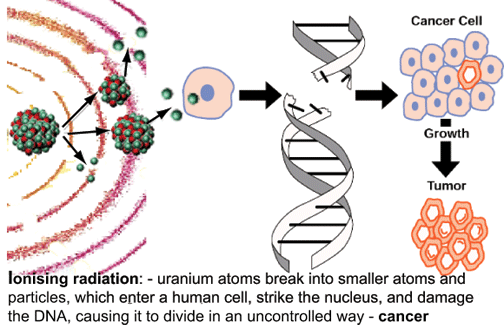
In a review of published studies of 136 nuclear reactor sites in the European Journal of Cancer Care in 2007, elevated leukemia disease rates in children were documented in the US, UK, France, Germany, Spain, Japan, and Canada. This is not a new story.
by beyondnuclearinternational, https://beyondnuclearinternational.org/2025/11/23/minnesotas-aging-nukes-pose-national-threat/
More than electricity, the reactors supply a steady dose of radioactive tritium in drinking water, writes Susu Jeffrey
“Sometimes before I give a speech, I ask the audience to stand up if they or someone in their family has had cancer,” says John LaForge of Nukewatch. “Eighty percent of the audience gets up.”
The Monticello nuclear power reactor is on the Mississippi River about 35-miles northwest of Minneapolis. Xcel’s twin Prairie Island reactors, plus about 50 giant dry casks storing waste reactor fuel, are all in the floodplain of the Mississippi. This waste is sited 44 to 51 miles southeast of Minneapolis and St. Paul.
There are no plans to move the waste off-island because there is no alternative destination. In fact, 34 more concrete encased steel casks are planned. There is no national hot radioactive waste repository. Think of these waste container sites as permanent radioactive waste dumps.
The greater Twin Cities’ 3.7 million people are in the nuclear “shadow” (within 50 miles) of all three nukes. The Mississippi River serves 20 million people with drinking water, way beyond the Minnesota state population of 5.7 million. Minnesota’s aging nukes are a national threat. For approximately the next six generations, radioactive tritium will be a part of the drinking water wherever those molecules wander.
The Monticello nuke was licensed in 1970 for 40 years, and went online in 1971, a year it had two radioactive cesium spills. In 2010, the license was renewed for another 20 years until 2030. Xcel Energy has even been granted an extension for another 20 years until 2050. It is a corporate financial security move not yet approved by the Minnesota Public Utilities Commission which holds the final consent. Paperwork is one thing, pipes are another.
In November 2022, a 50-year-old underground pipe leaked 829,000 gallons of tritium-contaminated wastewater that reached the Mississippi River, according to the Nuclear Regulatory Commission. Xcel failed to make public the radioactive spill for four months. After a May 15, 2024 public hearing in Monticello where citizens testified “We don’t trust you. You lie,” an NRC executive “clarified” Xcel’s “miscommunication.”
Senior Environmental Project Manager, Stephen J. Koenick admitted some tritium had been measured in the Mississippi. Tritium bonds with water and cannot be separated out. Water obeys gravity running downhill, in the case of Monticello, from the reactor to the Mississippi. The runaway tritium will persist in the environment for ten half-lives or about 123 years.
No telling where Xcel’s radioactive molecules will land. Men have a one in two chance of being diagnosed with cancer during their lifetimes; for women the chance is one in three (National Cancer Institute, 2/9/2022). There is tremendous popular, fear-driven support for the oncology industry.
The good news is that while cancer numbers are up so is the cancer survival rate. However, at nuke weapons, nuke reactors, and the virtually forever waste sites, “accidents” happen along with on-going radioactive decay. Radioactivity cannot be contained. When I was a newspaper reporter in Brevard County, Florida, where Cape Canaveral is located, I learned that nuclear waste cannot be rocketed off into space because it’s too hot, too heavy, and the rockets too faulty.
Nuclear Safety Regulations Changing
Among President Trump’s cost-cutting moves is a weakening of the Nuclear Regulatory Commission’s exposure standards. Staff would be cut and regulations “revised” virtually cutting off the commission’s independent status. The Monticello nuke was licensed for 40 years and was rubber stamped to work for 80. Octogenarian nukes are considered “safe enough” now by the nuclear/government consortium.
Piecemeal fix-it parts for geriatric machinery or people are a lucrative business. Locating a leaking tritium pipe underground, between buildings, removing and replacing it is a non-negotiable emergency at nuclear reactors with miles and miles of piping. Upkeep expenses figure in utility rate hikes.
Joseph Mangano and Ernest Sternglass did a study of eight downwind US communities in the two years after a nuclear reactor closure. A remarkable 17.4 percent drop in infant mortality was found. “We finally have peer-reviewed accurate data attaching nuclear power reactors to death and injury in the host communities,” New York State Assemblyman Richard Brodsky said of the 2002 report in the Archives of Environmental Health.
Monopoly capitalism or public service?
Clearly the Monticello reactor was designed to make money. In November 2024, Minnesota Attorney General Keith Ellison wrote that Xcel has “aggressively” pursued multi-year rate hikes while earning large profits. In 2024 Xcel reported $1.94-billion net earnings, a profit margin up 14% from 2023.
According to Xcel propaganda, the nuke is “the biggest employer and largest local taxpayer” in Monticello, MN, and generates an estimated $550 million in economic activity each year in the region. And like profits, cancer rates are up notably among people under 50 and rising faster among women than men the American Cancer Society reports.
Repeatedly, the Xcel corporation wins its rate hike and re-licensing “asks.” These asks get rewritten and resubmitted until a “compromise” is reached. In 2025, residential customers will pay $5.39 more per month, down from the original ask of $9.89, according to Minnesota Public Radio, which also noted that greater increases are on the horizon for EVs and data center capital improvements.
Cancer
St. Jude’s Children’s Hospital advertises heavily with videos of big-eyed, bald children cancer patients. In a review of published studies of 136 nuclear reactor sites in the European Journal of Cancer Care in 2007, elevated leukemia disease rates in children were documented in the US, UK, France, Germany, Spain, Japan, and Canada. This is not a new story.
The danger of mental retardation of fetuses exposed in the womb was reported in The New York Times (page A1 on 12/20/1989). Tritium crosses the placenta. In addition to the health costs of breathing and ingesting exhausts from nuclear power reactors, there is the problem of what to do with and how to contain its long-lived waste. The nuclear profit god is a once and future terrorist.
The Coalition for a Nuclear-Free Mississippi River is working for the immediate decommissioning of the Monticello nuclear reactor by educating the public on dangers of the nuclear power reactors and safe alternatives. To learn more, visit our website. See our Monticello report “Serial Killers on the Loose: Cancer Death Rates Rising in Reactor Host Communities”.
No comments yet.
1 This Month

of the week – Shut Down Drone Warfare!


Tell the Ukrainian Government to Drop Prosecution of Peace Activist Yurii Sheliazhenko

Petition to revoke the licensing of the Near Surface Nuclear Disposal Facility (NSDF) at Chalk River. https://www.ourcommons.ca/petitions/en/Petition/Details?Petition=e-7247
To see nuclear-related stories in greater depth and intensity – go to https://nuclearinformation.wordpress.com
-
Archives
- April 2026 (34)
- March 2026 (251)
- February 2026 (268)
- January 2026 (308)
- December 2025 (358)
- November 2025 (359)
- October 2025 (376)
- September 2025 (257)
- August 2025 (319)
- July 2025 (230)
- June 2025 (348)
- May 2025 (261)
-
Categories
- 1
- 1 NUCLEAR ISSUES
- business and costs
- climate change
- culture and arts
- ENERGY
- environment
- health
- history
- indigenous issues
- Legal
- marketing of nuclear
- media
- opposition to nuclear
- PERSONAL STORIES
- politics
- politics international
- Religion and ethics
- safety
- secrets,lies and civil liberties
- spinbuster
- technology
- Uranium
- wastes
- weapons and war
- Women
- 2 WORLD
- ACTION
- AFRICA
- Atrocities
- AUSTRALIA
- Christina's notes
- Christina's themes
- culture and arts
- Events
- Fuk 2022
- Fuk 2023
- Fukushima 2017
- Fukushima 2018
- fukushima 2019
- Fukushima 2020
- Fukushima 2021
- general
- global warming
- Humour (God we need it)
- Nuclear
- RARE EARTHS
- Reference
- resources – print
- Resources -audiovicual
- Weekly Newsletter
- World
- World Nuclear
- YouTube
-
RSS
Entries RSS
Comments RSS
 nuclear-news
Leave a comment