UN Security Council Gives US ‘Mandate’ Over Palestine

The council endorsed Donald Trump’s neo-colonial governing board over a territory that he said should be depopulated to make way for his resort fantasy to be built on the bones of the victims of Israel’s genocide, reports Joe Lauria.
November 17, 2025, By Joe Lauria, Consortium News, https://consortiumnews.com/2025/11/17/un-security-council-gives-us-mandate-over-palestine/
The United Nations Security Council on Monday adopted a resolution that gives the world body’s imprimatur to Donald Trump’s plan for Gaza, a territory he said publicly should be ethnically cleansed to develop a Mediterranean resort.
The council voted 13 nations in favor with two abstentions from China and Russia, which could have vetoed Trump’s plans.
The resolution essentially revives the colonial mandate system of the League of Nations after the First World War, and the United Nations’ trusteeship system after the Second World War, both schemes in which colonial powers remained in charge of a colonized territory while it was supposed to wean it towards independence.
The resolution that passed on Monday says “conditions may finally be in place for a credible pathway to Palestinian self-determination and statehood.”
The resolution “welcomes” the establishment of a Board of Peace (BoP) “as a transitional administration” in Gaza to coordinate reconstruction. The resolution authorizes the board to set up a temporary International Stabilization Force (ISF) in Gaza “to deploy under unified command acceptable to the BoP.” Though the resolution does not say who will head the BoP, Trump has made it clear that he would be running it himself.
Nations will contribute troops to the force “in close consultation and cooperation” with Egypt and Israel. But it will be Donald Trump who ultimately gets to call the shots of this international military force.
[See: Jeffery Sachs: Trump’s UN Ploy]
Among the Trump-run forces’ tasks is to demilitarize Gaza by decommissioning weapons and destroying military infrastructure. In a statement reacting to the resolution, Hamas said: “The resolution imposes an international guardianship mechanism on the Gaza Strip, which our people and their factions reject.” Hamas says it has a legal right under international law, which it does, to resist Israel’s occupation with force if necessary.
If the stabilization force actually tries to disarm Hamas we could be looking at armed combat between them. The U.N.-approved force would in essence then be taking up the unfinished job of the Israel Defense Forces (IDF) to defeat Hamas.
In step with Hamas’ disarmament, the IDF is supposed to withdraw from Gaza, according to the measure. An annex to the resolution says Palestinians cannot be forcibly expelled from Gaza and Israel can neither annex nor continue to occupy Gaza, according to the remarks to the council by Algeria’s ambassador.
An expert Arab committee with take part with Trump’s board in running Gaza until the Palestinian Authority takes full control. Israel took part in the meeting as a guest but did not have a vote.
Why Russia Abstained
The U.S. draft resolution initially did not mention possible future, Palestinian sovereignty, but it was added after opposition from Arab states and other countries. That addition allowed the Arabs, and importantly the Palestinian Authority, to back the resolution. That led Russia, which had opposed the initial draft, to drop the threat of its veto and China joined in abstaining.
In explaining his abstention to the Council, Russian Ambassador Vassily Nebenzia said Russia “has taken note of Ramallah’s position, as well as that of many Arab-Muslim States that spoke in favor of the American draft so as to avoid renewed bloodshed in the enclave. In this regard, we chose not to submit our own draft, which was aimed at amending the US concept to bring it in conformity with long-standing UN resolutions agreed previously.”
Bur he also complained that the stabilization force would not coordinate with the Palestinian Authority
“This may entrench the separation of the Gaza Strip from the West Bank, and it is reminiscent of colonial practices and the British mandate for Palestine granted by the League of Nations, when the opinions of the Palestinians themselves were not taken into account whatsoever,” he said.
Nebenzia also raised an alarm about the force become engaged in the war. “The resolution … confers on the ISF such extensive peace enforcement mandate that the Mission may actually transform into a party to the conflict going beyond the confines of peacekeeping,” he said. The Russian envoy blamed the U.S. for “arm-twisting in capitals or pressuring delegations here in New York,” which he said can “hardly be called working in good faith.”
Nebenzia said:
“In essence, the Council is giving its blessing to the US initiative relying exclusively on Washington’s honor, we leave the Gaza Strip at the mercy of the Board of Peace and the ISF, whose working methods are still unknown to us.
The most important thing here is making sure that this document does not become a smokescreen for unbridled experiments by the US and Israel in the occupied Palestinian territory (OPT) nor turn into a death sentence for the two-state solution.” … There is no cause for celebration: today is a sorrowful day for the Security Council. Besides the wishes of the parties concerned, there is also such notion as the integrity of the Security Council. And today, with the adoption of this resolution, that integrity and the prerogatives of the Council have been undermined. …
Regrettably, we’ve already had the unfortunate experience when decisions on the Palestinian-Israeli conflict, which were pushed through by the US, led to the opposite to what was intended. Don’t say we didn’t warn you.
PA & Arabs Agree
The PA has long collaborated with Israel in its occupation of the West Bank. Its long-standing opposition to Hamas’ resistance makes it amenable to the United States taking control of Gaza to run it with Israel if the Authority is given a seat at the table.
That, however is not a sure thing as the extremists in Israel’s cabinet blew a fuse when it saw that a mere mention — a throwaway line — about some distant possibility of recognizing Palestine was added to the resolution. Netanyahu himself on Sunday reiterated his opposition to the Palestinian state and vowed that it would never come to pass.
How his government will proceed with U.S. administration of Gaza will be of the greatest interest. As Netanyahu is loudly insisting that Hamas will disarm the “easy way or the hard way,” it will bear watching whether the IDF, which occupies half of Gaza, and the international force, with the Palestinian Authority’s blessings, join arms to fight Hamas to crush the last of the violent resistance to Israeli dominance over Palestine.
Joe Lauria is editor-in-chief of Consortium News and a former U.N. correspondent for The Wall Street Journal, Boston Globe, and other newspapers, including The Montreal Gazette, the London Daily Mail and The Star of Johannesburg. He was an investigative reporter for the Sunday Times of London, a financial reporter for Bloomberg News and began his professional work as a 19-year old stringer for The New York Times. He is the author of two books, A Political Odyssey, with Sen. Mike Gravel, foreword by Daniel Ellsberg; and How I Lost By Hillary Clinton, foreword by Julian Assange.
Lucky Dip: Drone companies await spending bonanza as UK’s Defence Investment Plan (DIP) to be revealed.

Plans already announced to ‘reconnect society with the military’ include the expansion of youth cadet forces, education work in schools to develop understanding among young people of the armed forces, and broader public outreach events to outline the threats and the need for greater military spending despite increased social challenges.
, Chris Cole, https://dronewars.net/2025/11/18/lucky-dip-drone-companies-await-spending-bonanza-as-defence-investment-plan-dip-to-be-revealed/
Following the government’s commitment to increase military spending and the publication of the Strategic Defence Review (SDR) in early June, the military industry has been keenly awaiting the release of the government’s Defence Investment Plan (DIP) which will layout military spending plans and other details for the rest of this parliament. Numerous reports have indicated that many planned projects are ‘on hold’ until the plan is finalised and published.
Defence minister Luke Pollard told MPs in June that the DIP will “cover the full scope of the defence programme, from people and operations to equipment and infrastructure”. Time and again ministers have promised that the plan will be unveiled in the autumn and so this now seems likely to be soon after the Budget of 26 November (although such promises are of course routinely broken).
How much?!
UK military spending was £60.2bn in 24/25 (around 2.4% of GDP), up from £42.4bn in 2020/21. In February 2025, the Starmer government committed to further increase military spending raising the budget to 2.5% of GDP by 2027 (estimated at around an extra £6bn per year – roughly the amount cut from the UK’s Aid budget) with ‘an ambition’ to reach 3% by the next parliament. At the NATO summit in June 2025, however, Starmer upped the ante, with a pledge to reach a ‘goal’ of 5% (3.5% on ‘core defence’ (estimated to be an extra £30bn per year) with 1.5% (around £40bn per year) on ‘defence-related areas such as resilience and security’) by 2029. Subsequently the government said it “expected to reach at least 4.1% of GDP in 2027”.
‘Whole of Society’
Importantly, alongside the increase in military spending, the Strategic Defence Review argued that ‘defence’ is now to be seen as a ‘whole of society’ effort and this may well be re-emphasised when DIP is published.
The plan is being billed as enabling the UK to be at ‘warfighting readiness’ and alongside equipment and weapons programmes, the public is being urged to be ”prepared for conflict and ready to volunteer, support the military, and endure challenges”.
Plans already announced to ‘reconnect society with the military’ include the expansion of youth cadet forces, education work in schools to develop understanding among young people of the armed forces, and broader public outreach events to outline the threats and the need for greater military spending despite increased social challenges.
And to top this off, the government is deploying the hoary old chestnut that military spending is good for the economy (despite such claims being persistently and thoroughly debunked).
Trailed Plans
While specific spending details remain under wraps, government announcements since the publication of the SDR have indicated some of the broad areas which will receive more funding:
Drones, Drones, Drones. In the Spring Statement, Chancellor Rachel Reeves stated that “a minimum of 10% of the MoD’s equipment budget is to be spent on novel technologies including drones and AI enabled technology.” Defence Minister Alistair Cairns indicated in July that there would be around £4bn spending on uncrewed systems – ‘Drones, drones and drones‘ as he put it on twitter.

To the ever-expanding list of UK drone development programmes, many of which are seeking funding decisions as part of the DIP, we can add Project Nyx which seeks to pair a new drone with the British Army’s Apache Helicopter.
Perhaps most significantly in this area, publication of the Defence Investment Plan may illuminate UK plans for a ‘loyal wingman’ type drone – now described by the MoD as an Autonomous Collaborative Platform (ACP) – to accompany the UK’s planned new fighter aircraft, Tempest. While some funding has already been allocated to develop smaller Tier 1 and 2 ACP’s, plans for the more strategic and no doubt costlier level Tier 3 drone have been placed on the back burner pending funding decisions. Will the UK go it alone and build a new armed drone (as no doubt BAE Systems hopes) or will it buy Australia’s Ghost Bat or one of the two drones currently competing for the US contract?
Integrated targeting web. Alongside new drones, the UK is developing a ‘digital targeting web’ to link, as MoD-speak puts it, ‘sensors’, ‘deciders’ and ‘effectors’. In other words commanders supported by AI will be networked with ‘next generation’ drones, satellites and other systems to identify targets to be destroyed by a variety of novel and traditional military systems. The aim is to rapidly speed up the time between target identification and attack. As Drone Wars has reported, several tests of various elements of this system (such as ASGARD) have been tested and it is likely that further funding for this programme will be part of the DIP.
Alongside this, there is also a desire to persuade some of the newer drone companies to open factories here in the UK. While Tekever has announced it will open a new site in Swindon, Anduril and Helsing seem to be keeping their power dry while awaiting news that they have secured government contracts before committing to setting up premises. Both companies have, however, set up UK subsidiaries and have launched PR campaigns to persuade ministers and officials of the efficacy of their products.
While drones are key for these companies, a huge increase in UK spending on military AI systems is also in their sights.
An AI ‘Manhattan Project’ endeavour. Despite continued and significant concerns about the military use of AI, particularly in ‘the kill chain’, ministers, officials and commanders seem convinced that a rapid integration of AI into all areas of the armed forces is urgent and vital. Just before stepping down as Chief of the Defence Staff in September, Admiral Sir Tony Radakin put his weight behind calls from Helsing co-founder Gundbert Scherf for a “Manhattan-Project for AI defence”. Arguing such a plan “would not cost the earth” (but putting it at around $90bn!) Scherf suggested four areas to concentrate on: a) masses of AI-enabled defensive drones deployed on NATO’s eastern flank; b) deploying AI-enabled combat drones to dominate airspace; c) large scale deployment of ai-enabled underwater drones/sensors; and finally, d) replacing Europe’s ageing satellites with (you guessed it) ai-enabled surveillance and targeting satellites.
Anduril is also not shy of lobbying in its own interests. Anduril UK CEO Richard Drake told The House, Parliament’s in-house magazine, that Anduril US was “very much happy with the direction [the SDR is] taking” but went on to publicly push to reduce regulation on the use of drones in UK airspace:
“For UK PLC to get better and better and better in drones and autonomous systems, they have to always look at their regulatory rules as well. Companies like ours and other UK companies can design and build these really cool things, but if we can’t test them well enough in the UK, that’s going to be a problem.”
Winners and Losers
While wholesale adoption of Helsing’s plan seems unlikely, there seems little doubt that the new AI-focused military companies will be among the various military companies who will be the lucky beneficiaries of the UK’s DIP. Meanwhile, the rest of us seem assured of spending cuts and tax rises.
Corporate Media Parrot Dubious Drug Claims That Justify War on Venezuela

Ricardo Vaz, November 19, 2025, https://fair.org/home/corporate-media-parrot-dubious-drug-claims-that-justify-war-on-venezuela/
Since August, the US has been amassing military assets in the Caribbean. Warships, bombers and thousands of troops have been joined by the USS Gerald R. Ford, the world’s largest aircraft carrier, in the largest regional deployment in decades. Extrajudicial strikes against small vessels, which UN experts have decried as violations of international law, have killed at least 80 civilians (CNN, 11/14/25).
Many foreign policy analysts believe that regime change in Venezuela is the ultimate goal (Al Jazeera, 10/24/25; Left Chapter, 10/21/25), but the Trump administration instead claims it is fighting “narcoterrorism,” accusing Caracas of flooding the US with drugs via the Cartel of the Suns and Tren de Aragua, both designated as foreign terrorist organizations.
Over the years, Western media have endorsed Washington’s Venezuela regime-change efforts at every turn, from cheerleading coup attempts to whitewashing deadly sanctions (FAIR.org, 6/13/22, 6/4/21, 1/22/20). Now, with a possible military operation that could have disastrous consequences, corporate outlets are making little effort to hold the US government accountable. Rather, they are unsurprisingly ceding the floor to the warmongers.
Fabricating ‘tensions’
Despite Washington ominously amassing naval assets and issuing overt threats against Caracas, Western journalists often talk of “tensions” between the two countries (Fox, 11/17/25; ABC, 11/18/25), or even a “showdown” (Wall Street Journal, 10/9/25; Washington Post, 10/25/25). This is conceptually similar to the framing of Israel’s genocide in Gaza as a “conflict” with Hamas (FAIR.org, 12/8/23), except in this case the media does not have an equivalent of October 7 to rationalize all the atrocities by the US and its allies.
Though the Trump administration has largely abandoned the traditional US exceptionalist discourse of promoting “freedom” and “democracy,” that has not stopped corporate journalists from relentlessly demonizing the Venezuelan government.
Journalists are quick to label Venezuelan President Nicolás Maduro, currently facing hundreds of Tomahawk missiles pointed at his country, an “authoritarian” (Guardian, 11/14/25; New York Times, 10/15/25😉 or an “autocrat” (Wall Street Journal, 11/5/25; Washington Post, 10/24/25). In contrast, the same pieces place no labels on the Trump administration despite its authoritarianism both at home and abroad (Guardian, 10/16/25; CNN, 8/13/25).
Articles in the Guardian (11/6/25, 10/22/25) describe US operations in Grenada (1983) and Panama (1989) as success stories, fawning over special operations forces while ignoring the deadly impact. The Panama City neighborhood of El Chorrillo became known as “Little Hiroshima” after civilians were massacred there during the US invasion.
Very few outlets recall more recent US interventions, such as Afghanistan, Iraq, Libya and Syria, which according to Brown University’s Costs of War project have killed an estimated 4.5–4.7 million people over the past two decades. Such “accumulation by waste” has seen $8 trillion transferred to the military-industrial complex, Wall Street and Silicon Valley.
Hiding the evidence
Washington’s steady escalation in the Caribbean has evoked memories of the buildup to the Iraq War, when Washington also counted on crucial support from the media establishment to manufacture consent for imperialist war (FAIR.org, 2/5/13, 3/22/23).
At that time, corporate media parroted White House claims about Iraq’s hidden arsenal, despite evidence that Iraq had destroyed its banned weapons arsenal, in contradiction to the White House’s case for war (FAIR.org, 2/27/03). Fast forward more than 20 years, and once more there is ample information undermining the administration narrative, this time about “narcoterrorism.”
Reports from the United Nations Office on Drugs and Crime (UNODC) have consistently found Venezuela’s Eastern Caribbean corridor to be a marginal route for US-bound cocaine trafficking, with former UNODC director Pino Arlacchi estimating that only around 5% of Colombian-sourced drugs flow through Venezuela (L’Antidiplomatico, 8/27/25).
These findings have been corroborated by the DEA itself. For instance, the agency’s 2024 National Drug Threat Assessment report does not even include the word “Venezuela.” The 2025 report only has a small section on the gang Tren de Aragua, which dismisses any ties to the Venezuelan government and places its drug trafficking activities “mainly at the street level.”
Yet these glaring flaws in the Trump administration’s casus belli are often overlooked by Western media. Several outlets reporting on potentially imminent US strikes mention the White House’s declared anti-narcotics mission but conveniently omit the fact that, even according to US agencies, fewer drugs flow through this region than many others (Guardian, 11/11/25; Washington Post, 11/14/25; Bloomberg, 11/14/25; New York Times, 11/14/25)
Former UNODC director Arlacchi pointed out that “Guatemala is a drug corridor seven times more important than the Bolivarian ‘narco-state’ allegedly is.” He accused Washington of hypocritically driving the anti-Venezuela narrative due to interest in its massive oil reserves.
‘Maduro denies’
With the “narcoterrorism” accusations against Maduro and associates, Western journalists absolve US officials of the burden of proof (New York Times, 11/4/25; Financial Times, 10/6/25; Wall Street Journal, 11/5/25). There has never been any public evidence about Maduro, or other high-ranking Venezuelan officials indicted by the US, being involved in drug trafficking via the Cartel of the Suns, while a leaked US intelligence memo rejected the notion of government ties to Tren de Aragua.
The Cartel of the Suns’ very existence is far from established, with subject experts contending that, while drug trafficking may be entwined with corruption in Venezuela’s military, there is no evidence of a centralized structure going all the way up to the president (InSight Crime, 11/3/25, 8/1/25; AFP, 8/29/25).
Instead of exposing the unfounded accusations and providing data from experts and specialized agencies, Western outlets either let Trump’s case for war go unchallenged, or merely present a dissenting opinion from Maduro, whom they have systematically demonized (New York Times, 10/06/25; DW, 11/14/25; NPR, 11/12/25; CBS, 10/15/25; CNN, 11/14/25).
This behavior is certainly not new, as Western outlets have consistently pushed the unfounded “narcoterrorism” narrative, going back to the first Trump administration (FAIR.org, 9/24/19). Similar unfounded accusations of drug trafficking were made against Nicaragua in the 1980s (Extra!, 10–11/87, 7–8/88; FAIR.org, 10/10/17), which served to justify US attempts to overthrow the Sandinista government through the CIA-backed Contras.
Warmongers to the stage
In his typical style, Trump has sent mixed signals over whether he wants to strike targets inside Venezuela, with contradictory on-record and unofficial statements going back and forth. When asked if the White House is seeking regime change in Venezuela, Trump has been noncommittal (Wall Street Journal, 11/4/25). It is worth recalling that in June, Trump similarly sent all sorts of inconsistent messages before ultimately attacking Iran’s nuclear facilities.
True to form (FAIR.org, 2/9/17, 4/13/18, 7/3/20), many liberal establishment outlets have been more bellicose than the US president they have occasionally chided for murdering scores of civilians in the Caribbean (The Hill, 10/30/25; Foreign Policy, 11/7/25). The New York Times’ Bret Stephens (1/14/25, 10/10/25, 11/17/25) has advocated for a regime-changing military intervention for months (FAIR.org, 2/12/25). Quite tellingly, Stephens does not regret supporting the Iraq War (New York Times, 3/21/23).
The Washington Post published an editorial (10/10/25) after the recent Nobel Peace Prize award to far-right Venezuelan leader María Corina Machado, arguing that US interests would be “better served” by someone like Machado, a firm endorser of US-led regime-change (FAIR.org, 10/23/25). But with the war drums beating louder, the Jeff Bezos–owned paper granted a column (11/12/25) to John Bolton, a former Trump adviser whose main criticism was that the administration is not being efficient enough in overthrowing Maduro.
Bolton, an architect of the Iraq War, and of the “maximum pressure” campaign against Venezuela during Trump’s first term, bemoaned the White House’s “inadequate” explanations about the ongoing lethal boat strikes and international quarrels as damaging the “laudable goal” of throwing Venezuela into chaos.
Bolton went on to urge the administration to create a better “strategy,” which includes “greater efforts to strangle Caracas economically.” The Washington Post is happy to platform a call for escalating measures that have already caused tens of thousands of deaths (CEPR, 4/25/19).
Finally, the former Trump official says that “we owe it to ourselves and Venezuela’s people” to violently oust the Maduro government, despite opinion polls showing that such a military intervention is widely rejected both in the US and in Venezuela.
Bloomberg columnist Javier Blas (11/4/25) went one step further by saying the quiet part out loud: “Venezuelan Regime Change May Open Oil’s Floodgates.” Blas rejoiced at the prospect of a “US-enforced change of ideology” that would install a “pro-Western and pro-business government,” which would do wonders for energy markets in the long run.
Unfazed by the human cost of a military intervention, the corporate pundit was only concerned about the possible impact of Venezuela’s current 1 million daily barrels of oil being wiped out. Who cares about millions of Venezuelans when a “brief military campaign” could drive oil prices down and secure a steady supply in the 2030s?
Complicity with war
The White House’s military build-up and illegal strikes have drawn widespread condemnation and opposition, even from within the US political establishment (NPR, 11/5/25; Intercept, 10/31/25). US politicians have also raised alarm bells about a potential military intervention in Venezuela without congressional approval (New York Times, 11/18/25; Politico, 11/6/25), but these voices feature much less prominently than the administration’s.
There is hope that a combination of Venezuelan defense deterrence with domestic and international pressure, coupled with Trump’s own unpredictability, might ultimately avoid yet another US regime-change military assault.
But should the worst come to pass, the media establishment will have once again done nothing to stop yet another deadly US foreign invasion. Over weeks of military buildup and threats, corporate outlets elected to ignore the evidence disproving Trump’s claims and to platform warmongers. They will not wash the Venezuelan people’s blood off their hands.
Trump officials announce $1bn loan to restart Three Mile Island nuclear plant

Facility that was site of worst nuclear disaster in US history will provide power for Microsoft datacenters
Emine Sinmaz and agency, Guardian, 20Nov 25
The Trump administration has announced a $1bn federal loan to restart the
nuclear power plant at Pennsylvania’s Three Mile Island that is under
contract to provide power to Microsoft’s datacenters. The US energy
secretary, Chris Wright, said on Tuesday that the loan to Constellation
Energy, the plant’s operator, would “ensure America has the energy it
needs to grow its domestic manufacturing base and win the AI race”.
Constellation signed a 20-year purchase agreement in 2024 with Microsoft,
which needs power for its artificial intelligence operations, to restart
the 835MW reactor that shut in 2019. The other unit at the plant, renamed
the Crane Clean Energy Center, shut in 1979 after the most serious nuclear
meltdown and radiation leak in US history.
https://www.theguardian.com/us-news/2025/nov/19/three-mile-island-nuclear-loan-microsoft-datacenter
US to Own Nuclear Reactors Stemming From Japan’s $550 Billion Pledge.
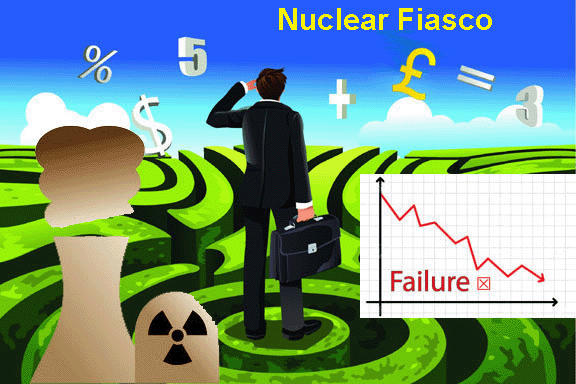
The US government plans to buy and own as many as 10 new, large nuclear reactors that could be paid for using Japan’s $550 billion funding
pledge, part of a push to meet surging demand for electricity. The new
details of the unusual arrangement were outlined Wednesday by Carl Coe, the Energy Department’s chief of staff, about the non-binding commitment made by Japan in October to fund $550 billion in US projects, including as much as $80 billion for the construction of new reactors made by Westinghouse Electric Co.
Bloomberg 19th Nov 2025,
https://www.bloomberg.com/news/articles/2025-11-19/us-to-own-reactors-stemming-from-japan-s-550-billion-pledge
Ukraine’s energy sector corruption crisis – what we know so far and who was involved.

Luke Harding, 19 Nov 25,
https://www.theguardian.com/world/2025/nov/19/ukraine-energy-sector-corruption-crisis
Anti-corruption investigators allege high-level kickback scheme involving Energoatom
Ukraine’s national anti-corruption bureau, known as Nabu, says it has uncovered a high-level criminal scheme at the heart of government. It involves Ukraine’s nuclear energy body, Energoatom, that runs three nuclear power plants supplying Ukraine with more than half of its electricity.
What is the scandal?
A group of insiders allegedly received kickbacks of 10-15% from Energoatom’s commercial partners. If these suppliers failed to pay up, they were removed from a list of approved counter-parties or not reimbursed for services already given. About $100m (£76m) was received in this way, Nabu says.
The alleged conspiracy had old-school touches. Its beneficiaries used code names for each other, such as “Professor”, “Karlson” and “Sugarman”. They carried blocks of cash around Kyiv in large and unwieldy bags, sometimes delivering it on foot. On one occasion, a plotter allegedly sent his wife to collect a stash of dollars, which she hid in her car.
Who was involved?
The alleged organiser of the scheme is Timur Mindich, an old friend and business partner of the Ukrainian president, Volodymyr Zelenskyy. Mindich co-founded Kvartal 95, the media production company set up by Zelenskyy before he went into politics.
Last week he fled his apartment in Kyiv’s government district hours before Nabu investigators came to arrest him, escaping abroad. He is now thought to be hiding in Israel.
Other alleged participants include Ukraine’s ex-deputy prime minister Oleksiy Chernyshov, who is already under suspicion in a separate case; the justice minster, Herman Halushchenko, and his protege, the energy minister, Svitlana Hrynchuk, who were both fired. All deny wrongdoing. At least three other backroom figures allegedly took part.
How have the public reacted?
With fury. Over the autumn, Russia has destroyed much of Ukraine’s energy infrastructure, leading to widespread and worsening blackouts. The hum of pavement generators has become a feature of everyday life, with electricity and heating supplies frequently interrupted. Meanwhile, Russian troops are advancing in the south and east after nearly four years of full-scale war.
In one conversation collected by Nabu in its 15-month investigation a suspect said it was a “pity” to build a structure to defend power stations from Russian bomb attacks since the money could be stolen instead. Chernyshov allegedly spent some of the illicit cash on four luxury mansions in a new-build riverside plot south of Kyiv.
The investigation, which has 1,000 hours of secretly recorded conversations, has been dubbed Operation Midas. The name seemingly refers to Mindich’s apartment, which features a gold toilet in the bathroom.
How far does the corruption go?
The big unanswered question. Was Mindichgate, as it has been called, a one-off? Or one of many similar insider schemes?
Zelenskyy has condemned the scandal, slapped sanctions on Mindich and stripped him of his Ukrainian citizenship. “The president of a country at war cannot have friends,” he said last week after the news broke. He has called for investigations to run their course and for those found guilty to be punished and put behind bars. In July, however – while the Midas investigation was active – Zelenskyy had signed a decree effectively stripping Nabu and the special prosecutor’s office, another anti-corruption agency, of their independence and only backed down after the most serious street protests since Russia’s 2022 full-scale invasion.
Nabu has indicated that the scandal extends to the defence ministry, where Mindich was involved in pursuing lucrative state contracts. And possibly banking, where he also had connections.
What happens next?
The affair is Ukraine’s biggest corruption scandal since Zelenskyy became president six-and-a-half years ago. Civil society activists, opposition MPs and prominent military veterans have urged him to take decisive action, even if that means the sacking and jailing of people who are personally known to him. The former president Petro Poroshenko has called for the current cabinet to be sacked and for a government of national unity to be formed. This is unlikely to happen. Poroshenko was himself embroiled in a defence procurement scandal, which played a role in his 2019 defeat to Zelenskyy, who promised to clean up public life.
Political commentators say corruption is the result of “mono-government”: the fact that Zelenskyy and his allies enjoy sweeping wartime powers under martial law. No elections can be held while fighting continues. The revelations have also dismayed Ukraine’s western partners and emboldened its enemies. Worst of all, there appears to be a connection with Moscow. According to Nabu, the kickbacks were funnelled through a Kyiv back office connected to the family of Andriy Derkach, a former Ukrainian politician who is now a pro-Kremlin Russian senator. Some cash ended up in Russia, the tapes suggest.
Is there an upside?
Of sorts. Some observers think the fact the scandal emerged at all is proof that Ukraine is slowly moving in the right direction – towards European norms and away from gloomy Soviet-style kleptocracy. Oleksandr Abakumov, the head of Nabu’s investigating team, acknowledged his colleagues had “faced a lot of obstacles” pursuing the Mindich case. But he stressed: “This isn’t a story about corruption in Ukraine. It’s about how the country is struggling with corruption, fighting with corruption.”
UN Security Council Resolution On Gaza Is An ‘Atrocity’
On Monday, November 17, the UN Security Council adopted a resolution endorsing Donald Trump’s so-called ‘peace plan’ for Gaza.
The resolution approves the creation of a Trump-led “peace board” to supervise the Gaza Strip, calls for the ‘demilitarization’ of Gaza without imposing any restrictions on the arming of Israel, and authorizes an “international stabilization force” to police and disarm Palestinian resistance groups.
Worst of all, the resolution does not provide for the creation of a Palestinian state. It merely expresses a hallucinatory aspiration that Palestinians might one day have a fireside chat with the genocidal Israeli entity about the two-state delusion.
The UNSC members that voted in favour of this travesty were: the U.S., U.K., France, Algeria, Denmark, Greece, Guyana, South Korea, Pakistan, Panama, Sierra Leone, Slovenia and Somalia.
To their discredit, Russia and China refrained from exercising their veto and abstained.
In this episode of R2R, I analyze the UNSC resolution with fellow attorney, Craig Mokhiber. Craig is an American former UN human rights official who resigned from the UN in late 2023 over its failure to stop what he described (with complete justification) as a “textbook genocide” in Gaza.
According to Craig, the Security Council’s resolution is an “atrocity”.
IAEA warns of safety importance of substations

Tuesday, 18 November 2025,
https://www.world-nuclear-news.org/articles/iaea-warns-of-safety-importance-of-substations
The International Atomic Energy Agency has stressed the importance of electrical substations in ensuring off-site power supplies to nuclear power plants.
The International Atomic Energy Agency (IAEA) said such substations “are indispensable for maintaining off-site power supplies that support safety systems and cooling functions, making their integrity vital for nuclear safety and security”.
Grossi said: “Reliable off-site power is vital for the maintenance and operation of nuclear safety functions. To this end, Agency experts will, through dedicated expert missions, continue to assess the functionality of substations critical for nuclear safety and security.”
Meanwhile, Zaporizhzhia Nuclear Power Plant, which has been under Russian military control since early March 2022, has had its main external power line shut since Friday after the activation of a protection system. The IAEA said the cause was still being investigated and they were “engaging with both sides to assist in the timely restoration of the line”.
The loss of the 750 kV Dniprovska line means the plant is relying on its 330 kV backup Ferosplavna-1 line for external power at the moment. The plant recently went a month relying on emergency diesel generators for power, before IAEA-mediated local ceasefires allowed necessary repair work to take place to reconnect.
Meanwhile, Energoatom issued a statement explaining that Khmelnitsky unit 2 has “been operating with a damaged turbine since 2022 … currently, the power unit can produce up to 900 MW of electricity”. The company added that it is in the process of purchasing a new, modernised rotor which “will not only restore the design nominal capacity, but also increase it by 40 MW to 1,040 MW”.
Zionists Are Freaking Out About Losing Control Of The Narrative.
Hurwitz went on to say that Holocaust education has begun backfiring, because it has been giving young people the wrong impression that genocide is always bad.
Caitlin Johnstone. Nov 19, 2025, https://www.caitlinjohnst.one/p/zionists-are-freaking-out-about-losing?utm_source=post-email-title&publication_id=82124&post_id=179311938&utm_campaign=email-post-title&isFreemail=true&r=1ise1&triedRedirect=true&utm_medium=email
Former Obama speechwriter Sarah Hurwitz made some very revealing remarks during an appearance at the Jewish Federations of North America General Assembly on Sunday, expressing frustration with the way younger Jews are dismissing pro-Israel arguments because of the carnage they’ve seen in Gaza.
“We are now wrestling with a new I think generational divide here, and I think that’s particularly true in that social media is now our source of media,” Hurwitz said. “It used to be that the news you got in America was American media, and it was pretty mainstream; you know it generally didn’t express extreme anti-Israel views. You had to go to a pretty weird bookstore to find global media and fringe media. But today we have social media, which is the global medium; its algorithms are shaped by billions of people worldwide who don’t really love Jews. So while in the 1990s a young person probably wasn’t going to find Al Jazeera or someone like Nick Fuentes, today those media outlets find them; they find them on their phones.”
“It’s also this increasingly post-literate media; less and less text, more and more videos,” Hurwitz continued. “So you have TikTok just smashing our young people’s brains all day long with video of carnage in Gaza. And this is why so many of us cannot have a sane conversation with younger Jews, because anything that we try to say to them, they are hearing it through this wall of carnage. So I want to give data and information and facts and arguments, and they are just seeing in their minds: carnage. And I sound obscene.”
Hurwitz went on to say that Holocaust education has begun backfiring, because it has been giving young people the wrong impression that genocide is always bad.
“And you know I think unfortunately, the very smart bet that we made on Holocaust education to serve as anti-semitism education in this new media environment, I think that is beginning to break down a little bit because, you know, Holocaust education is absolutely essential, but I think it may be confusing some of our young people about antisemitism,” Hurwitz said. “Because they learn about big, strong Nazis hurting weak, emaciated Jews, and they think oh, antisemitism is like anti-black racism, right? Powerful white people against powerless black people. So, when on TikTok all day long, they see powerful Israelis hurting weak, skinny Palestinians, it’s not surprising that they think, Oh, I know the lesson of the Holocaust is you fight Israel. You fight the big powerful people hurting the weak people.”
Hoo boy. Lots to unpack here.
It’s just so fascinating to see a former White House speechwriter making so many of the points that anti-Zionists have been making for years, but taking the exact opposite meaning from them:
- The mainstream legacy media has always hidden anti-Israel views from the public — and that was a good thing.
- Social media has now given Palestinians the ability to expose the truth about Israel’s abuses — and that’s a bad thing.
- People aren’t falling for the Zionist spin and narrative-diddling anymore because they’ve seen the carnage in Gaza with their own eyes — and that’s a problem.
- People who learned from Holocaust education that genocide is wrong have been applying those same lessons to the genocide in Gaza — and this means they’re “confused”.
Hurwitz isn’t denying Israel’s abuses or framing its genocidal atrocities as the problem, she’s just coming right out and saying that people obtaining information and moral clarity about those abuses is the problem. The atrocities aren’t wrong, what’s wrong is people seeing those atrocities and calling them what they are.
I love the way she complains that she looks “obscene” for trying to lay out arguments and narratives justifying the Gaza holocaust for people who’ve seen the “wall of carnage” from the genocide. I mean, yes. Yes obviously you’re going to look obscene if you try to tell someone why raw video footage of massacres, mutilated children and emaciated bodies is actually showing something that is justifiable and acceptable.
You can’t stand in front of a pile of child corpses justifying their murder and then whine when people ignore your spinmeistering and keep staring at the tiny bodies. That’s like murdering an entire family and then telling the cops, “But you’re not listening to my reasons for killing them!” They’re doing the normal thing while you are being obscene.
There’s a viral clip of this tirade going around Twitter and I was curious if Hurwitz had said anything after the video segment ended which might have made what she said sound less horrible, so I went to check out the original video on the Jewish Federations of North America’s Youtube channel, and nope. It didn’t get any better.
Hurwitz went on to say that people are wrong to carry the lessons of Holocaust education into opposition to Israel’s genocidal atrocities because the Holocaust was Nazi Germany blaming Jews for all their problems in the same way people think Israel is the source of all the world’s problems today.
She then mourned the way western Jews “re-imagined Judaism as a Protestant-style religion” in order to integrate into western society rather than retaining a strong identity that is loyal to the state of Israel.
“The problem is, we’re not just a religion,” Hurwitz said. “We’re a nation. Civilization. Tribe. Peoplehood. But most of all we’re a family. And so if you are a young person raised in America who thinks Judaism is a Protestant-style religion, then the seven million Jews in Israel are merely your co-religionists. So my co-religionists, if I look at them and they’re not practicing my religion of social justice and certain prophetic values then what do I have to do with them?”
“But that’s a category error,” says Hurwitz. “The seven million people in Israel, they are not my co-religionists, they are my siblings. But I think if you think of them as merely your co-religionists, it’s easy to slide into anti-Zionism. You don’t necessarily have that connection to them.”
Hurwitz is saying here that Jews around the world should be loyal to Israel no matter what Israel does, not because that’s the moral or truthful position but because Israel is where their loyalties belong.
I don’t know about you, but if my siblings were murdering civilians I would immediately become their enemy. I wouldn’t defend my brother if he was going around shooting children in the head like IDF snipers have been doing in Gaza, in fact I would feel a special responsibility to stop him exactly because he is my brother. Genocide doesn’t magically become acceptable if the perpetrators are your “siblings”, unless you are a sociopath.
It’s just incredible how hard Zionists have been freaking out about the way Israel has lost control of the narrative these last two years. More and more often we’re seeing them say the quiet parts out loud as they frantically scramble to manage perceptions and manipulate minds around the world.
Many things which used to be hidden are finding their way into the light.
First Minister John Swinney absolutely rules out changing SNP’s no nuclear stance
the proposal to develop new nuclear energy was both “economic and environmental folly” that would lead to more expensive bills.
First Minister John Swinney absolutely rules out changing SNP’s no nuclear stance saying ‘there is no way on this planet that I am going to change that policy’
By Scott Maclennan, John O’Groat Journal 20th Nov 2025
First Minister John Swinney has absolutely ruled out any change to the SNP’s position against nuclear energy saying: “There is no way on this planet that I am going to change that policy.”
He was speaking at the weekend at the adoption night for the party’s candidate for Skye, Lochaber and Badenoch Eilidh Munro in Dingwall alongside Deputy First Minister Kate Forbes.
The First Minister reiterated the position after it was revealed that Anglesey in North Wales – which has many objective similarities with Caithness – is about to receive a £2.5 billion nuclear boost.
That sparked Caithness, Sutherland and Easter Ross MP Jamie Stone to reignite his argument that it is not too late for Dounreay – but the SNP must lift its ban on new nuclear power.
“This is an important announcement which demonstrates two things,” he said. “Firstly, that the UK government is serious about establishing ‘a network of small modular reactors across the UK’ – as the Energy Secretary put it.
‘It’s brilliant for a small town like Wick’ – local opticians celebrate award win
“The second point, which will be of enormous interest to the far north, is the specific reference from the UK government to ‘sites across the United Kingdom, including Scotland’.”
But Mr Swinney rebuffed all of those points arguing instead that the proposal to develop new nuclear energy was both “economic and environmental folly” that would lead to more expensive bills.
“I don’t think the position on nuclear power is exactly a surprise,” he said. “We have been around for a long time when we have won Caithness, Sutherland and Ross and there’s absolutely no way on the planet that I’m going to change that policy because I think it’s economic and environmental folly.
“These nuclear stations are hyper-expensive so if people are going to get nuclear power stations put onto their bills then they ain’t seen nothing yet because these projects always go way over budget.
“So we’ve got the opportunity for low cost renewable energy in Scotland in abundance and we should seize that opportunity to do the right thing, fiscally and environmentally and the nuclear argument will just saddle people with exorbitant fuel costs for the years to come.”…………………… https://www.johnogroat-journal.co.uk/news/first-minister-john-swinney-absolutely-rules-out-changing-sn-419801/
Wylfagasm! What does it tell us about Cymru?
18 Nov 2025, https://nation.cymru/opinion/wylfagasm-what-does-it-tell-us-about-cymru/
Some of the most unpopular politicians in the UK and Cymru, led by Starmer, rolled up to Ynys Môn on 13th November to announce that three Small Modular Reactors (SMR’s), to be designed by Rolls-Royce SMR are to be built at Wylfa by publicly owned Great British Nuclear, backed by £2.5 billion of public money.
Following the deferred gratification as the Hitachi project collapsed in 2019, the consequent media ballyhoo was euphoric, with the announcement being seen as at last confirming that nuclear is back on Ynys Môn, with up to 3,000 jobs expected during construction, and up to 900 jobs required to run the plant. The politicians of the UK, Cymru and Ynys Môn of almost all political colours welcomed the news. Starmer also announced that Cymru was to be an Artificial Intelligence (A.I.) zone, with 3,500 jobs to be created.
What’s not to like about nuclear at Wylfa?
A great deal, as I know from too many years of campaigning with PAWB (People Against Wylfa B)! Let’s be brief, though several volumes are needed to do justice to the objections.
The main argument used to justify nuclear by local politicians can be summarised in one word: JOBS! Jobs for Ynys Môn, which has haemorrhaged jobs for years, thus giving youngsters an opportunity to stay on the Island. Yes, Ynys Môn, like other economically bereft areas of Cymru, needs jobs to retain youngsters who have been drifting away in search of opportunities. But this has been a running sore for decades, and the chief focus on Ynys Môn has been to concentrate on the economic silver bullet of Wylfa since Blair’s Energy Review in 2006. So our youngsters have been let down for two decades, during which time a reliable job creation strategy could have been devised and implemented. The result is that jobs of any sort are accepted with very little robust questioning.
Poverty induces gratitude for a poisoned chalice.
Why is the chalice poisoned? The arguments against nuclear have been listed so many times that it is frankly staggering that mainstream politicians largely ignore them.
- No solution to the problem of radioactive waste which must be safe for millennia.
- Spiralling costs of every nuclear project, at the taxpayer’s expense.
- Too little, too late to mitigate climate change.
- The myth that nuclear is low carbon and safe.
- Huge long term environmental damage where uranium is mined.
- Risk of catastrophe as at Chernobyl, Fukushima, Windscale, Three Mile Island.
- Risk of malicious attacks by cyberwarfare or direct military attack in a dangerous world.
- Risk of nuclear proliferation
- Intrinsic link to military nuclear – the first Wylfa was built to produce plutonium.
Other issues can be added.
Continue readingKiev Coup Poker Update, 19 November 2025
Russian & Eurasian Politics, by Gordon hahn, November 19, 2025
Beleaguered Ukrainian President Volodomyr Zelenskiy is still on the road, having arrived in Turkey, where he had a meet and greet with of all people Mindichgate-incriminated Head of the Defense and Security Council of Ukraine Rustem Umerov supposedly to restart peace talks with Moscow. Umerov has recently been heard on the Mindichgate tapes discussing a corrupt deal on bulletproof vests. Zelenskiy needs the support of the military, but Umerov did not and certainly will not have now command or authority inside the military. That is the domain of Ukraine’s most popular political figure, Kiev’s ambassador to the UK, and former commander of the Armed Forces of Ukraine (UAF) Gen. Valeriy Zaluzhniy, fired by Zelenskiy last year.
Head of Zelenskiy’s Office of the President (OP) Andriy Yermak was reportedly in Washington speaking with the FBI, which has a hand in the opening of Mindichgate. He reportedly is now in London, where he is likely to meet with Zaluzhniy and British governmental figues, such as MI6’s new Ukrainian-British director (https://gordonhahn.substack.com/p/is-the-uk-readying-a-coup-option). With Zaluzhniy and the FBI, Yermak’s hand in the developing pre-coup or coup crisis is stronger than that of Zelenskiy, who is potentially isolated in Turkey with Umerov, a wholly unpopular figure in Ukraine and an ethnic Tatar to boot.
But the army is no longer Zaluzhniy’s to have without a fight. It is also the feifdom of the neofascists such as Azov and its founder Brig. Gen, Andriy Biletskiy, who heads a 20,000-strong Azov army corps as well as other Azov-dominated units.
There are also reports that the Secretary of the U.S. Army Dab Driscoll and Army Chief of Staff Randy George are in Kiev and are then scheduled to head to Moscow! They may be in Kiev to deliver an ultimatum to Zelenskiy in the form of the reported new U.S.-Russian peace plan he will be required to sign or face the consequences (arrest, removal from office by impeachment or coup, assassination), perhaps explaining why Zelenskiy remains away in Istanbul. However, this may prove a fatal mistake, as he has left door open to machinations.
Tonight Kiev stands empty without its president, its presidential chief of staff, its Security and Defense Council chief, its energy minister (with the country in an energy crisis), and perhaps who knows who else. Last night, Energy Minister Svetlana Grinchuk, who also is implicated in Mindichgate, fled Ukraine, joining a full cohort of Kievan wanderers – Zelenskiy, Yermak, Umerov, Mindich himself, and his sidekick Tsukerman. They are going faster than American politicians to Epstein island. Ruslan Stefanchuk, the speaker of the badly splintered Rada, rocked by Mindichgate, and head of the Cabinet of Ministers, Yuliya Svyrydenko, in her post for less than a year remain if talking about civilian leaders. Military Intelligence (HRU) chief Kyryll Budanov, a creature of the CIA remains, as presumably do at least some members of the UAF’s General Staff, including its chair Mikhail Gnatov, who just a week ago asserted military over civilian authority to Zelenskiy’s face.
This would be an excellent time for some of these figures, who remain in Kiev, to author a coup, it would seem, perhaps with the backing of those U.S. Army officials in town. It probably will not happen tonight, but who knows? Maybe tomorrow night, when Zelenskiy and Umerov can be arrested, as some official sources say they will be doing. At present a coup to replace Zelenskiy gives everyone among the present moment’s main players something of what they want. Zelenskiy remains a free (if likely hunted) man. The West’s Project Ukraine is rid of him and can be moved to its next course of action within the framework of Russian and American demands and ultimata. Russia achieves its special military operation’s goals at least for now. (Neofascist or others’ countercoups can turn over the chessboard and bring real chaos ala Ukraine’s 17th century Great Ruin or 1917-1920). At any rate, as an old American saying goes: “Get while the getting is good.”……………………………………………….. https://gordonhahn.com/2025/11/19/kiev-coup-poker-update-20-november-2025/
At Least 13 Palestinians, ‘Mostly Children,’ Killed by Israel in Lebanon Massacre
Despite a November 2024 truce between Israel and Hezbollah, Israeli forces have killed at least 121 civilians, including 21 women and 16 children, in Lebanon.
Brett Wilkins, 19 Nov 25, https://www.commondreams.org/news/israeli-airstrikes-lebanon
A series of Israeli airstrikes on targets in southern Lebanon have killed at least 17 people and wounded more than 100 others in recent days, including 13 people—mostly children, according to local officials—massacred Tuesday at a camp for Palestinian refugees.
Officials and residents said that the Israeli strike on Ain al-Hilweh near Sidon struck an area where children were playing soccer. Ain al-Hilweh is the largest camp in Lebanon housing refugees from the Nakba—the ethnic cleansing and terror campaign through which the modern Israeli state was founded—and their descendants.
The Israel Defense Forces said it targeted members of the Palestinian resistance group Hamas “operating in a training compound” in the camp.
Hamas rejected the IDF claim as “fabrication and lies.”
The strike was the deadliest IDF attack in Lebanon since Israeli troops shot and killed at least 24 people including 6 women and injured 134 others in January.
The IDF carried out subsequent attacks, including a Wednesday morning drone strike on a vehicle in Al-Tayri that reportedly killed two civilians including the town’s treasurer and wounded at least 10 university students. Israeli forces also bombed a residential area of the town of Tair Filsay in Tyre district. It is unknown if anyone was harmed in the strike.
Often overshadowed by its genocidal war on Gaza—which has left at least 249,600 people dead, maimed, or missing; millions more forcibly displaced, starved, or sickened; and the coastal strip in ruins—Israel’s bombardment and invasion of Lebanon has killed more than 4,000 people since October 2023, according to the Lebanese Ministry of Public Health. This figure includes at least 790 women and 316 children. More than 16,600 others have been wounded. Upward of 1.2 million Lebanese were also forcibly displaced by Israel’s attacks and invasion.
This, despite a November 2024 truce between Israel and Lebanon-based Hezbollah. Since then, Israeli forces have killed at least 121 civilians, including 21 women and 16 children, in its northern neighbor—which Israel has invaded or bombed numerous times since 1948, killing and wounding tens of thousands of Lebanese and Palestinians.
Israeli forces also bombed the Qizan an-Najjar area, south of Khan Younis in the Gaza Strip on Wednesday, killing at least one Palestinian and wounding a mother and her child, according to local officials, who said at least 280 Palestinians have been killed and 650 others wounded in nearly 400 Israeli violations of the October ceasefire with Hamas.
Zelensky remains a creature of the corruption plaguing Ukraine.

A small number of oligarchs still possess outsized power in all spheres of business and politics. But the truth is moving in mysterious ways.
Ian Proud, Nov 18, 2025, https://responsiblestatecraft.org/ukraine-corruption/?utm_source=substack&utm_medium=email
The $100 million corruption scandal around Ukraine’s energy system that broke this past week is critical to ordinary Ukrainians for its timing. Russia has been bombarding the country’s energy infrastructure on a daily basis to deny ordinary citizens heat and electricity during the cold and dark winter months.
In November 2024, a separate scandal broke that $1.6 billion set aside to build protective bunkers around electricity sub-stations had not led to any being built.
With this in mind, many have responded that the highly publicized nature of this latest scandal, which resulted in the resignations of both the energy and justice ministers, offers visible proof that progress is being made in tackling corruption in Ukraine. The National Anti-Corruption Bureau (NABU) of Ukraine, which is often at the spearhead of such investigations, was first established by Presidential Decree in April 2015. That it continues to function is indeed a positive sign.
It’s not possible, however, to claim that corruption has emerged as a specifically wartime phenomena. This energy scandal is hardly a one-off. In September 2021, with Zelensky having already been in power for two and a half years, the European Court of Auditors reported that state corruption and capture were still widespread in Ukraine. It pointed out that “tens of billions of Euros are lost annually as a result of corruption,” and that EU support delivered over 20 years had not delivered the desired results.
Since Russia invaded in 2022, Ukraine has been flooded with hundreds of billions of dollars of aid, of a much greater value than its yearly economic output. The United States has been unable to accurately account for the billions it has sent there. No country at this point would be able to assure itself that its funds have been spent well.
The scale of each new corruption scandal has seemingly grown over time. In August 2023, Zelensky sacked all the heads of the regional military recruitment offices following widespread complaints about kick-backs, often bribes to let potential recruits escape military service. In September 2023, Ukraine’s Defense Minister, Oleksii Reznikov, resigned following a procurement scandal related to the marking up the cost of purchased body armour and helmets by 4-5 times. In January 2024, Ukrainian defense officials were arrested over the theft of $40 million, related to an order for 100,000 artillery shells that were never delivered.
To date, President Volodymyr Zelensky has been able to keep Western donors off his back through a sacking here or a prosecution there. What has changed this year is that the erstwhile NABU investigators have been gradually nudging closer to his inner circle.
In July of this year, as the noose was closing around his close ally former Deputy Prime Minister Oleksiy Chernyshov because of a large-scale property fraud, Zelensky made a failed attempt to hobble NABU and bring it under his personal control. As it turns out, Chernyshov has also been implicated in the current $100m energy scandal, with NABU detectives documenting the transfer of an estimated $1.3 million in cash to him and an associate. On 14 November, NABU sought an order for pre-trial detention of Chernyshov.
Timur Mindich, the man at the centre of the current scandal, is a close ally of Zelensky and co-founded the TV company ‘Kvartal 95’ with him. He was allowed to flee the country before the NABU raids, which discovered duffel bags stuffed with cash and a golden toilet. It hasn’t been lost on some commentators that, in 2014, the ousted President Yanukovych was also alleged to have possessed a toilet made of gold.
Which provides another reminder that, stepping back from the canvas, not much has really changed in Ukraine over the past decade. I first met an anti-corruption activist in Kyiv in late 2015, at the foot of the postcard perfect Andriivsky descent in the quaint Lviv Handmade Chocolate Café. Approaching two years after the ouster of Yanukovych, she was visibly distressed that little progress had been made in tackling corruption. Within weeks, the government of Arseny Yatseniuk faced a no-confidence vote over a slew of corruption scandals involving figures close to him that led, ultimately, to his resignation in February 2016.
In the midst of that scandal, Vice President Joe Biden visited Kyiv in a bid to shore up the government, anxious that Ukraine might not be able to form a better coalition than the one in power. “Corruption siphons away resources from the people. It blunts economic growth, and it affronts human dignity. We know that. You know that. The Ukrainian people know that,” Biden said.
For many ordinary Ukrainians, who protested peacefully in the Maidan in late 2013, rooting out corruption was at the core of the so-called “revolution of dignity.” Biden’s 2015 visit was an attempt to paper over the cracks, and close down moves to unsettle the pro-western government. Yet the endemic corruption carried on.
When it released its recent report on EU accession states, the European Commission noted Ukraine’s remarkable commitment to its EU path. However, it downgraded its assessment to B grade, expressing concern about progress in tackling corruption. As with the 2015 Biden visit it was, I fear, another example of papering over the cracks of a much bigger problem.
The vertical of power in Ukraine, in which a small number of oligarchs possess outsized power in all spheres of business and politics, remains largely unchanged to this day. Zelensky has emerged as a creature of that system, having both clashed and aligned himself with different oligarchs at different times. With presidential elections paused, there are fewer constitutional checks and balances on his power than before the war. And for all its excellent work, NABU is not yet powerful enough to break the system.
There is a persuasive case to make that ending the war and turning off the gravy train would make it easier for Ukraine’s future leaders to refocus on the path to European membership. This would require real and measurable reform. It’s possibly for this reason that public support for an end to the war continues to grow along with outrage at every new case of graft by cronies close to Zelensky. But it may also help to explain why he is in no hurry to see the war end.
Big Loss for US Empire: Ecuador Votes To Reject Foreign Military Bases
Geopolitical Economy, By Ben Norton, November 19, 2025
Ecuador’s Trump-backed right-wing oligarch President Daniel Noboa tried to rewrite the constitution to allow US military bases in the country’s territory. 61% of Ecuadorians voted against it.
The Donald Trump administration is trying to expand the presence of the US military across Latin America, in an attempt to forcibly impose Washington’s hegemony in the region.
The people of Ecuador just delivered a major blow to Trump’s aggressive Latin America strategy.
More than three-fifths of Ecuadorians voted to reject a change to their progressive constitution, which would have allowed the Pentagon to establish US military bases in their territory……………………………. https://geopoliticaleconomy.com/2025/11/18/noboa-ecuador-vote-foreign-military-bases/
1 This Month

of the week – Shut Down Drone Warfare!


Tell the Ukrainian Government to Drop Prosecution of Peace Activist Yurii Sheliazhenko

Petition to revoke the licensing of the Near Surface Nuclear Disposal Facility (NSDF) at Chalk River. https://www.ourcommons.ca/petitions/en/Petition/Details?Petition=e-7247
To see nuclear-related stories in greater depth and intensity – go to https://nuclearinformation.wordpress.com
-
Archives
- April 2026 (19)
- March 2026 (251)
- February 2026 (268)
- January 2026 (308)
- December 2025 (358)
- November 2025 (359)
- October 2025 (376)
- September 2025 (257)
- August 2025 (319)
- July 2025 (230)
- June 2025 (348)
- May 2025 (261)
-
Categories
- 1
- 1 NUCLEAR ISSUES
- business and costs
- climate change
- culture and arts
- ENERGY
- environment
- health
- history
- indigenous issues
- Legal
- marketing of nuclear
- media
- opposition to nuclear
- PERSONAL STORIES
- politics
- politics international
- Religion and ethics
- safety
- secrets,lies and civil liberties
- spinbuster
- technology
- Uranium
- wastes
- weapons and war
- Women
- 2 WORLD
- ACTION
- AFRICA
- Atrocities
- AUSTRALIA
- Christina's notes
- Christina's themes
- culture and arts
- Events
- Fuk 2022
- Fuk 2023
- Fukushima 2017
- Fukushima 2018
- fukushima 2019
- Fukushima 2020
- Fukushima 2021
- general
- global warming
- Humour (God we need it)
- Nuclear
- RARE EARTHS
- Reference
- resources – print
- Resources -audiovicual
- Weekly Newsletter
- World
- World Nuclear
- YouTube
-
RSS
Entries RSS
Comments RSS
 nuclear-news