A New Gold(en) Mine for Arms Contractors

Golden Dome seems like a marketing concept designed to enrich arms contractors and burnish Trump’s image rather than a carefully thought-out defense program.
William D. Hartung and Ashley Gate, November 16, 2025
“…………………………………………………………….as TomDispatch regulars Bill Hartung and Ashley Gate point out today, Trump has long been wildly in favor of building a “Golden Dome” nuclear defense system that would prove a remarkable (and remarkably costly) boon for the corporations of what still passes as the “defense” industry, even if it would do nothing whatsoever for the rest of us. Let them fill you in on that nightmare project of our moment and the president who seems intent on recreating a nuclear arms race globally on a planet that already has enough problems to deal with. What a nightmare! Tom
Doomed, Not Domed? The Wrath of the Con Man
By Ashley Gate and William D. Hartung
Kathryn Bigelow’s new nuclear thriller, A House of Dynamite, has been criticized by some experts for being unrealistic, most notably because it portrays an unlikely scenario in which an adversary chooses to attack the United States with just a single nuclear-armed missile. Such a move would, of course, leave the vast American nuclear arsenal largely intact and so invite a devastating response that would undoubtedly largely destroy the attacker’s nation. But the film is strikingly on target when it comes to one thing: its portrayal of the way one U.S. missile interceptor after another misses its target, despite the confidence of most American war planners that they would be able to destroy any incoming nuclear warhead and save the day.
At one point in the film, a junior official points out that U.S. interceptors have failed almost half their tests, and the secretary of defense responds by bellowing: “That’s what $50 billion buys us?”
In fact, the situation is far worse than that. We taxpayers, whether we know it or not, are betting on a house of dynamite, gambling on the idea that technology will save us in the event of a nuclear attack. The United States has, in fact, spent more than $350 billion on missile defenses since, more than four decades ago, President Ronald Reagan promised to create a leak-proof defense against incoming intercontinental ballistic missiles (ICBMs). Believe it or not, the Pentagon has yet to even conduct a realistic test of the system, which would involve attempting to intercept hundreds of warheads traveling at 1,500 miles per hour, surrounded by realistic decoys that would make it hard to even know which objects to target.
Laura Grego of the Union of Concerned Scientists has pointed out that the dream of a perfect missile defense — the very thing Donald Trump has promised that his cherished new “Golden Dome” system will be — is a “fantasy” of the first order, and that “missile defenses are not a useful or long-term strategy for defending the United States from nuclear weapons.”
Grego is hardly alone in her assessment. A March 2025 report by the American Physical Society found that “creating a reliable and effective defense against even [a] small number of relatively unsophisticated nuclear-armed ICBMs remains a daunting challenge.” Its report also notes that “few of the main challenges involved in developing and deploying a reliable and effective missile defense have been solved, and… many of the hard problems we identified are likely to remain so during and probably beyond” the 15-year time horizon envisioned in their study.
Despite the evidence that it will do next to nothing to defend us, President Trump remains all in on the Golden Dome project. Perhaps what he really has in mind, however, has little to do with actually defending us. So far, Golden Dome seems like a marketing concept designed to enrich arms contractors and burnish Trump’s image rather than a carefully thought-out defense program.
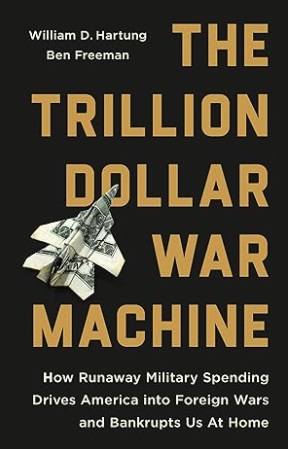
Contrary to both logic and history, Trump has claimed that his supposedly leak-proof system can be produced in a mere three years for $175 billion. While that’s a serious chunk of change, analysts in the field suggest that the cost is likely to be astronomically higher and that the president’s proposed timeline is, politely put, wildly optimistic. Todd Harrison, a respected Pentagon budget analyst currently based at the conservative American Enterprise Institute, estimates that such a system would cost somewhere between $252 billion and $3.6 trillion over 20 years, depending on its design. Harrison’s high-end estimate is more than 20 times the off-hand price tossed out by President Trump.
As for the president’s proposed timeline of three years, it’s wildly out of line with the Pentagon’s experience with other major systems it’s developed. More than three decades after it was proposed as a possible next-generation fighter jet (under the moniker Joint Strike Fighter, or JSF), for example, the F-35, once touted as a “revolution in military procurement,” is still plagued by hundreds of defects, and the planes spend almost half their time in hangars for repair and maintenance.
Proponents of the Golden Dome project argue that it’s now feasible because of new technologies being developed in Silicon Valley, from artificial intelligence to quantum computing. Those claims are, of course, unproven, and past experience suggests that there is no miracle technological solution to complex security threats. AI-driven weapons may be quicker to locate and destroy targets and capable of coordinating complex responses like swarms of drones. But there is no evidence that AI can help solve the problem of blocking hundreds of fast-flying warheads embedded in a cloud of decoys. Worse yet, a missile defense system needs to work perfectly each and every time if it is to provide leak-proof protection against a nuclear catastrophe, an inconceivable standard in the real world of weaponry and defensive systems.
Of course, the weapons contractors salivating at the prospect of a monstrous payday tied to the development of Golden Dome are well aware that the president’s timeline will be quite literally unmeetable. Lockheed Martin has optimistically suggested that it should be able to perform the first test of a space-based interceptor in 2028, three years from now. And such space-based interceptors have been suggested as a central element of the Golden Dome system. In other words, Trump’s pledge to fund contractors to build a viable Golden Dome system in three years is PR or perhaps PF (presidential fantasy), not realistic planning.
Who Will Benefit from the Golden Dome?
The major contractors for Golden Dome may not be revealed for a few months, but we already know enough to be able to take an educated guess about which companies are likely to play central roles in the program………………………………………………………………………………………………………………………………………………………………
Should the Golden Dome system indeed be launched (at a staggering cost to the American taxpayer), its “gold” would further enrich already well-heeled weapons contractors, give us a false sense of security, and let Donald Trump pose as this country’s greatest defender ever. Sadly, fantasies die hard, so job number one in rolling back the Golden Dome boondoggle is simply making it clear that no missile defense system will protect us in the event of a nuclear attack, a point made well by A House of Dynamite. The question is: Can our policymakers be as realistic in their assessment of missile defense as the makers of a major Hollywood movie? Or is that simply too much to ask? https://tomdispatch.com/doomed-not-domed/
No comments yet.
1 This Month


18 March Webinar @ 1 PM EST: An Assessment of SMR Projects: The Case of Canada
register for the zoom:
https://us02web.zoom.us/webinar/register/WN_o8BIIOUvQ2ONJR1nta65DQ#/registration


of the week – STOP SMALL MODULAR REACTORS IN CANADA
To see nuclear-related stories in greater depth and intensity – go to https://nuclearinformation.wordpress.com
-
Archives
- March 2026 (129)
- February 2026 (268)
- January 2026 (308)
- December 2025 (358)
- November 2025 (359)
- October 2025 (376)
- September 2025 (258)
- August 2025 (319)
- July 2025 (230)
- June 2025 (348)
- May 2025 (261)
- April 2025 (305)
-
Categories
- 1
- 1 NUCLEAR ISSUES
- business and costs
- climate change
- culture and arts
- ENERGY
- environment
- health
- history
- indigenous issues
- Legal
- marketing of nuclear
- media
- opposition to nuclear
- PERSONAL STORIES
- politics
- politics international
- Religion and ethics
- safety
- secrets,lies and civil liberties
- spinbuster
- technology
- Uranium
- wastes
- weapons and war
- Women
- 2 WORLD
- ACTION
- AFRICA
- Atrocities
- AUSTRALIA
- Christina's notes
- Christina's themes
- culture and arts
- Events
- Fuk 2022
- Fuk 2023
- Fukushima 2017
- Fukushima 2018
- fukushima 2019
- Fukushima 2020
- Fukushima 2021
- general
- global warming
- Humour (God we need it)
- Nuclear
- RARE EARTHS
- Reference
- resources – print
- Resources -audiovicual
- Weekly Newsletter
- World
- World Nuclear
- YouTube
-
RSS
Entries RSS
Comments RSS
 nuclear-news
Leave a comment