Nuclear waste today; consumer products tomorrow?
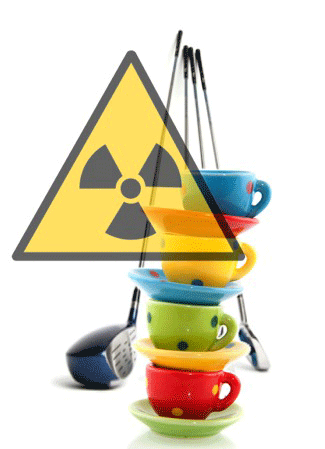
Extract from Trump’s new radiation exposure limits could be ‘catastrophic’ for women and girls, By Lesley M. M. Blume, Chloe Shrager | November 14, 2025
“………………………………………………………..Experts also warn that looser exposure standards might also lead to radioactive materials below a certain level being recycled into consumer products with no labeling or disclosures—effectively reviving a “below regulatory concern” policy revoked by the NRC in 1993 that deregulated low-level radioactive waste. A comparable “very low-level waste” policy was proposed in 2020 and rejected by the NRC. With weaker standards in place, some experts say, government agencies or entities that work with radioactive materials could sell materials that still emit radioactivity, albeit below the threshold newly dictated by the NRC: “There are salvage companies that they sell to. There are some [materials] that are sold at auction. There are some things that will be simply put out into regular trash instead of restricted trash,” Olson fears. If the threshold is loose enough, worries D’Arrigo, the recycling practice may become “so pervasive that it’s not going to be stoppable.”
In their 2007 report “Out of Control – On Purpose: DOE’s Dispersal of Radioactive Waste into Landfills and Consumer Products,” D’Arrigo and Olson provided a detailed timeline tracing Energy Department and NRC policies—and specific cases—of deregulated or mishandled radioactive waste entering commercial landfills, recycling streams, and consumer markets since the 1960s. The report narrows in on the case of Tennessee: The state licenses private companies to import, process, and “free release” nuclear waste from across the country, and is, the authors say, the nation’s de facto hub for deregulated radioactive waste disposal and recycling.
According to the report, contaminated materials in this state can be sent to ordinary landfills, combined with chemicals at hazardous waste disposal sites, or recycled into consumer markets with minimal public oversight or recordkeeping. Tennessee is an example of how even now, though it is illegal, “nuclear materials have gotten out into the marketplace by accident,” says D’Arrigo.
“We can easily say that deregulating nuclear waste is going to release [more] manmade radioactive materials … into the marketplace, into everyday household items that we consume, that we use every day,” she says. This could present significant health risks, she adds, especially when those materials are repurposed into products designed for populations most vulnerable to radiation harm: “Our frying pans, our IUDs [intrauterine devices used to prevent pregnancy], our belt buckles, our baby toys… It could be plastics. It could be concrete. It could be asphalt. It could be playgrounds. There’s no limit when you send it out into the marketplace unregulated.”
Olson posits additional alarming recycling scenarios, including uranium enrichment site pipes that carried radioactive waste being reused as scrap metal for cars or silverware, and contaminated nickel from NRC sites in Ohio, Kentucky, and Tennessee being used in rechargeable batteries, which can be subject to overheating and the associated risk of fire and explosion.
“Would everyone have laptops with radioactive batteries sitting on their laps?” she asks. Such material could be released into the international marketplace as well, or originate abroad and be legally imported and sold in the United States. Higley of the NCRP cites an example of radioactive material being melted down with other metals to make window panes in Taiwan in 1999—some of which were incorporated in kindergarten classrooms and exposed children to whole-body gamma radiation—and also cites a recent recall of imported shrimp from an Indonesian food company that the Food and Drug Administration said was contaminated with radioactive cesium. She also recalls an incident at Los Alamos National Laboratory in 1984 when Mexican-manufactured rebar table bases containing radioactive cobalt 60 set off the Lab’s road radiation detectors when driven through the monitors by a steel delivery truck.
The NRC’s Office of Public Affairs did not respond to a comment request from the Bulletin about expert concerns that loosened radiation exposure standards might allow contaminated materials to enter consumer markets; nor did NRC representatives respond to questions about enforcement protocol when it comes to maintaining safe radioactivity levels in materials being considered for reuse.
Despite the risks, Higley says that there is a valuable conversation to be had about sustainability and recycling reusable materials safely within the nuclear industry. But she concedes that the public is reliant on “good actors and a strong regulator” to properly clean contamination from recyclable materials and maintain the safety of consumer goods. With the Trump administration loosening NRC regulations, some experts and industry observers wonder if consumers will be at the mercy of self-regulating consumer products companies.
“We know that there is no zero risk when you’re exposed to radiation, that there could always be something that goes wrong, even [with] the smallest amounts of exposure,” says Beyond Nuclear’s Cindy Folkers. “One of the things that has struck me about this whole deal with the standards is: who’s minding the store? How are the folks that are supposed to be the regulators actually measuring how much is being released from any of these facilities, including nuclear power facilities or uranium mines, or whatever?”
“And really what they’re doing,” she adds, “is shifting the cost of having to containerize this radioactive material from themselves to us—at the cost of our health.” https://thebulletin.org/2025/11/trumps-new-radiation-exposure-limits-could-be-catastrophic-for-women-and-girls/
No comments yet.
1 This Month


18 March Webinar @ 1 PM EST: An Assessment of SMR Projects: The Case of Canada
register for the zoom:
https://us02web.zoom.us/webinar/register/WN_o8BIIOUvQ2ONJR1nta65DQ#/registration


of the week – STOP SMALL MODULAR REACTORS IN CANADA
To see nuclear-related stories in greater depth and intensity – go to https://nuclearinformation.wordpress.com
-
Archives
- March 2026 (129)
- February 2026 (268)
- January 2026 (308)
- December 2025 (358)
- November 2025 (359)
- October 2025 (376)
- September 2025 (258)
- August 2025 (319)
- July 2025 (230)
- June 2025 (348)
- May 2025 (261)
- April 2025 (305)
-
Categories
- 1
- 1 NUCLEAR ISSUES
- business and costs
- climate change
- culture and arts
- ENERGY
- environment
- health
- history
- indigenous issues
- Legal
- marketing of nuclear
- media
- opposition to nuclear
- PERSONAL STORIES
- politics
- politics international
- Religion and ethics
- safety
- secrets,lies and civil liberties
- spinbuster
- technology
- Uranium
- wastes
- weapons and war
- Women
- 2 WORLD
- ACTION
- AFRICA
- Atrocities
- AUSTRALIA
- Christina's notes
- Christina's themes
- culture and arts
- Events
- Fuk 2022
- Fuk 2023
- Fukushima 2017
- Fukushima 2018
- fukushima 2019
- Fukushima 2020
- Fukushima 2021
- general
- global warming
- Humour (God we need it)
- Nuclear
- RARE EARTHS
- Reference
- resources – print
- Resources -audiovicual
- Weekly Newsletter
- World
- World Nuclear
- YouTube
-
RSS
Entries RSS
Comments RSS
 nuclear-news
Leave a comment