‘Radioactive patriarchy’ documentary: Women examine the impact of Soviet nuclear testing
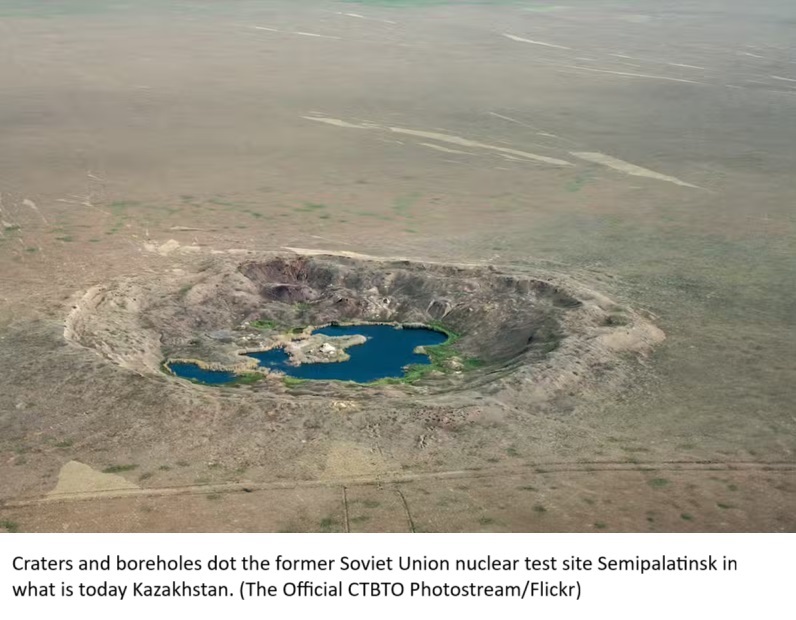
During the time of the detonations, approximately 1.5 million people lived near the sites, despite Soviet claims that the area was uninhabited.
In the ensuing decades, diagnoses of cancers, congenital anomalies and thyroid disease affected the surrounding communities at an alarming rate, particularly for women.
November 17, 2025, Rebecca H. Hogue, Assistant Professor, Department of English, University of Toronto https://theconversation.com/radioactive-patriarchy-documentary-women-examine-the-impact-of-soviet-nuclear-testing-256775
Following recent comments on nuclear testing by United States President Donald Trump and Russian leader Vladimir Putin, it’s more important than ever to remember that nuclear detonations — whether in war or apparent peace time — have long-lasting impacts.
Over a 40-year period, up to 1989, the Soviet Union detonated 456 nuclear weapons in present-day Kazakhstan (or Qazaqstan, in the decolonized spelling)
During the time of the detonations, approximately 1.5 million people lived near the sites, despite Soviet claims that the area was uninhabited.
In the ensuing decades, diagnoses of cancers, congenital anomalies and thyroid disease affected the surrounding communities at an alarming rate, particularly for women.
A new independent documentary, JARA Radioactive Patriarchy: Women of Qazaqstan, examines the impacts of nuclear weapons in Qazaqstan. Jara means “wound” in the Qazaq language.
The film is directed by Aigerim Seitenova, a nuclear disarmament activist with a post-graduate degree in international human rights law who co-founded the Qazaq Nuclear Frontline Coalition. Seitenova grew up in Semey (formerly called Semipalatinsk), Qazaqstan.
Close to Semey is the Semipalatinsk nuclear test site, also known as The Polygon, in Qazaqstan’s northeastern region. It’s an area slightly smaller than the size of Belgium — approximately 18,000 square kilometres — in the former Kazakh Soviet Socialist Republic.
Nuclear Truth Project
Seitenova introduced her film in March 2025 at the United Nations headquarters in New York, hosted by the Nuclear Truth Project. The documentary premiere was a side event at the Third Meeting of States Parties to the Treaty on the Prohibition of Nuclear Weapons.
As a literary and cultural historian who examines narratives of the nuclear age, I attended the standing-room-only event alongside many delegates from civil society organizations.
Nuclear disarmament activist
Seitenova, who wrote, directed and produced JARA Radioactive Patriarchy on location in Semey, aims to bring women’s nuclear stories to Qazaqstan and international audiences.
The 30-minute documentary features intimate interviews with five Qazaq women. The film shares the women’s fears, grief and the ways they have learned to cope, as well as reflections from Seitenova filmed at the ground-zero site.
For Seitenova, it was essential that the film be in Qazaq language.
“Qazaq language, like Qazaq bodies,” she said in an interview after the premiere, “were considered ‘other’ or not valuable.” Seitenova acknowledged it was also important to show a Qazaq-language film at the UN, as Qazaq is not an official UN language like Russian.
Women consensually share experiences
One of Seitenova’s directorial choices was not just what or who would be seen, but specifically what would not be seen in her film.
“I’m really against sensationalism,” said Seitenova. “If you Google ‘Semipalatinsk’ you will see all of these terrible images of children and fetuses.”
Seitenova accordingly does not show any of these images in her film, and instead focuses on women consensually sharing their experiences.
Seitenova explained how narratives regarding the health effects in Semey are often disparaged. When others learn she is from Semey, Seitenova shared, some will make insensitive jokes like “are you luminescent at night?” — making nuclear impact into spectacle, instead of taking it as a serious health issue.
These experiences have propelled her to take back the narrative of her community by correcting misconceptions or the minimization of harms. Instead, she brings attention to the larger structural issues.
“Everything was done by me because I did not want to invite someone who would not take care of the stories of these women,” said Seitenova.
Likewise, Seitenova only interviewed participants who had already made decisions to speak out about nuclear weapons. She did this so as not to risk retraumatizing someone by asking them to discuss their illnesses, especially for the first time on camera.
Global legacy of anti-nuclear art, advocacy
Seitenova also wanted to show a genealogy of women speaking out about nuclear issues in Qazaqstan, contributing to a global legacy of anti-nuclear art and advocacy.
The film features three generations of women, including Seitenova’s great aunt, Zura Rustemova, who was 12 at the time of the first detonations.
As part of this genealogy of nuclear resistance, the film includes footage of a speech from the Qazaq singer Roza Baglanova (1922-2011), who rose to prominence singing songs of hope during the Second World War.
Effects felt into today
JARA Radioactive Patriarchy shows how the impacts of nuclear weapons are felt intergenerationally into the present.
“Many women lost their ability to experience the happiness of motherhood,” interviewee Maira Abenova says in the film. Abenova co-founded an advocacy group representing survivors of the detonations, Committee Polygon 21.
Other interviewees shared how often men left their wives and children who were affected by nuclear weapons to begin a new family with someone else.
Seitenova looks at the roles of women and mothers not just as protectors, but also as those who have launched formidable advocacy.
The film highlights the towering monument in Semey, “Stronger than Death,” dedicated to those affected by nuclear weapons.
The Semey monument depicts a mother using her whole body to protect her child from a mushroom cloud. Just like the monument, Seitenova and the women in her documentary use the film to show how women have been doing this advocacy work in the private and public spheres, with their bodies and with their words.
“I want to show them as being leaders in the community, as changing the game,” Seitenova said.
While the film brings a much-needed attention to the gendered impact of nuclear weapons in Qazaqstan, she makes clear that this is, unfortunately, not an issue unique to her homeland or just to women.
“The next time you think about expanding the nuclear sector in any country” Seitenova said, “you can think about how it impacts people of all genders.”
The Invention of “Ethical AI”

Kissinger declared the possibility of “a world relying on machines powered by data and algorithms and ungoverned by ethical or philosophical norms,”
How Big Tech Manipulates Academia to Avoid Regulation
Rodrigo Ochigame, The Intercept, December 20 2019
The irony of the ethical scandal enveloping Joichi Ito, the former director of the MIT Media Lab, is that he used to lead academic initiatives on ethics. After the revelation of his financial ties to Jeffrey Epstein, the financier charged with sex trafficking underage girls as young as 14, Ito resigned from multiple roles at MIT, a visiting professorship at Harvard Law School, and the boards of the John D. and Catherine T. MacArthur Foundation, the John S. and James L. Knight Foundation, and the New York Times Company.
Many spectators are puzzled by Ito’s influential role as an ethicist of artificial intelligence. Indeed, his initiatives were crucial in establishing the discourse of “ethical AI” that is now ubiquitous in academia and in the mainstream press. In 2016, then-President Barack Obama described him as an “expert” on AI and ethics. Since 2017, Ito financed many projects through the $27 million Ethics and Governance of AI Fund, an initiative anchored by the MIT Media Lab and the Berkman Klein Center for Internet and Society at Harvard University. What was all the talk of “ethics” really about?
………………….. Inspired by whistleblower Signe Swenson and others who have spoken out, I have decided to report what I came to learn regarding Ito’s role in shaping the field of AI ethics, since this is a matter of public concern. The emergence of this field is a recent phenomenon, as past AI researchers had been largely uninterested in the study of ethics……………………………
At the Media Lab, I learned that the discourse of “ethical AI,” championed substantially by Ito, was aligned strategically with a Silicon Valley effort seeking to avoid legally enforceable restrictions of controversial technologies………………….
I also watched MIT help the U.S. military brush aside the moral complexities of drone warfare, hosting a superficial talk on AI and ethics by Henry Kissinger, the former secretary of state and notorious war criminal, and giving input on the U.S. Department of Defense’s “AI Ethics Principles” for warfare, which embraced “permissibly biased” algorithms and which avoided using the word “fairness” because the Pentagon believes “that fights should not be fair.”
…………………….IT lent credibility to the idea that big tech could police its own use of artificial intelligence at a time when the industry faced increasing criticism and calls for legal regulation.
…..corporations have tried to shift the discussion to focus on voluntary “ethical principles,” “responsible practices,” and technical adjustments or “safeguards” framed in terms of “bias” and “fairness”…………………………..
To characterize the corporate agenda, it is helpful to distinguish between three kinds of regulatory possibilities for a given technology: (1) no legal regulation at all, leaving “ethical principles” and “responsible practices” as merely voluntary; (2) moderate legal regulation encouraging or requiring technical adjustments that do not conflict significantly with profits; or (3) restrictive legal regulation curbing or banning deployment of the technology. Unsurprisingly, the tech industry tends to support the first two and oppose the last. The corporate sponsored discussion on ethical AI” enables precisely this position. ……………………….
Thus, Silicon Valley’s vigorous promotion of “ethical AI” has constituted a strategic lobbying effort, one that has enrolled academia to legitimize itself. Ito played a key role in this corporate-academic fraternizing, meeting regularly with tech executives. The MIT-Harvard fund’s initial director was the former “global public policy lead” for AI at Google. Through the fund, Ito and his associates sponsored many projects, including the creation of a prominent conference on “Fairness, Accountability, and Transparency” in computer science; other sponsors of the conference included Google, Facebook, and Microsoft.
……………………………………….. After the initial steps by MIT and Harvard, many other universities and new institutes received money from the tech industry to work on AI ethics. Most such organizations are also headed by current or former executives of tech firms……………………..
Big tech money and direction proved incompatible with an honest exploration of ethics, at least judging from my experience with the “Partnership on AI to Benefit People and Society,” a group founded by Microsoft, Google/DeepMind, Facebook, IBM, and Amazon in 2016. PAI, of which the Media Lab is a member, defines itself as a “multistakeholder body” and claims it is “not a lobbying organization.” In an April 2018 hearing at the U.S. House Committee on Oversight and Government Reform, the Partnership’s executive director claimed that the organization is merely “a resource to policymakers — for instance, in conducting research that informs AI best practices and exploring the societal consequences of certain AI systems, as well as policies around the development and use of AI systems.”
……— the partnership has certainly sought to influence legislation…….
…………………………………………………………………………………………………… the corporate-academic alliances were too robust and convenient. The Media Lab remained in the Partnership, and Ito continued to fraternize with Silicon Valley and Wall Street executives and investors. …………………………………..
Regardless of individual actors’ intentions the corporate lobby’s effort to shape academic research was extremely successful. There is now an enormous amount of work under the rubric of “AI ethics.” To be fair, some of the research is useful and nuanced, especially in the humanities and social sciences. But the majority of well-funded work on “ethical AI” is aligned with the tech lobby’s agenda: to voluntarily or moderately adjust, rather than legally restrict, the deployment of controversial technologies. How did five corporations, using only a small fraction of their budgets, manage to influence and frame so much academic activity, in so many disciplines, so quickly?
…………….The field has also become relevant to the U.S. military, not only in official responses to moral concerns about technologies of targeted killing but also in disputes among Silicon Valley firms over lucrative military contracts. On November 1st the Department of Defense’s Innovation Board published its recommendations for “AI Ethics Principles.” The board is chaired by Eric Schmidt, who was the executive chair of Alphabet, Google’s parent company,…….. The board includes multiple executives from Google, Microsoft, and Facebook, raising controversies regarding conflicts of interest. ……………………
The recommendations seek to compel the Pentagon to increase military investments in AI and to adopt “ethical AI” systems such as those developed and sold by Silicon Valley firms. …………………………………………..
“some applications will be permissibly and justifiably biased,” specifically “to target certain adversarial combatants more successfully.” The Pentagon’s conception of AI ethics forecloses many important possibilities for moral deliberation, such as the prohibition of drones for targeted killing.
The corporate, academic, and military proponents of “ethical AI” have collaborated closely for mutual benefit. For example, Ito told me that he informally advised Schmidt on which academic AI ethicists Schmidt’s private foundation should fund. Ito even asked me for second order advice on whether Schmidt should fund a certain professor who, like Ito, later served as an “expert consultant” to the Pentagon’s innovation board…………….Kissinger declared the possibility of “a world relying on machines powered by data and algorithms and ungoverned by ethical or philosophical norms,”….
No defensible claim to ethics” can sidestep the urgency of legally enforceable restrictions to the deployment of technologies of mass surveillance and systemic violence. Until such restrictions exist, moral and political deliberation about computing will remain subsidiary to the profit-making imperative expressed by the Media Lab’s motto, “Deploy or Die.” While some deploy, even if ostensibly “ethically,” others die. https://theintercept.com/2019/12/20/mit-ethical-ai-artificial-intelligence/
Nuclear Stocks Crash, With A Potential Payoff Still Years Away

Oil Price, By Alex Kimani – Nov 17, 2025
- Uranium prices have surged amid a structural supply deficit and a global policy-driven nuclear revival, but the sector faces long project timelines and mounting volatility.
- Despite major investment pledges like the U.S.–Canada $80 billion reactor partnership, nuclear and uranium stocks have plunged 15–45% in recent weeks.
- Investors confront the industry’s slow path to revenue.
‘…………………………………………… the harsh reality of the long lead and construction times of nuclear facilities, coupled with the fact that some stocks in the space with zero revenues are in nosebleed territory, has sent the sector into a tailspin. Nuclear and uranium stocks have pulled back sharply from recent highs, with many seeing double-digit losses: the sector’s popular benchmark, VanEck Uranium and Nuclear ETF (NYSEARCA:NLR) has declined -16.6% over the past 30 days, at a time when the S&P 500 has gained nearly 3%……………………………….
The market appears to be waking up to the reality that it could be up to a decade before we start to reap the benefits from the billions of dollars flowing into the sector. Whereas $80 billion can build enough reactors to power Virginia’s Data Center Alley, traditional reactors typically take 10 years or more to build. Meanwhile, the frequently touted small, modular reactors (SMRs) by the likes of NuScale Power, TerraPower and X-energy are still far from going mainstream primarily because the technology is still in early development and faces significant economic and regulatory hurdles.
While some prototype units are operational in countries like Russia and China, most designs are still in the theoretical or early construction phases………………………
Amazon has invested in X-energy with the goal of deploying up to 5 GW of SMRs by 2039.
Only Oklo Inc., Kairos Power and TerraPower have begun construction of their SMR plants; however, none have proven they can produce power at a commercial scale nor received regulatory approval to build a commercial system.
“There’s a lot going on, and nothing is going on,” BloombergNEF’s head nuclear analyst Chris Gadomski recently quipped.
To exacerbate matters, the markets have bid up these companies to absurd valuations despite many having no revenues to show for their troubles. To wit, Oklo’s market cap has at times exceeded $20 billion, despite the company having no operating reactors, no licenses to operate commercially, and no binding contracts to supply power. Wall Street analysts currently project Oklo will not generate significant revenue until late 2027 or 2028. Oklo’s current market cap is $15.3 billion…………………… https://oilprice.com/Alternative-Energy/Nuclear-Power/Nuclear-Stocks-Crash-With-A-Potential-Payoff-Still-Years-Away.html
Kashiwazaki Kariwa Nuclear Power Plant (KK) – even more dangerous than Fukushima.
Philip White, 18 Nov 25
A decision is expected very soon about whether the largest nuclear power station in the world can be restarted. The Governor of Niigata Prefecture in Japan is considering whether or not to give the go ahead to restart the number 6 reactor of the Kashiwazaki Kariwa Nuclear Power Plant (KK).
KK is owned and operated by the notorious Tokyo Electric Power Company (TEPCO), which was responsible for the Fukushima Nuclear Power Plant disaster. If the reactor is restarted it will be the first TEPCO reactor to be restarted since the nuclear disaster in 2011. If anything, KK is even more dangerous than Fukushima. Located in an area that used to be an oil field, the ground is said to be as ‘soft as tofu’. In fact, KK was forced to shut down after a major earthquake in 2007. TEPCO chose to ignore the warning, with tragic consequences.
Friends of the Earth Japan has produced an English video about the inadequacy of the emergency response plans. The translation and the voices seem to be AI generated, which is a bit off-putting, but you get the general message.
China has built first undersea data center — a breakthrough in ecocidal technology posing as “sustainable”.

18 Nov 25
China is framing the project as “sustainable,” but the project could accelerate deoxygenation and warming of the oceans already imperiled by the climate crisis. According to a July 16, 2025 report in Scientific American, “researchers say submerged data centers could harm aquatic biodiversity during a marine heat wave—a period of unusually high ocean temperatures. In those cases, the outlet water from the vessel would be even warmer and hold less of the oxygen that aquatic creatures need to survive.”
South Korea has announced plans to also pursue underwater data centers. Other countries, such as Japan and Singapore, are considering data centers that float on the ocean’s surface instead. Around the world, technocrats are going to senseless lengths to keep building data centers to churn endless volumes of data. And to what end? To replace more jobs? To generate more AI slop? To launch hypersonic missiles? To provide more AI “friends” that tell users to jump off the cliff? I have yet to see an upside to AI, while its downsides are on parade. Wouldn’t it be better for humanity and all living things if we just chucked the idea of AI all together?
US senator accuses Trump of ‘silence’ on huge Ukraine corruption scandal.
17 Nov, 2025, https://www.rt.com/news/627874-us-senator-slams-trump-silence/
Rand Paul had long called for oversight on aid to Kiev.
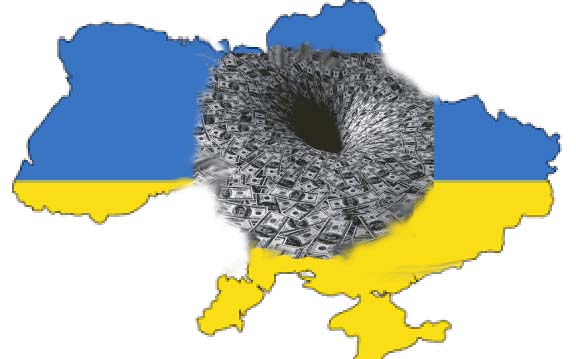
US Senator Rand Paul has accused President Donald Trump of staying silent on a major corruption scandal involving a close associate of Ukrainian leader Vladimir Zelensky.
Last week, Ukrainian anti-corruption agencies alleged that Timur Mindich, Zelensky’s former longtime business partner, led a scheme that siphoned $100 million in kickbacks from contracts with the country’s nuclear power operator Energoatom, which depends on foreign aid. Two government ministers have since resigned, while Mindich fled the country to evade arrest.
“Remember when the Ukraine first Uniparty opposed my call for an Investigator General for Ukraine? Trump silent on $100M Ukraine corruption scandal resignations,” Paul wrote on X on Saturday, commenting on a news story about the affair.
Paul, who frequently attacks what he calls “wasteful spending” of American taxpayers’ money on foreign projects, has repeatedly pushed for a watchdog to supervise funds directed to Ukraine “in order to detect and prevent waste, fraud, and abuse.”
Trump has criticized unconditional aid to Kiev in the past, calling Zelensky “the greatest salesman on earth.” In August, he said the administration of his predecessor, Joe Biden, had “fleeced” America by committing $350 billion to Ukraine. He has since argued that the US is profiting from the conflict by selling Ukraine-bound weapons to NATO.
Kiev’s European backers have also raised concerns about corruption. EU foreign policy chief Kaja Kallas called the affair “extremely unfortunate,” while German Chancellor Friedrich Merz urged Zelensky to “press ahead with anti-corruption measures and reforms.”
The scandal erupted just months after Zelensky had unsuccessfully tried to strip the country’s anti-corruption bodies, NABU and SAPO, of their independence – relenting only after protests in Kiev and outcry from Western supporters. He has since imposed sanctions on Mindich, who is reportedly hiding in Israel.
Ukraine’s ‘EnergyGate’ scandal explained: Why it spells danger for Vladimir Zelensky.

12 Nov, 2025, https://www.rt.com/russia/627713-energygate-corruption-scandal-ukraine/
What began as an inquiry into kickbacks at the state’s energy company has become a political firestorm circling the Kiev regime itself.
Ukraine’s anti-corruption detectives have opened Pandora’s Box. What started as a routine audit of the nuclear energy monopoly Energoatom has spiraled into a full-scale probe into embezzlement, implicating ministers, businessmen – and the man long known as Ukrainian leader Vladimir Zelensky’s personal “wallet.” The affair now raises the question of how much longer the formally acting but no longer legitimate president can maintain control over his own system.
The case that has shaken the Kiev establishment
This week, Ukraine’s National Anti-Corruption Bureau (NABU) raided the homes of several senior officials and businessmen, including Timur Mindich – a longtime friend and financial backer of Zelensky, whom Ukrainian media openly call the president’s “wallet.” Mindich fled the country before investigators arrived, while several of his associates have been detained.
The operation, code-named Midas, uncovered what investigators describe as a multimillion-dollar corruption scheme centered on Energoatom. According to NABU, officials demanded bribes of between 10% and 15% from private contractors supplying or building protective infrastructure for power facilities. Those who refused allegedly faced blocked payments or exclusion from tenders.
Wiretaps obtained by NABU include over a thousand hours of recorded conversations – excerpts of which have been released. In them, individuals identified by code names Carlson, Professor, Rocket, and Tenor discuss distributing kickbacks, pressuring business partners, and profiting from projects tied to nuclear plant protection during wartime. Ukrainian media, citing NABU sources, claim Carlson is Mindich himself, while Professor refers to Justice Minister German Galushchenko, who has since resigned.
The money trail and the missing “wallet”
NABU investigators allege that about $100 million passed through offshore accounts and shell companies abroad. Part of the funds were laundered through an office in central Kiev linked to state contract proceeds.
Mindich and several partners allegedly oversaw the network via intermediaries: Tenor – a former prosecutor turned Energoatom security chief – and Rocket, a one-time adviser to the energy minister. When the raids began, Mindich fled Ukraine with financier Mikhail Zuckerman, believed to have helped run the scheme.
While five people have been arrested, the alleged mastermind remains at large. NABU officials have hinted that further charges could follow, possibly reaching other ministries – including the Defense Ministry, where Mindich’s firms reportedly obtained lucrative contracts for drones and missile systems.
From energy to defense
At hearings before Kiev’s High Anti-Corruption Court, prosecutors argued that Mindich’s network also extended into military procurement. One company linked to him, Fire Point, manufactures Flamingo rockets and long-range drones, and has received major government contracts. If proven, these allegations would shift the case from financial misconduct to crimes threatening national security – drawing the probe dangerously close to Zelensky’s inner circle.
Rumors persist that among the intercepted recordings are fragments featuring Zelensky’s own voice. None have been released publicly, but NABU’s gradual publication strategy has fueled speculation that the most explosive revelations are still to come.
Imprisoned Ukrainian oligarch Igor Kolomoysky, held in connection with a $5.5 billion hole in his bank’s accounts, has told a court that beyond Mindich there are “bigger forces” in play.
Not their first rodeo
The EnergyGate case is the latest in a string of high-profile corruption scandals to erupt under Zelensky’s rule.
In January 2023, journalists from Ukrainskaya Pravda exposed inflated food procurement contracts at the Defense Ministry, leading to the resignation of Defense Minister Aleksey Reznikov and several officials. In May 2023, Supreme Court chairman Vsevolod Knyazev was arrested for allegedly accepting a $2.7 million bribe. In 2024, the State Audit Service found large-scale violations in reconstruction projects financed by Western aid, with billions of hryvnia missing.
The European Court of Auditors, in its 2024 report on EU assistance, concluded that corruption in Ukraine “remains a serious challenge” and that anti-corruption institutions “require greater independence and enforcement capacity.”
Political consequences
The scandal has deepened Ukraine’s internal political crisis. Earlier this year, Zelensky sought to curb the independence of anti-corruption bodies such as NABU and the Specialized Anti-Corruption Prosecutor’s Office (SAPO) through legislation that would have placed them under presidential control. The move triggered protests in Kiev and drew criticism from Brussels and Western donors, who fund much of Ukraine’s wartime budget.
Under EU pressure, lawmakers ultimately reversed the measure, but the episode further strained Zelensky’s relations with Western partners.
Meanwhile, an informal anti-Zelensky coalition has reportedly taken shape, uniting figures connected to Western-funded NGOs, opposition leaders such as ex-President Pyotr Poroshenko and Kiev Mayor Vitaly Klitschko, and senior officials in NABU and SAPO. Their shared goal, according to Ukrainian analysts, is to strip Zelensky of real authority and establish a “national unity government.”
The EU steps in
The EU has seized on the case as further evidence that Kiev’s leadership must remain under external oversight. The latest European Commission report on Ukraine’s EU accession progress explicitly demands that anti-corruption bodies stay free of presidential control and that top law-enforcement appointments involve “international experts.”
For Brussels, scrambling to finance Kiev’s $50 billion 2026 deficit, the scandal serves as both a warning to all potential backers that corruption is inevitable, while giving the EU leverage to tighten control over Kiev’s internal governance. For Zelensky it is another reminder that his ability to act independently is slipping away.
The stakes for Zelensky
The revelations of large-scale corruption in the energy sector weeks before winter sets could prove politically devastating for the Ukrainian leader. Public anger is mounting, while Western media have begun publishing increasingly critical coverage of his administration and its shrinking democratic space. Old allies of Zelensky’s such as Donald Tusk have claimed that they warned him of the damage such scandals will do.
With the country still under martial law and elections suspended, Zelensky remains president in name – but his legitimacy is under growing scrutiny. The EnergyGate affair has exposed the fragility of his position. If upcoming NABU disclosures implicate him directly, the fallout could be fatal to his political future.
For now, NABU’s latest video ends with a hint that more revelations are yet to come.
Nuclear waste today; consumer products tomorrow?
Extract from Trump’s new radiation exposure limits could be ‘catastrophic’ for women and girls, By Lesley M. M. Blume, Chloe Shrager | November 14, 2025
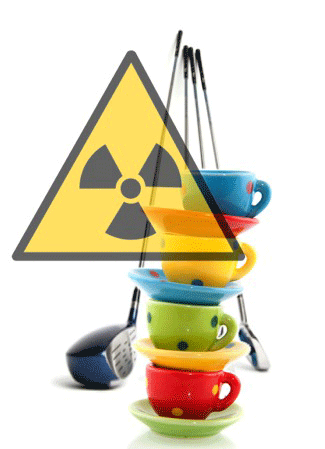
“………………………………………………………..Experts also warn that looser exposure standards might also lead to radioactive materials below a certain level being recycled into consumer products with no labeling or disclosures—effectively reviving a “below regulatory concern” policy revoked by the NRC in 1993 that deregulated low-level radioactive waste. A comparable “very low-level waste” policy was proposed in 2020 and rejected by the NRC. With weaker standards in place, some experts say, government agencies or entities that work with radioactive materials could sell materials that still emit radioactivity, albeit below the threshold newly dictated by the NRC: “There are salvage companies that they sell to. There are some [materials] that are sold at auction. There are some things that will be simply put out into regular trash instead of restricted trash,” Olson fears. If the threshold is loose enough, worries D’Arrigo, the recycling practice may become “so pervasive that it’s not going to be stoppable.”
In their 2007 report “Out of Control – On Purpose: DOE’s Dispersal of Radioactive Waste into Landfills and Consumer Products,” D’Arrigo and Olson provided a detailed timeline tracing Energy Department and NRC policies—and specific cases—of deregulated or mishandled radioactive waste entering commercial landfills, recycling streams, and consumer markets since the 1960s. The report narrows in on the case of Tennessee: The state licenses private companies to import, process, and “free release” nuclear waste from across the country, and is, the authors say, the nation’s de facto hub for deregulated radioactive waste disposal and recycling.
According to the report, contaminated materials in this state can be sent to ordinary landfills, combined with chemicals at hazardous waste disposal sites, or recycled into consumer markets with minimal public oversight or recordkeeping. Tennessee is an example of how even now, though it is illegal, “nuclear materials have gotten out into the marketplace by accident,” says D’Arrigo.
“We can easily say that deregulating nuclear waste is going to release [more] manmade radioactive materials … into the marketplace, into everyday household items that we consume, that we use every day,” she says. This could present significant health risks, she adds, especially when those materials are repurposed into products designed for populations most vulnerable to radiation harm: “Our frying pans, our IUDs [intrauterine devices used to prevent pregnancy], our belt buckles, our baby toys… It could be plastics. It could be concrete. It could be asphalt. It could be playgrounds. There’s no limit when you send it out into the marketplace unregulated.”
Olson posits additional alarming recycling scenarios, including uranium enrichment site pipes that carried radioactive waste being reused as scrap metal for cars or silverware, and contaminated nickel from NRC sites in Ohio, Kentucky, and Tennessee being used in rechargeable batteries, which can be subject to overheating and the associated risk of fire and explosion.
“Would everyone have laptops with radioactive batteries sitting on their laps?” she asks. Such material could be released into the international marketplace as well, or originate abroad and be legally imported and sold in the United States. Higley of the NCRP cites an example of radioactive material being melted down with other metals to make window panes in Taiwan in 1999—some of which were incorporated in kindergarten classrooms and exposed children to whole-body gamma radiation—and also cites a recent recall of imported shrimp from an Indonesian food company that the Food and Drug Administration said was contaminated with radioactive cesium. She also recalls an incident at Los Alamos National Laboratory in 1984 when Mexican-manufactured rebar table bases containing radioactive cobalt 60 set off the Lab’s road radiation detectors when driven through the monitors by a steel delivery truck.
The NRC’s Office of Public Affairs did not respond to a comment request from the Bulletin about expert concerns that loosened radiation exposure standards might allow contaminated materials to enter consumer markets; nor did NRC representatives respond to questions about enforcement protocol when it comes to maintaining safe radioactivity levels in materials being considered for reuse.
Despite the risks, Higley says that there is a valuable conversation to be had about sustainability and recycling reusable materials safely within the nuclear industry. But she concedes that the public is reliant on “good actors and a strong regulator” to properly clean contamination from recyclable materials and maintain the safety of consumer goods. With the Trump administration loosening NRC regulations, some experts and industry observers wonder if consumers will be at the mercy of self-regulating consumer products companies.
“We know that there is no zero risk when you’re exposed to radiation, that there could always be something that goes wrong, even [with] the smallest amounts of exposure,” says Beyond Nuclear’s Cindy Folkers. “One of the things that has struck me about this whole deal with the standards is: who’s minding the store? How are the folks that are supposed to be the regulators actually measuring how much is being released from any of these facilities, including nuclear power facilities or uranium mines, or whatever?”
“And really what they’re doing,” she adds, “is shifting the cost of having to containerize this radioactive material from themselves to us—at the cost of our health.” https://thebulletin.org/2025/11/trumps-new-radiation-exposure-limits-could-be-catastrophic-for-women-and-girls/
Japan edges towards hosting nuclear weapons
The Strategist, 18 Nov 2025, Rajeswari Pillai Rajagopalan
It looks like Japan will finally cast aside its ban on hosting nuclear weapons—specifically, those of the United States.
Moving towards action she called for last year, Prime Minister Sanae Takaichi is reviewing the three principles that have kept Japan at arm’s length from nuclear weapons since 1967. The ban is the third of those principles, the other two holding that Japan must neither own nor produce nuclear weapons.
Japan is responding to what it perceives as worsening security dynamics in the region, surrounded as it is by three nuclear powers—China, Russia and North Korea—all of which are engaging in aggressive behaviour.
A 14 November Kyodo news report citing government sources noted that any changes in the three principles would constitute a major shift in Japan’s security policy in line with the ‘tough security environment.’ According to the report, the Japanese government sees the ban on placement of nuclear weapons within its territory as ‘weakening the effectiveness of the nuclear deterrence provided by its ally, the United States.’ This is particularly relevant as US considers developing a nuclear-armed sea-launched cruise missile, known as SLCM-N, to strengthened deterrence against China.
Japan’s third nuclear principle was a non-issue after the end of the Cold War, when the US withdrew its tactical nuclear weapons. But Tokyo may need to re-think its position if Washington seeks to field SLCM-Ns………………………..
Any shift in Japan’s non-nuclear principles could invite reactions from the region. China has already responded to news of Japan’s review. Chinese Ministry of Foreign Affairs spokesperson Lin Jian said on 14 November that China remained ‘seriously concerned over Japan’s military and security moves recently …. The Sanae Takaichi administration has been making ambiguous statements about the three non-nuclear principles and implying the possibility of quitting the principles.’ The spokesperson added that China was also concerned about the claims by senior Japanese officials that Japan ‘has not ruled out the possibility of possessing nuclear submarines.’……..https://www.aspistrategist.org.au/japan-edges-towards-hosting-nuclear-weapons/
The Guardian view on a new nuclear age: great powers should not restock a house of dynamite
Donald Trump’s remarks on resuming nuclear testing have highlighted the risks. Proliferation must not be considered inevitable.
When Eisaku Satō, a former prime minister of Japan, received the Nobel peace prize in 1974 after committing his country to not making nuclear bombs, owning them or allowing them on its territory, he assured the audience: “I have no doubt that this policy will be pursued by all future governments.”
Yet last week, Sanae Takaichi, Japan’s new prime minister, declined to say whether the country that understands the cost of nuclear war better than any other would stand by its commitment – reflecting the bleak broader outlook. Eighty years after the US dropped Little Boy on Hiroshima, incinerating tens of thousands of people, and almost 40 after Mikhail Gorbachev and Ronald Reagan seriously discussed nuclear abolition in Reykjavik, the spectre looms once more. Last month, Donald Trump ordered the US military to match other countries’ nuclear weapons testing.
Vipin Narang and Pranay Vaddi, who worked on nuclear strategy in the Biden administration, warn that arms control has essentially broken down and that the growing risks amount to a “Category 5 hurricane”. Ankit Panda, another noted expert in the field, has published The New Nuclear Age: At the Precipice of Armageddon. Tellingly, the subject has returned to pop culture. Kathryn Bigelow’s new movie A House of Dynamite shows a nuclear attack targeting Chicago.
The last nuclear arms control treaty between Russia and the US, New Start, is due to expire in February. For decades the main fear was of terrorists or rogue states such as North Korea; now there is a new great power rivalry. In place of the old standoff between two hegemons comes a more complicated contest, with China massively expanding its capabilities, and broader proliferation. For unsettled US allies such as South Korea and Poland, acquiring their own arsenals is no longer out of the question. The nuclear taboo is wearing thin. The Biden administration believed Vladimir Putin could well follow through on his nuclear threats in Ukraine.
Donald Trump pulled out of the intermediate-range nuclear forces treaty, which Russia had been violating, in his first term. In withdrawing from the JCPOA nuclear deal with Iran in 2018, and bombing Iran’s nuclear facilities this year, though it did not have an active weapons programme, he told potential adversaries that the best strategy is North Korea’s: arm yourself as soon as you can. China was content with a relatively modest arsenal for decades after it acquired the bomb; its breakneck expansion reflects its growing global might, but its efforts ramped up after Mr Trump was first elected.
Mr Trump’s confusing comments on nuclear tests (prompting counter-threats from Mr Putin) appear to reflect his misunderstanding of Russian systems tests which, though alarming, do not breach the de facto moratorium. A resumption – the US last detonated a warhead in 1992 – would probably be more useful to adversaries than to the US itself. It would also strengthen suspicions that non-proliferation is window dressing for the maintenance of the nuclear monopoly of a few states, rather than a serious commitment for the sake of humanity.
Mr Trump, said to truly fear nuclear war, should instead challenge Mr Putin to make good on his proposal of a one-year extension of New Start treaty limits and revive non-proliferation endeavours by championing the comprehensive test ban treaty. The US and China have not ratified it; Russia withdrew ratification. A president aspiring to a Nobel peace prize could set an example that is sorely needed.
The Sandoval County Rocket and Missile Complex Deal Was Done Before the Public Ever Had a Say

By Elaine Cimino, 17 Nov 25
Sandoval County residents woke up Monday to the Rio Rancho Observer declaring that Castelion Corporation has “selected” Sandoval County as the site for its massive 1,000-acre solid-rocket-motor and missile assembly complex. But anyone who has followed the paper trail knows this wasn’t breaking news—it was political theater.
The State Land Office signed the leases months ago. County officials, the City of Rio Rancho, and the Economic Development Department all coordinated a tightly scripted rollout long before the public ever heard the words “Project Ranger.” Monday’s headline simply confirmed what insiders already knew: the “selection” was locked in before a single required hearing, study, or disclosure ever took place.
The Observer framed the announcement as a triumph of economic development. But it left out the most important fact—the legal process was reversed and violated at nearly every stage. LEDA requires a public hearing before an approval hearing. Necessary documents must be accessible before a vote. Environmental and hazard studies must be available. None of those requirements were met.
We now know that the 16-page “Sandia safety report” withheld from the public was not a safety review at all—Sandia explicitly warns it is “not an approved explosives safety document.” Meanwhile, the Project Participation Agreement reveals that land purchases, leases, and even LEDA financial structures were already in place. By the time the public meeting occurred, the outcome was predetermined.
This isn’t transparency. It’s not even bad governance. It is a deliberate circumvention of state law.
What’s Ahead for Sandoval County
The public is being told this project brings “high-paying jobs” and a “$650 million economic impact.” But buried in the PPA is the truth: Castelion commits to only 300 jobs and can close operations after five years. If they walk away after collecting public subsidies, the clawback penalties total just $10 million—far less than the public investment that enabled them to arrive here in the first place.
More concerning is what’s missing from every public statement:
• No federal NEPA environmental review.
• No ammonium perchlorate plume model—although the PPA references a “plume study.”
• No wildfire, evacuation, or transportation risk analysis despite half-mile blast zones and multi-thousand-foot withdrawal zones for trucks carrying explosives.
• No groundwater contamination modeling, even though perchlorate and combustion byproducts travel miles and persist for decades.
These aren’t hypotheticals. This is the same class of toxins that has contaminated groundwater around multiple rocket-motor test sites nationwide. This is the same wildfire-prone mesa where residents already face evacuation challenges. And this is the same water-stressed aquifer basin that state leadership claims to be protecting through its Strategic Water Supply agenda.
The public deserves science, not slogans.
A Statewide Pattern of Back-Room Deals
What happened here follows a now-familiar pattern: announcements made first, studies done later—or never. Whether it’s hydrogen hubs, produced-water schemes, data-center subsidies, or now hypersonic missile manufacturing, New Mexico’s political class increasingly treats residents as obstacles rather than constituents.
The Observer bought into the narrative that this facility represents innovation and opportunity. But what it really represents is a democratic bypass—one where decisions with generational consequences are made behind closed doors, backed by the voices of military contractors rather than the people who must live with the fallout.
What Comes Next
New Mexicans must demand independent environmental review, legally compliant public hearings, and a reset of the approval process—not a rubber-stamped after-the-fact validation of a deal already done.
We deserve leadership willing to follow the law, not bend it. We deserve economic development that strengthens communities, not exposes them to explosive hazards and toxic plumes. And we deserve a press willing to ask questions rather than repeat talking points.
The truth is simple: the public was cut out. But the fight is not over.
This is only the beginning.
Rio Rancho residents sound alarm over hypersonic missile plant
by Kevin Hendricks, Sandoval Signpost, 17 Nov 25
Rio Rancho residents packed a Nov. 13 city council meeting to voice sharp divisions over a resolution that would provide water services to a controversial hypersonic missile manufacturing facility, with speakers citing both national security imperatives and environmental risks.
The resolution, which authorizes the city manager to negotiate water and potentially wastewater services for Castelion’s Project Ranger facility, represents an exception to Rio Rancho’s longstanding policy against providing utilities outside city limits.
Four days after the meeting, on Nov. 17, California-based Castelion officially announced it had selected Sandoval County for the 1,000-acre manufacturing campus, which will be located about 3 miles west of Rio Rancho city limits on unincorporated county land.
The facility is projected to generate more than $650 million in economic output over the next decade and create more than 300 jobs with average salaries of $100,000, according to the New Mexico Economic Development Department.
Safety and environmental concerns
Several residents raised an alarm about potential risks to public health and the environment. Steven Van Horn noted that KRQE had announced just hours before the meeting that a toxic chromium plume from Los Alamos National Laboratory had spread to Pueblo land, with contamination levels exceeding state groundwater standards.
“This plant is going to be near three of our wells, transporting stuff that has no limitation on transport,” Van Horn said, warning of flood risks and water contamination.
Michael Farrell submitted a detailed written comment opposing the resolutions, arguing that Sandoval County advanced the project on county land while asking the city to fund access roads and deliver water without a guaranteed tax base or annexation. He said the move would break Rio Rancho’s policy since 2009 of limiting water and wastewater service to inside city boundaries.
Farrell expressed concern about water usage, citing a presentation from an Oct. 21 public meeting that indicated the facility would use water equivalent to approximately 50 households, or nearly 8 million gallons of water annually.
He also noted that the city dissolved its Utilities Commission in 2017, removing what he called “the public’s most technically qualified watchdog over major water and infrastructure decisions.”
Elaine Cimino filed a 10-page written objection citing procedural defects in the approval process and concerns about ammonium perchlorate, a toxic oxidizer used in rocket motors that can contaminate groundwater. She said no baseline groundwater, air or soil testing had been conducted before approval.
Cimino also raised concerns about impacts on mortgage insurance, noting that roughly 24 percent of Rio Rancho homeowners hold FHA-insured mortgages and could face rate increases of 20 to 100 percent if the area is reclassified as a high-fire-risk zone. She cited a wildfire report estimating potential public losses between $515 million and $2.5 billion from a wildfire or detonation incident.
“This project operates without active federal, state, or municipal oversight, relying instead on self-certification by a private weapons manufacturer,” Cimino wrote.
Connie Hoffman, a resident of Nicklaus Drive SE, said the facility is too close to residential areas and expressed concerns about unknown impacts on land, air and water supply.
“This belongs somewhere else, farther away from civilization,” Hoffman wrote. “I love the sunsets, the weather, the safe feeling — this will not be the same if this is allowed to go forward.”
Zachary Darden, a Bernalillo County Open Space employee who lives in Rio Rancho, questioned the impacts on property owners in the area and raised concerns about national security, given the facility’s proximity to Sandia National Laboratories and Kirtland Air Force Base.
Technical documents reviewed by the Sandoval Signpost in October showed that emergency explosion scenarios could affect structures up to 5 miles away, with 5,933 buildings and structures within that radius. The site sits 2.9 miles from Rio Rancho’s Northern Meadows neighborhood.
…………………………………………………………………………………………………………………………………………. Procedural concerns
Cimino’s written comment alleged multiple procedural violations in the approval process, including what she described as back-dating of the intergovernmental agreement between the city and county.
She noted that Sandoval County approved the agreement on Oct. 22, with an effective date of Nov. 1, even though the Rio Rancho City Council was not scheduled to vote on it until Nov. 13.
“This creates a chronological impossibility — an agreement cannot take effect before one of the contracting parties lawfully adopts it,” Cimino wrote.
She also alleged violations of the state’s Open Meetings Act, claiming that three lease agreements were added to a county agenda less than 24 hours before a vote in September, and that the company’s identity was withheld from the public until after county bonds were announced.
Farrell noted that the March city elections are approaching and said the Nov. 13 vote would have “enormous implications.”
“We’ve already seen how Sandoval County commissioners failed residents by fast-tracking this project without adequate notice, safeguards, or accountability — and voters will remember that,” Farrell wrote…………. https://sandovalsignpost.com/2025/11/rio-rancho-residents-sound-alarm-over-hypersonic-missile-plant/
Environmentalists FILE FEDERAL LAWSUITAGAINST HOLTEC’S UNPRECEDENTED PALISADES ATOMIC REACTOR RESTART.

Coalition Challenges Lawfulness of Exemption Request Key to High-Risk Scheme.
COVERT TOWNSHIP, MICHIGAN and WASHINGTON, D.C., NOVEMBER 17, 2025–An environmental coalition opposed to Holtec’s unprecedented and high-risk scheme to restart the Palisades atomic reactor on the Lake Michigan shoreline has filed a federal lawsuit seeking a permanent injunction against the impending return to nuclear power operations. The Complaint for Declaratory and Injunctive Relief was submitted to the U.S. District Court for the Western District of Michigan on November 17, 2025. The Court is headquartered in Grand Rapids, but the case will very likely be transferred to a federal judge in Kalamazoo, who has jurisdiction over Van Buren County, where Palisades is located.
The case is entitled Beyond Nuclear, Don’t Waste Michigan, and Michigan Safe Energy Future (Plaintiffs) versus the United States Nuclear Regulatory Commission and Holtec Decommissioning International (Defendants). Attorneys Terry Lodge of Toledo, Ohio and Wallace Taylor of Cedar Rapids, Iowa serve as co-counsel for the environmental coalition.
Arnold Gundersen, the coalition’s expert witness, a nuclear engineer with 54 years of experience, stated: “Holtec wanted its cake while eating it too on Palisades since 2022. They claimed that regulations like technical specifications, such as on anti-corrosion water chemistry, did not apply because the plant was in decommissioning mode. At the same time, they claimed that the plant still had an active legal license, the supposed legal basis for their NRC-approved regulatory pathway to restart. So Holtec is claiming that Palisades was both dead and alive at the same time. For the last three years, it has been both dead and alive simultaneously.”
“Holtec’s hiding behind decommissioning phase regulatory relief and waivers, and NRC compliantly allowing and enabling it, has resulted in serious, negative safety consequences, which could lead to a reactor core meltdown on the Great Lakes shore,” said Kevin Kamps of Beyond Nuclear, who resides in Kalamazoo, Michigan, 35 miles downwind.
On January 14, 2025, an NRC staff person affirmed that Holtec did not implement the proper “wet layup” on Palisades’ steam generator tubes, from 2022 to 2024. This resulted in widespread, accelerated degradation, with potentially very serious safety implications.
Wallace Taylor, Iowa-based co-counsel for the environmental coalition, said: “This lawsuit alleges that the NRC and Holtec didn’t just bend the regulations. They both broke the law to resurrect a reactor that was fifty plus years old, poorly maintained and could not compete in the open market. Palisades is not needed, way too expensive even with massive public subsidies, and unsafe.”
Holtec took over from the previous owner, Entergy, at Palisades on June 28, 2022. On September 9, 2022, Holtec and Michigan Governor Gretchen Whitmer jointly announced Palisades would be restarted by Holtec, breaking the promise made years earlier that Holtec would decommission Palisades instead.
“This bait and switch trick, con job, and big lie is how Holtec got ahold of Palisades in the first place, even though we had officially resisted it from the get-go, because we knew Holtec could not be trusted, even with decommissioning, let alone the zombie reactor restart,” said Kamps of Beyond Nuclear. “Now it is clear the NRC likewise cannot be trusted to obey, uphold, and enforce applicable laws and even its own regulations and mandates,” Kamps added.
On September 28, 2023, Holtec applied to NRC for an exemption from regulations in order to rescind the permanent shutdown certifications filed by Entergy, and docketed by NRC, in June 2022, after Entergy had shut down Palisades for good on May 20, 2022. The permanent shutdown had been announced in and planned since early December 2016.
The three environmental organizations, along with allies Nuclear Energy Information Service of Chicago and Three Mile Island Alert of Pennsylvania, have contested Holtec’s Palisades restart before the NRC’s Atomic Safety and Licensing Board (ASLB) ever since. Ironically, in early 2025 the coalition and Holtec actually agreed that the contested Exemption Request should not be included as a part of ASLB proceedings. However, the ASLB panel, by a 2-1 split decision, sided with NRC staff, and retained the Exemption Request as part of the licensing proceeding, effectively blessing NRC staff’s ultimate approval of the Exemption Request on July 24, 2025, “despite the exemption not qualifying for approval pursuant to the provisions of [10 Code of Federal Regulations Part] 50.12,” the coalition lawsuit argues.
The Complaint begins: “Plaintiffs seek a declaration from the Court that an ‘exemption’ granted by the U.S. Nuclear Regulatory Commission from the requirements of the Atomic Energy Act of 1954…which would allow the owner of a permanently shutdown commercial nuclear power plant to be restored to commercial generation is unlawful.”
The coalition alleges violations of the Atomic Energy Act, the Administrative Procedure Act, and NRC’s own implementing regulations.
“When those certifications were provided in connection with the decommissioning of a reactor, they legally prohibited any further operation of the Palisades reactor or replacement of the fuel into the Palisades reactor vessel,” the coalition argues in its lawsuit.
The coalition cited NRC’s 10 CFR Part 50.82, “Termination of license” regulations. At (a)(2), the regulation states: “Upon docketing of the certifications for permanent cessation of operations and permanent removal of fuel from the reactor vessel…the 10 CFR part 50 license no longer authorizes operation of the reactor or emplacement or retention of fuel into the reactor vessel.”
The environmental groups have brought the lawsuit on behalf of their members and supporters, some of whom live just 0.75 miles from the Palisades atomic reactor. The standing declarants are concerned the restart, especially considering Palisades’ age-related degradation and the high risks of a release of catastrophic amounts of hazardous radioactivity, could significantly and irreparably harm their health, safety, security, property, and the environment. Radioactivity releases even during so-called routine operations, Holtec’s lack of experience operating a reactor, and the company’s controversial history, were also cited as reasons for the lawsuit.
The coalition’s co-counsel argue:
“Before NRC grants the exemption Holtec seeks…it must be analyzed under the explicit limitations imposed…Additionally, the District of Columbia Circuit has limited the granting of exemptions to exigent circumstances…
Section 50.12 provides a mechanism for obtaining an exemption from the procedures incorporated in section 50.10, but one that may be invoked only in extraordinary circumstances. The Commission has made clear that section 50.12 is available “only in the presence of exigent circumstances, such as emergency situations in which time is of the essence and relief from the Licensing Board is impossible or highly unlikely…
The Commission has similarly emphasized that [Part] 50.12 exemptions are to be granted sparingly and only in cases of undue hardship…So Holtec bears an extremely heavy burden to justify its request for an exemption.” (Emphasis added)
The suit contends: “The underlying statutory intention is that a new license application must be sought post-shutdown to ensure that a ‘new’ nuclear power plant meets all contemporary licensing requirements and expectation.”
Along similar lines, in a February 7, 2023 ExchangeMonitor article entitled “To restart shuttered Palisades plant, Holtec would need to start ‘from scratch,’ NRC commissioner Crowell says,” Bradley Crowell, who is still serving as a commissioner at the agency, was quoted:
As for NRC’s role in a potential restart, Crowell — who joined the commission in August [of 2022] — said it would be difficult for the safety regulator to prepare for such a development because of the uncertainty surrounding Palisades’ fate.
I feel like it’s difficult to get our ducks in a row for that because it changes almost on a monthly basis,” Crowell said. “I understand they [Holtec] are in a posture of wanting to find a buyer to do it… but I think at this stage of the game, you’re gonna have to start from scratch.” (Emphasis added)
The lawsuit concludes:
“WHEREFORE…Plaintiffs request that the Court find and declare that the granting of the exemption by the NRC was arbitrary, capricious, an abuse of discretion, or otherwise not in accordance with law; in excess of statutory jurisdiction, authority, or limitations, or short of statutory right; and without observance of procedure required by law; and that consequently, Plaintiffs further request that the Court issue preliminary and permanent injunctions prohibiting the approval of the exemption requested by Holtec because Plaintiffs have suffered an irreparable injury…of having a dangerous nuclear plant being allowed to restart, in violation of the law and regulations.”
For its part, Holtec has continued to say it will restart Palisades by the end of 2025, in the lead up to an announced Initial Public Offering in early 2026, where it hopes to raise $10 billion in private investment.
For more information, see Beyond Nuclear’s “Newest Nuke Nightmares at Palisades, 2022 to Present”. It is a one-stop-shop of web posts dating back to April 2022, when Holtec CEO Krishna Singh first floated “Small Modular Reactor” construction and operation at Palisades, and Michigan Governor Gretchen Whitmer first floated restarting the closed-for-good reactor.
For New York Times, Trump’s Gulf Corruption Is the New Normal.

“the negotiations are the latest example of Mr. Trump blending governance and family business, particularly in Persian Gulf countries,”
it’s well past time for the kind of journalism that raises a lazy eyebrow at blatant corruption.
Ari Paul, November 17, 2025, https://fair.org/home/for-nyt-trumps-gulf-corruption-is-the-new-normal/
If any Onion opinion piece fully captures the corruption and venality of Donald Trump’s administrations, it’s one “authored” by former President Jimmy Carter (1/25/17) headlined, “You People Made Me Give Up My Peanut Farm Before I Got to Be President.” To be accurate, the farm was put into a blind trust (USA Today, 2/24/23), but contrasting the urgency of the potential conflicts with Carter’s humble agricultural asset to the unrestrained wheeling and dealing of the Trump machine paints the whole scene.
Trump had barely started his first term when the Onion piece came out, but nearly a year into his second administration, the satirical piece truly illustrates the degree to which the Washington establishment has seemed to accept that there will always be conflicts of interest in the White House, and that Trump’s policies will always be intertwined with his family’s profiteering.
It is a hallmark of corrupt societies that institutions like the media simply accept that payoffs and the personal business interests of politicians supersede public service. A good example of this casual resignation to a corrupt regime came from the New York Times (11/15/25) under the headline “Trump Organization Is Said to Be in Talks on a Saudi Government Real Estate Deal.” The subhead: “The chief executive of a Saudi firm says a Trump-branded project is ‘just a matter of time.’ The Trump Organization’s major foreign partner is also signaling new Saudi deals.”
The front-page report by Vivian Nereim and Rebecca Ruiz focused on Trump’s relationship with Dar Global, his business’ “most important foreign business partner and a key conduit to Arab governments and Gulf companies.” The Times matter-of-factly said that Dar “paid the Trump Organization $21.9 million in license fees last year,” noting that “some of that money goes to the president himself.”
The entire piece, in fact, presented this development in Saudi Arabia with a lackadaisical editorial attitude toward the president using the federal government that he administers as a channel for his family’s businesses, without much commentary from experts about the conflicts of interest. “The Trump Organization is in talks that could bring a Trump-branded property to one of Saudi Arabia’s largest government-owned real estate developments,” it began. It went on to say that “the negotiations are the latest example of Mr. Trump blending governance and family business, particularly in Persian Gulf countries,” without ever raising a question how that “blending” might undermine the presidency.
‘Maybe a little bit clever’
Earlier this year, Democratic Sen. Chris Murphy of Connecticut (5/13/25) said after Trump accepted the gift of a $400 million luxury plane from Qatar: “Usually, public corruption happens in secret.” But Trump “isn’t hiding it like other corrupt officials are,” Murphy noted, because “his corruption is wildly public, and his hope is that by doing it publicly, he can con the American people into thinking that it’s not corruption because he’s not hiding it.”
The New Republic (5/13/25) didn’t mince words on Trump’s business in the Gulf: “America Has Never Seen a President This Corrupt,” it announced in a headline, with the subhead, “Trump’s brazen use of the White House to advance his family businesses should be one of the biggest scandals in the country’s history.”
The New York Times reported:
“Nothing announced yet, but soon to be,” Jerry Inzerillo, chief executive of the Diriyah development and a longtime friend of President Trump, said in an interview. He said it was “just a matter of time” before the Trump Organization sealed a deal.
Saudi officials toured the Diriyah development with Mr. Trump during the president’s official state visit in May, with the goal of piquing his interest in the project, Mr. Inzerillo said.
“It turned out to be a good stroke of luck and maybe a little bit clever of us to say, ‘OK, let’s appeal to him as a developer’—and he loved it,” Mr. Inzerillo said.
Next week, Prince Mohammed is expected to make his first visit to the United States in seven years. He hopes to sign a mutual defense agreement with Washington and potentially advance a deal to transfer American nuclear technology to Saudi Arabia.
This is friendly, pro-business portraiture that basically repurposes Trump family public relations for the news page. The report only faintly touched on the ethical, saying that the situation creates a “scenario in which Mr. Trump discusses matters of national security with a foreign leader who is also a key figure in a potential business deal with the president’s family.”
The Times perhaps believes that simply narrating these things, without highlighting their egregious nature, is pushback enough. But it’s well past time for the kind of journalism that raises a lazy eyebrow at blatant corruption.
‘Ordinary in the Gulf’
A related New York Times piece (11/15/25) published the same day by the same reporters carried the headline “A Mideast Development Firm Has Set Up Shop in Trump Tower,” with the subhead: “Dar Global bet big on the Trump name. It is now an essential foreign partner for the Trump Organization.” Ruiz and Nereim in passing admitted that Trump’s Gulf deals “have shattered American norms,” but offered no other commentary about the potential corruption. They gave the last word to the president’s son, Eric, who said, We have the greatest partners in the world in Dar Global.”
The Times reporters used the same “shattered norms” expression in their other piece that day to indicate that some people in the democratic West might not approve of this kind of governance, but then reminded us that in the oil-rich Wahhabist monarchy, this is just how things are done. “The recent blending of business and politics has shattered American norms,” the article said, adding, “but is ordinary in the Gulf, where hereditary ruling families hold nearly absolute power and the phrase ‘conflict of interest’ carries little weight.”
It also wrote that “Dar would later call finalizing its first Trump collaboration ‘a straightforward but pivotal moment.’”
A keener editor would have seen the problem with nonchalantly passing off the corrupt practices of self-serving theocracy as normal. Saudi Arabia receives an abysmal score of 9/100 on the Freedom House index, and ranks 162 on the Reporters Without Borders press freedom list, behind Cambodia and Turkey.
No journalist can forget that Washington Post columnist Jamal Khashoggi was brutally murdered at the Saudi consulate in Istanbul (Guardian, 10/2/20). The country has a terrible record on workers rights (Human Rights Watch, 5/14/25) and free speech (UN News, 9/15/23). While it has lifted its notorious ban on women driving (BBC, 6/24/18), a coalition of rights groups last year highlighted the “targeting of women human rights defenders, use of the death penalty, lack of protection for women migrant domestic workers, the persistence of a de facto male guardianship system,” and other concerns (Amnesty International, 11/18/24).
‘Likely unconstitutional’
The New York Times (3/27/24, 1/17/25, 2/17/25, 5/13/25) has reported on Trump’s potential conflicts of interest in the past. As the Times editorial board (6/7/25) said last spring, Trump
and his family have created several ways for people to enrich them—and government policy then changes in ways that benefit those who have helped the Trumps profit. Often Mr. Trump does not even try to hide the situation. As the historian Matthew Dallek recently put it, “Trump is the most brazenly corrupt national politician in modern times, and his openness about it is sui generis.” He is proud of his avarice, wearing it as a sign of success and savvy.
All of this might spark some curiosity at the Times about Trump’s objectives in the Gulf, and what consequences his policies and personal dealings could have for the broader region. Alas, nothing.
“The whole point of the piece is—or should be—that making multi-billion dollar real estate deals with the Saudis represents a huge conflict of interest that is likely unconstitutional,” said Craig Unger, author of several books on Republican presidents and their ties to corrupt regimes, including the Saudi monarchy. He told FAIR that Trump’s “family is raking in millions, if not billions, from a country that has played a huge role in fostering terrorism and has a history of extraordinary human rights abuses.”
He added, “It’s striking that the Times didn’t bother to interview Richard Painter, the White House ethics lawyer in the George W. Bush administration, or a comparable figure to spell out precisely what those conflicts are.”
In Unger’s view, the Times has shrugged off a glaring crisis of legitimacy.
“Article 1, Section 9, Clause 8 of the Constitution prohibits any US official from accepting titles, gifts, or payments from foreign monarchs or states without congressional approval,” he said. “How is it that they don’t mention the fact that the deal is likely unconstitutional?”
1 This Month


18 March Webinar @ 1 PM EST: An Assessment of SMR Projects: The Case of Canada
register for the zoom:
https://us02web.zoom.us/webinar/register/WN_o8BIIOUvQ2ONJR1nta65DQ#/registration


of the week – STOP SMALL MODULAR REACTORS IN CANADA
To see nuclear-related stories in greater depth and intensity – go to https://nuclearinformation.wordpress.com
-
Archives
- March 2026 (129)
- February 2026 (268)
- January 2026 (308)
- December 2025 (358)
- November 2025 (359)
- October 2025 (376)
- September 2025 (258)
- August 2025 (319)
- July 2025 (230)
- June 2025 (348)
- May 2025 (261)
- April 2025 (305)
-
Categories
- 1
- 1 NUCLEAR ISSUES
- business and costs
- climate change
- culture and arts
- ENERGY
- environment
- health
- history
- indigenous issues
- Legal
- marketing of nuclear
- media
- opposition to nuclear
- PERSONAL STORIES
- politics
- politics international
- Religion and ethics
- safety
- secrets,lies and civil liberties
- spinbuster
- technology
- Uranium
- wastes
- weapons and war
- Women
- 2 WORLD
- ACTION
- AFRICA
- Atrocities
- AUSTRALIA
- Christina's notes
- Christina's themes
- culture and arts
- Events
- Fuk 2022
- Fuk 2023
- Fukushima 2017
- Fukushima 2018
- fukushima 2019
- Fukushima 2020
- Fukushima 2021
- general
- global warming
- Humour (God we need it)
- Nuclear
- RARE EARTHS
- Reference
- resources – print
- Resources -audiovicual
- Weekly Newsletter
- World
- World Nuclear
- YouTube
-
RSS
Entries RSS
Comments RSS
 nuclear-news