Threats of nuclear testing ignore its terrifying history

Computer modeling has effectively made nuclear testing obsolete
By Stephen Mihm / Bloomberg Opinion, https://www.taipeitimes.com/News/editorials/archives/2025/11/16/2003847274
Should the US and Russia resume nuclear testing?
The answer to that question must be a resounding “No.” Yet US President Donald Trump and Russian President Vladimir Putin, eager to project strength, have raised fears that they might be moving to revive the dangerous practice. While the significance of testing nuclear weapons dwindled more than 60 years ago, the terrifying circumstances that brought that era to a close should remain top of mind, reminding leaders why using nuclear testing to gain a strategic advantage is a terrible idea.
Thanks to Hollywood, many audiences know something about the dawn of the nuclear age. Led by physicist Robert Oppenheimer, a crack team of eccentric geniuses housed at Los Alamos, New Mexico, built and tested the first atomic bomb in 1945. It led Oppenheimer to recall a line from the Hindu sacred text, the Bhagavad Gita: “Now I am become death, the destroyer of worlds.”
Although the atomic scientists who followed Oppenheimer lacked his literary sensibilities, they took world-destroying quite seriously. Teams in the US and the Soviet Union competed to build and test ever-larger bombs in a blatantly obvious effort at intimidating the other side.
The US went first, forcing the indigenous people of Bikini Atoll to relocate so that it could detonate bombs in the Marshall Islands in 1946. Radioactive debris rained down on the sailors sent to watch the tests. They absorbed dangerous doses of radiation, as did many of the native islanders living in the area, inaugurating a multigenerational legacy of cancers and birth defects.
NUCLEAR RACE
Nevada, where the US military began above-ground tests in 1951, was no better. There, too, the federal government confiscated land owned by indigenous peoples and placed soldiers far too close to the detonation sites. In subsequent decades, their bodies would be plagued by cancers and other maladies born of their fateful exposure.
Back in the Marshall Islands, the US began testing a new generation of nuclear weapons that used conventional fission bombs to detonate a much larger, “fusion,” or hydrogen bomb. These experiments went terribly awry during the infamous Castle Bravo test of 1954.
The bomb in question was supposed to generate the equivalent of 5 to 6 megatonnes of TNT. However, hanks to some serious miscalculations, the explosion clocked in at 15 megatonnes, or 1,000 times the size of the bomb dropped on Hiroshima, Japan. The explosion sucked up 10 million tonnes of sand and pulverized coral, creating a massive fallout cloud that fell on islanders, US military personnel and even Japanese fishing vessels 129km east of the test site.
This was what historian Alex Wellerstein has described as “the greatest single radiological disaster in American history.” It also holds the record of being the biggest nuclear test ever conducted by the US. It might have remained the biggest test ever had it not been for the Soviet Union.
After World War II, the communist nation worked desperately to build and test its own bomb, terrified of what might happen if it failed. Indeed, a Russian nuclear scientist who attended the Bikini test in 1946 claimed that the purpose of the demonstration had been “to frighten the Soviets.”
Thanks to atomic spy Klaus Fuchs, the Soviets managed to detonate their first atomic weapon in 1949. Still, they spent much of the next decade playing catch-up, countering progressively larger tests with their own demonstrations. Former Soviet premier Nikita Khrushchev, eager to pull ahead, approved a top-secret project to build the biggest nuclear weapon in human history. It was known as “Kuzma’s mother,” an allusion to a Russian idiom that basically means: “We’ll show you.”
Threats of nuclear testing ignore its terrifying history
Computer modeling has effectively made nuclear testing obsolete
Should the US and Russia resume nuclear testing?
The answer to that question must be a resounding “No.” Yet US President Donald Trump and Russian President Vladimir Putin, eager to project strength, have raised fears that they might be moving to revive the dangerous practice. While the significance of testing nuclear weapons dwindled more than 60 years ago, the terrifying circumstances that brought that era to a close should remain top of mind, reminding leaders why using nuclear testing to gain a strategic advantage is a terrible idea.
Thanks to Hollywood, many audiences know something about the dawn of the nuclear age. Led by physicist Robert Oppenheimer, a crack team of eccentric geniuses housed at Los Alamos, New Mexico, built and tested the first atomic bomb in 1945. It led Oppenheimer to recall a line from the Hindu sacred text, the Bhagavad Gita: “Now I am become death, the destroyer of worlds.”
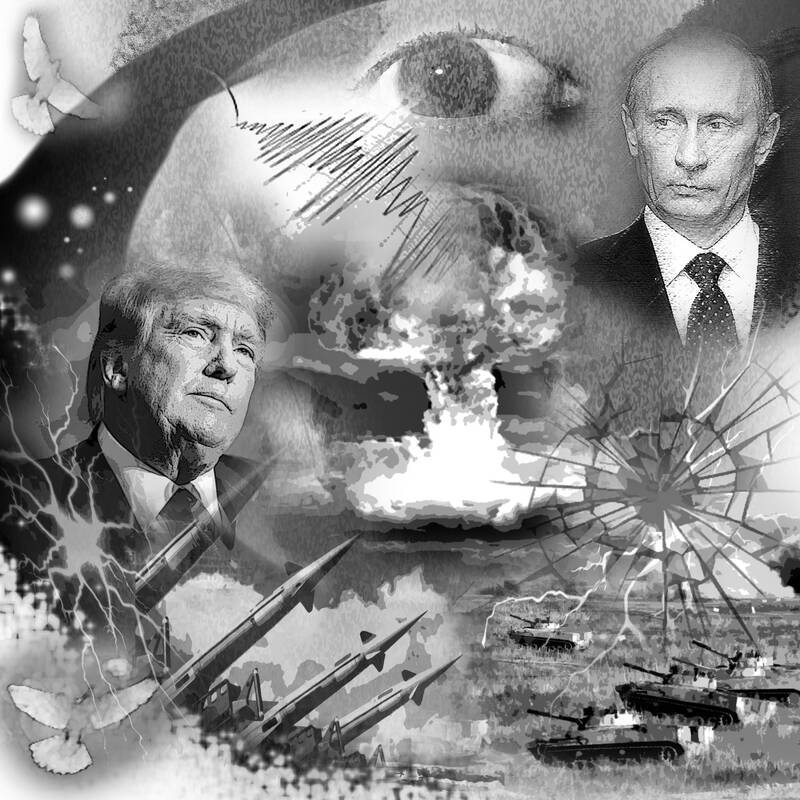
Illustration: Kevin Sheu
Although the atomic scientists who followed Oppenheimer lacked his literary sensibilities, they took world-destroying quite seriously. Teams in the US and the Soviet Union competed to build and test ever-larger bombs in a blatantly obvious effort at intimidating the other side.
The US went first, forcing the indigenous people of Bikini Atoll to relocate so that it could detonate bombs in the Marshall Islands in 1946. Radioactive debris rained down on the sailors sent to watch the tests. They absorbed dangerous doses of radiation, as did many of the native islanders living in the area, inaugurating a multigenerational legacy of cancers and birth defects.
NUCLEAR RACE
Nevada, where the US military began above-ground tests in 1951, was no better. There, too, the federal government confiscated land owned by indigenous peoples and placed soldiers far too close to the detonation sites. In subsequent decades, their bodies would be plagued by cancers and other maladies born of their fateful exposure.
Back in the Marshall Islands, the US began testing a new generation of nuclear weapons that used conventional fission bombs to detonate a much larger, “fusion,” or hydrogen bomb. These experiments went terribly awry during the infamous Castle Bravo test of 1954.
The bomb in question was supposed to generate the equivalent of 5 to 6 megatonnes of TNT. However, hanks to some serious miscalculations, the explosion clocked in at 15 megatonnes, or 1,000 times the size of the bomb dropped on Hiroshima, Japan. The explosion sucked up 10 million tonnes of sand and pulverized coral, creating a massive fallout cloud that fell on islanders, US military personnel and even Japanese fishing vessels 129km east of the test site.
This was what historian Alex Wellerstein has described as “the greatest single radiological disaster in American history.” It also holds the record of being the biggest nuclear test ever conducted by the US. It might have remained the biggest test ever had it not been for the Soviet Union.
After World War II, the communist nation worked desperately to build and test its own bomb, terrified of what might happen if it failed. Indeed, a Russian nuclear scientist who attended the Bikini test in 1946 claimed that the purpose of the demonstration had been “to frighten the Soviets.”
Thanks to atomic spy Klaus Fuchs, the Soviets managed to detonate their first atomic weapon in 1949. Still, they spent much of the next decade playing catch-up, countering progressively larger tests with their own demonstrations. Former Soviet premier Nikita Khrushchev, eager to pull ahead, approved a top-secret project to build the biggest nuclear weapon in human history. It was known as “Kuzma’s mother,” an allusion to a Russian idiom that basically means: “We’ll show you.”
When completed in 1961, “Kuzma’s mother” — also known as the Tsar Bomba or the “King of Bombs” — was the size of a school bus and weighed 25 tonnes. It was too big to fit into any of the Soviet bomber aircraft, so the military removed the bomb bay doors on a Tupolev TU-95 and strapped it to the bottom of the plane.
MASSIVE BLAST
On Oct. 31, 1961, the TU-95 left a Russian airfield bound for Novaya Zemlya, a collection of islands above the Arctic Circle; a separate plane containing a film crew accompanied it. They departed not knowing if they would return home: Authorities had given the planes a 50/50 chance of surviving the shock wave.
When they reached the target location, the bomber dropped its lethal package. The bomb, fitted with a parachute to slow its descent and give the planes time to escape, floated downward until it reached 4,000m before exploding.
The blast, which could be seen more than 1,000km away, registered at 57 megatonnes, 10 times more powerful than all the bombs and ordnance used in World War II. Had any human been within 100km of the epicenter (there were not any), they would have been immediately vaporized or have sustained third-degree burns. The shock wave shattered windows 901km away.
The test inflamed Cold War tensions, and a year later, the world came dangerously close to complete annihilation during the Cuban Missile Crisis. In its wake, saner heads began to prevail, and the US and Soviet Union signed the Partial Nuclear Test Ban Treaty in 1963, which moved nuclear testing underground, where it became less of a provocation. A complete test ban followed 30 years later, aided by that computer modeling has effectively made nuclear testing obsolete.
Trump and Putin now seem inclined to take us back to the bad old days of nuclear testing out of some misguided belief that it is an effective way to assert dominance over adversaries. History already shows how that story ends.
Stephen Mihm, a professor of history at the University of Georgia, is coauthor of Crisis Economics: A Crash Course in the Future of Finance.
No comments yet.
1 This Month

of the week – Shut Down Drone Warfare!


Tell the Ukrainian Government to Drop Prosecution of Peace Activist Yurii Sheliazhenko

Petition to revoke the licensing of the Near Surface Nuclear Disposal Facility (NSDF) at Chalk River. https://www.ourcommons.ca/petitions/en/Petition/Details?Petition=e-7247
To see nuclear-related stories in greater depth and intensity – go to https://nuclearinformation.wordpress.com
-
Archives
- April 2026 (114)
- March 2026 (251)
- February 2026 (268)
- January 2026 (308)
- December 2025 (358)
- November 2025 (359)
- October 2025 (376)
- September 2025 (257)
- August 2025 (319)
- July 2025 (230)
- June 2025 (348)
- May 2025 (261)
-
Categories
- 1
- 1 NUCLEAR ISSUES
- business and costs
- climate change
- culture and arts
- ENERGY
- environment
- health
- history
- indigenous issues
- Legal
- marketing of nuclear
- media
- opposition to nuclear
- PERSONAL STORIES
- politics
- politics international
- Religion and ethics
- safety
- secrets,lies and civil liberties
- spinbuster
- technology
- Uranium
- wastes
- weapons and war
- Women
- 2 WORLD
- ACTION
- AFRICA
- Atrocities
- AUSTRALIA
- Christina's notes
- Christina's themes
- culture and arts
- Events
- Fuk 2022
- Fuk 2023
- Fukushima 2017
- Fukushima 2018
- fukushima 2019
- Fukushima 2020
- Fukushima 2021
- general
- global warming
- Humour (God we need it)
- Nuclear
- RARE EARTHS
- Reference
- resources – print
- Resources -audiovicual
- Weekly Newsletter
- World
- World Nuclear
- YouTube
-
RSS
Entries RSS
Comments RSS
 nuclear-news
Leave a comment