The remnants of Chernobyl are still present in the Black Sea
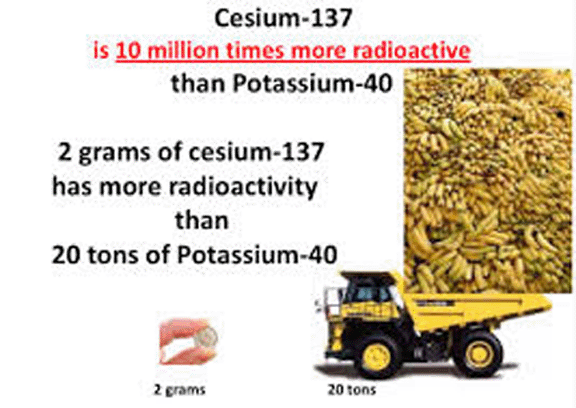
Forty years have passed since Chernobyl, but Chernobyl-related radioactive contamination in the Black Sea has not ended. TENMAK’s research has revealed that the concentration of caesium-137 in the Black Sea is seven times higher than in the Mediterranean Sea.
BirGün Daily, Giriş: 07.11.2025 , https://www.birgun.net/haber/the-remnants-of-chernobyl-are-still-present-in-the-black-sea-667018
Nearly 40 years have passed since the Chernobyl disaster, considered one of the world’s three largest nuclear accidents, but the radioactive contamination caused by the accident continues to affect the Black Sea. At the IVth National Symposium on Monitoring and Assessment in the Seas, Dr Aysun Kılınçarslan, presenting on behalf of the Turkish Energy, Nuclear and Mining Research Institute (TENMAK), announced the results of monitoring studies on radioactive contamination in Turkey’s coastal waters and sediments.
Analyses conducted in coastal sediments between 2015 and 2023 detected high levels of caesium-137 and strontium-90. While an average of 21 becquerels of caesium-137 isotope per kilogram was observed in the Black Sea, this rate was recorded as only 3.2 becquerels in the Mediterranean Sea. Values that are relatively high in the Sea of Marmara decrease as one moves towards the Aegean and Mediterranean Seas. The highest value found in the analyses exceeds 82 becquerels. This figure is 10 times higher than the highest value observed in the Mediterranean Sea. When viewed on a regional basis, the highest caesium-137 value in sediments, 50 becquerels, was found in Hopa. Hopa is followed by Trabzon and Sinop.
HIGH FIGURES IN TRABZON AND HOPA
In measurements taken in coastal surface waters between 2014 and 2023, the caesium-137 concentration averaged 9 millibecquerels per litre in the Black Sea, while this figure dropped to 1.6 millibecquerels in the Mediterranean Sea. Rates in the Bosphorus, Marmara and Çanakkale ranged between 8.4 and 6.9 millibecquerels, while the amount of caesium-137 in the water decreased in the Aegean Sea, falling to 1.8 millibecquerels. The highest figures were found in Trabzon and Hopa, which have been affected by Chernobyl for years and where cancer rates have increased. Tekirdağ, Ordu, Karasu and İğneada stand out as other regions with high measurements. Although the study’s findings indicate that these levels do not pose a risk to human health or environmental pollution, the significant difference between the Black Sea and the Mediterranean clearly demonstrates the consequences of Chernobyl-related contamination.
CHERNOBYL FLOWS
Another noteworthy finding of the study was the detection of plutonium-239, which does not occur naturally and is produced by nuclear reactions, alongside caesium-137. While average values do not differ between seas, the locations most affected by this contamination include Erdek, the Bosphorus Strait, Hopa, and Sinop. Experts point out that the sources of contamination linked to these isotopes are nuclear power plant accidents, nuclear weapons tests, and operational nuclear reactors. Chernobyl is also cited as a source of contamination in the Black Sea. Radioactive pollution from the out-of-control melted reactor and the surrounding area reaches the Black Sea via groundwater and the Dnieper River.
MARINE ASSESSMENT IS NECESSARY
Prof. Dr. İnci Gökmen, who revealed high levels of radiation in tea after Chernobyl, points out that the radiation level detected at 21 becquerels per kilogram is quite high. Gökmen states that data collected from the seas and coasts also highlights the need to measure radiation levels in the soil, adding, “It is surprising to see plutonium in the seas, even at low levels. Strontium is not surprising. However, since strontium does not emit gamma radiation and must be measured by chemical separation, measurements were rarely taken despite the presence of strontium in the environment and food after Chernobyl. However, the strontium values immediately after the accident can be estimated from the current results. By looking at the caesium levels in coastal surface water in some areas, it would be good to calculate the doses that swimmers or those working at sea, such as fishermen, would receive. It would be appropriate to take measurements in fish, mussels and other seafood. Thirty-nine years have passed since Chernobyl. Caesium has only undergone one half-life. This means that radioactive elements will remain in the seas for a long time to come,” he said. WHAT IS CAESIUM (CS-137)?
The most common radioactive form of caesium is Cs-137. Caesium-137 is produced by nuclear reactions. External exposure to Cs-137 can cause burns, acute radiation sickness and even death. Exposure to large amounts of Cs-137 can result from the misuse of a powerful industrial Cs-137 source, a nuclear explosion, or a major nuclear accident. Under normal conditions, large amounts of Cs-137 are not found in the environment. Exposure to Cs-137 can increase the risk of cancer due to the presence of high-energy gamma radiation. Ingestion or inhalation of Cs-137 increases the risk of cancer by causing the radioactive material to spread to soft tissues, particularly muscle tissue. Vascular plants do not accumulate high levels of caesium through root uptake because caesium is strongly adsorbed to the soil. However, the accumulation of radioactive residues on flora with large surface areas, such as lichens or mosses, is significant. Animals that feed on these plants can consume large amounts of radiocaesium (and other radionuclides present in radioactive fallout). Human consumption of the meat of such animals leads to the uptake of these radionuclides into the body.
Note: This article is translated from the original article titled Çernobil’in izleri hâlâ Karadeniz’de, published in BirGün newspaper on November 7, 2025.
Poseidon: The Ultimate Weapon of Vengeance [i]

“To wipe out the enemy coast…”
Very long article, with excellent illustrations.
Black Mountain Analysis Mike Mihajlovic, Nov 10, 2025
A weapon system on its own
The Poseidon, designated 2M39 in Russian service and known to NATO as Kanyon, is among the most enigmatic and controversial strategic systems developed in recent years. It resists conventional classification: neither a conventional torpedo nor a crewed submarine, it represents a novel class of autonomous, nuclear-powered underwater vehicle designed to carry a nuclear warhead.
This autonomous, nuclear-powered underwater vehicle, formerly designated Status-6, has been described in open sources as capable of carrying a very large thermonuclear warhead (some reports even cite yields as high as 100 megatons)1 and of transiting intercontinental distances at depths that would place it beyond the reach of most conventional antisubmarine weapons, arguably leaving only exceptionally large-yield nuclear depth charges as a theoretical counter. Open reporting also suggests it can adopt multiple mission modes: a high-speed transit phase at depth, which offers rapid repositioning but is more readily detectable by advanced acoustic sensors, and a prolonged low-speed, low-observability cruise that exploits nuclear endurance to remain submerged for effectively indefinite periods before conducting a final approach to a target.
As with many novel Russian weapons, most technical details remain classified; nevertheless, a synthesis of open-source analysis and official Russian statements permits a broad—albeit uncertain—reconstruction of Poseidon’s design philosophy, capabilities, and potential strategic effects.
………………………………………………………………………………………………………………………………………………………………………………………………………………... Summary
In summary, the Poseidon system represents a technically feasible but strategically extreme extension of known nuclear and naval technologies. It most likely uses a compact liquid-metal-cooled fast reactor to achieve long-range, high-speed operation at great depths, carries a warhead of 2-100 Mt, and could inflict catastrophic local damage and contamination on any coastal target. Yet the notion that it could raise ocean-wide radioactive tsunamis is unsupported by physical science. Its true significance may lie less in its physics than in its symbolism: a weapon designed to project the image of ultimate deterrence by threatening entire coastal societies, even if the practical mechanics of such annihilation are more limited than popular imagination suggests.
Politically, the deployment of Poseidon adds a new dimension to strategic deterrence. Its autonomous nature and perceived “doomsday” capability suggest a weapon intended more for psychological and geopolitical signaling than for practical battlefield use. Its mere existence challenges traditional arms control frameworks and complicates stability calculations by introducing a new underwater axis of nuclear deterrence.
Despite the growing public literature, many details remain unknowable. The reactor’s design, actual performance, warhead configuration, and even deployment status are tightly held secrets. Modeling the hydrodynamics of a multi-megaton underwater detonation is inherently uncertain, as no full-scale tests have ever been conducted at such yields or depths. Extrapolations from smaller historical tests provide useful guidance but cannot capture all nonlinear effects of deep-water bubble dynamics or coastal interactions. Moreover, the strategic intent behind Poseidon, whether as a second-strike deterrent, a terror weapon, or an anti-access denial system, remains speculative and politically sensitive. https://bmanalysis.substack.com/p/poseidon-the-ultimate-weapon-of-vengeance?utm_source=post-email-title&publication_id=1105422&post_id=177880124&utm_campaign=email-post-title&isFreemail=true&r=1ise1&triedRedirect=true&utm_medium=email
Rich countries have lost enthusiasm for tackling climate crisis, says Cop30 chief.

Guardian 10th Nov 2025
Brazil’s André Corrêa do Lago says countries should follow China’s lead on clean energy as conference begins
Rich countries have lost enthusiasm for combating the climate crisis while China is surging ahead in producing and using clean energy equipment, the president of the UN climate talks has said.
More countries should follow China’s lead instead of complaining about being outcompeted, said André Corrêa do Lago, the Brazilian diplomat in charge of the Cop30 conference, which begins on Monday.
“Somehow the reduction in enthusiasm of the global north is showing that the global south is moving,” Corrêa do Lago told reporters in Belém, the city in the Amazonian rainforest where the fortnight-long Cop30 conference is taking place. “It is not just this year, it has been moving for years, but it did not have the exposure that it has now.”
He pointed to the world’s biggest emitter of greenhouse gases, China, which is also the biggest producer and consumer of low-carbon energy. “China is coming up with solutions that are for everyone, not just China,” he said. “Solar panels are cheaper, they’re so competitive [compared with fossil fuel energy] that they are everywhere now. If you’re thinking of climate change, this is good.”…………………………………………………………………………………………………………………………………………… https://www.theguardian.com/environment/2025/nov/10/rich-countries-have-lost-enthusiasm-for-tackling-climate-crisis-says-cop30-chief
Russia deliberately ‘endangering nuclear safety in Europe’ says Kyiv
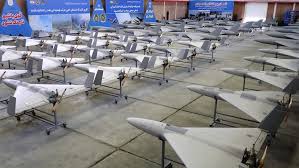
Ukraine says drones are targeting substations that power the Khmelnytskyi and Rivne nuclear plants. What we know on day 1,355
Guardian staff and agencies, 9 Nov 25
- Russia is again targeting substations that power the Khmelnytskyi and Rivne nuclear power plants in Ukraine, the country’s foreign minister Andrii Sybiha said on X on Saturday. Sybiha said drone attacks on the weekend were not accidental but well-planned strikes. “Russia is deliberately endangering nuclear safety in Europe,” he said.
- Russia launched a barrage of drones and missiles at Ukraine over the weekend, killing at least seven people and damaging energy infrastructure in three regions, according to Ukrainian officials. Ukraine’s president, Volodymyr Zelenskyy, said Russia had launched more than 450 drones and 45 missiles, most of which were shot down. Three people were killed and 12 wounded when a drone hit an apartment building in Dnipro, and another person was killed in the Kharkiv region. Three were killed in the south-eastern Zaporizhzhia region, regional officials said. https://www.theguardian.com/world/2025/nov/09/ukraine-war-briefing-russia-deliberately-endangering-nuclear-safety-in-europe-says-kyiv
Labour’s ‘national security threat’ attacks on Scottish National Party are hypocrisy 101
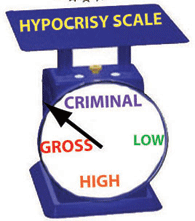
TO no one’s surprise, Anas Sarwar has lined up behind his UK bosses and doubled-down on claims that the Scottish Government is a “national security threat”. The Scottish Labour leader has meekly joined Defence Secretary John Healey, Deputy Prime Minister David Lammy, and Scottish
Secretary Douglas Alexander in deploying the inflammatory rhetoric against the SNP Government.
National security expert Professor Nick Ritchie pointed
out last week, Labour’s pro-nuclear rhetoric also undermines the international law that they are supposedly signed up to. The UK is a signatory to the nuclear Non-Proliferation Treaty (NPT), which obliges Britain to “pursue negotiations in good faith on effective measures” relating to nuclear disarmament.
But instead of uphold their obligations – which many top experts believe they are breaching – Labour ministers
are on the airwaves accusing the SNP of being a security threat for opposing nuclear weaponry.
The National 10th Nov 2025, https://www.thenational.scot/news/25611206.labours-national-security-threat-attacks-snp-hypocrisy-101/
Does Britain really need nuclear power? – Campaign for Nuclear Disarmament
, https://labouroutlook.org/2025/11/10/does-britain-really-need-nuclear-power-campaign-for-nuclear-disarmament/
With funding confirmed for a new nuclear power station in Suffolk, Dr Ian Fairlie, CND Vice-President and science adviser, and a leading consultant on radioactivity in the environment, questions whether we actually need this development and the technology in general.
In recent months, the government has continued to promote nuclear reactors. For example, the Energy Secretary is now asking GB Energy to assess sites to be used to host new nuclear reactors. And the Prime Minister continues to push for so-called Small Modular Reactors and has backed the US President’s wishful thinking of ‘a golden age of nuclear’.
But these announcements and proposals are mostly pie-in-the-sky statements and should be treated with a pinch (or more) of salt, as the reality is otherwise.
Let’s look at what is happening in the rest of the world. Last year, a record 582 GW of renewable energy generation capacity was added to the world’s supplies: almost no new nuclear was added.
Indeed, each year, new renewables add about 200 times more global electricity than new nuclear does.
Of course, there are powerful economic arguments for this. The main one is that the marginal (i.e. fuel) costs of renewable energy are close to zero, whereas nuclear fuel is extremely expensive. Nuclear costs – for both construction and generation – are very high and rising, and long delays are the norm. For example, the proposed Sizewell C nuclear station is now predicted to cost £47 billion, with the government and independent experts acknowledging even this estimate may rise significantly. The upshot is that new nuclear power means massive costs, a poisoned legacy to future generations, and whopping radioactive pollution.
iven these manifest disadvantages, independent commentators have questioned the government’s seeming obsession with nuclear power. It is not that nuclear provides a good solution to global warming: it doesn’t. The United Nations’ Intergovernmental Panel on Climate Change (IPCC) reports that renewables are now 10 times more efficient than new nuclear at CO2 mitigation. It’s not that AI centres will need nuclear: the International Energy Agency expects data centres will cause a mere 10% of global electricity demand growth to 2030. And it forecasts that the renewables will supply 10 to 20 times the electricity required for data-centre growth, with Bloomberg NEF predicting a 100-fold renewables expansion.
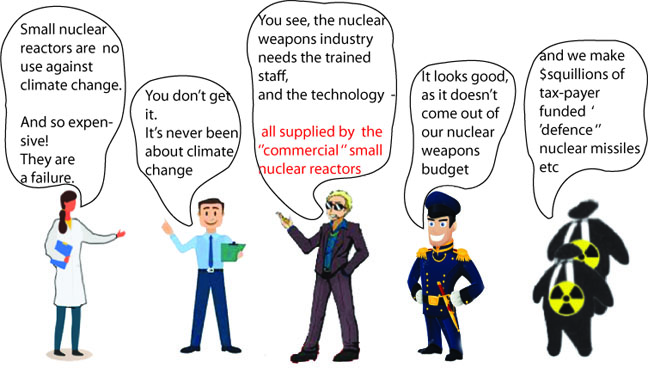
As for so-called Small Modular Reactors, the inconvenient truth is that these designs are all just paper designs and are a long way off. They would also be more expensive to run than large reactors per kWh – the key parameter. And as the former Chair of the US government’s Nuclear Regulatory Commission (NRC) says, SMRs will produce more chemical and radioactive waste per KW produced than large reactors.
Given a UK Treasury strapped for cash, the unsolved problem of radioactive nuclear waste, the spectre of nuclear proliferation, and it’s being a target in future wars, many wonder why the government is so fixated with nuclear power.
Well, the answer was supplied in 2023 by the Rishi Sunak administration which admitted that the main reason for its continued eye-watering financial support for civil reactors was that they provided needed technical support and expertise for the government’s nuclear weapons programme.
Zelensky blames ex-energy chief for failure to protect power grid.
Volodymyr Kudrytsky has been charged with large-scale fraud and abuse of office but anti-corruption campaigners say he is being targeted for speaking out
President Zelensky has blamed the former head of the Ukrainian state energy company for the extraordinary damage being done to the country’s power grid. Although Russia is responsible for attacks on the grid, there is growing anger among Ukrainians that the authorities in Kyiv have failed
to properly protect national infrastructure.
Large sections of Kyiv, Kharkiv and other big cities lost power on Saturday after one of the heaviest missile and drone assaults of the war, which killed 11 civilians and injured more than 40. In a single night, President Putin’s forces
launched 458 long-range drones and 45 missiles, battering critical infrastructure across the country.
Kyiv was without power again on Sunday
night. Centrenergo, one of the biggest energy suppliers, said that four of its main power stations were unable to produce electricity as they had all been struck by Russian ballistic missiles and drones. The power stations had only recently been repaired after strikes in 2024. Volodymyr Kudrytsky
has been charged with large-scale fraud and abuse of office but anti-corruption campaigners say he is being targeted for speaking out.
Times 9th Nov 2025, https://www.thetimes.com/world/russia-ukraine-war/article/zelensky-blames-ex-energy-chief-for-failure-to-protect-power-grid-db3g335l9
Rosyth councillor doesn’t want Trident submarines at yard
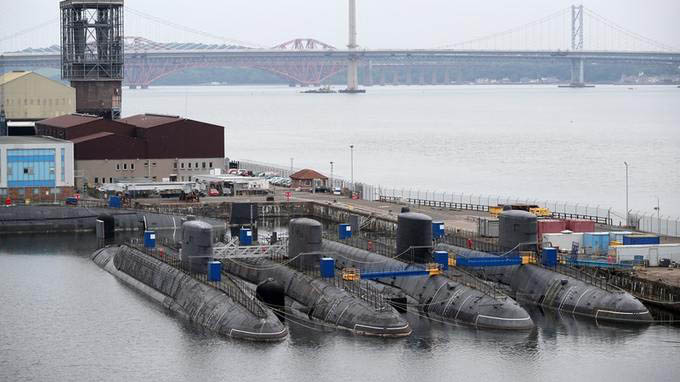
10th November, By Ally McRoberts, Herald Scotland
Iodine tablets to counteract the effects of radiation would need to be given to “half the population of Rosyth” if proposals to bring more nuclear subs to the dockyard go ahead.
That’s the fear of local SNP councillor Brian Goodall who said the emergency planning measures that would be needed was an issue of “great public concern”.
The next generation of Trident submarines is the Dreadnought class and, in September, Babcock bosses said that a £340 million investment from the UK Government would help pay for a contingent dock for the boats to come into Rosyth.
There are already seven decommissioned nuclear subs being cut up at Rosyth and the defence firm are due to give an update on the dismantling project to councillors at next month’s South and West Fife area committee meeting.
At this week’s meeting Cllr Goodall said: “I am hopeful that we can make a request to Babcock and the Ministry of Defence that they include in that update some more information about the proposal to use Rosyth as a contingent docking base for the Trident submarines.
“Apparently the MoD has decided it is the only suitable venue other than Faslane.”
He said he first heard of the proposal at a recent Rosyth Dockyard Local Liaison Committee meeting and added: “They did say that one of the issues, if it was to go ahead, the emergency planning would have to involve issues like arrangements to distribute iodine tablets to half the population of Rosyth, which to me means this is an issue of great public concern.
“Certainly something that should be subject to wider public consultation rather than just a decision being taken by the MoD that this is the only suitable site to do it.”
Committee convener, Cllr David Barratt, said he had attended the recent Rosyth Community Council meeting and added: “They were clear as well that there is significant community interest on this and consultation and community engagement is essential if significant changes are proposed for the use of the dockyard.
“I hope we can write to the MoD and ask that that is addressed or that they are prepared to answer questions when they attend in December.”
Iodine tablets, taken at the right time, can block the absorption of radioactive iodine by flooding the thyroid gland.
The UK Government have detailed plans for providing the tablets – potassium iodate or potassium iodide – in the event of a radiation emergency involving a release of radioactive iodine.
The possibility of bringing more subs to Rosyth was raised after the UK Government’s £340m investment in the dockyard was confirmed in September………………………………………………………….. https://www.heraldscotland.com/news/25607814.rosyth-councillor-doesnt-want-trident-submarines-yard/
EDF boss vows to speed up nuclear projects and narrow gap to Asian peers
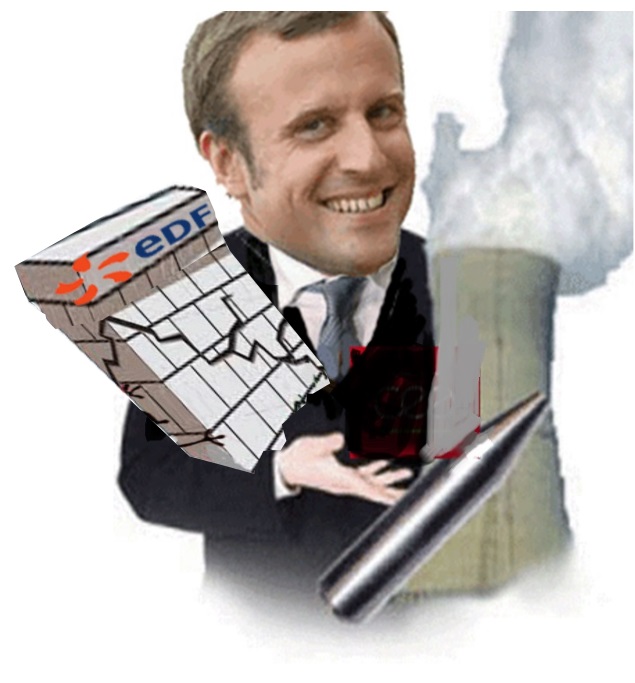
EDF’s new boss has vowed to speed up the delivery of new nuclear reactors in an increasingly competitive market, after costly overshoots in the past weighed on the French energy group.
The company wants to use the
development of the UK’s Sizewell C nuclear power station to show that huge reactors capable of powering millions of homes can be delivered at speed, in the hope that this will help it attract private funding and compete with more efficient rivals, including those from Asia.
Bernard Fontana, chief executive, said the state-owned group remained “open to international markets” and hoped to export more of its designs beyond the projects it is undertaking in the UK and France. EDF has been tasked with
delivering at least six new French reactors from 2038 onwards and is due to deliver two for the £38bn Sizewell C project in the middle to late 2030s.
Fontana’s push for efficiency comes as EDF, weighed down by a net debt of €50bn, needs to finance €30bn of investments annually over the next five years, including on maintaining current sites, according to estimates by France’s budget watchdog. EDF operates 57 French reactors.
FT 9th Nov 2025, https://www.ft.com/content/cc39da49-6ebf-40e2-bfbe-296ee2596ce9
Three firms to appear in court over Hinkley Point C death and serious injury incidents
By John Thorne ,
West Somerset Free Press, Sunday 9th November 2025
THE prosecution of two companies after a Hinkley Point C worker was seriously injured will reach its first court hearing next month.
A hearing is due in Bristol Magistrates Court on December 15 into allegations of health and safety breaches by Bouygues Travaux Publics SAS and Laing O’Rourke Delivery Ltd…………………………………
The legal proceedings have been brought after an investigation by the Office for Nuclear Regulation (ONR), the independent regulator of the UK’s nuclear industry.
An ONR spokesperson said: “The incident was a conventional health and safety matter and there was no radiological risk to the public………………………………………..
The three companies each face a similar health and safety charge and will be represented for a plea and allocation hearing before the magistrates in a prosecution brought after another investigation by the ONR. https://www.wsfp.co.uk/news/three-firms-to-appear-in-court-over-hinkley-point-c-death-and-serious-injury-incidents-849562
1 This Month


18 March Webinar @ 1 PM EST: An Assessment of SMR Projects: The Case of Canada
register for the zoom:
https://us02web.zoom.us/webinar/register/WN_o8BIIOUvQ2ONJR1nta65DQ#/registration


of the week – STOP SMALL MODULAR REACTORS IN CANADA
To see nuclear-related stories in greater depth and intensity – go to https://nuclearinformation.wordpress.com
-
Archives
- March 2026 (129)
- February 2026 (268)
- January 2026 (308)
- December 2025 (358)
- November 2025 (359)
- October 2025 (376)
- September 2025 (258)
- August 2025 (319)
- July 2025 (230)
- June 2025 (348)
- May 2025 (261)
- April 2025 (305)
-
Categories
- 1
- 1 NUCLEAR ISSUES
- business and costs
- climate change
- culture and arts
- ENERGY
- environment
- health
- history
- indigenous issues
- Legal
- marketing of nuclear
- media
- opposition to nuclear
- PERSONAL STORIES
- politics
- politics international
- Religion and ethics
- safety
- secrets,lies and civil liberties
- spinbuster
- technology
- Uranium
- wastes
- weapons and war
- Women
- 2 WORLD
- ACTION
- AFRICA
- Atrocities
- AUSTRALIA
- Christina's notes
- Christina's themes
- culture and arts
- Events
- Fuk 2022
- Fuk 2023
- Fukushima 2017
- Fukushima 2018
- fukushima 2019
- Fukushima 2020
- Fukushima 2021
- general
- global warming
- Humour (God we need it)
- Nuclear
- RARE EARTHS
- Reference
- resources – print
- Resources -audiovicual
- Weekly Newsletter
- World
- World Nuclear
- YouTube
-
RSS
Entries RSS
Comments RSS
 nuclear-news