Destroying Europe in order to save it: Extortion, theft, and the EU’s two disastrous choices
Strategic Culture Foundation, Joaquin Flores, November 5, 2025
Europe can postpone recognition of failure, but it cannot postpone the bill.
Europe now faces a stark choice forced by its disastrous war policy against Russia: either allow the EU to successfully move toward a centralized state over the heads of its member states, risking a mass Eurexit that may or may not succeed in reaction to that gamble, or delay the larger crisis through member states quietly accepting one of several schemes that will cripple the economy and create social strife regardless.
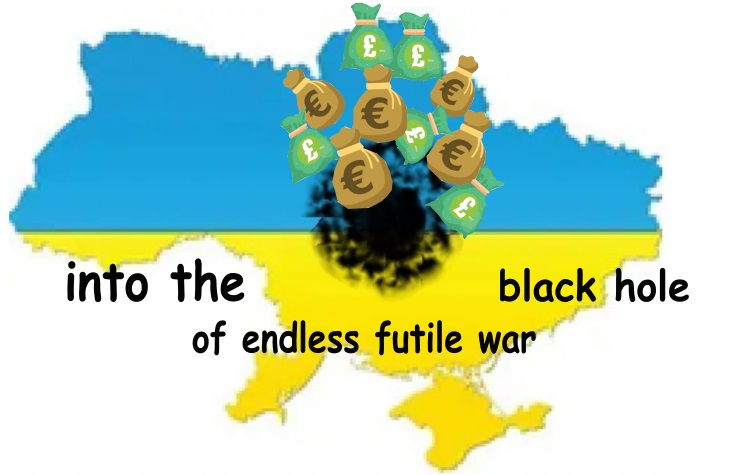
The Union must decide whether to use frozen Russian sovereign assets to finance a €140 billion “reparation” loan for Ukraine, or to issue joint debt through Eurobonds.
Both paths carry severe legal risks and impose heavy costs on citizens: one through contingent liabilities, the other through immediate taxes, austerity, and political instability. Pushing through the Eurobond option would amount to a structural coup, a radical re-engineering of the EU against its current form. A recent Politico piece framed these in terms of Option A and B, which helps to contrast these two potential ways forward.
Commission President Ursula von der Leyen’s scheme from the European Commission reveals the depths of EU tyranny in its failed gambit to defeat Russia and guarantee investment outcomes in Ukraine.
SAFE, (Security Action for Europe), a €150 billion defense loan program, was initially proposed in March by von der Leyen with the goal of stimulating rapid defense investment. By May, EU ministers had given their final approval to the program, without consulting the European Parliament, provoking a suit from the Parliament.
Whether or not the Eurobond or Russian asset-seizure (theft) scheme is being proposed in light of (perhaps) likely-to-succeed challenges to the SAFE loan program, or if the Commission is trying to actually raise a total of nearly €300 billion, remains to be seen. What is certain is the push for SAFE comes chronologically after there was significant push-back from EU member states and ministers themselves on the feasibility of spending seized/frozen Russian assets (including interest on the moneys, for war against Russia, or anything else). And the Commission push for this Eurobond scheme comes after the EU Parliament presented a suit against SAFE.
What the Eurobond scheme and SAFE both have in common, nevertheless, is the mechanism for implementation, recklessly assuming authority to do so under a radically broadened interpretation of its powers re Article 122 TFEU.
The Commission is using threats to force member states to spend the frozen Russian assets. Refuse and each government faces a political crisis. Eurobonds are deeply unpopular because the mutualized debt falls on the population, leading to the overturning of governments at the ballot-box, and imposing them unilaterally would break EU treaties, leading to an emboldened Eurexit movement. Member states are being pushed to approve the use of unlawfully seized assets, completing the illegal expropriation through their own consent.
The stakes are far higher than money. This is a coup against the EU as it was conceived, a total re-envisioning of the Union itself. Ursula von der Leyen is not merely leveraging bonds to secure Ukraine funding. She is playing a game of chicken that risks the Union’s structure………………………………
Option A: Frozen Russian assets – huge legal risk, long-term cost to citizens
Legally, tapping frozen Russian assets is precarious………………………………….
….sovereign assets normally enjoy immunity from seizure under international law and bilateral treaties, reflected in the United Nations Convention on Jurisdictional Immunities of States and Their Property (2004) and the 1989 Belgium–Russia bilateral investment treaty.…………………………………………………………………………………..
Option B: Eurobonds – unconstitutional overreach and overt social burden
Unilateral Eurobonds generally collide with the EU’s treaty architecture: the Commission cannot force the issuing of mutualized debt; joint borrowing requires unanimous backing and national ratification.
To do otherwise requires violating the EU’s treaty itself. Brussels is signaling it might act first and fight legal challenges later. …………………………………………………………………………………………………………………..
If forced, citizens face higher taxes, constrained public services, and renewed austerity. Debt obligations do not disappear with elections; social unrest could deepen inequality, provoke Euroscepticism, and trigger exit pressures. Constitutionally, this makes the Commission behave as a sovereign treasury without legitimacy.
€140 bn in debt spread across 200 million workers equals €700 per worker. At 3 % annual interest, servicing costs €21 bn/year, or €105 per worker annually over ten years. Principal plus €42 bn interest totals €182 bn, or €910 per worker. This translates into grandmothers skipping groceries, students delaying college, and curtailed public services. Trade unions, left-wing groups, and small-business forces could trigger a pan-European ‘Yellow Vests’-style crisis.
Conclusion: Evergreening, sunk costs, and Who pays
Both options are evergreening: keeping failing policies alive to avoid losses. Option A buries legal risk and hands latent liabilities to future citizens; Option B openly burdens taxpayers and risks constitutional rupture. And even worse, both scenarios ignore the chronic economic hazard to Europe if it continues its course of sanctions on Russian energy, which could make it the least competitive economy in the developed world.
In both options, the EU is pouring billions either directly into Ukraine or into arms to supply it yet the war is almost certainly lost and the billions spent on expected returns from reconstruction of Russian-liberated territories will never be recovered, turning these investments into sunk costs that serve only to prolong the illusion of economic coherence.
Europe suffers a paradigm problem and an existential crisis at the level of its ‘Eurocracy.’ Paradoxically, the policies that are politically hardest to enact at this bureaucratic level are also the most necessary and potentially fruitful. Since the EU proposes to embark upon a radical reconstruction of the Union itself, perhaps it is appropriate to presume something as radical, but in the direction of stability, growth, and peace: 1) reversing its war-footing; 2) rapprochement with Russia along the U.S.-Russia model; 3) restoring energy pipelines like Nord Stream 2; 4) recognizing Ukraine as Russia’s legitimate sphere of influence; 5) joint investment with Russia in the post-Warsaw Pact sphere; 6) building on the OSCE and 1975 Helsinki Final Act framework; 7) developing a joint Eurasian economic and security architecture. This ensures stability, development, and prosperity for generations.
For Europe, this requires overcoming chronic Russophobia and eschewing Atlanticist paranoia. Europe can postpone recognition of failure, but it cannot postpone the bill. Who will be left holding it, and will there even be an EU that can pull this off? https://strategic-culture.su/news/2025/11/05/destroying-europe-in-order-to-save-it-extortion-theft-and-the-eus-two-disastrous-choices/
No comments yet.
-
Archives
- February 2026 (199)
- January 2026 (308)
- December 2025 (358)
- November 2025 (359)
- October 2025 (376)
- September 2025 (258)
- August 2025 (319)
- July 2025 (230)
- June 2025 (348)
- May 2025 (261)
- April 2025 (305)
- March 2025 (319)
-
Categories
- 1
- 1 NUCLEAR ISSUES
- business and costs
- climate change
- culture and arts
- ENERGY
- environment
- health
- history
- indigenous issues
- Legal
- marketing of nuclear
- media
- opposition to nuclear
- PERSONAL STORIES
- politics
- politics international
- Religion and ethics
- safety
- secrets,lies and civil liberties
- spinbuster
- technology
- Uranium
- wastes
- weapons and war
- Women
- 2 WORLD
- ACTION
- AFRICA
- Atrocities
- AUSTRALIA
- Christina's notes
- Christina's themes
- culture and arts
- Events
- Fuk 2022
- Fuk 2023
- Fukushima 2017
- Fukushima 2018
- fukushima 2019
- Fukushima 2020
- Fukushima 2021
- general
- global warming
- Humour (God we need it)
- Nuclear
- RARE EARTHS
- Reference
- resources – print
- Resources -audiovicual
- Weekly Newsletter
- World
- World Nuclear
- YouTube
-
RSS
Entries RSS
Comments RSS
 nuclear-news
Leave a comment