Nuclear Tests and Their Legacy of Harms in Asia-Pacific
Far from being mere experiments, the detonations of nuclear weapons during such tests are best understood as a global catastrophe
Nuclear “tests” are best conceptualized as environmental disasters with consequences that are still felt today, particularly in Oceania and Central Asia.
By Maxime Polleri, November 05, 2025, https://thediplomat.com/2025/11/nuclear-tests-and-their-legacy-of-harms-in-asia-pacific/
Recently, U.S. President Donald Trump made headlines when he told the Pentagon to resume testing of U.S. nuclear weapons, citing his concerns that countries like China or Russia had supposedly conducted secret underground nuclear weapons tests and that the United States was falling behind. While the president’s post created much controversy around the nature of such tests, the U.S. energy secretary later explained that Trump’s planned tests would not include any actual nuclear explosions, but would encompass “system tests” to verify the state of American nuclear arsenals.
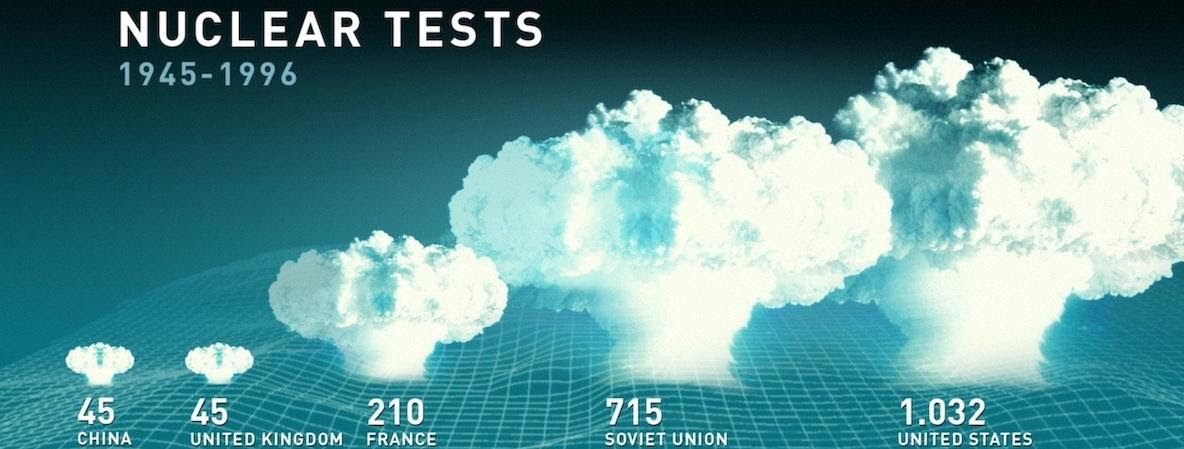
While the fact that the United States does not plan to detonate nuclear weapons is reassuring, the country, as well as China and Russia, have a long history of experimenting with real nuclear weapons to measure the performance of their devastating arsenals. Throughout the 20th century, nuclear testing has taken different forms, such as aboveground nuclear weapon tests, underwater tests, and underground tests. The 1963 Partial Test Ban Treaty prohibited atmospheric, outer space and underwater tests, while some nation states later declared moratoria on underground tests.
Nowadays, nuclear “tests” are done via computers or laboratory scale experiments and do not include actual explosions. However, understanding former nuclear experiments as “tests” is highly misleading, since each atomic and thermonuclear explosion throughout the 20th century released a tremendous quantity of long-lasting radioactive pollutants. Nuclear “tests” are best conceptualized as environmental disasters with long-lasting consequences that are still felt nowadays, particularly in Oceania, as well as Central Asia.
n the early 1950s, the United States began to test numerous nuclear weapons at the Nevada Test Site, releasing large quantities of radioactive fallout that afflicted its own population. People exposed to such fallout became known as “downwinders” and faced a plethora of health problems. Aware of the danger of bombing themselves, many nation states began to “export” nuclear testing to colonial areas, where vulnerable local populations faced the burden of contamination. Testing nuclear weapons in such locations was often a strategic choice, since many of the indigenous local population were already invisible from the public scrutiny or did not have the means to speak back to the dominant power that controlled their territories.
For instance, in March 1954, the U.S. tested a thermonuclear weapon, Castle Bravo, in the Bikini Atoll of the Marshall Islands, an archipelago in Micronesia that was turned into U.S. military bases after World War II. The nuclear fallout heavily impacted residents of the atolls, who were later forced to evacuate their beloved home. In fact, the scope of the fallout was so powerful that a Japanese fishing boat, the Daigo Fukuryū Maru, was contaminated by the test, resulting in cases of acute radiation syndrome for the fishing crew and the death of its radioman.
Much like the United States, France also conducted atmospheric and underwater tests in French Polynesia, resulting in the contamination of many atolls, like Moruroa. Nuclear tests in the Asia-Pacific region created a tremendous legacy of harms, which included the destruction of coral reefs and the death of marine ecosystems, but also forced displacements, contamination of the food chain, destruction of the social fabric, and health issues.
A similar pattern of exporting nuclear tests to vulnerable populations was also apparent in Central and East Asia. For instance, the Soviets repeatedly tested their nuclear weapons in the Semipalatinsk Test Site, a region that was historically dominated by ethnic Kazakhs. Nowadays, as anthropologist Magdalena Stawkowski highlights, Kazakhstan has inherited the remnants of one of the world’s most contaminated landscapes, dealing with contested health issues, precarious economy and marginalization.
Moreover, the People’s Republic of China has historically tested its nuclear weapons in the region of Lop Nur, leading Uyghurs, a Muslim minority ethnic group of northwestern China, to voice concerns about the long-term impact of residual radiation. In many of these instances, issues of national security – such as the health and well-being of local populations – were sacrificed for issues of international security.
Ironically, in each of these cases, humans tested nuclear weapons to prepare for a war that never came – globally contaminating ourselves in the process.
Far from being mere experiments, the detonations of nuclear weapons during such tests are best understood as a global catastrophe. And while a moratorium on nuclear testing ought to be applauded, many people are still grappling with the legacy of past nuclear tests.
The recent movie “A House of Dynamite” has brought up fresh fears of a nuclear war, as well as numerous discussions surrounding nuclear deterrence theories and mutually assured destruction. Instead of focusing our time, energy, and resources on hypothetical strikes that happen in science fiction or game theory, we should delve deeper into the poisoned heritages of the real explosions that occurred in the 20th century and prompt efforts to revitalize communities that are still suffering from its harm.
No comments yet.
1 This Month


18 March Webinar @ 1 PM EST: An Assessment of SMR Projects: The Case of Canada
register for the zoom:
https://us02web.zoom.us/webinar/register/WN_o8BIIOUvQ2ONJR1nta65DQ#/registration


of the week – STOP SMALL MODULAR REACTORS IN CANADA
To see nuclear-related stories in greater depth and intensity – go to https://nuclearinformation.wordpress.com
-
Archives
- March 2026 (141)
- February 2026 (268)
- January 2026 (308)
- December 2025 (358)
- November 2025 (359)
- October 2025 (376)
- September 2025 (258)
- August 2025 (319)
- July 2025 (230)
- June 2025 (348)
- May 2025 (261)
- April 2025 (305)
-
Categories
- 1
- 1 NUCLEAR ISSUES
- business and costs
- climate change
- culture and arts
- ENERGY
- environment
- health
- history
- indigenous issues
- Legal
- marketing of nuclear
- media
- opposition to nuclear
- PERSONAL STORIES
- politics
- politics international
- Religion and ethics
- safety
- secrets,lies and civil liberties
- spinbuster
- technology
- Uranium
- wastes
- weapons and war
- Women
- 2 WORLD
- ACTION
- AFRICA
- Atrocities
- AUSTRALIA
- Christina's notes
- Christina's themes
- culture and arts
- Events
- Fuk 2022
- Fuk 2023
- Fukushima 2017
- Fukushima 2018
- fukushima 2019
- Fukushima 2020
- Fukushima 2021
- general
- global warming
- Humour (God we need it)
- Nuclear
- RARE EARTHS
- Reference
- resources – print
- Resources -audiovicual
- Weekly Newsletter
- World
- World Nuclear
- YouTube
-
RSS
Entries RSS
Comments RSS
 nuclear-news
Leave a comment