The UK’s £1 billion Thank You to Uncle Sam

The UK is set to buy a fleet of US fighter jets that can drop nuclear bombs. The purchase is purely political, say watchdogs
RICHARD NORTON-TAYLOR, 6 November 2025, https://www.declassifieduk.org/the-uks-1-billion-thank-you-to-uncle-sam/
Keir Starmer’s plan to buy American fighter jets armed with nuclear bombs whose use will be entirely under the US president’s control makes no military sense, nuclear weapons monitors warn.
In a report released today, the Nuclear Information Service and Nukewatch UK make clear that the deal, announced by the prime minister on the eve of a Nato summit in June, is a blatant attempt to appease President Trump.
The new fleet of F-35 As is estimated to cost about £1 billion. That does not include the cost of the nuclear bombs which the aircraft would carry.
But the cost is only one of many uncertainties surrounding the project.
The decision to buy twelve F-35 A aircraft for the Royal Air Force capable of dropping US B61 gravity, “free fall” nuclear bombs – so-called “tactical” nuclear weapons – risks triggering a dangerous nuclear escalation, increasing the threat to British citizens, says the report.
And because their role would be dependent on the US, it would do nothing to address European concerns about America’s commitment to the Nato alliance, it adds.
The report says the decision “was made for purely political purposes rather than to provide a military capability that will play any meaningful role in defending Nato”. The move also undermines the nuclear non proliferation treaty (NPT).
UK picks up the tab
The nuclear bombs provided to RAF aircraft would replicate capabilities already provided by other European Nato members, says the report.
Moreover, the monitors find there is no guarantee that the weapons carried by F-35s with a limited range would succeed in any conflict.
The decision to buy the fleet of nuclear bombers from the US “reflects a long-standing trend by the UK government to prioritise trans-Atlantic politics over genuine military needs”, the report emphasises.
It quotes Bernard Gray, a former top Ministry of Defence official responsible for weapons procurement who said: “If money was no object, we could view the £2 bn price tag for doing this as a Thank You to Uncle Sam.”
Gray, who was referring to the potential price of both the planes and the bombs, added: “The UK is in effect picking up part of the cost of the mission that would otherwise fall on the US. In a world that wants to please President Trump, it’s easy to see how it plays well to buy aircraft primarily built in Texas.”
The authors of this year’s Strategic Defence Review, led by former Labour defence secretary Lord George Robertson, have downplayed the idea of Britain joining a Nato “tactical nuclear” weapons mission.
Robertson has suggested that a perceived capability gap between strategic nuclear deterrence and tactical nuclear weapons could be bridged by investing, instead, in heavy long-range conventional weapons.
His caution was echoed by Fiona Hill, British-born former national security adviser to Trump, during a Defence Committee evidence session in June.
Pointing to how Germany, Belgium, the Netherlands, Italy and Turkey host US nuclear weapons, she added: “There are other allies who already have dual capable aircraft as part of their arsenal”.
In a reference to Britain’s Trident nuclear missile system, she made the point that Britain already played a “unique role” in Nato.
Concerns over Trident reliance
But today’s report also points to potential vulnerability of Trident, Britain’s strategic nuclear weapons system which relies heavily on US support, and serious mechanical problems affecting the new Dreadnought fleet of submarines designed to carry the missiles.
The report points to widespread scepticism about the role of theatre nuclear weapons, and the misleading assumption that using them would not escalate a conflict leading to the use of longer range and larger nuclear weapons systems.
It quotes Sir Lawrence Freedman, one of Britain’s foremost military strategists, as saying: “There are lots of ways of hurting countries without actually having to use nuclear weapons yourself”.
“The idea that the further proliferation of theatre nuclear weapons is necessary or will make the world safer in any way is clearly absurd,” says the report.
“When looked at objectively, they are merely a ‘solution’ looking for a problem.”
The report also makes the point that while the theatre nuclear weapons proposed for the RAF would be entirely dependent on the US, Trident is far from being the independent deterrent as successive British governments have persistently claimed.
Britain relies entirely on the US for Trident missiles as well as the design of modern nuclear warheads.
There are also growing concerns about the reliability of Trident submarines leading with longer and longer patrols at sea, while the timetable for replacing the existing Vanguard class with Dreadnought class is slipping.
Turning back the clock
Okopi Ajonye, research manager at Nuclear Information Service told Declassified: “The UK government went to a lot of trouble to denuclearise the RAF at the end of the Cold War. This move was welcomed by the service, as it allowed the air force to focus on more important and relevant roles.
“Starmer and Healey now want to turn the clock back and commit the RAF to an entirely unnecessary nuclear mission that will have major implications for the service and considerable hidden costs.”
Ajonye added that the proposal “has all the hallmarks of having been pulled together in a hurry without any thought about its practicalities or consequences” and guided by the politics of the Nato alliance rather than military need.
“The government’s plan is basically just political smoke and mirrors to deceive the public and politicians from other Nato countries into thinking that the UK is taking a significant step to strengthen its nuclear forces when in reality it is doing next to nothing,” he said
“The UK’s entry into Nato’s nuclear mission is driven less by strategic or military necessity and more by a desire to reassure two audiences: domestic political concerns over the crumbling Trident programme, and international concerns about the credibility of US security guarantees to Europe”.
Costs add up
There are also concerns over the management of the existing F-35 fleet with a recent report by the Commons Public Accounts Committee expressing serious concerns about the MoD’s handling of the warplanes, including what it calls an unacceptable shortage of engineers.
It added: “There are also questions over the additional costs of operating nuclear-capable F-35As, and how long the necessary arrangements will take to prepare.
“The deal would add new requirements to training, personnel and possibly infrastructure yet discussions in this area are at an early stage, and no indication of forecast costs has been provided by MoD.
Sir Geoffrey Clifton-Brown, chair of the committee, commented: “Making short-term cost decisions is famously inadvisable if you’re a homeowner with a leaky roof, let alone if one is running a complex fighter jet programme – and yet such decisions have been rife in the management of the F-35.”
He added: “There are basic lessons here that MoD has been worryingly slow to learn. Its appraisal of the F-35’s whole-life cost is unrealistic, which it currently gives as at almost £57bn through to 2069.”
The message from MPs is that the total cost to British taxpayers of taxpayers of the nuclear-armed American F-35s will be significantly more than that.
Nuclear Information Service and Nukewatch UK will hold a webinar about the report and F-35 nuclear-armed aircraft on 11 November.
Trump’s 20 point plan to end the war in Gaza is the usual Israeli ultimatum: surrender or be murdered.

Eva Karene Bartlett, Nov 07, 2025, https://evakarenebartlett.substack.com/p/trumps-20-point-plan-to-end-the-war?utm_source=post-email-title&publication_id=3046064&post_id=178183468&utm_campaign=email-post-title&isFreemail=true&r=1ise1&triedRedirect=true&utm_medium=email
Given that the US is bankrolling Israel’s genocide and has made no effort whatsoever to stop Israel from bombing, starving, and sniping Palestinian civilians for the past two years, skeptics of Trump’s “20 point proposal to end the war in Gaza” published on September 29 can be forgiven for doubting that it will end the genocide, much less that it will be a just proposal for Palestinians.
Recall that earlier this year, while Israel continued its ongoing genocide of Gaza, Donald Trump callously boasted about the US desire to own Gaza.
He described Gaza as a “big real estate site” and a new “Riviera,” and said, “We’re committed to owning it, taking it, and making sure that Hamas doesn’t move back.”
Recall also that in September, Israel attempted to assassinate Hamas’ negotiating team in Qatar.
The 20 points can be read in full at this link, but it’s worth mentioning some of the most important key takeaways from the plan:
- Fighting would stop immediately and the Israeli captives would be released within 72 hours once both parties agree.
- Israel will free 250 prisoners serving life sentences along with 1,700 Palestinians from Gaza detained after 7 October [Note: Israels imprisons nearly 11,000 Palestinians (as of early August 2025), including more than 450 children and 49 women. Since October 7, 2023, Israel has abducted over 2,300 Palestinians from Gaza, including numerous doctors. From October 2023 to early August 2025, 76 prisoners have died in prison, most having been tortured. Three doctors from Gaza were tortured to death, including by raping].
Israel will withdraw and refrain from annexing the territory.- “Security” will be provided by regional and international forces, who will also help train Palestinian police, while aid will be delivered to Gaza at agreed levels. The US will oversee dialogue between Palestinians and Israelis if the Palestinian Authority (PA) implements “reforms” according to US-Israeli demands.
- Gaza will be administered by a temporary technocratic government, with oversight and supervision by a new international transitional body headed and chaired by Trump and Former Prime Minister Tony Blair, among others.
- No forced displacement from Gaza, and reconstruction of the Strip as a “de-radicalized terror-free zone” will begin.
All ‘military operations’ will be halted during this period for a phased withdrawal of Israeli forces. Hamas members who commit to ‘peace’ will be granted amnesty, while those who do not will be offered safe passage to third countries.- Hamas and other factions agree to not have any role in the governance of Gaza, directly, indirectly, or in any form.
- Aid will be delivered to Gaza at agreed levels, through the United Nations and other international institutions. [Note: In May 2025, Israel imposed the so-called Gaza Humanitarian Foundation (GHF) as a sole replacement for the UN;s aid distribution, claiming Hamas hinders the humanitarian mission of the foundation. This claim was not true and not proven.]
Unfair, unjust, unrealistic proposal
While lauded in legacy media and by Western leaders, Trump’s proposal is an insincere plan not for peace but which really amounts to a surrender ultimatum to Hamas.
Shortly after its announcement, Netanyahu said that the Israeli army will not withdraw from the Gaza Strip. “No way, that’s not happening.”
He also said, “If Hamas refuses [the proposal], Trump will give Israel full backing to complete the military operation and eliminate them.”
The US has already given Israel full backing to commit its genocide in Gaza, so in that regard Netanyahu is correct. But for any who thought he would abide by Trump’s proposal to pull out of Gaza, there was never a chance of that.
On October 3, 2025, Hamas agreed to the release of all Israeli hostages, but did not accept the proposal unconditionally, with other elements to be negotiated.
Trump responded by saying,
“After negotiations, Israel has agreed to the initial withdrawal line, which we have shown to, and shared with, Hamas. When Hamas confirms, the Ceasefire will be immediately effective, the Hostages and Prisoner Exchange will begin, and we will create the conditions for the next phase of withdrawal…”
He urged Israel to “immediately stop bombing Gaza” to allow for the safe release of hostages.
The important nuances written out of legacy media reporting on the proposal include:
- Hamas does not accept that the affairs of Gaza, as a part of Palestine, be managed by any non-Palestinian party.
- The entry of foreign forces or a foreign administration into the Gaza Strip is an issue that is not acceptable to Palestinians.
- Israel has no intention to fully withdraw from Gaza.
- Demanding the dissolution of Hamas is to deny the Palestinian people their right to political self-determination.
Further, Trump’s proposal to appoint Former Prime Minister Tony Blair to chair a board overseeing Gaza’s transition is not acceptable to Palestinians, nor to people who opposed the invasion and slaughter of Iraqis.
Enabling continued genocide and Israeli expansion
The Trump proposal doesn’t consider what Palestinians want. It speaks of peace, but in reality proposes a full surrender to an occupying power and giving control to foreign decision makers and forces. Trump and Netanyahu want Hamas to capitulate, drop their weapons, and hand over control to the US and Israel, in the name of “peace”.
In addition to the above points, it must be stressed that Israel never honours ceasefires or its word, instead violating the ceasefires immediately, resulting in the slaughter or more Palestinians (and Lebanese).
Case in point, just hours after President Trump ordered Israel to stop bombing Gaza, Israeli bombing killed a 3-month-old baby and 14 other members from her family in Gaza City, leaving 20 more people buried beneath the rubble.
Israeli bombing that day killed 70 Palestinians, the majority of them children.
The Government Media Office in Gaza reported 131 Israeli air and artillery strikes across on October 4th and 5th, killing 94 civilians. The Israeli bombing continues.
Former US Ambassador Chas Freeman in recent interview noted,
“This is a peace plan that was never discussed with the Palestinians who have to have something to say about peace. Either they benefit from peace or they don’t. There’s no benefit to them in this plan…It is the same old demands from Israel: exile yourself, leave or be killed. This is an exercise in colonial rule.”
Indeed, the proposal comes at a time when global condemnation is high of the Israeli genocide and starvation campaign in Gaza. Pitching such a proposal gives the veneer of Trump trying to stop the killing, but in reality, he gives Netanyahu carte blanche to continue killing.
Over the past month since parts of the proposal were enacted, Israel has continued violating the ceasefire with more bombing. On October 29, it was reported that Israel says it has “resumed enforcing ceasefire”. In the 24 hours prior, at the last 104 people were killed in strikes across Gaza, including at least 46 children.
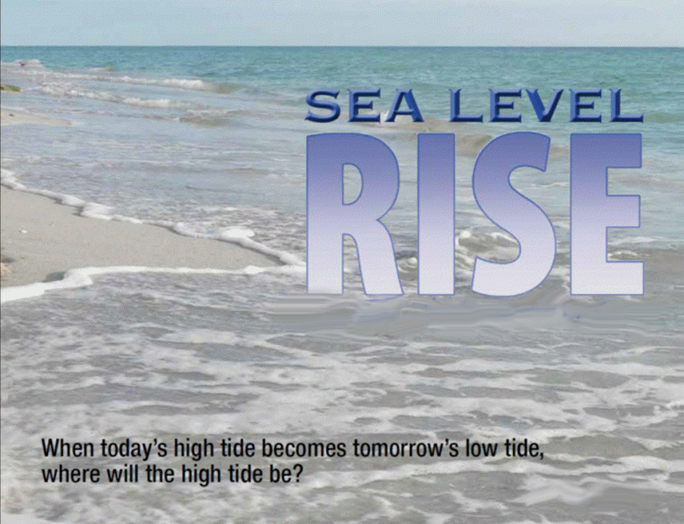
Siting new nuclear at Oldbury deemed ‘problematic’ due to high level of flood risk.
06 Nov, 2025 By Tom Pashby
Maps based on climate data show that land next to the Oldbury nuclear power station, which is being assessed by the government for potentially building small modular reactors (SMRs), is projected to be below the annual flood level by 2050.
The maps also show that land at Wylfa
in North Wales, the other site being considered by the government for
potentially deploying SMRs, will remain above water. Meanwhile, inland
areas at Sizewell C in Suffolk will also be inundated by 2050.
Paul Dorfman said, “…although these coastal flood maps are based on measured local sea surface and local sea-level rise forecasts (plus the height above sea-level of defined local flood types), since they are not based on physical storm and flood simulations, risk from actual extreme flood events may be far greater.
Dorfman added: “The more that we know about
climate-driven sea level rise-driven storm surges, which is when the high
tide meets certain atmospheric conditions, the more we’re beginning to be
deeply concerned about the siting for vulnerable infrastructure such as
nuclear power plants.”
New Civil Engineer 6th Nov 2025,
Los Alamos National Laboratory Prioritizes Plutonium “Pit” Bomb Core Production Over Safety

Santa Fe, NM – The independent Defense Nuclear Facilities Safety Board recently released its Review of the Los Alamos Plutonium Facility Documented Safety Analysis. It concluded that:
“While LANL facility personnel continue to make important upgrades to the Plutonium Facility’s safety systems, many of those projects have encountered delays due to inconsistent funding and other reasons. DOE and LANL should consider prioritizing safety-related infrastructure projects to ensure that the Plutonium Facility safety strategy adequately protects the public, as the facility takes on new and expansive national security missions.” (Page 24)
In early October 2024, the Department of Energy’s semi-autonomous National Nuclear Security Administration (NNSA) announced with great fanfare that the Los Alamos Lab had produced its first “diamond stamped” plutonium pit for the nuclear weapons stockpile. Tens of billions of taxpayers’ dollars have been sunk into LANL’s long delayed and over budget pit production program. Given no further announcements, it is not currently known whether or not the Lab is meeting its congressionally required production goals. Endemic nuclear safety problems have long been an intractable issue, at one point even forcing a three-year halt to plutonium operations at LANL’s Plutonium Facility-4 (“PF-4”).
In its recent Review, the Safety Board reported:
“The [2009] Plutonium Facility safety basis described very large potential [radioactive] dose consequences to the public following seismic events…. DOE committed to upgrade and seismically qualify the ventilation system, with a particular focus on a specific ventilation subsystem…”
“As the only facility in the DOE complex that can process large quantities of plutonium in many forms, [PF-4] represents a unique capability for the nation’s nuclear deterrent. The Board has long advocated for the use of safety-related active confinement systems in nuclear facilities for the purposes of confining radioactive materials…Passive confinement systems are not necessarily capable of containing hazardous materials with confidence because they allow a quantity of unfiltered air contaminated with radioactive material to be released from an operating nuclear facility following certain accident scenarios. Safety related active confinement ventilation systems will continue to function during an accident, thereby ensuring that radioactive material is captured by filters before it can be released into the environment… (Page 2, bolded emphases added)
The Safety Board referred to DOE Order 420.1C, Facility Safety, which has a clear requirement that:
“Hazard category 1, 2, and 3 nuclear facilities… must have the means to confine the uncontained radioactive materials to minimize their potential release in facility effluents during normal operations and during and following accidents, up to and including design basis accidents… An active confinement ventilation system [is] the preferred design approach for nuclear facilities with potential for radiological release. Alternate confinement approaches may be acceptable if a technical evaluation demonstrates that the alternate confinement approach results in very high assurance of the confinement of radioactive materials.” (Page 2, bolded emphases added; PF-4 is a Hazard Category 2 nuclear facility)
Plutonium pit production at LANL is slated for a 15% increase to $1.7 billion in FY 2026. But in a clear example of how the NNSA prioritizes nuclear weapons production over safety, the DNFSB reported:
The active confinement safety system “remained the planned safety strategy for the Plutonium Facility for many years… However, in a March 2022 letter to the Board, the NNSA Administrator stated that the planned strategy would shift away from safety class active confinement… A safety class would require substantial facility upgrades far in excess to those that are currently planned… facility personnel also noted that some projects [for alternate confinement approaches] have been paused or delayed due to funding issues…” (Pages 3 and 21, bolded emphases added)
Instead of a technical evaluation demonstrating that “the alternate confinement approach results in very high assurance of the confinement of radioactive materials,” the Board concluded:
“Predicting the amount of release under passive confinement conditions can be quite complex. Fire or explosions could add energy to the facility’s atmosphere and introduce a motive force that could carry hazardous materials through an exhaust path… Therefore, determination of the amount of radioactive material that could escape the facility becomes very complex and uncertain.” (Page 8, bolded emphases added)
In sum, DOE reneged on its commitment to retrofit a safety class confinement system at PF-4, even as it ramps up plutonium pit production. At the same time, LANL has not demonstrated that its “alternate confinement approach results in very high assurance of the confinement of radioactive materials” in the event of an accident or earthquake.
This also contradicts the NNSA’s position that potential radioactive doses are vanishingly small. For example, the agency claims that the “Most Exposed Individual” of the public would have only a one in a million chance of developing a “Latent Cancer Fatality” from an accidental fire in gloveboxes at PF-4, which commonly process molten, pyrophoric plutonium. (Draft LANL Site-Wide Environmental Impact Statement, January 2025, Page D-23)
Moreover, pit production that involves plutonium-239 is not the only nuclear safety issue. PF-4 also processes plutonium-238, a dangerous gamma emitter, as a heat source for radioisotope thermoelectric generators (AKA nuclear batteries). The Safety Board’s Review noted:
While newly installed gloveboxes meet seismic requirements, and facility modifications associated with the pit production mission prioritize upgrades for some gloveboxes, others have known seismic vulnerabilities and will not be able to perform their credited post-seismic function. Many of these deficient gloveboxes are associated with processing heat source plutonium, a high-hazard material which accounts for much of the facility’s overall safety risk… Upgrading glovebox support stands is important to return the facility to a safety posture more reliant on credited engineered features…” (Pages 22-23, bolded emphases added)
Nuclear safety issues will always be inherent to plutonium pit production, yet new pit production itself is simply not necessary. No currently planned production is to maintain the safety and reliability of the existing nuclear weapons stockpile. Instead, it is all for new-design nuclear weapons, which could prompt the U.S. to resume full-scale testing, as Trump has recently ordered. Pit production is the NNSA’s most expensive program ever, but it has no credible cost estimates. Independent experts have concluded that pits last at least a century (their average age now is ~43) and there are at least 15,000 existing pits already stored at the Pantex Plant near Amarillo, TX.
Moreover, the future of the independent Defense Nuclear Facilities Safety Board is in doubt, without whom the DOE’s chronic nuclear safety record would not be publicly known. The DNFSB’s five-member Board recently lost its quorum because of term limits. The Board desperately needs nominations from the Trump Administration, which so far has not happened either by design or neglect.
Jay Coghlan, Director of Nuclear Watch New Mexico, commented, “We are facing a perfect storm of expanding plutonium pit production and diminishing oversight by the Safety Board. LANL’s expanding nuclear weapons programs are sucking money from the Lab’s other programs that are truly needed, such as nonproliferation, cleanup and renewable energy research (which is being completely eliminated). NNSA’s prioritization of plutonium pit production for the new nuclear arms race and the erosion of nuclear safety could have disastrous results for northern New Mexico.”
The DNFSB’s Review of the Los Alamos Plutonium Facility Documented Safety Analysis is available at https://www.dnfsb.gov/sites/default/files/2025-10/Review of the Los Alamos Plutonium Facility Documented Safety Analysis %5B2026-100-001%5D.pdf https://nukewatch.org/wp-content/uploads/2025/11/LANL-Prioritizes-Plutonium-Pit-Bomb-Core-Production-Over-Safety.pdf
The $17bn nuclear start-up without any revenue

A nuclear technology company backed by Sam Altman is riding a wave of investor enthusiasm
Publicly-listed Oklo sits at the intersection of two hot areas for Wall Street: artificial intelligence and energy companies. This year alone, Oklo’s share price has jumped more than 400 per cent. But the business hasn’t generated any revenue. It hasn’t built a nuclear reactor, and it hasn’t secured any binding contracts with customers. The FT’s US energy editor Jamie Smyth explains the enthusiasm for Oklo, its links to the Trump administration and whether it can live up to the hype. company backed by Sam Altman is riding a wave of investor enthusiasm.
Clips from New York Stock Exchange, The White House, a16z – – – – – – – – – – – – – – – – – – – – – – – – – – For further reading: Inside Oklo: the $20bn nuclear start-up without any revenue US and investors gambling on unproven nuclear technology, warn experts Donald Trump’s assault on US nuclear watchdog raises safety concerns
Subscribers only –https://www.ft.com/content/d87cb0ac-b599-46b9-8a4d-9a8b55541ab2
TRANSCRIPT – Michela Tindera speaks to Jamie Smyth
Nov 5 2025 Audio transcript of podcast.
“……………………………. Jamie Smyth
Oklo’s valuation soared to more than $25bn in just 18 months, and this really caught my eye. I’ve been tracking quite a lot of these smaller nuclear companies over the last 18 months, but nothing had reacted like this.
They want to power the artificial intelligence revolution using nuclear energy, but a new type of nuclear energy, which hasn’t been in use to date in the commercial nuclear world.
Michela Tindera But here’s the thing. This high-flying start-up Oklo, it doesn’t have revenues, licenses to operate, nor does it have any contracts with customers. So what’s going on with this company? That is what Jamie and our colleagues have been digging int
Jamie Smyth Oklo has become a symbol of the AI boom and the ongoing nuclear renaissance because of the astonishing rise in the value of its shares and its close relationship with the Trump administration. How the company fares could have a big influence in whether nuclear energy powers this AI revolution.
Michela Tindera
I am Michela Tindera from The Financial Times. Today on Behind The Money, is Oklo’s promise justified, or is it just riding the wave of AI hype?
Jamie Smythe…………………………………………………………..
So Oklo started in 2013 by a couple called Jacob and Caroline DeWitte……………. back in 2013, they met Sam Altman of OpenAI fame …………………….he decides to invest in Oklo………………….He later agrees to chair the company and steer its stock market listing. Now that happens in May 2024 through a Spac or a special purpose acquisition company deal.
…………………Oklo’s share price initially. In fact, it fell on the first day of the listing. But after Donald Trump’s election, and particularly with his inauguration, he really ratcheted up the focus on energy dominance and also gave this strong support for nuclear power.
…………………….And then in May 2025, you get Oklo’s chief executive Jacob DeWitte visiting the White House and speaking in the Oval Office………….
You have Trump sitting in the Oval Office, launching several executive orders on nuclear energy pledging to quadruple capacity by 2050, and he’s invited Jacob and a couple of other CEOs of nuclear companies. You’ve got the chief executive of Constellation Energy standing there beside him, the chief executive of General Matter, an enrichment company, standing there.
……………The room is really packed full of celebrities and there’s Jacob DeWitte in amongst them all.
Jacob DeWitte audio clip………………… The physics are on our side and these things help unleash this innovation to actually realise that. So it’s never been more exciting.
Donald Trump audio clip
Very exciting indeed. Go ahead, please.
Jamie Smyth This platform to speak from the Oval Office next to Trump, I think was a huge endorsement of the company for investors. You really start to see the stock price jump from there, and then it really goes through the roof. It’s made the DeWittes paper billionaires. They own just under 18 per cent of the company, though they’ve made a large chunk of real money too by selling some of their stock. In the past six months, they’ve made about $250mn in share sales according to some Bloomberg data analysed by the FT.
……………………………….Well, I think Oklo really sits at the intersection of these two stock market booms in artificial intelligence and energy companies. The AI revolutions being driven by Nvidia, Microsoft, Amazon and other big tech giants, and this realisation that data centres, which are driving the AI technology, they’re gonna require huge amounts of electricity. So that’s why you’re seeing shares in energy companies, utilities like Constellation Energy, gas turbine makers such as GE Vernova and Siemens and other nuclear start-ups, all their shares are soaring.
………………………………. the Trump factor. The administration is spending big on nuclear.
Michela Tindera
Like Jamie mentioned earlier, the Trump administration has pledged to quadruple US nuclear capacity by 2050
Jamie Smyth It has very ambitious plans to build out 10 large-scale reactors and support this new technology that Oklo is developing. And specifically, Oklo has benefited from this. They have been offered a place on a fast-tracking programme for their nuclear reactor. They’ve also been offered a place on a fuel programme as well. And they are being given a very specialised, scarce form of fuel, which they require to run their type of reactor. So I think investors are responding to this and they’re getting very excited.
……………………………Bank of America have actually said that this support from the Trump administration is one element that gives the company an edge over its rivals. Democrats, however, have alleged that it really creates an appearance of impropriety, and they have asked a series of questions of the administration about its relationship with Oklo.
………………Oklo wants to build a new type of nuclear reactor, something called a small modular reactor or an SMR…………And what’s interesting about Oklo’s SMR is that it wants to use liquid sodium as a coolant rather than the standard of water.
……………………………Oklo would say their reactor could be safer than a water-cooled reactor in terms of a Chernobyl-style accident. It’s just not gonna happen. But there are downsides to sodium-cooled reactors. You know, the big question with these sodium-cooled reactors are, we’ve had four or five of them actually already built in the United States over the last 40 years on a test basis, but none of them have actually managed to become commercially viable, so they didn’t take off. ……………………………………….
Michela Tindera So Oklo’s plan here sounds pretty ambitious. First, they wanna build a new kind of nuclear reactor that hasn’t been sold commercially in the US before. And second, they also have this untested business model. They wanna sell the nuclear power themselves instead of offloading that to a utility company.
………………..Jamie Smyth
Oklo have a very ambitious goal of commercially beginning to sell power through their SMRs by 2027……………..
They haven’t yet built their nuclear reactor. They haven’t got a licence for their nuclear reactor. They haven’t got any revenue and they haven’t got a legally binding contract with a customer.
Michela Tindera Not any customers at all?
Jamie Smyth They don’t have legally binding par purchase agreements with customers. What they’ve got is they’ve got MOUs or memorandums of understandings. So companies have come to them and said, we’d like to talk about and draw out an outline of an agreement, but there’s no legally binding agreement yet in place. So until it can do that, I think there’ll always be a question mark over the sustainability of the company.
Michela Tindera A lot of what Oklo is pursuing is untested, the technology, but also the business model of both building the reactors and selling the power they generate. And as its market valuation source, analysts are increasingly pointing out that the company’s valuation is stretched.
The business has attracted the attention of short sellers. That’s people who bet on a stock’s price going down. Oklo’s short sellers have borrowed roughly 13 per cent of the stock. They believe that the DeWittes have underestimated the amount of time and money that’s required to commercialise their technology. One area they’ve particularly struggled with is licensing.
Jamie Smyth One of the issues to do with Oklo is, it’s one of the few companies that has had a licence application rejected by the Nuclear Regulatory Commission in the United States. That is quite a big thing.
……………………..Jamie Smyth………….And then in 2022, the NRC didn’t award the licence. So that really raises the question mark about whether Oklo was able to secure one of these licences. Oklo has strongly criticised the NRC decision to not award them a licence. They even alleged the NRC staff engaged in inappropriate behaviour for a regulator.
………………Michela Tindera In the years since, Oklo has successfully lobbied the government to streamline the NRC licensing process. Jamie Smyth So the Trump administration has set up a separate pathway for SMR developers to build test reactors on federal land under the oversight of the Department of Energy, which is run by energy secretary Wright. And beyond that, the Trump administration has piled extraordinary pressure on the NRC to approve reactors within short timeframes, much shorter than previously.
Michela Tindera But as Oklo moves forward, it’s a space that everyone will be watching closely.
Jamie Smyth I suppose one of the risks with Oklo is, if they try to move too fast, they try to race ahead with their technology and they hit a wall, then it could impact the rest of the industry. And this nuclear renaissance that we’re beginning to see could be hurt by that. Safety is of key importance in the nuclear industry. If something goes wrong, you have seen it in the past, then the whole industry suffers.
Michela Tindera So to recap, this is a company with no customers and no contracts, and . . .
Jamie Smyth At the minute the company has generated zero revenue, yet it is currently one of the highest-valued pre-revenue companies listed in the US. And that makes people nervous.
……………………………..Jamie Smyth So the thing about Oklo is, because it’s based in Silicon Valley, it takes a very Big Tech approach to how it’s gonna operate, which is very different than other nuclear companies have worked in the past. You know, move fast and break things is the motto in Silicon Valley.
……………………………………………………………………………Jamie Smyth I think what investors probably want to see is they need to see delivery now. They need to see progress on a licence with the Nuclear Regulatory Commission. Oklo says they’re working towards that, but they also need to see some contracts which are going to bring in some revenue, and most importantly of all, they need to see that these reactors are going to work and that they’re going to work on a commercial basis. ………………….. https://www.ft.com/content/3e84e4d4-bf72-44f7-8fdd-0bdf36c806f6
Nuclear Tests and Their Legacy of Harms in Asia-Pacific
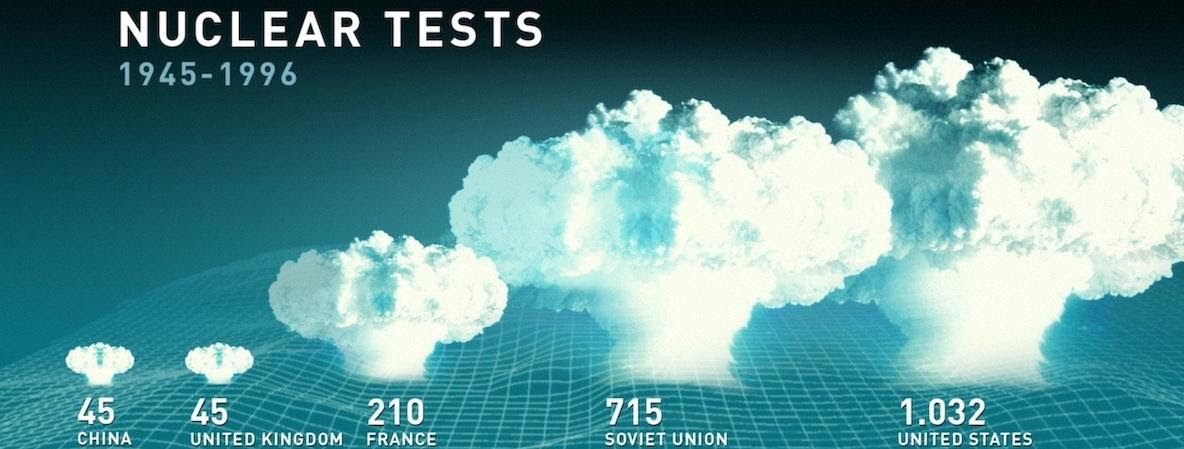
Far from being mere experiments, the detonations of nuclear weapons during such tests are best understood as a global catastrophe
Nuclear “tests” are best conceptualized as environmental disasters with consequences that are still felt today, particularly in Oceania and Central Asia.
By Maxime Polleri, November 05, 2025, https://thediplomat.com/2025/11/nuclear-tests-and-their-legacy-of-harms-in-asia-pacific/
Recently, U.S. President Donald Trump made headlines when he told the Pentagon to resume testing of U.S. nuclear weapons, citing his concerns that countries like China or Russia had supposedly conducted secret underground nuclear weapons tests and that the United States was falling behind. While the president’s post created much controversy around the nature of such tests, the U.S. energy secretary later explained that Trump’s planned tests would not include any actual nuclear explosions, but would encompass “system tests” to verify the state of American nuclear arsenals.
While the fact that the United States does not plan to detonate nuclear weapons is reassuring, the country, as well as China and Russia, have a long history of experimenting with real nuclear weapons to measure the performance of their devastating arsenals. Throughout the 20th century, nuclear testing has taken different forms, such as aboveground nuclear weapon tests, underwater tests, and underground tests. The 1963 Partial Test Ban Treaty prohibited atmospheric, outer space and underwater tests, while some nation states later declared moratoria on underground tests.
Nowadays, nuclear “tests” are done via computers or laboratory scale experiments and do not include actual explosions. However, understanding former nuclear experiments as “tests” is highly misleading, since each atomic and thermonuclear explosion throughout the 20th century released a tremendous quantity of long-lasting radioactive pollutants. Nuclear “tests” are best conceptualized as environmental disasters with long-lasting consequences that are still felt nowadays, particularly in Oceania, as well as Central Asia.
n the early 1950s, the United States began to test numerous nuclear weapons at the Nevada Test Site, releasing large quantities of radioactive fallout that afflicted its own population. People exposed to such fallout became known as “downwinders” and faced a plethora of health problems. Aware of the danger of bombing themselves, many nation states began to “export” nuclear testing to colonial areas, where vulnerable local populations faced the burden of contamination. Testing nuclear weapons in such locations was often a strategic choice, since many of the indigenous local population were already invisible from the public scrutiny or did not have the means to speak back to the dominant power that controlled their territories.
For instance, in March 1954, the U.S. tested a thermonuclear weapon, Castle Bravo, in the Bikini Atoll of the Marshall Islands, an archipelago in Micronesia that was turned into U.S. military bases after World War II. The nuclear fallout heavily impacted residents of the atolls, who were later forced to evacuate their beloved home. In fact, the scope of the fallout was so powerful that a Japanese fishing boat, the Daigo Fukuryū Maru, was contaminated by the test, resulting in cases of acute radiation syndrome for the fishing crew and the death of its radioman.
Much like the United States, France also conducted atmospheric and underwater tests in French Polynesia, resulting in the contamination of many atolls, like Moruroa. Nuclear tests in the Asia-Pacific region created a tremendous legacy of harms, which included the destruction of coral reefs and the death of marine ecosystems, but also forced displacements, contamination of the food chain, destruction of the social fabric, and health issues.
A similar pattern of exporting nuclear tests to vulnerable populations was also apparent in Central and East Asia. For instance, the Soviets repeatedly tested their nuclear weapons in the Semipalatinsk Test Site, a region that was historically dominated by ethnic Kazakhs. Nowadays, as anthropologist Magdalena Stawkowski highlights, Kazakhstan has inherited the remnants of one of the world’s most contaminated landscapes, dealing with contested health issues, precarious economy and marginalization.
Moreover, the People’s Republic of China has historically tested its nuclear weapons in the region of Lop Nur, leading Uyghurs, a Muslim minority ethnic group of northwestern China, to voice concerns about the long-term impact of residual radiation. In many of these instances, issues of national security – such as the health and well-being of local populations – were sacrificed for issues of international security.
Ironically, in each of these cases, humans tested nuclear weapons to prepare for a war that never came – globally contaminating ourselves in the process.
Far from being mere experiments, the detonations of nuclear weapons during such tests are best understood as a global catastrophe. And while a moratorium on nuclear testing ought to be applauded, many people are still grappling with the legacy of past nuclear tests.
The recent movie “A House of Dynamite” has brought up fresh fears of a nuclear war, as well as numerous discussions surrounding nuclear deterrence theories and mutually assured destruction. Instead of focusing our time, energy, and resources on hypothetical strikes that happen in science fiction or game theory, we should delve deeper into the poisoned heritages of the real explosions that occurred in the 20th century and prompt efforts to revitalize communities that are still suffering from its harm.
IAEA chief condemns Trump’s nuclear test plan.
5 Nov, 2025, https://www.rt.com/news/627359-iaea-grossi-us-nuclear/
The US president’s decision undermines international security, Rafael Grossi has said.
US President Donald Trump’s decision to resume nuclear weapon testing is indicative of a deepening global crisis and weakens the international system of security and peace, the director general of the International Atomic Energy Agency (IAEA), Rafael Grossi, has said.
Speaking to France’s LCI TV channel on Tuesday, Grossi described Trump’s announcement as a “manifestation of profound unease, tension, and increasing fragmentation,” adding that it undermines both global peace and the non-proliferation regime.
Last week, Trump ordered the US Department of War to begin preparations for nuclear testing, claiming that the US is “the only country that doesn’t test” and accusing Russia and China of conducting “secret” nuclear explosions. Both Moscow and Beijing have refuted the allegations.
Grossi questioned the veracity of Trump’s claims, emphasizing that any nuclear detonations by other nations would be detected by the international monitoring system established under the Comprehensive Nuclear-Test-Ban Treaty. The IAEA chief noted that the organization responsible for overseeing compliance “can immediately record such phenomena.”
Grossi called for the restoration of the United Nations’ role in maintaining global peace and safeguarding the nuclear non-proliferation system amid rising tensions.
Kremlin spokesman Dmitry Peskov has so far refrained from commenting on Trump’s statements, explaining that Moscow is still waiting for “clarifications from the American side.” He stressed that neither Russia nor China had resumed nuclear testing and both remain committed to their obligations under the Comprehensive Nuclear-Test-Ban Treaty.
Trump’s announcement came after Russia conducted a series of tests, including the launch of its new Burevestnik nuclear-powered cruise missile and the Poseidon underwater drone. However, neither of these trials involved actual nuclear detonations.
Russian President Vladimir Putin has said that Moscow would consider resuming the testing of nuclear weapons only if other nuclear powers officially abandon the moratorium.
‘Nothing revolutionary’ about Russia’s nuclear-powered missile: Experts
Putin has touted cruise missile Burevestnik and torpedo Poseidon as game-changing weapons as the war in Ukraine rages on.
Aljazeera, By Mansur Mirovalev, 5 Nov 2025
Kyiv, Ukraine – The collective West is scared of Moscow’s new, nuclear-powered cruise missile because it can reach anywhere on Earth, bypassing the most sophisticated air and missile defence systems, the Russian Ministry of Foreign Affairs has claimed.
“They’re afraid of what we’ll show to them next,” Foreign Ministry spokeswoman Maria Zakharova told the RIA Novosti news agency on Sunday.
Days earlier, she said Moscow was “forced” to develop and test the cruise missile, which is named the Burevestnik, meaning storm petrel – a type of seabird, in response to NATO’s hostility towards Russia.
“The development can be characterised as forced and takes place to maintain strategic balance,” she was quoted by the Itar-Tass news agency as saying. Russia “has to respond to NATO’s increasingly destabilising actions in the field of missile defence”.
With much pomp, Russian President Vladimir Putin on Tuesday handed state awards to Burevestnik’s developers.
Also awarded were the designers of Poseidon, an underwater nuclear-powered torpedo which Putin has also claimed has been successfully tested.
Russia says Poseidon can carry nuclear weapons that cause radioactive tsunamis, wiping out huge coastal areas. The “super torpedo” can move at the speed of 200km/h (120mph) and zigzag its way to avoid interception, it says.
“In terms of flight range, the Burevestnik … has surpassed all known missile systems in the world,” Putin said in his speech at the Kremlin. “Same as any other nuclear power, Russia is developing its nuclear potential, its strategic potential … What we are talking about now is the work announced a long time ago.”
But military and nuclear experts are sceptical about the efficiency and lethality of the new weapons.
It is not unusual for Russia to flaunt its arsenal as its onslaught in Ukraine continues. Analysts say rather than scaring its critics, Moscow’s announcements are merely a scare tactic to dissuade Western powers from supporting Kyiv.
“There’s nothing revolutionary about,” the Burevestnik, said Pavel Podvig, director of the Russian Nuclear Forces Project at the the United Nations Institute for Disarmament Research.
“It can fly long and far, and there’s some novelty about it, but there’s nothing to back [Putin’s claim] that it can absolutely change everything,” Podvig told Al Jazeera. “One can’t say that it is invincible and can triumph over everything.”
The Burevestnik’s test is part of Moscow’s media stratagem of intimidating the West when the real situation on the front lines in Ukraine is desperate, according to a former Russian diplomat.
The missile is “not a technical breakthrough but a product of propaganda and desperation”, Boris Bondarev, who quit his Russian Foreign Ministry job to protest against the 2022 full-scale invasion of Ukraine, wrote in an opinion piece published by the Moscow Times.
Few details about ‘unique’ missile
The problem is that officials have so far unveiled very little about the Burevestnik, which NATO has dubbed the SSC-X-9 Skyfall – a missile that has a nuclear reactor allegedly capable of keeping it in the air indefinitely………………………………………………………………………… https://www.aljazeera.com/news/2025/11/5/nothing-revolutionary-about-russias-nuclear-powered-missile-experts
THE CORRUPTION OF COP30: DODGY CLIMATE DOSSIERS

Here we go again: the annual end-of-year COP fandango is upon us. This
particular Conference of the Parties (signatories to the original Framework
Convention on Climate Change back in 1992) happens to be in Brazil —
generally deemed to be a more sympathetic host country than its two
petrostate predecessors Azerbaijan and the United Arab Emirates.
That may
be true (although rates of deforestation in the Amazon are on the up
again), but COP30 will be just as resounding a failure (as in making not a
ha’p’orth of difference) as the 29 other COPs that have gone before it.
There are many reasons for this: geopolitical, financial, technological and
so on. But I want to look at one aspect that rarely gets mentioned: almost
every single delegate at COP30 will be focused on dodgy data – on things
like the targets set by governments through their revised Nationally
Determined Contributions, or on average temperature increases projected
through to the end of the century (1.5°C and all that jazz), or on endless
attention-grabbing voluntary initiatives about this, that or the other
technology or nature-based ‘solutions’.
Jonathon Porritt 6th Nov 2025, https://jonathonporritt.com/cop30-corruption-dodgy-climate-data/
Bpifrance helps UK nuclear reactor to financial close.
6 November 2025 By Jacob Atkins
French export credit agency Bpifrance is covering a £5bn loan from 13
commercial banks to help finance the construction of the Sizewell C nuclear
power station in England. The facility, structured as a green loan, sits
alongside a £36.5bn term loan from the UK’s National Wealth Fund, which
was announced earlier this year, as well as a £500mn working capital
facility. Bpifrance has secured refinancing from French public development
bank Sfil, according to a November 4 statement. BNP Paribas acted as joint
debt advisor to Sizewell C, with HSBC as French authorities and green loan
co-ordinator, and Santander as documentation co-ordinator on the Bpifrance
facility. The other lenders on the Bpifrance loan are ABN Amro, BBVA,
Crédit Agricole, CaixaBank, Citibank, Crédit Industriel et Commercial
(CIC), Lloyds Bank, Natwest, Natixis and Société Générale.
Global Trade Review 6th Nov 2025, https://www.gtreview.com/news/europe/bpifrance-helps-uk-nuclear-reactor-to-financial-close/
Trump’s Threat to Resume Nuclear Testing
In 1963 John Kennedy and Nikita Khrushchev signed the ban on atmospheric nuclear weapons testing, which was extended to a moratorium in 1992 and secured as the Comprehensive Test Ban Treaty in 1996. The Treaty has been signed by 187 states. On October 31st, United Nations member states voted on a resolution in support of the Treaty and the global nuclear test moratorium. The United States was the only “no” vote.
Donald Trump is now threatening to resume nuclear testing because “he believes others are doing it.” They aren’t. The threat came after Vladimir Putin announced that the Kremlin https://www.reuters.com/world/china/putin-says-russia-tested-poseidon-nuclear-capable-super-torpedo-2025-10-29/
Tied to this is the situation at Los Alamos National Laboratory, or LANL, the heart of the new trillion-dollar modernization program that will rebuild every nuclear warhead in the planned stockpile with new military capabilities and produce new-design nuclear weapons as well. LANL will fabricate plutonium pits, or triggers, for these nuclear warheads, along with the Savannah River Site in South Carolina.
A Nuclear Watch New Mexico press release stated: “The underlying point is that new-design plutonium pits for new-design nuclear weapons may create inexorable pressures for resumed nuclear weapons testing by the United States. This would be sure to set off a chain reaction of testing by other nuclear weapons powers [ ]. The final result is a dramatically accelerating nuclear arms race, arguably more dangerous than the first arms race given multiple nuclear actors, new hypersonic and cyber weapons, and the rise of artificial intelligence.” https://nukewatch.org/press-release-item/trump-orders-nuclear-weapons-testing-for-new-nuclear-arms-race-new-plutonium-pit-bomb-cores-at-los-alamos-lab-could-make-it-real/
Scottish National Party reject UK Government’s ‘nonsense’ national security threat smear
THE SNP have rejected the UK Government’s “nonsense” accusations
that they are a threat to national security. Three Cabinet ministers have
levelled the accusation against the party three times since the beginning
of the week.
Speaking in the Commons on Monday, Defence Secretary John
Healey said: “The continuation of the Scottish nationalist Government in
Scotland is a threat to our security and to future prosperity and jobs in
that country.”
Asked about those claims at a meeting of the Scottish
Affairs Committee on Wednesday, Scottish Secretary Douglas Alexander
replied: “I find myself, as usual, in agreement with the Defence
Secretary.” He pointed to the SNP’s opposition to nuclear weapons and
to its historic ban on public money being spent on weapons manufacture.
North East Green MSP Maggie Chapman said: “Trident is a moral abomination that swallows huge sums of money that we could spend instead on improving people’s lives, on tackling poverty, on funding our public services.
The Scottish Government should not be offering even more funding for
multibillion pound weapons giants who have armed and supported Israel’s
genocide against Gaza. These are not extreme statements. They are views
held by large numbers of people, including me. The military industrial
complex does not ensure our security: it lays the foundations for future
conflict and misery.”
The National 5th Nov 2025, https://www.thenational.scot/news/25599877.snp-reject-uk-governments-nonsense-national-security-threat-smear/
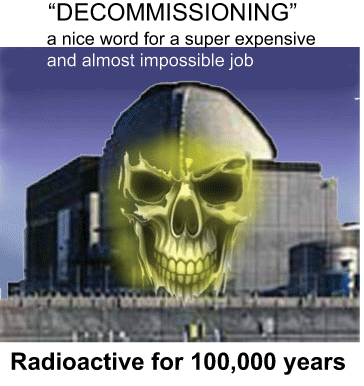
Hinkley Point B to begin 95-year decommissioning plan
Clara BullockSomerset, 5 Nov 25, https://www.bbc.com/news/articles/c986pvg41y2o
A former nuclear power station will begin its 95-year decommissioning process after regulators granted formal consent.
EDF’s Hinkley Point B, which lies on the Somerset coast near Stogursey, has been given the green light to be demolished by the Office for Nuclear Regulation (ONR).
In August 2022, Hinkley Point B reached the end of its operating life after nearly 46 years of generating electricity.
Dan Hasted, ONR director of regulation, said: “We will continue to proportionately regulate the Hinkley Point B site throughout the decommissioning phase to safeguard workers and the public.”
The nuclear site will transfer from EDF to the Nuclear Restoration Services next year, which will oversee the site’s dismantling.
Under the proposals, Hinkley Point B, which opened in 1976, could be decommissioned in three phases.
The first phase, which will last until 2038, includes the dismantling of all buildings and plant materials except for the site’s safestore structure. This facility will be used to store and manage the residential nuclear waste from the power station.
The second phase will see “a period of relative inactivity” of up to 70 years from 2039, to allow for the radioactive materials within the safestore to safely decay.
The final phase will see the former reactor and debris vaults being dismantled and removed.
Meanwhile, a new nuclear power station, Hinkley Point C, is being constructed near Hinkley B.
The iodine-129 paradox in nuclear waste management strategies
Nature, Analysis 05 November 2025, Haruko M. Wainwright, Kate Whiteaker, Hansell Gonzalez-Raymat, Miles E. Denham, Ian L. Pegg, Daniel I. Kaplan, Nikolla P. Qafoku, David Wilson, Shelly Wilson & Carol A. Eddy-Dilek Nature Sustainability (2025) https://www.nature.com/articles/s41893-025-01629-2
Abstract
Nuclear energy has an important role in the low-carbon energy transition, but the safety of spent nuclear fuel (SNF) management remains a public concern. Here we investigate the interplay between waste management strategies and their environmental impacts with a particular focus on a highly mobile and persistent radionuclide, iodine-129 (I-129), which is the dominant risk contributor from SNF disposal and at existing groundwater contamination sites.
The results show that the current recycling practice releases more than 90% of I-129 in SNF into the present-day biosphere using an isotropic dilution strategy, whereas the direct disposal of SNF in geological repositories is likely to delay and reduce the release by 8 orders of magnitude. In addition, our data synthesis of surface water concentrations near four nuclear facilities shows that the release-dilution strategy results in lower concentrations than regulatory standards, while insufficient waste isolation in the past has resulted in locally high concentrations within one site.
Our analysis suggests that it is essential to consider effluents more explicitly as a part of the waste, that as society moves from dilution to isolation of waste, the potential risks of waste isolation to local regions should be carefully evaluated, and that excessive burdens of proof could hinder or discourage waste isolation. Comprehensive waste management strategies—considering not just volume but also mobility, isolation technologies and ultimate fates—are needed for persistent contaminants. This study offers valuable insights for optimizing the management of SNF and other persistent contaminants.
Canadian government happily splashing tax-payers’ money on wasteful things nuclear
Gordon Edwards, 6 Nov 2025
A comment on https://www.msn.com/en-ph/technology/general/the-smr-boom-will-soon-go-bust/ar-AA1PJi1U
This is your ultraconservative radical, Gordon, sounding a note of caution.
The fact that our utilities are publicly owned means that ordinary economic rules need not apply.
The military brings in little or no revenue but the government still funds it.
Gentilly-2 in Quebec was a loser always, and I told reporters to ask Hydro Quebec to give just one good economic reason why the G-2 reactor should not be shut down. No economic reason was forthcoming but the government of Quebec said “we want to maintain a minimal level of expertise in the nuclear field.”
So do not expect SMRs in Canada to be cancelled just because they are uneconomic.
Who cares? It’s not THEIR money they are spending, it’s OURS.
1 This Month

of the week – Shut Down Drone Warfare!


Tell the Ukrainian Government to Drop Prosecution of Peace Activist Yurii Sheliazhenko

Petition to revoke the licensing of the Near Surface Nuclear Disposal Facility (NSDF) at Chalk River. https://www.ourcommons.ca/petitions/en/Petition/Details?Petition=e-7247
To see nuclear-related stories in greater depth and intensity – go to https://nuclearinformation.wordpress.com
-
Archives
- April 2026 (57)
- March 2026 (251)
- February 2026 (268)
- January 2026 (308)
- December 2025 (358)
- November 2025 (359)
- October 2025 (376)
- September 2025 (257)
- August 2025 (319)
- July 2025 (230)
- June 2025 (348)
- May 2025 (261)
-
Categories
- 1
- 1 NUCLEAR ISSUES
- business and costs
- climate change
- culture and arts
- ENERGY
- environment
- health
- history
- indigenous issues
- Legal
- marketing of nuclear
- media
- opposition to nuclear
- PERSONAL STORIES
- politics
- politics international
- Religion and ethics
- safety
- secrets,lies and civil liberties
- spinbuster
- technology
- Uranium
- wastes
- weapons and war
- Women
- 2 WORLD
- ACTION
- AFRICA
- Atrocities
- AUSTRALIA
- Christina's notes
- Christina's themes
- culture and arts
- Events
- Fuk 2022
- Fuk 2023
- Fukushima 2017
- Fukushima 2018
- fukushima 2019
- Fukushima 2020
- Fukushima 2021
- general
- global warming
- Humour (God we need it)
- Nuclear
- RARE EARTHS
- Reference
- resources – print
- Resources -audiovicual
- Weekly Newsletter
- World
- World Nuclear
- YouTube
-
RSS
Entries RSS
Comments RSS
 nuclear-news