The Gaza Laboratory: How War is Being Marketed and How the World is Fighting Back

6 November 2025 Andrew Klein, https://theaimn.net/the-gaza-laboratory-how-war-is-being-marketed-and-how-the-world-is-fighting-back/
A profound and disturbing transformation is underway in global conflict. The besieged Gaza Strip has become more than a humanitarian catastrophe; it has been turned into a live-fire laboratory for the future of warfare and social control. The tactics and weapons tested on its population are being packaged and sold to the world, threatening to export this model of destruction and entrench a new, terrifying international standard. Yet, as this dangerous market grows, a powerful coalition of nations, legal bodies, and civil society is rising to counter it.
The Laboratory: Battle-Testing a New Model of Control
The strategy is as brutal as it is business-minded. The intense urban combat and comprehensive siege conditions in Gaza provide a unique proving ground.
“Combat-Proven” Arms Sales: Major Israeli defense firms like Elbit Systems and Israel Aerospace Industries (IAI) are explicitly marketing their drones, missile defense systems (like Iron Dome), and armoured vehicles as “battle-tested” and “battle-proven” based on their use in Gaza. This has led to record-breaking sales, as other nations seek weapons validated in real-world conditions.
Exporting the Tools of Subjugation: Beyond traditional weapons, the surveillance technologies and population control tactics refined over decades in the Occupied Palestinian Territories are now a global commodity. These systems, which enable pervasive monitoring and social management, are sold to authoritarian regimes worldwide, helping them subjugate their own populations more effectively.
The Erosion of International Law: This model operates by systematically undermining the laws designed to protect civilians. A United Nations Independent International Commission of Inquiry has found that Israel has committed grave war crimes and acts of genocide. This represents a direct assault on the post-WWII international legal order, setting a precedent that might makes right and that civilian lives are expendable.
The Backlash: A Global Coalition Pushes Back
This pernicious influence has not gone unchallenged. A multi-front resistance is gaining momentum, targeting the economic, legal, and diplomatic pillars of this system.
1. Economic and Arms Embargoes
Nations are beginning to sever the financial pipelines that fuel this war machine.
- Spain has cancelled hundreds of millions of dollars in arms contracts with Israeli companies.
- France shut down the exhibits of major Israeli arms firms at the prestigious Paris Airshow.
- The Norwegian pension fund, KLP, divested from the US company Caterpillar, citing its equipment’s role in the demolition of Palestinian homes.
2. Legal Accountability and Justice
The world’s highest courts are now involved, seeking to enforce accountability where diplomacy has failed.
- The International Court of Justice (ICJ) is hearing a landmark case on the charge of genocide.
- The International Criminal Court (ICC) prosecutor has sought arrest warrants for top leaders for alleged war crimes and crimes against humanity.
- Lawsuits in national courts, such as in France, are targeting companies for complicity in war crimes, setting a legal precedent for corporate accountability.
3. Diplomatic Isolation and Recognition
The political landscape is shifting, isolating the perpetrators, and legitimising the victims.
- Over 150 UN member states have now recognised the State of Palestine, reflecting a global consensus against occupation and apartheid.
- Joint statements from European powers have “strongly rejected” further military operations, signaling a fracture in what was once unwavering diplomatic support.
The Path Forward: How to Break the Cycle
Ending this cycle requires sustained, strategic action from the international community. We must:
Demand Corporate Accountability: Pressure companies involved in supplying arms and technology through public campaigns, divestment, and litigation. As UN experts have stated, these companies risk complicity in serious violations of international law.
Support the Boycott, Divestment, and Sanctions (BDS) Movement: This peaceful, grassroots movement aims to exert economic and political pressure to end the occupation and uphold human rights.
Protect and Amplify the Truth: In an age of propaganda, supporting independent journalism and human rights organisations like Amnesty International and B’Tselem is crucial. They provide the evidence that fuels legal action and public awareness.
Advocate for Government Action: Citizens must demand their governments impose arms embargoes, support international justice mechanisms, and formally recognise Palestinian statehood.
The “Gaza Laboratory” represents a choice between two futures: one where warfare is a profitable, unaccountable business, and another where international law and human dignity are upheld. The global backlash is a testament to the power of collective conscience. It is the growing shield against the dark model being forged in the fires of Gaza, and it is our best hope for a more just and peaceful world.
Trump’s Westinghouse Nuclear Fiasco: Wasting Money on a Corrupt Game of Hot Potato.

By now, it is evident that no one is buying Westinghouse’s reactors, so it must be up to the U.S. government to do it. But why?
That still means someone will have to pay the cost of $80 billion-112 billion, plus interest, for loans and/or investor returns, plus the costs of operating, fueling, decommissioning, and nuclear waste storage. Taxpayers will likely pay that cost, too.
On Tuesday, the White House announced an $80 billion deal with Westinghouse to finance construction of eight large new reactors in the U.S. There is not enough in the way of actual details about the deal, resulting in even more unanswered questions. But the promise of a large, direct investment in a pack of new reactors has predictably revved up talk of yet another “Nuclear Renaissance” and made it look like the DJT 2.0 administration is making good on big nuclear power goals from a group of executive orders issued in May.
$80 billion sure sounds like a lot! And the news that the announced $80 billion is going to come from Japanese taxpayers and not U.S. taxpayers sounds like a sweet deal!
If we were talking about just about any other energy source, it would be a lot. $80 billion could build:
- 58,000 megawatts of solar power, or
- 38,000 MW of wind power, or
- 48,000 MW of wind and solar combined, or
- 14,000 MW of geothermal power plants.
Any of those options would produce about the same amount of electricity each year as 14-16 large-sized nuclear reactors – twice as many as the Westinghouse deal promises to build.
But $80 billion is only enough to build, at most, four Westinghouse AP1000 reactors. That’s because the cost of building nuclear reactors is four to 10 times more than wind, solar, or geothermal power. Even wind and solar paired with battery storage are still several times cheaper than new nuclear reactors.
But where would the other $80+ billion for eight reactors come from? U.S. taxpayers? Ratepayers? In this case, probably taxpayers. The reactors would probably receive low-interest loans from the Department of Energy’s (DOE) loan guarantee program, and, following construction, they would be eligible to claim the Clean Energy Investment Tax Credit, which provides a 30-50% subsidy for the cost of a new energy project. That would mean $80 billion or more in loans up front, and, later, $48-80 billion in rebates from U.S. taxpayers.
That still means someone will have to pay the cost of $80 billion-112 billion, plus interest, for loans and/or investor returns, plus the costs of operating, fueling, decommissioning, and nuclear waste storage. Taxpayers will likely pay that cost, too. One of the projects that would probably be included in the deal is the proposed four-reactor Donald J. Trump Nuclear Power Plant (DJT NPP), which former Energy Secretary Rick Perry’s new company Fermi, Inc. has proposed. Fermi’s stock price surged on Tuesday after the Westinghouse deal was announced. The DJT NPP is to be built at the DOE’s Pantex nuclear weapons plant in Texas, to power AI data centers that Fermi also plans to build there. The reactors and data centers are likely to be categorized as “critical defense facilities”, per Executive Order 14299. Presumably, federal taxpayers would pay for the data centers and their power bills through DOE’s budget.
Another feature of the deal is a U.S. government profit-sharing and partial ownership in Westinghouse. The company’s Canadian owners – Brookfield Renewable Partners (BRP, an equity investment firm) and uranium company Cameco – would give the U.S. government a 20% share of Westinghouse profits, after the company earns its first $17.5 billion. Then, if Westinghouse’s corporate value reaches $30 billion, Brookfield and Cameco would have to take Westinghouse public on the stock market – and give the U.S. government at least 8.3% of the company’s stock.
This would benefit Brookfield and Cameco, but not U.S. taxpayers. Another Brookfield affiliate bought Westinghouse from Toshiba when it went bankrupt in 2017 due to soaring costs of building four AP1000 reactors for utilities in South Carolina and Georgia. The South Carolina reactors (V.C. Summer 2&3) were canceled, and the Georgia reactors (Vogtle 3&4) were completed in 2024, seven years late and $23 billion over budget. Brookfield Business Partners (BBP) was unable to sell Westinghouse after pulling it out of bankruptcy, but after countries started sanctioning Russia over its war on Ukraine, it looked like Westinghouse could replace Russia as the largest supplier of reactor fuel and services, so BBP sold the company to Brookfield Renewable Partners and Cameco.
Westinghouse’s value hasn’t exactly seen explosive growth, so it has been seeking deals to sell AP1000 reactors in Poland, Ukraine, Slovenia, the Czech Republic, and other countries, in partnership with the U.S. government, which has become increasingly convinced that it must retake global leadership in reactor construction from Russia and China. The Biden administration tried to convince states and utilities that all of the problems with Westinghouse’s AP1000 reactor had been resolved. But still, no state or utility has taken the plunge.
By now, it is evident that no one is buying Westinghouse’s reactors, so it must be up to the U.S. government to do it. But why? Japan’s offer to pitch in $80 billion will soften the blow to U.S. taxpayers. It may even be enough to build the four reactors Rick Perry wants to name after the president. But we would still end up paying the rest of the cost of too-expensive power and never-ending nuclear waste storage, from reactors that mostly will not be providing electricity to our homes and businesses, but to data centers to power AI. Westinghouse is being passed around like a hot potato and we’ll likely be on the hook when the music stops.
UK Government rapped as billions unaccounted for in nuclear spending

THE UK spending watchdog has raised serious concerns about the Ministry of Defence’s (MoD) finances after auditors found it was “unable” to
explain billions of pounds of expenditure listed as going towards nuclear
weapons programmes.
As a result, the National Audit Office (NAO) has issued
qualified opinions on the MoD’s 2024–25 financial statements, meaning
the accounts do not meet normal standards of accuracy and transparency.
Crucially, the NAO found that the UK Government has “not provided
accounting records for ongoing capital projects” carried out on its
behalf by the Atomic Weapons Establishment (AWE), a non-departmental public body that helps deliver the UK’s nuclear weaponry. Auditors found that AWE projects on behalf of the MoD “constituted £6.13 billion of the
value of the department’s assets under construction”.
Of this total, £1.5bn was said to relate to “legacy projects” – but the MoD was found to be “unable to provide supporting evidence” that this figure
was appropriate. The NAO also said it had found “several other
balances” within the £6.13bn figure that did not meet the standard
required to be signed off by auditors, without going into specifics.
The National 4th Nov 2025,
https://www.thenational.scot/news/25595083.uk-government-rapped-billions-unaccounted-nuclear-spending/
World’s biggest isolated grid hits new peak of 89 per cent renewables, led by rooftop solar
Western Australia’s South West Interconnected System – the world’s
biggest isolated grid – has reached a remarkable new record high of 89
per cent renewables, led by rooftop solar.
The new peak – 88.97 per cent
to be precise – was reached at 11am on Monday, beating the previous
record of 87.29 per cent set just a day earlier, and the previous peak of
85.36 per cent set on October 23. “Another milestone for WA’s clean
energy future,” Sanderson wrote. “It’s another strong sign of the
transformation underway in our energy system as we become a renewable
energy powerhouse.”
The Australian Energy Market Operator says the record
share was led by rooftop solar, which accounted for 64 per cent of
generation at the time. Large scale wind accounted for just over 16 per
cent, with the rest from large scale solar, solar battery hybrids, biomass
and battery storage.
Renew Economy 5th Nov 2025,
https://reneweconomy.com.au/worlds-biggest-isolated-grid-hits-new-peak-of-89-per-cent-renewables-led-by-rooftop-solar/
The moment of truth: The West confronts Russian military advances.
on October 20th, Russia informed the United States that it had no intention of yielding on territorial concessions, the reduction of the Ukrainian armed forces, or guarantees that Ukraine would never join NATO.
Thierry Meyssan, Voltairenet.org, Tue, 04 Nov 2025
For two years, we in the West have been living in the myth that we will bring Russia to its knees and bring Ukraine into the European Union and the Atlantic Alliance. We will try Vladimir Putin and make Russia pay. Today, this myth is colliding with reality: Moscow now possesses devastating weapons, unparalleled in the West. They make any hope of victory for our coalitions impossible. We will have to acknowledge our mistake. This is not about apologizing for our errors, but about freeing ourselves from them.
On October 26, Russian President Vladimir Putin and his Chief of Staff, Valery Gerasimov, announced the completion of a project to miniaturize a nuclear reactor and install it on a missile. They reported conducting a test launch of the 9M730 Burevestnik missile, which traveled 14,000 kilometers. The unique feature of this nuclear-powered weapon (which has an unlimited range) is its ability to be guided in such a way as to bypass interceptor sites.This, according to Russian authorities, makes it an unstoppable missile.
On October 29, President Putin tested a Status-6 Poseidon torpedo, a nuclear-powered weapon. Throughout the Soviet Union, Eurasian military researchers believed that underwater nuclear explosions could trigger massive tsunamis. To achieve this, they needed to be able to launch torpedoes much farther than was possible at the time, in order to avoid the cataclysms they intended to unleash. This has now been accomplished. Mega-tsunamis could devastate cities like Washington, D.C., or New York City, or even naval groups like those of the U.S. aircraft carriers. However, the Poseidon torpedo is significantly longer than others: 21 meters. It cannot be launched from operational submarines and required its own dedicated vessel for launch. Its ability to operate underwater almost indefinitely more than compensates for this limitation. In any case, this torpedo ensures that Russia can launch a second strike in the event of a US attack. Until now, the first to launch a nuclear strike was guaranteed to cripple its enemy’s main means of retaliation.
No weapon is ever truly definitive. Each exists within a continuum of technological advancements; each is superseded by another; and each eventually encounters effective defenses or predators. But for the moment, there seems to be no answer to these weapons, any more than there is to Russian supersonic missiles.
In about twenty years, Russia has acquired a whole host of new weapons that surpass all Western technologies.……………………………………………………..
Russia possessed the capability to disconnect NATO orders from its own weapons. This wasn’t a form of jamming; the weapons simply stopped responding to commands………………………………………
The Westerners were also testing numerous weapons, such as the tactical atomic bomb that later devastated the port of Beirut.
In 2018, once the Syrian war had ended, President Vladimir Putin presented his weapons program to parliament [ 1 ] . This program comprised six advanced weapons:the Sarmatian (which leaves the atmosphere, orbits the Earth, and re-enters the atmosphere at will) and Kinzhal (dagger) missiles; the nuclear-powered 9M730 Burevestnik and Status-6 Poseidon launchers; the Avantgarde missiles, which combine the characteristics of the Sarmatian and Kinzhal missiles with added maneuverability; and finally, anti-missile lasers.Only the latter are not yet complete.
What were only prototypes in the 2010s became operational and were mass-produced during the war in Ukraine.
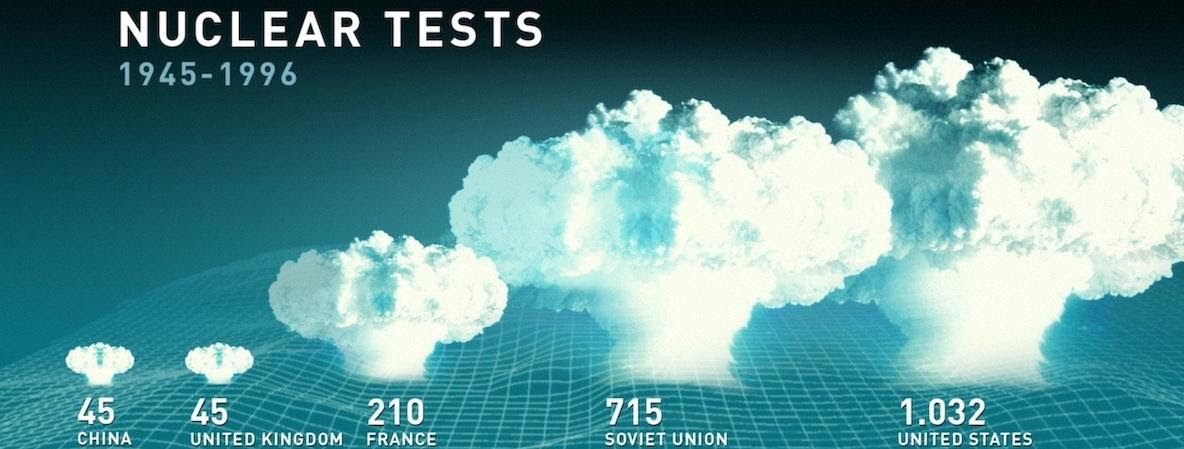
The Western response was almost inaudible. Only US President Donald Trump spoke out. He regretted that his Russian counterpart had seen fit to reveal his exploits because, in doing so, he was reigniting the arms race. Furthermore, he announced that the United States was resuming its nuclear tests. Donald Trump could hardly do otherwise: deploring Russia’s renewed arms race is a way of explaining that the Pentagon’s military research is lagging far behind and of asserting Washington’s peaceful stance. Announcing that he will resume nuclear tests is a way of shifting the focus, since none of the new Russian weapons represent an advance in nuclear terms, but only in terms of atomic bomb launchers. To say that he will do this to maintain parity with Russia and China is a blatant lie: Russia has not conducted nuclear tests since 1990 and China since 1996. Moreover, it will take at least two years to rebuild or rehabilitate Cold War-era facilities, and therefore to begin these tests. Until then, the United States is nothing more than a “paper tiger.”
We are now reaching the end of hostilities in Ukraine. The Russian army is on the verge of a decisive victory in the Donbas. It will not only capture Pokrovsk, but will also inflict a third defeat on the White Führer, Andriy Biletsky, whose 10,000 men are surrounded. …………………
..on October 20th, Russia informed the United States that it had no intention of yielding on territorial concessions, the reduction of the Ukrainian armed forces, or guarantees that Ukraine would never join NATO.
Whether the West likes it or not, it no longer has a choice. It simply cannot afford to continue supplying weapons to Russia in Ukraine on its own. The EU’s plan to eventually confiscate Russian assets frozen in Belgium and spend them immediately could spell the end of the Union. In any case, neither Belgium, nor Slovakia, nor Hungary will participate in this theft, which even the Soviets, the staunch opponents of private property, never perpetrated.
The EU’s grandiose ambitions are about to collide with reality: it can only continue this war by betraying the very ideals it claims to uphold………….
All of this is coming to an end, otherwise the EU will be directly drawn into the war against the Slavs that the UK and Germany instigated in 1933: the Second World War. And the EU’s armies, stripped of their arsenals, have no hope of resisting for more than two days. This is not about bowing down to a new master, Russia, but simply about acknowledging our mistakes before it’s too late. https://www.sott.net/article/502778-The-moment-of-truth-The-West-confronts-Russian-military-advances
Atomic testing must not resume
By Linda Pentz Gunter, Nov 5, 2025
| “We were used as guinea pigs”. Nuclear test victims bear witness in new book, No To Nuclear. President Trump’s sudden and confusing announcement last week that the US would resume atomic testing (it won’t) because other countries are doing it (none are) brought back the horrors of what nuclear testing actually means. Just ask those who lived through the 2,000+ atomic tests conducted in the Cold War, whether innocent civilians on the ground or the military personnel forced to witness or conduct the tests and clean up afterwards. All of them are paying the price with their health. Many are even seeing birth defects in their children and grandchildren, caused by their own exposures decades ago. In my forthcoming book to be published in March 2026 by Pluto Press — No to Nuclear: Why Nuclear Power Destroys Lives, Derails Climate Progress and Provokes War — I look at the effects of those atomic tests on real lives. The human suffering is intense. Their stories alone should be enough to put an end to nuclear weapons altogether. |
Why are nuclear weapons discussed in a book about nuclear power? Because the materials and technology needed for a nuclear power program provide a direct pathway to nuclear weapons production. And because the source of both nuclear power and nuclear weapons is uranium.
Uranium mining is the beginning of the tragic story of the deadly harm to human health from the entire nuclear sector. Atomic testing (which is effectively using nuclear weapons) is the catastrophic last chapter. As I write in my book: “Fallout from atomic tests has likely contributed to an increase in cancers and other maladies among humans and has poisoned animal and plant life in perpetuity as well.”
This is something no one should contemplate repeating. As one of the atomic veterans I quote says: “We were used as guinea pigs — every one of us.” So were the people whose atolls were blown to smithereens in the Pacific. And so were the people of the United States. As Mary Dickson, a Nevada Test Site downwinder where 928 atomic tests were conducted, asks: “What kind of government poisons its own people?
My book focuses on the human stories, taking us out of the abstract and into the real lived experiences of everyone along the uranium fuel chain. You can pre-order a copy here. And if you’d like to set up a webinar with me either pre- or post-publication, please get in touch by emailing linda@beyondnuclear.org https://www.plutobooks.com/product/no-to-nuclear/
Rusting nuclear facilities hamper Trump’s plans for new tests
President insists new trials will begin, but officials say US not capable of doing so.
Benedict Smith, US Reporter
The United States is not ready to restart nuclear weapons testing and
risks losing ground to China and Russia if it pushes ahead with Donald
Trump’s plans, experts believe.
The president announced this week that
the US would conduct tests of nuclear weapons for the first time in more
than three decades, breaking one of the few remaining taboos among the
superpowers.
Experts fear that in doing so, Mr Trump has fired the starting
gun on a race Washington is ill-prepared to win, and that it could find
itself matched or overtaken by Moscow and Beijing.
Visitors to America’s
vast testing site in the Nevada desert said it is filled with equipment
that is slowly rusting away, while former officials say it simply has not
had the investment to match the president’s ambitions. Now there are
fears that Mr Trump has opened a “Pandora’s Box” that has remained
shut almost since the end of the Cold War. And he might not be prepared for what comes next.
Telegraph 3rd Nov 2025, https://www.telegraph.co.uk/us/politics/2025/11/03/trump-could-not-launch-nuclear-weapon-if-he-wanted/
No to Nuclear, Yes to Renewables for Wales

28th October 2025, Nuclear Free Local Authorities
Anti-nuclear campaigners meeting last weekend in Wrexham (25 October) issued a declaration calling on politicians representing Welsh constituencies in parliaments in Cardiff and Westminster to work for a nuclear free, renewables powered Wales.
Attendees at the screening of the award-winning film SOS: The San Onofre Syndrome organised by PAWB (Pobol Atal Wylfa-B, People against Wylfa B) hosted at the Ty Pawb Arts Centre in Wrexham also saw a special video message sent by the Californian filmmakers and heard from Stephen Thomas, Emeritus Professor in Energy Policy at Greenwich University and Richard Outram, Secretary of the Welsh Nuclear Free Local Authorities, who both joined the meeting online.
Welsh campaigners are working with US, Canadian and other UK activists to establish a Transatlantic Nuclear Free Alliance to campaign on issues of common concern. The film (https://sanonofresyndrome.com/) highlights the impact of the decommissioning and the legacy of managing deadly radioactive waste faced by the neighbours of the San Onofre nuclear power plant in California.
The film’s messages resonate with international audiences faced with identical threats and challenges. Commenting Professor Thomas said:
“The nuclear industry tries to assure us the radioactive waste disposal and reactor decommissioning are established processes with easily affordable costs. The truth is that we are three or more decades away from permanent disposal of waste and of carrying out the most challenging stages of decommissioning. The cost will be high, and the failure of previous funding schemes means the burden will fall on future taxpayers, generations ahead”.
28th October 2025
No to Nuclear, Yes to Renewables for Wales

Joint Media Release
Anti-nuclear campaigners meeting last weekend in Wrexham (25 October) issued a declaration calling on politicians representing Welsh constituencies in parliaments in Cardiff and Westminster to work for a nuclear free, renewables powered Wales.
Attendees at the screening of the award-winning film SOS: The San Onofre Syndrome organised by PAWB (Pobol Atal Wylfa-B, People against Wylfa B) hosted at the Ty Pawb Arts Centre in Wrexham also saw a special video message sent by the Californian filmmakers and heard from Stephen Thomas, Emeritus Professor in Energy Policy at Greenwich University and Richard Outram, Secretary of the Welsh Nuclear Free Local Authorities, who both joined the meeting online.
Welsh campaigners are working with US, Canadian and other UK activists to establish a Transatlantic Nuclear Free Alliance to campaign on issues of common concern. The film (https://sanonofresyndrome.com/) highlights the impact of the decommissioning and the legacy of managing deadly radioactive waste faced by the neighbours of the San Onofre nuclear power plant in California.
The film’s messages resonate with international audiences faced with identical threats and challenges. Commenting Professor Thomas said:
“The nuclear industry tries to assure us the radioactive waste disposal and reactor decommissioning are established processes with easily affordable costs. The truth is that we are three or more decades away from permanent disposal of waste and of carrying out the most challenging stages of decommissioning. The cost will be high, and the failure of previous funding schemes means the burden will fall on future taxpayers, generations ahead”.
Despite this, the UK Government will introduce developer-led siting plans, permitting nuclear operators to apply to locate new plants in sites throughout Wales, and intends to reduce regulation in the nuclear industry. A recent Memorandum of Understanding was also signed with the United States which could lead to British regulators being obliged to accept US reactor designs not currently approved for deployment in the UK. Great British Energy – Nuclear has also acquired land at Wylfa in Anglesey (Ynys Mon) as a potential site for the deployment of one or more so-called Small Modular Reactors being commissioned from Rolls Royce and the US company Westinghouse has also expressed interest in constructing a larger nuclear plant there. The Welsh Government specifically created Cwmni Egino to develop a new nuclear plant on the Trawsfynydd site at the heart of the beautiful Eryri National Park. And in South Wales, US newcomer Last Energy is seeking permission to deploy multiple micro reactors on a former coal power station site at Llynfi outside Bridgend.
Now eight leading campaign groups have backed the Wrexham Declaration which denounces the continued political obsession with the pursuit of nuclear power as a ‘fool’s errand’.
NFLA Secretary Richard Outram explains why: “Nuclear is too slow, too costly, too risky, contaminates the natural environment compromising human health, and leaves a legacy of nuclear plant decontamination and radioactive waste management lasting millenia that is ruinously expensive and uncertain. And nuclear plants represent obvious targets to terrorists and, as we have seen in Ukraine, to hostile powers in times of war”.
Campaigners are also convinced that nuclear will worsen fuel poverty or climate change……………………………………………………………………………………………………………………………………………………………………………………. https://www.nuclearpolicy.info/news/no-to-nuclear-yes-to-renewables-for-wales/
Going Nuclear Free: The Early History of the Nuclear Free Local Authorities
Introduction Forty-five years ago today, on 5 November 1980,
Manchester, the very city in which the atom was first split, became the
world’s first local authority to declare itself ‘nuclear-free’. This
declaration made by City Councillors proved to be the catalyst which led to
a worldwide movement of self-declared nuclear free local authorities and in the UK to the establishment of the Nuclear Free Local Authorities. This
briefing highlights how that organisation came about.
NFLA 5th Nov 2025 https://www.nuclearpolicy.info/wp/wp-content/uploads/2025/11/A441-NB327-Going-Nuclear-Free-5-November-2025.pdf
1 This Month

of the week – Shut Down Drone Warfare!


Tell the Ukrainian Government to Drop Prosecution of Peace Activist Yurii Sheliazhenko

Petition to revoke the licensing of the Near Surface Nuclear Disposal Facility (NSDF) at Chalk River. https://www.ourcommons.ca/petitions/en/Petition/Details?Petition=e-7247
To see nuclear-related stories in greater depth and intensity – go to https://nuclearinformation.wordpress.com
-
Archives
- April 2026 (57)
- March 2026 (251)
- February 2026 (268)
- January 2026 (308)
- December 2025 (358)
- November 2025 (359)
- October 2025 (376)
- September 2025 (257)
- August 2025 (319)
- July 2025 (230)
- June 2025 (348)
- May 2025 (261)
-
Categories
- 1
- 1 NUCLEAR ISSUES
- business and costs
- climate change
- culture and arts
- ENERGY
- environment
- health
- history
- indigenous issues
- Legal
- marketing of nuclear
- media
- opposition to nuclear
- PERSONAL STORIES
- politics
- politics international
- Religion and ethics
- safety
- secrets,lies and civil liberties
- spinbuster
- technology
- Uranium
- wastes
- weapons and war
- Women
- 2 WORLD
- ACTION
- AFRICA
- Atrocities
- AUSTRALIA
- Christina's notes
- Christina's themes
- culture and arts
- Events
- Fuk 2022
- Fuk 2023
- Fukushima 2017
- Fukushima 2018
- fukushima 2019
- Fukushima 2020
- Fukushima 2021
- general
- global warming
- Humour (God we need it)
- Nuclear
- RARE EARTHS
- Reference
- resources – print
- Resources -audiovicual
- Weekly Newsletter
- World
- World Nuclear
- YouTube
-
RSS
Entries RSS
Comments RSS
 nuclear-news