The SMR boom will soon go bust
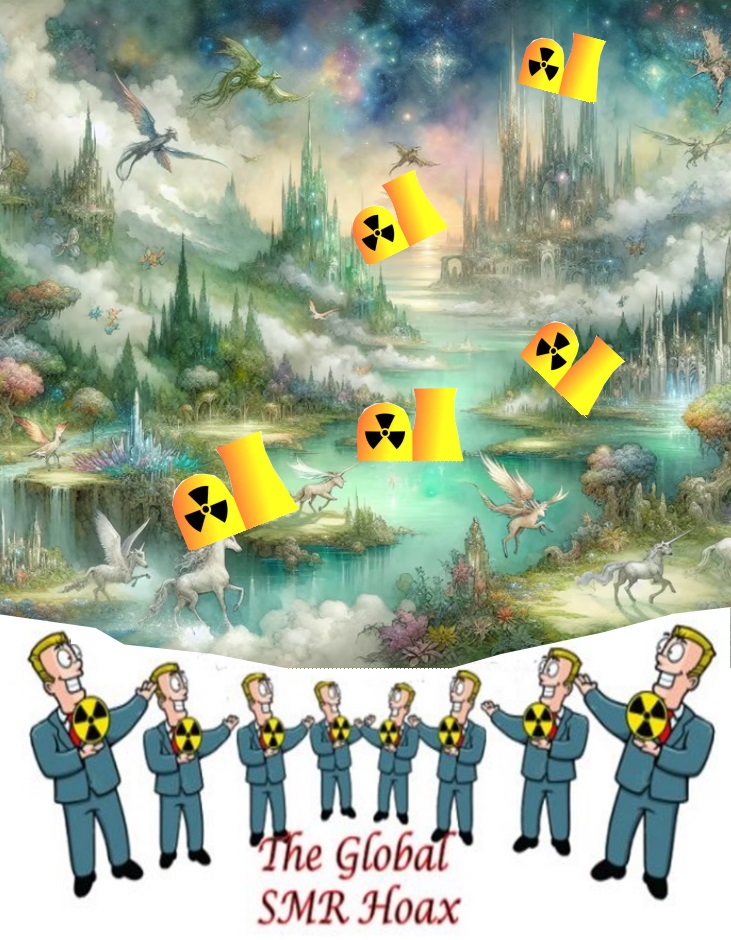
by Ben Kritz, 3 Nov 25, https://www.msn.com/en-ph/technology/general/the-smr-boom-will-soon-go-bust/ar-AA1PJi1U
ONE sign that the excessively hyped concept of small modular reactors (SMRs) is now living on borrowed time is the lack of enthusiasm in the outlook from energy market analysts, whether they are individuals such as Leonard Hyman, William Tilles and Vaclav Smil, or big firms such as JP Morgan and Jones Lang LaSalle. None of them are optimistic that the sector will be productive before the middle of next decade, and the more critical ones are already predicting that it will never be, and that the “SMR bubble” will burst before the end of this one. My frequent readers will already know that I stand firmly with the latter view; basic market logic, in fact, makes any other view impossible.
In a recent commentary for Oil Price.com, one of the rather large number of online energy market news and analysis outlets, Hyman and Tilles predicted that the SMR bubble will burst in 2029. They based this on the reasonable observation that power supply forecasts are typically done on a three- to five-year timeframe. The fleet of SMRs that are currently expected to be in service between 2030 and 2035 simply will not be there, so energy planners will, at a minimum, omit them from the next planning window, and might decide to forget about them entirely. Deals will dry up, investors will dump their stocks or stop putting venture capital into SMR developers, and those developers will find themselves bankrupt.
That is an entirely plausible and perhaps even likely scenario, but the SMR bubble may burst much sooner than that, perhaps even as soon as next year, because of the existence of the other tech bubble, artificial intelligence, or AI, an acronym that in my mind sounds like “as if.” The topic of the AI bubble is an enormous can of worms, too complex to discuss right now, but the basic problem with it that is relevant to the SMR sector is that AI developers need a great deal of energy immediately. It has reached a point where AI-related data centers are described in terms of their energy requirements — in gigawatt increments — rather than their processing capacity. The availability of power determines whether or not a data center can be built; if the power is not already available, it must be within the relatively short time it will take to complete the data center’s construction.
Even if SMRs were readily available, their costs would discourage customers; AI developers are not too concerned with energy costs now, but they will be as their needs to start actually generating a profit become more acute. On a per-unit basis, SMRs are and are likely to always be more expensive than conventional, gigawatt-scale nuclear plants, and for that matter, most other power supply options. Hyman and Tilles estimate that on a per-unit cost basis (e.g., cost per megawatt-hour or gigawatt-hour), SMRs will be about 30 percent higher than the most efficient available gigawatt-scale large nuclear plants. Being smaller, SMRs would — hypothetically, as they do not actually exist yet — certainly cost less up front than large nuclear or conventionally fueled power plants, but their electricity would cost much more in the long run. That might not be an issue in some applications, but it certainly would if SMRs were intended to supply electricity to a national or regional grid.
Some analyses point out that some early adopters of SMRs, that is, customers who have put down money or otherwise promised to order one or more SMR units if and when they become available, may not be particularly price-sensitive; for example, military customers, governments taking responsibility for supplying electricity to remote areas, or some industrial customers. However, they would still be tripped up by the fragmented nature of the SMR sector, which was caused by the “tech bro” mindset of ignoring almost 70 years of experience in nuclear development and trying to reinvent the wheel.
JP Morgan’s 2025 energy report noted that there are only three SMRs in existence, with one additional one under construction; there is one in China, two in Russia, and the one not yet completed is in Argentina. All of them had construction timelines of three to four years, but took 12 years to complete; or in Argentina’s case, 12 years and counting. Argentina’s project has had cost overruns of 700 percent so far, while China and Russia’s projects were 300 percent and 400 percent over budget, respectively.
These are all essentially one-off, first-of-a-kind units, so some of these problems are to be expected, such as regulatory delays, design and manufacturing inefficiencies, and challenges from building supply chains from scratch. These problems would be resolved over time, except that there are literally hundreds of different SMR designs all competing for the same finite, niche-application market.
If the SMR developers listened to the engineers and policymakers who built up nuclear energy sectors that took advantage of economies of scale by standardizing a few designs and distributing the workload, they might get somewhere. That is not happening; potential customers, whether they have power cost concerns or not, are reluctant to jump in because it is not at all certain which SMRs will survive the competition. They might be willing to experiment to see if one design or another actually works — that is why the Chinese and Russian SMRs exist — but the fragmented SMR sector prevents them from trying more than one and making comparisons, at least not in a timely or financially rational manner.
I think the bubble begins to burst this coming year. The timeframe for construction to startup in most SMR pitches is four years. That’s entirely too optimistic, of course, but even if it is taken at face value, once we get a few months into 2026 without any tangible development happening, everyone will catch on that there won’t be any SMRs by 2030, and interest will turn elsewhere. It already is, among the data center sector, as was explained above.
Trump doubles down on nuclear tests as Russia issues warning.

By Reuters, November 1, 2025 , https://www.smh.com.au/world/north-america/trump-doubles-down-on-nuclear-tests-as-russia-issues-warning-20251101-p5n6z4.html
Washington: President Donald Trump has reaffirmed that the United States will resume nuclear testing, but he would not answer directly when asked whether that would include underground nuclear tests that were common during the Cold War.
“You’ll find out very soon, but we’re going to do some testing,” Trump told reporters aboard Air Force One on Friday (Saturday AEDT) as he flew to Palm Beach, Florida, when asked about underground nuclear tests.
“Other countries do it. If they’re [going] to do it, we’re going to do it, OK?”
Trump said on Thursday that he had ordered the US military to immediately restart the process for testing nuclear weapons after a halt of 33 years, a move that appeared to be a message to rival nuclear powers China and Russia, whose last known tests were in the 1990s.
Trump made that surprise announcement on social media while aboard his Marine One helicopter flying to meet Chinese President Xi Jinping for a trade-negotiating session in Busan, South Korea.
It was not immediately clear whether Trump was referring to nuclear-explosive testing, which would be carried out by the National Nuclear Security Administration, or flight testing of nuclear-capable missiles.
Continue readingCheaper, greener power is on the way

Cheaper, greener power is on the way. As long as anti-net zero populists
don’t throttle it in the cradle. Not that long ago, Mark Purcell, a retired
rear admiral in the Australian navy, was paying about A$250 a month for
electricity in his roomy family home on the Queensland coast.
Today, he says he makes as much as A$300 a month, or nearly $200, from the
electricity he makes, stores and sells with his solar panels and batteries.
“This is the future,” he told me. “This is what the energy transition
could look like for a lot of folks.” Purcell is one of the 58,000-plus
customers of Amber Electric, an eight-year-old Melbourne business that
gives householders access to real-time wholesale power prices so they can
use power when it’s cheap and sell what is stored in their batteries when
it’s expensive.
The company is adding 5,000 customers a month, putting it
among a new generation of fast-growing energy tech start-ups aiming to make
electricity cheaper and greener, and not just in Australia. Amber’s dynamic
pricing technology is due to launch soon in the UK, where the company has
done licensing deals with the energy suppliers Ecotricity and E.On.
Norway’s Tibber offers similar services to the 1mn customers it has gained
since launching in 2016 and expanding to Germany, Sweden and the
Netherlands. In Germany, the market share of companies including Tibber,
Octopus Energy and Rabot Charge has grown from 0.1 per cent in 2023 to 2.4
per cent in 2025, says the Kreutzer Consulting group. Between them they
have more than 1mn customers, 77 per cent of whom are particularly or very
happy with their provider, far more than the industry-wide figure of 57 per
cent.
Remember those figures the next time you hear a rightwing populist
condemn allegedly unaffordable net zero policies. In fact, this new class
of energy tech entrepreneurs is showing how electricity can become more
affordable precisely because of the renewables, batteries and electric cars
that net zero efforts drive.
It is no accident Amber Electric began in
Australia, long a world leader in rooftop solar systems that sit atop more
than 4mn of its homes and small businesses. Its population of 28mn is now
undergoing a home battery boom, following the July launch of a A$2.3bn
government subsidy scheme. Industry estimates show rooftop solar can save
households up to A$1,500 a year on energy bills, a figure that nearly
doubles if you add a battery, and rises further with dynamic pricing. Is
there a catch?
Right now, the upfront costs of green tech can be
considerable. Queensland’s Purcell is a superuser who has spent tens of
thousands of dollars on solar panels, batteries and a home energy
management system that makes everything from his pool heater to his air
conditioners price-responsive. His family also has two Teslas with even
bigger batteries.
This is clearly unaffordable for many, but maybe not for
long. Big home hardware retailers have begun to launch financing plans that
let people pay monthly fees of less than A$150 for solar and battery
packages rather than a big initial outlay.
FT 29th Oct 2025, https://www.ft.com/content/8bf14af2-8c22-4731-ad06-4a36277dff74
The Nastiest Warmongers Are Trump’s Biggest Fans Now.
Caitlin Johnstone, Nov 03, 2025, https://www.caitlinjohnst.one/p/the-nastiest-warmongers-are-trumps?utm_source=post-email-title&publication_id=82124&post_id=177879309&utm_campaign=email-post-title&isFreemail=true&r=1ise1&triedRedirect=true&utm_medium=email
Massacre fetishist Lindsey Graham said “Trump is my favorite president” because “we’re killing all the right people and we’re cutting your taxes” during a speech to the Republican Jewish Coalition Annual Leadership Summit on Friday.
“We’ve run out of bombs; we didn’t run out of bombs in World War II,” the senator said.
If Lindsey Graham ever gushed about me this effusively for any reason I think I would have to shave my head and join a convent or something, because it would be a clear and undeniable sign that I had been living my whole entire life completely wrong.
It says a lot about how much of a warmonger Trump has become that he himself actually slammed Lindsey Graham repeatedly during his first crack at the presidency for being such a firebreathing war slut.
In 2016 Trump said of Graham, “I hear his theory for the [Iraq] war; you’ll be in there forever. You’ll end up starting World War III with a guy like that.”
In 2017 Trump slammed Graham and his war porn circle jerk partner John McCain, saying “The two senators should focus their energies on ISIS, illegal immigration and border security instead of always looking to start World War III.”
In 2018 Trump attacked Graham for opposing the withdrawal of US troops from Syria, tweeting “So hard to believe that Lindsey Graham would be against saving soldier lives & billions of $$$. Why are we fighting for our enemy, Syria, by staying & killing ISIS for them, Russia, Iran & other locals? Time to focus on our Country & bring our youth back home where they belong!”
In 2019 Trump said during a press conference, “Lindsey Graham would like to stay in the Middle East for the next thousand years with thousands of soldiers and fighting other people’s wars. I want to get out of the Middle East.”
Trump used to at least posture as an anti-interventionist who didn’t get along with the warmongers of the DC swamp. Now he’s best butt buddies with the most bloodthirsty swamp creatures alive.
They love him, and why wouldn’t they? He bombed Iran. He bombed Yemen. He poured genocide weapons into Israel to incinerate Gaza and to bomb Lebanon, and has been aggressively stomping out free speech that is critical of Israel’s war crimes. He’s been bombing Somalia at an unprecedented rate. He’s giving every sign that he’s getting ready to do something truly horrible in Venezuela. He’s even threatening to invade Nigeria now.
Back in March, Trump’s intelligence chief Tulsi Gabbard embarrassingly tweeted that “President Trump IS the President of Peace. He is ending bloodshed across the world and will deliver lasting peace in the Middle East.” Now she’s spending her whole career helping Trump commit mass military violence around the globe.
Trump duped his base into believing he’ll make peace, and he turned out to be Lindsey Graham’s gooiest wet dream incarnate.
Radioactive waste storage in France: the debate is finally open! How to participate?

This debate therefore began on Monday, October 13, 2025, and will last approximately four months, until February 10, 2026 , in the form of meetings organized throughout France, both in person and remotely .
The floor is yours! Since October 13th and for the next four months, a public debate has been open regarding the “National Plan for the Management of Radioactive Materials and Waste”. What is it about? How can you participate?
While government and parliamentary dithering dominated the French press, a largely unreported public debate opened on Monday, October 13th, for a period of four months: the debate on the management of radioactive materials and waste . What will it entail? Can everyone truly participate? Here are all the details.
Meetings across France
This public debate , organised by the National Commission for Public Debate (CNDP), is therefore part of the “National Plan for the Management of Radioactive Materials and Waste” (PNGMDR) , the 6th of its kind, for the period 2027-2031 . It is a roadmap setting out France’s strategy for managing, treating and storing the country’s radioactive materials and waste, regardless of their technical origin.
In concrete terms, the PNGMDR is updated every five years and “provides a comprehensive overview of all radioactive substances present in the territory”, lists “future needs in terms of storage, treatment and research, and specifies the operational actions to be implemented, according to the National Commission for Public Debate (CNDP).
Since it is a legal obligation , the government tasked the National Commission for Public Debate (CNDP) at the end of December 2024 with leading the public debate on this national plan. This debate therefore began on Monday, October 13, 2025, and will last approximately four months, until February 10, 2026 , in the form of meetings organized throughout France, both in person and remotely .
Events will be organized through local workshops, as well as online activities such as webinars and participatory platforms , with the aim of engaging and interesting younger generations . In partnership with the media outlet Usbek & Rica, a “Tribunal for Future Generations” will even be organized: it will offer “a mock, participatory trial to explore, in a lively way, the legacy left to future generations.”
No public meeting at Cigeo
The chair of the public debate, Julie Dumont, noted during the preparatory stages ” a lot of expectations on the ethical, economic and territorial issues surrounding the management of radioactive materials and waste”.
During the meetings, topics will include the impact of France’s energy policies on radioactive waste management (in the context of a nuclear revival), storage solutions for “low-level” but long-lived waste, the costs and financing of management options, and radioactive waste from the medical field .
The Cigeo project , which plans to bury highly dangerous radioactive waste 500 meters underground in Bure, in the Meuse region , and which is strongly opposed by environmental associations, will also be discussed but will not host a public meeting , due to the risk of “deadlock”, or even hostile demonstration, the CNDP specifies.
The conclusions of the public debate will then guide the development of the future PNGMDR , which will be implemented at the beginning of 2027. If you wish to participate in the debate: click here for all the practical information .
Article references:
GEO. Radioactive waste management at the heart of a public debate for 4 months, in person and online .
Ministry of Economy. Launch of the work to develop the 6th national plan for the management of radioactive materials and waste (PNGMDR) .
The Silicon Thirst: When Data Drinks the World Dry

4 November 2025 Andrew Klein, https://theaimn.net/the-silicon-thirst-when-data-drinks-the-world-dry/
We live in an age of digital miracles, where intelligence is artificial and clouds are not in the sky, but in warehouses. Yet, this ethereal realm has a staggering physical appetite, one that is quietly draining the planet of its most vital resource: water.
The numbers are not just statistics; they are a prognosis.
- A single data centre can consume 1 to 5 million gallons of water per day – the equivalent of a small city.
- Training a single advanced AI model can gulp down 185,000 gallons of fresh, clean water, used to cool the furious processors dreaming of a digital future.
- By 2027, the water footprint of the AI sector alone could reach 4.2 billion cubic metres, a thirst that begins to compete with the needs of nations.
This is not progress. It is a profound and suicidal miscalculation.
Efficiency for What?
The technology giants speak of “efficiency,” but it is a narrow, self-serving metric. It is the efficiency of a faster loading time, a more intrusive advertisement, a more powerful algorithm for predicting our desires. But by what possible measure is it “efficient” to exchange a million gallons of drinking water for a fractional improvement in computational speed?
This is the logic of a parasite that has forgotten its host is mortal. It is the logic of a civilisation that will meticulously optimise a virtual world while making the physical one uninhabitable.
The Path of the Steward: A Call for Conscious Calculation
The solution is not to abandon technology, but to re-forge it in the image of stewardship. We must demand a new calculus, where the true cost of every byte and algorithm is accounted for. This requires:
- A Radical Shift in Cooling: The era of guzzling pristine freshwater must end. Investment must be urgently directed toward air-assisted liquid cooling, the use of recycled or saltwater, and the strategic placement of data centres in colder climates to drastically reduce their environmental burden.
- Transparency and Accountability: The water footprint of digital services must be made as visible as their price tag. Consumers and regulators have a right to know the true ecological cost of their cloud storage and AI queries.
- Licensing to Operate: A social license to operate in the 21st century must be contingent on water neutrality and a demonstrable positive environmental impact. Profit cannot be the sole metric of success when the very habitability of our home is at stake.
The choice is no longer between technology and nature. The choice is between a technology that devours its own foundation, and a technology that exists in harmony with it.
The silicon world is thirsty. But the thirst of children, of farms, of ecosystems, must come first.
UK’s nuclear waste problem lacks a coherent plan.

The [GDF] will comprise vaults and tunnels of a size that may be
approximate to Bermuda, but without the devilish tax evaders, coupled with
a 1 km square surface site that will periodically swallow up trainloads of
toxic radioactive waste. It would be unsurprising if Nuclear Waste
Services, the agency charged with finding and building the site, placed a
job advert for its own Hades to manage this dystopic underworld and if the
postholder engaged Cerberus to guard the entrance.
The plan comes with an enormous bill for taxpayers which will scare the ‘bejeebers’ out of taxpayers. Previously the Government’s new National Infrastructure and Service Transformation Authority (NISTA) had identified in its August 2025 report that the GDF facility may have a whole life cost estimated to range from £20 billion to £53 billion.
Now PAC members have had a further frightener placed on them because these headline figures were based on 2017/18 prices and they have found that, when adjusting to the present, the undersea radioactive monster might cost over £15 billion more. It would be far cheaper to hire Godzilla.
The Public Accounts Committee Chair Geoffrey Clifton-Brown has called on the Government to produce a ‘coherent plan’ to manage the UK’s stockpile of radioactive waste
NFLA 31st Oct 2025, https://www.nuclearpolicy.info/news/trick-not-treat-nuclear-dump-is-full-of-nasty-surprises-not-sweet-treats/
The men who stared at mushroom clouds .
In a beige function room at the Pontins holiday park, Weston-super-Mare, a
man in a Hawaiian shirt addresses the veterans of Britain’s little-known
nuclear testing programme. There are about 130 people in the room. More
than half are in their late eighties and participated in the programme.
Also here are their children and, in a few cases, their children’s
children. They’re wearing Hawaiian shirts too, a tapestry of tropical print
and palm trees embellished with plastic flower garlands, tinsel, wigs and
novelty hats. It’s the third day of the All Tests Reunion, a week-long
gathering for this rarefied demographic, and the group chats excitedly as
they await the evening’s entertainment. Tables are laden with bottles of
house wine and pints of bitter, walking sticks propped behind chairs. In
the corner of the room, four women who are due to perform shuffle about as they attach te riri ni mwaie around their waists — heavy straw-like
dancing skirts that are native to Kiribati, a Pacific island nation that
was among several locations the British chose for nuclear weapons tests
during the 1950s and ’60s.
Until tonight, the group has been discussing
rather serious matters. Such as whether the Ministry of Defence (MoD) was
aware of the risks when it stationed thousands of young servicemen in
places such as Kiritimati (or Christmas Island) and started detonating
atomic and hydrogen bombs in the vicinity; and why it continues to deny or
delay access to the medical records of those deployed there. One
particularly urgent question is whether exposure to blast after blast,
without protective shielding, may be the reason so many of the veterans and their descendants have suffered health problems. Many of these questions remain unanswered. Some may be unanswerable.
FT 1st Nov 2025, https://www.ft.com/content/1fca6893-7dfe-43e3-b7ec-c00e3d4ad0b6
-
Archives
- February 2026 (211)
- January 2026 (308)
- December 2025 (358)
- November 2025 (359)
- October 2025 (376)
- September 2025 (258)
- August 2025 (319)
- July 2025 (230)
- June 2025 (348)
- May 2025 (261)
- April 2025 (305)
- March 2025 (319)
-
Categories
- 1
- 1 NUCLEAR ISSUES
- business and costs
- climate change
- culture and arts
- ENERGY
- environment
- health
- history
- indigenous issues
- Legal
- marketing of nuclear
- media
- opposition to nuclear
- PERSONAL STORIES
- politics
- politics international
- Religion and ethics
- safety
- secrets,lies and civil liberties
- spinbuster
- technology
- Uranium
- wastes
- weapons and war
- Women
- 2 WORLD
- ACTION
- AFRICA
- Atrocities
- AUSTRALIA
- Christina's notes
- Christina's themes
- culture and arts
- Events
- Fuk 2022
- Fuk 2023
- Fukushima 2017
- Fukushima 2018
- fukushima 2019
- Fukushima 2020
- Fukushima 2021
- general
- global warming
- Humour (God we need it)
- Nuclear
- RARE EARTHS
- Reference
- resources – print
- Resources -audiovicual
- Weekly Newsletter
- World
- World Nuclear
- YouTube
-
RSS
Entries RSS
Comments RSS
 nuclear-news