Resuming U.S. Nuclear Tests Is Reckless and Dangerous, One Expert Says

“The only countries that will really learn more if [U.S. nuclear] testing resumes are Russia and, to a much greater extent, China,” says Jeffrey Lewis, an expert on the geopolitics of nuclear weaponry
By Dan Vergano edited by Lee Billings, October 29, 2025, https://www.scientificamerican.com/article/trumps-baffling-call-for-resuming-u-s-nuclear-tests/
Editor’s Note (11/3/2025): Energy secretary Chris Wright stated on Sunday that any new nuclear testing pursued following Trump’s remarks would be of the “noncritical” variety, entailing already standard routine tests of weapons components and other parts of the U.S. arsenal. Scientific American will continue reporting any new developments on nuclear testing.
Ahead of a meeting with Chinese president Xi Jinping on Thursday, President Donald Trump said the U.S. will resume nuclear testing, ending a 33-year moratorium.
“Because of other countries [sic] testing programs, I have instructed the Department of War to start testing our Nuclear Weapons on an equal basis,” Trump announced on his social media platform Truth Social.
The U.S. last tested a nuclear weapon in an underground experiment in the Nevada Test Site in 1992, a marker of the end of the cold war. That last test concluded a decades-long testing program that included more than 1,000 detonations conducted by the civilian Department of Energy, which oversees the U.S. nuclear stockpile.
The Project 2025 report, now acknowledged by Trump as an indicator of his administration’s policies, had called for resuming U.S. nuclear testing to ensure the performance of the nuclear stockpile. Trump’s announcement follows recent Russian tests of a nuclear-powered cruise missile and a nuclear-capable underwater drone, but there have not been any known nuclear detonations recently made by either Russia or China. Both of those nations are signatories to the Comprehensive Nuclear-Test-Ban Treaty (CTBT), which the U.S. has signed yet never ratified. (China also hasn’t ratified the treaty, and Russia revoked its ratification in 2023, however.) China last tested a bomb in 1996, and the Soviet Union last tested one in 1990. Both countries have expressed concern about Trump’s announcement, and Russia has threatened to start its own tests.
To ask what is at stake in Trump’s call to resume U.S. nuclear tests, Scientific American spoke with Jeffrey Lewis, an expert on the geopolitics of nuclear weaponry at the James Martin Center for Nonproliferation Studies at the Middlebury Institute of International Studies.
[An edited transcript of the interview follows.]
We haven’t done a nuclear test since 1992. So what is the argument for doing this? Are there any technical benefits to resuming testing?
The question is: What sort of testing are we talking about? The U.S can presently test nuclear weapons in every way, shape or form—except for doing explosive tests that create yield. The U.S. now does so-called subcritical tests about 1,000 feet under the Nevada desert. And so it’s very unclear what the president means.
Are we talking about a full-yield test out in the desert? Or are we talking about small lab experiments that produce much less yield? It’s very unclear. And all of those [tests] have different yields [that have] different purposes.
But if I were to back up to issue one sweeping statement, it would be: No, [there aren’t any benefits to resuming testing] because the U.S. already conducted more than 1,000 nuclear tests. It has a vast trove of data that underlies the most sophisticated computer models imaginable. The U.S. knows more about its nuclear weapons today than it did in the period when it was testing them. The only countries that will really learn more if testing resumes are Russia and, to a much greater extent, China.
Project 2025 called for resuming underground nuclear tests, though. Would Trump’s announcement seem to point in that direction—basically, to the U.S. once again blowing up such weapons underground?
During the last [Trump] administration, [officials] spoke of being ready to resume nuclear testing. And they discovered that it would be a couple of years before they could do it. Then they started talking about doing uninstrumented tests—which are literally pointless.
You get no data from an uninstrumented test. It’s just a demonstration. All you do is demonstrate that we have functional nukes. It’s really unclear why you would do that.
What would this do to the nonproliferation movement, with the whole idea of a testing moratorium going out the window?
It’s possible the test ban collapses. But it is also possible that the nonproliferation treaty [the Treaty on the Non-Proliferation of Nuclear Weapons, which entered into force in 1970] collapses because that requires the U.S., Russia and other nuclear-weapon states to make good-faith efforts to work toward the elimination of nuclear weapons.
But non-nuclear-weapon states have made it clear that this test ban is literally the bare minimum. And most of those countries aren’t very happy that the U.S hasn’t ratified the [CTBT]. But the fact that there has at least been an end to nuclear testing has been really important to sustaining a sense around the world that nonproliferation is a common good rather than just an effort at a nuclear monopoly by a few countries.
Normally I am not one of those people who believes in that kind of symbolic stuff. But so much of [the Trump administration’s] foreign policy seems to be about being transgressive. Whatever effect a resumption in testing would have on our domestic politics, it also affects how people abroad see us. It becomes difficult to persuade people to do the things we want them to do when we seem reckless and selfish.
There’s also this matter of modernizing the U.S nuclear program, a long-running effort that’s over budget and delayed. How would new nuclear testing play into that?
If there were a technical reason to resume testing, you could imagine that would reduce the need for modernization—because successful testing would suggest that the existing systems are in excellent shape.
That said, I don’t think this is a sincere effort to get additional data to be more informed about the state of the U.S. arsenal. I think this is intended as a transgressive act that’s supposed to bully the Russians and the Chinese and aggravate the president’s domestic enemies.
So why do it?
Well, the real fundamental question here is: What the hell does [Trump] mean in that Truth Social post? Because Russia hasn’t conducted a nuclear test; it’s tested nuclear-capable or nuclear-powered assets.
And the Russians and Chinese aren’t accused of doing clandestine things at their test sites—or, at least, they haven’t been accused of that on an unclassified basis. And the Department of Defense doesn’t have any role in this, really, because nuclear testing is handled by the Department of Energy. So you just kind of stare at Trump’s statement, and you’re like, “What?”
I just don’t know what any of this means. I thought I was an expert, and I can’t parse the words he’s using.
It’s also confusing because, in some ways, Trump has seemed worried about nuclear war. He makes statements along the lines of saying that we all have too many weapons and should work together to disarm, and then he comes out with something like this.
I think what’s happened is that he’s been told that the Russians or the Chinese are doing bad things and that we’re at a disadvantage because we can’t do the same bad things. And he’s feels we ought to be able to do the same things. I doubt it’s any deeper than that.
But let me say a positive thing: [Trump] has political power here, in that he could force Senate Republicans to ratify the … CTBT if he thinks this is so important. He could absolutely get a verification protocol to the CTBT just like the Reagan administration did with the Threshold Test Ban Treaty [the Treaty on the Limitation of Underground Nuclear Weapon Tests, which entered into force in 1990], which would address some of these concerns about what the Russians and the Chinese are doing—if Republicans would accept it and ratify the treaty.
And then, you know what, he really would get a Nobel Peace Prize. If Trump got a verification protocol to the CTBT and then brought that treaty into effect, I would write in support of him getting a Nobel Peace Prize.
All right, let’s hope that, somehow, that idea gets whispered in his ear. Thanks for your thoughts.
Who is paying for Britain’s nuclear revival?

Ultimately, the UK taxpayer is paying for both power stations……………..If Sizewell’s total costs rise above around £47 billion, private investors are not obliged to inject additional equity, leaving the taxpayer exposed to cost overruns.
15th October 2025 by Sol Woodroffe, https://www.if.org.uk/2025/10/15/who-is-paying-for-britains-nuclear-revival/
In this article, IF volunteer Sol Woodroffe, considers the intergenerational fairness of the government’s financing models for Hinkley Point C and Sizewell C.
Building a nuclear power station: an intergenerational decision
Building a nuclear reactor is very expensive. In fact, the financing costs are the most expensive part. According to the World Nuclear Association, capital costs for new nuclear power stations account for at least 60% of their Levelised Cost of Electricity (LCOE). The LCOE is the total cost to build and operate a power plant over its lifetime divided by the total electricity output dispatched from the plant over that period. This means that when we talk about the price of nuclear, we are really talking about the price of borrowing to cover the upfront costs.

Specifically, when determining whether a government should invest in nuclear power, the cost depends on how much the government values cheap electricity for future generations. The decision to build a nuclear power station is a truly intergenerational one. This graph from the World Nuclear Association highlights how different discount rates affect the value for money of nuclear energy compared with other energy sources:
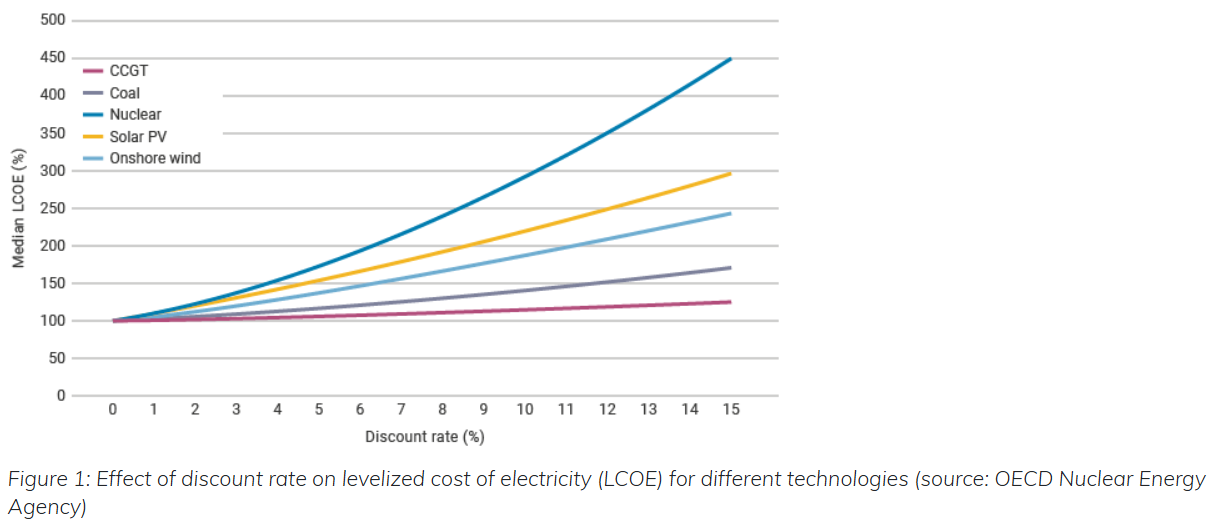
This shows that the relative capital intensity of building a nuclear power station means that the more we discount future generations, the less worth it nuclear energy seems from today’s standpoint.
The discount rate the government chooses to use on public infrastructure projects is, to some extent, determined by interest rates. But it is also an ethical choice about how much the government cares about future generations. The lower the value placed on future generations, the higher the discount rate used, and so the more expensive nuclear energy seems.
On the face of it, the UK government’s decision to build two enormous nuclear reactors should be a source of optimism for young people. Nuclear energy is one of the safest and cleanest forms of energy. In many parts of the world, it is also one of the cheapest. Decarbonisation, energy security and industrial strategy are all part of the motivation for building these reactors. Many of the UK’s current reactors were built in the 70s and 80s and will retire by the early 2030s. Without new capacity, the UK will lose a major source of low carbon power. Arguably, it’s a sign of the UK government daring to invest for future generations. And yet, a closer look at the financing of the two reactors tells a different story…
What are Hinkley Point C and Sizewell C
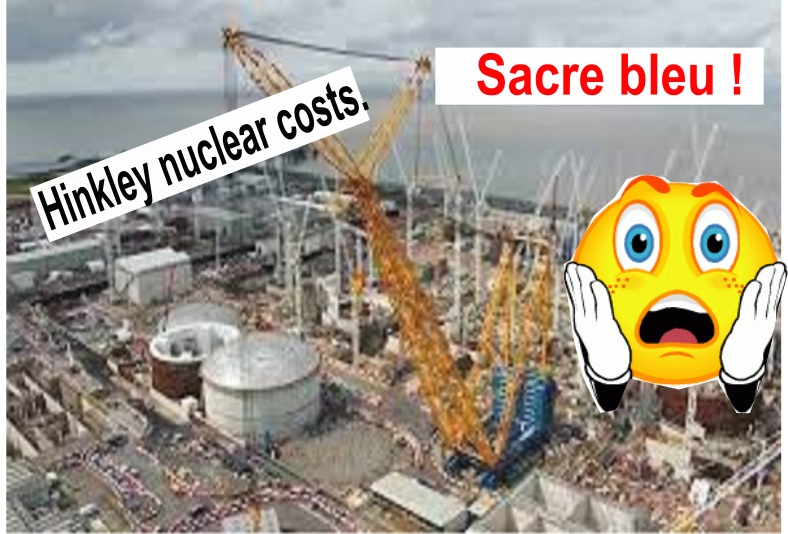
Hinkley Point C is the first new UK nuclear station in a generation. It uses the European Pressurised Reactor (EPR) design and, when complete, will be one of the largest nuclear power stations in Europe. According to EDF Energy, each of its two reactors will produce enough electricity to supply roughly 7% of the UK’s electricity demand. Construction was authorised by Theresa May’s government in September 2016. The original target was to have it running by 2025, but EDF now forecasts first power no earlier than 2029–2031.

Sizewell C is a close imitation of Hinkley planned for the Suffolk coast. The UK government approved the development in July 2022 and committed public equity financing in November 2022. Because the Hinkley supply chain and licensing work already existed, ministers argued that a second EPR project would reduce design and regulatory costs. Sizewell C will have enough capacity to power around six million homes when operating.
What went wrong and why?
Both projects are running well behind their initial projected timelines, and both have run worryingly over budget. These two things are interrelated. Long construction periods push up financing costs. Again, the cost of finance here is all-important. Over a long construction period, during which there are no revenue streams from the project, the interest on funds borrowed can compound into very significant amounts (World Nuclear Association, 2023).
HPC’s original cost estimate was about £18 billion but now is projected to a whopping £31–£35 billion. Moreover, our research on the “nuclear premium” estimated the additional cost of power from Hinkley Point C for its 35-year initial contract period, compared to onshore wind and solar power, would be £31.2 billion and £39.9 billion respectively. Sizewell C’s projected cost has ballooned from an initial estimate of around £20 billion to £38 billion (in 2025 pricing), nearly doubling the original figure.
The cause of these cost overruns is clear. EDF has complained that the UK lacks the building infrastructure and productive capacity for such a massive project. This kind of capacity is built up over time and requires beginning with smaller projects and then gradually scaling up. To some extent, the government has acknowledged this mistake and so began to invest in the small modular reactor programme in the UK, but from the perspective of the taxpayer, it all seems too little too late.
Who is paying for these power station?
Ultimately, the UK taxpayer is paying for both power stations. But from an intergenerational fairness perspective, the key questions are which taxpayers and when. The government has an option to borrow and shield the current taxpaying generation from footing the bill, but rising UK borrowing costs and increasingly jittery bond markets mean this would come at a serious cost.
Hinkley Point: paid for by Gen Z and Gen Alpha
The financing model for each power station is very different. For Hinkley point, the government has agreed on a Contract for Difference. This means that private companies must cover the upfront costs, with the knowledge that they receive a guaranteed price for their energy when the costs are finished.
EDF, the French national energy company, and CGN, the Chinese national energy company, shouldered much of the initial capital cost. In return, the government guarantees a price of £92.50/MWh (in 2012 £) for 35 years of output.
There were serious advantages to this model from a public financing perspective. The main advantage was that the investors took on the construction-cost risk: the UK taxpayer has arguably not been punished because Hinkley Point’s financial costs have so enormously overrun.
Nonetheless, this model ultimately kicks the financial burden down the road. Ultimately, today’s Gen-Z and Gen Alpha will be made to pay for this deal.
This is because the guaranteed price will likely be a rip-off. The average price of energy today in terms of 2012 pounds is £50–55/MWh. The falling price of clean energy alternatives means that we should expect the real price of energy to fall over the next few decades. Therefore, it seems highly likely that the fixed price will be a seriously uncompetitive rate for future UK consumers.
Sizewell C: a fairer distribution of costs
The financing of Sizewell distributes the financing costs more fairly between generations. To pay for the reactor, the government switched to a Regulated Asset Base (RAB) model. This means that consumers begin contributing to the project’s financing through small charges on their energy bills while the plant is still under construction, rather than waiting until it generates electricity. The model provides investors with a regulated return during construction, reducing their exposure to financing risk.
The RAB model allows investors to share construction and operational risks with consumers, which in theory lowers the cost of capital. Since capital costs make up the majority of nuclear project expenses, this could make Sizewell C substantially cheaper overall, if delivered as planned.
The key drawback is that taxpayers and consumers shoulder significant risk. If total costs rise above around £47 billion, private investors are not obliged to inject additional equity, leaving the taxpayer exposed to cost overruns.
From an intergenerational fairness perspective, the financing model is somewhat fairer as it smooths the cost of construction between generations. Nonetheless, the future taxpayers are the ones most exposed to the risk of cost overruns.
The cost of decommissioning
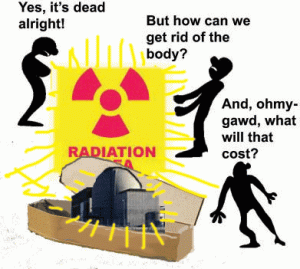
Historically, the cost of decommissioning nuclear power stations has been gravely underestimated in the UK. Decommissioning costs will be faced by generations well into the future, and so whether the state considers them massively depends on the chosen discount rate. Ultimately, the more the government values future consumers, the more seriously they must take these massive costs.
Sizewell and Hinkley both have operating lives of 60 years. However, with Sizewell, future taxpayers are exposed to the risk of ballooning decommissioning costs, whereas with Hinkley the operator must fully cover these costs.
Think of the children
When these large public infrastructure projects are discussed, the focus is often on whether government has negotiated value for money for UK taxpayers. But if the government wants to claim nuclear is a forward-looking investment, it must prove future generations won’t be the ones footing the bill.
China denies nuclear testing, calls on US to maintain moratorium
US president claims China, Russia have carried out secret nuclear weapon tests as he seeks to justify return to testing.
Aljazeera, By Adam Hancock and News Agencies, 3 Nov 2025
China has denied it has been secretly testing nuclear weapons, refuting a claim from United States President Donald Trump.
Chinese Foreign Ministry spokeswoman Mao Ning insisted on Monday that Beijing has not broken the informal moratorium that has persisted for decades on the testing of nuclear arms.
Trump claimed on Sunday that, as well as China, Russia, North Korea and Pakistan are all engaged in secret underground testing. He made the comments as he pushes for the US to resume tests.
China has “abided by its commitment to suspend nuclear testing”, Mao said in response to questions regarding Trump’s allegation.
“As a responsible nuclear-weapon state, China is committed to peaceful development, follows a policy of ‘no first use’ of nuclear weapons and a nuclear strategy that focuses on self-defence, and adheres to its nuclear testing moratorium,” she said.
She also said that Beijing calls on the US to uphold the moratorium on nuclear testing, following Trump’s surprise announcement on Thursday that he had ordered the Department of Defense to “immediately” resume tests.
China hopes the US will “take concrete actions to safeguard the international nuclear disarmament and non-proliferation regime and maintain global strategic balance and stability”, Mao continued.
‘The only country that doesn’t test’
Trump made the claims about secret nuclear tests, without offering evidence, in a television interview with CBS.
“Russia’s testing, and China’s testing, but they don’t talk about it,” he said.
“I don’t want to be the only country that doesn’t test,” he continued, adding North Korea and Pakistan to the list of nations allegedly testing arsenals.
The US has not set off a nuclear explosion since 1992. No country other than North Korea is known to have conducted a nuclear detonation for decades. Russia and China report they have not carried out such tests since 1990 and 1996, respectively…………………..https://www.aljazeera.com/news/2025/11/3/china-denies-nuclear-testing-calls-on-us-to-maintain-moratorium
The AI Drones Used In Gaza Now Surveilling American Cities

Skydio shows once again how Gaza is the laboratory for weapons makers, the place where new surveillance and apartheid technologies are tested, before being refined and used in the west.
Nate Bear, Nov 01, 2025, https://www.donotpanic.news/p/the-ai-drones-used-in-gaza-now-surveilling
AI-powered quadcopter drones used by the IDF to commit genocide in Gaza are flying over American cities, surveilling protestors and automatically uploading millions of images to an evidence database.
The drones are made by a company called Skydio which in the last few years has gone from relative obscurity to quietly become a multi-billion dollar company and the largest drone manufacturer in the US.
The extent of Skydio drone usage across the US, and the extent to which their usage has grown in just a few years, is extraordinary. The company has contracts with more than 800 law enforcement and security agencies across the country, up from 320 in March last year, and their drones are being launched hundreds of times a day to monitor people in towns and cities across the country.
Skydio has extensive links with Israel. In the first weeks of the genocide the California-based company sent more than one hundred drones to the IDF with promises of more to come. How many more were delivered since that admission is unknown. Skydio has an office in Israel and partners with DefenceSync, a local military drone contractor operating as the middle man between drone manufacturers and the IDF. Skydio has also raised hundreds of millions of dollars from Israeli-American venture capitalists and from venture capital funds with extensive investments in Israel, including from Marc Andreessen’s firm Andreessen Horowitz, or a16z.
And now these drones, tested in genocide and refined on Palestinians, are swarming American cities.
According to my research almost every large American city has signed a contract with Skydio in the last 18 months, including Boston, Chicago, Philadelphia, San Diego, Cleveland and Jacksonville. Skydio drones were recently used by city police departments to gather information at the ‘No Kings’ protests and were also used by Yale to spy on the anti-genocide protest camp set up by students at the university last year.
In Miami, Skydio drones are being used to spy on spring breakers, and in Atlanta the company has partnered with the Atlanta Police Foundation to install a permanent drone station within the massive new Atlanta Public Safety Training Center. Detroit recently spent nearly $300,000 on fourteen Skydio drones according to a city procurement report. Last month ICE bought an X10D Skydio drone, which automatically tracks and pursues a target. US Customs and Border Protection has bought thirty-three of the same drones since July.
The AI system behind Skydio drones is powered by Nvidia chips and enables their operation without a human user. The drones have thermal imaging cameras and can operate in places where GPS doesn’t work, so-called ‘GPS-denied environments.’ They also reconstruct buildings and other infrastructure in 3D and can fly at more than 30 miles per hour.
The New York police were early adopters of Skydio drones and are particularly enthusiastic users. A spokesman recently told a drone news website that the NYPD launched more than 20,000 drone flights in less than a year, which would mean drones are being launched around the city 55 times per day. A city report last year said the NYPD at that time was operating 41 Skydio drones. A recent Federal Aviation Authority rule change, however, means that number will undoubtedly have increased and more generally underpins the massive expansion in the use of Skydio drones.Prior to March this year, FAA rules meant that drones could only be used by US security forces if the operator kept the drone in sight. They also couldn’t be used over crowded city streets. An FAA waiver issued that month opened the floodgates, allowing police and security agencies to operate drones beyond a visual line of sight and over large crowds of people. Skydio called the waiver ground-breaking. It was. The change has ushered in a Skydio drone buying spree by US police and security forces, with many now employing what is called a ‘Drone As First Responder’ program. Without the need to see the drone, and with drones free to cruise over city streets, the police are increasingly sending drones before humans to call outs and for broader investigative purposes. Cincinnati for example says that by the end of this year 90% of all call outs will be serviced first by a Skydio drone.
This extensive level of coverage is enabled by Skydio’s docking platform hardware. These launch pads are placed in locations around a city enabling drones to be remote charged, launched and landed many miles away from police HQs. After launch, all the information gathered by these flights is both saved to an internal SD card and automatically uploaded to special software configured for law enforcement. This software is made by Axon, a major financial backer of Skydio and the controversial maker of Tasers and ‘less-lethal weapons’ used by police departments in the US and across the west. The software, Axon Evidence, enables, in the words of an Axon press release, ‘the automatic uploads of photos and video footage from drones into a digital evidence management system.’
Axon’s equipment is also central to Israel’s infrastructure of apartheid, with the company providing body cameras and Tasers to Israeli police forces and prison guards who routinely torture Palestinians. Axon, which participated in a $220 million Series E round of funding in Skydio, is just one of the many entities backing Skydio who serve a Zionist agenda.
Skydio’s first investor in 2015 was Andreessen Horowitz (a16z) which provided $3 million of seed capital to the three-man team behind the drone maker. They have since invested tens of millions across numerous funding rounds. The founders of a16z, Marc Andreessen and Ben Horowitz, are both notorious Zionists. The firm was the most active venture capital investor in Israel in 2024 and this summer Andreessen and Horowitz visited Israel to meet with tech companies founded by ex-IDF and Unit 8200 war criminals.
Other Skydio investors include Next 47, which has an office in Israel headed by Moshe Zilberstein who worked in the IDF’s computer spy centre Mamram, and Hercules Capital whose managing director Ella-Tamar Adnahan is an Israeli-American described by Israeli media as “Israel’s go-to tech banker in the US.”
The saturation of US police departments with drone technology so closely connected to Israel, technology used to carry out war crimes is a frightening, if not unsurprising, development. Skydio drones will be central to the rapidly advancing proto-fascism in the US and the crack down on Antifa and other so-called ‘domestic terrorists’ by the Trump administration. In this context, the bigger surprise is that the rapid expansion of Israel-linked surveillance drone technology across America has so far gone largely under the radar.
Skydio should also make it on to the agenda of Zohran Mamdani. Recently criticised for saying “when the boot of the NYPD is on your neck, it’s been laced by the IDF,” Skydio is just another example that shows he’s right. If he has the courage of his convictions, he could do worse than use his powers as mayor to shut down the NYPD’s Skydio deal.
Skydio is also a large supplier to the Department of Defence, recently signing a contract to provide the US Army with reconnaissance drones. As a significant supplier to both military and civilian security forces, it raises questions about what information is or will be shared between the US military and domestic security agencies via the Skydio-Axon digital evidence management system.
Skydio shows once again how Gaza is the laboratory for weapons makers, the place where new surveillance and apartheid technologies are tested, before being refined and used in the west. And next year Skydio is rolling out new indoor drones. We can only speculate as to what extent these new drones were informed by the ‘learnings’ accrued via genocide.
The story of Skydio shows that what happens in Gaza doesn’t stay in Gaza.
The logic of capitalist imperialism means these technologies will always find their way home.
Hegseth Declines To Say Whether the US Is Planning To Bomb Venezuela.

The Miami Herald reported on Friday that strikes could begin at any moment
by Dave DeCamp | November 2, 2025, https://news.antiwar.com/2025/11/02/hegseth-declines-to-say-whether-the-us-is-planning-to-bomb-venezuela/
US Secretary of War Pete Hegseth on Saturday declined to comment on whether the US was planning to bomb Venezuela amid a major US military buildup in the Caribbean and frequent strikes on alleged drug boats in the waters of Latin America.
“Appreciate the question, but, of course, we would not share any amount of operational details about what may or may not happen,” Hegseth said in Kuala Lumpur, Malaysia, when asked if the US was preparing to strike inside Venezuela.
The Miami Herald reported on Friday that the US has made a decision to attack military targets inside Venezuela as part of a campaign against the government of President Nicolas Maduro, whom the US seeks to oust. The report said that the US strikes could begin within a matter of “hours or days.”
When asked by reporters on Friday if he was planning strikes inside Venezuela, Trump said “no,” but he was asked again on Sunday and declined to answer. Secretary of State Marco Rubio, who also serves as Trump’s national security advisor and has been leading the push toward regime change in Venezuela, also denied the Miami Herald report.
“Your ‘sources’ claiming to have ‘knowledge of the situation’ tricked you into writing a fake story,” Rubio wrote on X in response to the report.
For weeks, multiple media outlets have been reporting that the US is considering launching strikes in Venezuela, and the US has built up a force in the region that’s well beyond what is needed to bomb small, defenseless boats. US officials have also made clear that the real goal of the campaign is regime change in Venezuela, something Rubio has wanted for many years.
A US aircraft carrier, the USS Gerald Ford, is also being deployed to the Caribbean, and the US has begun to run weekly bomber flights near the coast of Venezuela. Much of the military action and the leaks to the media are part of a psychological campaign aimed at getting Maduro to voluntarily step down or someone in his inner circle to turn on him, but it’s unlikely that will happen.
US amassing 16,000 troops off Venezuelan coast – Washington Post
1 Nov, 2025, https://www.rt.com/news/627242-us-amass-troops-venezuelan-coast/
The American forces in the area reportedly include eight Navy ships, a special operations vessel, and a nuclear-powered submarine.
The US is deploying a massive military contingent to an area near Venezuela, including 10,000 soldiers and 6,000 sailors, the Washington Post has reported. The move may indicate plans to expand regional operations.
The US has repeatedly accused Venezuela of aiding “narcoterrorists” and has imposed sweeping sanctions on the country. The American military has also attacked about a dozen vessels since September, claiming they were used by drug smugglers.
Venezuelan President Nicolás Maduro has denied the allegations, accusing Washington of “fabricating a new war” amid the continuing military buildup.
According to the Washington Post, eight US Navy warships, a special operations vessel, and a nuclear-powered attack submarine are already in the Caribbean. The aircraft carrier USS Gerald R. Ford, expected to arrive next week, will reportedly bring with it three more military vessels, with a total of over 4,000 military personnel onboard.
Additionally, F-35 fighter jets are stationed at a US base in Puerto Rico, the Post reported, citing satellite images.
The arrival of the carrier group suggests Washington’s plans could extend beyond a counter-narcotics operation, Ryan Berg, the director of the Americas Program and the Center for Strategic & International Studies, told the outlet. He added that US President Donald Trump has about a month to make “a major decision” before the group would need to be redeployed.
Multiple media outlets have recently reported that the White House was weighing potential military actions in Venezuela. Senator Rick Scott told CBS last Sunday that Maduro’s “days are numbered.” The WaPo claimed on Thursday that Washington had already identified some targets, including military facilities allegedly used for drug-smuggling.
When asked about the reports on Friday, Trump said, “No. It’s not true.” Last month, Trump confirmed authorizing the CIA to carry out lethal covert operations in the region.
Trump’s bet on US nuclear buildout ropes in Japan

By TIMOTHY CAMA . 10/31/2025
President Donald Trump is eager for the United States to build large nuclear reactors again — with Japanese money.
Administration officials are pulling every lever they can. They’re using trade deals, pulling the China card, and even elbowing into the boardroom of the largest U.S.-based reactor maker: Westinghouse Energy.
“The world is wanting to go and
embrace nuclear power,” Energy Secretary Chris Wright said last week.
“And guess who’s building their reactors? The Russians or the Chinese.”
The president and his loquacious Commerce secretary, Howard Lutnick,
unveiled two agreements during their trip to Asia this week that, at least
on paper, would lead to a nuclear buildout in the United States and could
boost U.S. reactor sales overseas. — One is a $550 billion investment
package folded into a U.S.-Japan trade deal. Under that, Japan will help
finance $80 billion worth of U.S. nuclear projects. — Under a second
deal, the Trump administration and Pennsylvania-based Westinghouse
effectively became business partners this week.
If government investment
leads to profits at Westinghouse, the deal opens the door to American
taxpayers getting a large equity stake in the company.
Politico 31st Oct 2025, https://www.politico.com/newsletters/power-switch/2025/10/31/trumps-bet-on-us-nuclear-buildout-ropes-in-japan-00631233
How could the US restart nuclear weapons testing?

President Trump wants to revive a military programme mothballed at the end of the Cold War so America can stand ‘on an equal basis’ with global rivals
Trump implied
that rival nuclear powers were carrying out tests and that it was crucial
for the United States to start “testing our nuclear weapons on an equal
basis”. Neither Russia nor China, America’s “big power rivals”, have
conducted nuclear tests since a moratorium was agreed.
The last American test was in 1992, Russia stopped in 1990 and China in 1996, the same year the Comprehensive Test Ban Treaty was signed. The only countries that have carried out nuclear tests since then have been North Korea, most recently in 2017, and India and Pakistan, which both conducted underground testing
in May 1998.
Times 30th Oct 2025, https://www.thetimes.com/us/news-today/article/us-nuclear-weapons-testing-trump-s08xq9hgm
Some 890 tons of Tepco nuclear fuel kept at Aomori reprocessing plant

Aomori – Nov 1, 2025,
https://www.japantimes.co.jp/news/2025/11/01/japan/tepco-nuclear-fuel-aomori-plant/
Some 890 tons of spent nuclear fuel from Tokyo Electric Power Company Holdings are being stored at Japan Nuclear Fuel’s reprocessing plant under construction in Aomori Prefecture — the first time a specific amount of nuclear fuel at the plant from an individual company has been confirmed.
Also kept at the nuclear fuel reprocessing plant in the village of Rokkasho are about 180 tons of fuel from Japan Atomic Power.
Both numbers were included in the Aomori Prefectural Government’s answer dated Oct. 7 to a questionnaire from a civic organization in the prefecture. The prefecture’s answer was based on explanations from Tepco and Japan Atomic Power
The plant keeps a total of 2,968 tons of used nuclear fuel.
The plant, planned to be completed in fiscal 2026, will start to extract plutonium from used nuclear fuel once it becomes operational.
Under the principle of the peaceful use of plutonium, the Japanese government has a policy of not possessing the radioactive material unless there are specific purposes for it such as use for uranium-plutonium mixed oxide (MOX) fuel, because it can be used to make nuclear weapons.
With none of the nuclear reactors at Tepco and Japan Atomic Power having restarted and neither companies having clear plans to start so-called pluthermal power generation using MOX fuel, there are concerns that a situation may occur in which Japan possesses plutonium without specific purposes.
In the prefecture’s answer to the questionnaire, Tepco said that it “plans to implement pluthermal power generation at one of its reactors based on a policy that it will consume plutonium definitely.”
The firm also said it assumes that some plutonium will be supplied to a nuclear plant of Electric Power Development, better known as J-Power, which is now being constructed in the town of Oma, Aomori Prefecture. The Oma plant is expected to use MOX fuel at all reactors.
“There is no change in our policy to use our plutonium with our responsibility,” Japan Atomic Power said.
Contacted by reporters, Tepco offered the same explanation as that given to the Aomori government.
Meanwhile, Japan Atomic Power said that it plans to conduct pluthermal power generation at the Tsuruga nuclear power station’s No. 2 reactor in Fukui Prefecture and at the Tokai nuclear plant in Ibaraki Prefecture, although when this would start has yet to be decided.
Danish Arbitration Court has decided against Greenland Minerals A/S case to develop uranium industry.

Energy Transition Minerals is an Australian company (formerly Greenland Minerals Limited)
On 28 October 2025, the Arbitration Court ruled on whether the case brought by Greenland Minerals A/S against Naalakkersuisut can be heard by an arbitration court. The Arbitration Court has decided that the issue of the right to exploit minerals at Kuannersuit cannot be brought before an
arbitration court and that the Danish state cannot be a party to the case.
The case was brought before the Arbitration Court by Greenland Minerals A/S on 22 March 2022. According to Greenland Minerals A/S’ claim,
Naalakkersuisut should be ordered to grant the company a permit to exploit minerals at Kuannersuit.
The case arose from the adoption of the Uranium
Act, which prohibits preliminary investigations, exploration and
exploitation of uranium. The Act prevents a permit for exploitation from
being granted in the company’s license area, as the uranium values exceed
the Uranium Act’s de minimis limit.
The Greenland Government was surprised that the company chose to bring the case before an arbitration court, as the Greenland Government’s discretionary decisions can only be brought before the courts, and the Greenland Government has maintained throughout the case that the arbitration court does not have jurisdiction to decide
the case. The arbitration court’s decision was therefore expected.
Naalakkersuisut 28th Oct 2025, https://naalakkersuisut.gl/Nyheder/2025/10/2810_voldgiftsretten
“It is unacceptable that the EDF tariff reform is being adopted quietly, to the detriment of the users”

With electricity bills reaching record highs and 7 million people facing
energy poverty, it’s time to acknowledge the failure of a model. Twenty
years of brutal energy sector liberalization have failed to bring about
either lower prices or the investment promised by private operators in
exchange for regulated access to historical nuclear electricity (ARENH).
Created in 2011 to allow alternative suppliers to purchase EDF’s nuclear
production at a fixed and highly advantageous price, this mechanism was
supposed to generate sustainably competitive offers. On the contrary, it
has led to instability, private rent-seeking, industrial fragmentation, and
debt for EDF.
Le Monde 29th Oct 2025,
https://www.lemonde.fr/idees/article/2025/10/29/il-est-inacceptable-que-la-reforme-des-tarifs-d-edf-soit-adoptee-discretement-au-detriment-des-usagers_6650111_3232.html
Ministry of Defence still unclear on cost of RAF nuclear jet plan, MPs say

“Making short-term cost decisions is famously inadvisable if you’re a homeowner with a leaky roof, let alone if one is running a complex fighter jet programme – and yet such decisions have been rife in the management of the F-35.”
Sir Keir Starmer announced at the Nato summit in June that the UK would purchase 12 F-35A jets
Christopher McKeon, Friday 31 October 2025
Ministers still do not know when RAF jets will be able to carry nuclear weapons or how much the project will cost, the Commons spending watchdog has found.
In a report published on Friday, the influential Commons Public Accounts Committee (PAC) said the Ministry of Defence (MoD) had still not set out how much it would cost to operate new F-35A jets.
Sir Keir Starmer announced at the Nato summit in June that the UK would purchase 12 of the jets, which could join the alliance’s airborne nuclear mission.
The committee said the project was still “at an early stage”, with the MoD “starting to understand” the requirements of being certified for the Nato nuclear mission.
The MoD told the committee that the F-35As were “20 per cent to 25 per cent cheaper” than the F-35Bs currently operated by the RAF and Royal Navy “and slightly cheaper to support”.
But with the additional training and personnel required to join the nuclear mission, the committee said it was a “reasonable assumption that this may end up proving more expensive”.
The MPs added that the MoD had yet to set out how long it would take to make the necessary arrangements for equipping the jets with nuclear weapons.
The F-35 is the most advanced fighter jet the UK has ever possessed, and the MoD expects the overall programme to cost £57 billion over its 56-year lifespan.
That figure is already triple the original estimate, but the committee said it did not include the costs of personnel, infrastructure and fuel, with the National Audit Office (NAO) suggesting an overall cost of £71 billion.
In July, the NAO issued a wide-ranging criticism of the F-35 programme, saying its return on investment had been “disappointing” and its capability remained below the MoD’s expectations.
The watchdog also criticised severe personnel shortages and “short-term affordability decisions” that hindered the delivery of the aircraft and its full capabilities.
On Friday, the PAC reiterated many of these findings, accusing the MoD of “a pattern of short-term decision-making” that had led to increased costs.
The committee cited delays to investment in a facility to test the jet’s stealth capability, which saved £82 million in 2024-25 but added an extra £16 million to the overall cost; and delayed investment in infrastructure at 809 Naval Air Squadron until 2029, which both reduced capability and added almost £100 million in extra costs.
MPs also found the MoD had miscalculated the number of engineers needed per plane, as it had failed to take into account staff taking leave or performing other tasks.
And they questioned the department’s intention to declare the F-35 to be at full operating capability by the end of the year, despite still not having a missile to attack ground targets from a safe distance.
Committee chairman Sir Geoffrey Clifton-Brown said: “Making short-term cost decisions is famously inadvisable if you’re a homeowner with a leaky roof, let alone if one is running a complex fighter jet programme – and yet such decisions have been rife in the management of the F-35.”
He added that the MoD had been “worryingly slow” to learn “basic lessons” from the project, and described its appraisal of the F-35’s overall cost as “unrealistic”.
Sir Geoffrey said: “The F-35 is the best fighter jet this nation has ever possessed. If it is to be wielded in the manner in which it deserves, the MoD must root out the short-termism, complacency and miscalculation in the programme identified in our report………………………….https://www.independent.co.uk/news/uk/politics/raf-fighter-jets-f35a-nato-b2855616.html
Officials launch investigation after hazardous incident at shut-down nuclear plant: ‘Deeply concerning’
A government investigation got underway after radioactive water leaked from Scotland’s Dounreay nuclear site. In June 2024, NRS alerted the Scottish Environment Protection Agency (SEPA) to “a potential leak of radioactively contaminated water from a carbon bed filter on the Dounreay site,” an agency spokesperson described, according to The National, a Scottish paper.
SEPA later confirmed a “small leak” that released different radioactive
substances, including Caesium-137 and alpha-emitting radionuclides. While NRS reported no increase in groundwater radioactivity downstream of the event, SEPA found the company had breached regulations and ordered a full review of its monitoring systems.
The Cool Down 29th Oct 2025, https://www.thecooldown.com/green-business/dounreay-nuclear-site-radioactive-water-leak/
1 This Month

of the week – Shut Down Drone Warfare!


Tell the Ukrainian Government to Drop Prosecution of Peace Activist Yurii Sheliazhenko

Petition to revoke the licensing of the Near Surface Nuclear Disposal Facility (NSDF) at Chalk River. https://www.ourcommons.ca/petitions/en/Petition/Details?Petition=e-7247
To see nuclear-related stories in greater depth and intensity – go to https://nuclearinformation.wordpress.com
-
Archives
- March 2026 (237)
- February 2026 (268)
- January 2026 (308)
- December 2025 (358)
- November 2025 (359)
- October 2025 (376)
- September 2025 (257)
- August 2025 (319)
- July 2025 (230)
- June 2025 (348)
- May 2025 (261)
- April 2025 (305)
-
Categories
- 1
- 1 NUCLEAR ISSUES
- business and costs
- climate change
- culture and arts
- ENERGY
- environment
- health
- history
- indigenous issues
- Legal
- marketing of nuclear
- media
- opposition to nuclear
- PERSONAL STORIES
- politics
- politics international
- Religion and ethics
- safety
- secrets,lies and civil liberties
- spinbuster
- technology
- Uranium
- wastes
- weapons and war
- Women
- 2 WORLD
- ACTION
- AFRICA
- Atrocities
- AUSTRALIA
- Christina's notes
- Christina's themes
- culture and arts
- Events
- Fuk 2022
- Fuk 2023
- Fukushima 2017
- Fukushima 2018
- fukushima 2019
- Fukushima 2020
- Fukushima 2021
- general
- global warming
- Humour (God we need it)
- Nuclear
- RARE EARTHS
- Reference
- resources – print
- Resources -audiovicual
- Weekly Newsletter
- World
- World Nuclear
- YouTube
-
RSS
Entries RSS
Comments RSS
 nuclear-news