President Trump has largely ceased supplying weapons directly to Ukraine. But he’s cool about goosing US weapons builders’ profits by selling them to Europe’s Big 3 so they can take over squandering their treasure on an impossible, quixotic effort to defeat Russia.
Walt Zlotow, West Suburban Peace Coalition, Glen Ellyn IL ,1 Nov 25
The UK’s Keir Starmer, France’s Emmanuel Macron and Germany’s Friedrich Merz are wildly unpopular. Starmer has the best approval rating at 13% followed by Macron at 11%. Merz is nearly invisible at 5%.
There are several reasons but likely tops is their insistence on continuing the lost US/NATO proxy war against Russia destroying Ukraine for nearly 4 years.
President Trump has largely ceased supplying weapons directly to Ukraine. But he’s cool about goosing US weapons builders’ profits by selling them to Europe’s Big 3 so they can take over squandering their treasure on an impossible, quixotic effort to defeat Russia. Trump, a realist on the war Biden made inevitable, wants out, not only on funding the war, but on endlessly funding Europe’s paranoia about a reconstituted Soviet empire. This is one foreign policy Trump is getting right.
Starmer, Macron and Merz are degrading their economies as they reduce critically needed social spending on the commons to fund a wildly unpopular war. No wonder far right, nationalistic political movements are nipping at their heels and may soon send them packing.
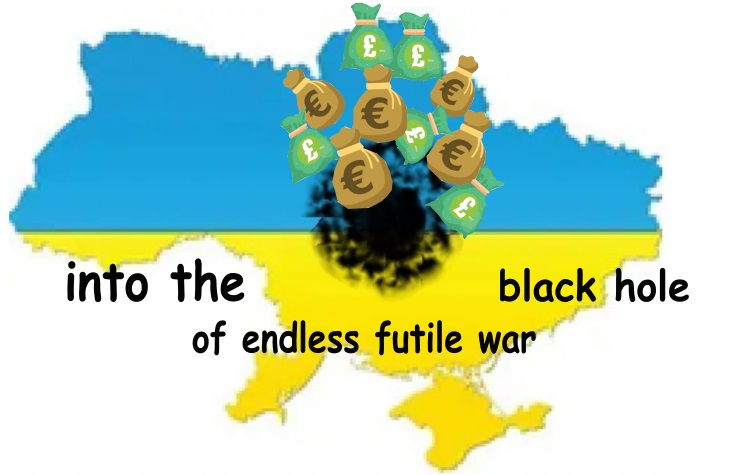
Europe has a pittance of America’s wealth to fund continuation of the war. Yet, the Starmer, Macron, Merz trio endlessly bleat that Ukraine can prevail, even get back its massive lost territory now forever part of Russia, if only they provide Ukraine more, more, more. They fear monger that Russia will come for them next unless they’re defeated in Ukraine. No responsible historian, political scientist or retired diplomat (without a job to protect) would support that delusional view.
Two things are certain. The economies and political stability of the UK, France, and Germany are being severely undermined by their leaders’ refusal to negotiate the war’s end, acknowledging Russia’s valid security concerns. Second, Ukraine descends deeper into failed state status, losing more cannon fodder and territory, every day the war grinds on.
What is not certain if Starmer, Macron and Merz do not come to their senses, is whether nuclear confrontation between Russia and NATO can be avoided. All 3 need to be forced to watch ‘Forrest Gump’ to learn that ‘Stupid is as stupid does.
As the licensing team dug in, Oklo couldn’t provide the supporting analysis for many of its basic safety assumptions
As the licensing team dug in, Oklo couldn’t provide the supporting analysis for many of its basic safety assumptions
A Silicon Valley startup called Oklo is leading the charge to bring nuclear power back to the US with small reactors. Its backers have wealth and political connections that could undermine nuclear safety.
When Oklo Inc., a nuclear power startup, applied in 2020 to operate its first reactor, the company rested largely on outsize ambition. Its MIT-educated co-founders, a married couple named Jacob and Caroline DeWitte, lived in a mobile home park in Mountain View, California, in space 38. Oklo, which had only 20 full-time employees, wanted to build small reactors across the country, transforming the way towns and industries are powered. To realize that dream, it needed the US Nuclear Regulatory Commission to say the company’s design was safe.
Two years later, Oklo had failed to pass even the first step of the approval process. In 2022, after months of frustrating back and forth, the NRC concluded that the company didn’t provide verifiable answers to the most basic safety questions. The regulator denied the application. A former senior agency official, who spoke on the condition of anonymity, says Oklo “is probably the worst applicant the NRC has ever had.”
For Jake DeWitte, the denial was maddening. He still grows visibly agitated when recounting the moment. “They completely screwed up,” he says. By the end, Caroline says, the agency “became kind of malicious, frankly.”
In 2025, Oklo’s reactor design is still unlicensed. But, in a sign of how radically the safety landscape has changed for nuclear power, the company’s business promise seems bright. Oklo went public last year and now has a market value hovering around $20 billion. In May, Jake was in the White House when President Donald Trump signed four executive orders designed to herald a nuclear renaissance. “It’s a brilliant industry,” Trump said, DeWitte at his side.
The startup’s backers long had a Plan B: If Oklo couldn’t win approval from the agency charged with protecting the public from nuclear accidents, they would, essentially, go after the regulator, in much the way Uber Technologies Inc. and other Silicon Valley startups have obliterated regulatory roadblocks. One of the architects of Oklo’s attack-the-regulator strategy is a law professor-turned-venture capitalist with ties to the Koch empire. He says the public shouldn’t be worried.
The revival of nuclear power in the US has been predicted countless times since President Dwight D. Eisenhower’s Atoms for Peace program rose from the ashes of Hiroshima and Nagasaki. This version, though, is something never before seen. Rather than huge power stations built by engineering companies for giant utilities, a new breed of nuclear startup wants to commercialize reactors, some so small they could be carried on semitrucks, so mighty they could power the hungriest of artificial intelligence data centers. Not one of these so-called advanced reactors has yet to be built in the US, but their promise has touched off a dealmaking frenzy, with backing from tech giants including Amazon.com, Google, Meta Platforms and Microsoft. The US Department of Energy has announced a goal of having at least three of these reactors switched on by July 4 of next year.
Oklo’s power and influence in the MAGA era have let it seize the political moment
Oklo isn’t the most obvious company of the two dozen or so newcomers to have broken through as a front-runner. Bill Gates’ TerraPower LLC has been trying to develop an advanced reactor for almost two decades. Kairos Power LLC, backed by Google, has made quick progress through the government’s licensing process.
But Oklo’s power and influence in the MAGA era have let it seize the political moment. The company is backed by some of Silicon Valley’s most important leaders, including Sam Altman, co-founder of OpenAI. A former board member is now Trump’s secretary of energy. Critically, Oklo has capitalized on the deregulatory fever gripping Washington. The NRC, which became a target of Trump’s Department of Government Efficiency, or DOGE, has lost at least 195 staff since January, and efforts to strip the agency of key powers are underway.
For a half-century, the NRC has been the watchdog of an industry built on some of the most dangerous technologies ever known. Yet Oklo and its backers say that its reactors will be so small and safe, little NRC oversight is needed.
Even a year ago, this proposition would have been absurd. Experts say advanced reactors are indeed safer in some respects: Because they’re a third or less the size of traditional reactors and aren’t cooled by water circulating under immense pressure, a serious accident is less likely to spread radioactive debris across a major populace. But for anyone nearby—workers operating the plant, say, or soldiers on a military base powered by one—the dangers could be substantial.
“All these nuke bros who know nothing about operating a reactor, they just want a free pass,” says Allison Macfarlane, former chairman of the NRC. “They can have their free pass, but then they will have an accident.”…………………………………………………………………………………………………………………………………………………………………………….
Transatomic’s collapse left venture capital’s tech titans looking for a new standard bearer in their drive to disrupt nuclear power.
In January 2018, some of the country’s richest and most powerful descended on the desert resort town of Indian Wells, California, for three days of hobnobbing over canapés and golf. They had come for the annual donor retreat established by the chemicals-and-refining billionaires Charles and David Koch; before the weekend was out, they had pledged to spend more than $400 million to support the Kochs’ political influence operation, which counted governors, senators and state legislative leaders as foot soldiers.
Among those attending was a law professor-turned-venture capitalist named Salen Churi. Co-founder of a new Koch-backed VC firm called Trust Ventures, Churi explained the firm’s novel strategy as he worked the target-rich room for potential investors: identify startups facing steep regulatory challenges; solve them through litigation, advocacy and political influence; and then watch the profits roll in.
“Imagine a startup able to tap into the know-how of Koch from Day 1,” Churi said, according to news coverage of his presentation. The company’s first big investment, in mid-2018, was in Oklo. (Another investor in 2018 was Rothrock; he invested in Oklo around the same time that Transatomic folded.)……………………………………………..
…………………………………………………….. Eighty feet high and fashioned from 1-inch-thick steel plating, the shiny silver dome of the Experimental Breeder Reactor-II rises from the eastern Idaho sagebrush like a lost artifact of the Atomic Age. At one point, 52 test reactors of various types operated on this stretch of high desert. It’s the home of the Idaho National Laboratory, formerly known as Argonne-West, where nuclear power was born.
Nowadays, scientists, government officials, tourists and others have turned this site into a pilgrimage. (The filmmaker Oliver Stone paid a visit not long ago.) Some of them come to see or learn from the Experimental Breeder Reactor-II, or EBR-II, a sodium fast reactor that is considered by many to be the lab’s most successful attempt to revolutionize the way nuclear energy is created.
There’s a renewed belief that this long-forgotten technology—EBR-II was built six decades ago and decommissioned in the mid-1990s—holds the keys to a safer, more efficient nuclear industry. Adherents argue that the technology, unlike other reactors, is “passively safe”—so safe that in even some of the worst accident scenarios, a sodium fast reactor would shut down without human intervention.
Not far from the massive silver dome is a patch of government land where the DeWittes have staked their future. Little more than a sign and a couple of porta potties stashed amid the juniper bushes, this is where the two are planning to build Oklo’s reactor, Aurora, which they’ve described as a more modern version of the EBR-II. They have vowed that their reactor will share the same inherent safety characteristics.
Edwin Lyman, a physicist and director of nuclear power safety with the Union of Concerned Scientists, says the assumption that reactors like EBR-II are “passively safe” is misguided. “It’s gaslighting,” he says. Sodium fast reactors are notoriously difficult to operate, which accounts for the technology’s long history of accidents and meltdowns. Sodium leaks can create fires that spray a toxic sodium-oxide aerosol into the air. If the coolant comes into contact with water, hydrogen explosions can result in both the reactor itself and the power generation plant. And compared with light-water reactors, fast reactors leak neutrons that need extensive shielding to make them safe. “If something goes wrong, the potential for a Chernobyl-like escalating event is actually much higher than it is with light-water reactors,” Lyman says.
When Oklo submitted its first application to the NRC in 2020, the agency was under pressure from Congress and the industry to show it could license new reactors more efficiently. The agency’s licensing team was eager to begin what it called a Phase 1 review—essentially checking that the application is complete enough to move to a more rigorous scientific and safety evaluation. With an experienced company, Phase 1 usually takes about two months. “We thought we could get Oklo to that point in about six months,” says a former agency official familiar with the company’s application, who asked for anonymity to talk openly about the company’s application.
Major sticking points soon emerged. The company declared that, based on its extensive calculations, Aurora was one of the safest nuclear reactors in the world and there was no plausible accident that would result in a release of radiation into the environment. Yet the NRC staff identified important scenarios that Oklo didn’t appear to consider: What if undulating pipes from a sudden leak wrecked key systems? What if the seals of the reactor capsule failed, creating a pathway for radiation to reach the outside? The regulators also asked about the risk of flooding inside the reactor capsule, which the NRC said “may represent a potential criticality issue.” Nuclear experts say that’s a technical way of saying that the agency was worried about the possibility of an uncontrolled fission uncontrolled fission event, which could result in a dangerous steam explosion inside the reactor vessel.
As the licensing team dug in, Oklo couldn’t provide the supporting analysis for many of its basic safety assumptions, according to four officials who spoke to Businessweek about the application, as well as public NRC documents. In some cases, supporting files the company claimed to have were not available when the NRC tried to examine them, one official says.
“We needed the evidence that this reactor could be built and operated safely, and it just wasn’t forthcoming,” says one of the four officials.
Finally, in January 2022, the NRC denied Oklo’s application. By that point, the company had raised more than $25 million, and its dream of mass producing small nuclear reactors had seemed in reach. But at the NRC, the company never made it beyond Phase 1.
In a flashy video posted on YouTube last year, the DeWittes, clad in jeans, stroll across the high prairie near the Idaho National Laboratory. They’re introduced by a narrator whose tone mixes soothing and serious. “Meet the husband-and-wife engineering duo that discovered a game-changing technology buried in a government lab in Idaho,” the narrator says.
The six-and-a-half-minute video was published on the YouTube channel of a Utah-based organization called the Abundance Institute, identified on its website as “a mission-driven nonprofit focused on creating a space for emerging technologies.” In contrast to other pro-nuclear outfits including Third Way and the Breakthrough Institute, the Abundance Institute has been ferocious in its criticism of the NRC. In January its CEO penned an op-ed in the Wall Street Journal that labeled the regulator “lawless,” then followed up with social media posts declaring that it was time to abolish the agency.
What the videos and op-eds don’t disclose is that the Abundance Institute is Churi’s brainchild. He’s a co-founder and is listed as the institute’s treasurer in papers filed with the Utah secretary of state’s office. The same papers list, as an institute director, Derek Johnson. He’s a central player on the Kochs’ national political team and executive vice president at the Kochs’ umbrella group, Stand Together, which also published the Oklo video……………….
“The people who get one-cent electricity from nuclear don’t exist yet because we can’t give it to them yet,” Churi says. “We wanted to be the lobbyist for companies that don’t exist yet and for consumers who haven’t gotten the benefit of those technologies yet.”
The institute is so intertwined with the Koch family’s famed influence network that it’s hard to distinguish between the two. Many of its key employees, including the CEO, come from the Center for Growth and Opportunity at Utah State University, sometimes called “Koch U of the West,” a reference to a similar Koch-funded outfit at George Mason University in Virginia. Churi listed CGO’s offices as his address in papers that the Abundance Institute filed with the state. (Christopher Koopman, the institute’s CEO, called that a “clerical error.”)
Emails and other documents obtained through public records requests show that the Abundance Institute effectively serves as a front for Churi’s attack-the-regulator mission. As his team dissected federal regulations, Churi spotted language that might offer an opening. In 1956 the Atomic Energy Commission determined that because any apparatus designed to carry out a nuclear fission chain reaction can affect the health and safety of the public, it needs a federal license. Nuclear startups could argue that their reactors are so small and safe that they don’t present any risk to the public—and therefore fall outside federal jurisdiction. It was a long-shot position on the science, but the right court might just buy it. Churi and the team went to work.
They began looking for a nuclear startup willing to be the public face of the challenge. And, because a major goal of the lawsuit was to shift oversight of small nuclear reactors from the NRC to the states, they recruited state attorneys general as lead plaintiffs.
For the first, they linked up with Bret Kugelmass, founder and CEO of Last Energy Inc., which boasts a reactor design using off-the-shelf components. Kugelmass has little to no experience in nuclear engineering—his last company used drones to map farmland—but he has a popular energy podcast and is close to the MAGA movement. One Oklo investor called him “like Elon in his take-no-prisoners approach to getting stuff done.”
For the second, Churi and the Abundance Institute targeted officials in Texas and Utah, two states where Churi spends much of his time and knows, he says, “a lot of folks who work in both politics and the AG offices.” In Utah, the Abundance Institute served as a conduit to those officials, leveraging the Koch family’s political clout as well.
According to emails obtained by Businessweek through a public records request, Utah Senate President J. Stuart Adams and an aide met with Abundance Institute staff in the fall of 2024. Afterward, the aide wrote Utah Chief Deputy Attorney General Dan Burton, saying the institute was “gathering clients for a nationwide lawsuit against the NRC.” Then he added, “We think it would be worth you/the AG’s time to explore their proposal and determine whether it makes sense for Utah to join.”…………………………………………………..
As the team prepared to file its federal lawsuit, a second and potentially more direct path to gutting the NRC opened up. The country had just voted to send Donald Trump back to the White House.
In February 2023, Jake DeWitte flew spur of the moment to Denver in hopes of buying a Kia Telluride he’d found online. His trip changed the future of the company.
Denver happened to be the home base for Chris Wright, founder and CEO of the second-largest fracking company in North America, Liberty Energy Inc. …………………………….
The timing was propitious, and not only for Oklo. The buy-in—structured as a $10 million strategic investment by Liberty—was finalized just weeks before an announcement in June that one of Altman’s companies, a special purpose acquisition company (SPAC), would take Oklo public. Jake says Oklo extended its last VC round to allow Liberty to get in under the wire, making Liberty one of the last early investors before Oklo began trading on the New York Stock Exchange the following year, with an initial valuation of $850 million……………………………………………..
In his first departmental directive, issued in early February, Wright declared that “the long-awaited American nuclear renaissance must launch during President Trump’s administration.” The directive said that the Energy Department would work to enable the “rapid deployment” of next-generation nuclear technology.
Meanwhile, Trump began a slash-and-burn campaign to hollow out federal regulators, including nominally independent agencies such as the Securities and Exchange Commission and the National Labor Relations Board. By April, drafts of four executive orders targeting the regulation of nuclear energy began circulating…………………………………………………………………..
One person who did get input on the orders, by her own account, was Isabelle Boemeke, a Brazilian model and self-described nuclear energy influencer who goes by the moniker Isodope. Author of a book on nuclear power titled Rad Future, Boemeke is famous for mobilizing her social media followers in a successful drive to keep the Diablo Canyon nuclear power plant north of Los Angeles operating beyond its scheduled retirement. She’s also the spouse of Joe Gebbia, one of the founders of Airbnb and a prominent DOGE figure………………………………………….
……………………………………….. The federal lawsuit against the NRC was filed in December, with Texas and Utah as lead plaintiffs. By March the NRC had responded with a strongly worded motion asking the court to dismiss the lawsuit.
Behind the scenes, something very different was happening. At the end of April, the plaintiffs’ lead lawyer, a partner at the boutique firm Boyden Gray named Michael Buschbacher, emailed his colleagues with good news. The NRC was ready to discuss a settlement and potentially agree to the plaintiffs’ biggest demand: the initiation of a rule-making process with the goal of exempting some small nuclear reactors from traditional NRC oversight and handing it to state agencies instead.
Meanwhile, the startups have another pathway to get their reactors to market quickly. In August, the Department of Energy announced a pilot program with the goal of deploying at least three untested reactors by next July 4, to coincide with the 250th anniversary of the signing of the Declaration of Independence. Oklo plans to license its first Aurora reactor through this program, the company says, although its reactor won’t be ready by then.
The company says it still plans to license future reactors via the NRC, but it will benefit from a radically changed agency. The executive orders signed in May push the agency to approve new reactor licenses within 18 months and to further expedite approval for any power plants already OK’d by the Defense Department or the Energy Department, two entities that have never licensed a commercial reactor. The NRC’s Advisory Committee on Reactor Safeguards, a panel of experts who weigh in on safety issues posed by new designs, had its remit pared back to the “minimum necessary” required by law.
………………………..both the NRC’s general counsel and its executive director of operations were pushed out, two people familiar with those moves said. Trump fired one commissioner in mid-June, and a second resigned a few weeks later.
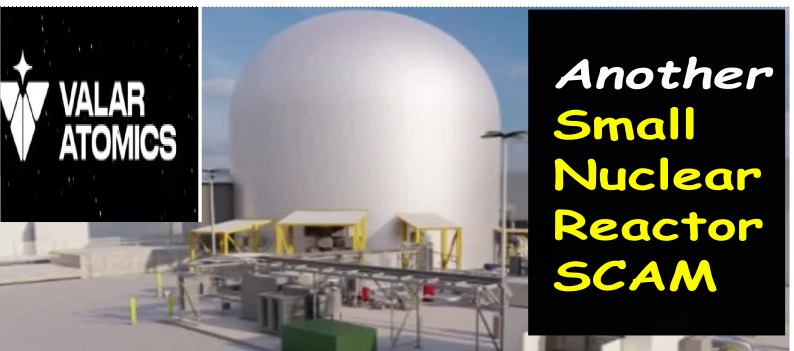
………………………………………… At a recent meeting with NRC employees, DOGE representatives handed out black ballcaps emblazoned with “Make Nuclear Great Again” alongside the logo for another nuclear startup, Valar Atomics, according to a former agency official familiar with the meeting……………………………………………………………………………
A huge nuclear deal announced by the Trump administration earlier this week provides a multi-billion-dollar incentive for the US government to issue permits and approvals for new Westinghouse reactors – an unprecedented structure that critics say poses environmental and safety risks.
Under the agreement with Westinghouse Electric’s owners, Canada-based Cameco and Brookfield Asset Management , the US government will arrange financing and help secure permits and approvals for $80 billion worth of Westinghouse reactors.
In return, the plan offers the US government a path to a 20% share of future profits and a potential 20% stake in the company if its value surpasses $30 billion by 2029.
The deal is one of the most ambitious plans in US atomic energy in decades, underscoring President Donald Trump’s agenda to maximize energy output to feed booming demand for artificial intelligence data centers.
But the financial incentives risk clouding regulatory scrutiny aimed at preventing nuclear accidents, according to safety advocates and regulatory experts. “The things that could go wrong are Three Mile Island, Chernobyl and Fukushima,” said Greg Jaczko, a former chairman of the Nuclear Regulatory Commission, pointing to three of the worst nuclear power accidents on record.
“All have causes tied to insufficient regulatory independence.”
The White House said concerns about safety were unfounded.
“The regulatory regime remains the same and is not compromised. There’s nothing in the deal about regulatory changes,” the White House said in an emailed statement. Westinghouse owner Cameco declined to comment. Brookfield and Westinghouse did not respond to messages requesting comment.
TD Cowen analysts told clients in a research note this week they expect Westinghouse to have 10 new large-scale reactors – enough gigawatts to power several million homes – under construction by 2030 as a result of the deal.
Typically, it takes around a decade for a new nuclear power plant to get built, largely due to the rigorous permitting requirements and enormous costs and complexities associated with construction.
Patrick White, a nuclear regulatory and technology expert at the Clean Air Task Force, said effective regulation did not need to be a slow or extended process and there were benefits to moving more efficiently.
“Ensuring that nuclear regulation is also timely and predictable is in the best interest of both companies and the public,” White said. Todd Allen, a nuclear expert at the University of Michigan, said the design of Westinghouse reactors is well established, but questioned how fast projects could progress.
“With that aggressive timeline, and demand for the reactors around the world, I wonder if there is a big enough workforce to handle all of these projects,” Allen said.
DELAYS TO PREVIOUS US PROJECT
Westinghouse’s last US-based nuclear project, building two nuclear reactors at the Vogtle power plant in Georgia, forced the company into bankruptcy protection in 2017.
The two reactors were about seven years behind schedule and cost about $35 billion, more than double the original estimate of $14 billion.
Patty Durand, director of nonprofit Georgians for Affordable Energy, has spent years analyzing that project and said she fears fast permitting would overlook the risks associated with climate change.
She said severe droughts have forced operators to curtail nuclear power in Europe and the United States to avoid overheating their reactors. Westinghouse also had a slew of problems related to the modular design of its AP1000 reactors, such as some parts’ dimensions being wrong when they arrived on site. The AP1000 would also be used for the new reactors, built from prefabricated parts and assembled on site.
Edwin Lyman, a physicist at the Union of Concerned Scientists, said he fears the Trump administration will exert too much power over the Nuclear Regulatory Commission to get the new reactors permitted.
“If the White House fully takes over the NRC and it is no longer at all independent, then it could be used just as a tool for sweeping deals for which the White House could accelerate licensing on its preferred projects regardless of their actual safety implications, and that’s a dangerous thing,” Lyman said.
while the determination of Ukraine to fight is unquestionable, the emotional belief in the west that this will overcome the enormous social and economic challenges the country faces in an extended attritional war with Russia is wildly misplaced.
A full 180 degree change in diplomatic course by Europe would require an acceptance that the war against Russia was unwinnable, and that Russia’s underlying concerns – namely Ukrainian neutrality – would finally have to be accepted as a political reality.
Better for EU leaders to accept this now although, of course, they won’t.
Caught between a rock and a hard place, European leaders continue to deny the obvious realities of the dire situation in Ukraine, which will only worsen over time. Yet I see no evidence of any willingness to change course, despite the obvious political hazard they face and the increasingly grim forecast for Europe and for Ukraine should they continue to push an unwinnable war.
The war in Ukraine is now entirely dependent on the ability of European states to pay for it at a cost of at least $50bn per year, on the basis of Ukraine’s latest budget estimate for the 2026 fiscal year. Ukraine itself is bankrupt and has no access to other sources of external capital, beyond that provided by the governments sponsoring the ongoing war.
That then brings the conversation back to the expropriation of $140bn in assets currently frozen in Belgium which the Commission would like to use for a reconstruction loan. The term ‘reconstruction loan’ is itself disingenuous, on the basis that any expropriated Russian assets would not be used for reconstruction, but rather to fund the Ukrainian war effort. Indeed. Chancellor Merz of Germany recently suggested that the fund could allow Ukraine to keep fighting for another three years.
The most likely scenario, in the terrible eventuality that war in Ukraine did continue for another three years is that the Russian armed forces would almost certainly swallow up the whole of the Donbass region – comprising Donetsk and Luhansk oblasts. This – Ukraine’s departure from the Donbas – appears to be the basis of President Putin’s conditions for ending the war now, together with a Ukrainian declaration of neutrality and giving up any NATO aspirations. More likely, the Russian Armed forces might also capture additional swathes of land in Zaporizhia and Kherson oblasts, and also in Dnipropetrovsk, where they have made recent incursions.
So, there is a strong likelihood, at the currently slow pace of the war effort in which Russia claims small pieces of land on a weekly basis, that three years from now Ukraine would have to settle for a peace that was even more disadvantageous to it than that which is available now, having lost more land, together with potentially hundreds of thousands of troops killed or injured.
Logically, European policymakers would be able to look into the future to see this grim predicament with clear eyes and encourage Zelensky to settle for peace now.
But European policy is driven by two key considerations. Firstly, an emotional belief that an extended war might so weaken Russia that President Putin was forced to settle on unfavourable terms. The idea of a strategic defeat of Russia – which is often spoken by European politicians – however, doesn’t bear serious scrutiny.
Russia doesn’t face the same considerable social and financial challenges that Ukraine faces. Its population is much larger and a wider conscription of men into the Armed forces has not been needed – Russia can recruit sufficient new soldiers to fight and, indeed, has increased the size of its army since 2022. Ukraine continues to resort to forced mobilisation of men over the age of 25, often using extreme tactics that involve busifying young men against their will from the streets.
Critically, Russia could likely continue to prosecute the war on the current slow tempo for an extended period of time without the need for a wider mobilisation of young men, which may prove politically unpopular for President Putin domestically. Yet, the longer the war continues, Ukraine will come under increasing pressure, including from western allies, to deepen its mobilisation to capture young men below the age of 25 to shore up its heavily depleted armed forces on the front line.
There has been considerable resistance to this so far within Ukraine. Mobilising young men above the age of 22 would prove unpopular for President Zelensky but it would also worsen Ukraine’s already catastrophic demographic challenge: 40% of the working age population has already been lost, either through migration or through death on the front line and that number will continue to go south, the longer the war carries on.
Russia’s financial position is considerably stronger than Ukraine’s. It has very low levels of debt at around 15% of GDP and maintains a healthy current account surplus, despite a narrowing of the balance in the second quarter of 2025. Even if Europe expropriates its frozen assets, Russia still has a generous and growing stock of foreign exchange reserves to draw upon, which recently topped $700bn for the first time.
Russia’s military industrial complex continues to outperform western suppliers in the production of military equipment and munitions. In the currently unlikely event that Russia started to fall into the red in terms of its trade – what commentators in the west refer to as destroying Russia’s war economy – it would still have considerable scope to borrow from non-western lenders, given the strength of its links with the developing world, aided by the emergence of BRICS.
Ukraine is functionally bankrupt because it is unable to borrow from western capital markets, on account of its decision to pause all debt payments. With debt expected to reach 110% in 2025, even before consideration of any loan backed by frozen Russian assets, it depends entirely on handouts from the west. Ukraine’s trade balance has continued to worsen throughout the war, reinforcing its dependence on capital injections from the west to keep its foreign exchange reserves in the black.
So while the determination of Ukraine to fight is unquestionable, the emotional belief in the west that this will overcome the enormous social and economic challenges the country faces in an extended attritional war with Russia is wildly misplaced.
So, let’s look at the rational explanation for Europe’s continued willingness to prolong the fight in Ukraine. The uncomfortable truth is that Europe’s political leaders have boxed themselves into this position because of a hard boiled determination not to concede to Russia’s demands in any peace negotiations. Indeed, there is a steadfast and immovable objection to talking to Russia at all, which has been growing since 2014.
However, across much of Europe, the political arithmetic is turning against the pro-war establishment with nationalist, anti-war parties gaining ground in Central Europe, Germany, France, Britain and even in Poland. And despite positive overtures made by President Trump towards negotiation with President Putin, Trumpophobia provides another brake on the European political establishment shifting its position.
So, changing course now and entering into direct negotiations with Russia would have potentially catastrophic consequences, politically, for European leaders, which they must surely be aware of. A full 180 degree change in diplomatic course by Europe would require an acceptance that the war against Russia was unwinnable, and that Russia’s underlying concerns – namely Ukrainian neutrality – would finally have to be accepted as a political reality.
On this basis, European politicians would face the prospect of explaining to their increasingly sceptical voters that their strategy of defeating Russia had failed, having spent four years of war saying at all times that it would eventually succeed. And that would lead potentially to internationalist governments falling across Europe starting in two years when Poland and France will again go to the polls, and in 2029 when the British and German governments will face the voters.
There are deeper issues too. An end of war would accelerate the process of admitting Ukraine into the European Union with potentially disastrous consequences for the whole financial basis of Europe. The European Commission will face the prospect of accepting that a two-tier Europe is inevitable, admitting Ukraine as a member without the financial benefits received by existing member states; for probably understandable reasons, this would cause widespread resentment within Ukraine itself, having sacrificed so much blood to become European, precipitating widespread internal dissent and possibly conflict in a disgruntled country with an army of almost one million. Alternatively, the European Commission would need to redraw its budget and face huge resistance from existing Member States, who would lose billions of Euros each year in subsidies to Ukraine.
Caught between hoping for a strategic defeat of Russia which any rational observe can see is unlikely, and accepting the failure of their policy, causing a widespread loss of power and huge economic and political turmoil, Europe’s leaders are choosing to keep calm and carry on. If they had any sense, the likes of Von der Leyen, Merz, Starmer or Macron would change tack and pin their hopes on explaining away their failure before the political tide in Europe evicts them all from power. But I see no signs of them having the political acumen to do that. So we will continue to sit and wait, while storm clouds grow ever darker over Europe.
Letter to Ft.com : It almost feels impolite to point out some simple facts regarding your story “Westinghouse and US government strike $80bn nuclear reactor deal”. We are celebrating what Donald Trump hails as its “great friendship” between US and Japan, in addition to the election of our first female prime minister, and an $80bn nuclear reactor deal — struck by Washington and funded by Tokyo — all under the bright banner of what appears to be a new era for our two countries.
Yet the simple fact remains, whether we like it or not, that Japan is one of the most seismically active countries in the world, which makes operating nuclear power plants far riskier there than in the US.
The major nuclear players in both countries — Westinghouse and Tokyo Electric Power (Tepco) — have faced bankruptcy or financial collapse. All publicly available, reliable data shows that solar power is significantly cheaper than new nuclear energy. Both our countries’ leaders have issued similarly nationalistic statements on green energy — President Trump even signed executive orders on “Unleashing American Energy”, implicitly pointing to a common foe, namely China.
Warren Buffett once wrote that “more money has been stolen with the point of a pen than at the point of a gun”. These nuclear power plant projects will consume billions of dollars over the coming decades — long after today’s leaders have left office. Future generations are being made the “collateral” for decisions taken today.
The Office for Nuclear Regulation (ONR) has approved EDF’s plans for the decommissioning of its Hinkley Point B nuclear power station, despite wide-ranging concerns raised by organisations, including the Environment Agency, which regulates the nuclear sector.
The National Press Club of Australia lists 81 corporate sponsors on its website.
Twenty-one of them (listed below) are either part of the global arms industry or actively working on its behalf.
Ten are multinational weapons manufacturers or military services corporations. They include the world’s two biggest weapons makers, Lockheed Martin and Raytheon (RTX); British giant BAE Systems; France’s largest weapons-maker, Thales; and US weapons corporation Leidos – all five are in the global top 20. BAE Systems, which is the largest contractor to the Department of Defence, received $2 billion from Australian taxpayers last year.
In 2023, these five corporations alone were responsible for almost a quarter – 23.8 per cent (US$150.4 billion (A$231.5 billion)) – of total weapons sales (US$632 billion (A$973 billion)) made by the world’s top 100 weapons companies that year.
Last year, UN experts named Lockheed Martin, BAE Systems, RTX (Raytheon) and eight other multinationals in a statement, warning them that they risked being found in violation of international law for their continued supply of weapons, parts, components and ammunition to Israeli forces. The experts called on the corporations to immediately end weapons transfers to Israel. None has done so.
Another of the Club’s sponsors – Thales – is being investigated by four countries for widespread criminal activity in three separate corruption probes. In a fourth, long-running corruption case in South Africa, the country’s former president, Jacob Zuma, is now in court, alongside Thales, being tried on 16 charges of racketeering, fraud, corruption and money laundering in connection with arms deals his government did with Thales.
Global expert Andrew Feinstein has documented his extensive research into the arms industry. He told Undue Influence that wherever the arms trade operates, it “increases corruption and undermines democracy, good governance, transparency, and the rule of law, while, ironically, making us less safe”.
Undue Influence asked the Press Club’s CEO, Maurice Reilly, what written policies or guidelines were in place that addressed the suitability and selection of corporations proposing to become Press Club sponsors.
Mr Reilly responded: “The board are informed monthly about…proposals and have the right to refuse any application.”
Wherever the arms trade operates it “increases corruption and undermines democracy, good governance, transparency, and the rule of law, while, ironically, making us less safe”. – Andrew Feinstein, author of Shadow World: Inside the Global Arms Trade
National Press Club board
The National Press Club, established by journalists in 1963, is an iconic Australian institution. It is best known for its weekly luncheon addresses, televised on the ABC, covering issues of national importance, after which the speaker is questioned by journalists.
The Club’s board has 10 directors led by Tom Connell, political host and reporter at Sky News, who was elected president in February following the resignation of the ABC’s Laura Tingle.
The other board members are: vice president Misha Schubert (CEO, Super Members Council of Australia; formerly with The Age and The Australian); treasurer Greg Jennett (ABC); Steve Lewis (senior adviser, SEC Newgate; formerly with NewsCorp and the Financial Review); Jane Norman (ABC); Anna Henderson (SBS); Julie Hare (Financial Review); Andrew Probyn (Nine Network); Gemma Daley (Media & Government Affairs, Ai Group); and Corrie McLeod, the sole representative from an independent media outlet – InnovationAus.
At least two board members have jobs that involve lobbying.
Long-term board member Steve Lewis works as a senior adviser for lobbying firm SEC Newgate, which itself is a Press Club sponsor and also has as clients the Press Club’s two largest sponsors: Westpac and Telstra. SEC Newgate has previously acted for several Press Club sponsors, including Serco (one of the arms industry multinationals listed below), BHP, Macquarie Bank, Tattarang, and Spirits & Cocktails Australia Inc.
Gemma Daley joined the board a year ago, having started with Ai Group as its head of media and government affairs four months earlier. Ms Daley had worked for Nationals’ leader David Littleproud, former prime minister Malcolm Turnbull and former treasurer Joe Hockey and, before that, for media outlets the Financial Review and Bloomberg. Ai Group has a significant defence focus and promotes itself as “the peak national representative body for the Australian defence industry”. The group has established a Defence Council and in 2017 appointed a former assistant secretary of the Defence Department, Kate Louis, to lead it. The co-chairs of its Defence Council are senior arms industry executives. One of them, Paul Chase, is CEO of Leidos Australia, a Press Club sponsor.
Undue Influence asked Ms Daley for comment on several aspects related to her position on the board, including whether she has had to declare any conflicts of interest to date. She responded: “Thanks for the inquiry. I have forwarded this through to Maurice Reilly. Have a good day.”
Given the potential for conflicts of interest to arise, as happens on any board, Undue Influence had already asked the Press Club CEO what written policies or guidelines existed to ensure the appropriate management of conflicts of interest by board members and staff.
Mr Reilly responded:
The Club has a directors’ conflict register which is updated when required. Each meeting, board members and management are asked if they have conflicts of interest with the meeting agenda. We have a standard corporate practice that where a director has a conflict on an agenda item they excuse themselves from the meeting and take no [part] in any discussion or any decision.
Undue Influence is neither alleging nor implying inappropriate or illegal behaviour by anyone named in this article. Our objective, as always, is to shine a light on, and scrutinise, the weapons industry’s opaque engagement in public life in Australia.
While Mr Reilly declined to disclose the Club’s sponsorship arrangements with Westpac and Telstra, citing “commercial in confidence” reasons, The Sydney Morning Herald reported earlier this year that Westpac paid $3 million in 2015 to replace NAB as the Press Club’s principal sponsor.
The SMH article, “Westpac centre stage at post-budget bash”, on Treasurer Jim Chalmers’ National Press Club address in the Great Hall of Parliament House in late March, added:
[Westpac] … gets more than its money’s worth in terms of access. New-ish chief executive Anthony Miller got the most coveted seat in the house, between Chalmers and Prime Minister Anthony Albanese… Finance Minister Katy Gallagher and Deputy Prime Minister Richard Marles were also on the front tables.
Westpac occupied prime real estate in the Great Hall, with guests on its tables including Treasury Secretary Steven Kennedy, Department of Prime Minister and Cabinet boss Glyn Davis, Attorney-General Mark Dreyfus, Housing Minister Clare O’Neil and Labor national secretary and campaign mastermind Paul Erickson…
Communications Minister Michelle Rowland was on the Telstra table.
Mr Reilly told Undue Influence that all the other corporate sponsors pay $25,000 per year, with a few paying extra as partners in the Club’s journalism awards.
The 21 arms industry and related sponsors therefore contribute an annual $525,000 to the Press Club’s coffers. This is 23% of the $2.26 million revenue it earns from “membership, sponsorship and broadcasting”, the Club’s largest revenue line, as shown in its 2024 financial statement.
“The National Press Club of Australia proudly partners with organisations that share our commitment to quality, independent journalism,” says the Club’s website.
“Aligning your brand with the National Press Club is an opportunity for unparalleled engagement in the Australian political debate and announces that your organisation is part of the business culture in Canberra.”
In response to Undue Influence’s questions about the Club’s cancellation of a planned address by the internationally acclaimed journalist Chris Hedges (covered below), Mr Reilly stated that: “For the avoidance of doubt [sponsors] do not receive any rights to speak at the club [nor are they] able to influence decisions on speakers.”
Sponsors may not be granted a right to speak, but they are sometimes invited to speak, with their status as sponsors not always disclosed to audiences.
When the Club’s second largest sponsor, Telstra, spoke on 10 September, both Club president Tom Connell and Telstra CEO Vicki Brady noted the corporation’s longstanding sponsorship.
Sponsors may not be granted a right to speak, but they are sometimes invited to speak, with their status as sponsors not always disclosed to audiences.
When the Club’s second largest sponsor, Telstra, spoke on 10 September, both Club president Tom Connell and Telstra CEO Vicki Brady noted the corporation’s longstanding sponsorship.
Compare this with two addresses given by $25,000 corporate sponsors – Kurt Campbell (former US deputy secretary of state, now co-founder and chair of The Asia Group) who gave an address on 7 September; and Mike Johnson, CEO of Australian Industry and Defence Network (AIDN), who gave an address on 15 October. Neither the Press Club nor the speakers disclosed the companies’ sponsorship of the Press Club.
While both speakers are considered experts in their field, the sponsorships should have been disclosed as a matter of public accountability.
“Priority seating and brand positioning”
On its website, the Club also promotes additional benefits of corporate sponsorship, including, “Brand association with inclusion on our prestigious ‘Corporate Partners’ board and recognition on the National Press Club of Australia website”.
The Club also promises corporate sponsors that they will receive “priority seating and brand positioning” at its weekly luncheon addresses, as the following examples show. (As principal sponsor, the logo of Westpac appears on every table and on the podium.)
The local subsidiary of British giant BAE Systems has benefited handsomely from its modest $25,000 annual sponsorship. It had the best table – behind the microphone from which journalists asked questions – at then defence minister Peter Dutton’s address in November 2021. The BAE logo appeared on the national public broadcaster – which has strict rules against advertising – eight times during the half-hour question period following Mr Dutton’s address, giving BAE Systems extended ‘brand positioning’ with its target market: senior politicians, defence public servants and military officers.
On 28 November 2023, Minister for Defence Industry Pat Conroy spoke about AUKUS. The logos of Press Club sponsors DXC Technology and Deloitte were also well-situated for the camera during question time. Both companies are significant contractors to the Defence Department. Deloitte also works for the weapons industry, including BAE Systems.
Cancelling Chris Hedges
The Press Club recently drew significant attention to itself after it cancelled a planned address by the Pulitzer-prize-winning American journalist, and former long-term war correspondent, Chris Hedges. Mr Hedges reported for The New York Times for 15 years, from 1990-2005, including long stints as its bureau chief in the Middle East and in the Balkans. He was to have appeared at the Press Club on 20 October.
However, in late September, Press Club CEO Maurice Reilly cancelled Mr Hedges’ appearance. This occurred two weeks after the Club was sent details of what Mr Hedges proposed to cover, including a link to an article he had entitled The Betrayal of Palestinian Journalists. In that article, Mr Hedges wrote:
Israel has murdered 245 journalists in Gaza by one count and more than 273 by another… No war I covered comes close to these numbers of dead. Since Oct 7 [2023], Israel has killed more journalists “than the US Civil War, World Wars I and II, the Korean War, the Vietnam War (including the conflicts in Cambodia and Laos), the wars in Yugoslavia in the 1990s and 2000s, and the post-9/11 war in Afghanistan, combined”.
Mr Hedges also intended to cover what he has described as the “barrage of Israeli lies amplified and given credibility by the Western press”, examples of which he provides in the above article.
Following a scathing post from Mr Hedges about the Press Club’s cancellation of his address, and significant public disquiet, the Press Club issued a statement denying it had come under external pressure to cancel his address. Inexplicably, the Press Club also denied it had confirmed the Hedges address. This claim was easily checked and soon reported to be false. Undue Influence has seen the emails showing that the Press Club had confirmed the address.
National Press Club funded by companies profiting from genocide
In July, Francesca Albanese, UN Special Rapporteur on the situation of human rights in the Palestinian territories, issued a report explaining how the corporate sector had become complicit with the State of Israel in conducting the genocide.
Her report also noted that arms-making multinationals depend on legal, auditing and consulting firms to facilitate export and import transactions to supply Israel with weapons.
Numerous members of the public posted their concerns on the Press Club’s Facebook page. Here are three examples: [on original]
Four of the world’s largest accounting, audit and consulting firms – all of which have arms industry corporations as clients – are sponsors of the Press Club: KPMG, Accenture, Deloitte and EY. Until recently, PwC counted among them.
EY (Ernst & Young) has been Lockheed Martin’s auditor since 1994. EY is also one of two auditors used by Thales, and has been for 22 years. Deloitte has been BAE Systems’ auditor since 2018. PricewaterhouseCoopers (PwC) – a Press Club sponsor until 2024 – has been Raytheon’s auditor since 1947.
Lockheed Martin’s supply to Israel of F-16 and F-35 fighter jets and C-130 Hercules transport planes, and their parts and components, along with Hellfire missiles and other munitions, has directly facilitated Israel’s genocide.
Raytheon’s (RTX) supply of guided missiles, bombs, and other advanced weaponry and defence systems, like the Iron Dome interceptors, also directly supports Israel military capability.
In England, BAE Systems builds the rear fuselage of every F-35, with the horizontal and vertical tails and other crucial components manufactured in its UK and Australian facilities. It also supplies the Israeli military with munitions, missile launching kits and armoured vehicles, while BAE technologies are integrated into Israel’s drones and warships.
Thales supplies Israel’s military with vital components, including drone transponders. Australian Zomi Frankcom and her World Central Kitchen colleagues were murdered by an Israeli Hermes drone, which contain Thales’ transponders. Yet, echoing Australia, France claims its military exports to Israel are non-lethal.
National Press Club sponsors from military-industrial complex
# Rankings compiled by SIPRI at December 2023 (published December 2024)
^ NOTE ON US COMPANIES: The Defence Department procures weapons/military goods directly from Lockheed Martin, RTX (Raytheon) and other US corporations via the US Government’s Foreign Military Sales program. The value of FMS contracts is not included in the table.
Note on the use of the word ‘genocide’
Three independent experts appointed by the UN’s Human Rights Commission – the Commission of Inquiry on the Occupied Palestinian Territory and Israel – issued a report in September that concluded Israel is committing genocide in Gaza. One of the Commissioners – Chris Sidoti – speaking at the Press Club recently, said the Commission’s report will remain the most authoritative statement on this issue until the world’s highest authority, the International Court of Justice, makes its ruling.
Nuclear weapons have made the world safe for hypocrisy and unsafe in every other respect. Astride the nonsense that is nuclear apartheid – the forced separation of the states that are permitted to have nuclear weapons and those that do not – sits that rumpled, crumpled creature called the Treaty on the Non-Proliferation of Nuclear Weapons (NPT). For decades, the nuclear club has dangled an unfulfilled promise to eventually disarm their arsenals by encouraging non-nuclear weapons states to pursue peaceful uses of the atom. Preference, instead, has been given to enlarging inventories and developing ever more ingenious and idiotic ways of turning humans, and animal life, into ash and offal.
Little wonder that some countries have sought admission to the club via the backdoor, avoiding the priestly strictures and promises of the NPT. The Democratic Republic of North Korea is merely the unabashed example there while Israel remains even less reputable for its coyness in possessing weapons it regards as both indispensable and officially “absent”. Other countries, such as Iran, have been lectured, and bombed into compliance. Again, more hypocrisy.
On such rocky terrain, the US President’s instruction to his newly named Department of War to resume nuclear testing is almost prosaic, if characteristically inaccurate. On social media, Donald Trump declared that, “Because of other countries testing programs, I have instructed the Department of War to start testing our Nuclear Weapons on an equal basis. That process will begin immediately.” Strictly speaking, North Korea remains the black sheep of an otherwise unprincipled flock to consistently test nuclear weapons since the late 1990s, while 187 states have added signatures to the Comprehensive Test Ban Treaty (CTBT).
Other streaky details included the assertion that the US had a nuclear weapons inventory larger than that of any other state, something “accomplished” through “a complete update and renovation of existing weapons” during Trump’s first term.
The announcement did cause a titter among the nuclear chatting classes. “For both technical and political reasons,” remarked Heather Williams, Director of the Project on Nuclear Issuesand a Senior Fellow in the Defense and Security Department at the Center for Strategic and International Studies, “the United States is unlikely to return to nuclear explosive testing any time soon.” She did concede that Trump’s post pointed “to increasing nuclear competition between the United States, Russia, and China.” Whatever the bluster, and however many bipartisan calls to do so, the current administration had been “slow to seriously invest in this nuclear competition.”
This line of reasoning is telling. The issue for Williams is not to decry the resumption of a type of testing – the explosive, high-yield variety – less than to chide the President for not taking a serious interest in joining the great game of nuclear modernisation with other powers. “Nuclear testing is not the best step forward in that competition, but it should raise alarm within the administration about the state of the United States’ nuclear enterprise and the urgency of investing in nuclear modernization.” And there you have it.
Rebeccah L. Heinrichs of the Hudson Institute does some speculative gardening around the announcement with the same sentiment. Trump might have meant, she writes in the Wall Street Journal, “conducting flight tests of delivery systems.” Maybe he was referring to explosive yield-producing tests. And those naughty Russians and Chinese were simply not behaving in terms of keeping their nuclear arsenals splendidly inert. With the familiar nuclear hawkishness that occupies the world of stubborn lunacy, Heinrichs is unequivocal about what the administration should do: “Whatever Mr. Trump means by ‘testing,’ the US should work urgently to improve and adapt its nuclear deterrent. To do this, Mr. Trump should let the last arms-control treaty between the US and Russia – the New Strategic Arms Reduction Treaty, or New Start – expire in February.” This, it seems, counts for good sense.
Other commentators tended to fall into the literal school of Trump interpretation. There is no room for allegory, symbolism or fleeting suggestion there. Tilman Ruff, affiliated with the International Physicians for the Prevention of Nuclear War, among other groups, offers his concerns. “If Trump is referring to the resumption of explosive nuclear testing, this would be an extremely unfortunate, regrettable step by the United States,” he fears, writing in that blandest of fora, The Conversation. “It would almost inevitably be followed by tit-for-tat reciprocal announcements by other nuclear-armed states, particularly Russia and China, and cement an accelerating arms race that puts us all in great jeopardy.”
Ruff points out the obvious dangers of such a resumption: the risks of global radioactive fallout; the risk, even if the tests were conducted underground, of “the possible release and venting of radioactive materials, as well as the potential leakage into groundwater.” Gloomy stuff indeed.
Others did the inevitable and, in Trump’s case, inconsequential thing of trying to correct America’s highest magistrate by appealing to hard boiled facts. “Nothing [in the announcement] is correct,” grumbled Tom Nichols from The Atlantic. “Trump did not create a larger stockpile by ‘updating’ in his first term. No nation except North Korea has tested nuclear weapons since the 1990s.”
At The New York Times, W. J. Hennigan took some relish in pointing out that the province of nuclear testing lay, not with the Pentagon, but the Energy Department. But then came the jitters. “The president’s ambiguity is worrisome not only because America’s public can’t know what he means, but because America’s adversaries don’t.”
The problem goes deeper than that, and Hennigan admits that the breaking of the moratorium on nuclear testing is always something peaking around the corner. The US, for instance, is constructing the means of conducting “subcritical nuclear tests, or underground experiments that test nuclear components of a war head but stop short of creating a nuclear chain reaction, and therefore, a full weapons test.”
Even if the Trump announcement was to be taken seriously – and there is much to suggest that it be confined to a moment of loose thinking in cerebral twilight – dangers of any resumption of full testing will only marginally endanger the planet more than matters stand. The nuclear club, with its Armageddon fanciers and Doomsday flirters, remains snobbishly determined to keep the world in permanent danger. An arms race is already taking place, however euphemised it might be.









 nuclear-news