“Mr President, take our critical minerals”: Albanese in the White House

In an attempt to seize a share of a market currently dominated by China, Albanese has willingly placed Australia’s rare earths and critical minerals at the disposal of US strategic interests. The framework document focusing on mining and processing of such minerals is drafted with the hollow language of counterfeit equality.
the next annexation of Australian control over its own affairs by the US
28 October 2025 Dr Binoy Kampmark, https://theaimn.net/mr-president-take-our-critical-minerals-albanese-in-the-white-house/
The October 20 performance saw few transgressions and many feats of compliance. As a guest in the White House, Australian Prime Minister Anthony Albanese was in no mood to be combative, and US President Donald Trump was accommodating. There was, however, an odd nervous glanceshot at the host at various points.
The latest turn of events from the perspective of those believing in Australian sovereignty, pitifully withered as it is, remains dark. In an attempt to seize a share of a market currently dominated by China, Albanese has willingly placed Australia’s rare earths and critical minerals at the disposal of US strategic interests. The framework document focusing on mining and processing of such minerals is drafted with the hollow language of counterfeit equality. The objective “is to assist both countries in achieving resilience and security of minerals and rare earths supply chains, including mining, separation and processing.” The necessity of securing such supply is explicitly noted for reasons of war or, as the document notes, “necessary to support manufacturing of defense and advanced technologies” for both countries.
The US and Australia will draw on the money bags of the private sector to supplement government initiatives (guarantees, loans, equity and so forth), an incentive that will cause much salivating joy in the mining industry. Within 6 months “measures to provide at least $1 billion in financing to projects located in each of the United States and Australia expected to generate end product for delivery to buyers in the United States and Australia.”
The inequality of the agreement does not bother such analysts as Bryce Wakefield, Chief Executive Officer of the Australian Institute of International Affairs. He mysteriously thinks that Albanese did not “succumb to the routine sycophancy we’ve come to expect from other leaders”, something of a “win”. With the skill of a cabalist, he identified the benefits in the critical minerals framework which he thinks will be “the backbone for joint investment in at least six Australian projects.” The agreement would “counter China’s dominance over rare earths and supply chains.”
Much of what was agreed between Trump and Albanese was barely covered by the sleepwalking press corps, despite the details of a White House factsheet. There were more extorting deals extracted from Canberra, with agreements to purchase US$1.2 billion in Anduril unmanned underwater vehicles and US$2.6 billion worth of Apache helicopters. Of particular significance was the agreement to push Australia’s superannuation funds to increase investments in the US to US$1.44 trillion by 2035, which would increase the pool by US$1 trillion. “This unprecedented investment will create tens of thousands of new, high paying jobs for America.
Back in Australia, attention was focused on other things. The mock affair known as the opposition party tried to make something of the personal ribbing given by Trump to Australia’s ambassador to the United States, Kevin Rudd. Small minds are distracted by small matters, and instead of taking issue with the appalling cost of AUKUS with its chimerical submarines, or the voluntary relinquishment of various sectors of the Australian economy to US control, Sussan Ley of the Liberal Party was adamant that Rudd be sacked. This was occasioned by an encounter where Trump had turned to the Australian PM to ask if “an ambassador” had said anything “bad about me”. Trump’s follow up remarks: “Don’t tell me, I don’t want to know.” The finger was duly pointed at Rudd by Albanese. “You said bad?” inquired Trump. Rudd, never one to manage the brief response, spoke of being critical of the president in his pre-ambassadorial phase but that was all in the past. “I don’t like you either,” shot Trump in reply. “And I probably never will.”
This was enough to exercise Ley, who claimed to be “surprised that the president didn’t know who the Australian ambassador was.” This showed her thin sheet grasp of White House realities. Freedom Land’s previous presidents have struggled with names, geography and memory, the list starting with such luminaries as Ronald Reagan and George W. Bush. Not knowing the name of an ambassador from an imperial outpost is hardly a shock.
The Australian papers and broadcasters, however, drooled and saw seismic history in the presence of casual utterance. Sky News host Sharri Markson was reliably idiotic: “The big news of course is President Trump’s meeting with Albanese today and the major news story to come out of it is Trump putting Rudd firmly in his place.” Often sensible in her assessments, the political columnist Annabel Crabb showed she had lost her mind, imbibing the Trump jungle juice and relaying it to her unfortunate readers. “From his humble early days as a child reading Hansard in the regional Sunshine State pocket of Eumundi, Kevin Rudd has been preparing for this martyrdom.”
Having been politically martyred by the Labor Party at the hands of his own deputy Julia Gillard in June 2010, who challenged him for being a mentally unstable, micromanaging misfit driving down poll ratings, this was amateurish. But a wretchedly bad story should not be meddled with. At the very least, Crabb blandly offered a smidgen of humour, suggesting that Albanese, having gone into the meeting “with the perennially open chequebook for American submarines, plus an option over our continent’s considerable rare-earths reserves” was bound to come with some human sacrifice hovering “in the ether.”
In this grand abdication of responsibility by the press and bought think tankers, little in terms of detail was discussed about the next annexation of Australian control over its own affairs by the US. It was all babble about the views of Trump and whether, in the words of Australian Foreign Minister Penny Wong, Rudd “did an extremely good job, not only in getting the meeting, but doing the work on the critical minerals deal and AUKUS.” For the experts moored in antipodean isolation, Rudd had either been bad by being disliked for past remarks on the US chief magistrate, or good in being a representative of servile facilitation. To give him his due, Wakefield was correct to note how commentators in Australia “continue to personalise the alliance” equating it to “an episode of The Apprentice.”
It’s Not a Ballroom. It’s a Bunker.

The billionaires have gone bunkers. …..every action indicates that they’re not just preparing for collapse, they’re betting on it, they’re driving it. They want it to happen. We’re already crossing tipping points, like the loss of the coral reefs. Things we predicted for the 2040s are happening now.

Trump serves as the figurehead of a deeply paranoid technocratic network who sees the world collapsing, because they collapsed it. They plan to wage wars from their cyberbunkers, at home and abroad.
And there’s a reason.
Jessica Wildfire, Sentinel Intelligence, October 27 2025
The Trump administration has torn down the East Wing to build a new ballroom. Despite all the noise, everyone seems to be overlooking a simple fact.
As a piece in The Hill mentions in passing, the east wing hides a bunker. Roosevelt built the bunker during WWII, after Pearl Harbor, and he used the east wing specifically to cover it up. The bunker has served as an emergency operations center ever since. They don’t care what sits on top of it. That’s an afterthought.
Traditionally, the First Lady uses it.
Tiny corners of the internet are whispering that the demolition has nothing to do with a ballroom. It has everything to do with upgrading the bunker. Since they’re hardening the bunker, they might as well build Trump the ballroom of his dreams, the perfect place to run crypto schemes and host corrupt dictators.
Trump’s niece Mary, a vocal critic, has confirmed that the regime is simply using the ballroom as a cover for new bunker plans. Sources have also informed CBS News that the bunker upgrades will definitely happen during the ballroom’s construction. You can read about all of that here.
So, there you go.
If you don’t believe in conspiracies: When Roosevelt’s administration was building the first bunker, they also lied to the public about it. They said they were renovating the east wing to put in a museum. They knew they were fibbing.
The president technically has more than one bunker. There’s the first one built by Roosevelt’s administration, and a second one under the north lawn, and potentially a whole network of subterranean tunnels and command centers throughout D.C., stretching all the way into the Virginia mountains. They run hundreds of feet deep. The second one, under the White House Lawn, contains its own air supply.
It also has a food and water cache.
The media frequently primes the public to salivate over plush bunkers while dismissing the motivations for them as “paranoia.” Meanwhile, actuaries have warned world leaders that current estimates of the climate crisis are deeply misleading. In reality, 3C of global warming will drop the global GDP by 50 percent and kill billions. As a report by The Guardian summarizes: “At 3C or more of heating by 2050, there could be more than 4 billion deaths, significant sociopolitical fragmentation worldwide, failure of states (with resulting rapid, enduring, and significant loss of capital), and extinction events.” That’s right, 3C of warming equals 4 billion deaths. Climate research increasingly points at 3-4C of warming as the new likely scenario. In practical terms, we’ve already crossed the 1.5C threshold, a decade earlier than expected.
We’ll likely breach 2C by the end of the decade, and by then things will look bad enough that life will look and feel like collapse. It won’t be theoretical or hypothetical anymore. It’s going to be a lived experience for many of us.
That’s why they’re building bunkers.
It’s not exactly surprising that someone like Trump would want an upgraded bunker where he plans to spend more time hanging out as the world falls apart. Everyone from Sam Altman to Mark Zuckerberg are doing it. Zuckerberg has reportedly spent $300 million on his bunker, which just happens to match the amount Trump has raised to pay for his bunker, ahem, I mean, his ballroom.
They’re not just making the Spartan bomb shelters of yore.
They’re installing premium sanctuaries. Their demands have spawned an entire industry that builds luxury bunkers. These bunker companies are building their clients everything from underground sports car garages and swimming pools to movie theaters and virtual golf courses. They’re building fabrication workshops. They’re building arsenals. They’re building drone hatches. As one bunker builder puts it, “The scale and complexity of these environments have expanded dramatically, evolving far beyond survivalist shelters into fully integrated, high-comfort retreats.”
Will Trump’s bunker have a virtual golf course?
I wouldn’t doubt it.
The press casts doubt on the Trump regime’s timeline, saying there’s almost no chance they’ll actually finish before he leaves office. Of course, they’re basing that on what’s “normal.” Nothing normal is happening under this administration. As we’ve seen, when the super rich put their minds to it, they can accomplish almost anything with a swiftness that leaves everyone’s jaws on the floor.
For example:
Elon Musk’s AI company partnered with Nvidia to build the Colossus supercomputer near Memphis. It took them about four months, after estimates said it would take years. Experts consider it a superhuman feat. Now look at the speed they’re attacking the “ballroom” with. They’ve already completely torn down the old east wing. They’re not wasting any time on this thing, are they?
Consider who’s paying for it.
From The Guardian:
Donors for the proposed ballroom include a slew of major tech companies, including Apple, Amazon, Meta, Microsoft and Google. Defense contractors and communications companies have also pitched in, including Lockheed Martin, Palantir, T-Mobile and Comcast.
These corporations have accumulated $350 million for construction. The biggest tech companies in the world are paying hundreds of millions for… a ballroom? Defense contractors are chipping in?
No, I don’t think so…
Companies like Palantir don’t dabble in ballrooms. They’re in the business of building mass surveillance software, artificial intelligence suites, and drones. In fact, the U.S. military recently signed a $10 billion contract with Palantir for new toys. They’ve signed contracts with several big tech companies, including Google, Meta, and OpenAI. Even Amazon is quietly starting partnerships with the defense industry.
As we recently noted here, Silicon Valley has taken a hard military turn over the last year. The Trump administration has even created a “technical innovation unit” that’s recruiting CEOs and project managers from the same major tech companies that are funding the east wing construction. Tech investment in military tech has spiked 33 percent. They’re clearly preparing for all kinds of wars, especially urban ones.
Of course, Mary Trump makes the big mistake of dismissing the bunker as yet another sign of a fragile ego, and not a dark omen.
It’s a dark omen.
You don’t spend hundreds of millions on a structure with a bunker underneath it simply because you’re a paranoid loon with a big ego. Big military tech companies certainly don’t foot the bill for it. Don’t get me wrong, Trump is definitely a paranoid loon with a big ego. So is Peter Thiel and Russell Vought. But these aren’t the paranoid loons of ten years ago. They’re the paranoid loons of the 2020s, the ones who understand the depths of the climate crisis, the ones who lived through a pandemic, the ones watching the collapse take shape and all of the civil unrest it’s inspiring.
These bunkers have become their own perverse status symbols, with super rich families trying to top each other in terms of luxury and spectacle. Some families have built bunkers with moats, with underground race tracks for their kids, inside bamboo forests, and I suspect one or two have theme parks and shopping malls. The Kardashians tried to build a bunker with an underground spa.
Trump’s bunker tells us something.
They know.
As we’ve discussed here, the super rich and their political puppets are fully aware of what’s going on with the climate crisis. Big tech companies have largely dropped their climate pledges. So have the big banks and investment firms. They’re all going full steam ahead with coal and gas, and they’re rebooting nuclear plants, too. They’re doing it to power their AI fantasies, because they desperately want to replace people with robots while starving us and unleashing a pandora’s box of diseases. They know what’s in the latest climate reports. They know “there’s no future.” They sell hope to the masses, while quietly preparing for the end of the world. The mainstream media, and the Mary Trumps of the world, write them off as paranoid.
It’s so much worse than that.
The billionaires have gone bunkers. As we document here every week, every action indicates that they’re not just preparing for collapse, they’re betting on it, they’re driving it. They want it to happen. We’re already crossing tipping points, like the loss of the coral reefs. Things we predicted for the 2040s are happening now.
What else?
Consider what’s going on in South America…………………………………….
Trump serves as the figurehead of a deeply paranoid technocratic network who sees the world collapsing, because they collapsed it. They plan to wage wars from their cyberbunkers, at home and abroad.
You may have also seen stories that Trump is contemplating a third term. Yes, we already know it’s unconstitutional. But this Trump, often called “Trump 2.0,” has even less regard for the constitution than he did in 2020.
Everything they’ve done so far indicates that they’re planning to seize control of elections by 2026, and certainly by 2028. By then, it won’t matter what’s constitutional. The Thiels and Voughts will run Trump as long as they can, until he literally keels over dead, either in office or at one of his rallies, and then they’ll replace him with Vance. By then, they’ll have a firm grip on blue cities and polling places. If Trump never gets to enjoy his ballroom bunker, I’m sure Vance will use it.
So, if you were planning to take over the government, invade major cities, preside over a deep recession, nurture new pandemics, start wars with other countries for their resources, and potentially invade Canada, all while the planet’s climate breaks down into a chaotic mix of droughts, dust storms, heat waves, and hurricanes that ultimately collapse the GDP by 50 percent and kill billions of people….
Wouldn’t you want a cool new bunker?
What we should be talking about after watching Bigelow’s ‘A House of Dynamite’ nuclear thriller.
It’s hard to avoid wondering how the change in leadership and the loss of expertise within the government would affect decision-making today.
Damage limitation in nuclear war is fundamentally a mirage.
By Mark Goodman | October 25, 2025,
Mark Goodman is a former senior scientist at the US State Department who specialized in nuclear policy—nuclear energy, nuclear nonproliferation,…
Kathryn Bigelow’s new film, A House of Dynamite, presents a compelling, Rashomon-style dissection of a moment of crisis from three different perspectives. Other nuclear wonks have praised the film for exposing the dangers of nuclear weapons. While the film is a work of cinematic art in its own right, Bigelow’s main objective is to make the audience reflect on those dangers and discuss how to deal with them.
Surprise attack, realistic response. The film gets many important facts right. Chiefly, it illustrates the dilemmas and paradoxes of nuclear deterrence. Deterrence is supposed to prevent war, but it depends on making the threat of nuclear war credible enough that it deters actions that could lead to war. In normal times, when tensions are low, deterrence can contribute to stability; in times of crisis, it can prompt decision makers to act with greater caution. But crises can also create a “use it or lose it” pressure to launch nuclear weapons while it’s still possible. The decision time can be painfully short—19 minutes in this movie. As one character puts it in the film, the choice is between suicide—launching a retaliatory strike knowing the response will be devastating—and surrender. This is why President Barack Obama’s Nuclear Posture Review in 2010 put a premium on giving the president more time to decide.
The movie also shows the machinery of government as it faces a crisis. It presents the drama first at the operational level: soldiers and watch officers going from routine to “What the heck?” in the blink of an eye. A single long-range missile is heading to Chicago from northeast Asia—probably from North Korea, but it could be Russia or China. The second iteration brings in a sprawling array of experts and policy advisors as they seek to understand what is happening, the choices, and the consequences.
The third iteration shows decision makers—the defense secretary and the president—suddenly facing an urgent dilemma with no good choices. In the movie, the scenario jumps to “DEFCON 2,” which is the second-highest state of military readiness for which armed forces are on high alert and could deploy and engage in combat within six hours. And when the interception fails, the scenario moves to “DEFCON 1,” the maximum readiness posture when an attack is imminent or already underway. I’ve never been that close to a crisis—DECON 2 was ordered only once during the Cuban Missile Crisis, and DEFCON 1 is without precedent—but the human and institutional dynamics at each level seemed plausible. It’s hard to avoid wondering how the change in leadership and the loss of expertise within the government would affect decision-making today.
But for all it gets right, the film also muddles some key points……………..
Illusion of ‘damage limitation.’ The film brings to mind current debates over whether the United States needs more nuclear weapons to simultaneously deter Russia and China, particularly as China’s stockpile is growing by roughly a hundred warheads a year. The conventional wisdom seems to be that the United States does, based on arcane calculations of what deterrence requires, which in turn are based on policy assumptions about what nuclear weapons are for.
It turns out that what drives the numbers is not what one might think of as the primary role of nuclear weapons—to deter a nuclear attack against the United States. Rather, the numbers are based on the secondary role of trying to limit damage to the United States if deterrence fails. Damage limitation makes sense in principle, but in practice is virtually impossible, and trying to limit damage can do more harm than good. According to the logic of damage limitation, the United States would launch a preemptive attack to destroy the other side’s nuclear weapons and limit their ability to destroy the United States. This notion of preemption is what creates the use-it-or-lose-it pressure, and that pressure gets worse when the United States designs its nuclear forces to emphasize the ability to strike first over the ability to ride out the attack and then retaliate.
Damage limitation in nuclear war is fundamentally a mirage.
If even a small number of nuclear weapons survive a first strike, they could still wreak massive devastation. A nuclear power cannot escape its own vulnerability. There’s a saying that the first casualty of war is the war plan, and nuclear war is no exception. Any use of nuclear weapons would fundamentally change the nature of a conflict. Everything, including the scenarios and dilemmas confronting decision makers, would be transformed in unpredictable ways. Catastrophe might not be inevitable, but it would loom at every turn. It is this incalculable danger—not the calculations of the planners—that is the unavoidable essence of nuclear deterrence.
Missile defense myth. A House of Dynamite also gets the futility of missile defense right, but it does not explain why. Sure, the limited defense system failed in the film, but one could argue we could do better. Wouldn’t President Donald Trump’s proposed Golden Dome defend the United States against a nuclear attack? As counterintuitive as it sounds, the answer is no. Worse, it would be futile and dangerous.
Golden Dome is futile because it’s always going to be easier and cheaper for the attacker to overwhelm, spoof, or circumvent any missile defense system.
Take Russia’s war against Ukraine for example: Russian missiles can relatively easily hit Ukrainian cities and infrastructure, while Russian ground forces are at a standstill. The attacker’s advantage is magnified for intercontinental-range missiles, which are faster and harder to hit, and any failure to intercept a nuclear warhead would be disastrous.
And missile defense is dangerous because, if paired with a nuclear force structure designed to preempt, it can magnify the temptation to use that force to strike first. ………………………………
I spent most of my career in government trying to prevent the spread of nuclear weapons and avoid nuclear war. After the Cold War, the world seemed to lose interest in nuclear weapons. Arms control and risk reduction became niche topics for a narrow group of insiders and experts. Bigelow’s A House of Dynamite is a welcome and useful reminder that the dangers of nuclear weapons not only never went away, but they have been growing in recent years. Hopefully, this renewed attention will stimulate a rethinking of the United States’ nuclear posture so that the danger of possessing and deploying nuclear weapons does not outweigh the threats they are meant to deter.https://thebulletin.org/2025/10/what-we-should-be-talking-about-after-watching-bigelows-a-house-of-dynamite-nuclear-thriller/?utm_source=ActiveCampaign&utm_medium=email&utm_content=What%20we%20should%20be%20talking%20about%20after%20%20%20A%20House%20of%20Dynamite&utm_campaign=20251024%20Monday%20Newsletter
Report: Israel Launched Airstrike in Gaza on Saturday After Getting US Approval.

The IDF has killed at least 93 Palestinians in Gaza since the ceasefire went into effect
by Dave DeCamp | October 26, 2025, https://news.antiwar.com/2025/10/26/report-israel-launched-airstrike-in-gaza-on-saturday-after-getting-us-approval/
Israel launched an airstrike in Gaza on Saturday after notifying the US and getting approval to launch the attack, the Israeli news site Ynet has reported.
The Israeli military launched the strike in the Nuseirat Refugee Camp in central Gaza, claiming it targeted a member of Palestinian Islamic Jihad (PIJ) who was planning an attack on the IDF, a claim PIJ strongly denied.
PIJ said in a statement that the claim that its military wing, the al-Quds Brigades, was preparing an attack was “a pure false claim and fabrication through which the occupation seeks to justify its aggression and violation of the ceasefire.” PIJ, which supported the ceasefire deal, called on mediating countries to “compel” Israel to stop its attacks on Gaza.
The strike wounded four Palestinians, according to the al-Awda Hospital. “The hospital has received four injured people following the Israeli occupation’s targeting of a civilian car in the al-Ahli Club area in Nuseirat Camp in central Gaza,” the hospital said.
The Ynet report said the alleged PIJ operative who was targeted was wounded, not killed. According to Israeli sources, the strike came after Israel passed intelligence to the US, and the attack was only launched after coordination with US Central Command (CENTCOM), which included notifying CENTCOM Commander Adm Brad Cooper. CENTCOM has established a military post in southern Gaza where it is overseeing the Gaza ceasefire.
US Middle East envoy Steve Witkoff was also briefed on the strike right after it was launched. The attack marked the first time that Israel and the US used a new mechanism to coordinate on military action in Gaza under the ceasefire deal. Hamas, a signatory to the ceasefire deal, called the Israeli strike a “clear violation” of the agreement.
In response to the report and criticism of the US-Israel relationship, Israeli officials said they were coordinating with the US but insisted Israel doesn’t need “approval” to bomb Gaza.
According to the Palestinian news agency WAFA, Israel also launched a drone strike on Friday that killed two Palestinians, and there’s no sign that Israel coordinated with the US on the attack. Gaza’s Health Ministry said on Sunday that Israeli forces have killed at least 93 Palestinians in Gaza since the ceasefire went into effect, including four who were killed over the previous 48 hours.
US Deploying Aircraft Carrier Strike Group Near Venezuela as Regime Change Push Heats Up
by Dave DeCamp | October 26, 2025 , https://news.antiwar.com/2025/10/26/us-deploying-aircraft-carrier-strike-group-near-venezuela-as-regime-change-push-heats-up/
The US military is deploying an aircraft carrier to the waters near South America as the Trump administration continues its military buildup in the Caribbean and its push toward war with Venezuela.
Sean Parnell, a US War Department spokesman, wrote on X on Friday that the USS Gerald Ford and its strike group, which includes five destroyers, will be heading to US Southern Command’s area of responsibility to “bolster US capacity to detect, monitor, and disrupt illicit actors and activities that compromise the safety and prosperity of the United States homeland and our security in the Western Hemisphere.”
The Gerald Ford has been deployed in the Mediterranean Sea, and according to a ship tracker, it is currently off the coast of Croatia in the Adriatic Sea. According to USNI News, it would take the aircraft carrier at least a week to reach SOUTHCOM’s area of responsibility from Croatia.
The deployment of the aircraft carrier and accompanying warships will mark a significant escalation of US military power in the region amid reports that the US is soon planning to bomb Venezuela with the goal of ousting President Nicolas Maduro.
The US has been stepping up the military pressure on Venezuela by flying bombers near its coast and continuing its bombing campaign against alleged drug boats in the region. A US Navy destroyer, the USS Gravely, has also arrived in Trinidad and Tobago for joint exercises near the coast of Venezuela.
Also on Friday, War Secretary Pete Hegseth announced the 10th US airstrike against a boat that he claimed was carrying drugs. The Pentagon has provided no evidence to back up its claims about what the boats it has been bombing are carrying, and has also not provided any information about the identities of the people it has been killing, who are labelled as “narco-terrorists” to justify their extrajudicial execution.
Hegseth said the latest boat strike targeted a vessel in the Caribbean and killed six “narco-terrorists,” bringing the total number of people extrajudicially executed by the US military in the region since September 2 to 43, according to numbers released by the Trump administration. “If you are a narco-terrorist smuggling drugs in our hemisphere, we will treat you like we treat Al-Qaeda. Day or NIGHT, we will map your networks, track your people, hunt you down, and kill you,” the US war chief said.
President Trump and his top officials have framed the bombing campaign and push toward war with Venezuela as a response to the large number of overdose deaths in the US, but the deaths are primarily caused by Fentanyl and other opioids, which do not come from Venezuela. A US official has told Drop Site News that US intelligence has assessed that little to no of the fentanyl trafficked to the United States is being produced in Venezuela.
Trump officials have also been claiming that the boats they are targeting are attempting to carry drugs to the US, but the official speaking to Drop Site said many of the boats targeted for strikes do not even have the requisite gasoline or motor capacity to reach US waters.
Furious French fairies challenge nuclear plans.

Frogtifa is just catching on in Portland, but French protesters have used street theatre for years. This summer’s anti-nuclear actions were no exception, reports Reseau sortir du nucléaire
Editor’s note: In her forthcoming book — No To Nuclear. Why Nuclear Power Destroys Lives, Derails Climate Progress and Provokes War — to be published by Pluto Press next March, Linda Pentz Gunter describes the creative resistance of French protesters, including the anti-nuclear movement. “The French anti-nuclear movement,” she writes, “has engaged in protests that deliver considerable numbers, abundant creativity — and sometimes a lot of useful tractors as well. France also has a long theatrical tradition, and French anti-nuclear activists have invariably embraced that as well. They understand that street theater is an attention-getter. They also know it makes protesting a lot more fun.” The chapter features the “goat ZAD” mobilized by the Piscine Nucléaire Stop collective. Since then, they have “escalated,” as sortir du nucléaire describes in this article.
From July 18 to 20, 2025, in La Hague, “HARO” made its grand debut: three days of meetings and mobilization around nuclear waste and local communities. Nearly a thousand people from the Cotentin region and elsewhere responded to the call of the Piscine Nucléaire Stop collective to participate in round tables, workshops, concerts, screenings, hikes, and, of course, the big demonstration by the Fées furieuses (Furious Fairies). The event took place in a festive atmosphere of determination.
The name of the event set the tone: derived from Norman customary law, the interjection “Haro” was used to demand justice, even in the face of powerful oppressors. In the Cotentin Peninsula, it is Orano [owner of the La Hague reprocessing facility] that is attempting to impose its Aval du Futur mega-project.
The event, located on the La Hague plateau in a field lent by local farmers committed to the anti-nuclear cause, offered a breathtaking view of the Orano plant, when the fog didn’t interfere with the festivities. The typical La Hague weather did not discourage participants who had come from all over France to take part in meetings against waste, nuclear power, and the nuclear chain, with an intersectional approach………………………………………………………………………………..
The packed program then continued throughout the weekend: between round tables on feminist anti-nuclear struggles, discussions on ways of living in contaminated areas, workshops on the legacy of decolonial struggles, the manufacture of radio transceivers, etc., there was something for everyone.
As for the cooperative village [established for the events], it was as varied as the program itself: local and national associations committed to the anti-nuclear cause or installation projects such as Atomic Marney, social struggle associations such as France Palestine Solidarité (Cherbourg branch), citizen laboratories, bookstores, and collectives from other environmental struggles, such as local committees of Soulèvements de la Terre.
The most courageous, who wanted to venture outside the meeting site, sometimes in pouring rain, were able to take part in the Randos Radieuses (Radiant Walks)…………………………………………………………..
Within this cultural program, the fight against Cigéo [the French nuclear waste entity] was highlighted with the screening of a film recounting ten years of struggle: Vivre et lutter à Bure entre 2015 et 2025 (Living and Fighting in Bure between 2015 and 2025), the documentary Les Bombes atomiques (The Atomic Bombs), which recounts a feminist highlight of the struggle in Bure, and the film Après les Nuages (After the Clouds) by the collective Les Scotcheuses
The highlight of the weekend was a demonstration on Saturday afternoon against Aval du Futur and, more broadly, the ever-increasing nuclearization of the region. In keeping with its offbeat and militant approach, the Piscine Nucléaire Stop collective decided to draw on the local legend of the little fairies and their method of collective self-defense armed with heather and gorse to confront an offense: the paving over of the last remaining primary moors on the La Hague plateau and the accumulation of nuclear waste by Orano.

A thousand people gathered to march against Orano’s project. The procession left the camp in sunny weather and headed for the village of Vauville, accompanied by a police presence and a helicopter dispatched for the weekend.
In a family atmosphere, the demonstrators and little fairies danced to the sounds of the Planète Boum Boum collective, chanted slogans concocted for the occasion, and sang to the tune of a summer camp song: “In my beautiful Cotentin, there will be no MOX, no swimming pools either, and no concrete either.”
The links between the struggles in Bure and La Hague were strengthened during this event, culminating in a concert by the Bure-based band Les Free’meuses, during which the audience was moved by their latest cover of Les Demoiselles de Rochefort: “We are twin struggles… “
In various ways throughout the weekend, activists from the east and west reiterated that “we don’t want radioactive waste dumps in La Hague, Bure, or anywhere else!”
The weekend ended with an evening concert and a final HARO as a cry of convergence of struggles to support social and environmental struggles as well as the struggle of the Palestinian people.
This article was first published in French by the Reseau sortir du nucléaire, a national network of French anti-nuclear organizations.
2
The Russia-Ukraine War – Security Lessons
An analysis informed by sociological approaches to risk management, https://www.peterlang.com/document/1436503
by Simon Bennett (Author) ©2025MonographsXXX, 268 Pages
History & Political Science Series: Systems Thinking for Safety, Volume 2
Summary
As the Russia-Ukraine War sees its fourth year, this book provides a timely analysis of the successes and failures of Ukraine’s campaign to expel Russian forces from sovereign Ukrainian territory. Lessons are drawn using sociological approaches to risk management such as systems-thinking, organising for high-reliability, latent and active error, mindfulness, groupthink, strategic empathy, passive and active learning, single and double-loop learning, isomorphic learning and active foresight. The aim of this book is to help Western nations improve their defences against, as former British Prime Minister Rishi Sunak put it, ‘An axis of authoritarian states with different values to ours’. Lessons range from the urgent need to improve the resilience of critical national infrastructure to the benefits of allowing front-line commanders greater decision-making freedom. If Western liberal democracy is to survive, the lessons of the Russia-Ukraine War must be actioned.
What Ends the SMR Bubble?

In the up leg of any hype cycle, bad news is somehow massaged away.
The downleg of the SMR hype cycle should be epic.
By Leonard Hyman & William Tilles – Oct 22, 2025, https://oilprice.com/Alternative-Energy/Nuclear-Power/What-Ends-the-SMR-Bubble.html
- Analysts warn that small modular reactors (SMRs) are caught in a classic boom-and-bust pattern.
- Despite promises of faster, cheaper builds, early SMR projects in China, Russia, and Argentina have suffered cost overruns of 300–700%.
- With hundreds of competing SMR technologies and no standardization, the market risks fragmentation and inefficiency.
We think the concept of the Small Modular Reactor (SMR) as a solution to many of our future energy needs is in the midst of a major bubble or hype cycle. Think of the latter as an inverted “V”. In the up leg, investors feel great about prospects and profits, which are, they believe, soon on the way. In the down leg, investor disappointment sets in as earlier financial forecasts are seen as pure fiction, with reality being much worse. In a way, this is how free markets with imperfect information work. The question is: what triggers the down leg in the hype cycle for SMRs? Our answer is the year 2029.
Power supply forecasts, as our readers know, are made in three to five-year increments. We think 2029 is the forecast year in which energy planners acknowledge reality. The fleet of SMRs expected to be in service in the first half of the next decade (2030-2035) simply won’t be there. And we believe this will trigger the down leg in the hype cycle. That’s our thesis, simply stated, and we’ll discuss why in a moment.
First, it helps to understand that the SMR is a reactive technology, meaning that its designers are reacting to a real problem. New gigawatt-scale nuclear plants take too long to build, and they’re too expensive. The last big nuclear plant built in the US, Plant Vogtle, cost three times its original budget and took twice as long as expected to build. The new French reactor at Flamanville was more than 200% over budget, also with extensive delays. Not the sort of experience to trigger a nuclear Renaissance.
This situation is what the SMR industry is responding to, saying that with modular, factory-built components, we can do nuclear new-builds much faster, hopefully in three to four years. As an aside, we should point out that construction firms may be able to build faster, but they can’t be cheaper than gigawatt-scale reactors because they’re engaging in an exercise of reverse economies of scale. What does this mean?
Let’s discuss this in terms of cars, not power plants, for a moment. The soccer parent goes to the new car showroom and says they need a car that seats eight. They purchase a minivan for $40,000. The capital cost to move each passenger is $5,000 ($40,000 divided by 8). A thrifty person goes to the same dealership but insists on only spending $20,000 and drives away in a slightly used two-seater. A thrifty person saved half as much on the total capital cost. But their cost to move each passenger ($20,000 /2) was twice as high, $5,000 vs $10,000. If we substitute the term kilowatts for “cost to move each passenger,” this demonstrates the issue. Like the bigger minivan, the smaller two-seater has to have all the same components as the bigger vehicle, only tinier.
We assume a similar logic applies in building new nuclear plants. Our guess is that electricity from SMRs will be at least 30% more expensive than best-in-class (on a cost basis) gigawatt-scale reactors based on relative capital costs. But the overall units, because they’re tinier, will cost less per reactor than gigawatt-scale reactors.
But we don’t think the cost differential between SMRs and gigawatt scale reactors will make all that much difference, and won’t turn the hype cycle, at least not for a while, because early adopters of SMRs will be relatively price insensitive buyers like the military in extremely remote locales, and inside the fence industrial users like large chemical plants which require both electricity and steam, such as the Dow Chemical refinery in Baytown, Texas.
And here is where we have real concerns about SMRs. Consider the astonishing array of new competing technologies and the variety of sizes, all falling under the rubric of SMRs. A tiny SMR today is less than one megawatt, and a large one is 300 MWs. There are way too many different sizes and technologies, many extremely well-financed, for us to speculate about winners and losers at this point. But this looks like an awful lot of competitors for a finite market. However, there are certain definitive things we can say. First, all this variety ignores the advice of nuclear engineers who advocate construction of standardized designs in decent numbers in order to enjoy cost reduction benefits for the nuclear fleet as a whole. Second, it would take over 1300 SMRs (assuming each had a capacity of 100 MW) to make a 10% impact on US power-generating capacity. (Total US generating capacity was 1,326,000 MW at the end of 2024.) The likelihood of completing so many projects within a few years is low.
JP Morgan’s 2025 energy report discussed SMRs on a global basis. There are only three completed SMRs in the world, one in China and two in Russia, with a fourth under construction in Argentina. The report noted cost overruns of 300% for China’s project, 400% for Russia’s, and 700% for Argentina’s. All units promised 3-4 year build times. It all took twelve years. When perusing the articles on the finances of these facilities, one finds the following explanations: design and manufacturing immaturity, lengthy periods for verification of passive safety systems, supply chain limitations in an immature industry, cost overrun challenges in FOAK (first of a kind) units. Sound familiar?
Let’s return to our original point about hype cycles and what makes them turn. Markets are like tolerant parents in a room full of children. They may tolerate a lot, but there are certain things they won’t stand for. Right now, the market seems to be indifferent to reactor size, technology, or even economics. Which is another way of saying financing to the industry remains available on very easy terms. And as investors, we would probably continue to play this from the long side at least for the near-term.
But the one thing investors won’t tolerate is if new SMRs experience the lengthy construction delays and eye-watering cost increases that have plagued new gigawatt-scale reactors. This early evidence, albeit skimpy, of just three new facilities, is not encouraging. But we don’t think investors in the West will worry. Not yet. In the up leg of any hype cycle, bad news is somehow massaged away. So for us, 2029 is the year forecasters in the West begin to acknowledge the impact of disappointing SMR construction delays (probably similar to delays experienced in China and Russia) and that the new SMRs that energy buyers expected “in the early 2030s” won’t be there. But it gets worse. The industry will then realize that by pursuing SMRs they got the same intolerably long construction periods and all the huge cost overruns, but at far worse price points, thereby jeopardizing the entire commercial viability of SMRs. The downleg of the SMR hype cycle should be epic.
We will give the last word to noted energy expert, Vaclav Smil, who said this in response to a question about the impact of SMRs: “Call me or send me an email once you see such wonders built on schedule, on budget, and in aggregate capacities large enough to make a real difference.“ He added that he didn’t expect a call for ten or twenty years.
The hidden military pressures behind the new push for small nuclear reactors
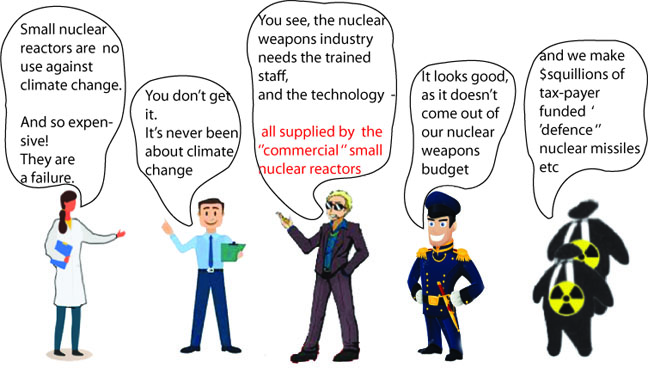
The neglected factor is the military dependence on civil nuclear industries.
By funding civil nuclear projects, taxpayers and consumers cover military uses of nuclear power in subsidies and higher bills – without the added spending appearing in defence budgets
October 28, 2025, Phil Johnstone, Visiting Fellow, School of Global Studies, University of Sussex; University of Tartu; Utrecht University, Andy Stirling, Professor of Science & Technology Policy, SPRU, University of Sussex Business School, University of Sussex
Donald Trump’s recent visit to the UK saw a so-called “landmark partnership” on nuclear energy. London and Washington announced plans to build 20 small modular reactors and also develop microreactor technology – despite the fact no such plants have yet been built commercially anywhere in the world.
The UK prime minister, Keir Starmer, promised these plans will deliver a “golden age” of nuclear energy that will also “drive down bills”. Yet the history of nuclear power has been decades of overhype, soaring costs and constant delays. Around the world, the trends point the wrong way.
So why the renewed excitement about going nuclear? The real reasons have less to do with energy security, or climate change – and far more to do with military power.
At first sight, the case may seem obvious. Nuclear supporters frame small modular reactors, or SMRs, as vital for cutting emissions, meeting rising demand for electricity from cars and data centres. With large nuclear plants now prohibitively expensive, smaller reactors are billed as an exciting new alternative.
But these days even the most optimistic industry analyses concede that nuclear – even SMRs – is unlikely to compete with renewables. One analysis in New Civil Engineer published earlier this year concluded that SMRs are “the most expensive source per kilowatt of electricity generated when compared with natural gas, traditional nuclear and renewables”.
Independent assessments – for instance by the formerly pro-nuclear Royal Society – find that 100% renewable systems outperform any energy system including nuclear on cost, flexibility and security. This helps explain why worldwide statistical analysis shows nuclear power is not generally linked to carbon emissions reductions, while renewables are.
Partly, the enthusiasm for SMRs can be explained by the loudest institutional voices tending to have formal pro-nuclear remits or interests: they include the industry itself and its suppliers, nuclear agencies, and governments with entrenched military nuclear programmes. For these interests, the only question is which kinds of nuclear reactors to develop, and how fast. They don’t wonder if we should build reactors in the first place: the need is seen as self-evident.
At least big nuclear reactors have benefited from economies of scale and decades of technological optimisation. Many SMR designs are just “powerpoint reactors”, existing only in slides and feasibility studies. Claims these unbuilt designs “will cost less” are speculative at best.
Investment markets know this. While financiers see SMR hype as a way to profit from billions in government subsidies, their own analyses are less enthusiastic about the technology itself.
So why then, all this attention to nuclear in general and smaller reactors in particular? There is clearly more to this than meets the eye.
The hidden link
The neglected factor is the military dependence on civil nuclear industries. Maintaining a nuclear armed navy or weapons programme requires constant access to generic reactor technologies, skilled workers and special materials. Without a civilian nuclear industry, military nuclear capabilities are significantly more challenging and costly to sustain.
Nuclear submarines are especially important here as they would very likely require national reactor industries and their supply chains even if there was no civil nuclear power. Barely affordable even vessel by vessel, nuclear submarines become even more expensive when the costs of this “submarine industrial base” is factored in.
Rolls-Royce is an important link here, as it already builds the UK’s submarine reactors and is set to build the newly announced civil SMRs. The company said openly in 2017 that a civil SMR programme would “relieve the Ministry of Defence of the burden of developing and retaining skills and capability”.
Here, as emphasised by Nuclear Intelligence Weekly in 2020, the Rolls-Royce SMR programme has an important “symbiosis with UK military needs”. It is this dependency that allows military costs (in the words of a former executive with submarine builders BAE Systems), to be “masked” behind civilian programmes.
By funding civil nuclear projects, taxpayers and consumers cover military uses of nuclear power in subsidies and higher bills – without the added spending appearing in defence budgets.
When the UK government funded us to investigate the value of this transfer, we put it at around £5 billion per year in the UK alone. These costs are masked from public view, covered by revenues from higher electricity prices and the budgets of supposedly civilian government agencies.
This is not a conspiracy but a kind of political gravitational field. Once governments see nuclear weapons as a marker of global status, the funding and political support becomes self-perpetuating.
The result is a strange sort of circularity: nuclear power is justified by energy security and cost arguments that don’t stand up, but is in reality sustained for strategic reasons that remain unacknowledged.
A global pattern
The UK is not unique, though other nuclear powers are much more candid. US energy secretary Chris Wright described the US-UK nuclear deal as important for “securing nuclear supply chains across the Atlantic”. Around US$25 billion a year (£18.7 billion) flows from civil to military nuclear activity in the US.
Russia and China are both quite open about their own inseparable civil-military links. French president Emmanuel Macron put it clearly: “Without civilian nuclear, no military nuclear, without military nuclear, no civilian nuclear.”
Across these states, military nuclear capabilities are seen as a way to stay at the world’s “top table”. An end to their civilian programme would threaten not just jobs and energy, but their great power status.
The next frontier
Beyond submarines, the development of “microreactors” is opening up new military uses for nuclear power. Microreactors are even smaller and more experimental than SMRs. Though they can make profits by milking military procurement budgets, they make no sense from a commercial energy standpoint.
However, microreactors are seen as essential in US plans for battlefield power, space infrastructure and new “high energy” anti-drone and missile weaponry. Prepare to see them become ever more prominent in “civil” debates – precisely because they serve military goals.
Whatever view is taken of these military developments, it makes no sense to pretend they are unrelated to the civil nuclear sector. The real drivers of the recent US-UK nuclear agreement lie in military projection of force, not civilian power production. Yet this remains absent from most discussions of energy policy.
It is a crucial matter of democracy that there be honesty about what is really going on.
Roll up, roll up for your free plutonium.

The 19-25 metric tons of plutonium Trump would be redirecting into the civil nuclear sector had previously been slated for permanent disposal as nuclear waste left over from the Cold War era. Disposing of it is far cheaper than reprocessing it — $20 billion versus $49 billion according to the senators’ letter — and also isolates it from potentially falling into the wrong hands.
Trump is preparing a dangerous giveaway to struggling commercial nuclear startups, writes Linda Pentz Gunter
Imagine you are a commercial nuclear reactor startup company but you just can’t quite start up because there’s one little problem. Your “new” reactor design needs a special kind of fuel. And that fuel requires a particular ingredient: plutonium.
Plutonium is the trigger component of a nuclear bomb. The countries that developed nuclear weapons — as well as those that have reprocessed irradiated reactor fuel in order to separate the plutonium from uranium — have massive surplus piles of plutonium left over, an ever-present security threat.
Now imagine that a former board member of one of those struggling startup companies, Oklo, is Chris Wright, the current US Secretary of Energy in the Trump government. Lo and behold, all of a sudden, that same carnival barker who passes for a US president is offering your former company plutonium for free from a stockpile of close to 20 metric tons or more.
The White House has announced that it will begin revealing its lucky free plutonium recipients on December 31 based on applications received by the US Department of Energy by November 21, according to Reuters. The news agency put the plutonium surplus amount at 19.7 metric tons, although the Trump administration has suggested it has 25 tons to spare.
That amount, according to a letter sent to the Trump administration by one senator — Ed Markey — and two representatives— Don Beyer, John Garamendi — all Democrats — is enough for at least 2,000 nuclear bombs.
Dishing out plutonium “to private industry for commercial energy use,” the trio wrote in their September 10 letter, “goes against long-standing, bipartisan US nuclear security policy. It raises serious weapons proliferation concerns, makes little economic sense, and may adversely affect the nation’s defense posture.”
Markey wrote to Trump again on September 23, specifically enquiring whether it was more than just a peculiar coincidence that Wright’s former company, Oklo, would be the beneficiary of the plutonium handout.
Earlier, with his colleagues, Markey had expressed concern that “the transfer of weapons-usable plutonium to private industry would increase the risk of nuclear weapons proliferation, including to rogue states or terrorists.”
Markey now wanted to know whether “a serious conflict of interest may exist within your Administration on this issue because the plutonium transfer will benefit Secretary of Energy Chris Wright’s former company.”
Saying that he had “questions about the propriety of the transaction,” Markey noted that in addition to the free plutonium, Trump’s Department of Energy was also supporting Oklo to build a $1.7 billion reprocessing plant in Tennessee that would enable Oklo to further extract the plutonium needed for its as yet unlicensed micro-reactors.

Markey went on to question whether the administration even cared whether or not a new Oklo-owned reprocessing plant made any sense but was instead backing the project with taxpayer money “because Oklo stands to benefit financially and Secretary Wright is acting in his former company’s interest.”
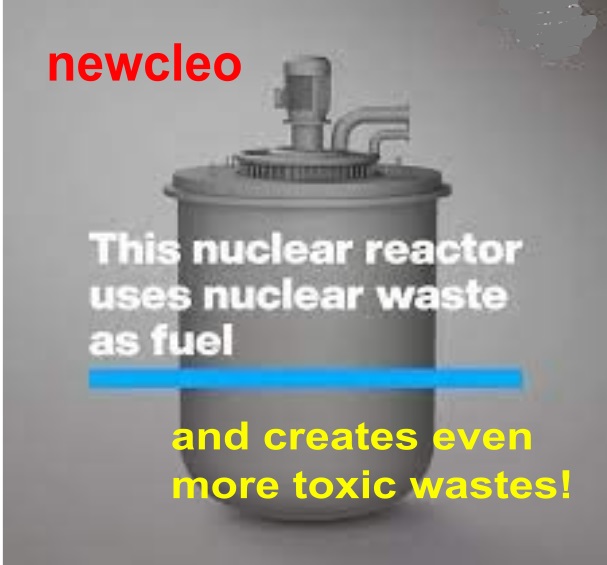
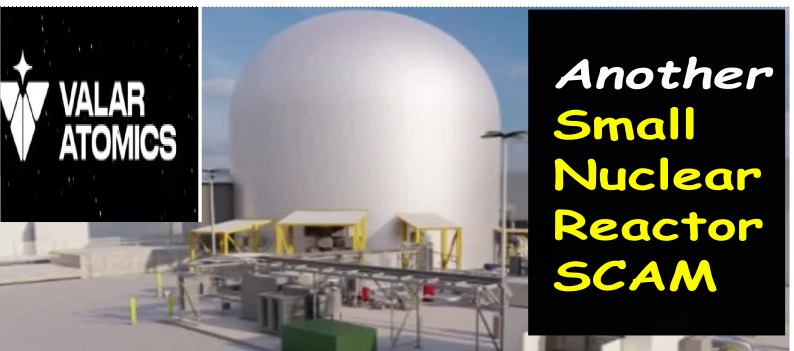
Among the eager corporations already lined up for their plutonium handouts are not only Oklo but also a foreign corporation, the now French-based but originally British nuclear company, newcleo, as well as US-based Valar Atomics, which has been criticized for developing a reactor that would not only consume but also produce plutonium.
Perhaps to celebrate the impending largesse, newcleo announced on October 20 that it has entered into a partnership with Oklo and will invest $2 billion to develop advanced nuclear fuel fabrication and manufacturing facilities.
On the very day — May 23rd —that Trump released his executive orders fast-tracking nuclear power expansion, Valar Atomics put out its own statement celebrating the news. (Do you think they’d seen the EOs in advance, or maybe even written parts of them themselves?)
Echoing the identical language repeatedly used by Trump officials, the Valar Atomics statement said: “There’s a new arm to national nuclear security: Dominance. Dominance in civilian nuclear technology development, dominance in nuclear energy infrastructure deployment, dominance in shaping global development.”
We should note here that the word “dominance” appears 35 times in the Heritage Foundation’s Project 2025 guide to autocracy, which contains an entire section called American Energy and Science Dominance and another called Restoring American Energy Dominance.
Accordingly, we now have something called the National Energy Dominance Council, headed by Secretary of the Interior Doug Burgum. Burgum heralded the newcleo-Oklo deal, saying: “This agreement to implement newcleo’s advanced fuel expertise into Oklo’s powerhouses and invest $2 billion into American infrastructure and advanced fuel solutions is yet another win for President Donald J. Trump’s American Energy Dominance Agenda.”
Standing in the way of such dominance, according to Valar Atomics and others, remains the US Nuclear Regulatory Commission (NRC). In April, Valar Atomics had joined the states of Texas, Utah, Louisiana, Florida, and Arizona, as well as fellow reactor companies Last Energy and Deep Fission, to sue the NRC. Their beef is that, going back to the days of NRC predecessor, the Atomic Energy Commission, there has been an annoying insistence “to require licenses even for reactors that use small amounts of special nuclear material that have no effect on US defense and security or public health and that the NRC itself has stated do not pose public health and safety risks.”
Innovation, complains Valar Atomics, is made “virtually impossible,” by the NRC. “Their rules — created in the overreaction to the Three Mile Island incident — shuttered the nuclear industry. Simply testing a reactor prototype takes five to seven years, at best. This is not the way to foster innovation! To regain our dominance in nuclear energy, the status quo must change, quickly.”
The suit is currently under discussion for a possible resolution, given that the Trump DOE is moving fast to rein in any excessive safety oversight by the newly downsized NRC, where the mission statement now extolls the “benefits” of nuclear energy for the US public.
The 19-25 metric tons of plutonium Trump would be redirecting into the civil nuclear sector had previously been slated for permanent disposal as nuclear waste left over from the Cold War era. Disposing of it is far cheaper than reprocessing it — $20 billion versus $49 billion according to the senators’ letter — and also isolates it from potentially falling into the wrong hands. ……………………………………………………………………………………………………………………………..
Plutonium has no place in the civil nuclear sector. But it should have no place in our lives, period, if we really want to avoid nuclear proliferation or worse.
Linda Pentz Gunter is the founder of Beyond Nuclear and serves as its international specialist. Her book, No To Nuclear. Why Nuclear Power Destroys Lives, Derails Climate Progress and Provokes War, can be pre-ordered now from Pluto Press. https://beyondnuclearinternational.org/2025/10/26/roll-up-roll-up-for-your-free-plutonium/
Rare Earths processing – a backdoor way into radioactive waste dumping in Australia?
28 October 2025, Noel Wauchope, https://theaimn.net/rare-earths-processing-a-backdoor-way-into-radioactive-waste-dumping-in-australia/
Joy and delight! Australia is to have a booming rare earths industry, mining and PROCESSING – jobs jobs jobs! Money money money!. And we can stick it up to China, confronting its near monopoly on the industry!
The reality is something very different.
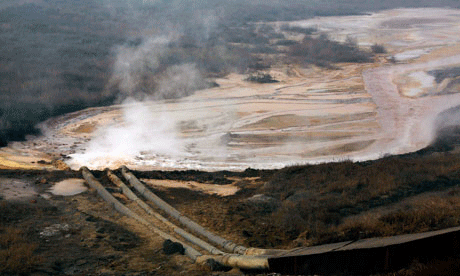
Apart from the enormous and time-consuming problems involved in establishing this industry, and in competing economically with China, there’s that other unmentionable problem – RADIOACTIVE WASTES.
Western Australia’s Lynas Rare Earths company knows all about this. They’ve had no end of trouble with their rare earths processing and its radioactive wastes. They were smart enough, had the foresight, to set up processing in another country. Lynas moved its rare earths processing to Malaysia because of Malaysia’s less stringent laws. But what they didn’t reckon with, was Malaysia’ ‘s history, and awareness of radioactive waste danger. As Lynas’ plant started operations in 2012 – in Kuala Lumpur: 10,000 marched for 13 days, rally against Lynas rare earths processing plant. Former Malaysian Prime Minister Mahathir Mohamad imposed stringent conditions on Lynas’ operations.
Malaysians remember the environmental and health disaster of Bukit Merah; where, early this century, rare earth processing left a toxic wasteland.
A longer explanation is provided in this documentary –
It is very hard to get information on Lynas’ processing operations in Malaysia. I remember that a few years ago, there was a controversy, and an Australian protest movement against Lynas’ plan to dump these wastes into an old growth forest in Malaysia. I can now find no record of this. And indeed, many news items of the controversies of Lynas’ Malaysia operations have now vanished from the internet.
But this Malaysian issue has not gone away – Pollution issues and controversy over rare earth company Lynas.
If Malaysia’s history of radioactive pollution from processing of rare earths is scandalous, – what about China’s history?
I know that in recent years, China has cleaned up its act on industrial pollution. But its history is shocking – with a legacy of “cancer villages” –
Whole villages between the city of Baotou and the Yellow River in Inner Mongolia have been evacuated and resettled to apartment towers elsewhere after reports of high cancer rates and other health problems associated with the numerous rare earth refineries there. – China’s legacy of radioactive pollution from rare earths processing.
Well, is everybody now pretending that that to introduce rare earths processing in Australia is a good thing, no problem, it’s progress – blah blah?
This new development comes just as Australia’s government introduces its new reforms to the Environment Protection and Biodiversity Conservation Act – including the aim to simplify and speed up approvals for development. We wait to see what that entails – could it be the weakening of environmental standards?
Coincidentally, Mr Trump’s USA is changing the standards on radiation safety. An Executive Order from the White House states:
“In particular, the NRC shall reconsider reliance on the linear no-threshold (LNT) model for radiation exposure and the “as low as reasonably achievable” standard, which is predicated on LNT. Those models are flawed”, – ORDERING THE REFORM OF THE NUCLEAR REGULATORY COMMISSION.
This will likely result in a significant weakening of the current standards at a time when the evidence strongly suggests that they are in need of further tightening.
The environmental movement fights on – but with a wave of enthusiasm for renewable energy development. A recent article discussed recycling of rare earths from our many digital devices. That’s an idea that seems to be ahead of its time, especially given the extreme difficulty of retrieving those elements from mobile phones, laptops etc.fficulty of retrieving those elements from mobile phones, laptops etc.
Well, it’s the (?) futuristic idea of the circular economy. It fits in with those unfashionable concepts of energy efficiency, energy conservation. We used to hear about them, in the early days of action on climate change.
These concepts are anathema to our billionaire leaders, as we are all drawn into the mindless rollercoaster of ever more artificial intelligence, with its ever more energy use.
Australia, federally and in each State has strong restrictions on radioactive processes. The nuclear lobby has tried for decades to weaken or overthrow those restrictions, and to introduce radioactive waste dumping in a big way.
We’ll be pitched the story that the radioactive wastes from rare earths processing are “minor” “low key” – acceptable. Let’s not worry – after all, the whole rare earths thing is so complex, and so far into the future.
But Albanese so readily agreed with Trump, that Australia can have both the mining and the processing of rare earths – it opens the door up to radioactive waste dumping,
Meanwhile, the issue is also relevant to Australia’s agricultural industry, particularly in Victoria. Victoria being blessed with rich agricultural land, regions like the Wimmera and Gippsland could be threatened by these new industries. The nuclear lobby, too, has long salivated on the possibility of a thorium industry there, too
It’s a sad thing – that history is forgotten, in these days of super-fast “progress’ into the Age of AI. We are being led by the nose by those technobillionaires surrounding Donald Trump – to believe that we don’t need to do much working, or thinking – as we race into this golden age, and embrace this new radioactively-polluting industry.
ATOMIC BLACKMAIL? The Weaponisation of Nuclear Facilities During the Russia-Ukraine War.
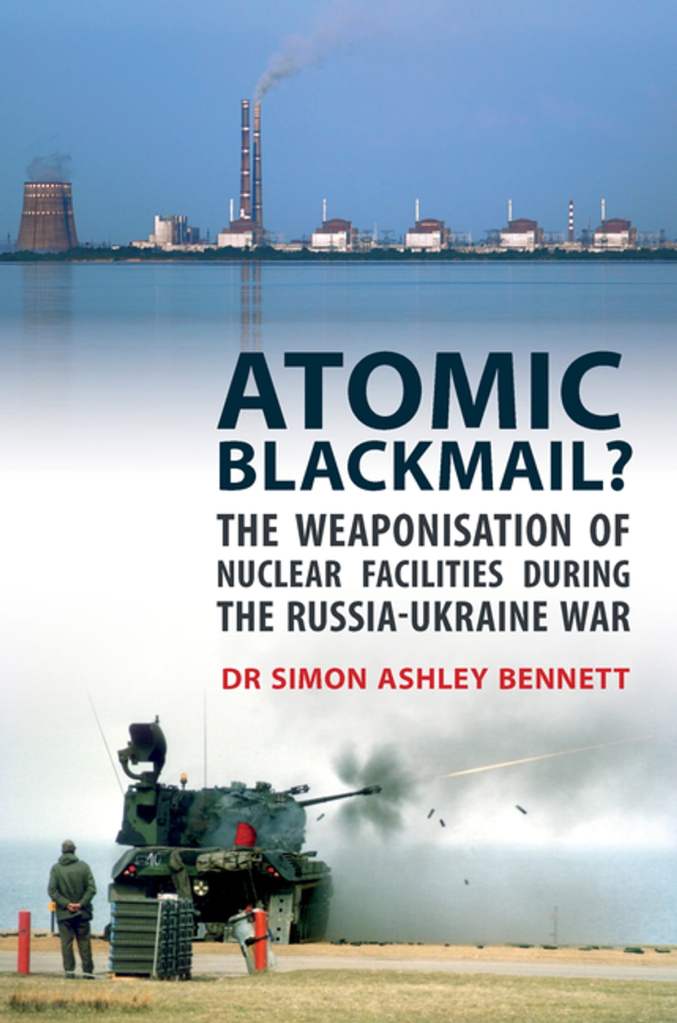
a protagonist could use long-range munitions to turn a NPP into a dirty bomb that would spread radioactive contamination over a wide area, dispersing or diverting army formations, rendering civilian infrastructure and farmland unusable, contaminating groundwater and creating a radioactive cloud that would – if the wind was blowing in a convenient direction – cause transborder harms.
Simon Ashley Bennett, https://www.libripublishing.co.uk/Products/CatID/16/ProdID=292
In Atomic Blackmail? Simon Bennett examines the very real possibility of the ‘weaponisation’ of nuclear facilities during the Russia-Ukraine War. The Russia-Ukraine War has several unique aspects, the most striking of which is that it is being fought in proximity to nuclear facilities and working nuclear power stations, including the six-reactor Zaporizhzhia Nuclear Power Plant (NPP), Europe’s largest, and the decommissioned four-reactor Chernobyl NPP that, in 1986, suffered a catastrophic failure that released radioactive contamination across much of Europe. Some experts claim the contamination caused several thousand excess cancer deaths.
In 1985, foreign affairs and nuclear expert Bennett Ramberg published Nuclear Power Plants: An Unrecognised Military Peril, with a second edition of the book published in 1992. In his visionary discourse, Ramberg posited that in future wars, regional or global, nuclear facilities and powerplants might be weaponised, to gain political traction over an opponent and/or neutralise opposing forces’ capacity for battlefield manoeuvre.
In one scenario, Ramberg described how a protagonist could use long-range munitions to turn a NPP into a dirty bomb that would spread radioactive contamination over a wide area, dispersing or diverting army formations, rendering civilian infrastructure and farmland unusable, contaminating groundwater and creating a radioactive cloud that would – if the wind was blowing in a convenient direction – cause transborder harms. As demonstrated by the Chernobyl disaster, a reactor malfunction can generate serious and long-lasting environmental impacts. Radioactive particles released from Chernobyl’s devastated Reactor Number Four were deposited as far afield as the Cumbrian hills in north-west England.
While, at the time of writing, none of Ukraine’s fifteen reactors had been damaged in an exchange of fire, the possibility remains that this could happen during Ukraine’s 2023, and subsequent, offensives to expel Russian forces from sovereign Ukrainian territory. Much to the consternation of the International Atomic Energy Agency (IAEA), there have been several near-misses, with weapons fired in and around both the decommissioned Chernobyl NPP and working Zaporizhzhia NPP. Further, Russian long-range precision munitions (cruise missiles) have been tracked flying either close to, or over Ukraine’s NPPs. The Pivdennoukrainsk (South Ukraine) NPP has been overflown. On 20 September, 2022, a missile landed some 300 metres from the NPP.
While Ramberg’s nightmare vision of destroyed NPPs rendering a country uninhabitable has not, yet, been realised in the Russia-Ukraine War, the longer and more intense the conflict, the greater the likelihood that one or more of Ukraine’s NPPs will be damaged or, via a credible sabotage threat, used to leverage tactical or strategic advantage. Atomic blackmail finally exampled.
Trump’s ‘peace plan’ traps Gaza in limbo
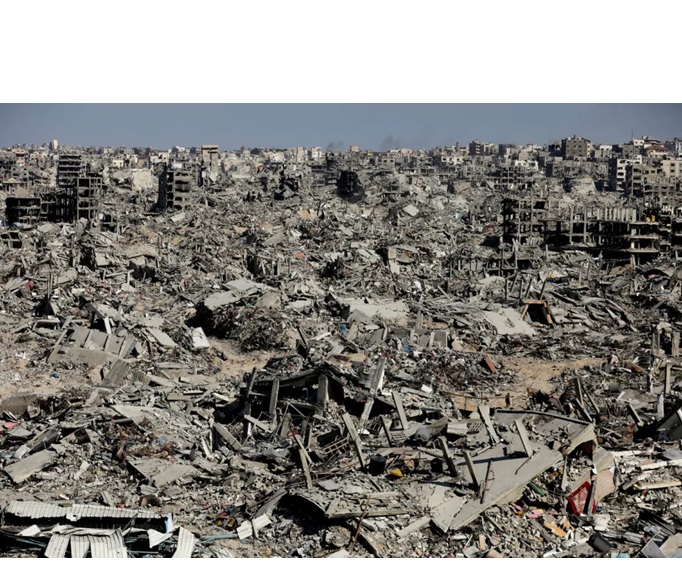
Gaza is now trapped in the limbo of the uncertainty surrounding the Trump plan. The U.S. might prevent Netanyahu from resuming Israel’s genocide, but unless Palestinians gain full control over Gaza’s future, it’s just a slower form of killing.
Mondoweiss, By Mitchell Plitnick October 25, 2025
On Tuesday, Israeli military sources announced that, in their estimation, Hamas still has some 20-25,000 fighters, although many of them are new recruits who are not well trained. They also said Hamas still has “hundreds” of rockets, although the majority of Hamas’ arsenal is said to have been destroyed.
Retired General Giora Eiland, who still has a significant position in Israel’s military hierarchy, added that the tunnel network in Gaza is still some 80% intact.
If these estimates are true, and that is far from clear, it’s either an admission of grave failure by Israel or an admission that destroying Hamas was never the point of the genocide that Israel has committed over the past two years. Or, possibly, both.
These statements are meant to arouse a feeling in Washington and in Israel that the “job” is not yet finished and Israel must be allowed to resume its genocide.
Israeli Prime Minister Benjamin Netanyahu has been squirming under the weight of President Donald Trump’s imposed ceasefire since it began, even while he has been forced to present a smiling public face about it.
Netanyahu’s immediate strategy is to require Trump to keep full pressure on Israel to maintain the “ceasefire.” He is doing this with a steady stream of provocative and deadly actions. He is allowing some aid into Gaza, but not nearly enough. Israel continues to work at provoking Palestinian responses with targeted attacks and provocative actions.
On Sunday, Israel suffered losses in the Rafah area under disputed circumstances. The United States allowed some response, but sharply limited it, preventing Israel from using the incident as an excuse for abandoning the ceasefire deal.
Lest anyone mistake the Trump administration’s actions for beneficence, there was complete silence from Washington the previous day, when Israeli forces fired on a Palestinian civilian vehicle near Gaza City, wiping out a family of eleven, including seven children.
Trump has continued to accuse Hamas of breaching the ceasefire, while ignoring Israel’s actions, which have thus far led to over 100 Palestinian deaths in Gaza since the ceasefire began.
But even while Trump has continued to issue empty threats against Hamas, his administration’s actions have been aimed at restraining Israel. The dispatch of Jared Kushner and Steve Witkoff, followed by Vice President JD Vance, and now Secretary of State Marco Rubio has had the effect of making sure that Israel is aware that the U.S. is watching and is not prepared to see this ceasefire collapse.
In a very telling episode, the Knesset voted to annex major chunks of the West Bank while Vance was in the country. This drew a sharp rebuke from the Vice President and a panicked response from Netanyahu. It is a stark contrast to Joe Biden’s meek response more than a decade ago when he visited Israel and the government announced a major new settlement while he was there. President Barack Obama was quite upset by the incident, but Biden wanted to ignore it.
Trump on Thursday warned Israel that the U.S. would no longer support Israel if it annexed the West Bank. But for Gaza, this isn’t a sustainable position. Trump is not going to maintain this kind of pressure indefinitely. He has put the annexation question to bed for some time (which just means that Israel will simply go on with its gradual annexation of the West Bank rather than the dramatic move of a formal annexation), but Gaza will require much longer-term engagement. More importantly, Trump’s “20-Point Plan” faces serious obstacles, and they are of a type that is very likely to result in the U.S. administration becoming frustrated with Hamas more than with Israel.
The danger of Hamas’ “Yes, but…”
Hamas made it clear when it agreed to the ceasefire that it was not agreeing to all of Trump’s plan. All parties understood that. ………………………………………………………………………………………………………………………………
Trump has a vested interest in seeing the ceasefire endure, but what does that mean in practice?
Neither Trump nor Netanyahu is going to be willing to allow Palestinians to govern themselves, even as technocrats. Without that, there will continue to be resistance. It’s that simple
Some limited rebuilding might be contemplated, but right now, that is being used as a tool to force Hamas to comply with Trump’s demands for their disarmament and disbandment. Jared Kushner made that clear, explicitly stating that any reconstruction efforts would be concentrated in the area of Gaza that remains under Israeli control.
Yet as much as Netanyahu would like to return to the all-out slaughter, he is not going to risk Trump’s wrath to do it. But in the meantime Gaza is likely to be trapped in a nightmarish middle ground between genocide and a functioning future.
Israel will not tolerate any security role in Gaza for Türkiye, as Trump has floated. They’d much prefer that both security and governing forces in Gaza be led by the U.S. or, short of that, more pliant Muslim countries such as Indonesia and Azerbaijan. Azerbaijan is perhaps Israel’s closest, if one of its quietest, allies in the Muslim world. Trump has already secured the participation of Indonesia and is working on Azerbaijan. ………………………………….
Gaza is now caught in the netherworld of the uncertainty of the Trump plan. While Vice President Vance says the ceasefire is “going better than expected,” it is not going anywhere for the people of Gaza.
Vance was remarking on how Israel is “complying” with Trump’s directives. That is, they are not killing so many Palestinians or doing so much shooting that the ostensible ceasefire would collapse.
But autumn is soon going to turn to winter in Gaza. There are insufficient shelters for most of the people, inadequate supplies of food and water, few heat sources, and limited means to address these issues in the short time allotted…………………………………………
The International Court of Justice’s advisory opinion, issued on Wednesday, provoked an hysterical response from Washington, as it ordered Israel to cooperate with all UN agencies, including the UN Relief and Works Agency (UNRWA), which Israel has falsely accused of supporting Hamas and encouraging attacks on Israel……………………….
All of this leaves the people of Gaza facing a different kind of hardship. There doesn’t seem to be any immediate rush to deploy an international force that would lead to a further Israeli withdrawal and enhanced efforts to clear the massive amounts of rubble. Without that necessary first step, reconstruction cannot truly begin in a sustainable way.
The population is cold, hungry, and facing unprecedented health crises that will go on for many years, according to the World Health Organization. While diplomats bicker, those conditions worsen……………………
Trump might prevent Netanyahu from returning to the full force of Israel’s two-year genocide, and that is still a real positive. But what the people of Gaza are facing now, with so many unanswered questions about how the Strip is to be managed, fed, supplied, and secured, carries with it its own set of threats.
It’s better than the genocide that was, but unless Palestinians are given full access to their own decisions and the tools they need to rebuild and survive until Gaza is rebuilt, it’s just a slower kind of killing. https://mondoweiss.net/2025/10/trumps-peace-plan-traps-gaza-in-limbo/
We should never have agreed to AUKUS
Albanese may come to regret his meeting with Trump, the deal and the endorsement by Trump. He may have underestimated the risk in kissing the ring of the Confidence Man.
but now he was a man of compromise, the politician who has exchanged principles for politics.
Australia should have put AUKUS on hold to let the people decide whether it should proceed. After all, we will pay for AUKUS, and we pay the salaries of the representatives of the people
By Kim Sawyer | 27 October 2025, https://independentaustralia.net/politics/politics-display/we-should-never-have-agreed-to-aukus,20307
Australia is paying for America’s submarines, striking a deal with a President we still have to fact-check. Dr Kim Sawyer reports.
HE IS THE MASTER showman. He knows where to position the actors, where to position the cameras, where to position the lights. He knows how to spray on his make-up and the make-up of others. Every press conference, every Cabinet meeting is the reality show of the showman.
U.S. President Donald Trump is the puppet master pulling the strings of the apprentices. He knows how to play them. Maggie Haberman’s The Confidence Man: The Making of Donald Trump and The Breaking of America tells of the actor who conned the world.
“Young Donald Trump had been an athlete as a teenager, and he aspired to a career in Hollywood. He ultimately fulfilled his father’s desire for a successor in the family business in real estate. But what the son really always wanted was to be a star.”
The reality show The Apprentice made him a star. The Apprentice was his apprenticeship. Trump knows who is willing to be conned; he knows their price or how to determine their price. He thinks he knows the price of everything and everyone, but really knows the value of nothing. He is the confidence man.
Trump is the confidence man of fiction best understood by reading Ibsen’s Master Builder or by viewing the 1958 episode ‘The End of the World’ of the CBS series Trackdown that featured a character who wanted to build a wall, and who had all the confidence of the confidence man. Sound familiar? The fictitious character was called Trump. He was finally exposed as a fraud. The fictitious Trump was finally arrested.
The meeting of Trump and Albanese was his latest reality show, the Master and the Apprentice. The Master got what we wanted. He got the deference he craved. He got the deal he wanted. The Apprentice got what he wanted. He got the endorsement of power of the Confidence Man.
The art of the deal.
Perforce, the deal is a con. Turnbull and Keating understand. Morrison and Albanese do not. We should never have agreed to AUKUS. It’s not just the cost of $368 billion over 30 years that includes $123bn as a contingency for the risk of a cost blowout. The risks are everywhere.
We have already paid more than $3 billion, the premium for a very uncertain insurance policy. As Turnbull has noted, the submarines are currently being produced at a rate of 1.1 per year.
“They need to get to two by 2028 to be able to meet their own requirements, and to 2.33 to meet their own, plus Australia’s. And they have not been able to lift production rates despite expenditure of over $10 billion over the last six or seven years. So, they’ve got a real problem.”
We’ve got a bigger problem.
Governments are like portfolio managers. The government needs to understand diversification, that you do not put all your eggs in a basket of submarines. The defence budget is so tied up in submarines, we don’t have room to invest in emerging defence technologies, in patrol boats, frigates or the amphibious landing craft we need for immediate problems like evacuations. The budget is being skewed towards submarines that will not be supplied until the early 2030s, away from writing off the $70 billion of student debt that three million young Australians face. The cost of the deal.
We have become so inured to the lies of the conman, we have to fact-check everything he says. When Trump said he had been to Australia, I thought it was another porky, but no, he had visited Australia, not as the President but as a spruiker to the National Achievement Congress in 2011. The conman spruiked the message of the grifter as to how to get everyone else to pay his debts. It wasn’t Trump’s first visit to the antipodes. In August 1993, Trump visited Auckland as part of a consortium bidding for a casino operator’s licence. At the time, Trump was mired in debt. The bid was unsuccessful.
Truth and falsity are transactional for Trump. He has always used the mantra. “If you say something often enough, it becomes true.” Interviewed by the Sydney Morning Herald in 2011, Trump criticised Obama’s job plan as doomed and unlikely to have any impact. At the time, the unemployment rate was nine per cent, at the end of Obama’s term, unemployment was 4.9 per cent. Trump was always anti-Obama. Trump was always false.
The other leading actor in the show that we watched last Monday was our own Prime Minister. Albanese had a lot to thank Trump for; perhaps that’s why he had wanted so much to meet him. The polls in February 2025 had the coalition leading 51–49, and then the Trump-Dutton factor came into play. Dutton was Albo’s trump card. No wonder he wanted the selfie with Trump. He invited Trump to visit, perhaps to spruik why Australia is paying for America’s submarines.
Albanese wore a lot of make-up to the meeting. The real Albo shared his confidences in private, perhaps with the other actor who sat opposite Trump, the Ambassador who Trump did not like. Albanese may come to regret his meeting with Trump, the deal and the endorsement by Trump. He may have underestimated the risk in kissing the ring of the Confidence Man.
The risk was everywhere to be seen. Two days before, 7 million joined the No Kings’ protests. Thirty years ago, when Albo was a man of principle, he may have joined those same protests, but now he was a man of compromise, the politician who has exchanged principles for politics.
On the day that Albo met Trump in the Whitehouse, the East Room was being demolished. In 1984, on a tour of the Whitehouse, we were asked to stand still, as the President appeared. Reagan had just left the East Room, where he had given a speech, where Carter, Obama, and FDR gave speeches. The East Room was built by President Theodore Roosevelt in 1902.
Apparently, there was no heritage overlay, at least for Trump. Betty Ford reflected on its significance. “If the West Wing is the mind of the nation, then the East Wing is the heart.” Confirmation that Trump is heartless.
Australia should have put AUKUS on hold to let the people decide whether it should proceed. After all, we will pay for AUKUS, and we pay the salaries of the representatives of the people. However, most will never get to see the submarines, not like the HECS debt on their tax bill. Australia has been too subservient, too sycophantic, too risk-averse in our dealings with Trump. There is a cost to being risk-averse just as there is a cost to being a risk-taker.
The Democrats paid the price for not dealing with Trump as they should have dealt with him. Dealing with Trump is like dealing with the devil; you must deal on your terms, not his terms. He is a convicted felon, a fraudster, a showman, the confidence man who became President.
The No Kings protests showed the divergence between the people and the institutions, between those who will not defer to Trump and those who will defer to him; between right and wrong. History may rewrite some of the story, but not the story of the Master and the Apprentice.
The threat of nuclear Armageddon.
The risk of nuclear conflict is higher today than ever before. The time is now to revive stalled efforts towards disarmament and arms control
IPS Journal, 27 Oct 25
Rolf Mützenich, Berlin, Rolf Mützenich has been a member of the German Bundestag since 2002. He was the Chairman of the SPD parliamentary group in the Bundestag from 2019 to 2025.

EN
Foreign and security policy 27.10.2025 | Rolf Mützenich
The threat of nuclear ArmageddonThe risk of nuclear conflict is higher today than ever before. The time is now to revive stalled efforts towards disarmament and arms control
The recently released thriller ‘A House of Dynamite’, now showing in cinemas and on Netflix, takes a powerful look at a topic that had long been considered a thing of the past following the end of the Cold War: the threat of nuclear Armageddon. In Kathryn Bigelow’s film, the US military suddenly discovers an intercontinental ballistic missile over the Pacific Ocean that could reach the US mainland within minutes. From different perspectives, the film tells how political and military decision-makers attempt to respond to the crisis. It becomes clear how vulnerable we are despite sophisticated defence systems and strategic war games, and how quickly a single attack using a nuclear weapon could escalate into a global catastrophe within minutes.The film is not a distant fantasy, but reflects an increasingly realistic scenario of our present. The days when former US President Barack Obama promoted the vision of a nuclear-free world in Prague back in 2009 now seem like a thing of the distant past. In their place, we are witnessing the return of open threats of nuclear war, tactical nuclear strikes being discussed as a serious military option in the strategic considerations of the major powers, disarmament and arms control treaties expiring or being terminated, nuclear arsenals being modernised and new delivery systems being developed. The bitter truth is that the risk of nuclear conflict is probably higher today than ever before. We are on the threshold of a new nuclear age that is even more complex, unpredictable and uncertain than the so-called ‘balance of terror’ during the Cold War…………………………………………………….
A broader global trend
The world is currently moving towards a new tri- or even multipolar nuclear age. At present, nine countries possess nuclear weapons, including the five permanent members of the UN Security Council as well as Israel, India, Pakistan and North Korea. However, in view of growing global uncertainties and geopolitical tensions, more and more countries are considering developing their own nuclear capabilities. ……………………………………………………………………..
The existing system of disarmament and arms control is already on the brink of collapse. In recent years, both Russia and the United States have terminated the Intermediate-Range Nuclear Forces Treaty (INF) and the Open Skies Treaty. With the expiry of the New START Treaty in February 2026, there is a threat that the last remaining arms control agreement between the two largest nuclear powers will be lost………………………………………………….
Counting on others and working together
It is therefore high time to breathe new life into the stalled efforts towards disarmament and arms control. The focus should be on limiting strategic nuclear arsenals and preserving the existing treaties…………………………………………………………. https://www.ips-journal.eu/topics/foreign-and-security-policy/the-threat-of-nuclear-armageddon-8642/
1 This Month
To see nuclear-related stories in greater depth and intensity – go to https://nuclearinformation.wordpress.com/
12 February – Webinar The Big Push: New Nuclear Projects in Canada
Thursday, February 12, 7 pm Eastern | 2nd of 4 sessions in the 2026 Nuclear Waste Online webinar series
Join a webinar on the push for new nuclear generation in Canada. Go to Northwatch.org to register or use the registration link https://us02web.zoom.us/webinar/register/WN_ZfWOf1GITqSRIZX8CB-A9w
-
Archives
- February 2026 (115)
- January 2026 (308)
- December 2025 (358)
- November 2025 (359)
- October 2025 (376)
- September 2025 (258)
- August 2025 (319)
- July 2025 (230)
- June 2025 (348)
- May 2025 (261)
- April 2025 (305)
- March 2025 (319)
-
Categories
- 1
- 1 NUCLEAR ISSUES
- business and costs
- climate change
- culture and arts
- ENERGY
- environment
- health
- history
- indigenous issues
- Legal
- marketing of nuclear
- media
- opposition to nuclear
- PERSONAL STORIES
- politics
- politics international
- Religion and ethics
- safety
- secrets,lies and civil liberties
- spinbuster
- technology
- Uranium
- wastes
- weapons and war
- Women
- 2 WORLD
- ACTION
- AFRICA
- Atrocities
- AUSTRALIA
- Christina's notes
- Christina's themes
- culture and arts
- Events
- Fuk 2022
- Fuk 2023
- Fukushima 2017
- Fukushima 2018
- fukushima 2019
- Fukushima 2020
- Fukushima 2021
- general
- global warming
- Humour (God we need it)
- Nuclear
- RARE EARTHS
- Reference
- resources – print
- Resources -audiovicual
- Weekly Newsletter
- World
- World Nuclear
- YouTube
-
RSS
Entries RSS
Comments RSS
 nuclear-news