Generation IV Nuclear Reactor Designs
The Next Nuclear Renaissance?
CATO Institute, Steve Thomas, Fall 2025 • Regulation,
……………………………………………………………………………..Around the time of the previous nuclear renaissance, there was talk of the designs that would succeed Gen III+, so-called Gen IV designs. Gen III+ designs were seen as transitional technologies filling the gap until their long-term successors were developed. The Gen IV International Forum (GIF), an international intergovernmental organization funded by the governments of nearly all the nuclear-using countries, was set up in 2001 to promote development of these designs.
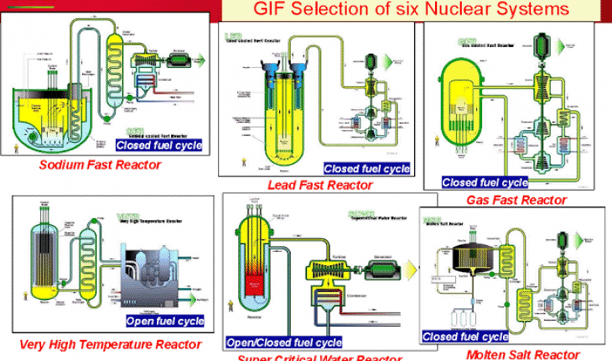
The GIF has stated, “The objectives set for Generation IV designs encompass enhanced fuel efficiency, minimized waste generation, economic competitiveness, and adherence to rigorous safety and proliferation resistance measures.” It identified six designs as the most promising, and these remain its focus. Some are designs that have been pursued since the 1950s and built as prototypes and demonstration plants but never offered as commercial designs. Among these are sodium-cooled fast reactors and high temperature gas-cooled reactors (HTGRs). Some, such as the lead-cooled fast reactor and the molten salt reactor, have been talked about for 50 or more years but never actually built. Others, such as the supercritical-water-cooled reactor and the gas-cooled fast reactor, do not appear to be under serious commercial development. When GIF was created, it expected some of the designs to be commercially available by 2025, but it now does not expect this to happen before 2050.
When the Gen IV initiative began, there was no expectation they would be small or modular. Gen IV designs are now sometimes known as Advanced Modular Reactors (AMRs) in an apparent attempt to profit from the positive press that LWR SMRs are receiving. However, they are very different from LWRs, with different designs and safety requirements, so the claims made for LWR SMRs compared to the large LWR designs are not relevant to AMRs.
There is particular interest in HTGRs because of the hope that they can operate at high temperatures (above 800°C /1,500°F). This would allow a plant to also produce hydrogen more efficiently than conventional electrolysis, providing the plant an additional revenue stream. However, existing HTGRs have only operated at 750°C /1,380°F, much higher than the 375°C /700°F of PWRs but not ideal for producing hydrogen. Increasing the temperature to the levels GIF anticipated originally, 950°C–1,000°C/1,750°F–1,850°F, would require new, expensive materials and would raise significant safety issues. The British government is concentrating its efforts on HTGRs, but it has said, “It is not currently aware of any viable fully commercial proposals for HTGRs that could be deployed in time to make an impact on Net Zero by 2050.” Nevertheless, the UK is still subsidizing development of HTGRs.
Overall, there are high-profile promoters of these Gen IV designs. For example, Microsoft cofounder Bill Gates is investing in sodium-cooled fast reactors through his nuclear innovation firm Terrapower. However, given the 50+ year history of these efforts, it is hard to see why these new companies would succeed now. Few of the more prominent Gen IV designs are being developed by firms with any history of supplying nuclear reactors. At most, Gen IV designs are a long-term hope……………………………. https://www.cato.org/regulation/fall-2025/next-nuclear-renaissance
No comments yet.
1 This Month
To see nuclear-related stories in greater depth and intensity – go to https://nuclearinformation.wordpress.com

-
Archives
- February 2026 (192)
- January 2026 (308)
- December 2025 (358)
- November 2025 (359)
- October 2025 (376)
- September 2025 (258)
- August 2025 (319)
- July 2025 (230)
- June 2025 (348)
- May 2025 (261)
- April 2025 (305)
- March 2025 (319)
-
Categories
- 1
- 1 NUCLEAR ISSUES
- business and costs
- climate change
- culture and arts
- ENERGY
- environment
- health
- history
- indigenous issues
- Legal
- marketing of nuclear
- media
- opposition to nuclear
- PERSONAL STORIES
- politics
- politics international
- Religion and ethics
- safety
- secrets,lies and civil liberties
- spinbuster
- technology
- Uranium
- wastes
- weapons and war
- Women
- 2 WORLD
- ACTION
- AFRICA
- Atrocities
- AUSTRALIA
- Christina's notes
- Christina's themes
- culture and arts
- Events
- Fuk 2022
- Fuk 2023
- Fukushima 2017
- Fukushima 2018
- fukushima 2019
- Fukushima 2020
- Fukushima 2021
- general
- global warming
- Humour (God we need it)
- Nuclear
- RARE EARTHS
- Reference
- resources – print
- Resources -audiovicual
- Weekly Newsletter
- World
- World Nuclear
- YouTube
-
RSS
Entries RSS
Comments RSS
 nuclear-news
Leave a comment