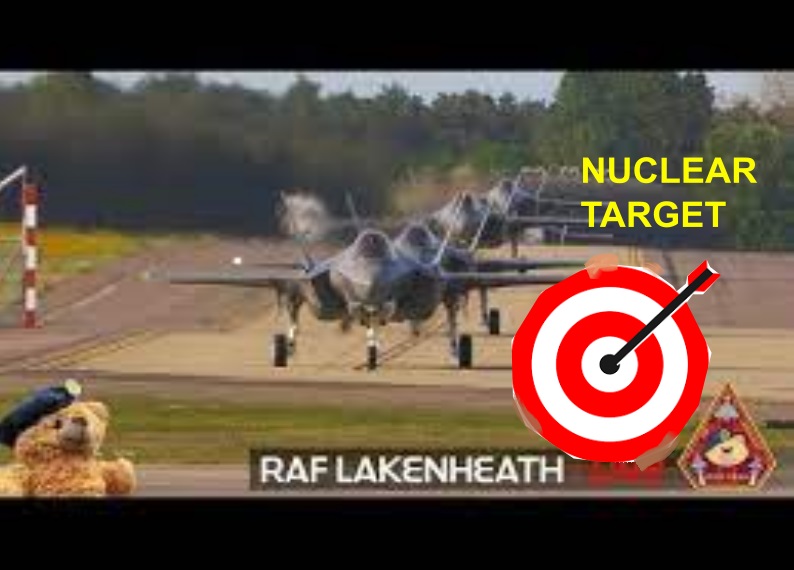
The UK is at risk of a nuclear attack as the US is set to house nuclear weapons in Suffolk, England, which would make the country a target in a US and Russia war
Emily Malia Mirror UK, GAU Writer, 27 Oct 2025
RAF Lakenheath in Suffolk, operated by the United States, is expected to house US/ NATO nuclear weapons in the near future. This development places the UK on the frontline of potential conflict between America and Russia.
The presence of American nuclear weapons on British soil significantly increases the nation’s risk of becoming a target. Military analysts suggest that in the event of war, Lakenheath would likely face strikes before attacks spread to other parts of the country.
Whilst experts acknowledge that nuclear conflict between the US, NATO and Russia would prove devastating globally, it’s crucial to grasp the direct consequences for British towns and cities. The Campaign for Nuclear Disarmament warns: “A single nuclear strike on any town or city would be catastrophic for the local community and environment, and the radioactive impact would spread much further.
“But a nuclear war would be catastrophic for all humanity, forms of life, and the entire planet. Yet the possibility of nuclear war is the greatest for many decades.”
Casualties
Their report reveals if a Russian warhead, such as an SS-25 or SS-27, were to strike the heart of London, nearly a million people would die. Similarly, a hit on Glasgow could result in 326,000 casualties, while in Cardiff, 196,000 lives would be lost.
The epicentre of the nuclear explosion is believed to reach a staggering temperature of several million degrees centigrade. Consequently, a heat flash would obliterate all human tissue within a 1.5 square mile radius.
Back in 1945, when the United States unleashed two atomic bombs over Hiroshima in Japan, all that was left within a half-mile radius were shadows seared into stone. The aerial bombings claimed up to 200,000 lives, most of whom were civilians………………………………………..
Further afield from the zone of instant devastation, there would be a gradual rise in fatalities among those who endured the initial explosion. Approximately seven miles from the blast site, individuals would sustain lethal burns or even require amputations, while others would be blinded or suffer internal injuries.
Unlike a typical disaster, the mortality rate would be shockingly high as most emergency services would be unable to respond due to their own personnel being killed and equipment destroyed. The sheer number of casualties would simply swamp the UK’s medical resources, with people as far as 11 miles away potentially suffering injuries from shattered windows or structural damage.
The long-term impact
In the ensuing days, even those fortunate enough to survive would now be impacted by the radioactive fallout, with the majority succumbing within a week. This would manifest in various ways, from hair loss to bleeding gums, fever, vomiting, delirium and even internal bleeding.
Those with lower levels of exposure would still face complications, including pregnant women who are at a high risk of miscarriage and birth complications. In addition, long-term effects could include radiation-induced cancers affecting many civilians, up to two decades after the event.
It’s believed that children of those exposed to radiation are statistically more likely to be born with abnormalities and suffer from leukaemia. Aside from public health, nuclear weapons are known to cause severe damage to the environment and climate on an unprecedented scale.
Predictions suggest that in the aftermath of a nuclear war, two billion people could face starvation due to climate disruption and its impact on food production. https://www.mirror.co.uk/news/world-news/horrifying-number-people-who-could-36139768
No comments yet.
1 This Month
29 Jan. Thursday 7-8 p.m. Webinar – World’s Largest Nuclear Station in Port Hope, ON?
To see nuclear-related stories in greater depth and intensity – go to https://nuclearinformation.wordpress.com/


31st January – Challenging the War Machine – a DECLASSIFIED UK SUMMIT

Website of the Week
Now until to February 10, 2026 Radioactive waste storage in France: the debate is finally open! How to participate?
-
Archives
- January 2026 (288)
- December 2025 (358)
- November 2025 (359)
- October 2025 (376)
- September 2025 (258)
- August 2025 (319)
- July 2025 (230)
- June 2025 (348)
- May 2025 (261)
- April 2025 (305)
- March 2025 (319)
- February 2025 (234)
-
Categories
- 1
- 1 NUCLEAR ISSUES
- business and costs
- climate change
- culture and arts
- ENERGY
- environment
- health
- history
- indigenous issues
- Legal
- marketing of nuclear
- media
- opposition to nuclear
- PERSONAL STORIES
- politics
- politics international
- Religion and ethics
- safety
- secrets,lies and civil liberties
- spinbuster
- technology
- Uranium
- wastes
- weapons and war
- Women
- 2 WORLD
- ACTION
- AFRICA
- Atrocities
- AUSTRALIA
- Christina's notes
- Christina's themes
- culture and arts
- Events
- Fuk 2022
- Fuk 2023
- Fukushima 2017
- Fukushima 2018
- fukushima 2019
- Fukushima 2020
- Fukushima 2021
- general
- global warming
- Humour (God we need it)
- Nuclear
- RARE EARTHS
- Reference
- resources – print
- Resources -audiovicual
- Weekly Newsletter
- World
- World Nuclear
- YouTube
-
RSS
Entries RSS
Comments RSS
 nuclear-news
Leave a comment