Right wing- Left wing – on the nuclear issue it doesn’t matter.

30 October 2025 Noel Wauchope, https://theaimn.net/right-wing-left-wing-on-the-nuclear-issue-it-doesnt-matter/
The promotion of nuclear power is a right-wing thing- isn’t it?
Over the years, I’ve been following the propaganda of the climate-change denialists, among other liars and frauds. I found that the Koch bothers in America were the source of much successful barrage against the truth on our heating climate.
Alongside the fight for a sustainable, liveable planet, there’s the fight for freedom against the nuclear peril. I’ve concentrated on the latter, but find that the two are strangely embroiled.
How do you know whom to believe? Well, as with the issue of cigarettes causing cancer – I’ve always found that the genuine scientific organisations to be credible, as against the propaganda from tobacco corporations, coal, oil gas, nuclear an uranium companies -and their political lackies.
So – the promotion of nuclear power is a right-wing thing- isn’t it?
So, in my efforts for a nuclear-free world, I’ve assumed that the pro-nuclear push is a right-wing thing, like climate denial. All self-respecting activists will know of the notorious climate-denialist campaigns of the Koch Charles and David Koch from 1980 onwards.
In 1974, the Charles Koch Foundation was set up, and later its name was changed to the CATO Institute.
The CATO Institute is largely funded by the Koch Family, (Koch Industries family foundation ) and also numerous right-wing organisations and corporations. It is a gloriously right-wing organisation, and I suppose I should hate it.
So, it comes as a shock to me today, to find the most plausible, credible case against the nuclear industry – coming not from my beloved anti-nuclear movement , but in a very long article from the CATO Institute.
Author Steve Thomas does not denounce the nuclear industry. He just opens up the question – does it have any real hope of surviving, let alone thriving?
Thomas points out, in the later part of the article, that even for China and Russia, the countries now supposedly leading in nuclear development, the home demand is falling, and their hope is more to export nuclear technology. Meanwhile for the Western world, despite the brouhaha from policy-makers and the media , about new nuclear development, it’s just not really happening. Well, it is, a bit, but with the absolute imperative of tax-payer funding.
Thomas discusses all the publicity this century, about new nuclear reactors: the actual results have been dismal. In the USA there have been the abandoned V.C Summer project, and the A.W. Vogtle project, completed six or seven years behind schedule and at more than double the forecasted cost. There are now no proposals for additional large reactor projects in the United States.
In the UK, after years of “no government subsidy” for new nuclear, they still can’t get enough investors, even with government subsidy, and all sorts of perks about insulating insulate the reactors from competitive wholesale electricity markets. Hinkley Point C project is estimated now at £35 billion and rising. For the Sizewell project, France’s EDF has pulled out on financial grounds, and completion is not expected before 2040.
Thomas goes on to demolish the spin about Small Nuclear Reactors -showing that some are not even small, and all are not cheap, not so safe, not waste-free, and not happening, anyway, despite the hype.
He looks at the costs and feasibility of re-opening old closed reactors, and of life-extension of old ones still functioning:
“Life-extending a reactor by 20–40 years effectively means giving a whole new operating life to an old design that would not be considered if it were offered for a new reactor. In other words, life-extended nuclear power plants would not come close to meeting the standards required for new reactors. This raises several important safety questions“
The author concludes that the nuclear industry is just not going to revive.
And shock- horror !- this right-wing publication concludes that other power options are needed to face “serious risks from climate change”.
In other CATO publications, they have pushed for reducing America’s nuclear arsenal, and even for the USA to deal with the Ukraine crisis by diplomacy, not weaponry.
Yeah, I know CATO’s awful on health education etc – but it’s refreshing to find a right-wing institution explaining the nuclear industry so clearly. Do we have to do this right-wing left-wing fight all the time?
The anti-Russia, pre-SMO, Timeline of Which Legacy Media Won’t Speak
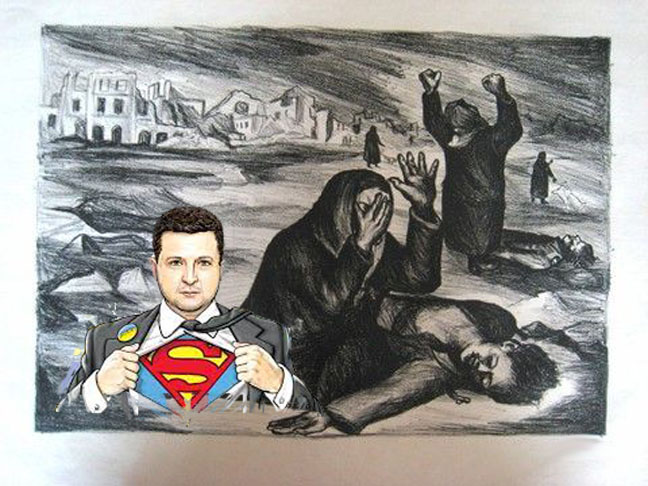
timeline of events leading up to the commencement in February 2022 of Russia’s Special Military Operation
Eva Karene Bartlett, Oct 28, 2025, https://evakarenebartlett.substack.com/p/the-anti-russia-pre-smo-timeline?utm_source=post-email-title&publication_id=3046064&post_id=177345476&utm_campaign=email-post-title&isFreemail=true&r=1ise1&triedRedirect=true&utm_medium=email
Very useful written timeline of events leading up to the commencement in February 2022 of Russia’s Special Military Operation.
Jacques Baud discussed much of this (see bottom of this post), but this written account is worth bookmarking.
Alan Watson:
“Vladimir Putin did not wake up on 24 February 2022 and decide, “I think I’ll invade eastern Ukraine today,” nor was the US campaign to expand NATO into Ukraine a last-minute maneuver. (US State Department documents show Ukraine’s future membership was discussed as early as 1994.)
9 Feb 1990: In a deal approved by Mikhail Gorbachev, the last leader of the Soviet Union, as a quid pro quo for accepting German reunification within NATO, Secretary of State James Baker pledged that NATO would not expand “one inch to the east.”
US, European and German leaders made explicit assurances to Gorbachev against any future eastward NATO expansion. Gorbachev understood the assurances as a “binding agreement.” Subsequently, Soviet leaders made decisions on that basis and acted on them – withdrawing the Red Army from Germany and dissolving the Warsaw Pact.
12 March 1999: Clinton is president. The Czech Republic, Hungary and Poland became members of NATO. A weakened post-Soviet Russia, led by Boris Yeltsin, controlled by a cabal of Oligarchs, could do nothing to prevent it. Powerless, Yeltsin was said to be “infuriated” with “his friend Bill Clinton…”
29 March 2004: George W. Bush is president. Seven more Eastern European countries join NATO: Bulgaria, Estonia, Latvia, Lithuania, Romania, Slovakia and Slovenia – largest wave of NATO enlargement ever.
April 2008: At the Bucharest NATO summit, George W. Bush announced that Ukraine and Georgia are on an “immediate path to NATO.” Bill Burns, ambassador to Russia, sent a memo to Secretary of State Condoleezza Rice. “Across the board,” he wrote, the Russian political class told him, “Ukraine is the reddest of red lines” – “Nyet means nyet.”
22 Feb 2014: Just as the Sochi Winter Olympics were underway, Kiev erupted in violence. State Department official Virginia Nuland boasted that since the 2004-2005 “Orange Revolution,” the US had spent $5 billion on regime change in Ukraine. NATO rooftop snipers killed both protestors and police, forcing Ukraine’s democratically elected president Viktor Yanukovych to flee the country.
2 May 2014: Bussed to Odessa from Kiev, Right Sector thugs carrying baseball bats confront ethnic Russians protesting the coup. When protestors fled into the city’s Trade Unions House, the building was set on fire. Forty-eight people were burned or bludgeoned to death – the Donbass civil war point of no return.
11 Feb 2015: Putin and Ukrainian President Poroshenko meet with French President Francois Hollande and German Chancellor Angela Merkel in Belarus to negotiate the Minsk ceasefire accords. The leaders agreed to a deal that would have ended the fighting – granting autonomy to the Russian-speaking Donbass, but successive Ukrainian governments refused to implement the accord.
German Chancellor Merkel later admitted that Minsk was a stall tactic to allow the West to build Ukraine’s army up to NATO standards. [Ed. note – Zelensky also admitted that he lied in his campaign for President, in pledging to uphold the Minsk agreement]
17 Dec 2021: Team Biden rejects Putin’s proposed mutual security accords that would have left a “neutral” Ukraine intact. For years, Russia had tried to convince US administrations that Ukraine was off-limits to NATO membership, but Russian concerns were brushed aside. December 2021, Team Biden insisted, “Russia doesn’t say who can join NATO.”
18 Feb 2022: During the Winter Olympics in China, the Organization for Security and Co-operation in Europe (OSCE) documented that Ukraine had ramped up artillery attacks along the Line of Contact.
(Since the 2014 coup in Kiev, the Armed forces of Ukraine, including the Neo-Nazi Banderites, had killed thousands of ethnic Russians in the Donbass.
19 Feb 2022: Invited to speak at the Munich Security Conference, Ukrainian President Zelensky said, “Ukraine will get and deploy nuclear missiles.”
20 Feb 2022: On CBS 60 Minutes, Ukraine’s Minister of Foreign Affairs Dmytro Kuleba said, “Ukraine will never honor the Minsk cease fire.”
21 Feb 2022: Russia captured a Ukrainian soldier, killed five others as they crossed over the border into Rostov. Russia learned the invasion of Donetsk city was imminent and recognized the breakaway Donbass and Luhansk oblasts as independent republics.
24 Feb 2022: With about 90,000 troops, Russia launched its “Special Military Operation” – not a “full scale invasion.” Citing the UN principle, “Responsibility to Protect,” Russia intervened in the eight-year Donbass civil war after all prospects for diplomacy had failed.
April 2022, week six of the war, Russian and Ukrainian negotiators convened peace talks in Istanbul. Later, Ukrainian diplomat Oleksandr Chalyi recalled, “Putin tried to do everything possible to conclude an agreement…” [The tentative accord would have left a “neutral” #Ukraine intact.]
On 1 April, USAID revealed photographic evidence of a “massacre” in Bucha and financed a press tour featuring US public figures. Problem: Four days earlier at a press conference, the mayor had announced that the Russians had retreated from the city [and he did not report there had been a massacre].
After the Russians voluntarily retreated, the regime scattered bodies in the streets that included both actors in body bags and recently killed “Russian collaborators” from around Bucha – giving an “outraged” Joe Biden and Boris Johnson, who flew unannounced to Kiev, the justification to order Zelensky to “keep fighting.”
If the US, UK and EU continue rejecting Russian proposals for a long term, European wide peace accord – as Putin proposed in December 2021 – the Russian army will continue advancing toward Kharkiv in the north and Odessa on the Black Sea. As Putin and Foreign Minister Sergei Lavrov emphasized: There will be no Minsk III.”
From a September 2024 interview I did with Jacques Baud (former Swiss intelligence & author). In this clip, Jacques lays out the history of events related to Ukraine prior to 2022, prior even to the 2014 coup which brought fascism to power in Ukraine, & how it was the NATO-Ukraine alliance which brought war, not Russia.
Full interview: https://rumble.com/v5fjhrh-jacques-baud-nato-threatened-russia-decades-before-2022.html https://odysee.com/@EvaKareneBartlett:9/JacquesBaudNATOThreatenedRussia:5
The UK is at risk of a nuclear attack as the US is set to house nuclear weapons in Suffolk, England, which would make the country a target in a US and Russia war
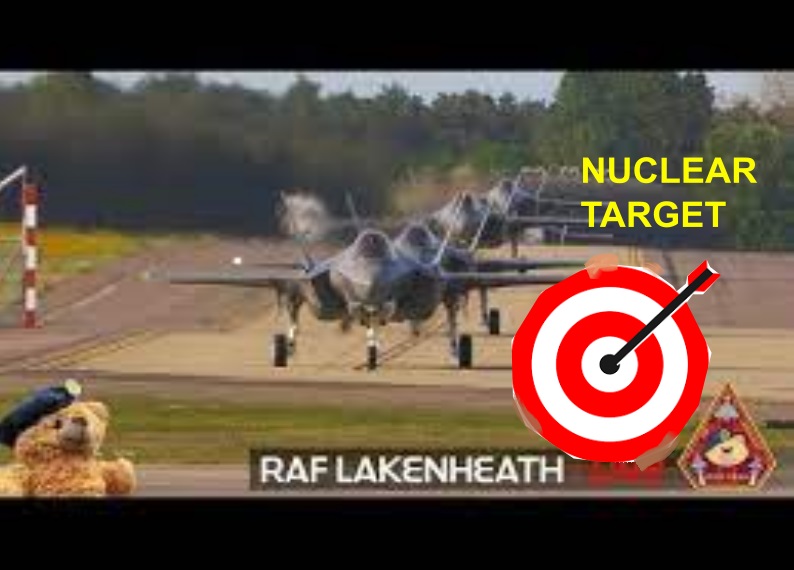
Emily Malia Mirror UK, GAU Writer, 27 Oct 2025
RAF Lakenheath in Suffolk, operated by the United States, is expected to house US/ NATO nuclear weapons in the near future. This development places the UK on the frontline of potential conflict between America and Russia.
The presence of American nuclear weapons on British soil significantly increases the nation’s risk of becoming a target. Military analysts suggest that in the event of war, Lakenheath would likely face strikes before attacks spread to other parts of the country.
Whilst experts acknowledge that nuclear conflict between the US, NATO and Russia would prove devastating globally, it’s crucial to grasp the direct consequences for British towns and cities. The Campaign for Nuclear Disarmament warns: “A single nuclear strike on any town or city would be catastrophic for the local community and environment, and the radioactive impact would spread much further.
“But a nuclear war would be catastrophic for all humanity, forms of life, and the entire planet. Yet the possibility of nuclear war is the greatest for many decades.”
Casualties
Their report reveals if a Russian warhead, such as an SS-25 or SS-27, were to strike the heart of London, nearly a million people would die. Similarly, a hit on Glasgow could result in 326,000 casualties, while in Cardiff, 196,000 lives would be lost.
The epicentre of the nuclear explosion is believed to reach a staggering temperature of several million degrees centigrade. Consequently, a heat flash would obliterate all human tissue within a 1.5 square mile radius.
Back in 1945, when the United States unleashed two atomic bombs over Hiroshima in Japan, all that was left within a half-mile radius were shadows seared into stone. The aerial bombings claimed up to 200,000 lives, most of whom were civilians………………………………………..
Further afield from the zone of instant devastation, there would be a gradual rise in fatalities among those who endured the initial explosion. Approximately seven miles from the blast site, individuals would sustain lethal burns or even require amputations, while others would be blinded or suffer internal injuries.
Unlike a typical disaster, the mortality rate would be shockingly high as most emergency services would be unable to respond due to their own personnel being killed and equipment destroyed. The sheer number of casualties would simply swamp the UK’s medical resources, with people as far as 11 miles away potentially suffering injuries from shattered windows or structural damage.
The long-term impact
In the ensuing days, even those fortunate enough to survive would now be impacted by the radioactive fallout, with the majority succumbing within a week. This would manifest in various ways, from hair loss to bleeding gums, fever, vomiting, delirium and even internal bleeding.
Those with lower levels of exposure would still face complications, including pregnant women who are at a high risk of miscarriage and birth complications. In addition, long-term effects could include radiation-induced cancers affecting many civilians, up to two decades after the event.
It’s believed that children of those exposed to radiation are statistically more likely to be born with abnormalities and suffer from leukaemia. Aside from public health, nuclear weapons are known to cause severe damage to the environment and climate on an unprecedented scale.
Predictions suggest that in the aftermath of a nuclear war, two billion people could face starvation due to climate disruption and its impact on food production. https://www.mirror.co.uk/news/world-news/horrifying-number-people-who-could-36139768
Generation IV Nuclear Reactor Designs
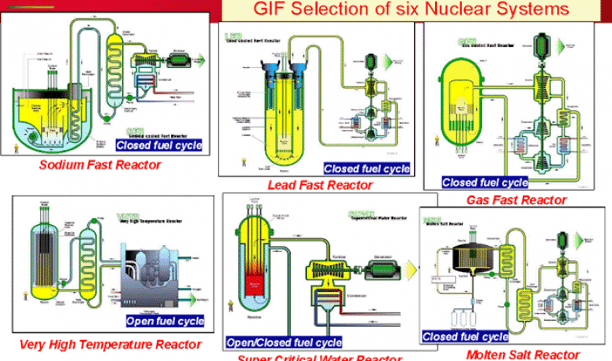
The Next Nuclear Renaissance?
CATO Institute, Steve Thomas, Fall 2025 • Regulation,
……………………………………………………………………………..Around the time of the previous nuclear renaissance, there was talk of the designs that would succeed Gen III+, so-called Gen IV designs. Gen III+ designs were seen as transitional technologies filling the gap until their long-term successors were developed. The Gen IV International Forum (GIF), an international intergovernmental organization funded by the governments of nearly all the nuclear-using countries, was set up in 2001 to promote development of these designs.
The GIF has stated, “The objectives set for Generation IV designs encompass enhanced fuel efficiency, minimized waste generation, economic competitiveness, and adherence to rigorous safety and proliferation resistance measures.” It identified six designs as the most promising, and these remain its focus. Some are designs that have been pursued since the 1950s and built as prototypes and demonstration plants but never offered as commercial designs. Among these are sodium-cooled fast reactors and high temperature gas-cooled reactors (HTGRs). Some, such as the lead-cooled fast reactor and the molten salt reactor, have been talked about for 50 or more years but never actually built. Others, such as the supercritical-water-cooled reactor and the gas-cooled fast reactor, do not appear to be under serious commercial development. When GIF was created, it expected some of the designs to be commercially available by 2025, but it now does not expect this to happen before 2050.
When the Gen IV initiative began, there was no expectation they would be small or modular. Gen IV designs are now sometimes known as Advanced Modular Reactors (AMRs) in an apparent attempt to profit from the positive press that LWR SMRs are receiving. However, they are very different from LWRs, with different designs and safety requirements, so the claims made for LWR SMRs compared to the large LWR designs are not relevant to AMRs.
There is particular interest in HTGRs because of the hope that they can operate at high temperatures (above 800°C /1,500°F). This would allow a plant to also produce hydrogen more efficiently than conventional electrolysis, providing the plant an additional revenue stream. However, existing HTGRs have only operated at 750°C /1,380°F, much higher than the 375°C /700°F of PWRs but not ideal for producing hydrogen. Increasing the temperature to the levels GIF anticipated originally, 950°C–1,000°C/1,750°F–1,850°F, would require new, expensive materials and would raise significant safety issues. The British government is concentrating its efforts on HTGRs, but it has said, “It is not currently aware of any viable fully commercial proposals for HTGRs that could be deployed in time to make an impact on Net Zero by 2050.” Nevertheless, the UK is still subsidizing development of HTGRs.
Overall, there are high-profile promoters of these Gen IV designs. For example, Microsoft cofounder Bill Gates is investing in sodium-cooled fast reactors through his nuclear innovation firm Terrapower. However, given the 50+ year history of these efforts, it is hard to see why these new companies would succeed now. Few of the more prominent Gen IV designs are being developed by firms with any history of supplying nuclear reactors. At most, Gen IV designs are a long-term hope……………………………. https://www.cato.org/regulation/fall-2025/next-nuclear-renaissance
Bechtel boss urges US government to share risk of nuclear build-out

The construction group that rescued the last big US nuclear energy project
from bankruptcy has called on Washington to share the risk of cost overruns to deliver Donald Trump’s “American nuclear renaissance”.
Bechtel president Craig Albert told the Financial Times industry could deliver on the president’s executive orders to start work on developing 10
large-scale nuclear reactors by 2030. But government and the private sector would need to work together to overcome financing hurdles linked to risks of cost overruns and delays.
“The advice we’ve been giving the government is . .there is overrun risk, and no one company can take it all because they’d be betting their company,” he said in an interview.
“The government has provided very good tax incentives that improve the
rate of return, but that doesn’t address overrun risk, that just improves
the rate of return. So, I do think the government will have a role to
play.”
FT 28th Oct 2025. https://www.ft.com/content/74d1f5f0-a255-4e63-8ffa-86a9cdf663df
The Next Nuclear Renaissance?

Will a new wave of nuclear power projects deliver the safe and economical electricity that proponents have long predicted?
CATO Institute, Fall 2025, By Steve Thomas
Over the past decade, there has been a growing interest in building new nuclear power stations, particularly among policymakers. This comes some two decades after a previously forecast “nuclear renaissance” petered out, having produced few orders, all of which went badly wrong.
This article reviews the previous renaissance: What was promised, what was delivered, and why it failed. It then considers the current claims of a new renaissance led by Small Modular Reactors, forthcoming “Generation IV” designs, new large reactors, and extending the lifetime of existing nuclear plants. Despite the need for clean generation, the growing demand for electricity to power new technologies and global development, and claims of nuclear generation breakthroughs that are either here or soon will be, this new renaissance appears destined for the same failure as the previous ones.
The Last Renaissance
Around the start of this century, there was a great deal of publicity about a new generation of reactors: so-called Generation III+ designs. These would evolve from the existing dominant “Gen III” designs—Pressurized Water Reactors (PWRs) and Boiling Water Reactors (BWRs), collectively known as Light Water Reactors (LWRs)—rather than be radical new designs. There was no clear definition of the characteristics that would qualify a design as Gen III+ rather than just Gen III LWRs. However, Gen III+ was said to incorporate safety advances that would mitigate the risks of incidents like the 1979 partial meltdown at Three Mile Island (a Gen II design) and the 1986 Chernobyl meltdown (a Soviet design that used Gen I/II technology). Three Gen III+ designs received the most publicity: the Westinghouse AP1000 (Advanced Passive), the Areva EPR (European Pressurized Water Reactor), and the General Electric ESBWR (Economic Simplified Boiling Water Reactor).
The narrative was that Gen III designs had become too complex and difficult to build because designers were retrofitting safety features to avoid another Three Mile Island. Gen III+ supposedly went back to the drawing board, rationalizing existing systems and incorporating new safety features, thereby supposedly yielding a cheaper and easier-to-build design. A particular feature of these designs was the use of “passive safety” systems. In an accident situation, these did not require an engineered safety system to be activated by human operators and were not dependent on external sources of power; instead, the reactor would avoid a serious accident by employing natural processes such as convection cooling. These had an intuitive appeal, and a common assumption was that because they were not mechanical systems, they would be cheaper, and because they involved natural processes, they would never fail. Neither assumption is correct.
Another major safety feature resulting from the Chernobyl disaster was a system that, if the core was melting down, prevented the molten core from burning into the surrounding ground and contaminating it. A common approach was a “core-catcher” (already used in a few early reactors) that would be placed underneath the reactor. An alternative, often used for smaller reactors, was a system to flood the core with so much water that it would halt the meltdown.
After the September 11, 2001, terrorist attacks, designers attempted to further increase safety by strengthening the reactor shell so it could withstand an aircraft or missile impact. The core-melt and aircraft protection features inevitably tended to increase the size and complexity of the Gen III+ designs.
Nuclear advocates also claimed that the large cost and time overruns of previous plants were caused in part by the high proportion of work carried out on site. To combat this and the additional complexity noted above, designers vowed to rely more on factory-made modules that could be delivered by truck, reducing sitework mostly to “bolting together” the pieces. In practice, there was significant variability between the Gen III+ designs, with the AP1000 and ESBWR relying much more on passive safety and modular construction than the EPR.
What sold these designs to policymakers were some extraordinary claims about construction costs and times. It was claimed that their cost (excluding finance charges; so-called “overnight cost”) would be around $1,500–$2,000 per kilowatt (kW), meaning a large, 1,000-megawatt (MW) reactor would cost $1.5–$2 billion. Construction time would be no more than 48 months. While there were few existing nuclear projects then to compare the new designs with, these projected costs and times were far below the levels then being achieved with existing designs.
These claims convinced the US government, under President George W. Bush, and the UK government, under Prime Minister Tony Blair, to launch large reactor construction programs. As those countries were two of the pioneering users of nuclear power, this appeared to be a strategically important victory for the nuclear industry.
US / In 2002, President Bush announced his Nuclear 2010 program, so-called because it was expected the first reactor under the program would come online in 2010. It was assumed the new nuclear designs would be competitive with other forms of generation,………………………………………..
In states with regulated electricity markets, utilities were concerned that regulators might not allow them to recover their costs from consumers if there were time and cost overruns. Most of the other projects were abandoned on these grounds, leaving only two to enter the construction stage: a two-reactor project to join an existing reactor at the V.C. Summer plant in South Carolina, and a two-reactor project to join two existing reactors at the A.W. Vogtle project in Georgia. All four new reactors would be Westinghouse AP1000s.
In those two states, regulators gave clear signals that the utilities would be allowed to recover all their costs. The state governments broke with regulatory practice by passing legislation allowing the utilities to raise rates and start recovering their costs from the date of the investment decision, not the date when the reactors entered service…………………………………………….
Consumers started paying for the reactors in 2009–2010, even though construction didn’t start until 2013. By 2015, both projects were in bad shape, way over time and budget. Westinghouse, then owned by Toshiba of Japan, was required to offer fixed-price terms to complete the projects. Those prices soon proved far too low, and in March 2017 Westinghouse filed for Chapter 11 bankruptcy protection. The whole of Toshiba was reportedly at risk as a result. In August 2017, the V.C. Summer project was abandoned. The A.W. Vogtle project continued, and the first reactor was completed in July 2023 with the second unit following in April 2024, six or seven years behind schedule and at more than double the forecasted cost. There are now no proposals for additional large reactor projects in the United States.
UK / In 2003, a UK Energy White Paper (DTI 2003) concluded there was no case for nuclear power because renewables and energy efficiency measures were cheaper. According to the report, “the current economics of nuclear power make it an unattractive option for new generating capacity and there are also important issues for nuclear waste to be resolved.” Only three years later and despite the lack of evidence that nuclear had become cheaper or that renewables and energy efficiency had become more expensive, Blair reversed the government’s position, claiming nuclear power was “back on the agenda with a vengeance.”
As with the US program, the assumption was that the new designs would be competitive. A key promise that made the program politically acceptable was there would be no public subsidies. Politicians—even those who were favorable to nuclear—were aware that previous UK nuclear projects had gone badly and the costs of this had fallen on taxpayers and electricity consumers. The energy minister told a Parliamentary Select Committee:
There will be no subsidies, direct or indirect. We are not in the business of subsidizing nuclear energy. No cheques will be written; there will be no sweetheart deals.
This promise of no subsidies remained government policy until 2015, despite it being clear long before then that new nuclear projects were only going forward in anticipation of large public subsidies……………………………………………………………
Three consortia were created, each led by some of the largest European utilities………………………………………………….. As early as 2007, the consortium led by EDF established a leading presence, with the CEO of EDF Energy, Vincent de Rivaz, notoriously claiming that Christmas turkeys in the UK would be cooked using power from the Hinkley Point C EPR in 2017. In 2010, the UK energy secretary still claimed Hinkley would begin generating no later than 2018.
The Final Investment Decision (FID) for Hinkley was not taken until October 2016, when it was expected the two reactors would be completed by October 2025 at an overnight cost of £18 billion (in 2015 pounds sterling, equivalent to $35 billion in today’s dollars). ……………………………………………..In January 2024, EDF issued a new cost and time update—its fifth—with completion now expected to be as late as 2032 at a cost of £35 billion (in 2015 pounds sterling, equivalent to $68.7 billion in today’s dollars). As a result, EDF wrote off €12.9 billion ($14 billion) of its investment in Hinkley Point C in 2023. By 2018, EDF recognized the error it made in accepting the risk of fixing the power price, and it abandoned plans for an EPR station at Sizewell using the Hinkley C financial model. In July 2025, an FID was taken on the Sizewell C project using a different financial model and completion is not expected before 2040.
The effect of the 2011 Fukushima, Japan, nuclear plant disaster, where a tsunami resulted in meltdowns in three reactors, combined with the effect of competition in wholesale and retail markets in electricity meant that European utilities could not justify to their shareholders the building of new reactors. The Horizon and Nugen consortia were sold to reactor vendors Westinghouse and Hitachi–GE, respectively. Those firms did not have the financial strength to take significant ownership stakes in the reactors, but they saw this as an opportunity to sell their reactors on the assumption that investors could later be found. Westinghouse (then planning three AP1000s for the Moorside site) filed for Chapter 11 bankruptcy protection in 2017. Hitachi–GE abandoned its two projects (four ABWRs, two each at Wylfa and Oldbury) in 2019 when it became clear that, despite the UK government offering to take a 30 percent stake in the reactors and to provide all the finance, other investors were not forthcoming.
Lessons learned / Thus ended the last nuclear renaissance. Its failure does not determine the outcome of the present attempt, but there are some important lessons that will shape the outcome this time:
- While governments have always had to play a facilitating role in nuclear power projects, such as providing facilities to deal with the radioactive waste, they were centrally involved in the 2000 renaissance. This trend has continued, and governments are now offering to provide finance, take ownership stakes, offer publicly funded subsidies, and impose power purchase agreements that will insulate the reactors from competitive wholesale electricity markets.
- Forecasts of construction costs and times made by the nuclear industry must be treated with extreme skepticism. The claim that the new designs would be so cheap they would be able to compete with the cheapest generation option then available—natural gas generation—proved so wide of the mark that other claimed characteristics, such as supplying base-load power and offering low-carbon generation, are now given as the prime justifications for the substantial extra cost of nuclear power over its alternatives.
- The technical characteristics claimed to give advantages to the Gen III+ designs (such as factory-manufactured modules and passive safety) have not been effective in controlling construction times and costs.
- The large reactor designs now on offer are the same ones that were offered previously. No fundamentally new designs have started development this century. It is hard to see why these designs that have failed by large margins to meet expectations will now be so much less problematic……………………………………………… https://www.cato.org/regulation/fall-2025/next-nuclear-renaissance#small-modular-reactors
A Torturous Sanitation Disaster Is Unfolding in Gaza’s Displacement Camps
Every morning we wake to disease, dust, and the unbearable stench of open sewage.
By Sara Awad , Truthout, October 25, 2025
Ceasefire is a relief. After two years of surviving war, we can finally breathe — but that doesn’t mean our suffering is over. For many of us, it’s only just begun. The tents, and the people still living in them, stand as a heavy reminder that our struggles are far from over. After two years of immense destruction by the Israeli military, most families in Gaza are now living in tents — nylons and fabric that don’t protect them either from summer or winter.
In tent life, there is an unlivable war — a war that doesn’t begin with bombs, but with the absence of everything that makes life human. It is a war whose weapons are the denial of clean water, the lack of hygiene, the absence of toilets, dignity, and safety. I am not writing this as a distant witness. No — I am writing this from within it. From the ground. From inside the tent. These are not stories I’ve heard; these are the sensations I experience.
One month living in a tent was enough for me to understand the immense sanitation disaster and horrific conditions that make displaced people feel suffocated by everything around them. This kind of news doesn’t make headlines, and you might not have heard about it. But it is a silent kind of violence — one that kills us every day.
I am here to tell you how my people — including my family — are facing the devastating consequences of the sanitation crisis in these tents.
Thousands of makeshift tents at displacement camps all across Gaza are full of families seeking refuge.
A lack of sufficient toilets, access to clean water, and the presence of open sewage are catastrophic consequences faced by displaced Palestinians — conditions that have persisted since the early months of Gaza’s displacement crisis.
After spending over a month in Gaza City under Israeli occupation, 39-year-old Asma Mohammad and her family fled to the central Gaza Strip, seeking refuge in Al-Nuseirat Camp to escape the ongoing Israeli offensive. Speaking to me via WhatsApp, she described the daily struggle to access basic sanitation. “I have to walk nearly half an hour just to reach the bathroom,” Asma said. “I stopped drinking coffee or tea so I wouldn’t have to walk so far to use a filthy toilet that’s shared by hundreds of people.”
This is something that touches our dignity. I know what she meant because I am experiencing the same thing. Here where I am in az-Zawayda, in central Gaza, men spend a whole week building a bathroom — a toilet. It takes so long because there is no sewage system anywhere anymore. Israel has destroyed the vast majority of sewage facilities in every part of Gaza……………………………………………………………………………………………………………………………………………………………………………. https://truthout.org/articles/a-torturous-sanitation-disaster-is-unfolding-in-gazas-displacement-camps/?utm_source=Truthout&utm_campaign=ec58022e30-EMAIL_CAMPAIGN_2025_10_25_06_42&utm_medium=email&utm_term=0_bbb541a1db-ec58022e30-650192793
America’s $80bn nuclear reactor fleet exposes Sizewell C costs.

The plants are expected to be bankrolled by Japanese investors as part of the $550bn investment pledged by Tokyo under the new US-Japan trade deal.
The United States has announced an $80 billion plan to build a fleet of nuclear power plants for less than two thirds of the cost per gigawatt of
Britain’s Sizewell C project. About eight of Westinghouse’s one
gigawatt AP1000 reactors are to be built across America, under a
partnership between the US government and the reactor-maker’s owners,
Brookfield and Cameco, to accelerate nuclear power deployment. The plants are expected to be bankrolled by Japanese investors as part of the $550 billion investment pledged by Tokyo under the new US-Japan trade deal.
The cost of about $10 billion (£7.5 billion) per gigawatt of new capacity is
significantly cheaper than the UK government’s recently approved plans
for the Sizewell C plant in Suffolk. Sizewell is due to generate 3.2
gigawatts of electricity — enough to power six million homes — at a
cost of £38 billion, or £11.9 billion per gigawatt. The contrast will do
nothing to alleviate concerns about the high costs of Britain’s nuclear
programme, although the US plans are still at a much earlier stage.
Critics have blamed factors including the UK’s choice of EDF’s “EPR”
reactor and safety red tape for inflating nuclear construction costs in
Britain. The costs of the 3.2GW Hinkley Point plant in Somerset, already
under construction, are estimated to have risen to as much as £48 billion.
Times 28th Oct 2025,
https://www.thetimes.com/business-money/companies/article/americas-80bn-nuclear-reactor-fleet-exposes-sizewell-c-costs-qxcqfdv5z
International Court of Justice Delivers Opinion on Israel’s Obligations

Voltaire Network | 25 October 2025, https://www.voltairenet.org/article223043.html
At the request of the UN General Assembly, the International Court of Justice (ICJ), the internal court of the United Nations, issued an advisory opinion on 22 October on the “Obligations of Israel with regard to the presence and activities of the United Nations, other international organizations and third States in and in connection with the Occupied Palestinian Territory”
he Court is of the opinion that the State of Israel, as the occupying power, must fulfil its obligations under international humanitarian law. These obligations include:
ensuring that the population of the Occupied Palestinian Territory has access to the essentials of daily life, including water, food, clothing, sleeping materials, shelter and fuel, as well as medical items and services;
accepting and facilitating to the fullest extent possible relief actions for the population of the Occupied Palestinian Territory as long as they are inadequately supplied, as has been observed in the Gaza Strip, including relief actions by the United Nations and its entities, in particular the United Nations Relief and Works Agency for Palestine Refugees in the Near East, and by international organizations and third States, and not to prevent such actions;
respecting and protecting all emergency and medical personnel, as well as their premises;
respecting the prohibition of forcible transfer and deportation to the Occupied Palestinian Territory;
respecting the right of protected persons in the Occupied Palestinian Territory who are detained by the State of Israel to receive visits
respecting the prohibition of the use of starvation as a method of warfare against civilians. Furthermore, the Court is of the opinion that, as the occupying power, the State of Israel has an obligation under international human rights law to respect, protect and fulfil the human rights of the population of the Occupied Palestinian Territory, including through the presence and activities of the United Nations, other international organizations and third States in and in connection with the Occupied Palestinian Territory;
It is of the view that the State of Israel has an obligation to cooperate in good faith with the United Nations by giving it full assistance in any action undertaken by it in accordance with United Nations’ Charter, including through the United Nations Relief and Works Agency for Palestine Refugees in the Near East, in and in connection with the Occupied Palestinian Territory;
It is of the view that the State of Israel has an obligation under Article 105 of the United Nations Charter to ensure full respect for the privileges and immunities accorded to the United Nations, including its structures and organs, and its officials, in and in connection with the Occupied Palestinian Territory;
It is of the view that the State of Israel has an obligation under article II of the Convention on the Privileges and Immunities of the United Nations to ensure full respect for the inviolability of the premises of the United Nations, including those of the United Nations Relief and Works Agency for Palestine Refugees in the Near East, and the exemption of the property and assets of the United Nations from all forms of coercion.
Finally, it is of the view that the State of Israel has an obligation, under articles V, VI and VII of the Convention on the Privileges and Immunities of the United Nations, to ensure full respect for the privileges and immunities accorded to United Nations officials and experts on mission for the United Nations, in and in connection with the Occupied Palestinian Territory.
‘Change course now’: humanity has missed 1.5C climate target, says UN head

‘Devastating consequences’ now inevitable but emissions
cuts still vital, says António Guterres in sole interview before Cop30.
Humanity has failed to limit global heating to 1.5C and must change course
immediately, the secretary general of the UN has warned. In his only
interview before next month’s Cop30 climate summit, António Guterres
acknowledged it is now “inevitable” that humanity will overshoot the
target in the Paris climate agreement, with “devastating consequences”
for the world. He urged the leaders who will gather in the Brazilian
rainforest city of Belém to realise that the longer they delay cutting
emissions, the greater the danger of passing catastrophic “tipping
points” in the Amazon, the Arctic and the oceans.
Guardian 28th Oct 2025, https://www.theguardian.com/environment/2025/oct/28/change-course-now-humanity-has-missed-15c-climate-target-says-un-head
Three workers at nuclear fuel reprocessing plant possibly exposed to internal radiation

AOMORI – https://www.japantimes.co.jp/news/2025/10/29/japan/society/nuclear-plant-internal-exposure/
Three workers may have suffered internal radiation exposure while working in a spent nuclear fuel reprocessing plant in Rokkasho, Aomori Prefecture, Japan Nuclear Fuel has said.
The men in their 20s to 40s are employees of a partner company sent to work in a controlled area of the plant, according to an announcement by Japan Nuclear Fuel on Monday.
Radiation was detected inside the nasal cavity of one of the three, who is in his 40s, prompting the company to check whether all three had been internally exposed.
None of them has reported any change in their health condition so far, Japan Nuclear Fuel said.
According to the company, the three were working to replace filters that remove radioactive materials from gas emitted from a tank, in a building used for denitration of uranium-plutonium mixed solution, when radiation levels rose at around 11:10 a.m. Friday.
After they left the area, as instructed, contamination was found on the outer surface of the filters of their protective masks.
When contamination is detected, workers are typically instructed to cover air intake filters with tape to prevent further contamination and replace the filter while holding their breath.
However, two of the three breathed without filters for up to three minutes, according to Japan Nuclear Fuel. It is not clear when that occurred.
The company is still investigating why the two men breathed without filters. It is also analyzing urine and stool samples from the three workers to determine whether internal radiation exposure occurred, and investigating the cause of the increase in radiation levels.
Nuclear industry -not likely to be a big future winner in China and Russia
The Next Nuclear Renaissance?
CATO Institute, Steve Thomas, Fall 2025 • Regulation,
………………………………………………………………………….China, through its home market, and Russia, through its exports, have appeared to buck the trend of apparently increasing difficulty in obtaining new nuclear orders. Does this experience mean they will have a dominant role in future world nuclear power markets?
China / China’s first nuclear plant began construction in 1985, and up until 2007 there followed a trickle of 14 orders, six imported from France, two from Canada, and the rest supplied by Chinese vendors. Then, from 2008 to 2010, there was a flood of 20 orders: most of which were to use 1970s technology licensed from Areva NP. China also imported four Westinghouse AP1000s and two Framatome EPRs with the expectation that one of those designs—most likely the AP1000—would be licensed by a Chinese company and form the basis for future orders for China. Those six imports saw the worst construction performance of any nuclear plants in China, all taking about 10 years to complete, not the four years forecast. Reliable costs for them have not been published but are certain to be high.
There was then a sharp fall in home orders for China, with only a few placed in the period 2011–2016 after the Fukushima disaster. Ordering then resumed at two to four reactors per year. Two of the three Chinese vendors, China General Nuclear (CGN) and China National Nuclear Corporation, both previously licensed to Areva, began to develop a design, Hualong One, that they claim would meet the safety standards in Europe and the United States. China’s State Nuclear Power Technology Corporation indigenized the AP1000 under license to Westinghouse, calling reactors using its version CAP1000. It also scaled up the design to 1,500 MW in the CAP1400 design, claiming the design is its own intellectual property. From 2015 onward, most new orders used either the Hualong One or CAP1000 design. There have also been six orders for Russian imports to add to four previous imports from Russia.
From about 2014 onward, China began efforts to win reactor export orders. It appeared to have won orders in Turkey (CAP1000/CAP1400) and the UK (CGN HPR1000), and it planned to carry out the construction for two reactors in Romania using Canadian technology, but those projects all collapsed. Its only exports have been six units to Pakistan, four dating back to before 2011. Little has been published about the factors that led to these orders for Pakistan, but the conspicuous failure to win export orders elsewhere suggests special political factors were involved in Pakistan.
China is increasingly dominating world nuclear statistics and is likely to overtake France in the next couple of years to become the country with the second largest nuclear capacity in the world (behind the United States). In May 2025, it had 57 operating reactors, and it accounts for nearly half (28) of the reactors under construction in the world in 2025. However, in terms of its contribution to China’s electricity supply, in 2023 nuclear was less than 5 percent, and the reactors under construction are likely only to cover demand growth. New low carbon generating capacity in China is dominated by renewables. It was reported that, in April 2025, the capacity of renewables plants in China had reached 1,400 GW, compared to 56.5 GW of nuclear capacity.
China is now explicitly excluded from bidding by the potential nuclear markets in Europe, so it seems likely the Chinese nuclear industry will continue to rely mainly on its home market. Whether China judges it worthwhile to try to win the few orders likely to be placed in the developing world remains to be seen.
Russia / Russia, via its vendor Rosatom, was the first country to offer modern reactors with a core-catcher with its AES–91 design (sold to China). In 2006, it launched its AES-2006 design, which it claimed met all the European safety standards at the time. There were ambitious targets for orders for the home market, but by 2025 only four new reactors using the AES–2006 design had been completed, with two under construction and a further two using its successor, VVER–TOI, under construction. Rosatom was much more successful in export markets, accounting for the majority of world nuclear export orders from 2010 onwards. This includes eight orders from China and six from India. However, Rosatom’s most impressive achievement probably was its exports to countries with little or no existing nuclear capacity. These included reactor sales to Bangladesh (two), Belarus (two), Egypt (four), Iran (one), and Turkey (four). Some other prospective orders never materialized; for example, to Jordan and Vietnam.
The factors behind this export success appear to have been Russia’s offer to finance the purchase and the possibility of it taking an ownership stake in the power company (as in Turkey). Also, Rosatom is willing to sell to markets like Iran that would have been politically infeasible for other suppliers.
Rosatom has been relatively unsuccessful in Europe, apart from its orders to Belarus. An order for Finland, Hanhikivi, was abandoned in 2021 before construction started, following Russia’s invasion of Ukraine, and an order for Hungary, Paks 2, placed in 2014 was only expected to start construction in 2025. Plans to submit the Russian design for evaluation by the UK safety regulator in 2015 were not proceeded with. The Russian invasion of Ukraine means Rosatom is likely to be excluded from European markets for the foreseeable future.
Russia’s most recent export order was placed nearly a decade ago, and it currently has few export prospects. Several factors may explain this. One is a shortage of human and financial resources. Rosatom is reportedly struggling to recruit sufficiently skilled workers, and the strain on its financial institutions of providing loans, typically $5 billion per reactor, may be telling. Also, it may have exhausted the stock of new reactor markets. Its exports have often been to countries that have long aspired to own nuclear power plants, like Egypt and Turkey, but had never been able to place orders, often for reasons of finance. As with China, many markets will be closed to Russian exports, and it seems unlikely that Rosatom will win large numbers of nuclear exports……………………………………………… https://www.cato.org/regulation/fall-2025/next-nuclear-renaissance#china-and-russia
Are Our Priorities Wrong? Defence Spending vs Real Needs

the greatest threat to Australia’s security is subservience to U.S. militarism.
Politics for the people, 30 Oct 25
Introduction: A Nation Out of Balance
The latest Ipsos Issues Monitor shows that cost of living, housing, crime, and healthcare matter most to Australians. Yet fewer than 8 per cent name defence as a concern. Despite this, defence spending in Australia now stands at about A$59 billion for 2025-26, a record amount.
While households struggle with rent hikes, soaring groceries, and lengthy hospital waits, government priorities tell a different story. If our leaders can mobilise billions for submarines and foreign military bases, why not for homes, hospitals, and community safety?
The government’s growing defence spending shows how far priorities have shifted from citizens’ needs.
The Problem: Spending That Ignores Public Needs
1. Australians Struggle While Defence Budgets Soar
According to SBS’s “If the Budget Were $100”, defence receives $6.60, health $15.90, and welfare $37.00. The government insists on “fiscal responsibility” when it comes to families, but not when signing billion-dollar arms contracts.
This surge in defence spending contrasts sharply with the lack of targeted cost-of-living support.
The mismatch is stark: Australians cite the cost of living in Australia as their top issue, yet policies focus on militarisation. A nation cannot claim security when its citizens cannot afford food, rent, or electricity.
Internal link: Inflation in Australia: How It’s Reshaping Everyday Life
2. Housing and Healthcare Left Behind
The 2025-26 Budget allocates A$9.3 billion to social housing and homelessness, barely a sixth of defence spending. Hospitals receive about A$33.9 billion in Commonwealth funding, far short of what’s needed to end long emergency queues and staff shortages.
Using public money productively, Australia could expand housing supply and modernise hospitals without “finding” tax revenue. As a sovereign currency issuer, the Commonwealth can fund whatever domestic resources are available.
Internal link: Social Justice in Australia: Its Meaning and Path to Equality
The Impact: What Australians Are Experiencing
3. Everyday Australians Feel Forgotten
Workers juggle multiple jobs. Families spend over 30 per cent of their income on rent. Hospitals cancel surgeries due to staff burnout. Meanwhile, record military budgets create jobs, but not the kind that house or heal people.
This deepens inequality and fuels public frustration. Cost of living in Australia headlines dominate the news, yet solutions are still tokenistic while weapons programs thrive.
Internal link: Why It Feels So Hard to Get Ahead in Australia Today
4. Who Benefits from the Defence Boom – and Who Are We Really Defending Against?
Arms corporations and political donors benefit most. AUKUS contracts flow to foreign firms. U.S. forces rotate through Darwin, and Pine Gap stays a key U.S. intelligence hub.
So, who is Australia defending against? Officially, the government cites a “deteriorating Indo-Pacific environment.” Australia faces no imminent invasion. The real risk lies in our alliance obligations. Much of this defence spending directly supports U.S. strategic goals, not Australian security.
When Washington pursues containment of China, Australia follows, even if it damages trade and peace. This dependence undermines sovereignty and raises the uncomfortable truth: the greatest threat to Australia’s security is subservience to U.S. militarism.
Economic insecurity, environmental decline, and eroded independence are the dangers we should fear. As a nation with dollar sovereignty, Australia can defend its people through prosperity, not through weapons for U.S. wars.
The Solution: What Must Be Done
5. Use Dollar Sovereignty for People, Not War
Australia issues its own currency. It cannot “run out” of money but can run out of political will. By embracing Modern Monetary Theory principles, the government could fund full employment, universal healthcare, and green infrastructure before military expansion.
Internal link: Investing in Peace: Rethinking Australia’s Defence Strategy
6. Re-prioritise the Budget for National Wellbeing
Australia can realign its priorities by:
- Expanding public housing nationwide.
- Investing heavily in healthcare staffing and preventive care.
- Addressing crime through community programs, not incarceration.
- Keeping defence strictly for territorial protection, not for U.S. wars.
Redirecting even 10 per cent of Australia’s defence spending toward housing and health would transform lives and strengthen genuine security.
Frequently Asked Questions
- Why does Australia spend so much on defence?
Defence growth is politically tied to the U.S. alliance and AUKUS, not citizen demand. - Who are we really defending against?
Australia’s rising defence spending is driven more by alliance politics than genuine threats. No nation threatens Australia. The real danger is being drawn into conflicts created by foreign powers. - Can public money fund housing and health without cuts elsewhere?
Yes, as the currency issuer, Australia can fund both. The constraint is resources, not revenue. - What would happen if 10 per cent of defence spending were redirected?
Billions would build thousands of homes, hire nurses and teachers, and ease cost-of-living pressure.
Final Thoughts: Time to Fund What Matters…………………………………………………… https://socialjusticeaustralia.com.au/defence-spending-vs-real-needs/
Generation IV Nuclear Reactor Designs
The Next Nuclear Renaissance?
The CATO Institute, Fall 2025 • Regulation………………………………………………………..Around the time of the previous nuclear renaissance, there was talk of the designs that would succeed Gen III+, so-called Gen IV designs. Gen III+ designs were seen as transitional technologies filling the gap until their long-term successors were developed. The Gen IV International Forum (GIF), an international intergovernmental organization funded by the governments of nearly all the nuclear-using countries, was set up in 2001 to promote development of these designs.
The GIF has stated, “The objectives set for Generation IV designs encompass enhanced fuel efficiency, minimized waste generation, economic competitiveness, and adherence to rigorous safety and proliferation resistance measures.” It identified six designs as the most promising, and these remain its focus. Some are designs that have been pursued since the 1950s and built as prototypes and demonstration plants but never offered as commercial designs. Among these are sodium-cooled fast reactors and high temperature gas-cooled reactors (HTGRs). Some, such as the lead-cooled fast reactor and the molten salt reactor, have been talked about for 50 or more years but never actually built. Others, such as the supercritical-water-cooled reactor and the gas-cooled fast reactor, do not appear to be under serious commercial development. When GIF was created, it expected some of the designs to be commercially available by 2025, but it now does not expect this to happen before 2050.
When the Gen IV initiative began, there was no expectation they would be small or modular. Gen IV designs are now sometimes known as Advanced Modular Reactors (AMRs) in an apparent attempt to profit from the positive press that LWR SMRs are receiving. However, they are very different from LWRs, with different designs and safety requirements, so the claims made for LWR SMRs compared to the large LWR designs are not relevant to AMRs.
There is particular interest in HTGRs because of the hope that they can operate at high temperatures (above 800°C /1,500°F). This would allow a plant to also produce hydrogen more efficiently than conventional electrolysis, providing the plant an additional revenue stream. However, existing HTGRs have only operated at 750°C /1,380°F, much higher than the 375°C /700°F of PWRs but not ideal for producing hydrogen. Increasing the temperature to the levels GIF anticipated originally, 950°C–1,000°C/1,750°F–1,850°F, would require new, expensive materials and would raise significant safety issues. The British government is concentrating its efforts on HTGRs, but it has said, “It is not currently aware of any viable fully commercial proposals for HTGRs that could be deployed in time to make an impact on Net Zero by 2050.” Nevertheless, the UK is still subsidizing development of HTGRs.
Overall, there are high-profile promoters of these Gen IV designs. For example, Microsoft cofounder Bill Gates is investing in sodium-cooled fast reactors through his nuclear innovation firm Terrapower. However, given the 50+ year history of these efforts, it is hard to see why these new companies would succeed now. Few of the more prominent Gen IV designs are being developed by firms with any history of supplying nuclear reactors. At most, Gen IV designs are a long-term hope.
Large Reactors
If we exclude Russia and China (see below), three large reactor designs are currently available, at least in theory: the Westinghouse AP1000, Framatome (formerly known as Areva NP) EPR, and the South Korean KHNPC APR1400. These were all also available at the time of the previous nuclear renaissance, along with the GE–Hitachi ESBWR, but it won no orders and appears to no longer be marketed.
The only work in recent decades on a new design for a large reactor is for a modified version of the EPR, the EPR2. Despite this work starting in 2010, it had not entered detailed design phase as of the start of 2025, and the first reactor using this design is not expected online before about 2038. A new version, Monark, of the Canadian heavy water reactor CANDU has been publicized, but it seems to be at an early stage of development and the only interest in it appears to be from Canada.
The lack of new designs may reflect in part the very high cost of developing a nuclear reactor coupled with the uncertainty whether such research and development will lead to sufficient (if any) sales to recover those costs. For example, in 2023 NuScale stated that work developing its SMR design had cost $1.8 billion. In 2014, Westinghouse estimated it would have to sell 30–50 SMRs to get a return on its R&D investment. The GE–Hitachi ESBWR was carried through to detailed design and successfully completed the US NRC’s design evaluation, but commercial sales failed to materialize, and the vendor appears to no longer offer it. Another factor may be that vendors have exhausted their ideas for improving the economics of large reactors. During the previous renaissance, concepts such as passive safety, modularization, and use of production-line-made components were unable to solve the financial problems associated with large reactor designs (Thomas 2019).
Despite these setbacks, there is growing interest in Europe in large reactors, not just in the well-established markets of France and the UK, but also in countries such as the Czech Republic, Poland, the Netherlands, and Sweden. Below is a more careful look at these units.
Westinghouse AP1000 / The AP1000 (Advanced Passive) 1,100MW PWR won eight orders, four for the United States (two for the Summer plant in South Carolina and two for Vogtle in Georgia) and four for China. The Summer orders were abandoned after four years’ construction, but the others have been completed. The most recent orders were placed in 2010, and all six completed reactors were late and over budget. The Vogtle project took 11 years and cost more than double the forecasted cost. Similarly, the four reactors in China each took about 10 years to complete.
The AP1000 has been chosen by Poland for its first nuclear orders, with construction supposed to begin in 2028 and first power slated for 2036. The design was excluded from the bidding process in the Czech Republic because it “did not meet the necessary conditions.” Westinghouse is competing to win orders in Sweden and the Netherlands, neither of which has made a design choice.
Framatome EPR / The French EPR design is in a sort of limbo at the moment. In 2010, Areva NP acknowledged that the EPR design needed significant modification because of construction problems faced at Olkiluoto 3 (Finland) and Flamanville 3 (France). A modified design has been under development since then, and for the last decade Framatome has claimed it will be ready to order in two or three years. The new EPR2 design has long been expected to be used for follow-on orders from Flamanville 3, leaving only the UK as a customer for the original EPR design, for Hinkley Point C (under construction since 2018) and Sizewell C (ordered this year). In 2021, the French government required EDF to build six EPR2s, one every 18 months, with the first one expected to begin construction in 2026 and be operational in 2035. This timeline cannot be met, and the earliest first power is likely is 2038. Given the record of EPR projects, export customers likely want to see an EPR2 built and in operation before they order one. That would mean the EPR2 design is not an option for new export orders before 2040.
Despite the obvious uncertainties and risks, EDF/Framatome offered a scaled-down version of the EPR2, the EPR1200, to the Czech Republic and Poland. In both cases, Framatome’s bids were unsuccessful. Ordering an EPR1200 ahead of completion of the first EPR2 would have been an extraordinary gamble given that the reactor is an untested, scaled-down version of an untested design.
KHNPC APR 1400 / Korean Hydro and Nuclear Power Company (KHNPC) is a subsidiary of the state-owned monopoly electric utility KEPCO. The design is derived from the American engineering firm Combustion Engineering’s System 80+ design that completed a full safety review by the US NRC in 1997 but has received no orders. Combustion Engineering was absorbed into Westinghouse, and KHNPC purchased a technology license for the design.
In South Korea, six reactors of this design have been completed, the first in 2016, with two under construction as of July 2025. All except one of the completed reactors took more than 10 years to build, and the two under construction are far behind schedule. South Korea’s only reactor export has been four units, all using this design and built in the United Arab Emirates. All four took nine years to build.
KHNPC has acknowledged the design that has been built in South Korea and the UAE lacks features that would be essential for it to be licensed in Europe. Besides, under a recent change to its licensing agreement with Westinghouse, KHNPC is prohibited from marketing the unit in EU countries other than the Czech Republic, and also prohibited in Britain, Ukraine, Japan, and North America. Nevertheless, KHNPC appears confident that a scaled-down version of the APR1400, the APR1000, will be ordered by the Czech Republic. As with the EPR1200, ordering this untested design would be a gamble.
Prospects for large reactors / While the large reactor options look dated and their record is poor, in Europe they appear to have better prospects for orders in the next few years than SMRs. All will depend on a national government risking large amounts of public money to make these projects happen. France and the UK seem determined to follow this path, but other countries, which do not have as much financial strength, may waver when they find the scale of the financial commitment needed……………………………. https://www.cato.org/regulation/fall-2025/next-nuclear-renaissance#
“Mr President, take our critical minerals”: Albanese in the White House

In an attempt to seize a share of a market currently dominated by China, Albanese has willingly placed Australia’s rare earths and critical minerals at the disposal of US strategic interests. The framework document focusing on mining and processing of such minerals is drafted with the hollow language of counterfeit equality.
the next annexation of Australian control over its own affairs by the US
28 October 2025 Dr Binoy Kampmark, https://theaimn.net/mr-president-take-our-critical-minerals-albanese-in-the-white-house/
The October 20 performance saw few transgressions and many feats of compliance. As a guest in the White House, Australian Prime Minister Anthony Albanese was in no mood to be combative, and US President Donald Trump was accommodating. There was, however, an odd nervous glanceshot at the host at various points.
The latest turn of events from the perspective of those believing in Australian sovereignty, pitifully withered as it is, remains dark. In an attempt to seize a share of a market currently dominated by China, Albanese has willingly placed Australia’s rare earths and critical minerals at the disposal of US strategic interests. The framework document focusing on mining and processing of such minerals is drafted with the hollow language of counterfeit equality. The objective “is to assist both countries in achieving resilience and security of minerals and rare earths supply chains, including mining, separation and processing.” The necessity of securing such supply is explicitly noted for reasons of war or, as the document notes, “necessary to support manufacturing of defense and advanced technologies” for both countries.
The US and Australia will draw on the money bags of the private sector to supplement government initiatives (guarantees, loans, equity and so forth), an incentive that will cause much salivating joy in the mining industry. Within 6 months “measures to provide at least $1 billion in financing to projects located in each of the United States and Australia expected to generate end product for delivery to buyers in the United States and Australia.”
The inequality of the agreement does not bother such analysts as Bryce Wakefield, Chief Executive Officer of the Australian Institute of International Affairs. He mysteriously thinks that Albanese did not “succumb to the routine sycophancy we’ve come to expect from other leaders”, something of a “win”. With the skill of a cabalist, he identified the benefits in the critical minerals framework which he thinks will be “the backbone for joint investment in at least six Australian projects.” The agreement would “counter China’s dominance over rare earths and supply chains.”
Much of what was agreed between Trump and Albanese was barely covered by the sleepwalking press corps, despite the details of a White House factsheet. There were more extorting deals extracted from Canberra, with agreements to purchase US$1.2 billion in Anduril unmanned underwater vehicles and US$2.6 billion worth of Apache helicopters. Of particular significance was the agreement to push Australia’s superannuation funds to increase investments in the US to US$1.44 trillion by 2035, which would increase the pool by US$1 trillion. “This unprecedented investment will create tens of thousands of new, high paying jobs for America.
Back in Australia, attention was focused on other things. The mock affair known as the opposition party tried to make something of the personal ribbing given by Trump to Australia’s ambassador to the United States, Kevin Rudd. Small minds are distracted by small matters, and instead of taking issue with the appalling cost of AUKUS with its chimerical submarines, or the voluntary relinquishment of various sectors of the Australian economy to US control, Sussan Ley of the Liberal Party was adamant that Rudd be sacked. This was occasioned by an encounter where Trump had turned to the Australian PM to ask if “an ambassador” had said anything “bad about me”. Trump’s follow up remarks: “Don’t tell me, I don’t want to know.” The finger was duly pointed at Rudd by Albanese. “You said bad?” inquired Trump. Rudd, never one to manage the brief response, spoke of being critical of the president in his pre-ambassadorial phase but that was all in the past. “I don’t like you either,” shot Trump in reply. “And I probably never will.”
This was enough to exercise Ley, who claimed to be “surprised that the president didn’t know who the Australian ambassador was.” This showed her thin sheet grasp of White House realities. Freedom Land’s previous presidents have struggled with names, geography and memory, the list starting with such luminaries as Ronald Reagan and George W. Bush. Not knowing the name of an ambassador from an imperial outpost is hardly a shock.
The Australian papers and broadcasters, however, drooled and saw seismic history in the presence of casual utterance. Sky News host Sharri Markson was reliably idiotic: “The big news of course is President Trump’s meeting with Albanese today and the major news story to come out of it is Trump putting Rudd firmly in his place.” Often sensible in her assessments, the political columnist Annabel Crabb showed she had lost her mind, imbibing the Trump jungle juice and relaying it to her unfortunate readers. “From his humble early days as a child reading Hansard in the regional Sunshine State pocket of Eumundi, Kevin Rudd has been preparing for this martyrdom.”
Having been politically martyred by the Labor Party at the hands of his own deputy Julia Gillard in June 2010, who challenged him for being a mentally unstable, micromanaging misfit driving down poll ratings, this was amateurish. But a wretchedly bad story should not be meddled with. At the very least, Crabb blandly offered a smidgen of humour, suggesting that Albanese, having gone into the meeting “with the perennially open chequebook for American submarines, plus an option over our continent’s considerable rare-earths reserves” was bound to come with some human sacrifice hovering “in the ether.”
In this grand abdication of responsibility by the press and bought think tankers, little in terms of detail was discussed about the next annexation of Australian control over its own affairs by the US. It was all babble about the views of Trump and whether, in the words of Australian Foreign Minister Penny Wong, Rudd “did an extremely good job, not only in getting the meeting, but doing the work on the critical minerals deal and AUKUS.” For the experts moored in antipodean isolation, Rudd had either been bad by being disliked for past remarks on the US chief magistrate, or good in being a representative of servile facilitation. To give him his due, Wakefield was correct to note how commentators in Australia “continue to personalise the alliance” equating it to “an episode of The Apprentice.”
1 This Month

of the week – Shut Down Drone Warfare!


Tell the Ukrainian Government to Drop Prosecution of Peace Activist Yurii Sheliazhenko

Petition to revoke the licensing of the Near Surface Nuclear Disposal Facility (NSDF) at Chalk River. https://www.ourcommons.ca/petitions/en/Petition/Details?Petition=e-7247
To see nuclear-related stories in greater depth and intensity – go to https://nuclearinformation.wordpress.com
-
Archives
- April 2026 (34)
- March 2026 (251)
- February 2026 (268)
- January 2026 (308)
- December 2025 (358)
- November 2025 (359)
- October 2025 (376)
- September 2025 (257)
- August 2025 (319)
- July 2025 (230)
- June 2025 (348)
- May 2025 (261)
-
Categories
- 1
- 1 NUCLEAR ISSUES
- business and costs
- climate change
- culture and arts
- ENERGY
- environment
- health
- history
- indigenous issues
- Legal
- marketing of nuclear
- media
- opposition to nuclear
- PERSONAL STORIES
- politics
- politics international
- Religion and ethics
- safety
- secrets,lies and civil liberties
- spinbuster
- technology
- Uranium
- wastes
- weapons and war
- Women
- 2 WORLD
- ACTION
- AFRICA
- Atrocities
- AUSTRALIA
- Christina's notes
- Christina's themes
- culture and arts
- Events
- Fuk 2022
- Fuk 2023
- Fukushima 2017
- Fukushima 2018
- fukushima 2019
- Fukushima 2020
- Fukushima 2021
- general
- global warming
- Humour (God we need it)
- Nuclear
- RARE EARTHS
- Reference
- resources – print
- Resources -audiovicual
- Weekly Newsletter
- World
- World Nuclear
- YouTube
-
RSS
Entries RSS
Comments RSS
 nuclear-news