This week: Much non-corporate nuclear and related news

Some bits of good news –
China’s air quality policies have swiftly reduced pollution, improved life expectancy.
Green sea turtle saved from extinction in major conservation victory.
Quiet Revolution: Education in Vietnam Drives Poverty Reduction
TOP STORIES. Gaza to become a tax-free ‘billionaire haven’ according to Jared Kushner and Zionist billionaires.
Why Tony Blair governing Gaza would result in more war crimes.
Trump orders CIA to attack Venezuela: US military kills innocent people in war based on lies. Why hasn’t Trump been arrested for mass premeditated murder in the Caribbean?
Tomahawks, Raytheon, and Zelensky’s $90 billion shopping list at the White House.
European leaders are unable to inflict a strategic defeat on Russia yet unwilling to face the political consequences of peace in Ukraine.
Straight from the horses’ mouths: Nuclear is a dead end.
Moscow puts money on the table to raise nuclear subs from Arctic seabed.
Climate. World’s oceans losing their greenness through global heating, study finds. Coral die-off marks Earth’s first climate ‘tipping point’, scientists say. Climate disasters in first half of 2025 costliest ever on record, research shows. UN CLIMATE TALKS -Revealed: Only a third of national climate pledges support ‘transition away from fossil fuels’ .
AUSTRALIA.
- All the way with Donald J. – Albo supporting mass murder.
- AUKUS. Deal of the century! … For the Americans.AUKUS proves why Australia is no longer a middle power with sovereignty and autonomy.AUKUS: Revolving door, spiralling down. Australia to make next billion-dollar AUKUS payment ‘shortly’, says minister. Desperately seeking submariners: why keeping nuclear-powered boats afloat will be Australia’s biggest Aukus challenge.
- Unconstitutional “evil”. Albo’s plan for more government secrecy.
- Chris Hedges talks with Dave about journalism, censorship and empire. Inchoate Blobs: The National Press Club Cancels Chris Hedges.
- Trump’s public snub of Kevin Rudd leaves Albanese in an awkward spot.
- Could Australia’s trash become Donald Trump’s treasure? Turning our waste into critical minerals.
US, Australia sign rare earths deal as
Trump promises nuclear-powered attack submarines.
NUCLEAR-RELATED ITEMS
| ARTS and CULTURE. The madness of Trump’s vision for America.‘ You and the Atom Bomb’: how George Orwell’s 1945 essay predicted the Cold War and nuclear proliferation. |
| ATROCITIES. Vaunted Trump Ceasefire? – Israel has a genocidal Palestinian ethnic cleansing to complete. Israeli soldiers reveal thousands of tons of aid ‘buried, burned’ in Gaza as famine took over strip. They Said The Massacres Would Stop When The Hostages Were Released- They Haven’t Stopped. Fascist Israeli minister Smotrich calls Gaza genocide a “real estate bonanza”. |
ECONOMICS.
- ED MILIBAND’S NUCLEAR NIGHTMARES.
- Deloitte to pay $34mn over audit work on US nuclear fiasco- ALSO AT https://nuclear-news.net/2025/10/20/3-b1-deloitte-to-pay-34mn-over-audit-work-on-us-nuclear-fiasco/
- Inside Oklo: the $20bn nuclear start-up without any revenue – ALSO AT https://nuclear-news.net/2025/10/25/2-b1-inside-oklo-the-20bn-nuclear-start-up-without-any-revenue/
- Livret A: Will part of French savings soon be used to finance nuclear power? – ALSO AT https://nuclear-news.net/2025/10/21/1-b1-livret-a-will-part-of-french-savings-soon-be-used-to-finance-nuclear-power/
- Interest growing in nuclear-powered shipping, BUT – high costs and the nuclear WASTE problem.
| EMPLOYMENT. Trump Furloughs Top Nuclear Weapons Staff (What Could Go Wrong?) Fears raised that specialist Vulcan MoD work could shift to Sellafield |
| ENERGY. After Spain’s blackout, critics blamed renewable energy- It’s part of a bigger attack. Reward scheme for using less power at peak times could help lower US bills. Bristol Airport generates record amount of renewable energy. |
| ENVIRONMENT. Israel’s Untold Environmental Genocide. |
| ETHICS and RELIGION. They Tell Us To Fear Muslims While The US Empire Terrorizes The World. Criminalising an idea: the dangerous fiction of “ANTIFA, the organisation”. It is now antisemitic to object to Israeli football hooligans causing violence in your city. |
| LEGAL. International Court of Justice Finds Israelis Broke Law by Starving Palestinians of Gaza. |
| MEDIA. To Media, Gaza Ceasefire Holds Despite Repeated Israeli Strikes. Pentagon Creates New Legion of PR Toadies. Western Media Use ‘Peace’ Prize to Fuel War Propaganda. The power (and fun) of protest! |
| OPPOSITION to NUCLEAR . Tireless advocacy delivers victory. Request for an Immediate Stop to the Transportation of Radioactive Waste to Chalk River. |
POLITICS.
- The Trump Administration’s Military Occupation of America.
- Senate should invoke War Powers Act to prevent Trump invasion of Venezuela. Trump says he will inform Congress of plans to strike land-based cartel targets in Venezuela.
- The Palestinian Authority may become a casualty of the Trump plan and the new Western consensus.
- UK Government planning for nuclear power in Scotland in anticipation of a Labour 2026 victory. UK Government look at bypassing SNP amid block on ‘billion pound’ nuclear investment. A Genuinely Just Transition: Kill Off Sizewell C – Shaft Reform UK. Parliamentary Committee calls for clear direction on Oldbury and Wylfa, and a “one-stop shop” to finally overcome excessive cost and delays in deployment of nuclear energy.
| POLITICS INTERNATIONAL and DIPLOMACY. Trump-Zelensky meeting was ‘bad’ – Axios. |
| PLUTONIUM. US offers nuclear energy companies access to weapons-grade plutonium -ALSO AT https://nuclear-news.net/2025/10/25/2-b-1-us-offers-nuclear-energy-companies-access-to-weapons-grade-plutonium/ |
| SAFETY. Local ‘ceasefire’ area declared at Ukrainian nuclear plant for damage repairs.Incidents. Foreign hackers breached a US nuclear weapons plant via SharePoint flaws.NRC: Individual fell into ‘reactor cavity’ at Palisades Nuclear Plant |
| SECRETS and LIES. Gaza ceasefire is an illusion – starvation and killings still continuing. Why there can be no peace for Palestinians. The Great Narco Pretext: Trump Readies for Regime Change in Venezuela. The Rise of the Thielverse and the Construction of the Surveillance State (w/ Whitney Webb) – The Chris Hedges Report. |
| SPACE. EXPLORATION, WEAPONS. Mainers will not benefit from coastal rocket launch sites . |
| SPINBUSTER. NUCLEAR MISINFORMATION. |
| TECHNOLOGY. Amazon spills plan to nuke Washington…with X-Energy mini-reactors. |
WASTES. Russia to Raise Cold War Nuclear Submarines From Arctic—What’s Hiding on the Seabed? Radioactivity and nuclear waste under scrutiny in Peskotomuhkati homeland .
The Bloc Québécois is calling for an immediate halt to the transfer of radioactive waste to Chalk River, on the shores of the drinking water source for millions of Quebecers – ALSO AT https://nuclear-news.net/2025/10/21/1-b1-the-bloc-quebecois-is-calling-for-an-immediate-halt-to-the-transfer-of-radioactive-waste-to-chalk-river-on-the-shores-of-the-drinking-water-source-for-millions-of-quebecers/
True cost of UK’s nuclear waste disposal facility £15bn higher than recent Treasury figures
| WAR and CONFLICT.Gaza Officials Say Israel Has Violated Ceasefire 80 Times in First 10 Days. Israel Launches Wave of Heavy Airstrikes Across Gaza, Killing at Least 45. Trump furious War Chief Hegseth didn’t kill all on Venezuelan boat No. 6 he sent to Davy Jones Locker. A US Strike in Caribbean Leaves Survivors, Reports Say. Slouching Towards Peace. Ukraine Says It Struck a Chemical Plant Inside Russia With British-Provided Storm Shadow Missiles. EU and Ukraine to offer Trump ‘peace plan’ with no territorial concessions – Bloomberg. |
| WEAPONS and WEAPONS SALES. Trump: “Thank you so much, Bibi, Excellent work.” Pay attention to the nuclear threat on our doorsteps. Trump rejects Zelensky on Tomahawks, but Washington’s war lobby refuses to “lose”. |
Israel and US Scorn ICJ Ruling Against Starving Civilians as Method of Warfare

The World Court says Israel has a duty as the occupying power to cooperate with UN relief efforts, not impede them.
By Marjorie Cohn , Truthout. October 24, 2025
World Court) told Israel what seems obvious to any reasonable person — that it cannot starve civilians as a method of warfare. But Israel does not act in accordance with international law, as evidenced by its two-year campaign of genocide against the Palestinian people in Gaza, during which it has killed over 68,000 Gazans (more likely 680,000, UN Special Rapporteur Francesca Albanese said on September 15).
In its 71-page advisory opinion, issued on October 22, the ICJ reiterated that Israel is illegally occupying the Gaza Strip. The court unanimously held that as the occupying power, Israel has obligations under international humanitarian law to ensure that the population of the Occupied Palestinian Territory, including Gaza, has essential supplies of everyday life, including water, food, shelter, clothing, bedding, and fuel, as well as medical equipment and services. The court also held that Israel must respect and protect all medical and relief personnel and facilities.
The ICJ ruled 10-1 in its advisory opinion that Israel has an obligation to facilitate humanitarian relief by the United Nations Relief and Works Agency for Palestine Refugees in the Near East (UNRWA) and other international organizations and third states, and must refrain from impeding that relief.
And the court unanimously held that Israel must respect the prohibition on deportation and forcible transfer in the Occupied Palestinian Territory, and the right of the Palestinian prisoners held in Israel to be visited by the International Committee of the Red Cross. The court noted that transfer is forcible not just when it is achieved by physical force, but also when people have no choice but to leave because the occupying power has inflicted conditions of life that are intolerable.
The ICJ rejected Israel’s bogus defense that its national security trumped its obligations under international humanitarian law, saying that the protection of security interests is not a “free-standing exception” allowing a state to violate its international humanitarian law obligations………………………………………………………………………….
Impacts of ICJ Advisory Opinions
Although advisory opinions of the ICJ are nonbinding, they carry great moral, political, and diplomatic weight with third states. On July 19, 2024, the ICJ held that Israel’s occupation of Palestinian territory is illegal and all states have an obligation not to recognize as legal the situation arising from the unlawful presence of Israel in the Occupied Palestinian Territory, and not to render aid or assistance in maintaining that situation. As a result of that ruling (and domestic pressure), several states have now recognized Palestine as an independent state…………………………………………………………………………………………………………….
The Israeli Foreign Ministry said that it “categorically rejects” the ICJ’s October 22 advisory opinion, stating that the court ignored the “extensive evidence” Israel provided of what it claimed was UNRWA’s “infiltration” by Hamas and UNRWA’s complicity in terrorist activities. “This is yet another political attempt to impose political measures against Israel under the guise of ‘International Law,’” the ministry alleged.
Likewise, the U.S. State Department called the advisory opinion “corrupt,” claiming that it “unfairly bashes Israel and gives UNRWA a free pass for its deep entanglement with and material support for Hamas terrorism.”………………………………………………………………………………………………………………………………………………………………………………………………….
The Current Situation
Before the October 10 ceasefire deal between Israel and Hamas took effect, UN-supported global experts warned that over 640,000 Palestinians were facing catastrophic levels of food insecurity and that there was an “entirely man-made” famine in Gaza City.
Since the ceasefire began, Israel has started allowing some aid into Gaza, but nowhere near enough to meet its legal obligations and assist the starving Gazans. The UN World Food Program is getting about 750 tons of food aid into Gaza daily, still far below its target of 2,000 tons per day. Although the ceasefire agreement requires 600 trucks per day of food and other humanitarian supplies, only 263 trucks entered Gaza on October 20, and 281 trucks entered Gaza on October 22, less than half of the agreed-upon number.
The Gaza Humanitarian Foundation has suspended operations, as it runs out of money and faces leadership problems and logistical obstacles to a resumption of its work.
Meanwhile, the ICJ is considering the merits of South Africa’s case against Israel that alleges Israel breached the Genocide Convention. Arrest warrants for Israeli Prime Minister Benjamin Netanyahu and former Defense Minister Yoav Gallant for war crimes and crimes against humanity — for intentionally and knowingly depriving the civilian population in Gaza of objects indispensable to their survival and intentionally directing an attack against a civilian population — are pending in the International Criminal Court.
During the past two years, millions of people globally have demonstrated in solidarity with the Palestinian people, and the Boycott, Divestment, Sanctions movement has achieved widespread popular support.
The new advisory opinion issued by the ICJ will continue to shame Israel in the eyes of the world. https://truthout.org/articles/israel-and-us-scorn-icj-ruling-against-starving-civilians-as-method-of-warfare/
Nuclear waste plan turns neighbor against neighbor in a struggling Japanese fishing village
A huge underground vault could hold highly radioactive waste for thousands of years — but only if the government can overcome local opposition
Leslie Liang Science Line, • October 25, 2025
Nobuka Miki was flustered by the television reporter’s question. She was happily spending the day with her daughter, enjoying a Buddhist festival on the main street of her village in northern Japan, when the question came.
What did she think about the proposal to build an underground storage site for Japan’s high-level radioactive waste in Suttsu, the struggling fishing town where she lives? “As long as it’s not dangerous, then it should be OK?” Nobuka briefly answered before fleeing the uncomfortable exchange.
Until that 2020 interview, Nobuka, who owns a local beauty salon, had no idea the Japanese government was considering her village as the site for a huge underground vault capable of holding all of Japan’s high-level nuclear waste for thousands of years.
As soon as the television news clip was broadcast and calls from her worried friends started lighting up her phone, Nobuka had second thoughts.
“Everything was lovely and suddenly, I heard ‘nuclear waste’,” remembered Nobuka, who has since changed her mind and is now helping to voice the local opposition against the waste proposal. “I felt surprised.”
The bigger surprise came when Nobuka learned that years earlier, Suttsu’s own leadership had volunteered to be considered for the site, in an attempt to revitalize a community whose primary industry, herring fishing, has been declining for years.
Suttsu’s mayor, Kataoka Haruo, applied for the survey in 2020 to investigate if the village can be a permanent site for Japan’s high-level radioactive nuclear waste after a subsidy incentive was promised. The subsidies for the first stage of the survey were up-to-2 billion yen ($19.4 million), and seven billion yen ($48.6 million) for the second stage.
Five years later, the proposal remains highly divisive in Suttsu, which has a population of less than 3,000. Neighbors who know each other through generations of friendship have stopped talking. Their kids no longer play together……………………………………………………………………………………………………..
The situation has gotten slightly less heated recently after a series of community meetings, Nobuka says, but nothing is resolved yet. Suttsu remains one of three candidates for the waste disposal site — the other is another isolated northern town 60 kilometers farther up the coast — despite growing opposition centered on safety concerns, including the possibility of earthquakes and volcanic eruptions.
Japan needs to have a nationwide discussion about the waste issue, which has not attracted much attention beyond the potentially affected communities, said Takumi Saito, a professor who studies nuclear power at the University of Tokyo. He believes that for energy security, a natural resource-deprived country like Japan needs nuclear power.
The conflict in Suttsu is a small manifestation of a worldwide debate over what to do with highly radioactive waste products of nuclear power, especially spent fuel rods. As of 2023, Japan has generated more than 19,000 tons of used rods and other highly radioactive waste since it opened its first commercial nuclear reactor in 1966. Currently that waste is in temporary storage on the grounds of Japan’s 15 nuclear power plants, a situation experts say is risky considering that the waste will remain dangerous for more than 10,000 years.
Many other countries are in the same boat. More than a dozen nations are trying to develop underground storage facilities for high-level nuclear waste, but none are open yet, and many are mired in controversy. In the United States, the federal government has been pushing for the construction of a high-level waste storage facility at Nevada’s Yucca Mountain since 1987, but the proposal is now moribund after intense opposition from lawmakers and the public.
At a time when many countries are talking about building a new generation of nuclear power plants to reduce dependence on fossil fuels that drive global climate change, the lack of approved long-term waste storage facilities has been a critical hurdle — both in countries with long-established nuclear power programs and in many smaller nations that would like to develop their own………………………………………………………………………………………………………..
Like many other countries with nuclear power, Japan is also trying to make progress on building a plant to reprocess and ultimately reuse spent nuclear fuel. France and Russia have been operating similar plants for years. In Japan’s case, reprocessing is crucial because the country is determined to reuse as much material as possible before it is shipped to the long-term storage site.
Critics are skeptical. The reprocessing facility in the town of Rokkasho “has been under construction for 30 years. [It was] supposed to be finished by September 2024. But it’s delayed again [until 2027],” said Satoshi Takano, a researcher from Citizens’ Nuclear Information Center, an anti-nuclear group in Japan. “The policy is not working. We need to reconsider it.”
Plans to build the long-term storage site have been under consideration for almost as long. Suttsu’s leaders had volunteered their town for consideration more than 20 years ago, in response to a nationwide call from the Nuclear Waste Management Organization of Japan. The government promised billions in financial subsidies to the chosen community, but ultimately only three put themselves forward, including Suttsu.
In 2020, the government disclosed the names of the three communities. That was news to many local Suttsu residents, including Nobuka.
At the time, she didn’t even know what nuclear waste was. Even the devastating 2011 accident at Fukushima felt like a distant issue, 800 kilometers to the south. She and others quickly learned otherwise, not only because of the waste site proposal but also because of a plan to reopen the nuclear plant at Tomari, just 50 kilometers up the coast.
Their anxiety grew last November, when the government announced that a long-awaited review of the scientific literature on local geology showed that Suttsu and another northern coastal town, Kamoenai, were potentially suitable sites.
There are still numerous other steps, however, including drilling surveys and test tunnels — work that could take another 18 years, the government estimates.
The government’s plan is to build an underground storage site 1 to 2 kilometers wide and a depth of 300 to 500 meters, according to Satoshi. “If the site were to be built, it would be enough for the current waste in Japan,” he said
Nobuka, though, is one of many locals who say they are determined to stop it. She has made nuclear waste her second career, joining the Town Residents’ Association to speak out in opposition.
“People who are interested in this issue are quite doubtful about the decision” to name Suttsu as one of the finalists, Satoshi said. “The safety is not clear.”
Nobuka’s biggest concern is that nuclear accidents caused either by a natural disaster or man made malfunction will destroy Suttsu. But she worries that the project may already have too much momentum to stop, especially with the government’s drive to expand nuclear power.
She feels excluded from the government’s decision-making process. “Nobody showed up and asked about our concerns,” Nobuka said. “We’re not getting enough attention and I feel less and less hopeful.”…………………………………………..https://scienceline.org/2025/10/nuclear-waste-plan-turns-neighbor-against-neighbor/
Capitalism Is Shoving AI Down Our Throats Because It Can’t Give Us What We Actually Want.
Caitlin Johnstone, Oct 26, 2025, https://www.caitlinjohnst.one/p/capitalism-is-shoving-ai-down-our?utm_source=post-email-title&publication_id=82124&post_id=177138322&utm_campaign=email-post-title&isFreemail=true&r=1ise1&triedRedirect=true&utm_medium=email
At some point capitalism lost the ability to give us new things that we need and started giving us new things we don’t need, and now it’s giving us new things we never needed and don’t even really want.
Nobody needs all this generative AI crap. We were doing fine with online search functions and the ability to write and make art for ourselves. Only the most shallow and vapid of individuals find any appeal in the idea of talking to a chatbot like a companion, consuming “art” generated by a computer program, or letting the technology of some plutocratic megacorporation do their thinking, researching and expressing for them.
The economy is now balancing on a giant bubble of a fledgeling industry that is already underperforming expectations and hitting points of diminishing returns on multiple fronts, all while being really bad for the environment. And it doesn’t improve anyone’s life in any meaningful way.
Nobody asked for this.
And it’s not like people aren’t asking for things; capitalism just doesn’t have the ability to give them the things they are asking for. World peace. Affordable housing. Good health. Fast and efficient public transportation systems. Solutions to the various environmental catastrophes that status quo human behavior is driving us toward. The ability to have our needs met without spending all our time at work. Care for the needful. General human thriving. These are not demands that a system driven by the pursuit of profit for its own sake can supply.
When capitalism first showed up it delivered plenty of new things which people had a need and a desire for that weren’t available under previous systems like feudalism. The greatly increased material abundance and explosions of scientific and technological innovation ushered in with the dawn of capitalism caused human quality of life to improve by leaps and bounds.
But now we’re at a point where that just isn’t happening anymore. Things have stagnated, and we’re starting to backslide. People are getting dumber, sicker, lonelier, and more and more miserable. And the profit-driven systems we live under have no answers, besides throwing increasingly shitbrained technology at us so we can distract ourselves from how fucked up everything has gotten.
We are being driven into dystopia and annihilation by systems of our own making. We’re meant to be the smartest species on earth, but we locked ourselves in our invention — a self-reinforcing labor camp that makes us miserable — and then we get all huffy when people dare to question if it’s the only way of doing things. Literally every other species is smarter than us. Amoebas are having a better time of it.
This will change when humanity replaces capitalism with something better, in the same way we replaced feudalism with the superior system of capitalism. I don’t know what that system is going to look like, but it’s going to have to involve a move from a model that is driven by competition to one that is driven by collaboration. That’s the only way humanity will be able to channel all its brilliance toward the immense project of overcoming all the obstacles we now face as a species, along with all terrestrial organisms.
Until then, all we can do is try to help awaken as many of our fellow humans as possible to the reality of our circumstances. Use every means at our disposal to teach people how dire our plight is, how deceived we’ve been by the propaganda and indoctrination of the empire we live under, how sorely change is needed, and that a better world is possible. Once we get enough eyes open, we’ll have the numbers to force things to change.
Israel’s AI use in Gaza potentially normalizes civilian killings, obscures blame, exposes Big Tech complicity: Expert

Israel is using AI systems with known inaccuracy risks at ‘almost every stage’ of its military operations, says Heidy Khlaaf, chief AI scientist at AI Now Institute
Mevlut Ozkan 07.04.2025, https://www.aa.com.tr/en/artificial-intelligence/israel-s-ai-use-in-gaza-potentially-normalizes-civilian-killings-obscures-blame-exposes-big-tech-complicity-expert/3526518
– The sheer scale and complexity of AI models makes it ‘impossible to trace their decisions that can hold any individual or military accountable,’ warns Khlaaf, a former systems safety engineer at OpenAI
– ‘Amazon, Google and Microsoft are explicitly working with the IDF to develop or allow them to use their technologies … despite being aware of the risks of AI’s low accuracy rates … and how the IDF intends to use their systems for targeting,’ says expert
ISTANBUL
Israel’s use of artificial intelligence (AI) in its ongoing assault on the Gaza Strip – aided by tech giants such as Google, Microsoft, and Amazon – is fueling concerns over the normalization of mass civilian casualties and raising serious questions about the complicity of these firms in potential war crimes, according to a leading AI expert.
Multiple reports have confirmed that Israel has deployed AI models such as Lavender, Gospel, and Where’s Daddy? to conduct mass surveillance, identify targets, and direct strikes against tens of thousands of individuals in Gaza – often in their own homes – all with minimal human oversight.
Rights groups and experts say these systems have played a critical role in Israel’s incessant and apparently indiscriminate attacks, which have laid to waste massive swaths of the besieged enclave and killed more than 50,000 Palestinians, mostly women and children.
“With the explicit use of AI models that we know lack precision accuracy, we are only going to see the normalization of mass civilian casualties, as we have kind of seen with Gaza,” Heidy Khlaaf, a former systems safety engineer at OpenAI, told Anadolu.
Khlaaf, who is currently a chief AI scientist at AI Now Institute, warned that this trend could establish a dangerous precedent in warfare where military forces deflect responsibility for potential war crimes onto AI systems, while benefiting from the lack of a robust international mechanism to intervene or hold actors accountable.
“This is really a dangerous combination that can lead to military entities not being held accountable for potential war crimes, where they can simply point to an AI system and say, ‘Hey, it’s this algorithm that decided this. It wasn’t me,’” she said.
She stressed that Israel is using AI systems at “almost every stage” of its military operations – from intelligence collection and planning to final target selection.
The AI models, she explained, are trained on a variety of data sources, including satellite imagery, intercepted communications, drone surveillance, and the tracking of individuals or groups.
“They develop multiple AI algorithms that use a statistical or probabilistic calculation from this historical data that they’ve been trained on to predict where future targets may be,” she elaborated.
However, she emphasized that these predictions “do not necessarily reflect reality.”
Khlaaf pointed to recent revelations that commercial large language models (LLMs) like Google’s Gemini and OpenAI’s GPT-4 were used by the Israeli military to translate and transcribe intercepted Palestinian communications, automatically adding individuals to target lists “purely based on keywords.”
She noted that various investigations have confirmed that one of the Israeli military’s operational strategies involves generating large numbers of targets through AI without verifying their accuracy.
The expert underlined that AI models are fundamentally unreliable for tasks requiring high precision, such as targeting in military operations, because they rely on statistical probabilities rather than verified intelligence.
“Unfortunately, assessments have shown that AI models used for targeting can have an accuracy rate as low as 25%,” Khlaaf said.
“So, given this track record of AI’s high error rates, with a force like the IDF (Israel Defense Forces), who is willing to accept a large amount of civilian casualties to take one target out … then this sort of inaccurate automation of target selection is really not far from indiscriminate bombing at scale.”
Automation without accountability
Khlaaf further emphasized that the increasing use of AI in war is setting a dangerous precedent, where accountability is obscured.
“AI is setting this precedent that normalizes inaccurate targeting practices, and because of the sheer scale and complexity of these models, it then becomes impossible to trace their decisions that can hold any individual or military accountable,” she asserted.
Even the so-called “human in the loop” safeguard, often promoted as a fail-safe against AI errors, appears insufficient in the case of the IDF, she added.
Investigations revealed that the humans overseeing Israel’s AI-generated targets operated under “very loose guidance,” casting doubt on whether efforts were even made to minimize civilian casualties, according to Khlaaf.
She warned that the current trajectory could enable militaries to shield themselves from war crime allegations by blaming AI for erroneous targeting.
“If it’s hard to trace … why an AI may have contributed to civilian casualties, then you can very well imagine a case where it’s used heavily exactly to avoid accountability for killing a large amount of civilians,” she said.
‘Amazon, Google and Microsoft explicitly working with IDF’
Khlaaf confirmed that major US-based tech firms are directly involved in supplying AI and cloud computing capabilities to the Israeli military.
“This is not a new trend,” she noted, recalling that Google has been providing AI and cloud services to the Israeli military since 2021 through its $1.2 billion Project Nimbus, alongside Amazon.
Microsoft’s involvement also deepened after October 2023, as Israel relied more on its cloud computing services, AI models, and technical support, she said.
Other companies, including Palantir, have also been linked to Israeli military operations, although details of their roles remain sparse, she added.
Crucially, Khlaaf argued that these partnerships went beyond the sale of general-purpose AI tools.
“It’s important to point out that the IDF isn’t just using off-the-shelf cloud or AI services and taking them and just putting them in military applications,” she explained.
“Amazon, Google and Microsoft are explicitly working with the IDF to develop or allow them to use their technologies for intelligence and targeting, despite being aware of the risks of AI’s low accuracy rates, their failure modes, and how the IDF intends to use their systems for targeting.”
The implications suggest that tech companies were “complicit and directly enabling” Israeli actions, including those that “would be categorized or ruled as unlawful or that amount to war crimes,” Khlaaf said.
“If it has been determined that the IDF is committing specific war crimes, and the tech companies have guided them in committing those war crimes, then yes, that makes them very much complicit,” she added.
‘An enormous gap’
Khlaaf warned that the world is witnessing “the full embrace of automated targeting without due process or accountability,” a phenomenon backed by increasing investments from Israel, the US Department of Defense, and the EU.
“Our legal and technical frameworks are not prepared for this type of AI-based warfare,” she said.
Although existing international law, such as Article 36 of the 1949 Geneva Convention, mandates legal reviews for new weapons, there are currently no binding international regulations specific to AI-driven military technologies.
Additionally, while the US maintains export controls on specific AI-enabling technologies such as GPUs and certain datasets, there is no “wholesale ban on AI military technology specifically,” she noted.
“There’s an enormous gap there that hasn’t really been addressed as of yet,” Khlaaf said.
South Carolina’s state utility says private firm set to restart abandoned $9 billion nuclear project.
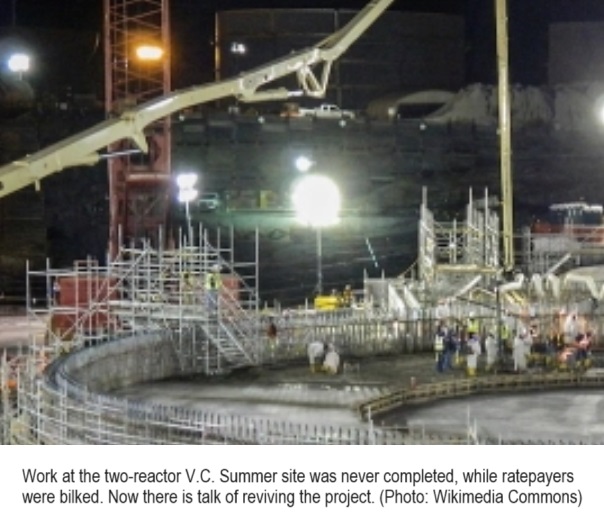
After eight years in the elements, all the equipment and the structure of the plant, which was less than halfway finished, will need to be carefully inspected before it can be used. The permits to build and the licenses to operate the nuclear plants will need to be renewed, likely starting from scratch.
The permits to build and the licenses to operate the nuclear plants will need to be renewed, likely starting from scratch,
the agreement appears to let Brookfield walk away if it decide it’s not feasible.
By ASSOCIATED PRESS, 25 October 2025, https://www.dailymail.co.uk/wires/ap/article-15225007/South-Carolinas-state-utility-says-private-firm-set-restart-abandoned-9-billion-nuclear-project.html
COLUMBIA, S.C. (AP) – South Carolina’s state-owned utility is looking to a private company to revive a project to build two nuclear power plants that was abandoned eight years ago, losing more than $9 billion without generating a watt of power.
Santee Cooper’s board agreed Friday to start six weeks of negotiations with Brookfield Asset Management that they hope will lead to a deal that lets the private company build the nuclear plants at the V.C. Summer site near Jenkinsville at their own risk to generate power that they could mostly sell to whom they want, such as energy-gobbling data centers.
Santee Cooper said Brookfield preliminarily agreed to provide the utility with some of the power generated. But that and probably thousands of other details will have to be negotiated. In a twist, Brookfield took over the assets of Westinghouse Electric Co., which had to declare bankruptcy because of difficulties building new nuclear reactors.
Utility officials said the agreement gives hope the state can get something out of a debacle that led to four executives going to prison or home confinement for lying to regulators, shareholders, ratepayers and investigators and left millions of people paying for decades for a project that never produced electricity.
“The risk to the ratepayer is nil. The risk to the taxpayer is nil,” Santee Cooper Board Chairman Peter McCoy said.
There are still too many hurdles for the project to get past to consider this a win right now, said Tom Clements, executive director of the nuclear watchdog group Savannah River Site Watch.
After eight years in the elements, all the equipment and the structure of the plant, which was less than halfway finished, will need to be carefully inspected before it can be used. The permits to build and the licenses to operate the nuclear plants will need to be renewed, likely starting from scratch, Clements said.
“I still believe that the cost, technical and regulatory hurdles are too big to lead to completion of the project,” Clements said, adding the agreement appears to let Brookfield walk away if it decide it’s not feasible.
Santee Cooper heard from 70 bidders and received 15 formal proposals to restart construction of the reactors. Interest in the project has grown as power demand in the U.S. surges with the increase in data centers as artificial intelligence technology develops.
Santee Cooper executives credited President Donald Trump’s executive order in May calling for the U.S. to quadruple the amount of power generated by nuclear plants over the next 25 years for opening the door to the potential agreement.
“You have placed South Carolina in the epicenter of the resurgence of nuclear power in the United States,” Santee Cooper CEO Jimmy Staton said.
Santee Cooper was the minority partner with what was then South Carolina Electric and Gas when construction on the two new nuclear plants started in 2013 at the V.C. Summer site – about 25 miles (40 kilometers) northeast of Columbia – where SCE&G was already operating a reactor.
The project needed to be finished in seven years to get tax credits to keep the project’s cost from overwhelming the utilities, but it ended up behind schedule almost immediately.
Executives lied about the problems to keep money coming in. Taxpayers and ratepayers ended up on the hook because of a state law that allowed the utilities to charge for costs before any power was generated.
Two nuclear reactors built in a similar way in Georgia went $17 billion over budget before they were fully operational in 2023.
Dounreay waste particle ‘most radioactive’ find for three years

Steven McKenzie, Highlands and Islands reporter and Rachel Grant, BBC Scotland. 23 Oct 25
A fragment of waste found near the decommissioned experimental nuclear power facility in Dounreay in April was the most radioactive to be detected in the past three years, the Highland site’s operator has said.
The fragment, categorised as “significant”, was discovered during monitoring work around the nuclear power plant near Thurso. It is the latest in a long line of particle discoveries in the area.
Dounreay was built in the 1950s as the UK’s centre of fast reactor research, but during the 1960s and 1970s sand-sized particles of irradiated nuclear fuel got into the drainage system.
Work to clear the pollution began in the 1980s, after particles were found washed up on the nearby foreshore.
The facility closed in 1994. The multi-billion pound decommissioning process involves hundreds of workers and is expected to last into the 2070s.
The full decontamination of the site is expected to take more than 300 years.
A Dounreay spokesperson said: “Particles are a legacy of industrial practices dating back to the early 1960s and our commitment today to environmental protection includes their monitoring and removal from the marine environment and transparent reporting of our activities.”
A group of independent experts, who advise the Scottish Environment Protection Agency (Sepa) and Dounreay, classify particles by the radioactivity of their caesium-137 content.
The categories are minor, relevant and significant.
Significant means a reading greater than one million becquerels of CS-137.
A becquerel is the standard unit of radioactivity.
The particle was found on the western part of Dounreay’s foreshore on 7 April. Eight other finds reported since then have been categorised as “minor” or “relevant”.
A significant-category particle was last discovered in March 2022.
Thousands of particles of different categories have been removed from beaches, foreshore and seabed at Dounreay.
The site’s operator said monitoring on the site on the north Caithness coast continued to be done on a fortnightly basis.
On occasions it said the scheduled work could be interrupted by bad weather or the presence of protected species of ground-nesting birds……………………………………………………..
What risk is there to the public?
According to official reports, risk to people on local beaches is very low.
Guidance issued by the UK government’s Nuclear Restoration Services says the most at-risk area is not accessible to the public.
The particles found along the coast vary in size and radioactivity with smaller and less active particles generally found on beaches used by the public.
Larger particles have only been found only on the foreshore at Dounreay, which is not used by the public.
The particles found on beaches are believed to come from the disintegration of larger fragments in the seabed near Dounreay. The area is continuously monitored for traces of radioactive materials.
Harvesting of seafood is prohibited within a 2km (1.2 mile) radius of a point near Dounreay. This is where the largest and most hazardous fragments have been detected.
Dounreay’s radioactive history
- 1954 – A remote site on the north coast of Scotland is chosen as the site of a new type of nuclear reactor. Modern homes were built in Caithness to attract workers to the sparsely populated area.
- 1957 – A chain reaction which provided sustained and controlled nuclear energy is achieved for the first time.
- 1959 – A new disposal site for radioactive waste called the Shaft opens. It drops 65.4m (214.5ft) below ground.
- 1962 – The fast reactor inside the dome is the first in the world to provide electricity to a national grid.
- 1977 – The original “golf ball” reactor is shut down and waste disposal in the Shaft ends after an explosion.
- 1994 – Dounreay nuclear power generating facility closes.
- 1998 – Decommissioning programme is announced.
- 2008 – Operation to scour the seabed for hazardous material begins and the Shaft shaft is encircled in a boot-shaped ring of grout to prevent contamination.
- 2020 – Clean-up begins of the highly contaminated Shaft – a three decades-long project.
- 2333 – Decontamination expected to be complete, making the 148-acre site available for other uses. https://www.bbc.com/news/articles/cz91nx0lv59o
Bannon Says Trump Will Run for an Illegal 3rd Term Because ‘He’s a Vehicle of Divine Providence’

Journalist Mehdi Hasan said Trump and his allies “plan to overturn the Constitution and democracy. They’re not hiding it. They’re bragging about it.”
Stephen Prager, Oct 24, 2025, https://www.commondreams.org/news/bannon-trump-third-term-plan
In a frightening interview, one of President Donald Trump’s top allies said there is a “plan” for the president to remain in power after 2028, despite constitutional limits.
Speaking to a pair of interviewers at The Economist, Steve Bannon—Trump’s former chief strategist and one of the most influential voices in the MAGA movement—described a third Trump term as a divinely ordained fait accompli that people must simply accept.
“Well, he’s gonna get a third term, so Trump ‘28,” Bannon said. “Trump is gonna be president in 2028, and people ought to just get accommodated with that.”
Asked about the 22nd Amendment of the US Constitution, which plainly forbids a president from serving more than two terms in office, Bannon proclaimed that “there are many different alternatives” to get around it.
“At the appropriate time, we’ll lay out what the plan is,” he said. “But there’s a plan. And President Trump will be president in ’28.”
Bannon continued: “We have to finish what we started… I know this will drive you guys crazy, but [Trump] is a vehicle of divine providence. He’s an instrument. He’s very imperfect. He’s not churchy. But he is an instrument of divine will.”
“We need him for at least one more term,” Bannon reiterated, “and he’ll get that in ‘28.”
In recent days, Trump has increasingly signaled his intent to run for a third term, selling “Trump 2028” merchandise on his website and displaying it in the Oval Office during negotiations with Democrats over the government shutdown.
His recent demolition of the White House’s East Wing to build a luxury ballroom has also raised alarms that Trump increasingly views himself as its permanent resident rather than a temporary steward.
Bannon was adamant that Trump would not only serve a third term, but that his staying in office would be “by the will of the American people.”
This assumption is out of line with what polls would seem to predict: Trump’s support recently hit a new low in his second term, with just 37% of voters approving of his job performance in the latest Associated Press-NORC Center for Public Affairs Research poll, compared to 61% who disapprove.
Bannon’s comments came days after the New York Times reported that Trump’s handpicked election officials have called for him to declare a “national emergency” ahead of the 2026 midterm election, which they say would allow him to assert more control over election laws and impose new rules on state and local elections without approval from Congress.
Max Flugrath of the voting rights group Fair Fight Action, who warned earlier this week of Trump’s plans to “hijack” the next elections, said that by pushing for a third term for the president, “Bannon is basically saying, ’Let’s light the Constitution on fire.‘”
Author and activist Jim Stewartson noted that Bannon “uses the same alchemy as [House Speaker] Mike Johnson and [Defense Secretary] Pete Hegseth to rationalize destroying the Constitution: ’spiritual war.‘”
Johnson has argued that the US government “must be biblically sanctioned” and that the Founders’ idea of the separation of church and state was “a misnomer.” Hegseth, meanwhile, has endorsed a video of a far-right pastor discussing the need to repeal the 19th Amendment, which enshrined the right of women to vote.
Some pointed out that Bannon often manages to create a stir in the media by saying provocative things and claiming to have privileged knowledge about the machinations of Trump’s inner circle. It’s not the first time Bannon has raised the possibility of a third Trump term.
“A question that I’ve never seen fully resolved is to what degree Bannon is just trying to get attention as a media figure and to what degree he’s actually clued in to what’s going on in the White House,” said HeatMap News correspondent Matthew Zeitlin.
However, Bannon was in the know about Trump’s plot to overturn the 2020 election well before it happened. Days before the vote, he was recorded telling right-wing allies that “What Trump’s gonna do is just declare victory… He’s gonna declare victory. But that doesn’t mean he’s a winner. He’s just gonna say he’s a winner.”
Others said that Bannon’s prognosis about a third Trump term is gravely serious, especially given Trump’s other actions during his second term.
“I would love to be wrong, but they keep saying this in public,” said writer John DiLillo. “He’s selling Trump 2028 merch. He’s massively remodeling the White House as if it were his personal residence. I don’t really see why the idea shouldn’t be taken seriously just because it’s ’unconstitutional.‘”
Mehdi Hasan, founder of the media outlet Zeteo, meanwhile, said: “They’re literally shouting it out loud! Their plan to overturn the Constitution and democracy. They’re not hiding it. They’re bragging about it. And the media are just ignoring it, or worse, normalizing it; the biggest story perhaps in modern American history.”
Germany destroys two nuclear plant cooling towers as part of nuclear phaseout plan.
Euronews, 25/10/2025,https://www.euronews.com/2025/10/25/germany-destroys-two-nuclear-plant-cooling-towers-as-part-of-nuclear-phaseout-plan
The two towers, equivalent to roughly 56,000 tonnes of concrete, collapsed in a controlled demolition on Saturday. It comes as part of Germany’s nuclear phaseout.
Two cooling towers of the former nuclear power plant in Germay’s Bavarian town of Gundremmingen were brought down in a controlled demolition at noon on Saturday.
The plant had served as an important landmark in the town for nearly six decades, bringing numerous new jobs and boosting the local economy.
As part of the country’s nuclear phaseout and under Germany’s energy transition policy, the Gundremmingen, as well as the Brokdorf, and Grohnde nuclear power plants, had already been decommissioned in December 2021.
The municipality, who had prepared for a large crowd of onlookers, set up a restricted zone around the power plant.
According to energy company RWE, the demolition could be observed from various watch points in the region. Some pubs also offered public “demolition viewing parties”
How the towers will be blown up
There were three explosions in total. The first was carried out to chase away nearby animals and wildlife. The second brought down the first tower, and the third caused the second tower to collapse.
Roughly 56,000 tonnes of concrete collapsed in a matter of seconds. Following Saturday’s demolition, the dismantling of the plant will further continue, local media report, with completion expected by 2040.
Leaked document reveals Amazon deliberately planned to hide data centers’ full water use.
Amazon deliberately excludes majority of water use from public sustainability reports
Serdar Dincel, Türkiye Today, Sat, 25 Oct 2025
mazon deliberately withheld information about the complete scope of its data centers’ water consumption from the public to protect its corporate image, according to an internal document obtained by the Guardian.
The leaked memo reveals that executives at Amazon Web Services, the company’s cloud computing arm, debated whether to report what they termed “secondary” water use — the water consumed in generating electricity for the company’s data centers — before launching a 2022 sustainability campaign.
Ultimately, leadership opted to publicize only a fraction of the company’s water footprint, citing concerns about “reputational risk” if total consumption figures became public knowledge.
The document, dated one month before AWS unveiled its “Water Positive” initiative in November 2022, shows Amazon consumed 105 billion gallons of water in 2021. That volume would supply approximately 958,000 U.S. households annually, comparable to a city larger than San Francisco.
Company reported fraction of actual consumption in public campaign
Instead of reporting this total, Amazon disclosed only its primary water use — 7.7 billion gallons per year, roughly equivalent to 11,600 Olympic-sized swimming pools — when measuring progress toward sustainability goals.
The Water Positive campaign committed Amazon to “return more water than it uses” by 2030, targeting a reduction in primary use to 4.9 billion gallons. Secondary water consumption was excluded from these calculations…………………………………………….
As the world’s largest data center operator, Amazon is rapidly expanding its artificial intelligence infrastructure despite growing concerns about water resources needed to cool computing facilities. The company has faced mounting criticism for refusing to disclose total water usage, a transparency measure adopted by competitors Microsoft and Google.
Amazon’s Water Positive campaign remains active but continues to exclude secondary water use from its accounting, and the company has not made its overall water consumption public. https://www.turkiyetoday.com/business/amazon-deliberately-excludes-majority-of-water-use-from-public-sustainability-reports-3208989
Pentagon orders USS Gerald R. Ford into Caribbean, first carrier sent to region
Yahoo News, Nicholas Slayton, Sat, October 25, 2025
The Pentagon ordered the Gerald R. Ford Carrier Strike Group to sail to the Caribbean, adding one of the Navy’s largest and most potent formations to the major U.S. build-up in the region. The new deployment will add the aircraft carrier’s more than 70 aircraft and multiple destroyers to the array of firepower already sent to the region for a mission the White House insists is aimed at drug traffickers.
Pentagon spokesperson Sean Parnell confirmed the deployment in a statement, saying the strike group would be “in support of the President’s directive to dismantle Transnational Criminal Organizations (TCOs) and counter narco-terrorism.”
Carrier Strike Group 12 includes the USS Gerald R. Ford, the destroyers USS Bainbridge and USS Mahan and Carrier Air Wing 8. Their arrival makes this fall’s buildup one of the largest deployments of naval power since the start of the Red Sea conflict in late 2023. The strike group’s air contingent includes four squadrons of F/A-18 fighters and one squadron of E/A-18G strike fighters.
Word of the deployment came shortly after Defense Secretary Pete Hegseth announced another airstrike on a civilian vessel in the Caribbean. Hegseth said the strike killed six on board, a tally which would bring the death toll in U.S. strikes on boats in the region to 43 since September, according to White House figures.
Hegseth accused the crew of being members of the gang Tren de Aragua, a group the administration has often linked to the boats with little public evidence. It was the 10th strike in total, and the third one in as many days.
Governments and media in the region have reported that those killed or wounded in U.S. strikes have included citizens from Colombia, Ecuador, and Trinidad and Tobago. At least two sailors have been rescued by U.S. forces after surviving strikes on their boats, including an Ecuadorian man who was released days later when authorities in his country said there was no evidence of a crime to charge him with.
Earlier this year, the Trump administration designated several gangs and drug cartels as “foreign terrorist organizations,” and accused the Venezuelan government of collaborating with them. The White House has advised Congress that the U.S. is in an “armed conflict” with these gangs, but no Congressional authorization for the use of force has been given……………………………………………………. https://www.yahoo.com/news/articles/pentagon-orders-uss-gerald-r-183731366.html?guccounter=1&guce_referrer=aHR0cHM6Ly93d3cuc290dC5uZXQv&guce_referrer_sig=AQAAAC-xq4OFcery8IiSv68w1zrTr-PmRrn6IBwmoiNxApl6bQszSfDGY6O51M4yAGAU1O90WYXwK-DRaUu0nfau6ncVUnxrYVkwer67gcsHqDulCR8Y2h3pG0HD-S1OJ9NpV1QqBFkaKO0mADBLxw3mgTmEliwGClbGebBO1lPCO-bZ
Trump’s push to uphold Gaza ceasefire is creating a political crisis in Israel.

Israel isn’t a vassal state of the U.S., JD Vance said. But when it comes to the ceasefire in Gaza and annexing the West Bank, Israeli decision-making is deeply intertwined with Washington’s current priorities.
Mondoweiss, By Qassam Muaddi October 24, 2025
The succession of U.S. officials arriving in Tel Aviv over the week has fueled consternation in Israeli political circles as Washington ups the pressure on Israel to stick to U.S. President Donald Trump’s Gaza ceasefire plan. Israeli political circles have bristled at having to bend to the American President’s will, as opposition use the opportunity to lambast Israeli Prime Minister Benjamin Netanyahu for turning Israel into a “vassal” of the United States.
Virtually all of Trump’s inner circle has made the rounds in Tel Aviv throughout the past week, including U.S. Special Envoy Steve Witkoff, Trump’s son-in-law, Jared Kushner, Vice President JD Vance, and U.S. Secretary of State Marco Rubio.
They were all there, JD Vance said, to monitor the ceasefire, rushing to add: “But not monitoring in the sense of, you know…you monitor a toddler.” But Israeli media referred to the flurry of visits as American “Bibi-sitting.”
Israeli daily newspaper Haaretz published a caricature on Wednesday portraying Netanyahu as a child playing with toy tanks and airplanes while Witkoff tells him, “Just a little while more, and then off to bed.” Maariv published another cartoon showing Witkoff, Vance, and Kushner closely tailing Netanyahu, who says, “Honestly, I’m just going to the toilet.”
Israeli opposition leader Yair Lapid didn’t hold back either. At the opening of the Knesset’s winter session, Lapid slammed Netanyahu for getting Israel into “the most dangerous political crisis in its history,” and for sabotaging past ceasefire deals that could have seen the earlier release of the Israeli captives in Gaza. Lapid also said that Netanyahu had turned Israel into “a vassal state that takes orders concerning its own security.”
Things got even tenser during a press conference with Netanyahu when Vance was asked by a reporter whether Israel was becoming a “protectorate” of the U.S. …………………………………………………
The visits by Vance, Witkoff, Kushner, and Rubio came as the fragile ceasefire in Gaza was about to unravel last Sunday, October 19, following an incident in Rafah in which two Israeli soldiers were killed in an explosion. Israel accused Hamas of breaching the ceasefire and launched a series of strikes across Gaza, killing at least 40 Palestinians. Hamas denied any knowledge of the Rafah incident, with reports that the explosion was caused by an Israeli bulldozer running over an unexploded ordinance, of which the White House was reportedly aware. …………….
Political circles in Israel regarded the halt of Israel’s blitz as a sign that Netanyahu had folded under continuous U.S. pressure to make the ceasefire work. Israel’s hardline National Security Minister, Itamar Ben-Gvir, regarded the decision as “shameful” and called on Netanyahu to resume its full-scale onslaught against Gaza.
Now there’s another sticking point that is continuing to fuel U.S.-Israeli tensions: annexation.
West Bank annexation is off the table. Or is it?
In the midst of this wave of criticism, Netanyahu announced his candidacy for the post of Prime Minister in the upcoming November 2026 elections. Netanyahu is currently the longest-serving Prime Minister in Israel’s history, having led a shifting arrangement of right and center-right coalitions for a total of 18 years.
In the middle of JD Vance’s visit, the Israeli Knesset voted in favor of the first reading of a bill that would annex the West Bank. The reaction from the U.S. was unprecedented.
Before boarding his flight to Tel Aviv earleir this week, Secretary of State Rubio said that the vote was “counterproductive” and “threatening to the peace deal.” Vance went further, calling the vote “weird,” “stupid,” and an “insult,” adding that “the policy of the Trump administration is that the West Bank will not be annexed by Israel.”
But the hardest U.S. reaction came from Trump himself, who said in an interview with Time magazine that Israel’s annexation of the West Bank “will not happen because I gave my word to the Arab countries,” adding that “Israel would lose all of its support from the United States if that happened.”
The problem is that annexing the West Bank has been Netanyahu’s most important electoral promise since 2019. He has been spearheading a years-long legislative effort to make that annexation a reality, starting with the 2018 Nation-State Law, then with the Knesset resolution to reject a Palestinian state in July 2024, and finally with last July’s Knesset resolution allowing the government to annex the West Bank.
This is particularly inconvenient for Benjamin Netanyahu, as he needs to avoid any major confrontation with Washington at the current moment……………………………………………………..
In his first term, Donald Trump also clashed with a Netanyahu-led government that had pledged to annex parts of the West Bank. Trump halted the annexation process by brokering normalization agreements with several Arab states, most crucially the United Arab Emirates. The importance of the so-called Abraham Accords, for Trump, comes from the fact that the remaining Gulf countries that have yet to normalize relations with Israel — Qatar and Saudi Arabia — are the key to securing regional U.S. economic and political dominance. This is part of the larger U.S. agenda of reasserting American hegemony and confronting the rising influence of China. A part of Trump’s roadmap to get there is by integrating Israel in the Middle East.
After its genocide in Gaza, Israel is facing international isolation, so regional integration should seemingly be an Israeli priority as well. But in this instance, integration would force Israel to at least temporarily pause its plans to assert Jewish sovereignty between the river and the sea, as the Likud’s charter put it.
Smotrich gave voice to that supremacist dream while speaking at a tech conference on Thursday, saying that Israel would not give up annexation for the sake of normalization: “If Saudi Arabia tells us ‘normalization in exchange for a Palestinian state,’ friends — no thank you. Keep riding camels in the desert in Saudi Arabia, and we will continue to develop.”……………………………………………………….
The ongoing frenzy of political recriminations in Israeli circles is a sign that they’re gearing up for elections and trying to score points against their rivals. What this tells us is that the Israeli political establishment has, at least implicitly, accepted that the war is over for the moment. But the fact that this political theater unfolds in the shadow of unprecedented U.S. pressure suggests how deeply Israeli decision-making is intertwined with Washington’s priorities. https://mondoweiss.net/2025/10/trumps-push-to-uphold-gaza-ceasefire-is-creating-a-political-crisis-in-israel/
As Millions March Against Fascism, NYT Warns Against Progressives

FAIR, Julie Hollar, October 25, 2025
What does this political moment in our country call for? The MAGA president and right-wing Supreme Court are shredding the Constitution at lightning speed, with the full acquiescence of Trump’s merry band of sycophants in Congress. Masked men are kidnapping people off the streets, disappearing them to detention centers across the country, and deporting them to countries our State Department warns travelers not to visit. Meanwhile, protesters against this lawlessness are attacked by federal troops with “less-lethal” weapons.
An estimated 7 million peaceful protesters took to the streets on October 18, in the second-largest demonstration in US history (after the first Earth Day in 1970), demanding accountability and a return to democracy and the rule of law. In a system of government where citizens can only use the ballot box every two to six years to show how they feel about their electeds, that’s something you’d think would warrant journalistic attention.
Yet at the nation’s paper of record—whose headquarters sat literally a stone’s throw away from the New York City No Kings march route—the protest was deemed not important enough for a front-page story. Two small below-the-fold photos were offered instead (10/19/25), with the accompanying article buried on page 23.
It’s true that the New York Times has a history of downplaying protests (FAIR.org, 9/24/25, 9/12/25, 1/25/24). But it’s also true that it’s only certain kinds of protests that they downplay. When right-wingers under the banner of the Tea Party movement held in 2009 what the Times (9/12/09) described as “the largest rally against President [Barack] Obama since he took office,” they drew a crowd two orders of magnitude smaller than No Kings, but its coverage got the same placement from the paper: front-page photo, article inside. Just one month after the Tea Party rally, a major LGBTQ march of equal or possibly even double the size was not noted on the paper’s front page at all (Extra!, 12/09).
The Times isn’t exactly an outlier in that respect; nearly all corporate media have a long history of downplaying major protests over women’s rights, war, genocide and the climate crisis, while offering much more ink and airtime to right-wing rallies like the Promise Keepers and the Tea Party.
But the Times deserves special attention—partly because it’s seen as the standard-bearing “liberal” newspaper in the country. And as the standard-bearer, it sees its role as establishing the ideological boundaries of the Democratic Party, most notably by drawing the line in the sand on the left that the Democrats must not cross. And this in turn is why, two days after the massive pro-democracy marches, the New York Times editorial board published a forceful message of its own—not against fascism, but against progressivism.
‘The center is the way to win’
In both its news and opinion sections, year after year, the New York Times‘ mantra has been that for electoral success, Democrats have to move to the right, and any electoral losses must be caused by excessive progressivism (Extra!, 7–8/06; FAIR.org, 5/27/15, 7/6/17, 11/14/19, 7/16/21). In a sprawling new iteration of this “move to the center” motto, the paper’s editorial board (10/20/25) announced: “The Partisans Are Wrong: Moving to the Center Is the Way to Win.”
The piece frames itself as talking to “partisans,” but it makes only the faintest nods to Republicans, and the last 2,000 of its 3,000-odd words are directly targeting Democrats. It opens:
American politics today can seem to be dominated by extremes. President Trump is carrying out far-right policies, while some of the country’s highest-profile Democrats identify as democratic socialists. Moderation sometimes feels outdated.
You could probably just stop right there, based on the absurdity of comparing the “extremes” of Trump’s unprecedented authoritarianism to democratic socialist Democrats. New York City mayoral candidate Zohran Mamdani, the highest-profile of the latter at the moment (and certainly top of mind for the city’s largest newspaper), has focused his campaign on freezing the rent, making city buses free and adding 2% to the tax bills of the wealthiest 1%……………………………………………………………………………………………………………………………………………………………………………………………………………….
Captured by elites
The example the Times offers of how moving to the center will make Democrats more “credible” and “effective” in confronting Trump is that “most voters disapprove of Mr. Trump’s immigration policies—and nonetheless trust his party on the issue more than they trust Democrats.” A more “moderate” position on immigration would make Democrats better able to “combat” him on the issue
But when the Times itself calls Biden’s immigration policies “lax”—when they were far more cruel and draconian than any recent president besides Trump—and frames them as the other side of the extremist coin to Trump’s “cruel immigration enforcement,” it shapes that public perception. It’s hardly a surprise that many voters think the Democrats are “too liberal,” when that’s what all of the country’s biggest news outlets have hammered into their heads for decades.
In fact, a recent poll shows that the Times‘ advice is fundamentally self-defeating. The paper is correct that Democrats’ approval ratings are abysmal, and also that some polls show voters say Democrats are “too left wing and too focused on niche issues.” But those polls give respondents prewritten choices, suggesting to them what the appropriate answer might be, which can skew responses. What happens if you ask voters directly what they think about the party, and let them fill in the blanks themselves? A recent poll of Rust Belt (read: swing state) voters did just that, and analyzed the unprompted answers. Here’s what they found (Jacobin, 10/15/25):
Contrary to many analyses that have blamed Democrats for holding extreme positions on social and cultural issues that alienated swing voters, the dominant theme we observed was voters’ anger at the Democratic Party for failing to deliver. Among Democratic and independent respondents, the most common critique of the Democratic Party was its perceived inability to carry out policies that help ordinary people.
………………………. And what happens when you ask them directly about progressive policies? Turns out that, on many issues, voters are much more progressive than the Times would have readers believe. Polls regularly show large majorities in favor of a wealth tax, a $15 or higher minimum wage, and Medicare for All, all key progressive demands that corporate media regularly lambaste.
Anti-democratic power grab
Equally important, the Times‘ argument imagines that a Democratic push to the center can overcome the structural obstacles to competitive elections that this authoritarian movement is rapidly laying down. Trump and his allies are working furiously to undermine election integrity for their own benefit, using a variety of strategies that the Brennan Center for Justice (8/3/25) details:
- attempting to rewrite election rules to burden voters and usurp control of election systems;
- targeting or threatening to target election officials and others who keep elections free and fair;
- supporting people who undermine election administration; and
- retreating from the federal government’s role of protecting voters and the election process.
GOP-controlled states are ramming through new gerrymandered maps at Trump’s behest to generate more safe seats. And the Voting Rights Act is currently before a Supreme Court that seems eager to eviscerate what little remains of it, which would allow further gerrymandering to give the GOP up to 19 more House seats.
Will it be possible in 2026 for Democrats to win at the ballot box, regardless of ideology? That’s very much up for debate. It certainly appears to be Trump’s goal to make it impossible, no matter how popular Democratic candidates might be.
Yet nowhere in its lengthy tirade against progressives does the Times mention this anti-democratic electoral power grab. It’s a key omission, and it brings us back to the paper’s downplaying of the No Kings protests. The Times in its editorial laments that Trump “threatens American democracy,” but it imagines the ship can be righted by retaking Congress with centrist Democrats.
If the Democrats have shown us anything under Trump 2.0, it’s that seeking to moderate and accommodate—as they did in confirming his extremist cabinet nominees and failing to block his first continuing resolution in the spring—only gives Trump and his enablers more power. Stopping the authoritarian machine is going to require all the levers of democracy that can be pulled—not just at the ballot box, but also on the streets. https://fair.org/home/as-millions-march-against-fascism-nyt-warns-against-progressives/
Buzz around nuclear shows the hole that [?]green shipping is in.

COMMENT. Note the headline – they’re still pretending that nuclear is “green”
Nuclear shipping is great in theory, but not a serious plan for decarbonisationSMRs are not the done deal their cheerleaders make them out to be
They have advantages over hydrogen, as long as money is no object
On paper, new nuclear for shipping offers great promise. But the fact it is being taken seriously shows how forlorn efforts to replace diesel have become in 2025
Lloyd’s List 24th Oct 2025, https://www.lloydslist.com/LL1155212/Buzz-around-nuclear-shows-the-hole-that-green-shipping-is-in
1 This Month

of the week – Shut Down Drone Warfare!


Tell the Ukrainian Government to Drop Prosecution of Peace Activist Yurii Sheliazhenko

Petition to revoke the licensing of the Near Surface Nuclear Disposal Facility (NSDF) at Chalk River. https://www.ourcommons.ca/petitions/en/Petition/Details?Petition=e-7247
To see nuclear-related stories in greater depth and intensity – go to https://nuclearinformation.wordpress.com
-
Archives
- April 2026 (44)
- March 2026 (251)
- February 2026 (268)
- January 2026 (308)
- December 2025 (358)
- November 2025 (359)
- October 2025 (376)
- September 2025 (257)
- August 2025 (319)
- July 2025 (230)
- June 2025 (348)
- May 2025 (261)
-
Categories
- 1
- 1 NUCLEAR ISSUES
- business and costs
- climate change
- culture and arts
- ENERGY
- environment
- health
- history
- indigenous issues
- Legal
- marketing of nuclear
- media
- opposition to nuclear
- PERSONAL STORIES
- politics
- politics international
- Religion and ethics
- safety
- secrets,lies and civil liberties
- spinbuster
- technology
- Uranium
- wastes
- weapons and war
- Women
- 2 WORLD
- ACTION
- AFRICA
- Atrocities
- AUSTRALIA
- Christina's notes
- Christina's themes
- culture and arts
- Events
- Fuk 2022
- Fuk 2023
- Fukushima 2017
- Fukushima 2018
- fukushima 2019
- Fukushima 2020
- Fukushima 2021
- general
- global warming
- Humour (God we need it)
- Nuclear
- RARE EARTHS
- Reference
- resources – print
- Resources -audiovicual
- Weekly Newsletter
- World
- World Nuclear
- YouTube
-
RSS
Entries RSS
Comments RSS
 nuclear-news