Coral die-off marks Earth’s first climate ‘tipping point’, scientists say.
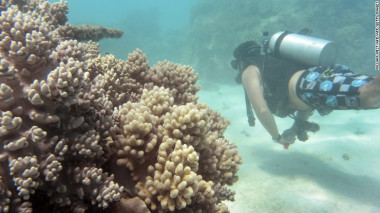
A surge in global temperatures has caused widespread bleaching and death of warm-water corals around the world.
By Jeff Tollefson, Nature 12th Oct 2025
Surging temperatures worldwide have pushed coral reef ecosystems into a state of widespread decline, marking the first time the planet has reached a climate ‘tipping point’, researchers announced today.
They also say that without rapid action to curb greenhouse-gas emissions, other systems on Earth will also soon reach planetary tipping points, thresholds for profound changes that cannot be rolled back.
“We can no longer talk about tipping points as a future risk,” says Steve Smith, a social scientist at the University of Exeter, UK, and a lead author on a report released today about how close Earth is to reaching roughly 20 planetary tipping points. “This is our new reality.”
Temperature spike
Led by Smith and other scientists at the University of Exeter, the report assesses the risk of breaching tipping points such as ice-sheet collapse, rising seas and dieback of the Amazon rainforest. It also discusses progress towards various positive tipping points focused on social and economic change, such as the adoption of clean energy.
The group’s first such assessment, released less than two years ago, raised alarms but did not officially declare that any climate tipping points had been reached. In the past few years, however, global temperatures have surged, sparking concerns among some scientists that global warming is accelerating and could lead to even more widespread impacts in the coming decades than the changes that have already been recorded.
The impact on coral reefs has been particularly severe in the past two years , pushing these ecosystems to their tipping point, the researchers say. The warming waters have caused corals across the globe to bleach, a process that occurs when the organisms expel the symbiotic algae that provide them with nutrients, oxygen and vibrant colours. The fourth global bleaching event in the past few decades began in January 2023, and researchers estimate that it has affected more than 84% of the planet’s coral ecosystems.
The initial tipping-point report talked about large-scale threats to corals in the future tense, but the latest global bleaching event has made it clear that the crisis is now, says Michael Studivan, a coral ecologist at the University of Miami in Florida………………………………………
https://www.nature.com/articles/d41586-025-03316-w
No comments yet.
1 This Month

of the week – Shut Down Drone Warfare!


Tell the Ukrainian Government to Drop Prosecution of Peace Activist Yurii Sheliazhenko

Petition to revoke the licensing of the Near Surface Nuclear Disposal Facility (NSDF) at Chalk River. https://www.ourcommons.ca/petitions/en/Petition/Details?Petition=e-7247
To see nuclear-related stories in greater depth and intensity – go to https://nuclearinformation.wordpress.com
-
Archives
- April 2026 (34)
- March 2026 (251)
- February 2026 (268)
- January 2026 (308)
- December 2025 (358)
- November 2025 (359)
- October 2025 (376)
- September 2025 (257)
- August 2025 (319)
- July 2025 (230)
- June 2025 (348)
- May 2025 (261)
-
Categories
- 1
- 1 NUCLEAR ISSUES
- business and costs
- climate change
- culture and arts
- ENERGY
- environment
- health
- history
- indigenous issues
- Legal
- marketing of nuclear
- media
- opposition to nuclear
- PERSONAL STORIES
- politics
- politics international
- Religion and ethics
- safety
- secrets,lies and civil liberties
- spinbuster
- technology
- Uranium
- wastes
- weapons and war
- Women
- 2 WORLD
- ACTION
- AFRICA
- Atrocities
- AUSTRALIA
- Christina's notes
- Christina's themes
- culture and arts
- Events
- Fuk 2022
- Fuk 2023
- Fukushima 2017
- Fukushima 2018
- fukushima 2019
- Fukushima 2020
- Fukushima 2021
- general
- global warming
- Humour (God we need it)
- Nuclear
- RARE EARTHS
- Reference
- resources – print
- Resources -audiovicual
- Weekly Newsletter
- World
- World Nuclear
- YouTube
-
RSS
Entries RSS
Comments RSS
 nuclear-news
Leave a comment