Israeli Government Votes to Implement Trump Peace Plan for Gaza as Hamas Pledges to Uphold It

Juan Cole, 10/10/2025, https://www.juancole.com/2025/10/government-implement-implementation.html
Ann Arbor (Informed Comment) – According to the Israeli newspaper Arab 48 , the Israeli government on Friday approved the ceasefire in Gaza and the hostage exchange, and agreed to begin withdrawing troops from the west of the Strip. The approval came after the arrival of President Donald Trump’s Middle East envoys Steve Witkoff and Jared Kushner and their meeting with Israeli Prime Minister Benjamin Netanyahu.
The ceasefire was expected to go immediately into effect, with the Israeli military beginning its withdrawal from Gaza, to be followed by the exchange of hostages between Hamas and Israel over the next three days.
The extreme-right Religious Zionism and Jewish Power blocs, led by Bezalel Smotrich and Itamar Ben-Gvir respectively, voted against the agreement. Ordinarily, Netanyahu would need these votes for a majority in the 120-member Knesset or Israeli parliament, where his coalition has 64 seats. In this instance, however, the other Israeli parties, mostly center-right, had wanted this sort of agreement all along, and so they supported the sitting government from its left.
Orit Strook, Minister of Settlements and National Missions, also from Religious Zionism, said she was disappointed that Netanyahu had not explained to President Trump that Gaza is an inalienable part of Israel. (It isn’t.)
Smotrich expressed “Mixed feelings on a complex morning.” He spoke of his joy about the release of the remaining hostages, even though he had earlier repeatedly said that achieving the release of the hostages was not a high priority.
Smotrich defended his earlier obstructionism on the grounds that he had opposed “partial deals” that would have prevented the occupation of Gaza and the elimination of Hamas. In fact, of course, he opposed all deals and wanted to empty Gaza of its indigenous Palestinians, or the ones still left alive after two years of intensive bombing of civilian apartment buildings and infrastructure. Smotrich had also obstructed the delivery of aid to Gaza’s civilian population. He also opposed the release of 250 Palestinian hostages taken over the years by Israel, warning that they would go on to spill Jewish blood. Large numbers of the some 10,000 Palestinians kidnapped by Israel have never been so much as charged with committing violence, much less convicted. He pledged to go on striving to “eradicate” Hamas. Some ceasefire.
Conflicting reports are issuing from high Trump administration officials about whether 200 American troops would be sent to Gaza as observers of the ceasefire, with some confirming it and others denying it.
Hamas affirmed that they were committed to a deal that would end the two-year-long conflict.
Meanwhile, the United Nations Relief and Works Agency said that it has enough food aid ready to go into Gaza to last for three months. The Israeli government has attempted to ban UNRWA, formed by the United Nations to help Palestinian refugees expelled from their homes by the Israelis, from operating in the occupied Palestinian territories, and has blocked most food aid since April. Gaza cannot feed itself, especially after the Israelis destroyed 80% of Gaza’s farmland. Nevertheless, UNRWA still has 12,000 workers in Gaza ready to swing into action to relieve the Israeli-imposed famine.
About the Author
Juan Cole is the founder and chief editor of Informed Comment. He is Richard P. Mitchell Professor of History at the University of Michigan He is author of, among many other books, Muhammad: Prophet of Peace amid the Clash of Empires and The Rubaiyat of Omar Khayyam. Follow him on Twitter at @jricole or the Informed Comment
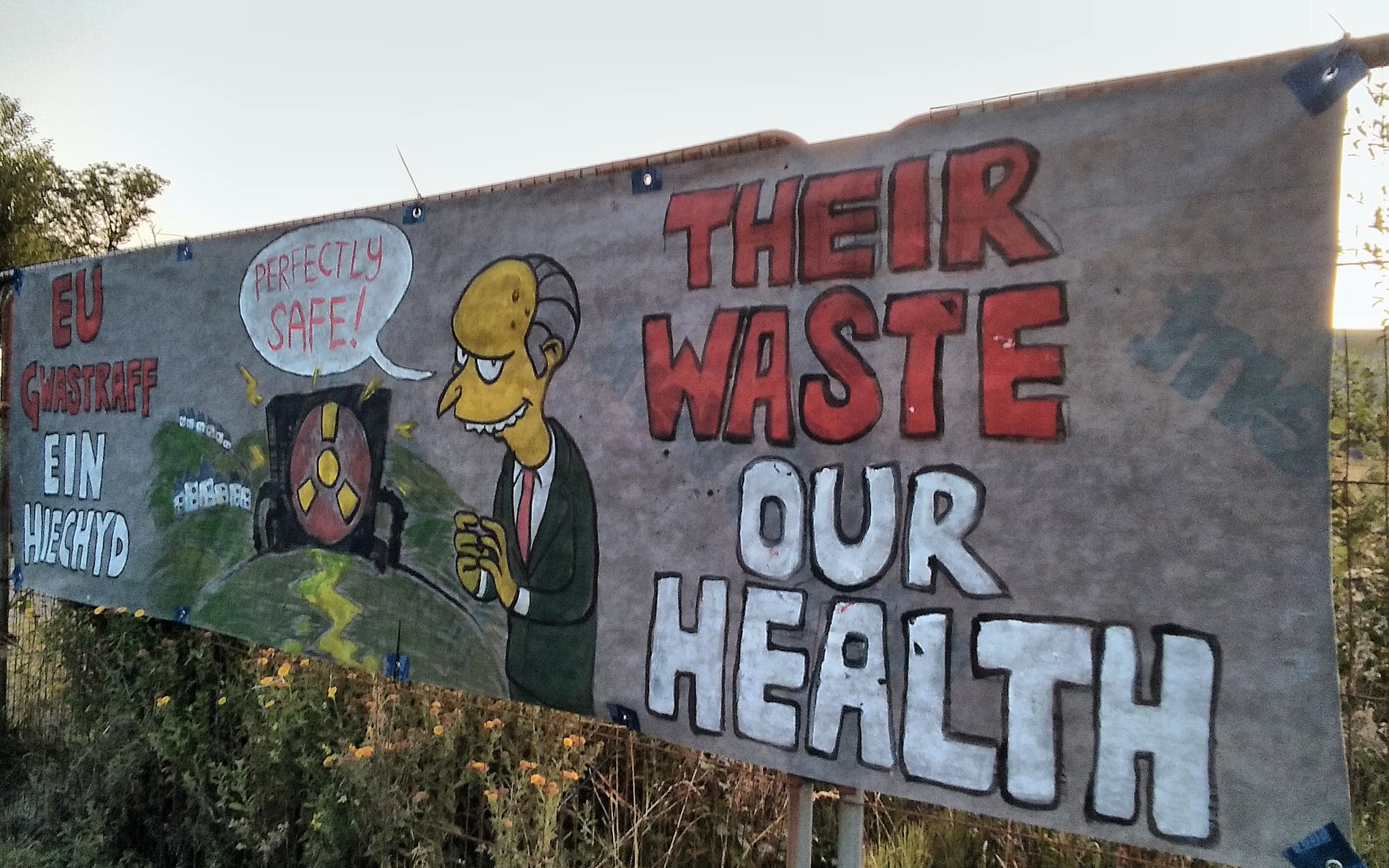
Campaigners warn of ‘dangerous experiment’ as nuclear plans face backlash.
Tom Sinclair, 10 Oct 25, https://pembrokeshire-herald.com/124146/campaigners-warn-of-dangerous-experiment-as-nuclear-plans-face-backlash/
Climate Camp Cymru supports Llynfi Valley protest against small modular reactors – campaigners urge Pembrokeshire to stay alert
ENVIRONMENTAL activists from across Wales – including several from Pembrokeshire – joined forces with Climate Camp Cymru this summer to support the No Nuclear Llynfi campaign near Llangynwyd in the Llynfi Valley, South Wales.
The group is opposing plans by American company Last Energy to build four small modular nuclear reactors (SMRs) on land within a mile of residential homes and two schools.
The company, a venture capital-backed start-up that has never built a reactor before, is currently seeking UK planning approval. Campaigners say it is deeply concerning that Last Energy is also suing the US Nuclear Regulatory Commission, claiming its safety regulations are “overburdensome” – while applying similar pressure in the UK to reduce oversight and speed up development.
Concerns over waste and flood risk
No Nuclear Llynfi campaigners have highlighted several risks, including plans to store radioactive waste on-site indefinitely, and the fact that the proposed location lies below the water table in a Zone 3 flood risk area – the highest flood designation.
Other worries include the need for 24-hour armed security, the site’s proximity to homes and schools, and the potential use of generated power for data centres running artificial intelligence systems, rather than for local homes or industry.
spokesperson for Climate Camp Cymru said the project “treats post-industrial communities as expendable,” adding that “people in the valleys, and in places like Pembrokeshire too, are being used as testing grounds for risky new energy technologies.”
Raising awareness
The summer camp, set up over the August bank holiday weekend, occupied open land near the proposed nuclear site. Volunteers raised banners along the A4063, distributed flyers, and knocked on around 1,000 doors to alert residents.
Most locals, campaigners said, were unaware of the nuclear proposal – despite claims by Last Energy that it had consulted the community. “There’s a legal duty to inform residents, and that simply hasn’t been met,” organisers said.
An open meeting at Maesteg Rugby Club on September 25 drew strong attendance and marked the beginning of organised local opposition.
Workshops and wider links
Throughout the weekend, the camp hosted workshops and talks from campaigners behind Save Kilvey Hill in Swansea – where activists are fighting a proposed adventure park development – and from CND, the Initiative for Nature Conservation Cymru (INCC), and academics from Cardiff University.
Discussions focused on linking environmental struggles across Wales, from open-cast mining and deforestation to speculative energy projects. Evenings featured live music and Welsh-language sessions celebrating Wales’ radical protest heritage.
Call for local action
Organisers say the success of the Llynfi camp shows the power of grassroots resistance. The camp was left clean and intact, with the landowner’s permission granted after the first day and support from nearby residents.
Pembrokeshire campaigners are now being encouraged to stay alert to similar proposals in the west. Sites such as Trawsfynydd and Wylfa are already under consideration for future SMR projects, and environmental groups warn that West Wales could be next.
Anyone interested in hosting or seeking support from next year’s Climate Camp Cymru can contact the group via email at climatecampcymru@proton.me.
Small reactors, big problems: the nuclear mirage behind AI’s energy hype

Enrique Dans, Medium.com, 12 Oct 25
In the debate over the energy infrastructure required for the rapid growth of AI, small (nuclear) modular reactors (SMEs)are being touted in some quarters as a reliable, dense and zero-carbon way to supply data centers and critical networks.
A seductive idea for industries looking to justify colossal investments, it also demands rigorous and critical scrutiny. After all, a nuclear reactor is a nuclear reactor, with inherent dangers, and multiplying the number of installations also multiplies the risk vectors. An SMR on a truck: what could possibly go wrong?
The promise of “safer”, “modular”, “quick to deploy” and “low carbon” energy doesn’t hold up in the face of history, economics, or risk analysis. Modular designs have been explored before, and they faced the same obstacles: uncontrollable costs, complex engineering, difficulties in scaling and operational problems. The simple truth is that small nuclear reactors can’t compete with renewables today. Instead, the arguments are based on political, financial and institutional motivations, fueled by a mentally ill person who hates renewables.
First, the technical and operational risks. A reactor, large or small, is based on fissile materials; radioactive, very hot and requiring complex cooling systems. There are no………………………………………………………….. (Subscribers only) https://medium.com/enrique-dans/small-reactors-big-problems-the-nuclear-mirage-behind-ais-energy-hype-77f93a3a4460
“A House of Dynamite”: Battling a nuclear nightmare
CBS News, By David Martin, October 12, 2025
It’s a nightmare we’ve been living with all our lives. “I grew up in an era when we had to hide under our desks in the case of an atomic bomb,” said director Kathryn Bigelow, “so I suppose I was sort of imprinted early on with the prospect of nuclear war.”
In Bigelow’s new film, “A House of Dynamite,” the prospect of nuclear war suddenly becomes an insane reality. It tells of a single missile launched from an unknown location in the Pacific. At first it looks like a test, but it keeps on coming – with a trajectory estimated to be the continental United States.
With 19 minutes to impact, the president (played by Idris Elba) has to make an impossible decision.
Noah Oppenheim, a former president of NBC News, wrote the script, which dramatizes what he calls “the insanity that we would expect a single human being with limited preparation to decide in a matter of minutes the fate of all mankind.”
Bigelow, whose previous movies include “The Hurt Locker” (an all-too-real look at the war in Iraq) and “Zero Dark Thirty” (about the hunt for Osama Bin Laden) applied her trademark authenticity to the unthinkable. “It’s my responsibility as a filmmaker, if I’m presenting an environment that really exists, to be as authentic as possible,” she said.
Bigelow says she did not seek cooperation from the Pentagon for the film: “I felt that we needed to be more independent. But that being said, we had multiple tech advisors who have worked in the Pentagon. They were with me every day we shot.”
One military consultant was retired Lt. Gen. Dan Karbler. “Never in a million years would I have thought that I would have been in this position,” he said.
Karbler nailed his audition when he opened his first Zoom call with Bigelow like this: “‘This is the DDO from the Pentagon convening a strategic conference. This conference is Top Secret. Please bring the President into the conference.’ And I stopped there and clicked on my camera and I said, ‘Ladies and gentlemen, that’s how the worst day of America’s history will begin.'”
I noted, “That doesn’t sound like something you were ad-libbing?”
“I was not ad-libbing at all,” said Karbler. “That comes from a lot of practice.”………………………………………………………………………………………………..
So, what does screenwriter Noah Oppenheim want audiences to be thinking, once they’ve caught their breath? “I want people to be reminded that, even though the Cold War is long over, the nuclear era is not, and that we live, as the title says, in a house full of dynamite,” he said.
To which director Kathryn Bigelow added, “My question is how do we take the dynamite out of the walls … without tearing down the house?” https://www.cbsnews.com/news/a-house-of-dynamite-battling-a-nuclear-nightmare/
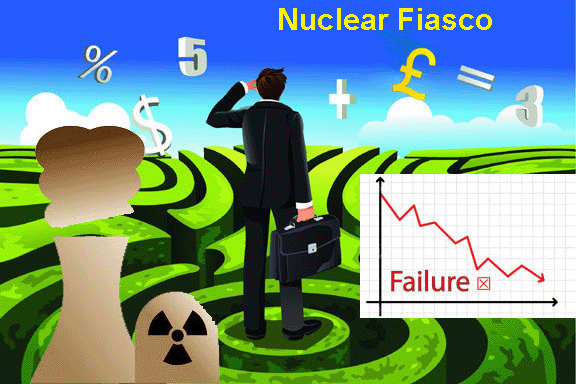
UK small businesses and charities say nuclear levy could add thousands to bills.
Charge from next month expected to have disproportionate impact after energy-intensive industries given exemption.
Jillian Ambrose Guardian, 13 Oct 25
British charities and small businesses have warned that a new levy on energy bills, intended to support the government’s nuclear power ambitions, could raise their costs by thousands of pounds a year.
The extra charge could mean a significant cost hike for charities and small businesses with high energy use, meaning community services may be cut and economic growth curtailed, according to trade groups.
For most charities, the levy, which takes effect in November, will mean an increase in costs of between £100 and £240 a year, but some could experience increases of up to £2,500, according to Social Investment Business, an organisation that offers loans and financial support to charities.
Nick Temple, the chief executive of Social Investment Business, said: “Adding yet more charges on top of charity electricity bills penalises our most vital community spaces at a time when they are already struggling.”
For small business, including those in hospitality, the extra costs could undermine growth in the UK economy and make the shift from fossil fuels to low-carbon electricity more expensive, according to trade associations.
The levy is designed to pay back investors in the Sizewell C nuclear project in Suffolk while the power plant is under construction.
Households can expect the levy to add about £12 a year to their energy bills, but organisations with high energy use will shoulder a greater cost burden. This will have a disproportionate impact on smaller businesses and charities with high energy demands because energy intensive industries such as steel, cement and glass-making have been granted exemption.
A Bristol-based community arts organisation, Spike Island, has been told to expect a hike of £1,ooo a year from the nuclear levy alone. The company, which provides subsidised studios for underrepresented artists, expects the extra costs to put a strain on its work……………………………………………………..
Business groups have also said that the costs are a “huge concern” for smaller companies, which they say will be forced to carry a disproportionate cost burden because larger companies were given exemptions………………………………………………………. https://www.theguardian.com/business/2025/oct/12/uk-small-businesses-and-charities-say-nuclear-levy-could-add-thousands-to-bills
Israeli Officials Are Openly Saying They Plan To Resume Attacks On Gaza.
information would seem to indicate that Israel is planning to use the unreturned bodies as a pretext to break the ceasefire.
Caitlin Johnstone, Oct 13, 2025, https://www.caitlinjohnst.one/p/israeli-officials-are-openly-saying?utm_source=post-email-title&publication_id=82124&post_id=176000209&utm_campaign=email-post-title&isFreemail=true&r=1ise1&triedRedirect=true&utm_medium=email
Israel’s top officials are openly declaring that they intend to terminate the Gaza ceasefire after they get their hostages back.
Defense Minister Israel Katz has posted a tweet in Hebrew which machine translates as follows:
“Israel’s great challenge after the phase of returning the hostages will be the destruction of all of Hamas’s terror tunnels in Gaza, directly by the IDF and through the international mechanism to be established under the leadership and supervision of the United States. This is the primary significance of implementing the agreed-upon principle of demilitarizing Gaza and neutralizing Hamas of its weapons. I have instructed the IDF to prepare for carrying out the mission.”
Hamas has not agreed to any demilitarization or destruction of its tunnels. There is no way to demilitarize Gaza and neutralize Hamas of its weapons against their will without continued warfare, something Israel has demonstrated it cannot do without killing shocking numbers of civilians.
Katz’s comments echo the public statements of Prime Minister Netanyahu, who said in a televised speech on Friday that “Hamas will be disarmed and Gaza will be demilitarized,” and that if Hamas doesn’t disarm voluntarily then “it will be achieved the hard way.”
In another statement Netanyahu said, “We have achieved tremendous victories but the campaign is not over; part of our enemies are trying to recover.”
Israeli outlet YNet reports that Israel is planning to resume its blockade and prevent reconstruction if all the bodies of the deceased captives are not returned, when Israel already knows that Hamas probably won’t be able to locate all the bodies of deceased Israeli captives due to the intensity of the Israeli bombing campaign over the last two years.
“If Hamas does not cooperate with the return process, and Israel suspects that it is deliberately hiding the bodies in order to preserve them as a bargaining chip, it is expected to impose a series of sanctions on it — including preventing the reconstruction of the Strip, the entry of caravans, the opening of bakeries and the entry of civilian equipment,” Ynet reports.
In a recent article titled “Israel assesses Hamas may not be able to return all remaining dead hostages,” CNN reports that “Sources say the Israeli government is aware that Hamas may not know the location of, or is unable to retrieve, the remains of some of the 28 remaining deceased hostages.”
As noted by Shaiel Ben-Ephraim, these two pieces of information would seem to indicate that Israel is planning to use the unreturned bodies as a pretext to break the ceasefire.
It is perhaps somewhat noteworthy that Israel’s open preparations to resume the onslaught in Gaza directly contradict the statements of the president of the United States.
Asked by the press about Netanyahu’s refusal to say that the “war” in Gaza is over, Trump forcefully stated, “The war is over. The war is over, okay? You understand that?”
Trump suggested (without stating outright) that he has received “verbal guarantees” from Israel that the violence will not resume.
So here we have Israeli officials openly and explicitly saying that the attacks on Gaza have not ended, and the US president saying that they have. It’s not often you see these two governments directly contradicting each other with mutually exclusive positions in ways that will necessarily be proven or disproven by the events which follow.
So I guess we’re about to find out who has ultimately been in charge of the Gaza genocide this whole time.
Labour investing in nuclear due to fear of Scottish independence.
LABOUR may be investing hard in nuclear energy due to the fear of Scottish
independence, Stephen Flynn has suggested.
The SNP Westminster was speaking
at an event at SNP conference and took aim at the amount of cash the UK
Government has diverted from funding GB Energy to nuclear projects in
England.
Labour’s General Election manifesto in 2024 pledged £8.3
billion to GB Energy but Rachel Reeves effectively cut billions in funding
from the energy company — which is officially headquartered in Aberdeen,
although most jobs so far are in England – in June.
The Chancellor’s
spending review said a new body tasked with spearheading Britain’s
nuclear renaissance would receive £2.5bn of that funding for small modular
reactors (SMRs). She also confirmed a further £14.2 billion UK Government
investment in the Sizewell C nuclear power station in Sussex.
“I understand from a UK Government perspective why they might seek to go down that route because of the lack of indigenous energy production that they have,” Flynn told delegates. “And maybe there’s a fear in the back of their mind that if Scotland goes, they’re going to have to find some
electricity tonto to meet their own energy security requirements.”
In 2024, renewable energy accounted for about 70% of Scotland’s electricity
generation, which is significantly higher than England – which relies
more heavily on a mix that includes fossil fuels and nuclear power. Swinney
also hit out at the amount of Scottish families who are living in fuel
poverty despite Scotland being energy rich. “Scotland produces 6 times
more gas than it consumes, and 70% of our electricity comes from renewable sources,” he said. “So, I think all of us should be should be
questioning why we are such an energy originator and so many of our people are living in fuel poverty and why we’re not able to maximise that energy production in order to attract businesses and then, therefore, grow our economy.”
The National 12th Oct 2025, https://www.thenational.scot/news/25536897.labour-investing-nuclear-due-fear-scottish-independence/
Will Trump’s ceasefire plan really lead to lasting peace in the Middle East? There’s still a long way to go
Andrew Thomas, Lecturer in Middle East Studies, Deakin University October 12, 2025, https://theconversation.com/will-trumps-ceasefire-plan-really-lead-to-lasting-peace-in-the-middle-east-theres-still-a-long-way-to-go-267112?utm_medium=email&utm_campaign=Latest%20from%20The%20Conversation%20for%20October%2013%202025%20-%203547436165&utm_content=Latest%20from%20The%20Conversation%20for%20October%2013%202025%20-%203547436165+CID_bcade8c9c4dad1f5a754fd2f23566c83&utm_source=campaign_monitor&utm_term=Will%20Trumps%20ceasefire%20plan%20really%20lead%20to%20lasting%20peace%20in%20the%20Middle%20East%20Theres%20still%20a%20long%20way%20to%20go
The first steps of the peace plan for Gaza are underway. Now both parties have agreed to terms, Hamas is obligated to release all hostages within 72 hours and the Israeli Defence Forces (IDF) will withdraw to an agreed-upon line within the strip.
Hopes are high, particularly on the ground in Gaza and in Israel after two years of brutal conflict. Some argue the parties are now closer than ever to an end to hostilities, and US President Donald Trump’s 20-point peace plan may be an effective road-map.
But the truth is we have been here before. Hamas and Israel have now agreed to a road-map to peace in principle, but what is in place today is very similar to ceasefire deals in the past, and a ceasefire is not the same as a peace deal or an armistice.
The plan is also very light on specifics, and the devil is definitely in the detail. Will the IDF completely withdraw from Gaza and rule out annexation? Who will take on governance of the strip? Is Hamas going to be involved in this governance? There were signs of disagreement on these issues even before the fighting stopped.
So if the ceasefire steps hold in the short term – then what? What would it take for the peace plan to be successful?
First, the political pressures to refrain from resuming hostilities will need to hold. Once all the hostages are returned, which is expected to take place by Tuesday Australian time, Hamas effectively loses any remaining leverage for future negotiations if hostilities were to resume.
Once the hostage exchange is complete, it’s likely Israeli Prime Minister Benjamin Netanyahu will see some pressure from his right to resume hostilities.
With Hamas relinquishing this leverage, it will be essential for the Israeli government to see these negotiations and the end of the war as fundamental to its long term interests and security for peace to hold. There must be a sincere desire to return to dialogue and compromise, not the pre-October 7 2023 complacency.
Second, Hamas will likely have to relinquish its arms and any political power in Gaza. Previously, Hamas has said it would only do this on the condition of recognition of a sovereign Palestinian state. As recently as October 10, factions in Gaza have said they would not accept foreign guardianship, a key part of the peace plan, with governance to be determined “by the national component of our people directly”.
Related to this, any interim governance or authority that takes shape in Gaza must reflect local needs. The proposed “body of peace” headed by Trump and former UK prime minister Tony Blair, could risk repeating previous mistakes of cutting Palestinians out of discussions over their own future.
Part of the peace deal is the resumption of humanitarian aid flows, but the fate of the Gaza blockade that has been effectively in place since 2007 is unclear. The land, sea and air blockade, which was imposed by Egypt and Israel following Hamas’ political takeover of Gaza, heavily restricts imports and the movement of Gazans.
Prior to October 2023, unemployment in the strip sat at 46%, and 62% of Gazans required food assistance as a result of the limits placed on imports, including basic food and agricultural items such as fertiliser.
Should the blockade continue, at best Israel will create the same humanitarian conditions in Gaza of food, medical and financial insecurity that existed prior to the October 7 attacks. While conditions and restrictions are orders of magnitude worse in Gaza today, NGOs called early incarnations of the blockade “collective punishment”. For peace to hold in the strip, security policy needs to be in line with global humanitarian principles and international law.
Most importantly, however, all parties involved must see peace in Gaza as fundamentally connected to broader peace between Israelis and Palestinians. Seeing the Gaza conflict as discrete and separate from the broader Palestinian-Israeli conflict would be a mistake. Discussions of Palestinian national self-determination in Gaza and the West Bank must be taken seriously and be a central part of the plan for peace to last.
While the 20-point plan mentions a “credible pathway to Palestinian self-determination and statehood”“, history tells us these pathways struggle to get past the rhetoric stage.
Many challenges stand in the way, including Israeli settlement and annexation, the status of Jerusalem and the question of demilitarisation.
A meaningful step would be for the US to refrain from using its veto power at the UN Security Council (UNSC) against votes supporting Palestinian statehood. While several states recognised a Palestinian state at the recent UN General Assembly, the US has blocked formal status at the UNSC every time.
Despite all these concerns, any pause in hostilities is undeniably a good thing. Deaths from October 7 2023 number nearly 70,000 in total, with 11% of Gaza’s population killed or injured and 465 Israeli soldiers killed. The resumption of aid delivery alone will go far in addressing the growing famine in the strip.
However, peace deals are incredibly difficult to negotiate at the best of times, requiring good faith, sustained commitment and trust. The roots of this conflict reach back decades, and mutual mistrust has been institutionalised and weaponised. Difficulties in negotiating the Oslo Accords in the 1990s showed just how deep the roots of the conflict are. The situation is now much worse.
It is not clear if any party involved in negotiation possesses the political will needed to reach an accord. However, an opportunity exists to reach one, and it should not be taken for granted.
Mainers: you have a chance to nip this Wiscasset data center idea in the bud

12 Oct 25
Scroll down for details on the next hearing, which will be October 21.
All these data centers are being fast-tracked to secure global fascism. I don’t even distinguish anymore between military or domestic control. It’s the same foe (Silicon Valley) with the same infrastructure: AI, data centers, nuclear power, mining, land theft, water theft, skyrocketing power bills, etc.
They can’t do AI and create a fascist surveillance planet with automated warfare unless they have these data centers. Stopping data centers is the most effective way of thwarting militarism in the 21st century. AI fascism is NOT a done deal (until they get the data centers up, get rid of physical cash, and make sure we continue scrolling on the internet.)
Here’s how to nip this in the bud:
When they wanted to build a space port in Hawaii and the company was in the early stages of building community trust (like the stage this data center is now in), we showed up in full force with a PA system and guitar and songs about how we didn’t want the spaceport. I also passed out hundreds of information sheets that talked about the devastation that the spaceport would bring. Basically, WE OWNED THE SPACE. It scared the shit out of them and they never came back. Hell, they didn’t want to deal with rowdies like us! See if you can get a gang together to do the same at the Oct. 21 hearing!
Westport, Wiscasset Residents Share Dissent on Possible Data Center
October 11, 2025 , Ali Juell
In a continuation of debate on a potential data center, the Wiscasset Select Board heard several public comments related to the possible development at their Tuesday, Oct. 7 meeting.
Wiscasset town officials told the county commissioners they were in early talks to turn the former Maine Yankee site on Old Ferry Road into a data center at a Sept. 16 commissioners meeting. At the time, Wiscasset Economic Development Director Aaron Chrostowsky said the project could strengthen Wiscasset’s tax base and provide jobs for construction and tech workers.
During the Oct. 7 meeting, Westport Island and Wiscasset residents expressed concerns about a data center’s potential long-term impacts to the environment and community.
“I would ask yourselves not only what is good for Wiscasset but … what’s good for Midcoast Maine,” Westport island resident Parkinson Pino said at the meeting.
Before opening the floor for public comment, Wiscasset Select Board Chair Sarah Whitfield said no formal proposal for a data center has been submitted. She said the town and the project assessor are asking questions of each other to ensure there is a complete understanding of the possible development.
If a completed application does come to the table, she said there will be ample opportunity for public involvement and input.
“We will absolutely do our due diligence,” Whitfield said. “Everything from environmental concerns to traffic to sound, light, water community, all of that will be addressed … if this moves forward, and we don’t even know if it will.”
Attendees raised a number of concerns such as the power demands, water capacity, and environmental effects brought on by a data center. Above all, people said they hope Wiscasset will consider the impacts of the data center both within and beyond town lines.
“There are questions here that could have huge consequences not just for Wiscasset but for Westport, Edgecomb, Georgetown, Boothbay, and Southport,” Westport Island resident Sam Godin said, calling on the board to keep the public informed if the process continues.
Comparing the data center to the Maine Yankee nuclear plant, Pino said the town should consider the potential aftermath of buying into corporate interest in the site.
“There are many consequences with this technology,” he said. “I would be very concerned about making sure you know as much as you can know about that (proposal).”
The next Wiscasset Select Board meeting is at 6 p.m. on Tuesday, Oct. 21 in the meeting room at the town municipal building. For more information, go to wiscasset.gov or call 882-8200.
The play’s the thing
12 Oct 25, Beyond Nuclear
Atomic Bill and the Payment Due, Libbe HaLevy’s new play, uncovers a shocking secret of journalistic malpractice and more, writes Karl Grossman
Can a play influence public perception of our shared atomic history enough to shift the conversation away from a presumed nuclear “renaissance” and into a more critical, life-protective examination of what this technology is and could do to us all?
Playwright and podcaster Libbe HaLevy believes it can. She spent 13 years researching and writing that play—Atomic Bill and the Payment Due—which had its premiere staged reading on September 9th as a featured presentation of the 50th anniversary celebration of the establishment of the Peace Resource Center at Wilmington College in Ohio.
For 14 years, HaLevy has hosted the podcast Nuclear Hotseat, aired on 20 Pacifica affiliate radio stations throughout the United States and, as its website (NuclearHotseat.com) says, has been tuned into and downloaded by audiences in over 124 countries around the world.
It was while working on a 2012 episode focusing on the Trinity atomic bomb test in New Mexico that she became aware of journalistic irregularities around that event that piqued her interest.
The play is “a true story about media manipulation at the dawn of the Atomic Age and the New York Times reporter who sold his soul to get the story.”
That reporter is William Laurence, a Pulitzer Prize-winning science reporter at the Times. In 1945, General Leslie Groves, director of the Manhattan Project, arranged with Times publisher Arthur Hays Sulzberger, and Edwin James, its managing editor, to have Laurence secretly inserted into the Manhattan Project. He was the only journalist embedded in the crash program to build the first atomic bombs– a position he relished.
Before World War II broke out and the splitting of the atom first occurred, Laurence wrote in the Times about how atomic energy could for mankind “return the Earth to the Eden he had lost.” He witnessed the Trinity test in New Mexico in July 1945, and wrote the Manhattan Project press release that was distributed afterwards, which claimed only that an ammunition dump exploded and no one was hurt. He had arranged a seat on the Enola Gay for its dropping of an atomic bomb on Hiroshima, but missed getting on—a bitter disappointment. But he did fly on an airplane that followed the B-29 that dropped an atomic bomb on Nagasaki. When the war ended, he wrote articles in the Times glorifying the Manhattan Project and for many years promoted nuclear energy in his stories— ignoring the lethal impacts of radioactivity.
HaLevy sensed a play lurking in the story.
HaLevy has a long background in theatre and playwriting, with more than 50 presentations of her plays and musicals, and multiple awards—most under her previous name, Loretta Lotman.
And she was exposed to the dangers of nuclear energy, having been in a house in Pennsylvania one mile away from the Three Mile Island nuclear power plant when it underwent a meltdown in 1979. She had been staying with friends on a badly timed vacation.
HaLevy authored a book about her experience, Yes, I Glow in the Dark! One Mile from Three Mile Island to Fukushima and Nuclear Hotseat, published in 2018. Dr. Helen Caldicott, author of Nuclear Madness and many other books on nuclear technology, has said of HaLevy’s book that it “must be read by all people who care about the future of the planet and their children.”
Of her book, HaLevy has said: “It’s the story of what happened when I found myself trapped one mile from an out-of-control, radiation-spewing nuclear reactor—how it impacted my life, health, sense of self—and what it took to recover. It’s a personal memoir, a guidebook on what the nuclear industry gets away with and how they get away with it, and a directory of resources and strategies with which to fight back. The information ranges from 1950’s Duck and Cover and Disney’s Our Friend the Atom to how I learned to fight nuclear with facts, sarcasm… and a podcast.”
HaLevy recounted in an interview last week that in 2012, with Nuclear Hotseat having begun in the aftermath of Fukushima a year earlier, she read that more than one press release was written about the Trinity Test before the blast, when no one knew exactly what it would do. She called me for more information. She was right: there had been four press releases written by Laurence in advance to cover every eventuality from “nothing to see here” to “martial law, evacuate the state”—a clear violation of journalistic ethics. I referred her to Beverly Ann Deepe Keever, who had written the book News Zero: The New York Times and the Bomb, published in 2004. Laurence is a main figure in it.
Keever was a journalist writing for publications including Newsweek, The New York Herald Tribune and the Christian Science Monitor, and for seven years reported on the Vietnam War from the front lines. At the time she wrote News Zero she was a professor of journalism at the University of Hawaii.
In News Zero Keever detailed “the arrangements” made by Groves with Sulzberger and James at the Times; how Laurence “was hired by the U.S. War Department in April 1945 to work for the Manhattan Project;” and how his four months of writing “provided most of the material” used by the Times “in devoting ten of its 38 pages on August 7, 1945 to the development of the atomic bomb and its first use on Hiroshima. Laurence was thus a major player in providing many text-based images, language and knowledge that first fixed and molded the meanings and perceptions of the emerging atomic age. But this major player served as a scribe writing government propaganda on a historic issue, rather than as a watchdog adhering to those high principles traditionally espoused by the press in general and the Times in particular.”
Inspired by Keever’s book, HaLevy launched into extensive research on Laurence—a quest made more difficult because he destroyed all his files, papers, correspondence, and calendars, leaving behind only his published articles, four nuclear-themed books, and two carefully manipulated oral histories recorded for Columbia University. But she was looking beyond the known facts to the human, emotional underpinnings of the story. “These events did not happen by themselves,” she said. “There were people, agendas, money and psychology behind the decisions made, and I saw Laurence as the lynchpin in conveying the earliest atomic story. I needed to know: who was this man and how could he do that?”
A play is different than a book— it focuses on human emotions, on drama.
And there is much drama in Atomic Bill and the Payment Due…………………………………………………………………………………………………..
A key scene takes place at a press conference at the Trinity site a month after the test bomb was exploded. It pinpoints Laurence’s decision that betrayed not only Burchett and himself, but all of humanity by steering the public away from the truth about radiation while obliterating Burchett’s story. For HaLevy, this highlights the moment where Laurence—if he ever had a soul —lost it.
But the rewards were immediate. Jessie says: “Laurence is front page in the Times for two full weeks in September 1945: Ten articles, 20,000 words. He coins the term ‘Atomic Age’ but uses the word ‘radiation’ only four times, not once mentioning its dangers.” And he wins a Pulitzer……………………………………………………………………………………….. https://beyondnuclearinternational.org/2025/10/12/the-plays-the-thing/
Antarctica may have crossed a tipping point that leads to rising seas

Scientists are beginning to understand the sudden loss of sea ice in
Antarctica – and there is growing evidence that it represents a permanent
shift with potentially catastrophic consequences.
Antarctica may have
passed a climate tipping point of no return, scientists are warning, with
mounting evidence that a sudden slump in sea ice formation since 2016 is
linked to human-induced ocean warming. For decades, Antarctic sea ice
levels remained relatively stable despite rising global temperatures. But
that shifted suddenly in 2016, when the extent of sea ice began to sharply
fall.
The consequences of this recent shift could be catastrophic.
Antarctica’s sea ice helps to stabilise glaciers and ice sheets on the
land. Without adequate sea ice formation, their melting rates will
accelerate, with the potential to cause extreme global sea level rise. It
is estimated that the Antarctic ice sheet contains enough water to raise
global sea levels by 58 metres.
New Scientist 2nd Oct 2025 https://www.newscientist.com/article/2498509-antarctica-may-have-crossed-a-tipping-point-that-leads-to-rising-seas/
Italy’s Second General Strike for Gaza Brought 2 Million Workers into the Streets
The next day, one million people joined a demonstration in Rome, which highlighted Italy’s complicity in the genocide.
By Laura Montanari , Truthout, October 11, 2025, https://truthout.org/articles/italys-second-general-strike-for-gaza-brought-2m-workers-into-the-streets/?utm_source=Truthout&utm_campaign=b6b31995af-EMAIL_CAMPAIGN_2025_10_11_04_35&utm_medium=email&utm_term=0_bbb541a1db-b6b31995af-650192793
It seemed impossible for Italy to strike for Palestine more successfully than it did the first time, yet it happened: 2 million people returned to the streets on October 3, blocking everything again. The second general strike was called by Si Cobas labor union on September 18, and circulated broadly after September 22, the date of the first strike.
After Israel attacked the Global Sumud Flotilla on the evening of October 1, CGIL (the biggest Italian union) and USB (the union that called the earlier general strike) joined the call. This landmark event marked the first time that all the leftist labor unions in the country decided to go on strike together.
The days preceding the strike were filled with constant mobilization. People took to the streets as soon as the attack on the flotilla was reported through media channels. A spontaneous rage and a will to act took over, with people rushing to the main squares in different Italian cities. After two years of genocide witnessed through phone and laptop screens, people of all ages gathered together physically in continuous and heterogeneous demonstrations. On October 2, the day after the attacks, people were in the streets again, in a diffuse vibrant and electric atmosphere that foreshadowed what would happen over the next two days.
As Marika Giati — a PhD student at the University of Pisa and part of the Women’s Assembly of the Migrants Coordination in Bologna — told Truthout, “In these demonstrations, a new consciousness could be felt — one that exploded and connected with the massive mobilizations stretching from Spain to France, Germany, the Netherlands, Greece, Tunisia, Mexico, and Morocco.”
People were enraged by the Italian government as well. Deputy Prime Minister Antonio Tajani, speaking about Israel’s illegal control of the international waters adjacent to Gaza, said that international law is important, “but does not always matter” — justifying both the Israeli blockade, and the fact that the Italian frigate accompanying the flotilla abandoned the flotilla while it was being attacked and while Italian citizens were being illegally arrested by Israel.
1 This Month
To see nuclear-related stories in greater depth and intensity – go to https://nuclearinformation.wordpress.com
-
Archives
- February 2026 (192)
- January 2026 (308)
- December 2025 (358)
- November 2025 (359)
- October 2025 (376)
- September 2025 (258)
- August 2025 (319)
- July 2025 (230)
- June 2025 (348)
- May 2025 (261)
- April 2025 (305)
- March 2025 (319)
-
Categories
- 1
- 1 NUCLEAR ISSUES
- business and costs
- climate change
- culture and arts
- ENERGY
- environment
- health
- history
- indigenous issues
- Legal
- marketing of nuclear
- media
- opposition to nuclear
- PERSONAL STORIES
- politics
- politics international
- Religion and ethics
- safety
- secrets,lies and civil liberties
- spinbuster
- technology
- Uranium
- wastes
- weapons and war
- Women
- 2 WORLD
- ACTION
- AFRICA
- Atrocities
- AUSTRALIA
- Christina's notes
- Christina's themes
- culture and arts
- Events
- Fuk 2022
- Fuk 2023
- Fukushima 2017
- Fukushima 2018
- fukushima 2019
- Fukushima 2020
- Fukushima 2021
- general
- global warming
- Humour (God we need it)
- Nuclear
- RARE EARTHS
- Reference
- resources – print
- Resources -audiovicual
- Weekly Newsletter
- World
- World Nuclear
- YouTube
-
RSS
Entries RSS
Comments RSS
 nuclear-news