‘It’s going to be really bad’: Fears over AI bubble bursting grow in Silicon Valley
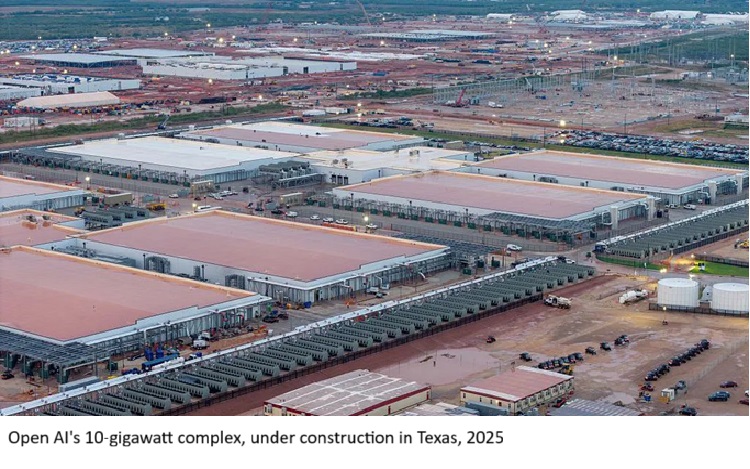
“We’re creating a new man-made ecological disaster: enormous data centres in remote places like deserts, that will be rusting away and leaching bad things into the environment, with no one left to hold accountable because the builders and investors will be long gone,”
He’s especially concerned now given the magnitude of money on the table as compared to the dot-com boom. There’s so much more to lose.
“When [the bubble] breaks, it’s going to be really bad,
BBC, Lily Jamali, Technology correspondent, San Francisco 11 Oct 25
At OpenAI’s DevDaythis week, OpenAI boss Sam Altman did what American tech bosses rarely do these days: he actually answered questions from reporters.
“I know it’s tempting to write the bubble story,” Mr Altman told me as he sat flanked by his top lieutenants. “In fact, there are many parts of AI that I think are kind of bubbly right now.”
In Silicon Valley, the debate over whether AI companies are overvalued has taken on a new urgency.
Sceptics are privately – and some now publicly – asking whether the rapid rise in the value of AI tech companies may be, at least in part, the result of what they call “financial engineering”.
In other words – there are fears these companies are overvalued.
Mr Altman said he expected investors would make some bad calls and silly start-ups would walk away with crazy money.
But with OpenAI, he told me, “there’s something real happening here”.
Not everyone is convinced.
In recent days, warnings of an AI bubble have come from the Bank of England, the International Monetary Fund, as well as JP Morgan boss Jamie Dimon who told the BBC “the level of uncertainty should be higher in most people’s minds”.
And here, in what is often considered the tech capital of the world, concerns are growing.
At a panel discussion at Silicon Valley’s Computer History Museum this week, early AI entrepreneur Jerry Kaplan told a packed audience he has lived through four bubbles.
He’s especially concerned now given the magnitude of money on the table as compared to the dot-com boom. There’s so much more to lose.
“When [the bubble] breaks, it’s going to be really bad, and not just for people in AI,” he said.
“It’s going to drag down the rest of the economy.”………………….
AI-related enterprises have accounted for 80% of the stunning gains in the American stock market this year – and Gartner estimates global spending on AI will likely reach a whopping $1.5tn (£1.1tn) before 2025 is out.
Tangled web of deals
OpenAI, which brought AI into the consumer mainstream with ChatGPT in 2022, is at the centre of the tangled web of deals drawing scrutiny…………………………………………………
Then there’s tech giant Microsoft, which is heavily invested, and cloud computing behemoth Oracle has a $300bn deal with OpenAI, too.
OpenAI’s Stargate project in Abilene, Texas, funded with the help of Oracle and Japanese conglomerate SoftBank and announced at the White House during President Donald Trump’s first week in office, grows ever larger every few months………………………………………
And as these increasingly complex financing arrangements get more and more common, the experts here in Silicon Valley say they may be clouding perceptions on AI demand.
Some people aren’t mincing their words about it either, calling the deals “circular financing” or even “vendor financing” – where a company invests in or lends to its own customers so they can continue making purchases.
“Yes, the investment loans are unprecedented,” Mr Altman told me on Monday……………………………………………….
OpenAI’s revenue is growing quickly, but it has never turned a profit.
And it is hardly a good sign that the people I’ve spoken to keep bringing up Nortel – the Canadian telecom equipment-maker that borrowed prolifically to help finance deals for their customers (and thereby artificially boost demand for their wares)………………………..
Telltale signs
Mr Kaplan says he seesa couple of telltale signs the AI sector – and therefore the wider economy – could be in trouble.
In frothy times, he says, companies announce major initiatives and product plans that they don’t yet have the capital for.
Meanwhile, retail investors clamour to get in on the start-up action.
The surge in AMD stock this week could indicate investors are trying to get a piece of the ChatGPT wealth machine – and while all this is playing out, real physical infrastructure aimed at satisfying the seemingly insatiable hunger for more AI development is being built.
“We’re creating a new man-made ecological disaster: enormous data centres in remote places like deserts, that will be rusting away and leaching bad things into the environment, with no one left to hold accountable because the builders and investors will be long gone,” Mr Kaplan said. ……………………………………….
There are plenty of believers in AI’s potential to transform society.
The question is whether the money to fund the ambitions of the foremost companies in the sector may be drying up………………………………https://www.bbc.com/news/articles/cz69qy760weo
No comments yet.
1 This Month

of the week – Shut Down Drone Warfare!


Tell the Ukrainian Government to Drop Prosecution of Peace Activist Yurii Sheliazhenko

Petition to revoke the licensing of the Near Surface Nuclear Disposal Facility (NSDF) at Chalk River. https://www.ourcommons.ca/petitions/en/Petition/Details?Petition=e-7247
To see nuclear-related stories in greater depth and intensity – go to https://nuclearinformation.wordpress.com
-
Archives
- March 2026 (251)
- February 2026 (268)
- January 2026 (308)
- December 2025 (358)
- November 2025 (359)
- October 2025 (376)
- September 2025 (257)
- August 2025 (319)
- July 2025 (230)
- June 2025 (348)
- May 2025 (261)
- April 2025 (305)
-
Categories
- 1
- 1 NUCLEAR ISSUES
- business and costs
- climate change
- culture and arts
- ENERGY
- environment
- health
- history
- indigenous issues
- Legal
- marketing of nuclear
- media
- opposition to nuclear
- PERSONAL STORIES
- politics
- politics international
- Religion and ethics
- safety
- secrets,lies and civil liberties
- spinbuster
- technology
- Uranium
- wastes
- weapons and war
- Women
- 2 WORLD
- ACTION
- AFRICA
- Atrocities
- AUSTRALIA
- Christina's notes
- Christina's themes
- culture and arts
- Events
- Fuk 2022
- Fuk 2023
- Fukushima 2017
- Fukushima 2018
- fukushima 2019
- Fukushima 2020
- Fukushima 2021
- general
- global warming
- Humour (God we need it)
- Nuclear
- RARE EARTHS
- Reference
- resources – print
- Resources -audiovicual
- Weekly Newsletter
- World
- World Nuclear
- YouTube
-
RSS
Entries RSS
Comments RSS
 nuclear-news
Leave a comment