The Nobel that wasn’t Trump’s: Why Oslo chose a Venezuelan rebel over a peacemaker.
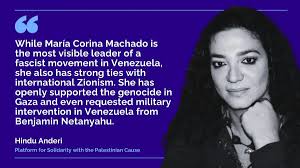
What Oslo calls a “peaceful transition” others might see as a strategy of regime change.
Machado in many ways stands on the same side as Trump. She’s seen positively by figures like Secretary of State Marco Rubio, and all of them share a goal of opposing Nicolás Maduro’s regime. So this may not have been a snub to Trump – it’s more of a balancing act.”
Rt.com 10 Oct 25
By honoring an opposition leader wanted in Caracas, the Nobel Committee reignited a debate over who gets to define “peace”.
The 2025 Nobel Peace Prize has gone to María Corina Machado, one of the most prominent faces of Venezuela’s opposition. The committee’s language is familiar – ”rights,” “peaceful transition” – but the story behind it isn’t. Machado’s record blends volunteer election networks with long-running fights over foreign funding; her name has appeared in cases tied to efforts to unseat the government – charges she rejects; and a country remains split over where legitimate politics ends and regime change begins.
The award lifts a domestic struggle onto a global stage and drops it into a fresh context: for much of the year, chatter about a “Nobel for Trump” hung in the air, and the very idea of what counts as peacemaking is once again up for debate far beyond Caracas.
From steel dynasty to political underground
María Corina Machado is an engineer by training and one of the most recognizable figures in Venezuela’s opposition over the past two decades. Born in Caracas to a family linked to the industrial group SIVENSA, she studied at the Andrés Bello Catholic University and later at IESA, Venezuela’s leading management school. Early exposure to the family business and an affinity for market-friendly ideas shaped her public profile: an emphasis on entrepreneurship, privatization, and integration with global markets
In 2002, Machado co-founded Súmate, a civic platform that built volunteer networks to train election observers and run parallel vote counts. That is when the first major controversy took hold: authorities alleged the group received funding from US-based organizations; her supporters countered that the money supported legitimate civic initiatives. From then on, every move she made in politics was viewed through the lens of where to draw the line on outside assistance.
That same year brought Venezuela’s most dramatic recent upheaval – the brief ouster of President Hugo Chávez and the “Carmona decree,” which proclaimed a provisional government. Machado’s name surfaced in debates over who backed the decree; she denied participating. The legal and historical arguments never fully settled, but the episode fixed an image of Machado as a politician whom opponents associate with the idea of “regime change.”
A long stretch of investigations and restrictions followed. Between 2003 and 2005, prosecutors examined alleged “illegal foreign funding” for NGOs; travel bans appeared periodically. In 2014, amid street protests, Machado became one of the most prominent voices criticizing the government and, in official rhetoric, was linked to cases alleging a plot and even an attempt on President Nicolás Maduro’s life. Machado rejected the accusations as politically motivated. The upshot was a prolonged ban on holding public office…………………………………………………….
After the 2024 vote, Machado largely disappeared from public events. Her statements came via video, with her whereabouts undisclosed. The phrase “underground network” took hold in media shorthand: supporters saw a movement operating under pressure; opponents argued it was a continuation of street-level tactics and external lobbying against the authorities. Against that backdrop, the Nobel Peace Prize elevates Machado’s biography to the international stage – and carries a long-running national argument over the limits of political struggle to a much wider audience.
Why Oslo chose her
In announcing its decision, the Nobel Committee said it was honoring María Corina Machado “for her tireless work promoting democratic rights for the people of Venezuela and for her struggle to achieve a just and peaceful transition from dictatorship to democracy.”
The language was familiar — rights, democracy, peaceful transition — but the context was not. Machado’s record blends civic mobilization and volunteer networks with long-running controversies over foreign funding. Her name has appeared in cases tied to efforts to unseat the government — allegations she has consistently rejected — and Venezuela remains deeply divided over what counts as legitimate political struggle.
Those contradictions make the award particularly charged. Within Venezuela, the same actions that Oslo calls “peaceful resistance” have been framed by officials as destabilization efforts supported from abroad. For Machado and her allies, the prize validates years of activism under pressure; for the government, it confirms a long-held view that Western institutions reward political opposition disguised as democracy promotion.
The decision also fits a larger pattern. By awarding Machado, the Nobel Committee effectively reintroduced Venezuela into the global political conversation – not as an energy supplier or a sanctions case, but as a test of how the world now interprets democracy itself. What Oslo calls a “peaceful transition” others might see as a strategy of regime change. That tension is what makes this year’s prize less about peace – and more about the politics of defining it.
The Nobel announcement also landed amid one of the most charged moments in US–Venezuela relations in years. Since early 2025, Washington has tightened its posture toward Caracas – reviving energy sanctions that had been partially lifted after the 2023 Barbados agreements and signaling a renewed focus on “transnational crime networks” in the Caribbean. In practice, that meant more joint naval patrols, renewed intelligence activity, and a sharper tone linking Venezuela to the regional drug trade – an accusation Caracas dismissed as a pretext for pressure.
At the same time, the Biden-era approach of limited engagement had given way to a more assertive line under Trump’s second administration. The new White House framed its strategy as a “war on narcotics” and a push to restore regional stability; in Venezuela and across Latin America, many viewed it as an attempt to reassert US influence in a region increasingly connected to Russia, China, and Iran.
Notably, María Corina Machado publicly voiced support for Washington’s decision to combat Venezuelan drug cartels through military means. Her statement drew wide attention, as it aligned her stance with the US administration’s tougher regional policy and blurred the boundary between domestic opposition and foreign strategy………..
The Nobel that got away
For much of the year, Washington buzzed with talk of a “Nobel for Trump.” The president himself didn’t hide his ambition: he wanted to go down in history as a peacemaker. After returning to the White House, he made foreign policy the centerpiece of his second term – launching a flurry of initiatives aimed at cooling global flashpoints and projecting a renewed American presence abroad.
Supporters pointed to a record few modern leaders could match. The Abraham Accords, signed during his first term, had already redefined Israel’s ties with its neighbors – and served as the basis for his 2024 nomination by congresswoman Claudia Tenney.
By late 2025, Trump’s team listed seven cases where US diplomacy had helped halt or de-escalate conflicts:………………………………………
……………………………………………………………………………………………………………………………………….. Anastasia Gafarova, deputy director of the Center for Political Information, described the Nobel Committee’s choice as “an attempt at compromise rather than confrontation.”
“Despite tensions between Washington and Caracas, Machado in many ways stands on the same side as Trump. She’s seen positively by figures like Secretary of State Marco Rubio, and all of them share a goal of opposing Nicolás Maduro’s regime. So this may not have been a snub to Trump – it’s more of a balancing act.”……………………………………………
What ‘peace’ means now
For the Nobel Committee, María Corina Machado’s name will likely stand beside those of activists and reformers who defied authoritarian systems. For Washington and Caracas, however, the meaning of her award reaches far beyond that frame………………….
To her critics, it is yet another example of Western institutions rewarding political alignment under the banner of human rights……………
Trump’s shadow still looms over the story. His claim to the title of “peacemaker” has turned the Peace Prize itself into a political mirror: a reflection of who gets to define peace, and on whose terms.
According to Fyodor Lukyanov, Trump’s prospects may not be gone for good:
“The door isn’t completely closed. For his achievements – real or perceived – he could very well be nominated again next year, and the Nobel Committee will have a chance to weigh everything once more.”…………..
No comments yet.
1 This Month

of the week – Shut Down Drone Warfare!


Tell the Ukrainian Government to Drop Prosecution of Peace Activist Yurii Sheliazhenko

Petition to revoke the licensing of the Near Surface Nuclear Disposal Facility (NSDF) at Chalk River. https://www.ourcommons.ca/petitions/en/Petition/Details?Petition=e-7247
To see nuclear-related stories in greater depth and intensity – go to https://nuclearinformation.wordpress.com
-
Archives
- March 2026 (251)
- February 2026 (268)
- January 2026 (308)
- December 2025 (358)
- November 2025 (359)
- October 2025 (376)
- September 2025 (257)
- August 2025 (319)
- July 2025 (230)
- June 2025 (348)
- May 2025 (261)
- April 2025 (305)
-
Categories
- 1
- 1 NUCLEAR ISSUES
- business and costs
- climate change
- culture and arts
- ENERGY
- environment
- health
- history
- indigenous issues
- Legal
- marketing of nuclear
- media
- opposition to nuclear
- PERSONAL STORIES
- politics
- politics international
- Religion and ethics
- safety
- secrets,lies and civil liberties
- spinbuster
- technology
- Uranium
- wastes
- weapons and war
- Women
- 2 WORLD
- ACTION
- AFRICA
- Atrocities
- AUSTRALIA
- Christina's notes
- Christina's themes
- culture and arts
- Events
- Fuk 2022
- Fuk 2023
- Fukushima 2017
- Fukushima 2018
- fukushima 2019
- Fukushima 2020
- Fukushima 2021
- general
- global warming
- Humour (God we need it)
- Nuclear
- RARE EARTHS
- Reference
- resources – print
- Resources -audiovicual
- Weekly Newsletter
- World
- World Nuclear
- YouTube
-
RSS
Entries RSS
Comments RSS
 nuclear-news
Leave a comment