When Maria Corina Machado Wins the Nobel Peace Prize, “Peace” Has Lost Its Meaning
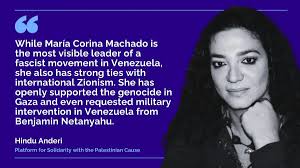
By Michelle Ellner, 10 October 2025, https://www.codepink.org/nobel_peace_prize_peace_has_lost_its_meaning
When I saw the headline Maria Corina Machado wins the Peace Prize, I almost laughed at the absurdity. But I didn’t, because there’s nothing funny about rewarding someone whose politics have brought so much suffering. Anyone who knows what she stands for knows there’s nothing remotely peaceful about her politics.
If this is what counts as “peace” in 2025, then the prize itself has lost every ounce of credibility. I’m Venezuelan-American, and I know exactly what Machado represents.
She’s the smiling face of Washington’s regime-change machine, the polished spokesperson for sanctions, privatization, and foreign intervention dressed up as democracy.
Machado’s politics are steeped in violence. She has called for foreign intervention, even appealing directly to Benjamin Netanyahu, the architect of Gaza’s annihilation, to help “liberate” Venezuela with bombs under the banner of “freedom,” She has demanded sanctions, that silent form of warfare whose effects – as studies in The Lancet and other journals have shown – have killed more people than war, cutting off medicine, food, and energy to entire populations.
Machado has spent her entire political life promoting division, eroding Venezuela’s sovereignty and denying its people the right to live with dignity.
This is who Maria Corina Machado really is:
- She helped lead the 2002 coup that briefly overthrew a democratically elected president, and signed the Carmona Decree that erased the Constitution and dissolved every public institution overnight.
- She worked hand in hand with Washington to justify regime change, using her platform to demand foreign military intervention to “liberate” Venezuela through force.
- She cheered on Donald Trump’s threats of invasion and his naval deployments in the Caribbean, a show of force that risks igniting regional war under the pretext of “combating narcotrafficking.” While Trump sent warships and froze assets, Machado stood ready to serve as his local proxy, promising to deliver Venezuela’s sovereignty on a silver platter.
- She pushed for the U.S. sanctions that strangled the economy, knowing exactly who would pay the price: the poor, the sick, the working class.
- She helped construct the so-called “interim government” a Washington backed puppet show run by a self-appointed “president” who looted Venezuela’s resources abroad while children at home went hungry.
- She vows to reopen Venezuela’s embassy in Jerusalem, aligning herself openly with the same apartheid state that bombs hospitals and calls it self-defense.
- Now she wants to hand over the country’s oil, water, and infrastructure to private corporations. This is the same recipe that made Latin America the laboratory of neoliberal misery in the 1990s.
Machado was also one of the political architects of La Salida, the 2014 opposition campaign that called for escalated protests, including guarimba tactics. Those weren’t “peaceful protests” as the foreign press claimed; they were organized barricades meant to paralyze the country and force the government’s fall. Streets were blocked with burning trash and barbed wire, buses carrying workers were torched, and people suspected of being Chavista were beaten or killed. Even ambulances and doctors were attacked. Some Cuban medical brigades were nearly burned alive. Public buildings, food trucks, and schools were destroyed. Entire neighborhoods were held hostage by fear while opposition leaders like Machado cheered from the sidelines and called it “resistance.”
She praises Trump’s “decisive action” against what she calls a “criminal enterprise,” aligning herself with the same man who cages migrant children and tears families apart under ICE’s watch, while Venezuelan mothers search for their children disappeared by U.S. migration policies.
Machado isn’t a symbol of peace or progress. She is part of a global alliance between fascism, Zionism, and neoliberalism, an axis that justifies domination in the language of democracy and peace. In Venezuela, that alliance has meant coups, sanctions, and privatization. In Gaza, it means genocide and the erasure of a people. The ideology is the same: a belief that some lives are disposable, that sovereignty is negotiable, and that violence can be sold as order.
If Henry Kissinger could win a Peace Prize, why not María Corina Machado? Maybe next year they’ll give one to the Gaza Humanitarian Foundation for “compassion under occupation.”
Every time this award is handed to an architect of violence disguised as diplomacy, it spits in the face of those who actually fight for peace: the Palestinian medics digging bodies from rubble, the journalists risking their lives in Gaza to document the truth and the humanitarian workers of the Flotilla sailing to break the siege and deliver aid to starving children in Gaza, with nothing but courage and conviction.
But real peace is not negotiated in boardrooms or awarded on stages. Real peace is built by women organizing food networks during blockades, by Indigenous communities defending rivers from extraction, by workers who refuse to be starved into obedience, by Venezuelan mothers mobilizing to demand the return of children seized under U.S. ICE and migration policies and by nations that choose sovereignty over servitude. That’s the peace Venezuela, Cuba, Palestine, and every nation of the Global South deserves.
Tell the Nobel Committee: The Peace Prize belongs to Gaza’s journalists, not María Corina Machado!
And Join our Venezuela Rapid Response Team!
What we know about the first phase of the Gaza ceasefire and what comes next
The ceasefire deal between Israel and Hamas includes halting military actions, an Israeli withdrawal, increased humanitarian aid, and a prisoner swap. But it doesn’t guarantee an end to the war or that Israel won’t resume the genocide.
By Qassam Muaddi October 9, 2025, https://mondoweiss.net/2025/10/what-we-know-about-the-first-phase-of-the-gaza-ceasefire-and-what-comes-next/
Two days after the Israeli war on Gaza entered its third year, Palestinians across the Gaza Strip burst into celebration on Thursday morning after U.S. President Trump announced that a ceasefire deal had been reached between Israel and Hamas.
The announcement came following four days of talks in Sharm al-Sheikh in Egypt, which included a Hamas negotiating team headed by its political chief, Khalil al-Hayyeh, whom Israel attempted to assassinate last month in an airstrike on Doha, Qatar. The Israeli negotiating team was headed by Israel’s Minister of Strategic Affairs, Ron Dermer. The ceasefire talks had been renewed after Trump announced his plan to end the war in Gaza in late September.
The known details of the deal include only the first phase of a ceasefire, which includes a halt to military operations, the withdrawal of Israeli forces to an agreed line inside Gaza, the entry of humanitarian aid into the Strip, and an exchange of prisoners that would see the release of all Israeli captives in Gaza.
According to the Trump plan’s map, Israel would withdraw its forces in an initial phase up to a line that starts from the northern Gaza governorate cities of Beit Hanoun and Beit Lahia. The line extends east of Gaza City, through the Bureij refugee camp in the central governorate, and east of Deir al-Balah. It then continues to the town of Khuza’a, east of Khan Younis, and ends in the east of Rafah.
Shortly after the deal was announced on Thursday, the Israeli Army Radio reported that the Israeli army began to withdraw its forces from Gaza City and its surroundings, where Israel has been conducting a large-scale invasion, forcing up to 900,000 Palestinians to flee the city.
Palestinian prisoners
The announced deal also includes the release of 20 living Israeli captives in exchange for the release of 250 Palestinian prisoners serving high sentences, in addition to 1,700 Palestinians who were detained in the Gaza Strip throughout the war.
Israeli reports indicated that the negotiations over the names of Palestinian prisoners to be released were still ongoing in the final hours before the deal was announced. Hamas and the other Palestinian factions insisted on releasing the 303 Palestinians who are serving life sentences for their involvement in attacks that led to the death of Israelis. Israel, on the other hand, only agreed to discuss 289 names, as the remaining 14 are citizens of Israel, and refuses to recognize them as Palestinians, considering them an internal Israeli issue.
In addition, Israel held its veto on several high-ranking names among Palestinian prisoners, namely Fatah leader Marwan Barghouthi, the secretary general of the PFLP, Ahmad Saadat, and Hamas leader Ibrahim Hamed, whom the Palestinian factions insisted on. The final list of Palestinian prisoners set to be released has not been made public yet. However, the Qatar-based al-Araby TV quoted sources as saying that negotiations over the names of prisoners have ended, and that both sides have made concessions.
Currently, Israel holds some 11,000 Palestinians in its prisons, a third of whom are administrative detainees, held without charge or trial. About 400 of them are minors.
Humanitarian aid
According to the deal, Israel would also allow the entry of 400 trucks carrying humanitarian aid per day for the first few days, with the quantity later increasing to 600 trucks per day. Before the war, the daily rate of trucks entering Gaza was 500-600 trucks per day, which is considered the minimum required quantity, according to international organizations. The UN Under-Secretary-General for Humanitarian Affairs, Tom Feltcher, said on Thursday that the entry of humanitarian aid into the Strip requires several entry points and security guarantees
The deal also stipulates that Palestinians would be allowed to return to Gaza City and areas of northern Gaza, which have been forcibly depopulated by Israeli forces in recent months. Israel had already displaced the residents of those areas in the final months of 2024 in a large-scale offensive known as “the Generals’ Plan.”
During the offensive, Israeli forces destroyed most residential blocks and buildings, leaving nowhere for Palestinians to return. In late January 2025, as Israel cleared the way back to the area as part of the first ceasefire deal, hundreds of thousands of Palestinians returned to the north in a historic return march.
After the ceasefire went into effect, some people tried to return to north Gaza via al-Rashid Street along the coast, but Israeli tanks positioned nearby fired tank shells at the displaced. At least a million Palestinians continue to be crowded in the narrow coastal Mawasi area in Khan Younis, and in Deir al-Balah in the central Gaza Strip.
Political responses
The deal has not been signed yet. Israel’s Prime Minister, Benjamin Netanyahu, held a cabinet meeting late on Thursday to approve the deal. Netanyahu’s account on X shared a post past midnight local time with photos of the cabinet meeting, which was also attended by U.S. special envoy Steve Witkoff and the son-in-law of President Trump, Jared Kushner.
Trump said in a statement to the press from the White House that he will travel to the Middle East and that Israeli captives will be released on Monday or Tuesday. Trump also admitted that around 70,000 Palestinians have been killed in Gaza. Hamas’s politburo member, Usama Hamdan, said the release of Israeli captives will begin on Monday.
Meanwhile, Israeli bombings continued in Gaza, even after the announcement of the ceasefire deal. The spokesperson of the Palestinian Civil Defense in Gaza, Muhammad al-Mughir, told AFP that since the announcement of the deal, Israeli strikes have targeted several areas in the Strip, especially in the north. Al-Mughir added that Civil Defense teams are having difficulties in reaching survivors due to the damage to roads and the continuous flights of Israeli warplanes in the area.
In Israel, hardline National Security Minister Itamar Ben-Gvir and Finance Minister Bezalel Smotrich voiced their opposition to the deal, stating that they would oppose it in the cabinet, but without pulling out of the government coalition, which the pair have threatened to do in the past.
Hamas, for its part, announced the end of the war in a statement read by its politburo chief, Khalil al-Hayyeh. The Hamas official said that the ceasefire deal was reached “thanks to the perseverance of our people,” adding that “despite the enemy’s attempts to break the agreements, our efforts continued seriously and responsibly in negotiations, and our only goal has been halting the aggression and saving the blood of our people.”
During al-Hayyeh’s live statement, Israeli warplanes bombed and destroyed a large residential building in the center of Gaza City. According to the Palestinian Civil Defense, approximately 40 people, including children, are still missing under the rubble.
Next steps
The deal doesn’t include any clauses on the definitive end of the war, the disarmament of Hamas and other Palestinian resistance factions, the postwar administration of Gaza, or reconstruction. All of these issues have been relegated to the second phase of the negotiations, which are set to begin immediately after the ceasefire officially takes effect, according to Hamas.
Although U.S. President Trump has repeatedly expressed his will to end the war as a pathway for peace in the Middle East, there is no written guarantee that Israel will not break the ceasefire and resume its bombing of Gaza after the release of its captives, as it did last March
Gaza Deal Requires A Permanent End To Israel’s War on Gaza.
So what is the ultimate significance of this agreement? In my view, if Israel complies with this agreement, it means a hell of a lot for the Palestinians because that would result in a permanent end to the war on Gaza, a permanent withdrawal from much, if not all of Gaza, and the provision of sufficient humanitarian aid uh to the people of Gaza along with the release of nearly 2,000 Palestinian prisoners. These are vitally important developments to be welcomed uh by all people of conscience for uh the people of Gaza.
Clearly uh the uh most lunatic members of Netanyahu’s cabinet are not being silent about this. They’re not agreeing to it.
I do remain suspicious on that basis just on the basis of Israel’s long and sorted history of violating ceasefire agreements about whether or not Netanyahu will comply with this agreement. even uh uh substantially let let alone uh completely.
Dimitri Lascaris, Oct 11, 2025
Hours before Israel’s genocide forces began withdrawing from the Gaza Strip, a reporter from Israel’s Kan News published a copy of the agreement between Hamas and Israel providing for a cessation of hostilities in the Gaza Strip.
In this episode of Reason2Resist, I analyze the terms of the agreement and conclude that it unambiguously requires Israel to end its war on Gaza and to withdraw permanently from most of the Gaza Strip.
I also examine the reactions of Netanyahu’s most extreme Ministers to the Gaza agreement, the reasons for which Donald Trump might finally force Israel to comply with the agreement, and the likely consequences if Israel violates it.
ED. Below I post extracts from this video
“As of now, no agreement has been reached regarding the list of prisoners and the circulating circulating lists concerning the prisoners intended for release …………….
whether the Israelis will release uh resistance leader Maran Barguti, who has been languishing in an Israeli dungeon for over 20 years on uh charges, trumped up charges uh of involvement in terrorist acts against Israelis. ……….
I’d like to note uh that Hamas officials have said repeatedly that the agreement provides for a permanent end to Israel’s genocidal war on Gaza………there’s much more than that. Uh, paragraph two states, quote, “The war will immediately end upon the approval of the Israeli government.” Close quote. So, here we’re not talking about a suspension of the war. We’re not talking about a pause of the war. We’re not talking even about u a temporary ceasefire. It says the war will immediately end. ……….
upon approval of the agreement, all military operations will be suspended. So there they use the term suspended but and they do not use the word terminated. Uh so the use of the word suspended suggests that under certain circumstances military operations can be resumed……..
key statement. It says that the Israeli military quote will not return close to areas it has withdrawn from as per the attached map quote as long as Hamas fully implements the agreement………
So this agreement clearly envisions a permanent withdrawal from certain parts of the Gaza Strip although we don’t know uh exactly which parts as of yet. Uh and uh moreover, and this too is critically important, the agreement says nothing about the IDF’s withdrawal from parts of the Gaza Strip that it will continue to occupy after the initial withdrawal
the question of course is whether those assurances are worth anything and uh that of course remains to be seen.
So, in any case, and for the reasons I just cited, the agreement clearly envisions a permanent end to Israel’s genocidal war on Gaza and a permanent withdrawal from the vast majority of the Gaza Strip. So, if anyone claims that uh this agreement does not envision a permanent end to Israel’s war in Gaza or a permanent withdrawal, then either they’re lying or they simply haven’t reviewed this agreement carefully or at all. …..
I’m showing you on the screen here, the United Nations Relief Works Agency and other international agencies that are independent of Israel must be permitted to deliver humanitarian aid to the people of Gaza.
This, of course, is important because the Gaza Humanitarian Foundation, as it’s called, this beast that was established by Israel and the Americans several months ago, purportedly to deliver aid uh to the starving population of Gaza turned out to be nothing but a tool for the mass murder of Palestinians seeking desperately needed humanitarian assistance. GHF assassins murdered more than 2600 Palestinians at aid distribution points since GHF was established several months ago. The assassins also wounded more than 19,000 Palestinian civilians at these aid distribution points during those several months. So it is extremely important, needless to say, that independent humanitarian agencies assume responsibility for distributing aid to the people of Gaza
That agreement provided as follows. Israel would have to allow the entry of sufficient quantities of humanitarian aid, 600 trucks per day, of which 300 are for the north. Included in this were 50 fuel trucks, including the fuel necessary for operating the power plant, trade, and equipment needed for rubble removal, rehabilitation, and operation of hospitals, health centers, and bakeries in all areas of the Gaza Strip. …….
But let’s recall what happened under the January ceasefire agreement. From the time it was agreed, Israel’s genocide forces killed Palestinians on a near daily basis and substantially hindered the entry of humanitarian aid into the Gaza Strip. And in fact, this led to the suspension by Hamas of the release of hostages and uh uh ultimately the uh the release of the hostages was resumed. Uh but there was nearly a blowup of the agreement at that point in time the point came for Israel to withdraw at as it had undertaken to do under the January 19th agreement from Ratha.
Israel refused to withdraw, tore up the agreement and started starving the civilian populationof Gaza. um the flimsy excuse that Israel offered for its killing of Palestinians while the January 19 agreement was in effect, daily killing of Palestinians and uh its hindrance of humanitarian aid was that uh Hamas it alleged was violating the deal with delays in providing the names of hostages. ….
So what is the ultimate significance of this agreement? In my view, if Israel complies with this agreement, it means a hell of a lot for the Palestinians because that would result in a permanent end to the war on Gaza ….
Now, there’s one other aspect of this prisoner exchange agreement that is, in my view, particularly odious. namely paragraph 5G prohibits any public ceremonies or media coverage of the release of prisoners and hostages.
Now, I can understand if Israel were demanding uh that there be no ceremonies involving uh the release uh at least
16:31ceremonies in the Gaza Strip uh involving the release of its PS.
16:37But uh there’s no conceivable justification for Israel demanding that there be no ceremonies or media coverage of the uh 2,000 or so Palestinians that are being released from its dungeons. Many of them, if not all of them, have been subjected to various levels and forms of torture and severe privation. Uh there’s uh no doubt that that will be apparent apparent from their appearance uh and upon their release uh from prison. They will be asked about this. Uh I’m sure that many of them will be anxious to tell the public and their fellow Palestinians what they endured under the brutalities of Israeli incarceration. Uh and essentially
this prohibition on ceremonies and media coverage of the release of Palestinian prisoners can only be designed to do two things. And that is first impede uh the delivery of the truth to the public about what was done to those prisoners in jail. Uh and secondly uh to prevent the Palestinians from uniting in what is an important victory uh for the resistance and you know sharing in a moment a desperately needed moment of uh national unity and relief and joy at the release of their brothers and sisters from Israeli dungeons.
Israeli genocidal regime does everything within its power to prevent the truth of what it is doing to the Palestinian people from reaching uh those of us living here in the West.
Uh finally, this agreement is important for what it does not say. It does not say uh unlike Trump’s 20point proposal that the resistance must disarm. And in fact, it says nothing about disarmament at all. Now, Western media continue to this very day to report without citing any credible identifiable sources that Hamas may be willing to agree to a complete or partial disarmament uh by, for example, a partial disarmament might involve uh Hamas giving up its missiles but retaining its uh small arms. Uh, however, Hamas has consistently and emphatically denied these reports.
Israel, remains armed to the teeth. If anybody should be required to disarm first, it should be the perpetrator of genocide and not its victims.
Now, returning to the one-pager, it also says nothing about the future governance of the Gaza Strip or the presence of foreign troops in Gaza or the departure of Hamas officials into exile…
The United States is sending 200 troops to Israel to monitor the implementation of the ceasefire deal in Gaza. US officials said Thursday. The official said US Central Command will establish a civil military coordination center in Israel to provide security and humanitarian support. The US troops will join soldiers from nations including Egypt, Qatar, Turkey, and the United Arab Emirates to provide oversight. The US troops are not intended to go into Gazo, one of the US officials said. So, uh, assuming we’re being told the truth….
The bottom line, my friends, is that the one-page agreement says nothing about the long-term issues confronting the Palestinian people, not even the uh reconstruction of Gaza and uh does not even contain an explicit commitment to negotiate the longer term and underlying issues. Uh and in particular, the agreement says nothing about a Palestinian state.
it also says nothing, not one word about the West Bank where Israel is also committing genocide, albeit at a lower level of intensity than in Gaza.
So what is the ultimate significance of this agreement? In my view, if Israel complies with this agreement, it means a hell of a lot for the Palestinians because that would result in a permanent end to the war on Gaza, a permanent withdrawal from much, if not all of Gaza, and the provision of sufficient humanitarian aid uh to the people of Gaza along with the release of nearly 2,000 Palestinian prisoners. These are vitally important developments to be welcomed uh by all people of conscience for uh the people of Gaza.
But at the same time, even if Israel complies fully with the deal, the core underlying injustices of the occupation will persist and no one would or should have the slightest faith in Israel to voluntarily address those injustices in a manner that is fair uh to the Palestinian people. Uh so even if Israel complies fully wit the deal, the core underlying problems will remain.
even worse, of course, Israel might simply flush the agreement down the toilet once it has its PS back.
When it comes to the question of whether Israel will comply, uh I think we can glean a lot from examining the reactions of the most lunatic ministers uh in Israel’s cabinet. Those who are typically referred to by the press as far although again any rational human being would regard every single member of Netanyahu’s uh cabinet as being far right. and in particular uh the arch war criminal Benjamin Netanyahu himself.
Now uh why do I say we can uh divine Israel’s true intentions from their reaction? Because if they the most lunatic members of his cabinet approve of the deal even grudgingly or if they are quiet about it uh then the most logical inference is that Netanyahu has given them private assurances that he’ll break the deal, resume the mass murder of Palestinians and reoccupy the Gaza trip.
So, this of course raises the question of how the lunatics uh have responded thus far. And here you’ll see an article that was published this morning at 3:32 a.m. by the Times of Israel. Uh Gaza ceasefire takes effect as the government approves deal to free the hostages. The subheading there, uh most far-right ministers vote against agreement to halt fighting with Hamas. Kushner and Witoff tell cabinet that IDF’s bravery, yes, the latte sipping baby killers are being lauded for their bravery by uh Kushner and Whitov. Uh but uh they commend Netanyahu’s difficult decisions and say that those decisions enabled the agreement.
Now the Times of Israel goes on and reports as follows. Netanyahu’s office announced the approval of the deal but did not immediately provide a vote tally though the agreement was opposed by national security minister Bengavir Negev Galilee and national resilience minister Yitsak was of and heritage minister am elyahu of the farright Otma Yahudate party. If I’m not mistaken, Eli Yahu was the uh the psychopathic lunatic who at some point during the genocide called for Israel to nuke Gaza.
Uh in any event, the Times of Israel article article goes on and says, “Far right leaders have been critical of the deal with Smootrich announcing on Thursday that religious Zionism would not vote in favor. Speaking with the Times of Israel, a party source said that it remained up in the air whether or not the far-right faction would bolt the government. Bengavir had also announced ahead of the cabinet meeting that Utma Yehudit would vote against the first phase of the deal in which Palestinian prisoners will be released in exchange for all four Israeli 48 Israeli hostages held in Gaza. So 48 I think refers obviously not only to the 20 living PS but also the remains of 28 uh other captives uh who died in captivity.
now uh what is my take uh on these revelations? I I do draw some encouragement from them. Clearly uh the uh most lunatic members of Netanyahu’s cabinet are not being silent about this. They’re not agreeing to it.
I do remain suspicious on that basis just on the basis of Israel’s long and sorted history of violating ceasefire agreements about whether or not Netanyahu will comply with this agreement. even uh uh substantially let let alone uh completely.
So uh let’s move on and uh let’s talk about the allimportant question of what the Trump is going to do to ensure Israel’s compliance. Now some are saying that Trump is serious this time about bringing an end to the war in Gaza because he desperately wants the Nobel Peace Prize. I understand that the winner of that peace prize is going to be announced today.
And let me say in passing that in a sane and decent world, the winner of 1that peace prize would be Francesca Albani, the extraordinarily brave, intelligent, and eloquent UN special rapaturur for the human rights situation in occupied Palestine. I’ve read reports that she’s been nominated. uh but frankly I don’t have much confidence in the Nobel committee to award the prize…
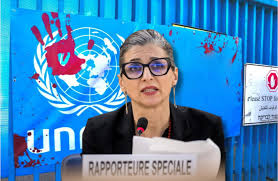
the main motivation that Trump has for doing this deal is because he wants to win the Nobel Peace Prize. I do recognize that he is extraordinarily narcissistic and a megalomaniac and I don’t doubt for one second that he wants this peace prize uh and that he’d love to have this peace prize.
But if he was so enamored of the Nobel Peace Prize, why did he allow Israel to tear up the agreement back in March and then begin to starve the civilian population of Gaza? …..
For example, um Donald Trump, I if I were him, I would be deeply concerned about the midterm elections. Uh right now, Donald Trump’s uh approval rating uh is very low. …
Uh he came into the White House and immediately began to involve America in new wars. uh and all of his rhetoric and all of the energies that he uh claimed to have invested in bringing an end to the Ukraine war have come to nowt. Donald Trump is now fully on board with the enterprise of uh Ukraine. He said as much with Ukraine trying to recapture all of its territory, which is a practical impossibility. There’s no indication whatsoever that Donald Trump is going to come anywhere close to doing what’s necessary to bringing that war to an end
so basically he has betrayed his base the president of peace. And uh if this genocide were to continue right up until the midterms, have no doubt about the fact that uh Netanyahu is capable of carrying this on for years to come. As long as there is a, you know, there are bullets in the guns of the Israeli military and bombs in the, you know, aircraft bays of the war planes supplied by the United States to the Israeli Air Force. uh they will continue to kill uh Palestinians in Gaza, in the West Bank, and then probably also in East Jerusalem, and within the 1948 boundaries of Israel itself.
Uh he’s basically uh you know using the United States Constitution as toilet paper running roughshot over the basic civil liberties of Americans uh you know engaging in outrageous overreach of the executive powers of the president. Uh so uh I think he must be quite concerned about this and to me that is probably the biggest point of pressure on Donald Trump to bring this slaughter to an end. his concern about the midterm elections. ….
And of course, the Zionist lobby must be very concerned……
also at the same time the United States, Germany and other Western military suppliers of Israel have been supplying Ukraine. And that is a conflict that has consumed even more munitions uh than Israel has consumed, I would imagine. So you’re looking at highly depleted weapon stocks, uh a demoralized and exhausted army, uh various forms of crisis within the Israeli military. Uh I would not at all be surprised if you know uh people within the Israeli military itself have secretly or perhaps not so secretly appealed to the Trump regime uh to bring this to an end. And there may be people, powerful and influential people in the Zionist lobby in the United States who are in contact with the uh Israeli military and understand the gravity of 1the situation who have been politely and quietly requesting that Donald Trump bring this to an end when it’s so obvious that Netanyahu himself uh was unwilling to do so. So again, I think this is likely to be much more important to Donald Trump than uh the Nobel Peace Prize.
Finally, let me offer a perspective on what will happen if Israel does does what it always has done and treats this agreement like toilet paper. Well, uh in my uh submission to you, my friends, uh that would put Israel in an even worse place than it is now. And it’s already in a very very dark place…..
think it will be much harder much harder for Netanyahu to uh to uh argue that the violence should be continue particularly violence directing civilians uh if these uh hostages have been returned or these PS have been returned to Israel. uh in a sense at a bare minimum what’s going to happen here in addition to the release of Palestinian prisoners which is in and of itself is very important and even if this is just a temporary pause in the bombing of the people of Gaza and even if the increase in humanitarian aid is substantial but temporary uh those are certainly good things important things vitally important things for the civilian population of Gaza
But uh I think that in effect by handing over the PS the resistance has situated itself more firmly on the moral high ground. And if we see a resumption now of the horrors that the Palestinians have endured for the past two years, um I think that you are going to see an even more rapid and precipitous decline in the standing of Israel in the West in the broader world. And it is already arguably the most detested so-called country on God’s green earth.
Uh so one way or another, this thing is coming to an end. This genocide will not succeed.
it’s just a question of when, not if. Perhaps now is the time. Perhaps we’re going to have to wait a little longer. But that day is coming and judgment day is coming for all the criminals who perpetrated this crime.
This is Demetri Lceris coming to you from Kalamat Greece on October 10th, 2025. https://reason2resist.substack.com/p/revealed-gaza-deal-requires-a-permanent?utm_source=post-email-title&publication_id=2811845&post_id=175824008&utm_campaign=email-post-title&isFreemail=true&r=1ise1&triedRedirect=true&utm_medium=email
Beware Trump’s Ceasefire Deal Absent Meaningful UN Action to Halt Israel’s Genocide.

Prime Minister Netanyahu has said publicly that Israel will not withdraw its forces from Gaza until Hamas and other Palestinian forces have been removed from power and disarmed, while Hamas insists it will not disarm until the occupation of Palestine ends and its fighters can hand over their weapons to the new armed forces of the sovereign nation of Palestine.
Without concrete global efforts to hold Israel to account, Trump’s new occupation plan for Gaza offers little hope for the future to the besieged, starved, bombed people of Gaza.
Nicolas J.S. Davies, Oct 09, 2025
As President Donald Trump surely intended, his “20-point Gaza plan” succeeded in upstaging calls by many other world leaders at the UN General Assembly for concrete, coordinated UN-led measures to force Israel to end its criminal genocide in Gaza and the illegal occupation of Palestine.
Trump’s White House meeting with Israeli prime minister Benjamin Netanyahu on September 29th coincided with the last day of the annual meeting of the UN General Assembly in New York, where Trump had met with eight Arab and Muslim leaders at the UN and won their support for a proposed plan for Gaza. In a textbook bait-and-switch, Trump then allowed the Israelis to significantly alter his plan before he unveiled it to the world at his meeting with Netanyahu, but pretended it was the same plan that the leaders of Saudi Arabia, Qatar, the UAE and other countries had endorsed.
Trump’s plan was based on cornering Hamas into a series of steps it hadn’t agreed to: freeing all the Israeli prisoners in Gaza without a full Israeli withdrawal; surrendering its weapons and its role in Palestinian politics; and handing Gaza over to a new phase of Israeli occupation. Gaza would be governed by a “board” headed by Trump and former UK prime minister Tony Blair, who not only invaded Iraq alongside the US in 2003, but at the same time masterminded a dirty war against Hamas that led to the isolation and blockade of Gaza, and ultimately to the current crisis.
On October 8th, after unprecedented pressure from Arab and Islamic mediators, Hamas dropped its insistence on a full Israeli withdrawal from Gaza as a precondition for the prisoner exchange. Other details remained to be worked out, but all sides seemed to believe they were close to an agreement. A source close to the negotiators told Drop Site News that Hamas was willing to gamble on Trump’s promise to prevent the Israelis from resuming the genocide once Israel had its prisoners back.
Trump’s plan is still rife with unresolved disagreements, but it may at least lead to a ceasefire and a prisoner exchange, and the ceasefire could possibly become permanent.
Under Trump’s plan, Israel would agree to end its genocidal assault on Gaza and partially withdraw its forces, but only his word would prevent it relaunching the genocide once it had the Israeli prisoners in Gaza safely back. Israel reportedly agreed to begin allowing 600 truckloads of aid to enter each day, but it would retain control of Gaza’s borders with Israel and Egypt, and could again restrict the entry of food, medicine, and rebuilding materials at any point.
Prime Minister Netanyahu has said publicly that Israel will not withdraw its forces from Gaza until Hamas and other Palestinian forces have been removed from power and disarmed, while Hamas insists it will not disarm until the occupation of Palestine ends and its fighters can hand over their weapons to the new armed forces of the sovereign nation of Palestine.
“Far from paving a path to peace, it offers a blueprint for the further colonisation and subjugation of the Palestinian people — the culmination of decades of dispossession and destruction that reached its dark zenith in the ongoing genocide in Gaza.”
Whatever the result of these negotiations, the UN and the world’s governments should not sit idly by as passive observers. The UN should urgently prepare to take the concrete steps that leaders from around the world called for at the General Assembly in September, to give force to UN General Assembly resolutions calling for an immediate and permanent ceasefire in Gaza, the unrestricted restoration of life-saving humanitarian aid, and a final end to the brutal Israeli occupation of Palestine.
In July 2025, the UN General Assembly organized a “High-level International Conference for the Peaceful Settlement of the Question of Palestine and the Implementation of the Two-State Solution.” The conference was chaired by France and Saudi Arabia, and its goal was “not only to reaffirm international consensus on the peaceful settlement of the question of Palestine but to catalyze concrete, timebound and coordinated international action toward the implementation of the two-State solution.”
The conference produced a lengthy “New York Declaration,” which was endorsed by the General Assembly in a resolution on September 12th, by a vote of 142 to 10, with 12 abstentions.
But this was a plan for the “day after,” which, by itself, failed to bring that day any closer, because it deliberately avoided taking the “concrete, timebound and coordinated international action” that the conference’s mandate had explicitly called for.
The declaration was based on the deliberations of 8 working groups, co-chaired by representatives of 15 different countries, the Arab League and the European Union, which each drew up plans for the aftermath of a hypothetical permanent ceasefire in Gaza, with topics like “Humanitarian Action and Reconstruction” and “Security for Israelis and Palestinians.”
Three roundtables at the July conference, chaired by former Irish president Mary Robinson, former Colombian president Juan Manuel Santos and former UN High Commissioner for Human Rights Zeid bin Ra’ad of Jordan, agreed that the General Assembly’s first step should be the international recognition of the state of Palestine.
UN recognition requires the approval of both the General Assembly and the UN Security Council. However, with such a large majority of countries supporting recognition, and the United States abusing its veto to sideline the Security Council, the General Assembly can call an Emergency Special Session (ESS) to act alone under the “Uniting for Peace” principle, to officially recognize Palestine and welcome it as a full UN member.
Instead, while several Western countries finally recognized Palestine, bringing the total number who have recognized its independent statehood to 157, the declaration was endorsed in a regular session of the General Assembly that lacked the power to grant formal UN recognition.
But the most serious omission from the July 2025 conference and the September 12th resolution was that they failed to take concrete, coordinated UN action to impose a ceasefire in Gaza, the vital first step to get to the “day after” that the working groups at the conference were tasked with planning for. Trump took advantage of that omission to propose an end to the genocide in Gaza on terms that would perpetuate the Israeli occupation instead of ending it.
It was entirely predictable that Israel would reject and ignore the New York Declaration, and Netanyahu did just that in his General Assembly speech on September 26th. But after most of the delegates walked out and left Netanyahu ranting to a nearly empty hall, the Hague Group of countries led by Colombia and South Africa hosted a meeting with representatives of 34 countries to plan the coordinated, concrete action the UN must now take to end the genocide and the occupation.
As Cuban foreign minister Bruno Rodriguez Parilla told the General Assembly in his speech the next day, it should convene an Emergency Special Session “without further delay” to take concrete measures for Palestine, including a binding resolution on full UN membership.
If the large majority of countries that voted for the New York Declaration are ready to back their words and their votes with coordinated action, a UN-led trade boycott, divestment campaign and arms embargo can put enormous pressure on Israel to end its genocide in Gaza and its illegal occupation of Palestine.
If the General Assembly is serious about ending the genocide and the occupation, the Emergency Special Session must also debate and vote on a UN-led arms embargo, economic boycott and other concrete measures designed to force Israel to comply withinternational law, international court rulings and UN resolutions on Palestine.
The UN Human Rights Office in Geneva already has a database of 158 Israeli and multinational corporations that are complicit in Israel’s illegal occupation, so an international boycott of those companies could take effect immediately.
Israel is a small country, dependent on trade and economic relations with countries all over the world. If the large majority of countries that voted for the New York Declaration are ready to back their words and their votes with coordinated action, a UN-led trade boycott, divestment campaign and arms embargo can put enormous pressure on Israel to end its genocide in Gaza and its illegal occupation of Palestine. With full participation by enough countries, these steps could quickly make Israel’s position very difficult.
Many speakers at the 2025 General Assembly called passionately for this kind of decisive action to bring about a ceasefire in Gaza and end the occupation. King Abdullah of Jordan asked, “How long will we be satisfied with condemnation after condemnation without concrete actiion.
President Lula said that Brazil already has an arms embargo against Israel and has cut off all trade with its illegal settlements; Turkiye severed all trade links with Israel in August; Dutch prime minister Dick Schoof called for an arms embargo and the suspension of the EU’s trade agreement with Israel; and Chadian prime minister Allah-Maye Halina declared, “Our duty from this moment on is to transform this strong declaration into concrete acts and make the Palestinian people’s hope a reality.”
The Hague Group of countries was formed by the Progressive International to support South Africa’s genocide case at the International Court of Justice and war crimes cases against Israeli officials at the International Criminal Court. In a meeting at Bogota in Colombia in July, twelve of those countries committed to an arms embargo and other concrete measures against the Israeli occupation. In his speech to the General Assembly on September 23rd, Colombian president Gustavo Petro called for an Emergency Special Session on Palestine and for a UN peacekeeping force to “defend Palestine.”
A previous Emergency Special Session in September 2024 demanded that Israel must end its post-1967 occupation of Palestine within a year. Israel’s refusal to even begin to do so, and its defiant escalation of its genocide in Gaza, increasing repression in the other occupied territories and attacks on other countries provide all the grounds the General Assembly should need to take the concrete, coordinated measures that many countries are calling for.
Tragically, instead of applying the diplomatic and economic pressure it will take to secure a ceasefire and end the occupation, France, Saudi Arabia and their partners instead relied on dangling carrots in front of Israel, such as regional economic integration and recognition by Arab and Muslim countries, to try to seduce or bribe Israel into complying with international law and UN resolutions.
Across the world, ordinary people are rising up to demand that their governments take action, while flotillas of activists set sail to breach the blockade of Gaza that their governments have failed to challenge.
This was never going to work. The toothless New York Declaration, and now Trump’s new occupation plan for Gaza, offer little hope for the future to the besieged, starved, bombed people of Gaza. The UN General Assembly must follow up on these flawed initiatives with decisive UN-led action to ensure a real, permanent end to the genocide and the occupation, by imposing economic sanctions, an arms embargo and other measures to diplomatically and economically isolate Israel.
There is nothing to prevent the UN General Assembly from quickly convening a new meeting of its Emergency Special Session on Palestine. The ESS can finally take the “concrete, time-bound, coordinated international action” that the French- and Saudi-led initiative promised but failed to deliver—what Malaysian foreign minister Mohamad Hasan described to the General Assembly as “concrete action against the occupying force.”
Across the world, ordinary people are rising up to demand that their governments take action, while flotillas of activists set sail to breach the blockade of Gaza that their governments have failed to challenge.
The Emergency Special Session of the UN General Assembly, meeting under the Uniting for Peace principle, can debate and pass binding resolutions on UN recognition of Palestine, a UN-led international arms embargo, economic boycott and disinvestment campaign, war crimes prosecutions, and other measures to diplomatically isolate Israel.
By responding to calls of conscience from their own people, voting for these measures at the UN and acting quickly to enforce them, the governments of the world have the collective power to end this genocide and the brutal, illegal occupation of Palestine that it is part of. Now they must use it.
Nicolas J. S. Davies is an independent journalist and a researcher with CODEPINK. He is the co-author, with Medea Benjamin, of War in Ukraine: Making Sense of a Senseless Conflict, available from OR Books in November 2022, and the author of Blood On Our Hands: the American Invasion and Destruction of Iraq.
Nobel Peace Prize’s hypocrisy
URGENT: The Nobel Peace Prize and Israel’s Influence
madison_morrisonil , 11 Oct 25 https://www.instagram.com/reel/DPojAqrEY5i/
The 2025 Nobel Peace Prize has been awarded to María Corina Machado, the Venezuelan opposition leader but what’s being left out of the headlines is her deep alignment with the Israeli state, a government the international community has repeatedly condemned for ongoing genocide in Gaza.
This isn’t just symbolic it’s political.
Machado’s party has a formal cooperation agreement with Israel’s Likud Party, led by Netanyahu. She’s pledged to restore full diplomatic ties with Israel and has consistently echoed their military and security rhetoric while Palestinians are being starved, displaced, and executed.
When a Nobel Peace Prize honors a figure tied to an apartheid regime, it sends a dangerous message: that “peace” is defined by the same powers funding war.
The Nobel Committee isn’t celebrating peace it’s legitimizing oppression.
It’s up to the global community to call out hypocrisy, demand accountability, and stand with the people of Gaza , not with those aligned with their oppressors.
New nuclear push brings old dangers back — and bigger than ever

by Kevin Kamps, opinion contributor – 10/06/25 https://thehill.com/opinion/energy-environment/5537588-nuclear-power-dangers-regulation/
When President Trump and Keir Starmer, prime minister of the United Kingdom, signed a deal to rapidly expand nuclear power in the U.K., nuclear stock prices soared to record highs. But the boom ignores the overwhelming evidence that nuclear is a bad risk.
The only U.S. reactors built in the last 30 years, Vogtle Units 3 and 4, cost over $35 billion, resulting in the world’s most expensive electricity. Prohibitive cost overruns also sank NuScale, the only U.S. attempt to commercialize small modular reactors.
Notwithstanding, irrational nuclear exuberance is reaching a pitch. Spiking electricity demand, cratering nuclear regulation, reckless nuclear boosterism and federal attacks on renewables have produced a perfect storm fueling nuclear expansionism. Former regulators warn that with the Nuclear Regulatory Commission now compromised, the storm may blow us onto the rocks.
Nuclear hubris is so extreme that NASA says it will put a reactor on the moon by 2030. But with regulatory guardrails down, we ought to worry more about preventing a nuclear moonscape on earth.
One neon danger sign is the rise of “zombie nukes” — restarting old, disused reactors, including those previously shut down for safety reasons. It’s happening at Michigan’s Palisades nuclear plant, Pennsylvania’s Three Mile Island 1 and Iowa’s Duane Arnold.
Another red flag is so-called “advanced” reactors, including small modular reactors. Contrary to the name, small modular reactors are not new, not always small and probably not modular, comprising 127 different designs that are mostly speculative and haven’t been built yet.
Small modular reactors aren’t “walk away safe” or carbon-free. Their lower output precludes economies of scale and their construction costs aren’t proportionately smaller than conventional nuclear, so their electricity is costlier. They also produce up to 30 times the waste and leak more neutrons. They emit greenhouse gases and thermal pollution. Subsidizing them and other nuclear undermines renewables and makes climate change worse.
Holtec, a privately held firm facing ethical questions and known for hawking (though not yet building) small modular reactors and pioneering zombie nuke restart, was tapped in the U.S.-U.K. deal to develop nuclear-powered data centers in northeast England worth $15 billion. It gained notoriety by buying moribund U.S. nuclear plants cheaply under pretense of dismantling them and then pivoting to convert them back to operations, though it has no experience as a nuclear operator. The Nuclear Regulatory Commission obliged, granting regulatory relief and safety exemptions enabling Palisades to transition from decommissioning to “operations” status.

Holtec also plans to install small modular reactors there, next to a large cache of radioactive waste. It has similar plans for decommissioned nuclear sites it owns in New Jersey, Massachusetts and New York, and it intends to go public in the next few months with an IPO potentially valued at $10 billion.
What could possibly go wrong?
A nuclear engineer recently warned the Nuclear Regulatory Commission’s Advisory Committee on Reactor Safeguards that once Palisades is restarted, it could fail within six months, with “unimaginable impacts to the general public,” due to mishandled steam generator tubes or its cracked primary cooling system.
Watchdog groups in Massachusetts, where Holtec wants to install small modular reactors on the closed Pilgrim nuclear site, are decrying a pending energy bill repealing a 1982 state law requiring a permanent repository for radioactive waste, as well as voting up a referendum before any new nuclear can be built. Neither condition is met, but Gov. Maura Healy (D) is bent on small nuclear reactors and nuclear-powered AI data centers anyway.
At New York’s Indian Point, Holtec proposes to install small modular reactors and restart old, partially dismantled reactors, despite signing an agreement that prohibits even proposing renuclearizing the site without local, county and state support, which it doesn’t have.
Last year, Holtec sued to block a state law prohibiting it from dumping radioactive water into the Hudson River, which Gov. Kathy Hochul (D) signed. Then nuclear lobbyists went into high gear in Albany, including hiring former Gov. Andrew Cuomo, prompting an ethics complaint. Hochul then flipped, directing the New York Power Authority to build at least 1 gigawatt of new nuclear in the state.
This about-face toward nuclear buildout is happening as the regulatory regime, never robust, is in free fall. Four former Nuclear Regulatory Commission chairs (three in this article), have sounded the alarm. Nuclear Regulatory Commission commissioners testified before Congress that they expect to be fired if they question unsafe reactor designs and fail to rubberstamp them. Former Department of Energy Assistant Secretary Katy Huff and colleagues wrote that making nuclear regulatory decisions “for political reasons” is “setting the U.S. on the fastest path to a nuclear accident. … This is neither hypothetical nor hyperbole.”
From their mouths to market handicappers’ ears. Amory Lovins wrote recently that nuclear-powered AI centers “may be a trillion-dollar bubble, but it’s sellable until market realities intervene.” The same is true of the harsh realities of nuclear’s inherent dangers. Let’s hope radiological disaster doesn’t intervene before nuclear’s unacceptable risks and costs get priced back in.
Kevin Kamps is the Radioactive Waste Watchdog at Beyond Nuclear.
The LAST American President. Got democracy?

Hartmann’s new book, The Last American President: A Broken Man, a Corrupt Party and a World on the Brink, is one giant fact check on the Whopper-in-Chief, and much more — a disturbing dive into the roiling miasma of self-aggrandizing, self-deluding, psychologically shattered, wailing man-child who is Commander-in-Chief.
by Greg Palast, for RawStory, October 9, 2025, https://www.gregpalast.com/the-last-american-president/?mc_cid=1390b5d94c&mc_eid=5e93be363b
Pay attention to this professional liar:
“I’m the only president in modern history who left office with a smaller national debt than when I came into office.”
That’s quite a whopper. Fact check: “During Trump’s presidency, the national debt actually increased by $7.8 trillion, nearly 40 percent and more than any president in history.”
The fact check is courtesy of Thom Hartmann. Indeed, Hartmann’s new book, The Last American President: A Broken Man, a Corrupt Party and a World on the Brink, is one giant fact check on the Whopper-in-Chief, and much more — a disturbing dive into the roiling miasma of self-aggrandizing, self-deluding, psychologically shattered, wailing man-child who is Commander-in-Chief.
Don’t read Hartmann’s book twice, as I have. It’s not just the nightmares it induces; it’s the fact that you’ll wake up to the nightmare that is our new reality.
Hartmann is known as America’s number one progressive radio host. But he is also a certified psychotherapist, ordained theologian and noted historian who has brought his extraordinary bandolero of skills to an excavation of the dark regions of the president’s brain.
And dark it is. Trump grew up in an atmosphere of cruelty under the familial dictatorship of his daddy Fred Trump, whom the future president saw bully his older brother into an early alcoholic death. His mother emotionally checked out, leaving us with a president who needs a mother’s hug — and is taking it out on government employees.
Trump learned cruelty from his dad but learned how to weaponize it from his second daddy: Roy Cohn, Joe McCarthy’s henchman, who taught Trump how to use fear and media manipulation to break your enemies — a group now encompassing most Americans.
Does Trump even believe his own bullshit? That’s not even a question for Trump, notes Hartmann. He quotes the master of prevarication himself:
“The final key to the way I promote is bravado. I play to people’s fantasies. People may not always think big themselves, but they can still get very excited by those who do. People want to believe that something is the biggest and the greatest. I call it ‘truthful hyperbole.”
The ghost-writer of Trump’s The Art of The Deal says he made up the term “truthful hyperbole” to cover up the word, “lie.”
But it’s a lie we love. Or, at least a lot of Americans love it. Here is a photo [on original] of one of Trump’s acolytes at a Trump rally my team attended in rural Georgia. There’s her T-shirt of Trump and JD Vance as vigilantes, gunning down the bad guys. She had a Trump hat, Trump socks, and sported a red, white and blue Trump ballet tutu.
The biggest sellers were shirts announcing, with an armed Trump image, “Daddy’s home.” Our national father figure is coming back for a second term to spank us bad kiddies as Trump Sr. did to his son. The parental abuse goes on, but now as a policy of fear, repression, mass firings, race-baiting, Constitution-defying lawsuits ginned up “by cynical attorneys and billionaires’ checkbooks, riding the algorithms of outrage and our insatiable hunger for spectacle,” as Hartmann says.
As Hartmann warns, democracy in America won’t roll in on tanks, it will come “packaged as entertainment.” He notes, chillingly, that, “It wasn’t just Trump, it was the system that fed him.” Trump’s beguiling fibs, his mayhem-making, his troops-in-the-street diktats are all spectacle to satisfy the desire for retribution of America’s working class wounded.
Trump is a symptom, notes Hartmann, not a cause, of what I’d call the New Hate. We don’t want to win arguments anymore. We want to hurt those who don’t share our politics. Trump revels in it.
And Hartmann is not afraid to call out the racism that lubricates Trump’s resentment machine, a GOP line of ugly innuendoes that originated with Richard Nixon. Hartmann quotes Nixon’s political guru Kevin Phillips:
“The more Negroes who register as Democrats in the South, the sooner the Negrophobe whites will quit the Democrats and become Republicans.”
Trump didn’t introduce racism into the GOP campaign plan, he merely, as Hartmann says, “revealed it.”
And Trump’s apostles are never coy about using code words for space-laser armed Jewish “globalists,” a line which Trump finds usefully echoed by Democrats on the Left.
What do we do? I think of those old billboards on Highway 80 that flashed, “STAY AWAKE! STAY ALERT!” That’s not too much to ask.
Hartmann, a happy-ending kind of guy, throws out a bunch of good ideas to, “Reform, Resist and Remember,” beginning with our own “empathy deficit,” though he admits our best efforts could be undone by AI “techno-feudalism.”
“Democracy,” Hartmann concludes, “doesn’t announce its departure with trumpets. It slips away in silence, one institution at a time.” But we do have Hartmann’s bugle blast. Hopefully, it’s a wake-up reveille and not Taps for this fragile experiment called America.
Thom Hartmann and Greg Palast will be speaking in San Diego on Friday, October 17 and in Los Angeles on Saturday, October 18 at fundraisers for the Pacifica Radio Network.
Get a copy of Hartmann’s Last American President signed by the author for a tax-deductible donation to the Palast Investigative Fund. Only 14 signed copies available.
Greg Palast
Greg Palast (Rolling Stone, Guardian, BBC) is the author of The New York Times bestsellers, Armed Madhouse, Billionaires & Ballot Bandits and the book and documentary, The Best Democracy Money Can Buy.
5 Days in Israel’s Desert Prison: Jewish Flotilla Activist David Adler on Harrowing Detention Ordeal
10 Oct 2025, https://www.youtube.com/watch?v=T_pM-ZDaPAA
Israeli forces have abducted over 500 peace activists over the past week who were sailing to Gaza in an effort to deliver humanitarian aid to the besieged territory.
Organizers of the Global Sumud Flotilla say most of the participants were sent to Ktzi’ot Prison, notorious for harsh and abusive conditions. Some have reported physical abuse, humiliation and inhumane treatment by Israeli soldiers. Jewish American activist David Adler, co-general coordinator of the Progressive International, says he faced additional abuse because of his background. Democracy Now! is an independent global news hour that airs on over 1,500 TV and radio stations Monday through Friday. Watch our livestream at democracynow.org Mondays to Fridays 8-9 a.m. ET.
U.S. Dept. of Energy steps up plutonium pit manufacturing at Savannah River Site

The site is part of the nation’s effort of “re-establishing capabilities retired after the Cold War,” the national nuclear stockpile plan stated. And also, provide a home for another data center.
Jillian Magtoto, Savannah Morning News, 9 Oct 25,
Key Points
ENVIRONMENT
U.S. Dept. of Energy steps up plutonium pit manufacturing at Savannah River Site
The site is part of the nation’s effort of “re-establishing capabilities retired after the Cold War,” the national nuclear stockpile plan stated. And also, provide a home for another data center.
Jillian Magtoto, Savannah Morning News
- The Department of Energy is accelerating construction of the new facility, aiming to produce 50 plutonium pits annually by 2030.
- While production ramps up, concerns remain about existing radioactive waste and the diversion of funds from cleanup efforts.
More than two hours up the river from Savannah is a nuclear Superfund site, about the size of Augusta just across the border. Despite decades of cleanup, radionuclides still trickle from nearby streams to cow udders, and lurk in the tissues and bones of alligators, hogs, and deer, and the flesh of tadpoles and fish. In July, workers discovered a radioactive wasp hive at one of its hazardous waste tank farms. The site spanning three South Carolina counties is still active as the country’s only plant extracting and purifying tritium, a radioactive isotope that boosts the efficiency and explosivity of nuclear weapons.
But the Savannah River Site (SRS) is about to be re-awakened to produce plutonium pits, hollow bowling-ball sized spheres of plutonium at the core of warheads that causes the nuclear blast. Plutonium is a heavier metal that, according the Environmental Protection Agency (EPA), can enter the bloodstream upon inhalation, resulting in lung scarring, disease, and cancer. It carries a half-life of about 24,000 years.
Last October, the Department of Energy’s (DOE) National Nuclear Security Administration (NNSA) assumed primary responsibility of the SRS to produce 50 of the country’s 80 annual plutonium pits by 2030. The remaining 30 will be made in the Los Alamos National Laboratory in New Mexico, where plutonium pits were first created in the 1940s.
Over 80 years later, “NNSA is being asked to do more than at any time since the Manhattan Project,” stated NNSA Administrator Jill Hruby at the 2024 Nuclear Deterrence Summit. For SRS, the goal “is aggressive, complete construction by 2032 so that rate production can support the W93 schedule.” W93 is the newest and 93rd nuclear weapon design the U.S. has considered after a 30-year hiatus, planned for deployment by U.S. Navy submarines…………………………………………………………………………………………………
While plans are accelerating, “most of the public doesn’t even know what’s going on out there,” said Tom Clements, founder of his one-man watchdog website, Savannah River Site Watch, who has monitored the plant since the 1970s. “They don’t know they’re building the pit plant.” And likely, also a data center…………………………………………………………………………………………..
Plutonium’s pitfall
It’s one thing to stop plutonium production, but it’s an entire other affair to dispose it.
Because weapons-grade plutonium cannot be blended with other materials to render it unusable for weapons, Russia and the U.S. agreed it would instead be made into mixed oxide (MOX) fuel and irradiated in civil nuclear power reactors for electricity. For the U.S., that MOX facility would be housed at the SRS, which began construction in 2007.
But the promise was a far cry from what the DOE was able to do.
Technical issues, delays, and mismanagement reported by outlets like the Post & Courier ended its operations in 2018. In 2022, the MOX building contractor paid $10 million to the DOE for fraudulent invoices for nonexistent materials. If completed, SRS’ MOX facility would have been 32 years behind schedule and $13 billion over budget, according to the DOE.
Meanwhile, the state of South Carolina was growing wary of the tanks sitting on its soils. In 2014, the state sued the U.S. government and six years later, won the state’s largest single settlement of $600 million and the DOE’s commitment to remove all 9.5 metric tons of plutonium from the state by 2037. Until then, South Carolina has waived its right to bring any lawsuit against DOE for plutonium disposal.
So the DOE went with a cheaper and quicker alternative: diluting the plutonium with a plutonium powder into a “more secure” and less weapon-usable form—though the potential of reversibility led Russia to back out of the deal. SRS has undergone a flurry of expansion, automation, tank transport, and construction of mega-sized disposal units all to dilute the plutonium into a Superfund smoothie that gets vitrified into obsidian-like glass and shipped to a waste isolation pilot plant 2,000 feet underground in a New Mexico salt mine, according to SRS. It completed the first shipment in December 2023.
Still, radioactive byproduct remains in 35 million gallons of waste stored in roughly 43 of the original 51 underground carbon steel containers according to most recently published updates this January.
“These tanks have outlived their design lives, posing a threat to the environment,” stated a Savannah River National Laboratory webpage. “Some of the tanks have known leaks.”
A new mission swipes cleanup funds
From aging plutonium pits housed at the Pantex facility in Texas, the SRS will generate new plutonium pits at the SRS unit originally intended to retire weapons-grade plutonium…………………………………..
But as the site shoulders the new plan, remediation funds get pulled. When the DOE EM handed over primary responsibility of the site to the NNSA last year, $173 million were reallocated from cleanup to weapons activities and transition costs. And it seems some environmental processes fell though the cracks.
“They basically named SRS as the second [plutonium pit] plant site without doing an environmental analysis,” said Clements. “And that’s we got them for, violating the National Environmental Policy Act.”
In 2021, Clements, the Savannah River Site Watch and a few other plaintiffs sued the DOE and NNSA, resulting in a settlement that will play out over the next couple of years. Until the DOE conducts a Programmatic Environmental Impact Statement (PEIS) examining the environmental impact of other approaches to pit production and reach a Record of Decision filed by July 17, 2027, the DOE will not introduce nuclear material into the SRPPF’s main processing building…………………………………. https://www.savannahnow.com/story/news/environment/2025/10/09/savannah-river-site-takes-on-an-enduring-mission-to-make-plutonium-pits-and-also-take-a-data-center/86442685007/
Holtec abandons nuclear waste project in New Mexico

by Energy News updated October 9, 2025, https://energynews.oedigital.com/energy-markets/2025/10/09/holtec-abandons-nuclear-waste-project-in-new-mexico
Holtec, a private nuclear power company, announced this week that it was abandoning a plan to store radioactive waste in New Mexico despite a U.S. Supreme Court decision in June which gave some hope for projects aiming at storing the material. The Supreme Court threw away a legal challenge in June by Texas, New Mexico, and some oil companies against the U.S. Nuclear Regulatory Commission’s licensing of nuclear storage projects in the drilling country. Some believed that this opened the door to temporary storage for these states.
New Mexico lawmakers and the Governor Michelle Lujan Grisham are opposed to storing nuclear waste on the site, even temporarily. They fear that without a permanent U.S. facility for nuclear waste, it will become a permanent solution.
Holtec announced in a Wednesday statement that it is leaving the HISTORE project in the Permian basin, near the oil hub Carlsbad. The statement said that the Eddy-Lea Energy Alliance and Holtec had mutually agreed to cancel the agreement due to the unsustainable path for used fuel storage. This was reported first by Axios.
It’s been obvious for years that New Mexicans are opposed to spent fuel storage and disposition in the state. “We’re happy that Holtec finally acknowledged that reality,” Don Hancock, director at the Southwest Research and Information Center of Albuquerque for the nuclear waste safety programs.
Holtec’s Pat O’Brien, a spokesperson for the company, said that the company hoped to work with states that were willing to store the waste following outreach efforts by the U.S. Department of Energy which began during former President Joe Biden’s Administration.
O’Brien stated that Holtec believes communities in 15 to 20 different states are interested in hosting a potential storage facility.
The danger to human health makes it necessary to store nuclear waste for a long time. Nuclear power plants, both active and closed, store the waste.
After state legislators raised objections, the former Obama administration halted funding in 2010. (Reporting and editing by Paul Simao; Timothy Gardner)
The Wall Street Journal Has Many Ways to Deny Genocide

Gregory Shupak, FAIR, October 9, 2025
As more and more scholars, and one rights group after another, confirm that Israel is carrying out a genocide in Gaza, it’s becoming ever more obvious that those who deny the genocide are the intellectual and moral equivalents of people who deny other genocides, such as the ones inflicted on the Indigenous peoples of the Americas, or the Holocaust, or the Armenian Genocide.
Yet the Wall Street Journal persists in running genocide denial. Looking at how the paper does so enables us to not only refute their falsehoods, but also to gain insight into the tactics Gaza genocide denialists, and genocide deniers in general, employ. These include:
- Hand-waving: brushing off the cataclysmic damage Israel and the US have done to Palestinians as merely the unavoidable byproducts of war;
- Victim-blaming: saying that Palestinian resistance groups such as Hamas are to blame for the suffering in Gaza;
- Inverting perpetrator and victim: presenting Palestinians, and not Israelis, as genocidal, with Israelis, rather than Palestinians, cast as the targets;
- Obscurantism: offering dubious pieces of information, usually in a decontextualized manner, as if they showed that Israel has pursued its military objectives humanely;
- Repudiation: flatly rejecting well-documented facts while offering little or no counter-evidence.
‘Justifiable, even necessary’
Ami Magazine columnist Avi Shafran’s Journal piece (7/22/25) utilized both hand-waving and victim-blaming. He asserted:
When critics distort Israel’s goal of self-preservation into a desire for genocide, the accusers have gone from righteous protesters to ignorant haters…. Civilians suffer and die in the prosecution of justifiable, even necessary, wars. That tragedy is intensified when you are fighting an enemy who hides behind human shields. Eradicating the engines of terror in Gaza requires attacking the places from which they operate: hospitals, schools and mosques.
Israel’s supposedly “justifiable, even necessary” war has entailed such policies (as Human Rights Watch—12/19/24—notes) as
intentionally depriv[ing] Palestinian civilians in Gaza of adequate access to water since October 2023, most likely resulting in thousands of deaths and thus committing the crime against humanity of extermination and acts of genocide.
Rather than offering a reasoned, evidence-based defense of such Israeli conduct, Shafran blithely wrote as if consciously withholding drinking water from a civilian population were as natural and inevitable as water boiling at a hundred degrees Celsius.
The author’s next move was to blame Palestinians for Israel killing Palestinians. Shafran, of course, didn’t offer a scintilla of proof for his claim that Palestinian fighters force their own people to be human shields, probably because it’s Israel—not Hamas—that routinely uses Palestinians as shields (FAIR.org, 5/13/25).
‘Systematically and deliberately devastated’
Equally weak is Shafran’s suggestion that it’s Palestinians’ fault that Israel attacks Palestinian hospitals, schools and mosques. The UN Independent International Commission of Inquiry on the Occupied Palestinian Territory said that Israel damaged and destroyed more than 90% of the school and university buildings in Gaza, and found just one case where Hamas had also used a school for military purposes. The commission also said that Israeli attacks have damaged more than half of all religious and cultural sites in Gaza, and noted that
all ten religious and cultural sites in Gaza investigated by the Commission constituted civilian objects at the time of attack, and suffered devastating destruction for which the Commission could not identify a legitimate military need.
……………………………………………………………………………………………………………………………………………………………………… https://fair.org/home/the-wall-street-journal-has-many-ways-to-deny-genocide/
Billionaire Larry Ellison says a vast AI-fueled surveillance system can ensure ‘citizens will be on their best behavior’

September 15, 2024, Business Insider, By Kenneth Niemeyer, https://www.businessinsider.com/larry-ellison-ai-surveillance-keep…
- Larry Ellison says AI will enable a vast surveillance system that can monitor citizens.
- Ellison, the billionaire cofounder of Oracle, shared his thoughts on AI during a recent meeting.
- Oracle, a software company, is aggressively pursuing AI projects.
Walking down a suburban neighborhood street already feels like a Ring doorbell panopticon.
But this is only the start of our surveillance dystopia, according to Larry Ellison, the billionaire cofounder of Oracle. He said AI will usher in a new era of surveillance that he gleefully said will ensure “citizens will be on their best behavior.”
Ellison made the comments as he spoke to investors earlier this week during an Oracle financial analysts meeting, where he shared his thoughts on the future of AI-powered surveillance tools.
Ellison said AI would be used in the future to constantly watch and analyze vast surveillance systems, like security cameras, police body cameras, doorbell cameras, and vehicle dashboard cameras.
“We’re going to have supervision,” Ellison said. “Every police officer is going to be supervised at all times, and if there’s a problem, AI will report that problem and report it to the appropriate person. Citizens will be on their best behavior because we are constantly recording and reporting everything that’s going on.”
Ellison also expects AI drones to replace police cars in high-speed chases. “You just have a drone follow the car,” Ellison said. “It’s very simple in the age of autonomous drones.”
Ellison’s company, Oracle, like almost every company these days, is aggressively pursuing opportunities in the AI industry. It already has several projects in the works, including one in partnership with Elon Musk’s SpaceX. Ellison is the world’s sixth-richest man with a net worth of $157 billion.
Israel illegally detained UK citizens, and Starmer did nothing
John McEvoy, 9 Oct 25
This week, Israeli forces kidnapped British citizens participating in the Global Sumud Flotilla, which aimed to break the siege of Gaza and deliver aid to starving Palestinians. The flotilla, carrying some 470 activists from over 40 countries, had been sailing in international waters some 90 nautical miles from Gaza when it was approached by Israeli naval boats and boarded by armed soldiers. The aid vessels were subsequently towed to the port of Ashdod in Israel, where the activists were unloaded and taken to Israeli prisons. Most of them were transferred to the notorious Ketziot prison, a maximum-security facility in the Negev desert which has served as a detention and torture site for Palestinian captives. The cells were infested with bed bugs, and the activists were deprived of food and water. “We had to drink out of a tap in the toilets that produced water infected with fecal matter”, said British-Palestinian journalist Kieran Andrieu. Israel’s national security minister Itamar Ben-Gvir, who travelled to Ketziot and taunted the activists, said they “should get a good feel for the conditions in Ketziot prison and think twice before they approach Israel again”. This was not the first time that the Global Sumud Flotilla had been attacked by the Israel Defence Forces (IDF). |
Back to Great Power Rivalry and Nuclear Risk as Russia Quits US Plutonium Pact.
8 Oct, 2025 – Defense News Army 2025
Russia’s State Duma on Oct. 8, 2025 approved withdrawing from the 2000 Plutonium Management and Disposition Agreement, which required the U.S. and Russia to each dispose of 34 metric tons of weapons-grade plutonium. The move deepens the unraveling of U.S.-Russia arms control as New START’s limits on deployed warheads and delivery systems face expiration in early 2026.
According to Reuters on 8 October 2025, the Duma approved Russia’s withdrawal from the Plutonium Management and Disposition Agreement, signed in 2000 and in force since 2011, which required Washington and Moscow to dispose of 34 metric tons each of weapons-grade plutonium, enough for thousands of Cold War-era warheads. The decision, taken in Moscow by the lower house of parliament, ends a key pillar of managing military-plutonium stockpiles, with the Kremlin citing the deterioration of the arms-control framework with the United States. This break comes as New START approaches its early-2026 expiry, a treaty that caps forces at 1,550 deployed warheads and 700 deployed strategic delivery systems, and as Moscow “suspended” inspections in 2023 while stating it would observe the ceilings. In September 2025, the Kremlin also pledged to remain close to those limits if Washington did the same.
The announcement lands while New START remains the last strategic-arms-limitation accord still in effect. It sets identical caps for both sides with well-defined counting rules, even though routine inspections have been suspended by Russia since 2023 and the outlook for any extension is uncertain. Practitioners of deterrence know these parameters and the compliance mechanics; what matters here is the dynamic they create, less verification means greater distrust and more room for edge-gaming…………………………………………………………………………………..
Finally, nuclear risks are rising across the board, driven by the rapid modernization of Russian, Chinese, and North Korean arsenals, joint patrols, and questions over the perceived credibility of U.S. extended deterrence in several regions. Washington and its allies face a clear, if costly, set of tasks. Hold the line in Ukraine, step up counter-proliferation measures that target dual-use parts and component networks, and reopen, wherever feasible, risk-reduction channels with Moscow, Beijing, and Pyongyang, including areas not covered by classic treaties. In the absence of a treaty, some experts advocate transparency gestures and minimal operational constraints to shrink uncertainty. The hard problem now is competition with two nuclear peers, China growing its warhead count and Russia preserving upload margins plus out-of-framework systems from Avangard to Poseidon. In this landscape, leaving the PMDA is not a technical footnote, it is a stitch in the safety net coming undone. https://www.armyrecognition.com/news/army-news/2025/back-to-great-power-rivalry-and-nuclear-risk-as-russia-quits-us-plutonium-pact
‘Humanitarian’ visa must be created for Pacific Islanders displaced by climate crisis, experts say

Climate and migration experts are calling for urgent action to create
legal pathways for people displaced by the climate crisis, as a new report
highlights the scale of the problem across the Pacific.
Research by Amnesty
International released on Thursday found current immigration systems are
inadequate for Pacific Islanders seeking safety and stability, as rising
seas threaten to make their homelands uninhabitable. Amnesty has called on
New Zealand – home to the world’s largest Pacific diaspora – to
urgently reform its policies to provide “rights-based approach to
climate-related displacement”. “This would include offering a dedicated
humanitarian visa,” the report said.
Guardian 9th Oct 2025, https://www.theguardian.com/world/2025/oct/09/climate-crisis-humanitarian-visa-displaced-pacific-islanders
1 This Month

of the week – Shut Down Drone Warfare!


Tell the Ukrainian Government to Drop Prosecution of Peace Activist Yurii Sheliazhenko

Petition to revoke the licensing of the Near Surface Nuclear Disposal Facility (NSDF) at Chalk River. https://www.ourcommons.ca/petitions/en/Petition/Details?Petition=e-7247
To see nuclear-related stories in greater depth and intensity – go to https://nuclearinformation.wordpress.com
-
Archives
- April 2026 (34)
- March 2026 (251)
- February 2026 (268)
- January 2026 (308)
- December 2025 (358)
- November 2025 (359)
- October 2025 (376)
- September 2025 (257)
- August 2025 (319)
- July 2025 (230)
- June 2025 (348)
- May 2025 (261)
-
Categories
- 1
- 1 NUCLEAR ISSUES
- business and costs
- climate change
- culture and arts
- ENERGY
- environment
- health
- history
- indigenous issues
- Legal
- marketing of nuclear
- media
- opposition to nuclear
- PERSONAL STORIES
- politics
- politics international
- Religion and ethics
- safety
- secrets,lies and civil liberties
- spinbuster
- technology
- Uranium
- wastes
- weapons and war
- Women
- 2 WORLD
- ACTION
- AFRICA
- Atrocities
- AUSTRALIA
- Christina's notes
- Christina's themes
- culture and arts
- Events
- Fuk 2022
- Fuk 2023
- Fukushima 2017
- Fukushima 2018
- fukushima 2019
- Fukushima 2020
- Fukushima 2021
- general
- global warming
- Humour (God we need it)
- Nuclear
- RARE EARTHS
- Reference
- resources – print
- Resources -audiovicual
- Weekly Newsletter
- World
- World Nuclear
- YouTube
-
RSS
Entries RSS
Comments RSS
 nuclear-news