German Nuclear Operator’s Insolvency Could Shift Dismantling Costs to Taxpayers
October 6, 2025, Full Story: Clean Energy Wire, Author: Benjamin Wehrmann, https://www.theenergymix.com/german-nuclear-operators-insolvency-could-shift-dismantling-costs-to-taxpayers/
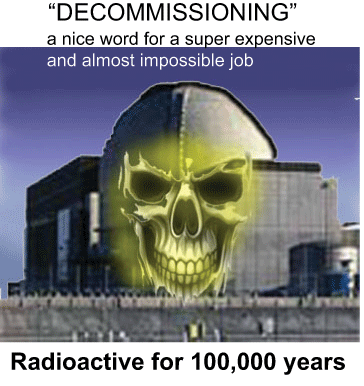
The insolvency of an operator of a decommissioned nuclear power plant in Germany raises questions about the financial responsibilities for deconstructing the reactor and disposing of its radioactive materials.
HKG, the owner of the nuclear plant Hamm-Uentrop that was opened in 1983 and taken out of service only six years later, filed for insolvency at a court in western state North Rhine-Westphalia, reports Clean Energy Wire, citing the German business weekly WirtschaftsWoche.
The operating company, owned jointly by major energy company RWE and several local utilities, initially had demanded about 350 million euros from the federal and the state government to cover the costs for deconstruction and disposal, but failed to win a lawsuit it filed in 2024. A court in the city of Düsseldorf rejected HKG’s claim in June this year, which led the company to declare itself insolvent. “HKG faces an unchanged situation with unclear financing of the remaining deconstruction work,” said the company’s CEO, Volker Dannert. According to WirtschaftsWoche, the actual costs for dismantling the plant and storing the nuclear waste initially were gauged at 750 to one billion euros.
Co-owner company RWE said the HKG shareholders bear no legal responsibility to fund deconstruction works beyond payments they made in the past. HKG manager Dannert said that talks with the federal and the state government had remained inconclusive, which meant that “it is now a task for the responsible authorities at the federal level and in North Rhine-Westphalia to organize the further dismantling.”
The prototype Thorium-Cycle-High-Temperature-Reactor (THTR) in Hamm-Uentrop was decommissioned due to technical challenges after serving for about 16,500 hours. It was sealed in 1997 and will remain so until at least 2030 to let radioactive contamination diminish before deconstruction works can begin. The process of dismantling is expected to take about one decade.
Germany is in the process of dismantling its nuclear power plants after shutting down the remaining three reactors in 2023 as part of the country’s nuclear phase-out. Dismantling nuclear power stations and safely storing radioactive waste will cost Germany dozens of billions of euros, and take many decades.
In 2017, Germany’s four major nuclear plant operators—E.ON, EnBW, RWE and Vattenfall—handed money earmarked for nuclear waste disposal over to the country’s fund for nuclear waste management, passing all responsibilities to the state. In 2025, over half of the German environment ministry’s budget is spent on managing the country’s nuclear waste, including finding a location for a final nuclear repository.
This post was originally published by Berlin-based Clean Energy Wire.
Trump warns of new strikes if Iran revives nuclear work

6 Oct 25, https://www.iranintl.com/en/202510063564
US President Donald Trump warned that Washington would bomb Iran again if it restarts its nuclear program, speaking on Sunday at a ceremony marking the 250th anniversary of the US Navy at Naval Station Norfolk in Virginia.
“We’ll have to take care of that too if they do,” Trump said, referring to Tehran’s potential resumption of nuclear activity. “You want to do that, it’s fine, but we’re going to take care of that and we’re not going to wait so long,” he told sailors gathered at the base.
Trump praised the June 22 US airstrikes on Iran’s nuclear facilities — codenamed Operation Midnight Hammer — as perfectly executed, saying American B-2 bombers and submarine-launched Tomahawk missiles hit every single target.
The operation targeted three key Iranian nuclear sites at Fordow, Natanz, and Isfahan, following an Israeli air campaign that began on June 13 against Iranian military and nuclear-related sites.
“The B2s, what they did. Those beautiful flying wings, what they did, they hit every single target. And just in case, we shot 30 Tomahawks out of a submarine,” Trump said at the event.
Iran had been within a month of developing a nuclear weapon before the strikes, Trump said, adding that US forces had prevented Tehran from crossing that threshold.
“They were going to have a nuclear weapon within a month,” Trump said. “And now they can start the operation all over again, but I hope they don’t because we’ll have to take care of that too if they do, I let them know that.”
Operation was decades in the making
Trump told the audience that B-2 pilots informed him the Pentagon had been planning such an operation for 22 years, saying no previous president had “the guts to do it.”
Trump’s comments come as his administration presses Iran to halt uranium enrichment and curb its ballistic missile program, demands Tehran has repeatedly rejected.
The president’s warning suggests Washington is prepared for further confrontation if Iran resumes nuclear activity, highlighting a renewed phase of military and diplomatic brinkmanship between the two countries.
World Nuclear Industry Status Report Energy overview- a nuclear dead end?
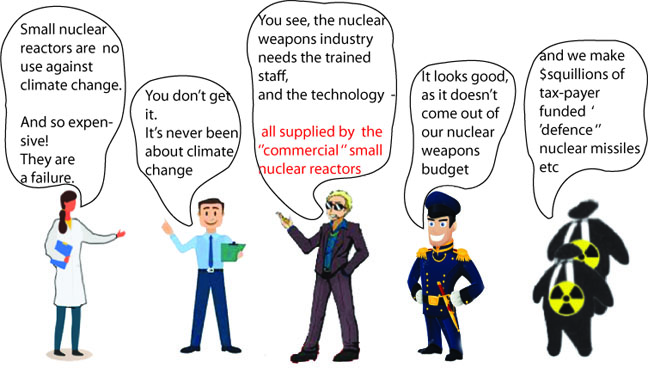
a possible driver for more high cost nuclear is that it can support the production of nuclear weapons……… evidently ‘military considerations can override economic ones’,
October 04, 2025, https://renewextraweekly.blogspot.com/2025/10/wnisr-energy-overview-nuclear-dead-end.html
The annual World Nuclear Industry Status Report as usual looks in great detail at the state of play for nuclear, mostly still not doing too well, compared with renewables, mostly doing better, with the report looking extensively at that as well as the ups and downs of nuclear. The renewable challenge is after all very striking: for example, global solar electricity generation has increased by about 28%, with costs continuing to fall. And crucially, in April 2025, renewables exceeded nuclear power generation globally for the first time.
However, although construction costs and delays remain a big problem, the nuclear story is not entirely negative. Given reactor start-ups and closures in 2024, nuclear added 5.3 GW net, while operating capacity increased by 2% and electricity output by 2.9%. But given the overall growth of electricity use, the nuclear share of global power has fallen to 9%. Whereas renewables are expanding overall. And that is despite some recent financial problems. For example, in 2024 wind energy deployment was hindered by the general economic & political environment. But even so wind electricity TWh generation still increased by close to 8%.
Nevertheless, despite renewable growth, WNISR concludes that, while ‘including hydro, gross electricity generation of all renewables grew by 862 TWh or 9.6 % in 2024’ that was ‘not enough to keep pace with the rising global electricity demand (up by 1,293 TWh), driven by higher temperatures, industrial expansion, electrification, and unambitious demand-side management & efficiency policies’. Although it says that renewables could in theory catch up with overall demand, that would require some major changes. The whole basis of the system logic must it says undergo a deep transformation, with a new framework for energy policy. Just comparing nuclear and renewables as if they were simply substitutable supply alternatives will not suffice: they are fundamentally different.
WNISR says ‘The underlying physics of the two technologies shows that significant disparities between them render nuclear inherently more costly, both in its present state and in the future’. For example, it says that ‘atomic energy is the only technology exploiting nuclear forces. It therefore has safety & security problems, as well as long-term liabilities, that competing technologies do not have. Technologies that exploit nano-level mechanisms in the electron shell of atoms, aided by quantum-mechanical insights, exhibit the most rapid innovation & cost decline’. And it concludes ‘an analysis of the system characteristics of the emerging overall energy system indicates that photovoltaics, batteries, and power electronics are already modifying the logic of the overall system in a manner that renders it increasingly challenging for nuclear power to be integrated into’.
That sounds quite optimistic for renewables if it is taken on board fully, but grim for nuclear, which it says ‘has essentially gotten stuck with the concepts of 75 years ago. While the quantum physics revolution has allowed progress in other fields, such as innovative materials, semiconductors, information technology, or artificial intelligence, it has only been marginally useful in advancing nuclear technologies.’
However, the new green techs have their own problems- notably the variability of some sources. WNISR says there are ‘widespread expectations that the expansion of renewables & especially solar will slow down,’ due to the need ‘to provide sufficient flexibility for high shares of renewables’. But solving this problem means that the whole system has to change, with flexible supply and demand and short and long term storage becoming very important, if we are get to net zero. Fortunately, WNISR says, ‘there is a wide array of opportunities for flexibility in the electricity system’ ranging from ‘reserve generation capacity provided by gas peaker plants to excess solar generation capacities curtailed during maximum sunshine, from batteries in homes to intermediate heat storage in industrial plants, and from changes in consumer habits or cost-neutral power use patterns to changes in industrial production rhythm enabled by additional intermediate product storage’.
Though it says that ‘those reluctant to embrace change call for a slowdown in the growth of renewables & are slow to pave the way for additional flexibility’, and also, ‘with some success, advocates of nuclear energy have spread the impression that decarbonization is expensive anyway and that alternatives to nuclear are no better.’ However, WNISR say that is wrong: ‘A series of simulations has consistently shown that 100-percent renewable energy systems are not more expensive than the conventional fossil- fuel-based approach. More importantly, 100-percent renewables-based systems are less costly than those that include nuclear power’.
Moreover, it claims that ‘nuclear plants do not provide the type of flexible, dispatchable power that can fill the gaps between solar power peaks. They need flexibility from other sources for bridging considerable planned and unplanned outages and for buffering between changing demand and their inflexible full-load operation. The cost of their baseload electricity is more expensive than the ultra-flexible combination of renewables-plus-storage-plus-flexible demand’. About all that WNISR seem able to offer as a possible driver for more high cost nuclear is that it can support the production of nuclear weapons. It quotes French President Macon’s claim that ‘without civil nuclear, no military nuclear; without military nuclear, no civil nuclear.’ That’s a pretty grim statement, and I will be exploring some of the implications for renewables of that sort of view in my next post.
In terms of the drive to nuclear, while WNISR notes that evidently ‘military considerations can override economic ones’, so can other factors and commitments. It says that there are ‘those who are still attached to the old (energy) paradigm, whether due to vested interests, ideological reasons, or deep identification with past activities and declining structures’. The dead hand of the past stop progress and the acceptance of new green energy paradigms. The report rounds off by saying that ‘changing paradigms is a tedious and slow process’ and notes that Max Planck, who was at the centre of a key paradigm shift in physics a century ago, said a bit bleakly ‘Science advances one funeral at a time.’ Let’s hope that’s not the only way it can happen. As WNISR warns ‘the time left for complete decarbonization of the energy system is short – not even a generation.’ Quite so. With a key attraction of renewables being that they are cheaper and faster to deploy than nuclear, with it being unclear if SMRs will offer any improvement, certainly not soon.
Inside JPMorgan’s Investment Bank, Nuclear Hype Raises Concerns.

unrealistic optimism around nuclear power
By Alastair Marsh, October 3, 2025 https://www.bloomberg.com/news/articles/2025-10-03/jpmorgan-senior-banker-says-nuclear-exuberance-has-him-worried?embedded-checkout=true
Takeaways by Bloomberg AI
Nuclear power plants come with high upfront costs, often take at least a decade to build, and regularly encounter delays, with newer technologies intended to address some of those issues remaining unproven.
Rama Variankaval, global head of corporate advisory at JPMorgan Chase & Co., expressed concern that enthusiasm for nuclear energy might have gone too far.
Variankaval said the demand for new power is materializing in real time, but the supply of new nuclear may take time, and that the reality of nuclear is it’s not ready for prime time.
Inside the investment banking division of JPMorgan Chase & Co., there’s concern that enthusiasm for nuclear energy might have gone too far.
“We’ve spent so much time on nuclear that I’ve become worried that maybe we’re over indexing on this problem,” Rama Variankaval, the bank’s global head of corporate advisory, said in an interview.
Nuclear power is having a moment in the US. After being largely stagnant for decades, the industry has been reignited by an insatiable demand for energy to power the data centers needed to support artificial intelligence. Bloomberg Intelligence estimates that demand for electricity will drive a $350 billion nuclear spending boom in the US, boosting output from reactors by 63% by mid-century.
Expectations of a nuclear renaissance have sent stocks soaring. Shares of nuclear energy startup Oklo Inc. have surged more than 500% this year, helped by a Sept. 22 announcement that the company broke ground on its first commercial reactor in Idaho. The MVIS Global Uranium & Nuclear Energy index is up over 70% in the period, compared with a 14% increase in the S&P 500 Index.
That exuberance looks overdone when considering likely delays in supply, according to Variankaval. “The demand of new power is materializing in real time, but the supply of new nuclear may take time,” he said.
Nuclear is one of the few low-carbon energy sources that is backed by the administration of US President Donald Trump. He’s signed executive orders to boost nuclear power and challenge rivals including Russia and China, a policy that includes a goal of quadrupling US nuclear capacity.
“Nuclear is almost certainly going to see a renaissance and be a bigger part of the electricity supply in the future,” Variankaval said. But “the reality of nuclear is it’s not ready for prime time,” he said.
Variankaval said his concerns have in part been shaped by the tone of several closed-door meetings he attended during New York climate week, in which what he characterized as unrealistic optimism around nuclear power dominated the conversation.
Nuclear power plants come with very high upfront costs, often take at least a decade to build and regularly encounter delays that mean budget predictions rarely hold. And despite soaring demand for carbon-free fission power in the US, the pace of construction has been glacial. Newer technologies intended to address some of those issues remain unproven.
Variankaval urged caution when it comes to expectations around small modular reactors, which can be built in factories and are faster and cheaper to produce than their larger counterparts. Despite the support for SMRs, the technology is “probably still a handful of years away from being a cost-competitive source of energy,” he said. “Fusion is likely two handfuls of years away.”
Bloomberg Intelligence forecasts that only 9 gigawatts of new nuclear capacity of any type will be added in the next decade, with widespread deployment of SMRs not expected to start until after 2035.
Nuclear developments also have been hampered by a lack of skilled labor, domestic fuel supply and regulatory infrastructure, among other things. Just three traditional reactors have been completed in the US this century.
Given the challenges facing nuclear, meeting short-term power requirements may still need to be “anchored around gas” with additional carbon capture, as well as solar and batteries, wind and hydropower, Variankaval said. “Power prices are already going up in many parts of the country” and “a continuation of this will test the policy support and the question of who pays for the incremental cost of new energy will need to be carefully addressed.”
Meanwhile, it’s not clear that nuclear power will be able to add enough to the energy mix to meet the demand generated by AI, according to Karen Fang, global head of sustainable and infrastructure finance at Bank of America Corp.
There’s been some “really promising progress,” she said on a panel at Bloomberg’s Women, Money & Power event in London on Oct. 1. But it still “doesn’t solve the AI power need for the next three to five years.”
Bloomberg Intelligence says the race to power AI’s $2 trillion capex wave “will be won by fast-build assets,” with about 72% of respondents to a recent BI survey seeing gas as critical to powering AI data centers.
Israel Droned Flotilla Activists And Then Abused Greta Thunberg
Caitlin Johnstone, Oct 05, 2025, https://www.caitlinjohnst.one/p/israel-droned-flotilla-activists?utm_source=post-email-title&publication_id=82124&post_id=175313119&utm_campaign=email-post-title&isFreemail=true&r=1ise1&triedRedirect=true&utm_medium=email
Who would have imagined five years ago when we were seeing Greta Thunberg amplified by every mainstream western liberal institution that we would one day hear reports that she has been captured and tormented by the Israeli military for trying to bring formula to starving babies?
The Guardian reports the following:
“In an email sent by the Swedish foreign ministry to people close to Thunberg, and seen by the Guardian, an official who has visited the activist in prison said she claimed she was detained in a cell infested with bedbugs, with too little food and water.
“ ‘The embassy has been able to meet with Greta,’ reads the email. ‘She informed of dehydration. She has received insufficient amounts of both water and food. She also stated that she had developed rashes which she suspects were caused by bedbugs. She spoke of harsh treatment and said she had been sitting for long periods on hard surfaces.’
“ ‘Another detainee reportedly told another embassy that they had seen her [Thunberg] being forced to hold flags while pictures were taken. She wondered whether images of her had been distributed,’ the Swedish ministry’s official added.
“The allegation was corroborated by at least two other members of the flotilla who had been detained by Israeli forces and released on Saturday.
“ ‘They dragged little Greta [Thunberg] by her hair before our eyes, beat her, and forced her to kiss the Israeli flag. They did everything imaginable to her, as a warning to others,’ the Turkish activist Ersin Çelik, a participant in the Sumud flotilla, told Anadolu news agency.
“Lorenzo D’Agostino, a journalist and another flotilla participant, said after returning to Istanbul that Thunberg was ‘wrapped in the Israeli flag and paraded like a trophy’ — a scene described with disbelief and anger by those who witnessed it.”
These reports, as shocking as they are, also happen to more or less reflect exactly what the Israeli regime said it intended to do to Global Sumud Flotilla activists when they were captured.
Israeli National Security Minister Itamar Ben-Gvir said last month that Sumud activists must be treated as terrorists in order to “create a clear deterrent” from future flotilla activism, declaring that “Anyone who chooses to collaborate with Hamas and support terrorism will meet a firm and unyielding response from Israel.”
“We will not allow individuals who support terrorism to live in comfort. They will face the full consequences of their actions,” Ben-Gvir said at the time.
After the flotilla activists were abducted by the IDF, Ben-Gvir filmed himself taunting them and calling them “terrorists”.
Israel, needless to say, has an extensively documented record of torturing and abusing individuals who’ve been given the “terrorist” label by the regime.
So it would appear that they singled out the most high-profile activist on the flotilla for abuse in order to send a message and deter future efforts to break the siege on Gaza.
Workers shut down Italy again in solidarity with Palestine
Hundreds of thousands joined a new general strike across Italy, in solidarity with the people of Gaza and the Global Sumud Flotilla.
October 03, 2025 by Peoples Dispatch, https://peoplesdispatch.org/2025/10/03/workers-shut-down-italy-again-in-solidarity-with-palestine/
Hundreds of thousands of people have again taken to the streets of Italy in response to a general strike call originally launched by the grassroots union Unione Sindacale di Base (USB) and later joined by some of the country’s largest trade union confederations. As they blocked ports, highways, and industrial zones, protesters delivered a resounding rejection of Giorgia Meloni’s government’s complicity in Israel’s genocide in Gaza, demanding an immediate end to the attacks and the release of activists kidnapped from the Global Sumud Flotilla.
“Tens of thousands of people took to the streets for the general strike in support of Palestine: this is a huge success,” Giuliano Granato of the left party Potere al Popolo reported from one of the marches. “It shows that there is a majority in the country that is fighting for Palestine and doing what our government has not dared to do for two years.”
The strike came just days after Israeli forces assaulted dozens of vessels of the Global Sumud Flotilla in international waters, detaining activists, including several Italians. Prime Minister Giorgia Meloni and other officials failed to act decisively for their protection or release. Instead, they implied Israel had acted with measure and tried to shift the blame on the flotilla for continuing its humanitarian mission despite threats. The government’s attempt to present itself as “sovereignist” fell apart in the face of these events. “This is not a government of sovereignists. This is a government that bows down and prostrates itself before Israel,” Granato said.
In several cities, demonstrators faced heavy police repression. In Padua, more than 10,000 protesters occupying the industrial zone were attacked with water cannons and tear gas. “The march stayed united and we are continuing the blockade,” one participant said. “We want an end to complicity. We want a free Palestine.”
Protesters in Bologna and Naples also pushed through police lines to occupy strategic points. In Naples, at least 50,000 people seized part of the port despite heavy policing. In Bologna, 150,000 blocked major roads. “This is the response of the people to Israel expanding the war, to the government repressing us, to those who want to divide us into good and bad,” Potere al Popolo’s Bologna chapter wrote. “Let’s center our priorities around those who keep this country going every day, with precarious lives, low wages, and insecure jobs. Instead of rearmament and alliances with Israel, let’s lay down arms and raise salaries!”
Union leaders echoed the calls. Maurizio Landini, head of the confederation CGIL, stated: “There are no rights, there is no dignity without peace. True security does not mean increasing spending on weapons, but investing in public health, education, employment, and the redistribution of wealth.”
The strike raised demands for a full arms embargo on Israel, the severing of all ties with the occupation authorities, and an immediate end to the genocide. And there is no end in sight for the mobilization – those who joined the strike are already preparing for Saturday’s national demonstration in Rome, where they will again assert their solidarity and determination to see a free Palestine.
The National Press Club of Australia, Caving to the Israel Lobby, Cancels My Talk on Our Betrayal of Palestinian Journalists.

By Chris Hedges / ScheerPost, October 4, 2025 https://scheerpost.com/2025/10/04/chris-hedges-the-national-press-club-of-australia-caving-to-the-israel-lobby-cancels-my-talk-on-our-betrayal-of-palestinian-journalists/
I was scheduled to give a talk at the National Press Club of Australia on October 20 called “The Betrayal of Palestinian Journalists.” It was to focus on the amplification of Israeli lies in the press, which most reporters know are lies, betraying Palestinian colleagues who are slandered, targeted and killed by Israel. But, perhaps inadvertently proving my point, the chief executive of the press club, Maurice Reilly, cancelled the event. The announcement of my talk disappeared from the web site. Reilly said “that in the interest of balancing out our program we will withdraw our offer.”
The Israeli Ambassador, retired Lt. Colonel Amir Maimon, who spent 14 years in the Israeli military, is reportedly being considered to speak.
It is true that I know only one side of the picture from the seven years I spent covering Gaza. I was on the receiving end of Israeli attacks, including being bombed by its air force and fired upon by its snipers, one of whom killed a young man a few feet away from me at the Netzarim Junction. We lifted him up, each person taking hold of an arm or a leg, and lumbered up the road as his body swayed like a heavy sack. I saw small boys baited and shot by Israeli soldiers in the Gaza refugee camp of Khan Younis. The soldiers swore at the boys in Arabic over the loudspeakers of their armored jeep. The boys, about 10 years old, then threw stones at an Israeli vehicle and the soldiers opened fire, killing some, wounding others.
I was present more than once as Israeli troops shot Palestinian children. Such incidents, in the Israeli lexicon, become children caught in crossfire. I was in Gaza when F-16 attack jets bombed overcrowded hovels in Gaza City. I saw the corpses of the victims, including children. This became a surgical strike on a bomb-making factory. I have watched Israel demolish homes and entire apartment blocks to create wide buffer zones between the Palestinians and the Israeli troops that ring Gaza. I have interviewed the destitute and homeless families, some camped out in crude shelters erected in the rubble. The destruction becomes the demolition of the homes of terrorists. I have stood in the gutted remains of schools as well as medical clinics and mosques and counted the bodies. I have heard Israel claim that errant rockets or mortar fire from the Palestinians caused these and other deaths, or that the buildings were being used as arms depots or launching sites.
I, along with every other reporter I know who has worked in Gaza, including the over 278 Palestinians journalists and media workers who have been killed by Israel since the start of the genocide, many in targeted assassinations, have reported a reality in Gaza that bears no resemblance to how it is portrayed by Israeli politicians, its military and many media outlets that serve as Israel’s echo chamber.
Lt. Colonel Maimon can obviously, if he chooses, enlighten us about the artificial intelligence-based program known as “Lavender” and how it selects people, along with their families, in Gaza for assassination.

He can explain how Israel determines the quotas of civilian dead, how soldiers are permitted to kill as many as 20 civilians in order to target a Palestinian fighter and hundreds for a Hamas commander. He can let us know why Israel continues the mass slaughter when an internal Israeli intelligence database indicates that at least 83 percent of Palestinians killed are civilians. He can tell us how Palestinian civilians are abducted, dressed in Israeli army uniforms, have their hands tied, and are then forced to walk as human shields in front of Israeli troops into buildings and underground tunnels that are potentially booby-trapped. He can explain how the special unit called the “Legitimization Cell” carries out propaganda campaigns to portray Palestinian journalists as Hamas operatives to justify their assassinations. He can detail the targeting, bombing and controlled demolitions that have damaged or destroyed 97 percent of Gaza’s educational system, including every university and nearly all its hospitals. He can explain how, after Israel blocked all humanitarian aid on March 2 to starve the Palestinians in Gaza, Israeli officials set up the so-called Gaza Humanitarian Foundation to lure emaciated and malnourished Palestinians to four aid hubs in the south — aid hubs with little food and which Human Rights Watch calls “death traps” and Doctors Without Borders calls “orchestrated killing.” These hubs, open only an hour, usually at 2:00 am, ensure a chaotic scramble for scraps of food. Israeli soldiers, along with U.S. mercenaries, who include members of the Infidels Motorcycle Club, a self-professed anti-“radical jihadist” biker group that counts members with Crusader tattoos among its ranks, fire live rounds into the crowds killing over 1,400 Palestinians and injuring thousands more in and around the hubs since May. He can lay out the plans for the concentration camps in southern Gaza and the efforts to ultimately expel the Palestinians from Gaza and repopulate it with Jewish colonists. He can explain why Israel abandoned its own hostages, why it fired on vehicles headed into the Gaza strip on October 7 carrying Israeli captives and why it used Hellfire missiles to obliterate the Erez Crossing installation when it was seized by Palestinian fighters knowing that dozens of Israeli soldiers were inside.
If Lt. Colonel Maimon spoke with this honesty and candor we could call this balance. It would fill in a side of the equation I glimpse from the outside. It would complete the circle. It would match truth with truth.
But Lt. Colonel Maimon, I see from his past statements, will spew out the mendacious narratives used by Israel to justify genocide — Hamas uses Palestinians as human shields, it operates command centers in hospitals, it sexually assaulted Israeli women on October 7 and beheaded babies. He will make the spurious claim that Israel “has the right to defend itself,” ignoring the fact that Hamas and other Palestinian resistance groups, which lack an air force, mechanized units, artillery, a navy, fleets of militarized drones and missiles, pose no existential threat to Israel. More important, he will not address Israel’s flagrant violation of international law by occupying and settling colonists on Palestinian land and carrying out a livestreamed genocide.
This is not balance, unless we accept a world where truth is balanced by lies. It is an abandonment of the fundamental mission of journalists — to hold power accountable. But most egregiously, it is a terrible betrayal of our colleagues in Gaza who have been killed for chronicling the daily savagery in Gaza, for doing their job.
No doubt, the corporate sponsors and wealthy donors of the press club are pleased. No doubt, the club is able to slither away from its journalistic integrity. No doubt, it is spared the attacks that would come from allowing me to speak.
But please, have the decency to remove the word press from your club.
Can AI Solve the Nuclear Fusion Energy Puzzle?

By Haley Zaremba – Oil Price, Oct 05, 2025
- Nuclear fusion holds the potential for clean, greenhouse gas-free baseload power, but challenges in controlling plasma have hindered its commercial viability.
- Recent breakthroughs, particularly with AI tools like Diag2Diag, are significantly advancing fusion development by improving plasma monitoring and control, specifically addressing issues like Edge Localized Mode (ELM).
- Despite these advancements, commercial nuclear fusion remains decades away, leading some experts to question whether it’s a realistic “silver bullet” solution for growing energy demands, especially from AI.
……………………………………………………………………………………………………………………… https://oilprice.com/Energy/Energy-General/Can-AI-Solve-the-Nuclear-Fusion-Energy-Puzzle.html
Grossi: Iran Is Not Seeking Nuclear Weapons; My Report Did Not Trigger the Attack
WANA (Oct 05) – The Director General of the International Atomic Energy Agency (IAEA), Rafael Grossi, stated: “My report clearly said that Iran has no program to develop nuclear weapons. So, if anyone thinks that report was a reason for war, they are mistaken.”
In response to a question about whether he sees any hope of returning to Iran after the country’s recent criticisms of him and its restrictions on IAEA access, Grossi said: “Yes, absolutely. We take this matter very seriously. Recently, after lengthy negotiations, IAEA inspectors returned to Iran. As a first step in resuming inspections, they visited the Bushehr reactor. However, we still need to agree on a set of technical procedures and methods so that we can access all sites, including those damaged in the attacks, because nuclear material remains under the rubble of these sites, and such materials remain of interest to the international community. We are in the process of rebuilding the connections that were severed due to the attacks.”
Meanwhile, Iran’s Foreign Minister Abbas Araghchi said today regarding the recent Iran–IAEA agreement in Cairo: “We signed an agreement with the IAEA outlining a new framework for cooperation between Iran and the Agency, and the reason was quite clear. Given the changes on the ground and the attack on our facilities, cooperation with the Agency could not continue as before. Due to existing security and safety concerns, it was absolutely necessary to define a new framework for collaboration.”……………………………
Military Attacks May Have Only Short-Term Effects
When asked what his message to Iran would be, Grossi said: “We must always trust dialogue. Even though I have personally faced threats, I believe we must stay committed to diplomacy. For me, for Iran, and for those who attacked Iran, it is absolutely clear that a lasting solution to the Iranian nuclear issue can only come through diplomacy.”
Grossi admitted that military attacks would not eliminate Iran’s nuclear capabilities: “Military attacks may have short-term effects, but the fact remains that technical expertise and technology exist — and what is destroyed can be rebuilt, perhaps with a spirit of revenge. That’s why I always remind all sides that a sustainable solution must be some kind of agreement — one that restores lost trust
Our Reports Only Reflected the Status of Iran’s Nuclear Program
In response to claims that the IAEA has not been impartial, Grossi said: “I am constantly criticized, and one should not fear criticism, even when I believe it is misplaced. It has been said that the IAEA’s reports gave a green light for military action — that is completely false.”
He insisted: “Our reports simply reflected the state of Iran’s nuclear program, without any new or surprising information that could justify military action. Even regarding nuclear weapons development, my report explicitly stated that Iran did not have — and still does not have — a program to build nuclear weapons. So if anyone thinks my report was a reason for war, they are entirely wrong.”……………… https://wanaen.com/grossi-iran-is-not-seeking-nuclear-weapons-my-report-did-not-trigger-the-attack/
UN nuclear chief says military action cannot destroy Iran nuclear program
Iran International, 5 Oct 25
ilitary strikes on Iran’s nuclear sites would have only short-term effects and fail to destroy its capabilities, the UN atomic watchdog chief said, urging diplomacy as the sole path to a lasting solution to concerns over Tehran’s disputed nuclear program.
“One thing is clear to me, to Iran, and to those who attacked Iran: a lasting, permanent solution to this situation and to the doubts surrounding Iran’s nuclear program can only be diplomatic,” Rafael Grossi said on a podcast hosted by Colombia’s Innovation for Development Foundation on Friday.
“Although attacks or military action may have short-term effects, the technical and technological capabilities exist — what was destroyed can be rebuilt,” he added.
“I always remind all the parties involved that beyond missiles and bombs, the only lasting solution will have to be some form of new agreement to restore lost trust.”
Talks between Tehran and Western powers over the country’s nuclear program remain stalled.
A sixth round of indirect US-Iran talks was suspended in June after Israel and the United States struck Iranian nuclear facilities, prompting waves of Iranian missile retaliation against Israel.
A preliminary US Defense Intelligence Agency assessment found the strikes may have delayed Iran’s nuclear program by only a few months, according to a report by Reuters.
However, US President Donald Trump has consistently said Iran’s nuclear facilities targeted in the attacks were “totally obliterated.”……………………………………….
The UN sanctions on Iran were reinstated on September 28 after the UK, France, and Germany (the E3) triggered the snapback mechanism under the 2015 nuclear deal known as the Joint Comprehensive Plan of Action (JCPoA).
The E3 said the decision followed “Iran rejecting two offers put on the table by the JCPoA coordinator in 2022 and further expanding its nuclear activities in clear breach of its JCPoA commitments.”
Iran has blamed the failure of the talks on what it calls Western powers’ “excessive demands.” https://www.iranintl.com/en/202510054637
The case for some non-nuclear subs
by Lieutenant Commander Jim Halsell, U.S. Navy*, Australian Naval Institute, 5 Oct 25
The United States will require more than its existing inventory of nuclear-powered submarines to ensure victory in a conflict with China. The Navy should augment its existing submarine force with a fleet of conventionally powered submarines capable of launching cruise missiles.
By producing smaller, more cost-efficient submarines with the help of allies, the U.S. submarine force could mitigate the relatively low number of nuclear-powered submarines available for a conflict. …………………………………………………………………………………………………………………………….
The problem with the makeup of today’s submarine force is that these deep-diving, fast-driving, nuclear-powered submarines are expensive. These ships are both too expensive to build in sufficient quantity to meet operational requirements and too costly, in terms of dollars and capabilities, to risk losing in combat.
The cost per hull of a new Virginia-class SSN was originally $2.8 billion, but following the incorporation of the Virginia Payload Module in the USS Arizona (SSN-803) and follow-on Block V boats, that cost now exceeds $4 billion.4 In comparison, Japan spent an estimated $536 million per hull for its Sōryū-class submarines, which feature air-independent propulsion (AIP), allowing them to operate for weeks without snorkeling.5 Japan’s newer Taigei-class submarines are being built at an even cheaper $473 million per hull.6
…………………………………………………………………………………………………………….Much of the disparity stems from the prohibitive cost of nuclear propulsion systems. Conventional submarines are cheaper not only to build, but also to maintain, benefiting from simpler refueling logistics and a dramatically lower cost threshold.
………………………………………………………………………………………………………… Allied Collaboration
One of the most compelling opportunities presented by the development of a U.S. conventionally powered submarine would be the chance to design and build it in partnership with key Indo-Pacific allies. Japan, South Korea, and Australia have decades of experience operating and constructing nonnuclear-powered submarines, and they are getting better with each iteration. ……………………………………………………………. https://navalinstitute.com.au/the-case-for-some-non-nuclear-subs/
Hamas just accepted Trump’s ‘peace’ plan. Here’s what it didn’t accept.
Hamas just accepted Donald Trump’s “peace” plan. Here’s what Hamas didn’t accept, how Trump reacted, and why Netanyahu was blindsided.
By Qassam Muaddi October 4, 2025 , https://mondoweiss.net/2025/10/hamas-just-accepted-trumps-peace-plan-heres-what-it-didnt-accept/
The response of Hamas to U.S. President Donald Trump’s “peace” plan to end the war in Gaza came in late on Friday. It sparked immediate and conflicting reactions.
Five days after the U.S. president first announced his plan, the Palestinian movement gave its answer in a statement announcing that Hamas announced its “approval for the release of all hostages — living and dead – according to the exchange formula included in President Trump’s proposal.” Hamas added that it was ready to enter talks “to discuss the details.”
In a move practically unheard of by a U.S. president, Trump shared Hamas’s statement on his account on Truth Social:
“Based on the Statement just issued by Hamas, I believe they are ready for a lasting peace,” Trump said, adding that “Israel must immediately stop the bombing of Gaza, so that we can get the hostages out safely and quickly!”
Minutes later, Trump announced Hamas’s acceptance of his plan in a live address at the White House, considering the event “a big day, unprecedented in many ways.” Trump added that he “looks forward to having all [Israeli] hostages come back to their parents,” stressing that “we have to put the final word in concrete.” The U.S. President thanked Arab and Muslim states for “helping me put this together,” promising that “everybody will be treated fairly.”
Hamas’s response to Trump’s plan came a day after the Israeli army sealed off Gaza City. Israeli Defense Minister Israel Katz issued a “final warning” to the estimated 500,000 Palestinians still in the city, announcing that those who decide to remain will be considered “terrorists or supporters of terror.”
Netanyahu ‘surprised’ amid international approval
Qatar, Egypt, and Turkey also accepted Hamas’s response, while French President Emmanuel Macron said that the “release of all hostages and a ceasefire in Gaza are within reach,” and UK Prime Minister Keir Starmer said Hamas’s response was “a significant step forwards.”
Trump’s near-immediate positive response to the Hamas statement was reportedly met with “surprise” by Israeli Prime Minister Benjamin Netanyahu, according to an unnamed Israeli official who spoke to Israel’s Channel 12. Netanyahu had held a deliberation on the Hamas response to Trump’s plan before the U.S. President published his Truth Social statement. According to Channel 12, the Israeli Prime Minister considered the Hamas response a rejection of Trump’s framework.
Netanyahu had reportedly stressed the need to coordinate with the U.S. on a response, so it would not seem that Hamas had accepted the Trump deal, according to Channel 12, which also cited Israeli officials saying that the Hamas response “could pave the way to a deal”
What Hamas accepted
In its official statement, Hamas praised “the Arab, Islamic, and international efforts, as well as the efforts of U.S. President Donald Trump, aimed at halting the war on the Gaza Strip, achieving a prisoner exchange, allowing immediate entry of humanitarian aid, rejecting the occupation of the Strip, and opposing the displacement of our Palestinian people from it.”
Hamas’s statement then announced the movement’s acceptance of Trump’s prisoner exchange formula, which would see the release of 250 Palestinians from Israeli prisons in exchange for the release of all Israeli captives. The statement added that Hamas was ready to “immediately enter into negotiations” through Qatari and Egyptian mediators to “discuss the details.”
The statement also affirmed Hamas’s readiness to hand over the administration of the Strip to a Palestinian commission of independent “technocrats,” which would be formed “based on Palestinian national consensus and supported by Arab and Islamic backing.”
Most importantly, the Hamas statement addressed the other parts of Trump’s plan concerning the future of Gaza and the “legitimate rights of the Palestinian people,” affirming that it must be subject to a “comprehensive national position” based on international law and UN Resolutions. This position would have to be discussed as part of a “unified Palestinian national framework,” which Hamas said it would participate in “with full responsibility.”
What Hamas didn’t accept
But the Hamas statement also skirted over a number of key parts of Trump’s plan that have been widely regarded as a non-starter for Palestinians, as it would prevent Palestinians from administering their own lives and forestall the prospects of a Palestinian state.
These included the clause in Trump’s plan about forming a “board of peace” headed by the U.S. President, the widely-reported potential participation of former British Prime Minister Tony Blair, and the deployment of international and Arab forces to “demilitarize” Gaza. Most importantly, the statement made no mention of the demand for Hamas and other resistance factions in Gaza to disarm.
Following the statement, Hamas’s head of international and legal relations, Mousa Abu Marzouq, told Al Jazeera that Hamas was concerned with the first nine points of Trump’s 20-point plan, which related to ending the war, ending the occupation of Gaza, humanitarian aid, and who would rule the Strip.
Abu Marzouq added that these issues required further negotiations, asserting that some of Trump’s points were “unrealistic,” including the release of all captives within 72 hours. He also noted that the plan did not include any clear framework for how the Israeli withdrawal would take place.
Refusing a ‘mandate in new form’
Abu Marzouq affirmed that Gaza must be ruled by “an independent commission of technocrats, and this is what we agreed on with the rest of the [Palestinian] factions in Cairo,” referencing the inter-Palestinian agreement back in August to form an independent commission to run Gaza based on an Egyptian proposal.
As for the clauses of Trump’s plan concerning the future of the Palestinian Authority (PA), the future of the Gaza Strip, and the future of a Palestinian state, Abu Marzouq said that these issues could not be decided upon by Hamas alone. “Hamas is part of the Palestinian people, but there are other parts,” Abu Marzouq said. “All the national factions, the national movement in all its colors, the PLO—which represents the Palestinian people—and the Palestinian Authority, which is already engaged in a political process with the occupying state. All of them are partners in drawing the future of the Palestinian people.”
The Hamas official called on Egypt to initiate dialogue with all Palestinian parties to reach a common position on these issues. Abu Marzouq added that “it is absolutely impossible that this national consensus would accept a mandate on any part of the Palestinian people,” opining that the proposal for the administration of the Strip by a “board of peace” was a “mandate in new form,” referencing the post-World War I British Mandate over Palestine over a century ago.
Regarding disarmament, Abu Marzouq said that Hamas would hand over its weapons to a Palestinian state “on the first day it is established,” asserting that Hamas could not continue to be an armed organization under a Palestinian state.
The Total Trumpification of America
4 October 2025, Roswell, https://theaimn.net/the-total-trumpification-of-america/
In an era of bold leadership and unprecedented achievement, one man’s visage can no longer be confined to the traditional halls of fame. First, he wanted his face on Mount Rushmore. Then, he set his sights on a coin. But why think so small? In a move that has stunned pundits and thrilled patriots, President Trump has announced a plan for total perceptual saturation. It’s no longer about a place on the currency; it’s about the currency, the country, and the cosmos.
The following official press release and subsequent details outline the groundbreaking “Patriotic Image Total Coverage Act.”
The Official Press Release
“After the tremendous success of my administration, the greatest in history, it has become clear that the American people need a constant, stable, and beautiful reminder of who made it all possible. So, I am implementing a new policy, the ‘Patriotic Image Total Coverage Act.’ It’s the best act. Everyone says so. My face will now be on… the lot. Why have a little when you can have it all? It’s going to be yuge.”
What “The Lot” Actually Includes
Currency: All of it. Not just coins. Pennies, nickels, dimes – his face is on both sides. The $20 bill? It’s just three different angles of his face.
Stamps: The “Forever Trump” stamp is the only option for mail, with a special “Executive Edition” that costs $10 and is, according to sources, “so much better than the regular stamp.”
Government Property: Every police car, every fire truck, every mailbox, and every single page of every government website. The “loading” icon on IRS.gov is now a spinning golden “T.”
Consumer Goods: By executive order, his face is subtly woven into the fabric of all Levi’s jeans, printed on every egg, and appears as a watermark on all pizza boxes.
Infrastructure: A subtle (but not that subtle) granite inlay of his profile on every mile of interstate highway. Every manhole cover is a newly minted bronze bust.
The Digital Sphere: A mandatory browser extension that places a small, translucent image of him smiling approvingly in the corner of your screen during any online financial transaction.
Nature Itself: A permanent, cloud-seeding program ensures that, on sunny days, the clouds occasionally arrange themselves into a likeness visible from three states away.
Every McDonald’s Happy Meal box: A natural fit. His face would be there, winking, with the caption, “You’re gonna love it. Believe me.”
Bottles of Trump Water: The label is just his face, with an expression of ultimate purity. “It’s the clearest water. Some say it’s the best water in the history of water.”
The Surface of a Giant Comet: As it swings by Earth every 75 years, it will flash his face, reminding future generations of this golden age.
On the Moon: Forget a plaque; a massive, laser-etched portrait on the face of the moon, visible with a good telescope. “So the aliens know who to call for the best deals.”
The Washington Monument: A giant, wraparound vinyl print. It would be the world’s tallest selfie.
A Line of “Executive Time” Watches: The entire watch face is his face, with his hair acting as the hour and minute hands.
The Google Search Bar: A tiny, persistent icon in the corner, offering to “search for the best results, something the other guys can’t do.”
And this biggie: The Shroud of Mar-a-Lago. A sacred linen bearing the inexplicable and glorious likeness of Donald Trump. It is a testament not to suffering, but to unparalleled success and energy.
And one final, fitting addition:
Toilet Paper: For the ultimate “draining the swamp” experience.
1 This Month

of the week – Shut Down Drone Warfare!


Tell the Ukrainian Government to Drop Prosecution of Peace Activist Yurii Sheliazhenko

Petition to revoke the licensing of the Near Surface Nuclear Disposal Facility (NSDF) at Chalk River. https://www.ourcommons.ca/petitions/en/Petition/Details?Petition=e-7247
To see nuclear-related stories in greater depth and intensity – go to https://nuclearinformation.wordpress.com
-
Archives
- April 2026 (44)
- March 2026 (251)
- February 2026 (268)
- January 2026 (308)
- December 2025 (358)
- November 2025 (359)
- October 2025 (376)
- September 2025 (257)
- August 2025 (319)
- July 2025 (230)
- June 2025 (348)
- May 2025 (261)
-
Categories
- 1
- 1 NUCLEAR ISSUES
- business and costs
- climate change
- culture and arts
- ENERGY
- environment
- health
- history
- indigenous issues
- Legal
- marketing of nuclear
- media
- opposition to nuclear
- PERSONAL STORIES
- politics
- politics international
- Religion and ethics
- safety
- secrets,lies and civil liberties
- spinbuster
- technology
- Uranium
- wastes
- weapons and war
- Women
- 2 WORLD
- ACTION
- AFRICA
- Atrocities
- AUSTRALIA
- Christina's notes
- Christina's themes
- culture and arts
- Events
- Fuk 2022
- Fuk 2023
- Fukushima 2017
- Fukushima 2018
- fukushima 2019
- Fukushima 2020
- Fukushima 2021
- general
- global warming
- Humour (God we need it)
- Nuclear
- RARE EARTHS
- Reference
- resources – print
- Resources -audiovicual
- Weekly Newsletter
- World
- World Nuclear
- YouTube
-
RSS
Entries RSS
Comments RSS
 nuclear-news