Cato Institute: Nuclear power’s hamster wheel
Beyond Nuclear,September 23, 2025 https://beyondnuclear.org/cato-institute-nuclear-powers-hamster-wheel/
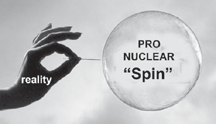
Accelerating climate change demands a stop to wasting precious little time along with human and financial resources being diverted from real solutions on nuclear power that’s going nowhere.
The conservative Cato Institute’s Fall 2025 status report on “The Next Nuclear Renaissance?” provides a comprehensive status report and global overview, nuclear nation by nation.
The report is best summed up in its concise conclusion:
The mystery is why the nuclear industry retains any credibility. Throughout its history, nuclear proponents have made rosy claims about the safety and economics of the next generation of nuclear projects, but they have all gone unfulfilled. In the early years of nuclear development, claims that processes such as learning by doing, technology change, standardization, economies of scale, and economies of number would result in improved performance had an intuitive credibility. However, after repeated failures to produce the forecasted results, why are renewed claims of this type being taken seriously now? Is it simple ignorance of the past, or are there other factors that make policymakers cling to a belief in nuclear?
Why are people unwilling to consider the reason that nuclear projects fail so often is the technology itself? Instead, they fall back on old, tired excuses such as unsympathetic regulators, delays caused by local protestors, and simply not getting the right ‘recipe’ for building nuclear power plants.
In March 2025, UK Prime Minister Keir Starmer claimed: For too long, blockers have had the upper hand in legal challenges—using our court processes to frustrate growth. We’re putting an end to this challenge culture by taking on the NIMBYs and a broken system that has slowed down our progress as a nation.
Starmer has created a taskforce to streamline safety regulation, but he has offered no evidence that the delays and cost escalation suffered at Hinkley Point C are in any way attributable to opposition or obstructive regulation—and he cannot because there is none.
The problem is not so much that money will be wasted on large numbers of uneconomic facilities. Rather, it is the opportunity costs of the time and human resources that are consumed by nuclear power and not available to other, quicker, more cost-effective and less financially risky options. We appear now to be facing serious risks from climate change, and there will not be a second chance if we fail to tackle it because too many resources are being consumed by an option—new nuclear—that will not work.”
No comments yet.
1 This Month

of the week – Shut Down Drone Warfare!


Tell the Ukrainian Government to Drop Prosecution of Peace Activist Yurii Sheliazhenko

Petition to revoke the licensing of the Near Surface Nuclear Disposal Facility (NSDF) at Chalk River. https://www.ourcommons.ca/petitions/en/Petition/Details?Petition=e-7247
To see nuclear-related stories in greater depth and intensity – go to https://nuclearinformation.wordpress.com
-
Archives
- March 2026 (230)
- February 2026 (268)
- January 2026 (308)
- December 2025 (358)
- November 2025 (359)
- October 2025 (376)
- September 2025 (257)
- August 2025 (319)
- July 2025 (230)
- June 2025 (348)
- May 2025 (261)
- April 2025 (305)
-
Categories
- 1
- 1 NUCLEAR ISSUES
- business and costs
- climate change
- culture and arts
- ENERGY
- environment
- health
- history
- indigenous issues
- Legal
- marketing of nuclear
- media
- opposition to nuclear
- PERSONAL STORIES
- politics
- politics international
- Religion and ethics
- safety
- secrets,lies and civil liberties
- spinbuster
- technology
- Uranium
- wastes
- weapons and war
- Women
- 2 WORLD
- ACTION
- AFRICA
- Atrocities
- AUSTRALIA
- Christina's notes
- Christina's themes
- culture and arts
- Events
- Fuk 2022
- Fuk 2023
- Fukushima 2017
- Fukushima 2018
- fukushima 2019
- Fukushima 2020
- Fukushima 2021
- general
- global warming
- Humour (God we need it)
- Nuclear
- RARE EARTHS
- Reference
- resources – print
- Resources -audiovicual
- Weekly Newsletter
- World
- World Nuclear
- YouTube
-
RSS
Entries RSS
Comments RSS
 nuclear-news
Leave a comment