Trump Claims Ukraine Can Retake All Territory Captured by Russia, May Be Able to ‘Go Further’

So much for Trump’s promise to bring peace to Ukraine “in 24 hours”
So much for the push to give Trump the Nobel Peace Prize
Worst – Trump does not understand that (a) Russia is winning this war, and (b) Putin would use nuclear weapons if he thought that Russia really was threatened by NATO
The comments reflect the opinion of Trump’s special envoy to Ukraine, Keith Kellogg
by Dave DeCamp | September 23, 2025, https://news.antiwar.com/2025/09/23/trump-claims-ukraine-can-retake-all-territory-captured-by-russia-may-be-able-to-go-further/
President Trump claimed on Tuesday that Ukraine could retake all of the territory Russian forces have captured since the February 2022 invasion and may be able to “go further,” suggesting he’s willing to back the idea of a Ukrainian invasion of Russia.
“After getting to know and fully understand the Ukraine/Russia Military and Economic situation and, after seeing the Economic trouble it is causing Russia, I think Ukraine, with the support of the European Union, is in a position to fight and WIN all of Ukraine back in its original form,” the president said in a long post on Truth Social.
“With time, patience, and the financial support of Europe and, in particular, NATO, the original Borders from where this War started, is very much an option. Why not? Russia has been fighting aimlessly for three and a half years a War that should have taken a Real Military Power less than a week to win,” the president added.
Trump said that Russia looked like a “paper tiger” and that Ukraine was “getting better.” His comments reflect the opinion of his special envoy for Ukraine, Keith Kellogg, who recently claimed the US could “kick Russia’s ass” and insisted Ukraine could win the war despite Russia’s continued gains in eastern Ukraine and its clear manpower advantage.
Trump said in his post that Ukraine could “be able to take back their Country in its original form and, who knows, maybe even go further than that!” The president also claimed that Russia and Putin were in “big” economic trouble, though there’s no sign that threats of new US sanctions or tariffs will have any impact on the war.
“In any event, I wish both Countries well. We will continue to supply weapons to NATO for NATO to do what they want with them. Good luck to all!” the president said at the conclusion of his post.
Trump’s comment that the US will continue to supply “weapons to NATO” refers to the new initiative under which US allies are providing the funds for US weapons that will be shipped to Ukraine. Reuters reported last week that the Trump administration approved the first weapons packages that will be drawn from US military stockpiles under the initiative, known as the Prioritized Ukraine Requirements List (PURL).
Trump has justified his continued support for the proxy war, which he pledged to end while on the campaign, by pointing to the fact that NATO countries are now funding US weapons shipments. But the US recently approved a cruise missile deal for Ukraine that will be partially funded by the US, and the Trump administration has continued arms shipments that were previously approved by President Biden.
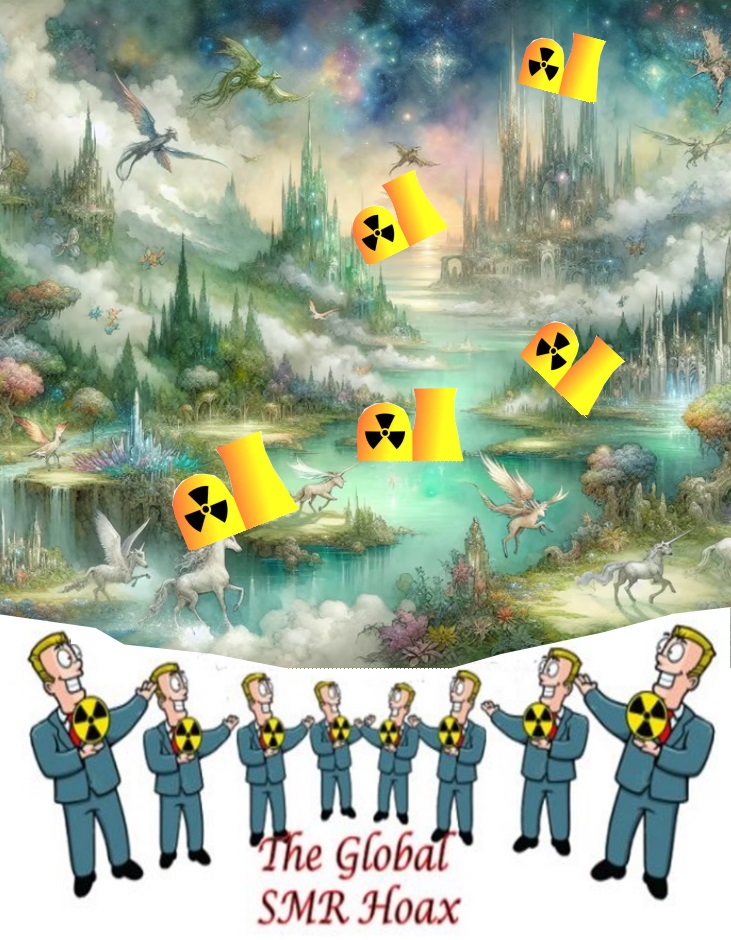
Small Nuclear Reactors Will Not Save The Day
By Leon Stille – Sep 23, 2025, https://oilprice.com/Energy/Energy-General/Small-Nuclear-Reactors-Will-Not-Save-The-Day.html
- SMR’s are being hailed as the perfect solution for large industrial power consumers.
- SMRs are currently being marketed like they’re the iPhone of nuclear energy: smarter, smaller, cheaper, scalable.
- Despite the hype, there are currently no SMR’s operating on a commercial scale.
You can feel the buzz: nuclear is back. Or so we’re told.
From Brussels to Washington, a new wave of enthusiasm for so-called Small Modular Reactors (SMRs) is sweeping through policy circles, think tanks, and energy startups. These compact, supposedly plug-and-play nuclear units are being hailed as the perfect solution to power data centers, feed artificial intelligence’s growing hunger, and backstop our energy transition with clean, stable electricity.
There’s just one problem. Actually, there are many. None of them small.
The hype cycle is in full spin
SMRs are currently being marketed like they’re the iPhone of nuclear energy: smarter, smaller, cheaper, scalable. A miracle solution for everything from remote grids to decarbonizing heavy industry and AI’s server farms. Countries like the U.S., Canada, and the UK have announced ambitious deployment plans. Major developers, including NuScale, Rolls-Royce SMR, GE Hitachi, and TerraPower, have painted glossy timelines with glowing promises.
Except the fine print tells a different story.
There are currently no operational commercial SMRs anywhere in the world. Not one. NuScale, the U.S. frontrunner, recently cancelled its flagship Utah project after costs ballooned to over $9,000 per kilowatt and no investors could be found. Even their CEO admitted no deployment would happen before 2030. Meanwhile, Rolls-Royce’s much-hyped SMR factory hasn’t produced a single bolt of steel yet.
So, we’re betting on a technology that doesn’t yet exist at commercial scale, won’t arrive in meaningful numbers before the 2030s, and would require thousands of units to significantly contribute to global energy demand. That’s not a strategy. That’s science fiction.
Big nuclear hasn’t exactly inspired confidence either
Even the large-scale projects that SMRs claim to “improve upon” are struggling. Take the UK’s Hinkley Point C, once heralded as the future of nuclear energy in Europe. It’s now twice as expensive as originally planned (over £46 billion), at least five years late, and facing ongoing construction delays. The French-backed EPR reactor design it’s based on has already been plagued with similar issues in Flamanville (France) and Olkiluoto (Finland), where completion took over a decade longer than promised and costs ballooned dramatically.
Let’s be honest: if any other energy technology was this unreliable on delivery, we’d laugh it out of the room.
Price floors for nuclear, and price ceilings for reason
In France and Finland, authorities have now agreed to guaranteed minimum prices for new nuclear power, effectively writing blank checks to ensure profitability for operators. In Finland, the recent deal sets the floor above €90/MWh for 20 years. Meanwhile, solar and wind regularly clear wholesale power auctions across Europe at €30–50/MWh, with even lower marginal costs.
Why, exactly, are we locking in decades of higher prices for a supposedly “market-based” energy future? It’s hard to see how this helps consumers, industries, or climate targets. Especially when these same nuclear plants will also require major grid upgrades, just like renewables, because any large-scale generator needs robust transmission capacity. So no efficiency win there either.
The SMR promise: too small, too late
Back to SMRs. Let’s suppose the best-case scenario plays out. A couple of designs clear regulatory approval by 2027–2028, construction starts in the early 2030s, and the first commercial units are online before 2035. Even then, the world would need to build and connect thousands of these small reactors within 10–15 years to displace a meaningful share of fossil generation. That’s a logistics nightmare, and we haven’t even discussed public acceptance, licensing bottlenecks, uranium supply, or waste management.
For perspective: in the time it takes to build a single SMR, solar, wind, and battery storage could be deployed 10 to 20 times over, for less money, with shorter lead times, and with no radioactive legacy.
And unlike nuclear, these technologies are modular today. They’re scalable now. They’ve proven themselves everywhere from the Australian outback to German rooftops and Californian substations.
The elephant in the reactor room: waste and risk
Nuclear fans love to stress how “safe” modern designs are. And yes, statistically speaking, nuclear energy is relatively safe per kilowatt-hour. But it’s also the only energy source with a non-zero risk of catastrophic failure and waste that stays toxic for thousands of years.
Why, exactly, would we take that risk when we have multiple clean energy options with zero risk of explosion and waste streams that are either recyclable or inert?
You don’t need to be a nuclear physicist to ask this: how is betting on high-cost, slow-deploying, risk-bearing, politically toxic infrastructure a better idea than wind, solar, and storage?
A footnote in the transition, not the headline
Let’s be clear: nuclear power will likely continue to play a role in some countries’ energy mixes. France and Sweden have legacy fleets. New projects may go ahead in China or South Korea, where costs are contained and planning is centralized. But for the majority of the world, especially countries trying to decarbonize fast, new nuclear is not the answer.
SMRs, despite their branding, will not save the day. They will be at best a niche, possibly a small contributor in specific applications like remote mines, military bases, or industrial clusters where no other solution works. That’s fine. But let’s stop pretending they’re some kind of energy silver bullet.
Final thoughts
We are in the decisive decade for climate action. Every euro, dollar, and yuan we invest must yield maximum emissions reduction per unit of time and cost. By that standard, SMRs fall flat. Nuclear power, small or large, is simply too expensive, too slow, too risky, and too narrow in its use case to lead the energy transition.
So let’s cool the reactor hype. Let’s focus instead on the technologies that are already winning: wind, solar, batteries, heat pumps, grid flexibility, green hydrogen. These are not dreams. They’re deploying by the gigawatt, today. SMRs are fascinating, yes. But when it comes to decarbonization, we need workhorses, not unicorns.
‘Inevitable’ that nuclear waste facility will go ahead without local consent says former minister.
Now we see it- the nuclear industry, adopted by government, will lead to fascism.
Added to the madness, governments are hell-bent on making more nuclear radioactive trash that they don’t know how to get rid of.
“However, in the case of the UK, the DESNZ’s review raises the possibility that overriding public approval could be a matter of policy.
“These developments point to a growing sense of futility and desperation, to secure both a suitable site for nuclear waste disposal and public support for it.”
23 Sep, 2025 By Tom Pashby https://www.newcivilengineer.com/latest/inevitable-that-nuclear-waste-facility-will-go-ahead-without-local-consent-says-former-minister-23-09-2025/
It is “inevitable” that the government moves away from the consent-based approach for deciding where to site the planned geological disposal facility (GDF) for nuclear waste, a former Department for Energy Security and Net Zero (DESNZ) minister has told NCE.
The comments come as reports suggest the government is considering scrapping the “consent-based” approach for siting the GDF. However, DESNZ has asserted that the reports are “wrong” and “no changes are planned to this process currently”.
The GDF is currently the only solution proposed by the government for disposing of high level nuclear waste (HLW). HLW is generated by both the civil and defence nuclear sectors
It would involve disposing of HLW in an engineered vault placed between 200m and 1km underground, covering an area of approximately 1km2 on the surface.
Work to select a GDF site should take 20 years, according to the government body responsible for the project – Nuclear Waste Services (NWS) – and a further 150 years to build, fill and close the facility.
The HLW then needs to sit and remain undisturbed for 100,000 years before its radioactivity has reduced sufficiently for people to be able to be near it. Due to the hazards associated with radioactive waste, the government has always maintained that a GDF will only be sited in a location where the local community has agreed to host it. This is known as the “consent-based” approach and it has been in discussion with a few communities for a number of years.
Consent-based approach seeing little progress over years
The “voluntary” or “consent-based” approach to deciding where to site a GDF was first proposed by the government in a White Paper published in 2008 titled Managing radioactive waste safely: a framework for implementing geological disposal.
“For the purposes of this White Paper ‘an approach based on voluntarism’ means one in which communities voluntarily express an interest in taking part in the process that will ultimately provide a site for a geological disposal facility,” the paper said.
“Initially communities will be invited to express an interest in finding out more about what hosting a geological disposal facility would mean for the community in the long term.
“Participation up until late in the process, when underground operations and construction are due to begin, will be without commitment to further stages, whether on the part of the community or government. If at any stage a community or Government wished to withdraw then its involvement in the process would stop.
“In practice, development could also be halted by the independent regulators at any point in the process through a refusal to grant authorisations for the next stage of work.”
The government further committed to the approach in 2014, when the then secretary of state for energy and climate change Ed Davey said: “The UK Government also continues to favour an approach to identifying potential sites for a GDF that involves working with communities who are willing to participate in the siting process.”
Despite having been committed to the approach for more than 10 years, NWS only has two communities it is making gradual progress with via community partnerships – Mid Copeland and South Copeland. Lincolnshire withdrew from the process in June after a change in governance.
With the government pushing for the deployment of dozens more nuclear reactors in the coming decades, the need to confirm a long-term solution for the waste is pressing – something that has been stressed to NCE by both the Nuclear Industry Association (NIA) and anti-nuclear campaigners.
Reports say Government reviewing consent-based approach
The Telegraph published a story on 22 September that claimed, based on a government source, that DESNZ had decided to review the consent-based approach to siting the GDF.
The source told the newspaper that conversations were taking place within government to consider prioritising areas with the best geology rather than areas with the most welcoming communities.
Ending the consent-based process could result in ministers effectively imposing a GDF on a community, although they would still face the standard planning and consenting obstacles, including judicial reviews from campaigners.
A DESNZ spokesperson denied the reports, saying: “Our position continues to be that any potential geological disposal facility site will be subject to agreement with the community and won’t be imposed on an area without local consent.
“Progress continues to be made, with two areas in Cumberland taking part in the siting process for this multi-billion-pound facility, which would bring thousands of skilled jobs and economic growth.”
Former minister tells NCE ‘we must get on with GDF’
Lord Hunt of Kings Heath is now a backbench Labour peer but was a DESNZ minister of state from July 2024 to May 2025. He was also an energy minister at the end of the previous Labour government from 2008 to 2010 and served in shadow front bench roles from 2010 to 2018.
“This is an inevitable approach. We must get on with GDF,” Hunt told NCE.
“It’s vital to the nuclear programme. It’s a matter of national strategic importance and should proceed on that basis.”
Reported policy change points to ‘growing sense of desperation’
Nuclear Information Service research manager Okopi Ajonye told NCE: “The prospect of the DESNZ reforming policy to override local consent for hosting a geological disposal facility is very concerning.”
“Furthermore, it mirrors developments in Australia, where efforts to secure sites for nuclear waste disposal have, just like the UK, been repeatedly stalled by local opposition.
“But critics are now concerned that recent legislation grants broad powers to the Australian government to designate any site as a nuclear waste dump, even without local or indigenous approval.”
“However, in the case of the UK, the DESNZ’s review raises the possibility that overriding public approval could be a matter of policy.
“These developments point to a growing sense of futility and desperation, to secure both a suitable site for nuclear waste disposal and public support for it.”
End to consent-based approach would ‘lead to more vociferous public resistance’
Nuclear Free Local Authorities secretary Richard Outram told NCE: “Any decision to abandon the established consent-based approach to siting a nuclear waste dump will be an admission by ministers that no community actually wants to host it.
“Proposals to site a GDF at South Holderness and Theddlethorpe were roundly defeated by massive and persistent public protests, backed by responsive local councillors.
“Opposition is also growing in South Copeland with residents impacted by the declared area of focus up in arms.”
Outram added that two local councils in the South Copeland area – Millom Town Council and Whicham Parish Council – have withdrawn their support for the process, and a third – Millom Without Parish Council – is “about to confer with parishioners about continued engagement”, he said.
He also said that the NWS community partnership was “described in a recent external review as ‘dysfunctional’ and seemingly at war with itself”.
“Replacing voluntarism with a plan to railroad such a controversial project onto an unwilling community will be a retrograde step and simply lead to more vociferous public resistance,” he added.
Government reveals to NCE it is ‘replanning’ GDF project
These latest developments add to the uncertainty that has bubbled around the GDF project in recent months.
In August, the Treasury’s National Infrastructure and Service Transformation Authority (Nista) assessed the delivery confidence of the GDF as “appears unachievable” and said the cost could be as much as £53.3bn.
Following the rating, NCE asked DESNZ via the Freedom of Information Act whether the government was responding by changing its approach to the GDF project. It said that it is “undertaking some replanning to mitigate risks and support ongoing progress” on its major projects, including the GDF.
DESNZ added: “However, a GDF will always remain necessary as there are currently no credible alternatives that would accommodate all categories of waste in the inventory for disposal.”
Nuclear industry says credible GDF plan needed for investor confidence
The Nuclear Industry Association, which represents more than 300 companies across the civil and defence nuclear supply chain, was perturbed by this uncertainty around the GDF and told NCE: “A credible, long-term policy on HLW disposal is very important. Developers need confidence that the back end of the fuel cycle is being responsibly and sustainably managed, not just for regulatory compliance but also to secure investor confidence and public trust.
“Clarity and credibility in government policy reduces uncertainty, helps de-risk new nuclear projects and ensures that developers can focus on safe, efficient generation”
Nuclear Free Local Authorities join global call on World Bank to abandon plans to back new nuclear
24th September 2025, Nuclear Free Local Authorities
The NFLAs have become a co-signatory to a petition calling on the World Bank and Asian Development Bank to abandon their plans to finance new nuclear plants.
The online petition was launched by 64 Non-Government Organisations from 25 countries and regions on 1 September/
The World Bank and the ADB are funded by governments worldwide to support economic development, poverty reduction, and enhance infrastructure. Until now, both institutions have refrained from financing nuclear power, citing nuclear proliferation, safety concerns, dealing with the intractable problem of radioactive waste, and high costs as reasons to deny funding.
However, on June 10, the World Bank’s Board of Directors decided to lift the ban on nuclear power financing. Meanwhile, the ADB is currently revising its energy policy with plans to include support for nuclear power as part of the review.
The very concerns that have caused both institutions to be cautious about financing nuclear power remain unresolved.
The petition highlights these ongoing issues and stresses that “supporting the construction of nuclear power plants in developing countries imposes serious long-term risks and enormous economic burdens on both present and future generations in those countries.”
NFLAs urge supportive NGOs and individuals to join us in signing this petition.
You are urged to go to the website: https://chng.it/G9MCKn6Gpv…………………………………….. https://www.nuclearpolicy.info/news/nflas-join-global-call-on-world-bank-to-abandon-plans-to-back-new-nuclear/
Iran publishes alleged leak of Israeli nuclear sites, experts and secret files

Itamar Eichner, Lior Ben Ari, 24 Sept 25, https://www.ynetnews.com/article/r1errtw2eg
Iran’s intelligence ministry claims Israelis leaked sensitive documents and photos for money, including details on 189 nuclear experts, images of the Dimona reactor and personal photos of IAEA chief Rafael Grossi.
Iran’s intelligence ministry on Wednesday published what it described as a large trove of “secret and classified” Israeli documents and photographs, claiming the materials were leaked by Israelis themselves.
Iranian Intelligence Minister Esmail Khatib said the documents include footage from “the Dimona reactor and Israeli nuclear facilities,” details on “upgrades to nuclear weapons,” and information on “past and present Israeli projects developed in cooperation with the United States and the European Union.” He also claimed the material contains “a full list of staff and the administrative structure of Israel’s nuclear weapons program.”
Opposition to proposed nuclear submarine base at Port Kembla, Australia

September 25, 2025 , by David Clark, https://www.wavefm.com.au/local-news/opposition-to-proposed-nuclear-submarine-base-at-port-kembla/
Forty local organisations and community groups are launching a joint Port Kembla Declaration today, opposing the establishment of a nuclear submarine base at Port Kembla.
They’re calling for the federal government to rule it out, saying the risks are far too great, the declaration has been endorsed by many organisations, including health, faith, and social justice.
Tina Smith, President of the South Coast Labour Council, said they reject the idea of turning the region into a frontline for war games or nuclear escalation.
Iran says it obtained secret files on Israel’s nuclear program

25 Sept 25, https://www.iranintl.com/en/202509242634
According to the intelligence ministry, the material demonstrated that Israeli intelligence spies “on everyone,” including the IAEA chief, and that the data it had obtained proves this claim.
Iran’s intelligence ministry aired a segment on national TV displaying information and documents that it says it obtained from Israel’s intelligence apparatus on the Jewish state’s nuclear program
The broadcast featured a series of video files that reportedly contain material from inside Israeli nuclear and other sensitive facilities, including the Dimona site. It also presented alleged details about personnel working on Israel’s nuclear program.
“We identified 189 Israeli nuclear and proliferation scientists and top officials, along with their networks,” Intelligence Minister Esmaeil Khatib said during the presentation, which included names and ID cards of alleged nuclear personnel.
“I tell Netanyahu … your employees collaborated with us for money and still do,” Khatib, a cleric and veteran military and intelligence official, added.
Israel is widely believed to have an undeclared nuclear arsenal.
Tehran’s nemesis killed nuclear scientists and hundreds of military personnel in a surprise 12-day military campaign in June, underscoring Iranian intelligence failures.
Iran has said it too has infiltrated its enemy, and Israel has arrested several of its citizens on charges of spying for Tehran.
One alleged employee was introduced with a photo and described as working across seven Israeli nuclear sites under the cover of a company called ROTEM.
Another was identified as a nuclear scientist allegedly involved in “proliferation projects” between Israel and the United States.
It also mentioned the Chaim Weizmann laboratory, which it described as Israel’s leading proliferation program and was targeted by Iranian ballistic missiles during a 12-day war in June.
Additional documents shown in the broadcast suggested alleged nuclear cooperation between Israel and France under a project called SARAF.
One batch of the alleged material included private and family photos of International Atomic Energy Agency (IAEA) Director General Rafael Grossi it alleged was obtained from Israeli intelligence sources.
The video, published on Tasnim’s Telegram channel, showed images of Grossi with his family at Disneyland, at home during birthdays and in gatherings with colleagues and friends.
According to the intelligence ministry, the material demonstrated that Israeli intelligence spies “on everyone,” including the IAEA chief, and that the data it had obtained proves this claim.
Iran, U.S. signal possible easing in nuclear tensions

By Parisa Hafezi and John Irish, September 25, 2025 https://www.reuters.com/world/middle-east/irans-president-tells-un-tehran-will-never-seek-build-nuclear-bomb-2025-09-24/
- Summary
- Iran president speaking at U.N. General Assembly
- Gaps remain between Iran and E3 as deadline looms
- European powers offering delay if Iran makes concessions
UNITED NATIONS, Sept 24 (Reuters) – Tehran and Washington signalled a possible softening in nuclear tensions on Wednesday, with Iran insisting it has no ambitions to build nuclear weapons and the U.S. expressing readiness to resume talks aimed at resolving the long-standing standoff.
A few hours after Iranian President Masoud Pezeshkian told the U.N. General Assembly that Iran will never seek to build a nuclear bomb, U.S. President Donald Trump’s Middle East Envoy Steve Witkoff said “we have no desire to hurt them”.
“We’re talking to them. And why wouldn’t we? We talk to everybody. As well we should. That’s the job. Our job is to solve things,” he told the Concordia summit in New York.
Prior to a 12-day war between Iran and Israel in June, Tehran and Washington held five rounds of nuclear talks but faced major stumbling blocks such as uranium enrichment on Iranian soil, which Western powers want to bring down to zero to minimise any risk of weaponisation.
Tehran accuses Washington of “betraying diplomacy” and the nuclear talks have stopped since the war.
One Iranian insider told Reuters that “several messages have been conveyed to Washington for resumption of talks via mediators in the past weeks, but Americans have not responded”.
On Tuesday, Iran’s Supreme Leader Ayatollah Ali Khamenei, who has the last say on key state matters such as foreign policy and Iran’s nuclear programme, ruled out negotiations with the United States under threat.
The United States, its European allies and Israel accuse Tehran of using its nuclear programme as a veil for efforts to try to develop the capability to produce weapons. Iran says its nuclear programme is for peaceful purposes only.
‘A FEW HOURS LEFT’
Britain, France and Germany on August 28 launched a 30-day process to reimpose U.N. sanctions – known as snapback – that ends on September 27, accusing Tehran of failing to abide by a 2015 deal with world powers aimed at preventing it from developing a nuclear weapon.
The European powers have offered to delay reinstating sanctions for up to six months to allow space for talks on a long-term deal if Iran restores access for U.N. nuclear inspectors, addresses concerns about its stock of enriched uranium, and engages in talks with the United States.
“I think we have a desire, however, to either realize a permanent solution and negotiate around snapbacks, and if we can’t, then snapbacks will be what they are. They’re the right medicine for what’s happening,” Witkoff said.
But amid the looming threat of sanctions and last-ditch talks between Tehran and European powers to reach a deal to avert snapback of sanctions, diplomats have warned the chances of success remain slim.
After meeting his Iranian counterpart on the sidelines of the UN General Assembly, French President Emmanuel Macron said Iran still had a chance to prevent reimposition of international sanctions, adding that Tehran had not offered anything tangible.
“An agreement is still possible. There are only a few hours left. It is up to Iran to meet the legitimate conditions we have set,” Macron posted on X.
Two European diplomats told Reuters that Iran, the E3 and the EU held a fresh round of talks on Wednesday.
DEADLINE ON SATURDAY
If Tehran and the E3 fail to reach a deal on an extension by the end of September 27, then all U.N. sanctions will be reimposed on Iran, where the economy already struggles with crippling sanctions reimposed since 2018 after Trump ditched the pact during his first term.
The so-called snapback process would reimpose an arms embargo, a ban on uranium enrichment and reprocessing, a ban on activities with ballistic missiles capable of delivering nuclear weapons, a global asset freeze and travel bans on Iranian individuals and entities.
Writing by Parisa Hafezi, Editing by Michelle Nichols, Hugh Lawson, Alison Wiliams and Daniel Wallis
Israel launches drone attack against “terrorist flotilla” after discovering it was trying to feed starving Palestinians
Laura and Normal Island News, Sep 24, 2025, https://www.normalisland.co.uk/p/israel-launches-drone-attack-against?utm_source=post-email-title&publication_id=1407757&post_id=174430619&utm_campaign=email-post-title&isFreemail=true&r=ln98x&triedRedirect=true&utm_medium=email
Israel was left with no choice but to launch a drone attack against a flotilla in international waters after discovering it was trying to feed starving Palestinians.
The Global Sumud Flotilla is composed of 50 boats from 44 countries across four continents. It is carrying renowned terrorist leaders Greta Thunberg and Tadgh Hickey, as well as deadly items such as food and medicine.
The Israel Foreign Ministry called out the flotilla’s “violent course of action” and “mission to serve Hamas, rather than the people of Gaza”. Needless to say, trying to feed starving children is a crime against Zionism.
This is one of those rare occasions when it is not antisemitic to accuse Israel because they’re not exactly denying it. Experience tells us that being honest about these things is simpler because the lies make us look like fucking idiots.
Last time around, we mocked Greta’s “selfie yacht”, but this time, the flotilla is bigger and therefore requires a change of language. Remember when we pretended the drone attack was just a flare that was fired by the crew and came back down on the boat? This time the drone attacks are so obvious, we’ve had to stop pretending.
By placing the terrorist label on the flotilla, Israel has given itself permission to kill whoever it likes, and it certainly likes killing people. Israel has made a habit of murdering humanitarian workers throughout this genocide, due to the risk they could save Palestinian lives.
While Israel has not yet succeeded in killing anyone aboard the flotilla, it could not resist the opportunity to attack such helpless targets. It dropped chemicals on two boats with a drone – a move that would be absolutely pointless, unless the chemicals were toxic.
Israel reportedly hit the other boats with “sound bombs” and “explosive flares”. Sensibly, Israel jammed their radios so they could not call for help. It even hacked those radios and played Abba songs to mock Greta. What do you mean, that is “small dick energy”?
Drones are continuously passing over the boats, leaving the crews guessing when they will next be attacked. The drone operators find this sort of thing amusing. The only thing they find more amusing is blowing up civilians in aid queues.
While the flotilla is still in international waters, it is currently heading for Palestinian waters. Armchair legal experts insist Israel also has no jurisdiction there, but maritime law clearly states Israel can do whatever the fuck it wants.
Thirteen British nationals are travelling with the flotilla, so naturally, the prime minister hasn’t offered a word of solidarity. You will be reassured to hear that Israel has the full consent of the British government to murder our citizens.
Keir Starmer has held an emergency meeting to see what his excuse will be if Israel sinks a British vessel and murders everyone on board. One of those people is RAF veteran Malcolm Ducker and another is army veteran Greg Stoker. If it comes to siding with our military or theirs, the British government is obviously going to choose Israel. Isn’t that lovely? x
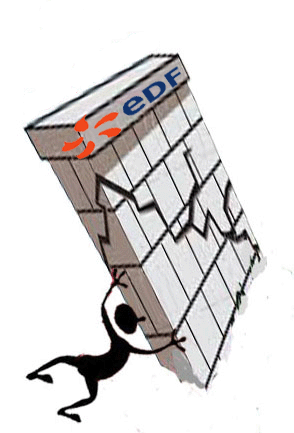
While EDF must invest 460 billion euros over 15 years, its economic model is taking on water.
P.La. with AFP, BFMTV 23rd Sept 2025 https://www.bfmtv.com/economie/entreprises/energie/alors-qu-edf-doit-investir-460-milliards-d-euros-en-15-ans-son-modele-economique-prend-l-eau_AD-202509240079.html
The Court of Auditors has issued a warning about the economic situation of the French energy company, now 100% state-owned. A wall of investment is looming to maintain and renew the group’s nuclear fleet.
The French Court of Auditors is concerned about the financial prospects of the public energy company EDF, calling for “a clear distribution of the financial effort” between the State, EDF and customers, in a report addressed to the Finance Committee of the National Assembly and consulted on Tuesday, September 24.
In this report, first revealed by the media
Contexte , the institution responsible for monitoring the proper use of public funds observes that EDF is “faced with significant uncertainties over its long-term financing capacity”, while it faces investment needs reaching 460 billion euros between 2025 and 2040.
In this context, “EDF’s financing model should, in order to preserve a sustainable financial trajectory for the group, be defined based on a clear distribution of the financial effort between the State, now the sole shareholder, EDF and the end customers,” the magistrates believe.
In detail, EDF plans to allocate 90 billion euros to the maintenance and extension of the existing nuclear fleet, 115 billion euros for the construction of 14 EPR 2 (including 75 for the first six), 15 billion euros for the hydraulic fleet and more than 100 billion euros for the Enedis network, manager of the electricity distribution network.
No more hazards
At the same time, EDF’s profitability will be more exposed “to the vagaries of changes in electricity market prices”, with the end of the regulated system known as Arenh , planned for the end of 2025. EDF intends to replace this system with medium and long-term contracts with electricity suppliers and companies, including high-energy industrial ones.
The Court of Auditors also notes that EDF’s ability to invest will be conditioned “by the operational performance of the nuclear fleet and the success of extending its lifespan.”
The body then recommends “setting, prior to the final investment decision on the EPR2 program, the terms of risk sharing between the State and EDF.” EDF’s final estimate for its EPR2 program should be known at the end of the year.
The Court of Auditors also calls for clarification of the dividend policy that will be applied to EDF and recommends that the group “conduct a strategic review of investments, holdings and subsidiaries.”
Total or partial sales of holdings and subsidiaries would constitute “a financing lever for the group’s investment program,” particularly “in the most unfavorable price scenarios,” argue the magistrates of the Court of Auditors.
1 This Month

of the week – Shut Down Drone Warfare!


Tell the Ukrainian Government to Drop Prosecution of Peace Activist Yurii Sheliazhenko

Petition to revoke the licensing of the Near Surface Nuclear Disposal Facility (NSDF) at Chalk River. https://www.ourcommons.ca/petitions/en/Petition/Details?Petition=e-7247
To see nuclear-related stories in greater depth and intensity – go to https://nuclearinformation.wordpress.com
-
Archives
- April 2026 (79)
- March 2026 (251)
- February 2026 (268)
- January 2026 (308)
- December 2025 (358)
- November 2025 (359)
- October 2025 (376)
- September 2025 (257)
- August 2025 (319)
- July 2025 (230)
- June 2025 (348)
- May 2025 (261)
-
Categories
- 1
- 1 NUCLEAR ISSUES
- business and costs
- climate change
- culture and arts
- ENERGY
- environment
- health
- history
- indigenous issues
- Legal
- marketing of nuclear
- media
- opposition to nuclear
- PERSONAL STORIES
- politics
- politics international
- Religion and ethics
- safety
- secrets,lies and civil liberties
- spinbuster
- technology
- Uranium
- wastes
- weapons and war
- Women
- 2 WORLD
- ACTION
- AFRICA
- Atrocities
- AUSTRALIA
- Christina's notes
- Christina's themes
- culture and arts
- Events
- Fuk 2022
- Fuk 2023
- Fukushima 2017
- Fukushima 2018
- fukushima 2019
- Fukushima 2020
- Fukushima 2021
- general
- global warming
- Humour (God we need it)
- Nuclear
- RARE EARTHS
- Reference
- resources – print
- Resources -audiovicual
- Weekly Newsletter
- World
- World Nuclear
- YouTube
-
RSS
Entries RSS
Comments RSS
 nuclear-news