What’s In a Name? The “Defense” Department Has Always Been About War.
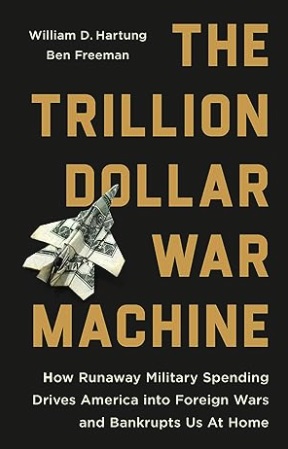
Washington reserves for itself the unilateral right to intervene, violently and antidemocratically, in the affairs of other nations to secure what it considers its interests.
The reversion of the Defense Department to the War Department should be seen less as a rupture than a revelation. It strips away a euphemism to make far plainer what has long been the reality of our world.
Tom Dispatch, By Eric Ross, September 18, 2025
The renaming of the Defense Department should have surprised no one. Donald Trump is an incipient fascist doing what such figures do. Surrounded by a coterie of illiberal ideologues and careerist sycophants, he and his top aides have dispensed with pretense and precedent, moving at breakneck speed to demolish what remains of the battered façade of American democracy.
In eight months, his second administration has unleashed a shock-and-awe assault on norms and institutions, civil liberties, human rights, and history itself. But fascism never respects borders. Fascists don’t recognize the rule of law. They consider themselves the law. Expansion and the glorification of war are their lifeblood. Italian fascist leader Benito Mussolini put it all too bluntly: the fascist “believes neither in the possibility nor the utility of perpetual peace… war alone brings up to its highest tension all human energy and puts the stamp of nobility upon the peoples who have courage to meet it.”
Pete Hegseth is now equally blunt. From the Pentagon, he’s boasting of restoring a “warrior ethos” to the armed forces, while forging an offensive military that prizes “maximum lethality, not tepid legality. Violent effect, not politically correct.” The message couldn’t be clearer: when the U.S. loses wars, as it has done consistently despite commanding the most powerful military in history, it’s not due to imperial overreach, political arrogance, or popular resistance. Rather, defeat stems from that military having gone “woke,” a euphemism for failing to kill enough people.
The recent rechristening of the Department of Defense as the Department of War was certainly a culture-war stunt like Trump’s demand that the Gulf of Mexico be renamed the Gulf of America. But it also signaled something more insidious: a blunt escalation of the criminal logic that has long underwritten U.S. militarism. That logic sustained both the Cold War of the last century and the War on Terror of this one, destroying millions of lives.
When Hegseth defended the recent summary executions of 11 alleged Venezuelan drug smugglers on a boat in the Caribbean, he boasted that Washington possesses “absolute and complete authority” to kill anywhere without Congressional approval or evidence of a wrong and in open defiance of international law. The next day, in responding on X to a user who called what had been done a war crime, Vance wrote, “I don’t give a shit what you call it.” It was the starkest admission since the Iraq War that Washington no longer pretends to operate internationally under the rule of law but under the rule of force, where might quite simply makes right.
While such an escalation of verbiage — the brazen confession of an imperial power that believes itself immune from accountability — should alarm us, it’s neither unprecedented nor unexpected. Peace, after all, has never been the profession of the U.S. military. The Department of Defense has always been the Department of War.
American Imperialism and “Star-Spangled Fascism”
The U.S. has long denied being an empire. From its founding, imperialism was cast as the antithesis of American values. This nation, after all, was born in revolt against the tyranny of foreign rule. Yet for a country so insistent on not being an empire, Washington has followed a trajectory nearly indistinguishable from its imperial predecessors. Its history was defined by settler conquest, the violent elimination of Indigenous peoples, and a long record of covert and overt interventions to topple governments unwilling to yield to American political or economic domination.
The record is unmistakable. As Noam Chomsky once put it, “Talking about American imperialism is like talking about triangular triangles.” And he was hardly the first to suggest such a thing. In the 1930s, General Smedley Butler, reflecting with searing candor on his years of military service in Latin America, described himself as “a racketeer, a gangster for capitalism… I helped make Mexico, especially Tampico, safe for American oil interests… I helped make Haiti and Cuba a decent place for the National City Bank boys to collect revenues in. I helped in the raping of half a dozen Central American republics for the benefit of Wall Street.”
Historically, imperialism and fascism went hand in hand. As Aimé Césaire argued in his 1950 Discourse on Colonialism, fascism is imperialism turned inward. The violence inherent in colonial domination can, in the end, never be confined to the colonies, which means that what we’re now witnessing in the Trumpian era is a reckoning. The chickens are indeed coming home to roost or, as Noura Erakat recently observed, “The boomerang comes back.”……………………………………………………………
Imperialism incubates fascism, a dynamic evident in the carnage of World War I, rooted, as W.E.B. DuBois observed at the time, in colonial competition that laid the foundations for World War II. In that conflict, Césaire argued, the Nazis applied to Europe the methods and attitudes that until then were reserved for colonized peoples, unleashing them on Europeans with similarly genocidal effect.
War is Peace
In the postwar years, the United States emerged from the ruins of Europe as the unrivaled global hegemon. With some six percent of the world’s population, it commanded nearly half of the global gross domestic product. Anchored by up to 2,000 military bases across the globe (still at 800 today), it became the new imperial power on which the sun never set. Yet Washington ignored the fundamental lesson inherent in Europe’s self-cannibalization. Rather than dismantle the machinery of empire, it embraced renewed militarism. Rather than demobilize, it placed itself on a permanent global war footing, both anticipating and accelerating the Cold War with that other great power of the period, the Soviet Union.
The United States was, however, a superpower defined as much by paranoia and insecurity as by military and economic strength. It was in such a climate that American officials moved to abandon the title of the Department of War in 1947, rebranding it as the Department of Defense two years later. The renaming sought to reassure the world that, despite every sign the U.S. had assumed the mantle of European colonialism, its intentions were benign and defensive in nature………………………………………………………………………….
“The Greatest Purveyor of Violence”
As with the CIA, the not-so-aptly-renamed “Defense Department” would oversee a succession of catastrophic wars that did nothing to make Americans safer and had little to do with the protection of democratic values. Within a year of its renaming, the U.S. was at war in Korea. When the North invaded the South in 1950, seeking to reunify a peninsula divided by foreign powers, Washington rushed to intervene, branding it a “police action,” the first of many Orwellian linguistic maneuvers to sidestep the constitutional authority of Congress to declare war………………………………………………………………………………………………………………………………………………..
Washington reserves for itself the unilateral right to intervene, violently and antidemocratically, in the affairs of other nations to secure what it considers its interests. The reversion of the Defense Department to the War Department should be seen less as a rupture than a revelation. It strips away a euphemism to make far plainer what has long been the reality of our world.
We now face a choice. As historian Christian Appy has reminded us, “The institutions that sustain empire destroy democracy.” That truth is unfolding before our eyes. As the Pentagon budget tops one trillion dollars and the machinery of war only expands in Donald Trump’s America, the country also seems to be turning further inward. Only recently, President Trump threatened to use Chicago to demonstrate “why it is called the Department of War.” Meanwhile, U.S. Customs and Immigration Enforcement, or ICE, is set to become among the most well-funded domestic “military” forces on the planet and potentially the private paramilitary of an aspiring autocrat.
If there is any hope of salvaging this country’s (not to speak of this planet’s) future, then this history has to be faced, and we must recover — or perhaps discover — our moral bearings. That will require not prolonging the death throes of American hegemony, but dismantling imperial America before it collapses on itself and takes us all with it.
Eric Ross is an organizer, educator, and PhD candidate in the history department at the University of Massachusetts Amherst https://tomdispatch.com/whats-in-a-name/
No comments yet.
1 This Month
10 March A LIVE WEBINAR THE REAL EFFECTS OF NUCLEAR POWER
What the Industry Isn’t Telling Us
1:00 PM Mountain, 2 pm Central, 3 pm Eastern. Live on the Keepers of the Water Facebook page



18 March Webinar @ 1 PM EST: An Assessment of SMR Projects: The Case of Canada
register for the zoom:
https://us02web.zoom.us/webinar/register/WN_o8BIIOUvQ2ONJR1nta65DQ#/registration


of the week – STOP SMALL MODULAR REACTORS IN CANADA
To see nuclear-related stories in greater depth and intensity – go to https://nuclearinformation.wordpress.com
-
Archives
- March 2026 (109)
- February 2026 (268)
- January 2026 (308)
- December 2025 (358)
- November 2025 (359)
- October 2025 (376)
- September 2025 (258)
- August 2025 (319)
- July 2025 (230)
- June 2025 (348)
- May 2025 (261)
- April 2025 (305)
-
Categories
- 1
- 1 NUCLEAR ISSUES
- business and costs
- climate change
- culture and arts
- ENERGY
- environment
- health
- history
- indigenous issues
- Legal
- marketing of nuclear
- media
- opposition to nuclear
- PERSONAL STORIES
- politics
- politics international
- Religion and ethics
- safety
- secrets,lies and civil liberties
- spinbuster
- technology
- Uranium
- wastes
- weapons and war
- Women
- 2 WORLD
- ACTION
- AFRICA
- Atrocities
- AUSTRALIA
- Christina's notes
- Christina's themes
- culture and arts
- Events
- Fuk 2022
- Fuk 2023
- Fukushima 2017
- Fukushima 2018
- fukushima 2019
- Fukushima 2020
- Fukushima 2021
- general
- global warming
- Humour (God we need it)
- Nuclear
- RARE EARTHS
- Reference
- resources – print
- Resources -audiovicual
- Weekly Newsletter
- World
- World Nuclear
- YouTube
-
RSS
Entries RSS
Comments RSS
 nuclear-news
Leave a comment