Plutonium, Public Money and a Perilous Nuclear Dump on the Lake District Coast, a Letter to Cumberland Council’s “Nuclear Issues Board”

By mariannewildart, https://mariannewildart.wordpress.com/2025/09/19/plutonium-public-money-and-a-perilous-nuclear-dump-on-the-lake-district-coast-a-letter-to-cumberland-councils-nuclear-issues-board/
Sent by Email 19th September 2025
For consideration by the Nuclear Issues Board
of Cumberland Council on Monday 22nd Sept 2025
Dear Nuclear Issues Board of Cumberland Council,
On 14 October 2021, Copeland Borough Council’s Executive of just four councillors took the decision to establish two Geological Disposal Facility (GDF) Community Partnerships in accordance with the UK Government’s “GDF siting process”
West Cumbria is predictably the only consideration by NWS as a potential site for a GDF (also known as a nuclear waste dump for the abandonment of high level wastes).
A lot has changed since those four Copeland councillors put forward the Lake District coast as a sacrifice zone for the UK’s nuclear waste geological disposal plan.
We urge the Nuclear Issues Board to exercise their democratic duty and call for a debate by the Full Cumberland Council and a Full vote before going any further in the partnership with Nuclear Waste Services for delivery of a very deep, very hot and very experimental nuclear waste dump for high level wastes.
There is no democratic mandate to continue in partnership with Nuclear Waste Services in delivery of a GDF for the following reasons:
Community Unwillingness.
Despite the ongoing Community Partnership funding, Millom Town Council and Whicham Parish Council have both withdrawn from the South Copeland Community Partnership. Whicham PC also held a parish poll that clearly indicated a 77% majority against the GDF . Millom Without Parish Council will be consulting its parishioners on withdrawal. An external review of the SCCP also found the Partnership to be totally dysfunctional with infighting between community representatives and NWS staff.
The Community of Seascale within the Mid-Copeland Community Partnership have also voiced opposition. Seascale Parish Council talked about GDF’s potential area of focus for Headworks and were shown a map of a potential area for Seascale: “as a Parish Council we rejected the proposal as it was not suitable for Seascale at all, but there needs to be more that just our voice, attached is a map of the proposed Headworks location for Seascale.. We encourage residents to attend these events with GDF and voice their concerns too.
” It is ironic, given the above, that one of the Copeland (now Cumberland) councillors who took the delegated decision to ‘volunteer’ the West Cumbrian coastline once again into the nuclear dump plan is Vice chair of Seascale Parish Council.
It is clear that previous geological work, public inquiries and Cumbria County Council resolutions on this subject are being ignored in order to proceed with a clearly unwanted, expensive, ultimately public money and time wasting project once more, casting known and unknown blight on communities for decades to come. As Martin Lowe of Close Capenhurst has observed “Cumberland Council have a duty of care to the public which this development flies in the face of.”
Increase of the mine footprint from 25km2 to 36km2 since Copeland Executive volunteered the Lake District coast.
Initially NWS literature stated that the mine footprint would be 25km2. A letter to Lakes Against Nuclear Dump from Nuclear Waste Services states that the footprint would now be 36km2 (or larger).
Increase in heat of the “thermal footprint” of the GDF from 100 degrees c to 200 degrees c.
100 degrees c is the maximum heat “allowed” to try to ensure integrity of the bentonite buffer (clay slurry to be pumped into the mine as backfill and to delay leakage), however the thermal footprint has been increased to 200 degrees c as confirmed in a letter to Lakes Against Nuclear Dump from Nuclear Waste Services.
Inclusion of Plutonium along with High Level Wastes.
The inclusion of plutonium for burial in a GDF is a new, experimental and dangerous concept. There are unresolved (and likely unresolvable) difficulties of containing the radiotoxic nature and criticality of plutonium in a geological disposal facility.
“The problems of criticality and toxicity to the biosphere essentially come down to water—it creates the conditions for potential criticality and provides the transport mechanism for plutonium’s toxicity.” (Plutonium—the complex and ‘forever’ radiotoxic element of nuclear waste. How exactly should we manage its containment? Nick Scarr 22/08/25).
Top geologists call the plan “dangerous”
– this is why…
Professor Stuart Haszeldine, Professor of Carbon Capture and Storage, School of Geosciences Edinburgh Climate Change Institute said: “Making waste into specialised solid compounds can help to become more resistant to dissolution in groundwater. But the heat generated from the radioactive decay of isotopes is not affected by that re-engineering. Adding material which may heat to 100-200C is a huge disruption and will undoubtedly change the pathways of groundwater flow. This is like having an electric kettle containing stable stationary water and then turning on the electricity to add heat – the water soon circulates and if heating continues, the water boils.”
Professor Haszeldine added: “Have the developers actually made computer predictions of these effects in this GDF? Because plutonium has isotopes which can last for thousands of years, it may be sensible to spread that through the GDF to minimise heating – but that will make predictions of containment in circulating hot water much more difficult. It’s perfectly reasonable to think of a 150C-200C heat source at 0.5km, producing a geyser of boiling water intermittently erupting at surface temperatures above boiling.”
The spread of this increased temperature, known as a thermal pulse, would be conducted through the rock over several thousand years. With the additional pressure of water column above the GDF (a hypothetical 500m below the surface), water would boil at the higher temperature of 250C, in which case superheated steam may also occur. There is currently no guarantee that the maximum heat of the GDF will remain at 200C.
Even a 1.0C increase in ocean water [ii]can cause ‘massive impacts’ on the health of sea life and contribute to marine desertification, including loss of biodiversity, collapse of fisheries, and accelerated climate change. The proposed GDF is planned to be at least 37 km3, a substantial section of seabed under the Irish Sea, in a Marine Protected Area. Similar to nature reserves or SSSIs, Marine Protected Areas are parts of the ocean established to protect habitats, species and healthy, functioning marine ecosystems. Professor Haszeldine pointed out that seeps of warm or hot waterfrom a GDF onto the seabed are unlikely to stabilise, repair, and rewild the natural seabed ecosystems.
Professor David K. Smythe, Emeritus Professor of Geophysics, University of Glasgow, said he agreed with Professor Haszeldine about the danger of trying to bury High Level Waste, whether it was conditioned or not. “The waste should be kept on the surface of the earth, and immobilised beyond any possibility of re-use, until a proper long-term solution is found.”
For all these reasons and many more, thousands of people including hundreds of Cumbrians have signed a pettion calling for the full Cumberland Council to debate and vote before going any further in the partnership with Nuclear Waste Services for delivery of an experimental and uniquely dangerous plan to abandon nuclear wastes.
We urge the Nuclear Issues Board to exercise their democratic duty and call for a full debate and vote by Cumberland Council. Currently there is no democratic mandate to continue with the GDF “process” without at least carrying out a full debate and full vote by all Cumberland Councillors
Yours sincerely,
Marianne Birkby, Lakes Against Nuclear Dump, a Radiation Free Lakeland campaign
Richard Outram, Secretary of the UK/Ireland Nuclear Free Local Authorities (NFLAs)
No comments yet.
1 This Month
To see nuclear-related stories in greater depth and intensity – go to https://nuclearinformation.wordpress.com/
12 February – Webinar The Big Push: New Nuclear Projects in Canada
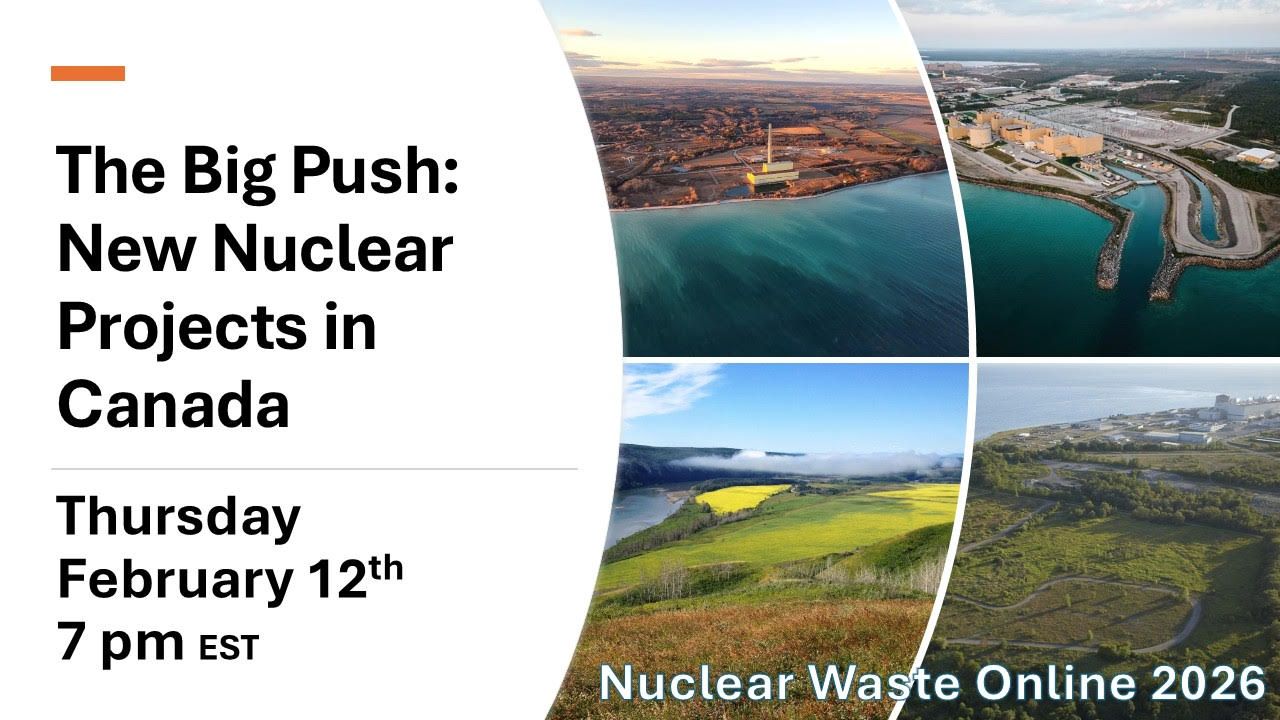
Thursday, February 12, 7 pm Eastern | 2nd of 4 sessions in the 2026 Nuclear Waste Online webinar series
Join a webinar on the push for new nuclear generation in Canada. Go to Northwatch.org to register or use the registration link https://us02web.zoom.us/webinar/register/WN_ZfWOf1GITqSRIZX8CB-A9w
-
Archives
- February 2026 (115)
- January 2026 (308)
- December 2025 (358)
- November 2025 (359)
- October 2025 (376)
- September 2025 (258)
- August 2025 (319)
- July 2025 (230)
- June 2025 (348)
- May 2025 (261)
- April 2025 (305)
- March 2025 (319)
-
Categories
- 1
- 1 NUCLEAR ISSUES
- business and costs
- climate change
- culture and arts
- ENERGY
- environment
- health
- history
- indigenous issues
- Legal
- marketing of nuclear
- media
- opposition to nuclear
- PERSONAL STORIES
- politics
- politics international
- Religion and ethics
- safety
- secrets,lies and civil liberties
- spinbuster
- technology
- Uranium
- wastes
- weapons and war
- Women
- 2 WORLD
- ACTION
- AFRICA
- Atrocities
- AUSTRALIA
- Christina's notes
- Christina's themes
- culture and arts
- Events
- Fuk 2022
- Fuk 2023
- Fukushima 2017
- Fukushima 2018
- fukushima 2019
- Fukushima 2020
- Fukushima 2021
- general
- global warming
- Humour (God we need it)
- Nuclear
- RARE EARTHS
- Reference
- resources – print
- Resources -audiovicual
- Weekly Newsletter
- World
- World Nuclear
- YouTube
-
RSS
Entries RSS
Comments RSS
 nuclear-news
Leave a comment