The dangerous new Washington consensus for more nuclear weapons
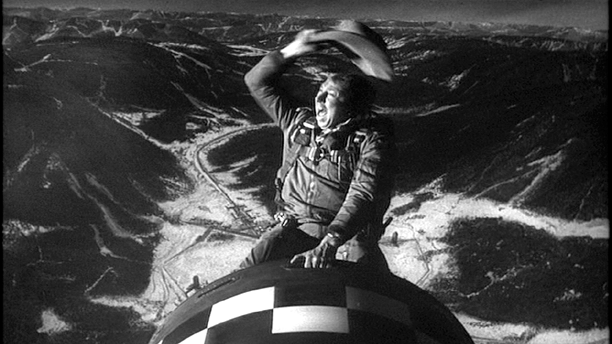
What are all these nuclear weapons for? What would happen if we used them? Or a fraction of them? How many would die? Would our nation survive? What would be the impact on global climate?
These are topics that are assiduously avoided by nuclear weapons proponents,
“We’re going to go on offense, not just on defense. Maximum lethality, not tepid legality. Violent effect, not politically correct.”
By Joe Cirincione | September 9, 2025
Two former Biden administration defense officials warn of a “Category 5 hurricane of nuclear threats” rapidly approaching. Their solution? Build more nuclear weapons.
The officials, Vipin Narang and Pranay Vaddi, develop their strategy in a July 17 article in Foreign Affairs. From their perches at the Department of Defense and the National Security Council, they helped guide President Joe Biden’s nuclear policies that kept—and even increased—the weapons programs and budgets inherited from the first Trump administration. Now, they say, we need more.
Much more.
Attempting to chart a course for “how to survive the new nuclear age,” they instead repeat the oldest strategic mistake of the nuclear age: seeking security through numbers.
Eighty years ago, before the bombings of Hiroshima and Nagasaki, a team of Manhattan Project scientists led by James Franck and Eugene Rabinowitz (who would later found The Bulletin of the Atomic Scientists) warned that the United States could not rely on its current advantage in atomic weaponry. Nuclear research would not remain an American monopoly for long. Staying ahead in production, they said, also gave a false sense of security: “The accumulation of a larger number of bigger and better atomic bombs… will not make us safe from sudden attack.”
They were ignored. During its first nuclear build-up, the United States sprinted from two atomic weapons in 1945 to 20,000 atomic and thermonuclear weapons by 1960, over twenty times the number of weapons held by the Soviet Union. It didn’t matter. We were ahead but afraid, with false fears of “missile gaps” dominating security debates.
Twenty years later, with the US arsenal at 24,000 warheads and the Soviets with 30,000, Ronald Reagan was swept into office with the backing of the Committee on the Present Danger and their fears that a “window of vulnerability” was opening that would allow the Soviets to launch a deadly first strike unless we vastly increased our forces. Committee members filled top defense posts and began the second nuclear build-up with new weapons and the false promise of missile defense shields. The “launch on warning” policy they adopted on an “interim basis” to protect US ICBMs from Russian attack still haunts us today, argues Princeton professor Frank von Hippel. This policy has contributed to several close calls when missiles were almost mistakenly launched.
Narang and Vaddi channel these past prophets of doom. The authors cite nuclear programs in North Korea, Pakistan, and Iran as justification for increasing the size of the US arsenal, largely ignoring diplomatic efforts that in the past effectively contained some of these programs and prevented others.
They also cite the interest of US allies in Europe and Asia in considering their own national nuclear programs as a proliferation risk that can only be addressed by “more, different, and better nuclear capabilities” and “more advanced missile defense… to intercept small or residual adversary nuclear forces.” They argue that if confronted by nuclear threats in Europe in the near future, “the United States might need to respond with nuclear use, and potentially with a larger nuclear exchange if it is unable to reestablish nuclear deterrence in Europe.”…………………………….
They fully endorse the third nuclear build up now underway, with an estimated cost of $2 trillion and rising. But it is not enough. “Washington needs to deploy not only more warheads but also more systems than originally planned under the modernization program,” they urge.
It is true that China’s force may grow, but as experts at the Federation of American Scientists point out, these projections are based on some questionable assumptions, including that future growth will follow recent growth on a straight line, that all the ICBM silos that we observe will be filled by new missiles, that China will be able to produce enough plutonium for all these new warheads, and that all the new warheads will be operational and deployed—which they currently are not.
Secondly, the authors understate the current US nuclear arsenal, which is more than 3,700 operational warheads, not 1,500. The United States currently has about 1,770 nuclear weapons deployed. (The New START treaty counts only 1,550 because it assumes each US bomber is loaded with only one weapon rather than the 8 to 20 they can carry.)
But that is only the deployed force. Approximately 1,930 nuclear warheads are held in reserve, ready to be deployed if needed. Finally, there are 1,477 retired but still intact warheads awaiting dismantlement—making for a total of more than 5,177 warheads in all, including those deployed, those on reserve, and those which are formally retired but intact. So, even if China does produce 1,500 weapons in ten years, it will still have only one-third the US force.
The real problem with the authors’ analysis, however, is not threat exaggeration or funny numbers. It is the war-fighting doctrine that it openly embraces.
What are all these nuclear weapons for? What would happen if we used them? Or a fraction of them? How many would die? Would our nation survive? What would be the impact on global climate?
These are topics that are assiduously avoided by nuclear weapons proponents, whether they be the corporations that realize large profits from the now $100 billion annual nuclear budget, or by the academics and policy operatives who provide the strategic justification for the indefinite continuation of the nuclear balance of terror.
Thus, the authors say “Congress will need to back an accelerated effort to overhaul the U.S. arsenal with significant funding and give the project urgent priority” because in addition to the standard rational that the United States must maintain a large nuclear arsenal “able to survive a first strike and impose assured destruction on its attacker in retaliation,” they argue the US must have weapons and policies “to meaningfully limit the amount of damage the attacker can inflict on the United States and its allies. To do this, the United States must maintain the capability to destroy as many of the attacker’s nuclear weapons as practicable before or after they are launched.”
This “damage limitation” strategy is key to the argument for larger forces. The authors seem to favor using US nuclear weapons first, to destroy the enemy’s weapons “before” they are launched, as well as believing without evidence that there could be a national missile defense system so effective that it could destroy missiles “after” their launch.
Former dean of the Georgetown University School of Foreign Affairs Robert Gallucci writes in his brief rebuttal to the authors: “One is left to wonder how the pursuit of all the ‘counterforce’ capability required of the second part of the strategy—an extraordinary characterization of the traditional goal of ‘damage limitation’ laid out in past U.S. nuclear posture reviews—can be distinguished from the pursuit of a disarming, preemptive, ‘first strike’ capability.”
Indeed, that is precisely what may be motivating the Chinese increases that the authors claim as the justification for an urgent US build-up. Narang and Vaddi do not discuss the impact on other nations of the massive US investment in offensive and defensive nuclear systems over the past ten years, or its withdrawal form the Anti-Ballistic Missile Treaty in 2002 that began the deterioration of the arms control regime.
From the Chinese perspective, however, the new, more capable and proliferated offensive nuclear weapons (especially those close to their borders) must indeed appear to be first-strike weapons, particularly when combined with a massive proposed national missile defense system erected to intercept any missiles not destroyed by an initial barrage of the United States.
China expert Fiona Cunningham of the University of Pennsylvania believes that it is very possible that “China is reacting to the continued development of some of the U.S. capabilities that could hold its nuclear arsenal at risk.” These include national missile defense, “its development of conventional strike capabilities that might be able to degrade its nuclear forces,” and the “idea that you would try and attack an adversary’s nuclear forces before they end up being launched.”
The Trump administration’s decision to “go on the offense” will further exacerbate these concerns. As the newly renamed Secretary of War, Pete Hegseth, said: “We’re going to go on offense, not just on defense. Maximum lethality, not tepid legality. Violent effect, not politically correct.”
The Chinese increase in forces may indeed be malevolent. But it also looks very similar to what one would do if trying to create exactly the kind of survivable force the authors say the United States must have for a credible deterrent. As Cunningham notes, “We should expect that if adversary capabilities change, then Chinese nuclear forces are going to change in tandem.”
The authors may intend to pave new ground, to develop a strategy for the “new nuclear age,” but they end up mirroring the failed policies of the past. In many ways, their article echoes the 1980 Foreign Policy article by nuclear hawks Colin Gray and Keith Payne, “Victory is Possible.” In support of that era’s nuclear modernization, they argued that “the United States must possess the ability to wage nuclear war rationally.” They, too, thought arms control was unattainable and out-of-date with current threats. They, too, thought “parity or essential equivalence is incompatible with extended deterrence.” They, too, claimed that “war-fighting… is an extension of the American theory of deterrence.”
Gray and Payne said that a war that resulted in 20 million dead Americans could still save 200 million or more. Narang and Vaddi are not as cavalier, but at the core, they are embracing the idea that the ability to fight and win a nuclear war is essential for national security.
The worst news is that they are not alone. Their views may be the dominant views in Washington now, in both parties. Cloaked in ominous strategic rhetoric, ignoring inconvenient truths, and backed by a formidable nuclear weapons lobby and massive budgets, these ideas are the new consensus. Without a vibrant, persistent pushback, these policies will not only prevail in the current Trump administration but in future governments as well. https://thebulletin.org/2025/09/the-dangerous-new-washington-consensus-for-more-nuclear-weapons/
No comments yet.
1 This Month


Tell the Ukrainian Government to Drop Prosecution of Peace Activist Yurii Sheliazhenko

Petition to revoke the licensing of the Near Surface Nuclear Disposal Facility (NSDF) at Chalk River. https://www.ourcommons.ca/petitions/en/Petition/Details?Petition=e-7247


of the week – STOP SMALL MODULAR REACTORS IN CANADA
To see nuclear-related stories in greater depth and intensity – go to https://nuclearinformation.wordpress.com
-
Archives
- March 2026 (204)
- February 2026 (268)
- January 2026 (308)
- December 2025 (358)
- November 2025 (359)
- October 2025 (376)
- September 2025 (258)
- August 2025 (319)
- July 2025 (230)
- June 2025 (348)
- May 2025 (261)
- April 2025 (305)
-
Categories
- 1
- 1 NUCLEAR ISSUES
- business and costs
- climate change
- culture and arts
- ENERGY
- environment
- health
- history
- indigenous issues
- Legal
- marketing of nuclear
- media
- opposition to nuclear
- PERSONAL STORIES
- politics
- politics international
- Religion and ethics
- safety
- secrets,lies and civil liberties
- spinbuster
- technology
- Uranium
- wastes
- weapons and war
- Women
- 2 WORLD
- ACTION
- AFRICA
- Atrocities
- AUSTRALIA
- Christina's notes
- Christina's themes
- culture and arts
- Events
- Fuk 2022
- Fuk 2023
- Fukushima 2017
- Fukushima 2018
- fukushima 2019
- Fukushima 2020
- Fukushima 2021
- general
- global warming
- Humour (God we need it)
- Nuclear
- RARE EARTHS
- Reference
- resources – print
- Resources -audiovicual
- Weekly Newsletter
- World
- World Nuclear
- YouTube
-
RSS
Entries RSS
Comments RSS
 nuclear-news
Leave a comment