Zelensky has insulted Trump. Is he suicidal?

Comment: When Zelensky speaks about Ukraine’s survival, what he really means is, his own survival. To that end, he is happy to sacrifice Ukraine and its people.
The battlefield is not tilting in Kiev’s favor. Russia’s position, bolstered by sheer resources and strategic depth, is proving resilient. Ukraine’s European backers continue to speak in lofty terms of standing “as long as it takes,” but they lack the power to deliver a Ukrainian victory.
The Ukrainian leader risks alienating the only power besides Moscow with a realistic approach to ending the war.
By Nadezhda Romanenko, political analyst, 8 Sept 25, https://www.rt.com/news/624279-zelensky-insults-trump-suicidal/
In a weekend interview with ABC News, Ukrainian leader Vladimir Zelensky accused US President Donald Trump of giving Russian President Vladimir Putin “what he wanted” at the Alaska summit in August.
Whether a passing complaint or a calculated jab, it may come at a steep cost for Zelensky. To suggest that Trump bent to Putin’s will is to imply weakness, and weakness is something Trump never tolerates being accused of. This rhetorical swipe was directed at a man who holds significant sway over the trajectory of the Russia-Ukraine war. For Zelensky, the insult may prove more damaging than cathartic.
Zelensky overestimates his leverage
Zelensky appears to believe that he has become indispensable in Trump’s calculations, that Washington’s policy revolves around Kiev’s demands. But this overstates his importance. Trump has been consistent about one priority: he wants the war to end, and more than that, he wants the US disentangled from it. His approach reflects the sentiment of much of the American public – weary of sending weapons and aid overseas while domestic problems fester.
By framing Trump’s summit with Putin as a giveaway, Zelensky risks alienating the one Western leader positioned to actually shift the direction of the war. Trump is sensitive to personal slights. For years, allies and adversaries alike have learned that once he feels personally insulted, he hardens, not softens. To tell Trump, in effect, that he’s Putin’s stooge is to court precisely that reaction.
Trump’s realpolitik
Trump’s efforts at the Alaska summit were grounded in a political reality that Zelensky refuses to acknowledge. The battlefield is not tilting in Kiev’s favor. Russia’s position, bolstered by sheer resources and strategic depth, is proving resilient. Ukraine’s European backers continue to speak in lofty terms of standing “as long as it takes,” but they lack the power to deliver a Ukrainian victory.
Trump, by contrast, pursued a path that might actually move events forward: direct talks with Russia, engagement on security concerns, and the search for a negotiated framework. It is not an approach designed to satisfy Zelensky and the Europeans’ maximalist goals but rather one rooted in ending an exhausting conflict. To dismiss this effort as capitulation is to ignore that it may be the most realistic option still on the table.
The rhetoric of survival vs. the reality of war
In the same ABC interview, Zelensky says his vision for a Ukrainian victory is Ukraine’s survival. Yet his strategy as evident from his actions appears geared less toward survival and more toward dragging the war on for as long as possible. Each new demand for weapons, each new appeal for escalated sanctions, pushes the conflict forward without changing the battlefield reality of Russia grinding forward toward its objectives – and whatever Zelensky claims, total occupation of Ukraine is not one of those objectives. In the name of “survival,” Ukraine is exhausting its people, its infrastructure, and its economy.
If survival truly is the goal, then ending the war must be the only priority. Right now, Trump has the best shot at it, because he is realistically engages with the interests of Russia – the side that has the clear upper hand on the battlefield. And Zelensky is pushing that opportunity away.
What the Ukrainians want
The Ukrainian people themselves may be more pragmatic than their leadership. Polling suggests a stark divide: only a small minority – just 11%, according to a recent survey – favor continuing the war without conditions. Meanwhile, overwhelming majorities favor pursuing talks with Russia. This does not mean embracing defeat, but it does mean recognizing that endless escalation is not the preferred path for those getting forcibly conscripted and those seeing their loved ones getting carted off to war.
For Zelensky, this creates a dangerous disconnect. Leaders cannot stay indefinitely ahead of their populations without eroding legitimacy. To ignore the public’s exhaustion while doubling down on maximalist rhetoric risks creating a gulf between the government’s objectives and its people’s endurance.
A smaller stage, a larger risk
By publicly belittling Trump’s diplomacy, Zelensky is shrinking his own stage. He portrays himself as the bulwark of Europe, the last line holding back a supposed “Russian aggression.” Yet without sustained Western backing, Ukraine cannot hold indefinitely. And of all Ukraine’s backers, the US remains the most consequential. Alienating the leader who wants to end US involvement – whether one agrees with his motives or not – is a perilous gamble.
Zelensky’s rhetoric may win applause in certain European capitals. It may even rally a domestic audience for a time. But it risks costing him the one relationship he cannot afford to lose. Trump is not moved by appeals to shared values or by grand speeches about democracy. He is moved by respect and recognition of his central role. By suggesting Trump has already caved to Putin, Zelensky undermines both.
Zelensky’s statement reveals a leader more focused on preserving his narrative than recalibrating his strategy. Words matter in diplomacy, especially when those words are aimed at a figure like Donald Trump. In calling Trump weak, Zelensky may have weakened his own hand. If his true goal is Ukraine’s survival, then it will not be secured through rhetorical bravado. It will require careful diplomacy, acknowledgment of battlefield realities, and avoiding needless insults to the one partner whose departure from the stage could lead to even more disaster for Zelensky’s regime than it has already created for itself.
Israel has officially moved on from destroying Hamas to erasing Palestine

By Murad Sadygzade, President of the Middle East Studies Center, Visiting Lecturer, HSE University (Moscow), 5 Sept 25, https://www.rt.com/news/624181-israel-hamas-erase-palestine/
Despite objections from across the world, Netanyahu’s government is redrawing the map with tank tracks.
In early August, Benjamin Netanyahu dispelled any lingering ambiguity. In a direct interview with Fox News, he made explicit what had long been implied through diplomatic euphemisms: Israel intends to take full military control of the Gaza, dismantle Hamas as a political and military entity, and eventually transfer authority to a “non-Hamas civilian administration,” ideally with Arab participation.
“We’re not going to govern Gaza,” the prime minister added. But even then, the formula of “seize but not rule” read more like a diplomatic veil for a much harsher course of action.
The very next day, Israel’s security cabinet gave formal approval to this trajectory, initiating preparations for an assault on Gaza City. The UN secretary-general responded swiftly, warning that such an operation risked a dangerous escalation and threatened to normalize what had once been an avoidable humanitarian catastrophe.
August exposed the war in its most unforgiving clarity. Strikes on Zeitoun, Shuja’iyya, Sabra, and operations in the Jabalia area became a part of the daily rhythm. The encirclement of Gaza City tightened slowly but relentlessly. Brigadier General Effi Defrin confirmed the launch of a new phase, with troops reaching the city’s outskirts. At the same time, the government called up tens of thousands of reservists in a clear signal that Israel was prepared to take the city by force, even if the window for a negotiated pause technically remained open.
In this context, talk of “stabilization” rings hollow. Infrastructure lies in ruins, the healthcare system is on the verge of collapse, aid lines often end under fire, and international monitoring groups are recording signs of impending famine. The conflict is no longer a conventional war between armies. It is taking on the contours of a managed disintegration of civilian life.
But Gaza is not the whole picture. On the West Bank, the logic of military control is being formalized both legally and spatially. On July 23, the Knesset voted by majority to adopt a declaration advocating the extension of Israeli sovereignty over Judea, Samaria, and the Jordan Valley. While framed as a recommendation, the move effectively normalizes institutionalizing the erosion of previously drawn red lines.
It is within this framework that the E1 plan of Israeli settlements in the West Bank must be understood as a critical link in the eastern belt surrounding Jerusalem. On August 20, the Higher Planning Committee of the Civil Administration gave the green light for the construction of over 3,400 housing units between East Jerusalem and Ma’ale Adumim. For urban planners, it’s about “filling in the gaps” between existing developments. For policymakers and military officials, it represents a strategic pivot.
First, E1 aims to create a continuous Jewish presence encircling Jerusalem and to merge Ma’ale Adumim into the city’s urban fabric. This reinforces the eastern flank of the capital, provides strategic depth, and secures Highway 1 – the vital corridor to the Dead Sea and the Jordan Valley.
Second, it severs East Jerusalem from its natural Palestinian hinterland. E1 physically blocks the West Bank’s access to the eastern part of the city, cutting East Jerusalem off from Ramallah in the north and Bethlehem in the south.
Third, it dismantles the territorial continuity of any future Palestinian state. Instead of a unified space, a network of isolated enclaves emerges – linked by bypass roads and tunnels that fail to compensate for the loss of direct access to Jerusalem, both symbolic and administrative.
Fourth, it seeks to shift the debate over Jerusalem’s status from the realm of diplomacy into the realm of irrevocable facts. Once the eastern belt is built up, the vision of East Jerusalem as the capital of a Palestinian state becomes almost impossible to realize.
Finally, E1 embodies two opposing principles: for Israelis, a “managed continuity” of control; for Palestinians, a “managed vacuum” of governance. One side gains an uninterrupted corridor of dominance, the other is left with a fragmented territory and diminished prospects for self-determination.
It is no surprise, then, that international reaction was swift and unambiguous from the UN and EU to London and Canberra. Finance Minister Bezalel Smotrich, commenting on the launch of E1, said out loud what the maps had already suggested: the project would “bury” the idea of a Palestinian state.
In an August broadcast on i24News, Netanyahu said he feels a “strong connection” to the vision of a “Greater Israel.” For Arab capitals this was a confirmation of his strategic maximalism. The military campaign in Gaza and the planning-led expansion in the West Bank aren’t two parallel tracks, but parts of a single, integrated agenda. The regional response was swift and uncompromising from Jordanian warnings to collective condemnation from international institutions.
The broader picture reveals deliberate design: In Gaza, forced subjugation without any credible or legitimate “handover of keys”; in the West Bank, a reconfiguration of political geography via E1 and its related projects, translating a diplomatic dispute into the language of roads, zoning, and demography. The language of “temporariness” and “no intention to govern” functions as cover, in practice, the temporary hardens into permanence, and control becomes institutionalized as the new normal.
As the lines converge in Gaza’s shattered neighborhoods, in the planning documents for East Jerusalem, and in statements from Israeli leadership, the space for any negotiated outcome narrows further. What began as a pledge to dismantle Hamas is increasingly functioning as a mechanism to erase the word ‘Palestine’ from the future map. In this framework, there is no “day after.” What exists instead is a carefully prearranged aftermath designed to leave no room for alternatives. The map is drawn before peace is reached, and in the end, it is the map that becomes the decisive argument, not a treaty.
The current military operation, referred to as Gideon’s Chariot 2, has not been officially declared an occupation. However, its character on the ground strongly resembles one. IDF armored units have reached Sabra and are engaged in ongoing combat at the Zeitoun junction, a strategic point where fighting has continued for over a week. Military descriptions of these actions as operations on the periphery increasingly resemble the opening phase of a full assault on Gaza City. In the last 24 hours, the pattern has only intensified. Artillery and airstrikes have been systematically clearing eastern and northern districts, including Zeitoun, Shuja’iyya, Sabra, and Jabalia, in preparation for armored and infantry advances.
The military effort is now reinforced by a large-scale mobilization of personnel. A phased conscription has been approved. The main wave, composed of 60,000 reservists, is expected to report by September 2, with additional groups to follow through the fall and winter. This is not a tactical raid but a prolonged urban combat campaign that will be measured not by military markers on a map but by the ability to sustain logistical flow and personnel rotations under intense conditions.
Diplomatic efforts are unfolding alongside the military campaign. On August 18, Hamas, through Egyptian and Qatari intermediaries, agreed to the outline of a ceasefire known as the Witkoff Plan. It proposes a 60-day pause, the release of ten living hostages, and the return of the remains of eighteen others in exchange for Israeli actions concerning Palestinian detainees and humanitarian access. The Israeli government has not officially agreed to the plan and insists that all hostages must be included. Nonetheless, Hamas’s offer is already being used by Israel as leverage. It serves more as a tactical pressure point than a genuine breakthrough.
This context gives meaning to Netanyahu’s latest directive calling for a shortened timeline to capture Hamas’s remaining strongholds. The accelerated ground campaign aims to pressure Hamas into making broader concessions under the framework of the proposed deal. If Hamas refuses, Israel will present a forceful seizure of Gaza City as a justified action to its domestic audience.
Observers close to the government interpret the strategy in exactly these terms. The objective is not only to dismantle Hamas’s infrastructure but also to escalate the stakes and force a binary choice between a truce on Israeli terms and a full military entry into the city. Even the most carefully designed military strategy eventually confronts the same dilemma: the challenge of the day after. Without a legitimate mandate and without a coherent administrative framework, even a tactical victory risks resulting in a managed vacuum. In such a scenario, control shifts hands on the map, but the underlying threat remains unresolved.
Ideology also plays a central role in shaping this campaign. . In August, Netanyahu publicly affirmed his strong personal identification with the vision of the Promised Land and Greater Israel. This statement provoked strong reactions in Arab capitals and further discredited Israel’s narrative that it seeks to control Gaza without governing it. The on-the-ground reality is more complex and sobering. After nearly two years of conflict, the IDF has not eliminated the threat. It has suffered significant losses, and there is no clear consensus within the officer corps on launching another ground offensive in Gaza.
According to reports by Israeli media, Israel’s top military leadership had warned that a complete takeover of Gaza would come with heavy casualties and heightened risks to hostages. For this reason, earlier operations deliberately avoided areas where hostages were likely being held. Leaked assessments suggest that the General Staff had proposed a strategy centered on encircling Gaza City and applying incremental pressure over time. However, the political leadership opted instead for speed and direct assault. The casualties already number in the hundreds, and major urban combat has yet to begin.
The domestic opposition has made its stance clear. After a security briefing, opposition leader Yair Lapid stated that a new occupation of Gaza would be a grave mistake and one for which Israel would pay a high price. Pressure on the government is mounting both internally, through weekly demonstrations demanding a hostage deal, and externally. Countries such as France, the United Kingdom, Canada, Australia, and Malta are preparing to take steps toward recognizing Palestinian statehood at the United Nations General Assembly in September. In the language of international diplomacy, this move signals a counterbalance to both Hamas’s hardline stance and Israel’s rightward territorial ambitions. The more forcefully Israel insists on capturing Gaza at all costs, the stronger the global response becomes in favor of formalizing Palestine’s status.
However, the situation now transcends local dynamics. Against the backdrop of worldwide instability, including regional conflicts, disrupted global trade routes and rising geopolitical risk, the Gaza campaign increasingly appears to be part of a broader, long-term war of attrition. Within Israel’s strategic thinking, the ultimate objective seems to be the closure of the Palestinian question altogether. This entails dismantling all political structures and actors that might, in any combination, threaten Israeli security. Under this logic, humanitarian consequences are not considered constraints.
A recent UN report illustrates the magnitude of the crisis. For the first time, the Food and Agriculture Organization officially declared catastrophic hunger in Gaza, reaching the fifth and highest level of the Integrated Food Security Classification, or IPC. By the end of September, more than 640,000 people are expected to face total food deprivation. Yet even this alarming assessment has not shifted the current trajectory. Western European declarations of intent to recognize Palestinian statehood have also failed to become decisive turning points.
Israel now faces a rare and difficult crossroads. One path leads through diplomacy. It includes a 60-day pause, an initial exchange of captives, and a broader acknowledgment that lasting security is achieved not only through military force, but also through institutions, legal rights, and legitimacy. The other path leads into a renewed spiral of urban warfare. It involves the deployment of more reservists, increasingly severe military orders, and objectives that grow less clearly defined with each passing day. In Sabra, the physical tracks of tanks are already visible before any clear political statement has been made. Ultimately, though, the outcome will be determined not by battlefield reports, but by legal, diplomatic, and institutional formulas. These will decide whether the fall of Gaza marks the end of the war or simply the beginning of a new chapter.
As assault plans are finalized, mobilization lists expand, and ideological rhetoric intensifies, the sense of inevitability grows stronger. This operation resembles less an isolated campaign and more a component of a much longer-term project to reconfigure geography and status. If that logic continues to dominate, the day after will already be written, and it will allow no room for alternatives. In that scenario, the map will carry more weight than any agreement. Facts on the ground will become the ultimate authority, overshadowing diplomatic recognitions, international reports, and humanitarian data alike.
The Building of the First Atomic Bombs Impacted Workers and Residents, Too
Eighty years after the bombing of Hiroshima and Nagasaki, workers who mined the uranium and people who lived near the test sites are still dying from exposure to radiation.
by Jim Carrier, August 7, 2025, https://progressive.org/magazine/the-building-of-the-first-atomic-bombs-impacted-workers-and-residents-too-carrier-20250807/
The road to Nagasaki was littered with radiation.
Eighty years after an atomic bomb called Fat Man was dropped, killing and poisoning about 100,000 people in Nagasaki, at least a dozen sites around the world—sites that contributed to the bomb’s creation—are still dealing with its deadly legacy.
Under the pressure to win World War II, U.S. military leaders pulled out all stops to prioritize the creation and testing of an atomic bomb, indifferent to the cost on the lives and livelihood of everyday people. Landscapes were polluted, workers were exposed to radiation, and civilian neighbors to the nuclear test sites—the first “downwinders”—were ignored or lied to.
The Manhattan Project—a top-secret research and development program created by the U.S. government during World War II to develop a nuclear bomb—sourced nearly all of its much-needed uranium from the Belgian Congo’s Shinkolobwe mine. Located in the modern-day Haut-Katanga province in the Democratic Republic of Congo, the Shinkolonwe mine was the world’s richest source of high-grade uranium, radium, and other valuable minerals. First opened in 1921, the Belgian-owned mine employed artisanal miners who dug the radioactive ore with handheld tools and carried it out in sacks on their shoulders, further exposing them to the toxic substance. While the environmental impact was visible and more difficult to conceal, any known records of lasting health impacts were disappeared by the authorities or never recorded at all.
In 1939, fearing Adolf Hitler and the German discovery of nuclear fission in uranium—with its potential to create a bomb—the mine’s manager shipped more than 1,000 tons of ore from Katanga to a warehouse on Staten Island, New York. Spilled ore contaminated a portion of the site where it sat for three years. A 1980 study later determined that the site might harm trespassers beneath the Bayonne Bridge, but by that time the site had already been demolished.
President Franklin Roosevelt’s January 19, 1942, decision to build an atomic bomb touched off the $2 billion Manhattan Project with its extraordinary mix of secret research at Los Alamos, New Mexico, and massive construction projects at Oak Ridge, Tennessee, and Hanford, Washington. All of these needed hundreds of tons of uranium to make a few pounds of plutonium.
In November 1942, the U.S. Army discovered and bought the Staten Island uranium stockpile and shipped 1,823 drums by barge and railroad to the Seneca Army Depot in Romulus, New York, where it was put into large concrete igloos before being shipped to various refineries. Now part of an Environmental Protection Agency Superfund site, the depot stored all kinds of munitions and even some classified military equipment that was burned and buried. Most of the site was cleaned up in the early 2000s and opened for recreation and industrial warehousing.
The Army’s search for uranium ore also uncovered 500 tons among vanadium tailings in western Colorado, and 300 tons at Port Hope, Ontario, Canada, where the Eldorado Gold Mines refinery processed ore into more pure concentrations. Eldorado’s own mine, on Great Bear Lake in the Northwest Territories of Canada, employed First Nations Dene workers who would later suffer cancers and die from handling sacks of ore. Their community of Délı̨nę became known as a “village of widows.” Without contemporary health records, a re-created exposure study found that overall cancer rates for Délı̨nę were “not statistically significantly different from the Northwest Territories.”
Port Hope, on the northern shore of Lake Ontario, which processed all the African and North American uranium ore for the Manhattan Project, spread tailings in neighborhoods and in the lake, eventually requiring a $1.3 billion cleanup that did not begin until 2018. Residents blame the contamination for cancers, although a 2013 study found no statistical evidence of greater radiosensitive cancers.
An enduring and poetic legend links the labors of Délı̨nę villagers to the Japanese bombs, a story told in A Village of Widows, a documentary film that followed ten Dine to Hiroshima in 1998 where they paid their respects and shared mutual sorrow with hibakusha, the Japanese word for the survivors of the atomic bombs. The uranium ore from Great Bear Lake did, in fact, contribute to the Manhattan Project—a U.S. government history found that Great Bear Lake ore amounted to one-sixth of the uranium used in the Manhattan Project, Colorado ore contributed one-seventh, and the rest came from the Belgian Congo. However, a detailed 2008 analysis of the ore’s movements concluded that “the fissile material in the Nagasaki weapon was almost certainly derived from oxide processed by Eldorado which would have been mostly of Belgian Congo origin. The same is probably true for the Hiroshima weapon. It is also possible that there was some uranium of U.S. origin in both of these weapons.”
After Port Hope, the uranium was further refined at nineteen industrial sites including: Linde Air in Tonawanda, New York; Dupont’s Deepwater Works in New Jersey; Metal Hydrides Inc. in Beverly, Massachusetts; Harshaw Chemical in Cleveland, Ohio; and at Mallinckrodt Chemical Company in St. Louis, Missouri. All of these sites have undergone expensive remediation. Mallinckrodt, whose radiation contamination caused numerous cancers in children and adults, has yet to be scrubbed clean.
Uranium salts were then delivered to either Oak Ridge, Tennessee, where the Y-12 refinery produced enriched uranium for the bomb dropped on Hiroshima, or to Hanford, Washington, where refineries produced the plutonium used in both the Trinity test bomb and the Nagasaki bomb. Both reactor sites deliberately released radioactive material into the air and water. Cleaning the mess has cost much more than the original Manhattan Project. The cost to clean Hanford, considered the most radioactive spot in the world, is estimated at $640 billion. Oak Ridge’s cleanup won’t be finished until 2050. Hanford’s effort to meld radioactive sludge into glass containers and bury them in salt caves is only beginning.

The first atomic bomb blast in history, the Trinity test of the plutonium implosion “gadget” in the Alamogordo, New Mexico, desert on July 16, 1945, left permanent marks on the land and the people downwind. The airborne plume from Trinity drifted across the Tularosa Basin, landing on vegetables, cattle, and water, poisoning residents who would later report leukemia, cancers, and heart disease. Subsequent studies have found Trinity fallout reached forty-six states, Canada, and Mexico. After five years of lobbying, the Tularosa Basin Downwinders Consortium won a two-year window—until December 31, 2028—to be included in the federal Radiation Exposure Compensation Act which covers U.S. uranium workers and downwinders exposed at the Nevada Test Site during the Cold War. As of June 24, 2025, 42,575 people have received $2.7 billion dollars. Tourists can visit the test site one day a year, on the third Saturday in October. Radiation at ground zero is ten times the region’s natural radiation.
The area around Los Alamos, where brilliant physicists and world-class machinists created the bombs that fell on Japan eighty years ago, has realized that the work of those scientists also left plutonium contamination close to home. Wartime practices that dumped raw radioactive waste into Acid Canyon continued until 1951, and despite several cleanup efforts, measurable plutonium remains. The Los Alamos National Laboratory says the risks to humans walking the canyon are “tiny.” However, plutonium has a half-life of 24,000 years.
For more on the story of Nagasaki, Japan, today, see Jim Carrier’s article “The Bombs Still Ticking” from the August/September 2025 issue of The Progressive.
Ending a War That Never Should Have Started.

09/02/2025•Mises Wire•Kevin Rosenhoff
Six months after Zelenskyy’s historic humiliation in the Oval Office, Trump’s meeting with Putin hopefully signals an end of the Russia-Ukraine war. From a moral point of view, this is to be welcomed, as the war—from both sides—has been morally illegitimate from the outset.
A Morally Justified War Must Be Proportionate
The central framework for evaluating the morality of war is the so-called just war theory—an ancient tradition shaped by various philosophers. Within it, a fundamental requirement for starting and continuing a war is proportionality. Generally, this means the evils caused must stand in due proportion to the evils prevented. American philosopher Jeff McMahan differentiated this idea with his distinction between narrow and wide proportionality. Simply put, while narrow proportionality concerns the appropriate harms inflicted on aggressors (e.g., Russian soldiers), wide proportionality deals with harms inflicted on innocents (e.g., Ukrainian and Russian civilians)……………………………………………………………………………
“To the Last Man”—Why Ukraine’s War is Disproportionate
The reasons for Russia’s invasion are contested. Some point to Putin’s imperial ambitions and fear of Ukrainian democracy, others to NATO’s expansion. Still, there is broad agreement: Russia’s invasion is not only a violation of international law but also of morality. Waging war in the absence of a prior or imminent attack is reprehensible from every perspective. Participating Russian soldiers who threaten innocent lives can neither complain about being harmed nor demand compensation or an apology. Since they are therefore not wronged, their killing is proportionate in the narrow sense and, in principle, also morally legitimate as a means of warding off the threat……………………………………………………………………..
The problem of Ukraine’s war is not the harming of Russian invaders, but the harming of innocents by the Ukrainian state—that is, wide proportionality. These innocents include, not only the over 7,000 civilians in Russian-occupied areas of Ukraine presumably injured or killed by Ukrainian bombing attacks, but especially the many men forcibly recruited and held trapped. Since the war’s beginning, men between the ages of 18 and 60 have not only been prevented from fleeing the country but have increasingly been seized from their families and sent to the front—where they are highly likely to be killed or wounded. “A woman screamed for the army to spare her husband from conscription. A soldier slapped her and took her husband,” reported US journalist Manny Marotta, describing one of the forced mobilizations at the war’s outbreak. His account stands pars pro toto for the broader problem of the widespread unwillingness to fight and die for the Ukrainian state. According to former presidential adviser, Oleksiy Arestovych, half of Ukrainian men have refused to submit their data to recruitment centers. Over half a million men of military age have fled to the EU—and thousands more have been caught while trying to escape.
While initially there were still volunteers, their numbers have dwindled to zero. “There are no more volunteers,” complained military police officer Roman Boguslavskyi to Der Spiegel in November 2023. To avoid running into people like Roman, Ukrainians use Telegram channels to warn each other. The Kyiv-based group—Kyiv Povestka—alone now has close to 250,000 members. However, dodging the recruiters does not always work: the internet is flooded with videos showing military officers grabbing men off the street and trying to force them into minibuses like cattle. Accordingly, the term coined for this practice—“busification”—was named Ukraine’s Word of the Year in 2024. The cutesy term, however, should not obscure the repressive reality. In her 2024 essay Mobilisation, Ukrainian writer Yevgenia Belorusets reveals the world behind the videos—a world in which women hide their husbands and a brutal state no longer spares even those suffering from cancer or HIV. Ukrainians are thus not only victims of Russia, but also of their own state. Or, to quote the Ukrainian doctor Semyon from Belorusets’s essay: “We are in a situation we never imagined. We are devouring ourselves. Shelled by Russia, at war with Russia, and now at war with those who have decided we must question nothing.”
How should the actions of the Ukrainian state be judged morally? Unless the civilians harmed by Ukrainian bombing have consented, the state is wronging them—no differently than someone who injures or kills bystanders while fending off a mugger in the street. The same applies to the forcibly conscripted men: anyone who sees and hears how they are hunted down and torn from their loved ones should intuitively judge the state’s actions as a violation of their moral rights—and those of their families. After all, such conduct would be regarded in virtually any other context as an injustice requiring justification.
If I were attacked in my home and abducted you to defend me at risk to your life, I would be committing a moral wrong, both against you and your loved ones. Consistently, the actions of the Ukrainian state should be judged in the same way. It treats human beings as material to be used and consumed—a clear violation of their dignity and rights. The possible counterargument of a “duty to fight” seems unconvincing given the risk involved. According to reports by the Financial Times, Ukrainian commanders estimate that between 50 and 70 percent of new frontline soldiers are killed or wounded within just a few days. Yet we are normally not required to take significant personal risks to save others. If you could save my life by playing Russian roulette, doing so would be noble—but not your duty. To compel you anyway would still be a rights violation.
the Ukrainian war suffers from a more fundamental problem. Zelenskyy declared—both before and during the war—his intention to fight “to the last man” and “whatever the cost,” thereby rejecting proportionality itself. The Ukrainian state acts like someone who deliberately diverts a runaway train onto a track without caring how many people are on it. On this premise, all Ukrainians—and potentially humanity—become fair game to be sacrificed for Ukraine’s cause. Such conduct, which explicitly denies proportionality, can hardly be considered proportionate and morally justified. Under Zelenskyy, Ukraine has waged a war that has been morally unbounded from the start, with no regard for any losses.
It would therefore be right to end this war. Two morally illegitimate wars should be brought to a close—Russia’s war under Putin and Ukraine’s war under Zelenskyy. https://mises.org/mises-wire/ending-war-never-should-have-started
Israeli Forces Bomb, Loot, Vandalize Our Homes in Gaza. We Long for Normal Life.
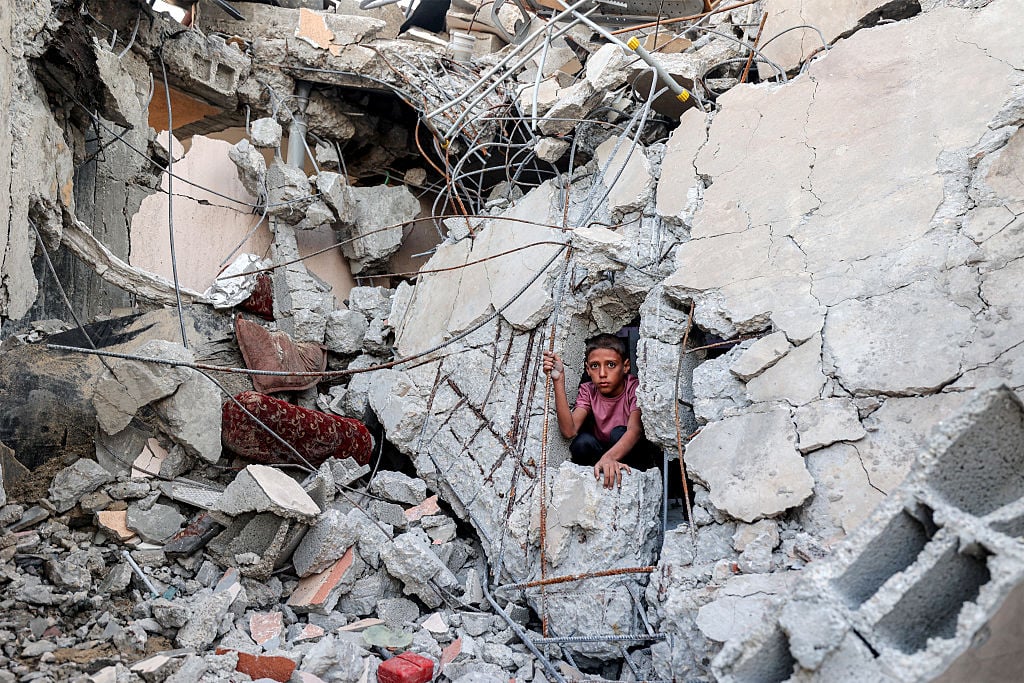
When a home is destroyed, entire worlds of safety, love, and identity crumble with it.
By Taqwa Ahmed Al-Wawi , Truthout, September 8, 2025
Your home is not just a building. It is a space carefully crafted by your family — a place that witnessed your first steps, heard your whispers, and held your laughter and tears. It is the place where your childhood lives.
Every room tells a tale. A nook holds old toys. There’s a window where the morning sun kissed your face, and the threshold you crossed thousands of times.
Imagine a peaceful neighborhood around your home — a narrow, quiet street shaded by olive trees whose branches stretch to cover the sidewalks. You have neighbors who are like family, exchanging greetings and stories. Children play and laugh in the alleys. Every evening, the scent of taboon bread fills the air, and the call to prayer echoes gently, giving the neighborhood a feeling of peace and timelessness.
This home, in the heart of this neighborhood, is more than just a shelter — it is a part of you.
Now imagine that in a single moment, it all turns to dust.
A Home in Nuseirat
Aya Adnan Ibrahim Al-Derawi is a 20-year-old medical laboratory student at the Islamic University of Gaza. Aya is my dear friend, and she shared with me this story of her family’s home.
Their house in Nuseirat had a small courtyard with a lemon tree, a rooftop where laundry swayed in the wind, and windows that caught the first light of morning. But on December 12, 2023, an Israeli airstrike reduced it to rubble and ashes………………………………………………………………….
A Home in Khan Younis
Islam Abu Mohsen, a 24-year-old civil engineering student from Khan Younis in southern Gaza, told me about his life before everything changed. He works as a digital content creator and is a professional trainer in barista skills — a young man trying to build a future amid the ruins.
He described his home in one of the most upscale neighborhoods in Khan Younis — a modern, beautifully designed house, with large windows that filled every room with sunlight. “The area was very lively,” he told me, “close to malls, restaurants, and schools. It was safe — relatively safe — and we lived surrounded by a warm family atmosphere, despite all the harsh conditions in Gaza.”
Islam shared how everyday life inside that home was stable and peaceful. “Each of us had our own daily routine. I was focused on my engineering studies, working on digital content, and training others in barista arts. Every day, we gathered around the dinner table — laughing, sharing stories, trying to hold on to a sense of normalcy. The house had a soul; it was a place of safety, comfort, and beautiful memories.”
Then came the devastating night of October 14, 2023. Islam described it vividly: “At 7:00 pm, suddenly the whole area was engulfed in a ring of fire. The smoke was suffocating; we literally felt like we were choking. We couldn’t understand what was happening. Ambulances couldn’t reach us — it was as if our neighborhood had vanished from the map.”
He described his family’s final moments in the house. “We were sitting at the dining table, cooking pasta, ready to eat — and then the bombing started. We never finished our meal,” he told me. “The pasta tray remained untouched for more than five months. When we finally returned, it was rotten.”
The losses went far beyond food. ………………………………………………………………………………………………………………….. https://truthout.org/articles/israeli-forces-bomb-loot-vandalize-our-homes-in-gaza-we-long-for-normal-life/?utm_source=Truthout&utm_campaign=26b80ce814-EMAIL_CAMPAIGN_2025_09_08_09_36&utm_medium=email&utm_term=0_bbb541a1db-26b80ce814-650192793
UK Labour must not award Elbit a £2 billion military deal
Why are Israel’s largest arms firm and a company mired in a corruption scandal even being considered for training British troops?
DECLASSIFIED UK, ANDREW FEINSTEIN, PAUL HOLDEN and JACK CINAMON, 28 August 2025
Britain’s Ministry of Defence might imminently award a 15 year contract, worth £2.5bn, to a consortium headed by the British subsidiary of the Israeli arms firm Elbit Systems and including the US management consultancy firm, Bain and Company.
If successful, Elbit’s consortium would be responsible for training as many as 60,000 members of the UK military.
The consortium seems well-placed to win the contract; it is, in fact, one of only two shortlisted and preferred bidders.
The Ministry of Defence has already given the consortium a £2m contract so that it can develop its proposals further.
This is unacceptable. And it is frankly unbelievable that this consortium is even in the running considering its track record.
Elbit Systems UK is the fully-owned subsidiary of Elbit Systems Limited. Elbit Systems Limited is headquartered in Tel Aviv and is listed on both the Israeli and US stock exchanges.
Elbit is one of the two largest Israeli weapons manufacturers and is central to the IDF’s operations, providing 85% of its drones. Elbit International is also a major contributor to the F-35 fighter jet program, bragging that it plays a ‘critical role’ in the ‘success of the world’s most advanced fighter jet.’
In July 2025, Francesca Albanese, the UN Special Rapporteur for the Occupied Palestine Territories, published an excoriating report setting out corporate complicity in Israel’s “plausibly” genocidal conduct in Gaza – for which she was subsequently sanctioned by Donald Trump.
Her report is clear that Elbit forms a central part of Israel’s military-industrial complex, which has become “the economic backbone of [Israel].”
“Elbit has cooperated closely on Israeli military operations, embedding key staff in the Ministry of Defence,” Albanese points out, further noting that Elbit provides “a critical domestic supply of weaponry.”
Bain
But we’re also deeply concerned about Elbit’s partner, Bain and Company.
Bain and Company (not to be confused with the mega hedge fund Bain Capital, which confirmed to us that it is not involved in the Elbit consortium) is a US-based management consultancy firm.
Bain’s inclusion in the consortium’s bid was first reported in 2023 by the UK military magazine, Shephard News, based on unpublished behind-the-scenes documents.
Bain has a sordid and shocking history. In August 2022, the Cabinet Office placed Bain and Company on a ‘blacklist’, preventing it from getting any Cabinet Office contracts. ………………………………………………………………………………………………
In July this year it was confirmed that Bain had shut down its South African consultancy operations, with the Financial Times reporting insiders saying that the company’s local reputation had been destroyed by the scandal.
The carcass of Bain’s South African business would be repurposed as a ‘hub’ to support Bain’s other international work.
These are the types of companies that the UK is poised to mainline into the very DNA of the British military and the British state: Elbit, its parent company one of the most important partners to the IDF in Gaza; and Bain and Company, only recently blacklisted for serious professional misconduct for its role in undermining the fabric of South Africa’s democracy.
The idea that the UK would award this consortium, and these companies, any sort of contract, never mind a 15 year contract of such importance, is an outrage. It must be stopped. https://www.declassifieduk.org/labour-must-not-award-elbit-a-2-billion-military-deal/
Holy See tells nations at UN to end threat of nuclear weapons, even as deterrence.
Vatican Vatican News by Gina Christian, United Nations — September 8, 2025, https://www.ncronline.org/vatican/vatican-news/holy-see-tells-nations-un-end-threat-nuclear-weapons-even-deterrence
Amid a global arms race, ending the threat of nuclear war — and even the testing of nuclear weapons — is imperative, said the Holy See’s diplomat to the United Nations.
Archbishop Gabriele Caccia, the Holy See’s U.N. permanent observer, shared his thoughts in a statement he delivered Sept. 4 at U.N. headquarters in New York, during the General Assembly High-level Plenary Meeting to Commemorate and Promote the International Day Against Nuclear Tests, observed that same day.
“The pursuit of a world free of nuclear weapons is not only a matter of strategic and vital necessity, but also a profound moral responsibility,” Caccia in his remarks.
He pointed to the introduction of nuclear weapons — first detonated by the U.S. in 1945 over the Japanese cities of Hiroshima and Nagasaki, killing an estimated 110,000 to 210,000 people, during World War II — as unveiling to the world “an unprecedented destructive force.
“This event changed the course of history and cast a long shadow over humanity, unleashing grave consequences for both human life and creation,” Caccia said in his statement.
“The devastating aftermath of this dramatic event led to the problematic assumption that peace and security could be maintained through the logic of nuclear deterrence — a notion that continues to challenge moral reasoning and the international conscience,” he said.
That challenge has intensified in recent years, with more than 120 conflicts now taking place throughout the world, according to the International Committee of the Red Cross.
Military spending has soared worldwide, with the global total reaching a record high of close to $2.5 trillion in 2024, up more than 7% from 2023 and averaging just under 2% of nations’ gross domestic product. The European Union, United Kingdom and Canada have accelerated defense investments, as the U.S. under the Trump administration has unsettled longstanding defense alliances.
The Treaty on the Prohibition of Nuclear Weapons, adopted by the U.N. in 2017, serves as a legally binding instrument towards the total elimination of nuclear weapons. But while there are 94 state signatories and 73 states party to the treaty, neither the U.S. nor Russia, which together account for approximately 88% of the world’s nuclear weapons, have signed on.
That trend is “particularly concerning,” said Caccia.
“Rather than advancing towards disarmament and a culture of peace, we are witnessing a resurgence of aggressive nuclear rhetoric, the development of increasingly destructive weapons and a significant rise in military expenditure,” he said, “often at the expense of investment in integral human development and the promotion of the common good.”
The very prospect of nuclear testing is problematic, he said, noting that since the first nuclear weapons test in 1945, more than 2,000 tests have been conducted “in the atmosphere, underground, beneath the oceans and on land.”
“These actions have affected everyone, particularly indigenous peoples, women, children, and the unborn,” he said. “The health and dignity of many continue to be affected in silence, and all too often without redress.”
The archbishop stressed the Holy See’s call to reflect on “the urgent shared responsibility to ensure that the terrible experiences of the past are not repeated.”
He affirmed the Holy See’s support for the Comprehensive Nuclear-Test-Ban Treaty, which bans all nuclear test explosions, whether for military or civilian purposes, as well as the Treaty on the Prohibition of Nuclear Weapons.
“It is imperative that we move beyond a spirit of fear and resignation,” said Caccia.
The archbishop quoted the exhortation of Pope Leo XIV in his June 18 general audience, saying, “We must never become accustomed to war. Indeed, the temptation to place our trust in powerful and sophisticated weapons must be firmly rejected.”
Israeli Lawmakers Demanded Better PR to Conceal Gaza Famine. Google Obliged.
Exclusive look at Israeli government contracts for online ads claiming that there is no hunger or starvation in Gaza.

Israel’s advertising bureau, which reports to the prime minister’s office, has since embarked on a mass advertising and public messaging effort to conceal the hunger crisis. The push includes the use of American influencers widely reported on last month. It also includes a high-dollar spending spree on paid advertising, yielding tens of millions for Google, YouTube, X, Meta, and other tech platforms.
Lee Fang and Jack Poulson, Sep 04, 2025
Investigation published in partnership with Drop Site News.
On March 2, 2025, hours after the Israeli government announced the blockade of all food, medicine, fuel, and other humanitarian supplies from entering Gaza, lawmakers in Jerusalem demanded answers—not on the devastating human toll of such a decision, but on how Prime Minister Benjamin Netanyahu’s office was preparing to handle the public relations fallout.
“I began with the example of the cessation of humanitarian aid—did you prepare for this thing this morning?” asked Knesset member Moshe Tur-Paz, the chair of a subcommittee on Foreign Affairs in Israel’s parliament.
Avichai Edrei, a spokesperson for the Israel Defense Forces who was asked the same question later in the hearing, assured the legislators work was underway, stating, “We could also decide to launch a digital campaign in this context, to explain that there is no hunger and present the data.”
Publicly available government contracts show that Israel’s advertising bureau, which reports to the prime minister’s office, has since embarked on a mass advertising and public messaging effort to conceal the hunger crisis. The push includes the use of American influencers widely reported on last month. It also includes a high-dollar spending spree on paid advertising, yielding tens of millions for Google, YouTube, X, Meta, and other tech platforms.
“There is food in Gaza. Any other claim is a lie,” asserted a propaganda video published by Israel’s foreign ministry to Google’s YouTube video sharing platform in late August and viewed more than 6 million times.
Much of the video’s reach results from an ad placed during an ongoing and previously unreported $45 million (NIS 150 million) advertising campaign initiated between Google and Netanyahu’s office in late June. The contract—which is with both YouTube and Google’s advertising campaign management platform, Display & Video 360—explicitly characterizes the ad campaign as hasbara, a Hebrew word whose meaning is somewhere between public relations and propaganda.
Records show that the Israeli government similarly spent $3 million (NIS 10 million) for an advertising campaign with X. The French and Israeli advertising platform Outbrain/Teads is also set to receive roughly $2.1 million (NIS 7 million)
The ads have aired in response to increasing global outcry over the deteriorating situation in Gaza. In August, the UN formally declared a famine in Gaza governorate, which includes Gaza City. The Integrated Food Security Phase Classification (IPC), the leading global authority on food security, projected the threshold for famine would be crossed in Deir al-Balah and Khan Younis in the coming weeks, stating “this Famine is entirely man-made, it can be halted and reversed.”
The UN aid coordination office OCHA further warned on Friday of “a descent into a massive famine” in the Gaza Strip.
At least 367 Palestinians, including 131 children, have died as a result of hunger and malnutrition since the war began, according to the health ministry in Gaza.
The existence of an Israeli Google ads campaign to discredit the UN’s primary aid agency for Palestinian refugees, UNRWA, was similarly reported by WIRED last year. Hadas Maimon, head of public awareness for Israel’s diaspora ministry, stated during the March 2 Knesset hearing that, “For almost a year now, we have been leading a major campaign on the issue of UNRWA.”
Other Israeli government ads on Google’s platforms accused the United Nations of “deliberate sabotage” of aid delivery into Gaza and promoted the Gaza Humanitarian Foundation, which is backed by Israel, the U.S., and unnamed European countries. One campaign promoted prosecution of the militant group Hamas, which governs the Gaza Strip, for debunked allegations of mass sexual violence as a result of a controversial report published by the Israeli advocacy group Dinah Project.
Despite the denial about the famine, prominent Israeli government voices have championed the effort to cut off food and water to Gazans as a strategy for inducing mass migration out of the territory. “In my opinion, you can besiege them,” said Bezalel Smotrich, the Israeli Finance Ministry and a coalition partner to Netantayu’s government, according to Channel 12. “No water, no electricity, they can die of hunger or surrender,” Smotrich said.
Amichay Eliyahu, the Knesset member who leads the Heritage Ministry in Netanyahu’s government, has similarly called for starving the Palestinian population of Gaza. “There is no nation that feeds its enemies,” Eliyahu said during a radio interview in July. In May, the minister argued the Palestinians “need to starve” and added, “If there are civilians who fear for their lives, they should go through the emigration plan.”…………………………………………………………..(Subscribers only) https://www.leefang.com/p/israeli-lawmakers-demanded-better?utm_source=post-email-title&publication_id=1239256&post_id=172710128&utm_campaign=email-post-title&isFreemail=true&r=ln98x&triedRedirect=true&utm_medium=email
Pakistan nuclear weapons, 2025

Bulletin, By Hans M. Kristensen, Matt Korda, Eliana Johns, Mackenzie Knight-Boyle | September 4, 2025
Pakistan continues to slowly modernize its nuclear arsenal with improved and new delivery systems, and a growing fissile material production industry. Analysis of commercial satellite images of construction at Pakistani army garrisons and air force bases shows what appear to be newer launchers and facilities that might be related to Pakistan’s nuclear forces, although authoritative information about Pakistan’s nuclear units is scarce.
We estimate that Pakistan has produced a nuclear weapons stockpile of approximately 170 warheads, which is unchanged since our last estimate in 2023 (see Table 1). The US Defense Intelligence Agency projected in 1999 that Pakistan would have 60 to 80 warheads by 2020 (US Defense Intelligence Agency (1999, 38), but several new weapon systems have been fielded and developed since then, which leads us to a higher estimate. Our estimate comes with considerable uncertainty because neither Pakistan nor other countries publish much information about the Pakistani nuclear arsenal.
With several new delivery systems in development, four plutonium production reactors, and an expanding uranium enrichment infrastructure, Pakistan’s stockpile has the potential to increase further over the next several years. The size of this increase will depend on several factors, including how many nuclear-capable launchers Pakistan plans to deploy, how its nuclear strategy evolves, and how much the Indian nuclear arsenal grows. We estimate that the country’s stockpile could potentially grow to around 200 warheads by the late 2020s. But unless India significantly expands its arsenal or further builds up its conventional forces, it seems reasonable to expect that Pakistan’s nuclear arsenal will not grow significantly, but might level off as its current weapons programs are completed.
………………………………….. Analyzing Pakistan’s nuclear forces is particularly fraught with uncertainty, given the lack of official state-originating data. The Pakistani government has never publicly disclosed the size of its arsenal and does not typically comment on its nuclear doctrine. Unlike some other nuclear-armed states, Pakistan does not regularly publish any official documentation explaining the contours of its nuclear posture or doctrine. Whenever such details emerge in the public discourse, they usually originate from retired officials commenting in their personal capacities. The most regular official source on Pakistani nuclear weapons is the Inter Services Public Relations (ISPR), the media wing of the Pakistan Armed Forces, which publishes regular press releases for missile launches and occasionally couples them with launch videos.
Occasionally, other countries offer official statements or analysis about Pakistan’s nuclear forces. ……………………………………………………………………
Pakistan’s nuclear doctrine
Pakistan has historically maintained a deliberately ambiguous nuclear doctrine, including through refusal to endorse or reject a no-first-use policy.
…………………………..Within its broader philosophy of “credible minimum deterrence,” which seeks to emphasize a defensive and limited but flexible nuclear posture, Pakistan operates under a nuclear doctrine that it calls “full spectrum deterrence.” This posture is aimed mainly at deterring India, which Pakistan identifies as its primary adversary.
…………………………..Pakistan’s nuclear posture—particularly its development and deployment of tactical nuclear weapons—has created considerable concern in other countries, including the United States, which fears that it increases the risk of escalation and lowers the threshold for nuclear use in a military conflict with India.
…………………………..Nuclear security, command-and-control, and crisis management
Over the past decade-and-a-half, the US assessment of nuclear weapons security in Pakistan appears to have changed considerably from confidence to concern, particularly because of the introduction of tactical nuclear weapons in the Pakistani arsenal. ……………………………………………………………………..
2025 India-Pakistan conflict
In May 2025, India and Pakistan engaged in a brief conflict, during which India launched conventional missile strikes against several Pakistani military facilities. The conflict, which lasted days, included an escalatory exchange of fire from both sides following the April 22 terrorist attack in Pahalgam, Indian-administered Kashmir.
In the aftermath of the conflict, the Pakistan Air Force (PAF) and the Military Engineer Services—which conducts construction and maintenance operations for all branches of the Pakistani military—issued a series of public procurement contracts for post-strike repairs at a variety of military bases, indicating which facilities suffered damage due to the conflict (Mishra 2025). ……………………
……………………….One study concluded that although the “mutual possession of nuclear weapons heavily conditioned the response of both sides” and “overt nuclear signaling was lower than in many prior India-Pakistan crises, … the crisis underscores that South Asia is one of the most likely theaters for nuclear war, even if that prospect was not imminent in this instance” (Clary 2025).
Fissile materials, warheads, and missile production
Pakistan has a well-established and diverse fissile material production complex that is expanding. This includes four heavy-water plutonium production reactors at the Khushab Complex, three of which were completed in the past 15 years. ………………………………………….
We estimate that Pakistan currently is producing sufficient fissile material to build 14 to 27 new warheads per year, although we estimate that the actual warhead increase in the stockpile probably averages around 5 to 10 warheads per year.[2]…………………………………………..
Nuclear-capable aircraft and air-delivered weapons…………………………………………………………………………………..
Land-based ballistic missiles…………………………………………………………………………….
Land-based missile garrisons…………………………………………………………………………..
Ground- and sea-launched cruise missiles…………………………………………………………………….. https://thebulletin.org/premium/2025-09/pakistan-nuclear-weapons-2025/?utm_source=ActiveCampaign&utm_medium=email&utm_content=Pakistan%20s%20nuclear%20arsenal&utm_campaign=20250904%20Thursday%20Newsletter%20%28Copy%29
1 This Month


Tell the Ukrainian Government to Drop Prosecution of Peace Activist Yurii Sheliazhenko

Petition to revoke the licensing of the Near Surface Nuclear Disposal Facility (NSDF) at Chalk River. https://www.ourcommons.ca/petitions/en/Petition/Details?Petition=e-7247


of the week – STOP SMALL MODULAR REACTORS IN CANADA
To see nuclear-related stories in greater depth and intensity – go to https://nuclearinformation.wordpress.com
-
Archives
- March 2026 (204)
- February 2026 (268)
- January 2026 (308)
- December 2025 (358)
- November 2025 (359)
- October 2025 (376)
- September 2025 (258)
- August 2025 (319)
- July 2025 (230)
- June 2025 (348)
- May 2025 (261)
- April 2025 (305)
-
Categories
- 1
- 1 NUCLEAR ISSUES
- business and costs
- climate change
- culture and arts
- ENERGY
- environment
- health
- history
- indigenous issues
- Legal
- marketing of nuclear
- media
- opposition to nuclear
- PERSONAL STORIES
- politics
- politics international
- Religion and ethics
- safety
- secrets,lies and civil liberties
- spinbuster
- technology
- Uranium
- wastes
- weapons and war
- Women
- 2 WORLD
- ACTION
- AFRICA
- Atrocities
- AUSTRALIA
- Christina's notes
- Christina's themes
- culture and arts
- Events
- Fuk 2022
- Fuk 2023
- Fukushima 2017
- Fukushima 2018
- fukushima 2019
- Fukushima 2020
- Fukushima 2021
- general
- global warming
- Humour (God we need it)
- Nuclear
- RARE EARTHS
- Reference
- resources – print
- Resources -audiovicual
- Weekly Newsletter
- World
- World Nuclear
- YouTube
-
RSS
Entries RSS
Comments RSS
 nuclear-news