Nuclear-armed states should come clean after 80 years of nuclear testing harm.
29 August 2025, https://www.icanw.org/nuclear_armed_states_should_come_clean_after_80_years_of_nuclear_testing_harm
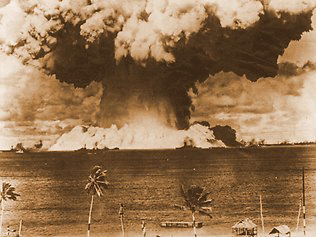
Today, the United Nations International Day Against Nuclear Testing, ICAN is calling on the nuclear-armed states that have detonated over 2,000 nuclear devices between them to take full responsibility for the harm they have caused people and the environment.
The first detonation was in New Mexico a few weeks before the nuclear bombings of Hiroshima and Nagasaki 80 years ago this month. Between 1945 and 2007, more than 2000 nuclear tests were carried out, across the world in Algeria, Australia, French Polynesia, Kazakhstan, Kiribati, the Marshall Islands, and the southwestern United States, as well as Alaska, western China, India, North Korea, Pakistan, Russia and Ukraine.
The majority of these explosions were detonated in what were then colonies and/or regions inhabited by Indigenous peoples or other ethnic communities. The communities involved are engaged in efforts for justice and to prevent any return to nuclear testing.
Nuclear testing left a legacy beyond test site boundaries
Radiation cannot be contained geographically; it respects no country’s border. Fallout patterns are complex and the full humanitarian consequences of the fallout of years of particular atmospheric nuclear testing is not known. Fallout is not comprehensively documented in this resource, although some studies on these impacts may be included. For a detailed study on the fallout of a few French nuclear weapons tests in the Pacific – and French efforts to cover it up – see The Moruroa Files.
Nuclear testing is banned
The first international treaty to completely outlaw nuclear testing, the Comprehensive Test Ban Treaty was adopted in 1996, although the treaty has not yet entered into force. The Treaty on the Prohibition of Nuclear Weapons is the only international treaty in force that prohibits nuclear testing. Other treaties ban types of nuclear testing or nuclear testing in certain regions.
What is being done to help those impacted?
The Treaty on the Prohibition of Nuclear Weapons (TPNW) is the first international treaty to ban all nuclear weapons activities, it also requires states parties to provide assistance for survivors of nuclear weapons use and testing and to begin to remediate contaminated environments in Articles 6 and 7. While the primary responsibility for this implementation rests with affected countries, all countries in a position to do so, should help those countries with this work.
Articles 6 and 7 of the TPNW establish a framework of responsibility that offers solidarity and support to affected states parties to address present-day humanitarian and environmental harm from past use and testing. They also serve to place these issues on the agenda of the wider international community, including donors and international organisations. They provide an opportunity for states parties to make a practical difference with and for affected communities.
In some countries where nuclear weapons have been tested there are programs to provide financial or health assistance to survivors or to clean up the environment but none sufficiently address all needs of survivors. Dozens of identified sites around the world remain contaminated by nuclear weapons use, production and testing and there is no one standard for their remediation. Notably there is no widely accepted standard to determine how clean is clean, or how to monitor radiation levels over time. This article in Global Policy reviews existing approaches and looks at what else can be done.
ICAN Calls for states to come clean
ICAN’s Executive Director, Melissa Parke, was in New Mexico last month for the commemorations of the world’s first explosion of a nuclear weapon and to meet communities whose lives were changed forever by the radioactive fallout from the detonation that poisoned their land, air and water. The ‘Trinity Test’ detonated the plutonium bomb design that was used a few weeks later to kill 74,000 people in Nagasaki.
Ms Parke said: “Trinity was followed by more than 2000 nuclear explosions all over the world and the countries responsible – the nuclear-armed states – have never fully acknowledged the catastrophic harm they have caused to people and environments. These countries must stop the cover-up, come clean and provide the support and recognition these communities deserve. The nuclear armed states also need to heed the calls from affected communities for the urgent abolition of nuclear weapons, so that these weapons of total destruction are eliminated before they eliminate us.”
No comments yet.
1 This Month
10 March A LIVE WEBINAR THE REAL EFFECTS OF NUCLEAR POWER
What the Industry Isn’t Telling Us
1:00 PM Mountain, 2 pm Central, 3 pm Eastern. Live on the Keepers of the Water Facebook page



18 March Webinar @ 1 PM EST: An Assessment of SMR Projects: The Case of Canada
register for the zoom:
https://us02web.zoom.us/webinar/register/WN_o8BIIOUvQ2ONJR1nta65DQ#/registration


of the week – STOP SMALL MODULAR REACTORS IN CANADA
To see nuclear-related stories in greater depth and intensity – go to https://nuclearinformation.wordpress.com
-
Archives
- March 2026 (99)
- February 2026 (268)
- January 2026 (308)
- December 2025 (358)
- November 2025 (359)
- October 2025 (376)
- September 2025 (258)
- August 2025 (319)
- July 2025 (230)
- June 2025 (348)
- May 2025 (261)
- April 2025 (305)
-
Categories
- 1
- 1 NUCLEAR ISSUES
- business and costs
- climate change
- culture and arts
- ENERGY
- environment
- health
- history
- indigenous issues
- Legal
- marketing of nuclear
- media
- opposition to nuclear
- PERSONAL STORIES
- politics
- politics international
- Religion and ethics
- safety
- secrets,lies and civil liberties
- spinbuster
- technology
- Uranium
- wastes
- weapons and war
- Women
- 2 WORLD
- ACTION
- AFRICA
- Atrocities
- AUSTRALIA
- Christina's notes
- Christina's themes
- culture and arts
- Events
- Fuk 2022
- Fuk 2023
- Fukushima 2017
- Fukushima 2018
- fukushima 2019
- Fukushima 2020
- Fukushima 2021
- general
- global warming
- Humour (God we need it)
- Nuclear
- RARE EARTHS
- Reference
- resources – print
- Resources -audiovicual
- Weekly Newsletter
- World
- World Nuclear
- YouTube
-
RSS
Entries RSS
Comments RSS
 nuclear-news
Leave a comment