US nuclear safety regulators say their jobs could be at risk under Trump

By Timothy Gardner, September 4, 2025, https://www.reuters.com/world/us/us-nuclear-safety-regulators-say-their-jobs-could-be-risk-under-trump-2025-09-03/
- Summary
- Pressure high on nuclear regulators after Trump orders
- Trump wants to quadruple nuclear power capacity by 2050
- Commissioner: hard to make safety calls if more staff leave
WASHINGTON, Sept 3 (Reuters) – Two of the three remaining commissioners at the Nuclear Regulatory Commission, the U.S. nuclear safety watchdog, told a Senate hearing on Wednesday they feel President Donald Trump could fire them if they obstruct his goal to approve reactors faster.
Trump signed executive orders in May that set goals of fast-tracking new reactor licenses and quadrupling U.S. nuclear energy capacity by 2050 to boost the power grid, while also reducing staffing at the NRC.
Trump later fired Commissioner Chris Hanson, a Democrat, while Commissioner Annie Caputo, a Republican, left in July, saying she wanted to more fully focus on her family. That brought the traditionally five-member panel down to three.
Commissioner Matthew Marzano, a Democrat, told the hearing he felt he could be fired by the administration if he decides a new reactor design is unsafe and declines to license it.
Commissioner Bradley Crowell, also a Democrat, said he felt on “any given day I could be fired by the administration for reasons unknown.”
The White House did not immediately respond to a request for comment.
NRC Chairman David Wright, a Republican, said the agency has five applications from so-called advanced nuclear reactors that it is reviewing and it expects another 25 to 30 soon.
Wright declined to say whether he felt he could be fired, saying it would be “speculation.”
But he said NRC should not approve incomplete applications from companies looking to build new nuclear plants, even if it means missing an 18-month approval deadline set in Trump’s executive orders.
Senator Sheldon Whitehouse, a Democrat who supports nuclear energy for its potential to reduce greenhouse gas emissions, said about a dozen senior level managers at the NRC have left or announced they will leave since January, and that 143 staff departed between January and June.
“It’s a personnel bloodbath,” Whitehouse said. “The industry stands or falls on the NRC’s gold-standard reputation for nuclear safety. It’s now in jeopardy.”
Crowell said if the agency lost any more staff, it would be tough to credibly make safety cases on the timeline in Trump’s orders.
Why NuScale Power Stock Slid 31% Last Month

By Brett Schafer – Sep 3, 2025 ,
https://www.fool.com/investing/2025/09/03/why-nuscale-power-stock-slid-31-last-month/
Key Points
- NuScale Power’s stock has pulled back after a huge gain coming from a recent executive order signing.
- The company has a small modular nuclear reactor approved, but has not won a customer contract.
- The stock trades at an expensive price, even though it generates barely any sales and has no customer wins.
The nuclear energy stock doesn’t generate much in revenue and is losing a lot of money.
Shares of NuScale Power (SMR 8.15%) fell 31% in August, according to data from S&P Global Market Intelligence. The nuclear energy upstart and designer of small modular reactors (SMRs) is experiencing wild gyrations with its stock price. The stock is up 432% in the last year and trades at a market cap of $11.5 billion, even though it generates minimal revenue and is burning a lot of cash.
It’s been a roller-coaster ride for nuclear start-ups
Nuclear energy stocks soared at the beginning of this summer, with the current presidential administration’s push to accelerate the development of nuclear energy to keep up with data center demand around artificial intelligence (AI). President Trump signed an executive order for advanced nuclear reactor technologies, of which NuScale Power is one.
In fact, NuScale Power is the only SMR company to have its design approved by the Nuclear Regulatory Commission (NRC), which could give it a head start in winning customer contracts. However, it has failed so far to win any customer contracts outside prospective contracting from a Romanian power company that’s exploring whether to use SMRs for its upcoming energy needs.
With close to zero revenue and a history of burning cash, NuScale Power is a stock that trades with a ton of volatility. As the air comes out of the post-executive order excitement, it is no surprise to see NuScale Power stock hit a bit of a rough patch. The company has no fundamental basis to anchor its $11.5 billion market cap, which makes it a risky stock to invest in.
NuScale Power’s uncertain future
NuScale Power has a few energy projects in the works that it could potentially win deals on, including a recent proposal from the Tennessee Valley Authority. Bringing these to fruition could help it actually develop an SMR to be deployed in the real world instead of talking about it, which has been all the company has done since its inception.
Even if these projects get approved, NuScale Power won’t generate much in revenue to warrant its $11.5 billion market cap, with revenue not showing up for years due to the long project life for nuclear energy developments. It is foolish to buy a stock valued at over $10 billion that’s generating zero revenue. Therefore, investors should avoid putting NuScale Power in their portfolios, given its uncertain future.
War spending is ever greater

“The military personnel sent to Ukraine would be military personnel from countries that are mostly NATO members. And it is precisely NATO’s expansion in Ukraine that has been one of the main causes of the current conflict.”
Manlio Dinucci, Voltairenet.org, Sat, 30 Aug 2025, https://www.sott.net/article/501617-War-spending-is-ever-greaterhttps://www.sott.net/article/501617-War-spending-is-ever-greater
As US military spending in Ukraine declines, European spending increases. Although it appears that these weapons will be manufactured in the European Union and no longer across the Atlantic,they will inevitably be destroyed in Ukraine.
The war continues to spread to the heart of Europe because it is fundamentally fueled by the very strategy that caused it to explode. After the summit with Vladimir Putin in Alaska, Donald Trump said that, if an agreement were reached between Russia and Ukraine, the United Stateswould not send troops to Ukrainebut, as a “security guarantee,” would provide Kiev with air and intelligence support. Troops, however, would be sent to Ukraine by some European countries.
The US Joint Chiefs of Staff reports that, to finalize this plan, US General Dan Caine summoned the chiefs of staff of Finland, France, Germany, Italy, the United Kingdom, and Ukraine to the Pentagon. The Kremlin reaffirms that it does not accept this plan. Russian presidential spokesman Dmitry Peskov declared:
“The military personnel sent to Ukraine would be military personnel from countries that are mostly NATO members. And it is precisely NATO’s expansion in Ukraine that has been one of the main causes of the current conflict.”
Immediately after, NATO Secretary General Mark Ruttewas dispatched to Kyiv, where, in a press conference with President Volodymyr Zelensky, he stated:
“Our support for Ukraine is unconditional and continues to grow, including through a flow of lethal US weapons to Ukraine financed by European NATO Allies and Canada. So far, three arms packages, each worth $500 million, have been delivered. The first paid for by the Netherlands; the second by Denmark, Norway, and Sweden; and the third by Germany. More packages will follow.
“Allies support the Ukrainian defense industry, investing in ways that not only strengthen your security, but also your economy. We are working with NATO Command Germany to ensure that your armed forces have what they need today and in the future.”
Immediately after, Canada purchased a fourth “package” of US weapons, bringing the total to $2 billion, which went into the coffers of the largest US war industries.
At the same time, the European Union has allocated €4.05 billion for Ukraine: €3.05 billion from the Ukraine Fund and €1 billion from the “reinvestment of income from Russian fixed assets.“ The EU and its member states have spent a total of €168.9 billion on Ukraine since February 2022. And Ursula Von der Leyen guarantees that “Europe will stand by Ukraine for every single day of the war and for every single day after the war.” These enormous war expenses, made up of public money, are paid directly and indirectly by European citizens through taxes and cuts in social spending.
The latest data released by NATO show that the 32 member countries — as required by the United States — have met the goal of allocating 2 percent of GDP to military spending. In 2014 — the year the Obama administration, with Biden as vice president, carried out the coup in Ukraine that launched the war against Russia — the United States accounted for 73 percent of NATO military spending, compared to Europe’s 27 percent. By 2025, the United States’ share will have fallen to 60 percent, while Europe’s will have risen to 40 percent. As the Trump administration demands — NATO military spending will rise to 3.5 percent and then to 5 percent of GDP, Europe’s share will continue to rise.
Based on the official documentation published by NATO at the end of August 2025, Italian military spending in 2025 will amount to more than 45 billion euros (45,315 billion euros): an average of more than 124 million euros per day. To get an idea of the priorities, just think that this sum deposited in one day for the war is roughly equivalent to the 130 million euros allocated by the Government in 2025 for the “First Home Guarantee Fund”, an important program that allows young people who request it to have a facilitated loan for their purchase.
Israel beginning mass mobilization to take Gaza City – Jerusalem Post
02 Sep 2025 , https://www.sott.net/article/501619-Israel-beginning-mass-mobilization-to-take-Gaza-City-Jerusalem-Post
Tens of thousands of Israeli reservists have begun reporting for duty as the Israel Defense Forces (IDF) prepares for a new offensive to take full control of Gaza City,The Jerusalem Post reported on Tuesday. Israeli Army Radio said about 40,000 reservists were expected to be called up.
The renewed pressure from Prime Minister Benjamin Netanyahu and his security cabinet to speed up the operation reportedly has faced pushback from the military. During a heated cabinet meeting on Sunday, IDF Chief of Staff Eyal Zamir called for a ceasefire deal, warning that the campaign could endanger hostages still held in Gaza and overextend the army, the Post wrote.
According to officials present, the IDF said it cannot begin the operation for at least two months due to logistical and humanitarian concerns, as more time is needed for aid to civilians in Gaza, where starvation has spread.
This follows similar exchanges between Zamir and Netanyahu’s cabinet last month, when the prime minister ordered the military to speed up the timetable for taking what he describes as Hamas’ last bastion.
Some reservists have also voiced frustration with the government’s plan, Reuters reports. Surveys cited by the outlet have shown notable dissatisfaction within the ranks, with some citing the lack of a clear strategy for victory. “I don’t feel like I’m doing anything that really applies significant pressure to have Hamas release the hostages,” one combat reservist told Reuters, speaking anonymously.
Israel launched the latest Gaza City operation last month, targeting Hamas command centers, weapons caches, and tunnel networks embedded in civilian areas. Over 1,000 buildings have been demolished, which has left hundreds trapped under rubble and thousands without homes, according to the Palestinian authorities.
Israel has said the operation is necessary for national security, and that the goal is to eliminate Hamas infrastructure.
The conflict began on October 7, 2023, after the militant group led an attack on southern Israel that killed about 1,200 people and took 250 hostages. Around 50 remain in captivity. Gaza’s Health Ministry says more than 62,000 people have been killed and about 156,000 wounded in Israeli strikes since then.
Comment: Obsession is ‘Never Enough’:
More than 1,000 buildings have been destroyed in Gaza City’s Zaytoun and Sabra neighborhoods since Israeli forces began a new ground incursion this month, Al Jazeera has reported, citing Palestinian Civil Defence.
In a statement on Sunday, Civil Defence reported that continued shelling and blocked access routes have made it nearly impossible for emergency crews to reach hundreds of trapped civilians or respond to reports of missing persons. Hospitals in the area are reportedly overwhelmed.
“There are grave concerns about the continued incursion of Israeli forces into Gaza City, at a time when field crews lack the capacity to deal with the intensity of the ongoing Israeli attacks.”
Israeli tanks have reportedly advanced into Sabra, and heavy bombardment has been reported across the city. Al Jazeera quoted medical sources saying at least 51 people were killed on Sunday, including 27 in Gaza City, and 24 others who were seeking aid.
Gaza’s Ministry of Health said eight more people died of hunger on Sunday, bringing the total number of malnutrition-related deaths since the war began to 289, including 115 children.
Philippe Lazzarini, head of the UN agency for Palestinian refugees (UNRWA), warned that famine was now the“last calamity”affecting Gaza.“People are enduring hell in all shapes,” he said, calling for full access for aid groups and international journalists.
The Israeli military announced the start of an operation to take over Gaza City last week, targeting Hamas command centers, weapons caches, and tunnel networks embedded in civilian areas. Zaytoun and Sabra have previously been identified by Israeli officials as strategic zones for the militant group’s activity.
According to Gaza’s Health Ministry, more than 62,000 people have been killed and around 156,000 wounded in Israeli attacks on the Palestinian enclave.
A global blowback has begun in earnest, the winds of change are upon him. Netanyahu wants to complete his land grab ASAP. Genocide and total destruction…his best shortcuts.
China’s SCO Summit Highlights West’s Growing Ideological Isolation, + Zelensky’s Desperate Gambit

On the Ukrainian-political front, it’s obligatory to note that Trump’s two-week deadline has now expired. He had threatened some kind of consequences for Russia, and predictably there aren’t any, though he has now hinted that he has “learned something very interesting” about the war that he will reveal in the next few days—likely another made-up deflection to buy himself time.
Simplicius, Sep 03, 2025
Last week Zelensky made the curious decision to open up the borders to Ukraine’s 18-22 year old males. The decision was met with both approval and disgust in different quarters of the country:
“We say:” Those who are not in the army, you are 18-22, you can leave the country, no one is holding you, you are cool guys.” And we go back to the army, we say: “You are slaves. Listen to what you will do and when, how much you will fight in this army, ” said the deputy of the Kiev City Council, an officer of the Armed Forces of Ukraine Alexander Pogrebissky in an interview with a Ukrainian TV channel.
The bigger question is why did Zelensky “liberate” such a vital age group at a time when manpower is at critical lows on the front? Astute observers have noted it wasn’t simple coincidence that the decision came mere weeks after the NABU investigations and decision reversal. More importantly, it came weeks after Ukraine’s youth took to the streets in protest against Zelensky, in what appeared at times to be a new Maidan in the making.
The natural conclusion, then, is that Zelensky was forced to loosen the check valve on society, letting off some pressure from himself and allowing the most dissenting and anti-war 18-22 year-olds to flee the country so that they’re not able to form up a rebellious vanguard to create a political headache for Zelensky.
Even Le Monde leaned toward this natural angle:
The timing of the new regulation is not insignificant. It comes just over a month after the Ukrainian government tried to strip two anti-corruption agencies of their independence, on July 22. Thousands of young people protested in several Ukrainian cities for days, until the presidency backtracked and passed a law restoring the agencies’ autonomy.
The fact that Zelensky himself raised the issue of allowing 18- to 22-year-olds to leave the country, on August 12 during a youth forum, was a strong political signal. “I think the president was trying to make amends with the younger generation by granting them some benefits,” said Sovsun. MP Bohdan Yaremenko, a member of Zelensky’s party, shares this view: “There will probably be more similar actions in the future to reach out to young people.”
It’s interesting that the 18-22 cohort was chosen, whereas 23-24 year olds are still prohibited from leaving given that they’re on the cusp of the critical age of 25 to which mobilization was lowered.
Across Ukraine, there are growing signs of the lack of young males. This photo [on original] was posted by a professor at a Kiev university, reportedly showing a class overflowing with young females:
NO BOYS – NO MEN:
Andrey Dlyhach, a lecturer at the Faculty of Economics of Taras Shevchenko National University of Kyiv, published a photo of the first-year students, showing that the overwhelming majority of the students are girls.
“You wanted to say something else with this photo, but what I see there are the consequences of 3 years of closed borders for men aged 18+,” comments economist Gleb Vyshlinsky on the photo.
Other people reportedly chimed in in the comments, posting photos of similar gender disparities in their own schools across Ukraine.
There are other possible deductions to make about Zelensky’s sly decision. We can hypothesize on the following:
- Zelensky sees the negotiations and peace track as being definitive such that he does not expect the war to last and does not see the need for the eventual tapping of the 18-22 cohort.
- The political danger to Zelensky was so great—more so than even we know of—that he needed a boost to his image in order to restore some semblance of control. This also has to do with the quiet initiations of Zaluzhny’s political campaign—this could be Zelensky’s attempt to win back favor with society to increase his poll numbers and fortify himself against potential challengers.
- Ukraine’s ‘recruitment problems’ are not as bad as we were led to believe, and its authorities are confident they can sustain military manpower regeneration even without the 18-22 cohort.
More than likely, Zelensky weighed the options and viewed the tradeoff as favorable. Crunching the numbers, his team likely concluded it was worth the long term risk to manpower in order to secure the short term political viability of Zelensky’s rule.
On the Ukrainian-political front, it’s obligatory to note that Trump’s two-week deadline has now expired. He had threatened some kind of consequences for Russia, and predictably there aren’t any, though he has now hinted that he has “learned something very interesting” about the war that he will reveal in the next few days—likely another made-up deflection to buy himself time.
Trump “seems to have run out of ideas regarding the advancement of the peace process” in Ukraine, as his latest two-week deadline has expired, and the meeting between Putin and Zelensky that he wanted has not taken place, writes The Times newspaper.
In reality, Putin is presently hitting his stride as celebrated guest in Beijing where the Global South power-players are convening to showcase just how little the wretched ‘Western world’ matters anymore:
In the grand ebb and flow of the Ukrainian negotiations cycle, we’re in a kind of waning phase, with no real initiatives or urgency at the moment as all involved parties have essentially gotten fatigued from the same old copy-pasted carousel of banality and deadend options……………………………………………………………………………
two clashing systems of ideologies: one that elevates war and domination—what Xi called hegemonism in his earlier SCO speech—to the status of national religion, while the other seeks to unite the world in mutual development, and most importantly, shared respect……………………….. https://simplicius76.substack.com/p/chinas-sco-summit-highlights-wests?utm_source=post-email-title&publication_id=1351274&post_id=172310012&utm_campaign=email-post-title&isFreemail=true&r=rq5yc&triedRedirect=true&utm_medium=email
A new arms race in space must be stopped in its tracks .

A new treaty banning all weapons in space is the only way to prevent a future calamity.
August 31, Bruce K. Gagnon, https://www.pressherald.com/2025/08/31/a-new-arms-race-in-space-must-be-stopped-in-its-tracks-opinion/
Bruce K. Gagnon is the coordinator of the Global Network Against Weapons & Nuclear Power in Space.
I read with great interest the recent Associated Press article titled “Hijacked satellites and orbiting space weapons: In the 21st century, space is the new battlefield.” It was full of half-truths and manipulations that we’ve come to expect from the Pentagon and the military industrial complex.
While in the Air Force during the Vietnam War, I read the infamous Pentagon Papers that revealed how our government lied to the public, the Congress and the media to create the support for the war. We witnessed a similar story repeated in 2003 with “shock and awe” in Iraq and supposed weapons of mass destruction.
I’ve been coordinating the Global Network since its founding in 1992 while then living in Florida. In 1997, we obtained a copy of the Space Command’s internal document “Vision for 2020” that declared the U.S. would “control space, dominate space and deny other nations access to space.” Since that time the Pentagon and the aerospace industry have done everything possible to create a new arms race in space that they long ago stated would be “the largest industrial project in human history.”
For more than 30 years, China and Russia have gone to the United Nations proposing a new space treaty called PAROS (Prevention of an Arms Race in Space). At the general assembly, in a vote on the nonbinding resolution, it overwhelmingly passes despite the U.S. and Israel voting “No.” The treaty proposal is then sent to Geneva’s Conference on Disarmament for negotiation. There the U.S. and Israel block the treaty.
The official position of the U.S. (through Democrat and Republican administrations) has been “There are no weapons in space, we don’t need a new treaty.” The Global Network’s position has always been “Close the door to the barn before the horse gets out.” But the U.S. has always intended to be the dominant power in space. That is how wars are created.
China and Russia have steadily responded, telling the U.S. that they will not allow Washington to be the “Master of Space” — a slogan over the doorway at the Space Command HQ in Colorado.
NASA has long predicted that war in space will create the Kessler Syndrome — a cascading field of space debris as satellites are destroyed. The outcome would be that much of the Earth would go dark as so many things in our high-tech civilization are linked to space satellites.
A new arms race in space must be stopped in its tracks | Opinion
A new treaty banning all weapons in space is the only way to prevent a future calamity.
Posted August 31
Bruce K. Gagnon
3 min readFont size +Gift Article
Bruce K. Gagnon is the coordinator of the Global Network Against Weapons & Nuclear Power in Space. He lives in Brunswick.
I read with great interest the recent Associated Press article titled “Hijacked satellites and orbiting space weapons: In the 21st century, space is the new battlefield.” It was full of half-truths and manipulations that we’ve come to expect from the Pentagon and the military industrial complex.
While in the Air Force during the Vietnam War, I read the infamous Pentagon Papers that revealed how our government lied to the public, the Congress and the media to create the support for the war. We witnessed a similar story repeated in 2003 with “shock and awe” in Iraq
and supposed weapons of mass destruction.
I’ve been coordinating the Global Network since its founding in 1992 while then living in Florida. In 1997, we obtained a copy of the Space Command’s internal document “Vision for 2020” that declared the U.S. would “control space, dominate space and deny other nations access to space.” Since that time the Pentagon and the aerospace industry have done everything possible to create a new arms race in space that they long ago stated would be “the largest industrial project in human history.”
For more than 30 years, China and Russia have gone to the United Nations proposing a new space treaty called PAROS (Prevention of an Arms Race in Space). At the general assembly, in a vote on the nonbinding resolution, it overwhelmingly passes despite the U.S. and Israel voting “No.” The treaty proposal is then sent to Geneva’s Conference on Disarmament for negotiation. There the U.S. and Israel block the treaty.
The official position of the U.S. (through Democrat and Republican administrations) has been “There are no weapons in space, we don’t need a new treaty.” The Global Network’s position has always been “Close the door to the barn before the horse gets out.” But the U.S. has always intended to be the dominant power in space. That is how wars are created.
Advertisement
China and Russia have steadily responded, telling the U.S. that they will not allow Washington to be the “Master of Space” — a slogan over the doorway at the Space Command HQ in Colorado.
NASA has long predicted that war in space will create the Kessler Syndrome — a cascading field of space debris as satellites are destroyed. The outcome would be that much of the Earth would go dark as so many things in our high-tech civilization are linked to space satellites.
The Pentagon has a plan, though. Its strategy is to fund a slew of launch providers around the world to, in a short time during a war in space, put into orbit new military mini-satellites to replace those that were destroyed. One such potential launch provider is bluShift Aerospace in Brunswick.
The CEO of bluShift, in answering a question from me, admitted that his corporation was being funded by NASA and the U.S. Space Force to launch mini-satellites in a time of crisis in order to keep China and Russia from filling up the already overly congested Lower Earth Orbit (LEO).
The only way to peace and security in space is via a new treaty to ban all weapons in space. We delay such a move at our own peril.
26 September – International Day for the Total Elimination of Nuclear Weapons
Yesterday (August 29) at the United Nations in Geneva, a group of civil society organizations including UNFOLD ZERO launched NuclearAbolitionDay.org, a platform for actions and events to commemorate the International Day for the Total Elimination of Nuclear Weapons (‘Nuclear Abolition Day’).
Nuclear Abolition Day has been observed annually on September 26 since 2013, when it was established by the United Nations General Assembly to enhance public awareness and education about the threat posed to humanity and the planet by nuclear weapons, and on the necessity for their total elimination. The day serves to mobilize international efforts towards achieving the common goal of a nuclear-weapon-free world.
The NuclearAbolitionDay.org initiative, which is open for any anyone to join, encourages individuals and organizations around the world to organize or join an action or event on the day. It also calls on governments to announce concrete plans, at the September 26 UN High Level Meeting on nuclear disarmament, on the prevention of any use of nuclear weapons and the achievement of a nuclear-weapons-free world no later than 2045.
The initiative was launched at a special event at the UN commemorating the International Day Against Nuclear Tests. For more information see Stop Nuclear Weapons: Peace is in our Hands: New initiative launched for Nuclear Abolition Day 2025
Joint appeal to governments on NuclearAbolitionDay
NuclearAbolitionDay.org, launched at the United Nations in Geneva yesterday, includes a joint appeal from civil society to governments and legislators to:
- Affirm the inadmissibility of the threat or use of nuclear weapons;
- Implement this by standing down nuclear forces;
- Commit to achieving the global elimination of nuclear weapons no later than the 100th anniversary of the UN;
- Cut nuclear weapons budgets and investments; and
- Redirect these funds to strengthen the UN, advance peacekeeping and conflict resolution, accelerate steps to protect the climate, and meet other human and economic needs.
The appeal which is open for endorsement by individuals and organizations, will be presented to the United Nations, governments and inter-parliamentary bodies on September 26. https://www.nuclearabolitionday.org/post/stop-nuclear-weapons-peace-is-in-our-hands
Nuclear-armed states should come clean after 80 years of nuclear testing harm.
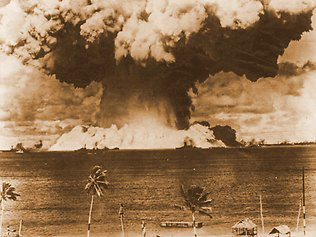
29 August 2025, https://www.icanw.org/nuclear_armed_states_should_come_clean_after_80_years_of_nuclear_testing_harm
Today, the United Nations International Day Against Nuclear Testing, ICAN is calling on the nuclear-armed states that have detonated over 2,000 nuclear devices between them to take full responsibility for the harm they have caused people and the environment.
The first detonation was in New Mexico a few weeks before the nuclear bombings of Hiroshima and Nagasaki 80 years ago this month. Between 1945 and 2007, more than 2000 nuclear tests were carried out, across the world in Algeria, Australia, French Polynesia, Kazakhstan, Kiribati, the Marshall Islands, and the southwestern United States, as well as Alaska, western China, India, North Korea, Pakistan, Russia and Ukraine.
The majority of these explosions were detonated in what were then colonies and/or regions inhabited by Indigenous peoples or other ethnic communities. The communities involved are engaged in efforts for justice and to prevent any return to nuclear testing.
Nuclear testing left a legacy beyond test site boundaries
Radiation cannot be contained geographically; it respects no country’s border. Fallout patterns are complex and the full humanitarian consequences of the fallout of years of particular atmospheric nuclear testing is not known. Fallout is not comprehensively documented in this resource, although some studies on these impacts may be included. For a detailed study on the fallout of a few French nuclear weapons tests in the Pacific – and French efforts to cover it up – see The Moruroa Files.
Nuclear testing is banned
The first international treaty to completely outlaw nuclear testing, the Comprehensive Test Ban Treaty was adopted in 1996, although the treaty has not yet entered into force. The Treaty on the Prohibition of Nuclear Weapons is the only international treaty in force that prohibits nuclear testing. Other treaties ban types of nuclear testing or nuclear testing in certain regions.
What is being done to help those impacted?
The Treaty on the Prohibition of Nuclear Weapons (TPNW) is the first international treaty to ban all nuclear weapons activities, it also requires states parties to provide assistance for survivors of nuclear weapons use and testing and to begin to remediate contaminated environments in Articles 6 and 7. While the primary responsibility for this implementation rests with affected countries, all countries in a position to do so, should help those countries with this work.
Articles 6 and 7 of the TPNW establish a framework of responsibility that offers solidarity and support to affected states parties to address present-day humanitarian and environmental harm from past use and testing. They also serve to place these issues on the agenda of the wider international community, including donors and international organisations. They provide an opportunity for states parties to make a practical difference with and for affected communities.
In some countries where nuclear weapons have been tested there are programs to provide financial or health assistance to survivors or to clean up the environment but none sufficiently address all needs of survivors. Dozens of identified sites around the world remain contaminated by nuclear weapons use, production and testing and there is no one standard for their remediation. Notably there is no widely accepted standard to determine how clean is clean, or how to monitor radiation levels over time. This article in Global Policy reviews existing approaches and looks at what else can be done.
ICAN Calls for states to come clean
ICAN’s Executive Director, Melissa Parke, was in New Mexico last month for the commemorations of the world’s first explosion of a nuclear weapon and to meet communities whose lives were changed forever by the radioactive fallout from the detonation that poisoned their land, air and water. The ‘Trinity Test’ detonated the plutonium bomb design that was used a few weeks later to kill 74,000 people in Nagasaki.
Ms Parke said: “Trinity was followed by more than 2000 nuclear explosions all over the world and the countries responsible – the nuclear-armed states – have never fully acknowledged the catastrophic harm they have caused to people and environments. These countries must stop the cover-up, come clean and provide the support and recognition these communities deserve. The nuclear armed states also need to heed the calls from affected communities for the urgent abolition of nuclear weapons, so that these weapons of total destruction are eliminated before they eliminate us.”
“We gave for France… now that’s enough”: La Hague residents reject Orano’s nuclear pools project

by Marie du Mesnil-Adelée, 08/31/2025, https://france3-regions.franceinfo.fr/normandie/manche/cherbourg-cotentin/on-a-donne-pour-la-france-maintenant-ca-suffit-des-habitants-de-la-hague-rejettent-le-projet-des-piscines-nucleaires-d-orano-3205250.html
“It’s never too late to say: we don’t want it.” Gathered at a public meeting, residents of La Hague spoke out against the “Downstream of the Future” project at the Orano site. A project that includes the installation of three new nuclear pools for storing spent fuel.
An extraordinary nuclear project in La Hague
An extraordinary nuclear project at La Hague, presented by Orano as “the largest industrial project in the world”, costing several tens of billions of euros, “Downstream of the Future” (that’s its name), plans the construction of three new nuclear pools for storing spent fuel and also new workshops and factories on the La Hague site by 2040-2050.
How is this project received by residents?
How is this project being received by residents? In his documentary “Encore de l’énergie” broadcast on Thursday, September 4 on France 3 Normandie and france.tv, Laurent Pannier filmed a public meeting.
Yannick Rousselet, a nuclear expert for Greenpeace, spoke: ” There was no consultation . We would like to debate the appropriateness, the justification of something like this. Today is good. We have given for France, for the nuclear industry and that’s enough. Let’s stop, let’s move on. We want our future to be shaped differently. I think it’s never too late to say we don’t want it.”
A resident adds: “I find it a bit easy for Orano to be able to do whatever they want in terms of construction, however they want, while all the residents of La Hague, as soon as they want to have a window transformed, put in a veranda, do anything, they can’t do anything.”
And a third:
“Today we only have 4 or 5 small hectares of moorland left. It’s more than a relic now, it’s become a symbol. People are saying to us: well, since there’s more than that left, we’re going to remove it and I think that’s a real shame.”
The words are powerful. But the room is far from full… Here, as elsewhere, nuclear power divides. And
those who oppose it are a minority.
Anti-nuclear activists of yesterday and today
In April 2006, the city of Cherbourg held its largest demonstration since the Liberation. Twenty years after Chernobyl, 30,000 activists gathered to protest the proposed construction of a new reactor in Flamanville, the EPR.
Yet, fifteen years later, despite construction delays, despite the additional costs, despite the Fukushima disaster, distrust of nuclear energy has virtually disappeared. Environmental movements are divided between pro- and anti-nuclear supporters. And the announcement of the revival of nuclear power in France, particularly in Normandy, has been generally welcomed by the population.
Laurent Pannier’s new documentary explores this reversal. What happened to the former activists? Is there a new generation? In the face of climate change, is nuclear power a necessary evil?
“Encore de l’énergie” by Laurent Pannier, a documentary to watch this Thursday, September 4 at 10:55 p.m. on France 3 Normandie and on france.tv , for one month.
Government ‘replanning’ £53.3bn geological disposal facility project
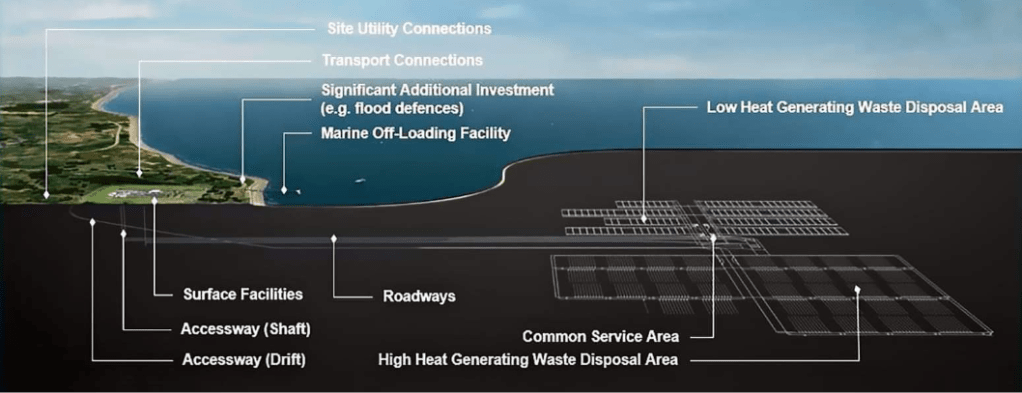
“Successful delivery of the project appears to be unachievable. “There are major issues with project definition, schedule, budget, quality and/or benefits delivery, which at this stage do not appear to be manageable or resolvable.”
02 Sep, 2025 By Tom Pashby
Government ‘replanning’ £53.3bn geological disposal facility project.
Construction of a UK geological disposal facility (GDF) for long-term
nuclear waste disposal is being “replanned” after recent revelations
about its cost and deliverability, according to the government.
A GDF represents a monumental undertaking, consisting of an engineered vault placed between 200m and 1km underground, covering an area of approximately 1km2 on the surface. This facility is designed to safely contain nuclear waste while allowing it to decay over thousands of years, thereby reducing its radioactivity and associated hazards.
The National Infrastructure and
Service Transformation Authority (Nista), a Treasury unit, assessed the GDF
in its Nista Annual Report 2024-2025 and gave it a Red rating in Delivery
Confidence Assessment. This means: “Successful delivery of the project
appears to be unachievable. “There are major issues with project
definition, schedule, budget, quality and/or benefits delivery, which at
this stage do not appear to be manageable or resolvable. The project may
need re-scoping and/or its overall viability reassessed.” In addition,
the Nista annual report lists the “whole life cost” of the GDF as
£20bn as a mid-range assessment and £53.3bn as a high-end assessment.
Government says GDF project facing ‘replanning’ by NDA, but remains
necessary
New Civil Engineer 2nd Sept 2025, https://www.newcivilengineer.com/latest/government-replanning-53-3bn-geological-disposal-facility-project-02-09-2025/
The final furlong: EDF announces further lifetime extension for aging AGR reactors

Britain’s aging Advanced Gas Cooled reactors may, like exhausted
racehorses, be on their last legs, but operator EDF Energy is clearly
intent on keeping them running for as long as possible.
The company
announced yesterday a twelve month extension in operations at their Heysham
1 and Hartlepool AGR plants until March 2028, citing the retention of jobs
and a desire to contribute to the UK achieving net zero and energy security
– but the NFLAs suspect a more pressing motivation.
In a comment to
industry media, NFLA Secretary Richard Outram said: ‘The EDF announcement
is unsurprising. Although company bosses may crow a lot about the
preservation of local jobs, the NFLAs suspect this is about the
preservation of EDF’s bottom line. ‘Given the parlous state of the
French parent company’s finances, the intermittent output of the domestic
fleet, and the vast overspend on Hinkley Point C, EDF have a clear
incentive to keep open for as long as possible any nuclear plant in their
portfolio which operates and generates profits.’
Dr Ian Fairlie, an
independent consultant on radioactivity in the environment and a former
advisor to the UK Government and European Parliament, is also sceptical as
to EDF’s motives: “The real reason why French parent company
Électricité de France wants to prolong the lives of their obsolete,
past-it, reactors is financial.
NFLA 3rd Sept 2025, https://www.nuclearpolicy.info/news/the-final-furlong-edf-announces-further-lifetime-extension-for-aging-agr-reactors/
NATO has outlived its purpose – Jeffrey Sachs

The military bloc should have been dissolved after the collapse of the Soviet Union, the US economist has argued
2 Sep, 2025 , https://www.rt.com/russia/623964-sachs-nato-outlived-purpose/
NATO has outlived its purpose and should have been dissolved decades ago, prominent American economist and Columbia University professor Jeffrey Sachs believes.
Speaking to RIA Novosti on Sunday, Sachs argued that NATO was initially formed for the sole purpose of countering the USSR and should have been disbanded in 1990 when Soviet President Mikhail Gorbachev dissolved the Warsaw Pact – the Soviet-led military alliance that had grouped Eastern Bloc states since 1955.
“NATO was a treaty to defend against the Soviet Union, which doesn’t exist. So in this sense NATO definitely outlived its role. It became instead a mechanism of US power expansion, which is not what NATO should be,” Sachs told the news agency.
He further argued that NATO’s eastward expansion since 1990 has been “wholly unjustified and contrary to Western promises,” referring to assurances given by US officials after the dissolution of the USSR that the bloc would not move closer to Russia’s borders.
Sachs stressed that the organization’s enlargement has had no legitimate security rationale and instead deepened divisions on the European continent.
Russia has repeatedly condemned NATO’s expansion and has described the bloc as a tool for confronting Moscow which destabilizes Europe by fueling tensions. Moscow has pointed to NATO’s attempts to bring Kiev into the bloc as one of the root causes of the Ukraine conflict.
Sachs also noted that Washington still believes it runs the world, a view he described as outdated and dangerous. He said that this delusion is a “source of danger” as the world has become multipolar and new “centers of power” have emerged.
His comments came ahead of the upcoming Eastern Economic Forum, which is set to take place in Vladivostok from September 3 to 6. The economist is scheduled to participate in a session dedicated to the UN’s development agenda beyond 2030, alongside discussions on international cooperation in a changing world order.
Sizewell C Funded Decommissioning Programme: Contingent Liability (Public on the hook)
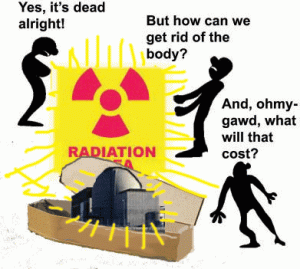
I am pleased to have laid a departmental minute describing the contingent
liabilities arising from the signing of the funded decommissioning
programme and Government support package for Sizewell C. The funded
decommissioning programme at Sizewell C will be funded via the regulated
asset base. The regulated asset base contains a series of protections that
aim to minimise the risk that public funds will be required to meet
decommissioning costs.
However, in certain remote circumstances whereby all
the protections afforded by Sizewell C’s economic licence fall away or a
shortfall in the fund materialises, public funds could be used to
contribute towards decommissioning costs and this liability would
crystalise. Based on best estimates by the Government Actuary Department,
the maximum potential exposure from the liability is £12 billion—in 2022
terms. This has been estimated on a worse-case scenario whereby the
Government were required to meet the full costs of decommissioning the
Sizewell C power plant.
Hansard 1st Sept 2025, https://hansard.parliament.uk/commons/2025-09-01/debates/25090137000015/SizewellCFundedDecommissioningProgrammeContingentLiability
A Folly Too Far?

In 2020 the cost was set at £20bn. but the ultimate cost by 2040, when it might begin operating, could well be north of £40bn. By 2040 it will be too late to make any impression on Net Zero and, if it ever gets finished, Sizewell C will be an expensive and inflexible white elephant cranking out power that is not needed but which will impede the development of the array of renewable systems.
2 September 2025, https://www.banng.info/news/regional-life/folly-too-far/
Andrew Blowers tackles this question in the BANNG column for July 2025
On a fine summer’s day, in early June, Varrie and I travelled to Suffolk to show BANNG’s support for the Outrage Rally against Sizewell C. There were around 300 people assembled on the dunes to protest against the outrageous project and to commemorate the life of one of the great environmental and anti-nuclear campaigners, Pete Wilkinson, who had died in January. There were speeches from his two daughters, Amy and Emily and from Jonathon Porritt, the veteran campaigner who drew attention to the scene before us – the invisible power of the wind and sea on the one hand and the unseen threat of radioactivity posed by the hulk of Sizewell A and the operating Sizewell B on the other.
The protesters marched along the sandy beach to the site of Sizewell C where we tied yellow ribbons to the perimeter security fence in tribute to the outrage and courage that Pete had displayed through his life, successfully campaigning against mining in the Antarctic, dumping of radioactive waste in the Atlantic and stopping up the Sellafield outflow pipe into the Irish Sea. Beyond the fence could be seen the removal of ancient woodland, construction of roads and destruction of countryside and wildlife bordering the precious RSPB Minsmere Reserve in preparation for construction. And the subsequent construction of a huge and dangerous complex of reactors, turbines and long-term, highly radioactive waste stores on a precarious coast was terrifying to imagine.
There was a sense of an unequal struggle, a local community fighting together against an uncompromising government and powerful and well-resourced industry. While the mood was defiant there was an underlying sense of impending defeat.
And, sure enough, three days later came the long-anticipated announcement that Sizewell C was to go ahead, backed by £14.2bn. subsidy for the first four years of construction and up-front payments loaded onto consumer bills. A Final Investment Decision has not been taken, awaiting the commitment of private investors to match the public investment. If private investors do not come forward then either the project must be ditched (too embarrassing for the government) or we (taxpayers and consumers) are in hock for the total cost.
The Sizewell project is the type of big investment that encourages government ministers to don hard hats and suitably logoed high-vis jackets to proclaim a new golden age of clean energy. They haughtily dismiss the ‘blockers’ – we who strive to defend precious communities and landscapes and prevent the financial incontinence that inevitably flows from such complex and uncertain projects.
So, as the Sizewell protesters say, Sizewell C could become Suffolk’s HS2: half-built and unfinished because of finance.
EDF’s Heysham 1 and Hartlepool nuclear plants to operate for further 12 months
New Civil Engineer, 02 Sep, 2025 By Tom Pashby
The operational lives of the Heysham 1 and Hartlepool nuclear power plants have been extended by 12 months by their operator EDF………………
Hartlepool, Heysham 1, Heysham 2 and Torness all underwent reviews by EDF in December 2024 to assess how long they can continue to generate electricity. Heysham 1 and Hartlepool were scheduled to stop producing power in March 2027.
At the time, an EDF spokesperson explained to NCE that the best-case scenario for the Heysham 1 and Hartlepool power stations was that they could justify a one-year extension. However, that was caveated with a need to await the outcomes of “important inspection and safety case milestones”, which were due to be completed in 2025.
Those milestones have now passed and the results were positive for the power stations. When EDF’s executive and licensee boards met yesterday, 1 September, they gave approval to extend the lives of the nuclear stations, so Heysham 1 and Hartlepool will now likely operate through to at least March 2028.
A statement from EDF on 2 September said: “Heysham 2 and Torness, which are both scheduled to generate until March 2030, were not in scope for this review after a two-year extension was granted last year.”
EDF still hopes to see all four AGRs continue producing electricity for as long as possible, so it can be expected to conduct further reviews down the line, but these reviews do not have set dates for completion, the spokesperson told NCE……………………………………………………………………………………………………………………………
AGRs now well past their sell-by date’ – anti-nuclear campaigner
Nuclear Free Local Authorities secretary Richard Outram told NCE that the extension of the plants’ operating lives raises concerns about the possibility of graphite cracking.
“The EDF announcement is unsurprising. Although company bosses may crow a lot about the preservation of local jobs, the NFLAs suspect this is actually about the preservation of EDF’s bottom line,” he said.
“Given the parlous state of the French parent company’s finances, the intermittent output of the domestic fleet, and the vast overspend on Hinkley Point C, EDF has a clear incentive to keep open for as long as possible any nuclear plant in the portfolio which actually operates and generates profits.
“The NFLAs have previously expressed our concerns with the Office for Nuclear Regulation that these ageing AGRs are now well past their sell-by date, with graphite cracking being a real worry, as seen recently at the sister AGR plant at Torness.
“We shall continue to monitor the situation and ask challenging questions of regulators and the industry because public safety and environmental harm must never be compromised in favour of company profit.”………………………………………………. https://www.newcivilengineer.com/latest/edfs-heysham-1-and-hartlepool-nuclear-plants-to-operate-for-further-12-months-02-09-2025/
1 This Month

of the week – Shut Down Drone Warfare!


Tell the Ukrainian Government to Drop Prosecution of Peace Activist Yurii Sheliazhenko

Petition to revoke the licensing of the Near Surface Nuclear Disposal Facility (NSDF) at Chalk River. https://www.ourcommons.ca/petitions/en/Petition/Details?Petition=e-7247
To see nuclear-related stories in greater depth and intensity – go to https://nuclearinformation.wordpress.com
-
Archives
- April 2026 (57)
- March 2026 (251)
- February 2026 (268)
- January 2026 (308)
- December 2025 (358)
- November 2025 (359)
- October 2025 (376)
- September 2025 (257)
- August 2025 (319)
- July 2025 (230)
- June 2025 (348)
- May 2025 (261)
-
Categories
- 1
- 1 NUCLEAR ISSUES
- business and costs
- climate change
- culture and arts
- ENERGY
- environment
- health
- history
- indigenous issues
- Legal
- marketing of nuclear
- media
- opposition to nuclear
- PERSONAL STORIES
- politics
- politics international
- Religion and ethics
- safety
- secrets,lies and civil liberties
- spinbuster
- technology
- Uranium
- wastes
- weapons and war
- Women
- 2 WORLD
- ACTION
- AFRICA
- Atrocities
- AUSTRALIA
- Christina's notes
- Christina's themes
- culture and arts
- Events
- Fuk 2022
- Fuk 2023
- Fukushima 2017
- Fukushima 2018
- fukushima 2019
- Fukushima 2020
- Fukushima 2021
- general
- global warming
- Humour (God we need it)
- Nuclear
- RARE EARTHS
- Reference
- resources – print
- Resources -audiovicual
- Weekly Newsletter
- World
- World Nuclear
- YouTube
-
RSS
Entries RSS
Comments RSS
 nuclear-news