Gaza to Donbass: How Israel and Ukraine Built a Fascist, Transnational War Machine.

Orinoco Tribune By Sarah B. – Aug 20, 2025
From Bandera to Ben-Gurion, a new axis of ethno-supremacy is rising, fueled by U.S. backing. Same guns. Same flags. Same ideology. Gaza and Donbass are not separate wars. They are one machine.
The Ukraine–Israel Nexus: Pragmatic Alliances Amid Paradoxes and Shared Challenges
From Bandera to Ben-Gurion, echoes of ethno-nationalist revival resonate in the modern trajectories of Ukraine and Israel, two states forged through war, hardened by siege mentalities, and fueled by historical narratives of existential struggle. But these similarities are no accident of parallel development. They reflect a deepening alignment shaped by shared adversaries like Russia and Iran, backed and brokered by the same Western patrons.
In 2022, an officer of Ukraine’s Azov Regiment, toured Israel after surviving the siege of Mariupol. By 2025, Israeli drones were flying missions over Rafah, while American-made PSRL-1 rocket launchers, initially supplied to Ukraine, were spotted in conflict zones across the Middle East. Some experts suggest these may have reached Gaza through black-market channels, though a direct transfer remains unproven. What is undeniable, however, is the convergence of military technologies, intelligence doctrines, and battlefield logistics spanning both theaters.
In April 2022, Ukrainian President Volodymyr Zelenskyy, himself a stalwart ally to the Zionist cause, declared that he envisioned Ukraine becoming “a big Israel.” In doing so, he abandoned the pretense of liberal reform and embraced a future defined by permanent militarization, domestic surveillance, and an ideologically mobilized citizenry. Ukraine, he suggested, would survive not by joining Europe’s post-national dream, only by imitating the ethos of a heavily securitized Middle Eastern state.
Zelenskyy’s statement didn’t emerge in a vacuum. It followed decades of quietly intensifying Ukrainian–Israeli ties, in historical memory, military cooperation, tech integration, and shared narratives of victimhood. But it also exposed a deeper and more disturbing fusion. When the president of a country still reckoning with the legacy of the Holocaust and its own fascist collaborators calls for the building of a “Big Israel,” he is not just invoking a model of defense, he is invoking a model of justified violence, permanent siege, and a long tradition of selective memory, one that both Ukraine and Israel have wielded to reconcile uncomfortable historical alliances of culpability.
Just as the OUN’s collaboration with Nazi Germany is selectively reframed within the Ukrainian national mythos, Israel’s founding story often omits its own moments of strategic accommodation with fascism.
In the 1930s and ’40s, elements of the Zionist movement, most notably the Haavara Agreement between Nazi Germany and the Jewish Agency, facilitated Jewish emigration to Palestine while bypassing international boycotts of the Nazi regime. Revisionist factions like Lehi (the Stern Gang) and Irgun Zvai Leumi even sought military cooperation with the Axis powers against the British. These uncomfortable truths, long buried beneath the moral absolutism of Holocaust remembrance, underscore a shared willingness, Ukrainian and Zionist alike, to collaborate with and even become genocidal regimes when national aspirations were at stake.
What binds Gaza and Donbass is not a monolithic “machine of violence” but a transnational matrix of ideological alignment, technical cooperation, and strategic utility. Ukraine’s campaign of “decommunization” often mirrors Israel’s internal securitization and demographic engineering, both clad in the moral armor of historical trauma. In practice, both states justify aggressive internal and external policies through the language of survival.
This article maps the ideological, military, economic, and cultural architecture of the Ukraine–Israel relationship. From Soviet-era tensions to the post-2014 reconfiguration of alliances, we explore how pragmatic imperatives have forged a new axis of ethno-nationalist power, increasingly central to NATO’s long-term vision of regional dominance.
I. Historical Ties
To understand the modern partnership between Ukraine and Israel, one must begin with their shared, and often contradictory past. Ukraine was both a cradle of early Zionism and a site of violent antisemitic pogroms. Movements like Hibbat Zion, emerged in the 1880s in cities like Odessa and Kiev, decades before Theodor Herzl’s more famous Vienna-based political Zionism. Their mission: to restore the Jewish people to their ancestral homeland in Palestine. Ukraine, in this sense, was an incubator for the ideological DNA of the Israeli state……………………………………………………………………………………………………………………………………………………………………………………………….
…………………….The historical relationship between Israel and Ukraine is not one of ideological clarity. It is a pragmatic evolution, shaped by war, memory, trauma, and strategy. The next sections will examine how these contradictions manifest on the battlefield through weapons, doctrine, personnel, and propaganda, across Gaza and Donbass alike.
Selective Memory: How Competing Genocides Forged Strategic Amnesia
In the narrative war between historical truth and political utility, few examples are as revealing, or as cynical, as the ways Ukraine and Israel have reframed and often embellished their respective traumas to enable strategic cooperation.
By the 1980s, Ukrainian nationalist émigrés began aggressively promoting the 1932–33 Soviet famine, or Holodomor, as the “Ukrainian Holocaust.” This was a calculated response to the rising global awareness of Jewish suffering, spurred by the 1978 NBC miniseries Holocaust, which explicitly portrayed Ukrainians as Nazi collaborators. For diaspora groups still loyal to Stepan Bandera’s legacy, the documentary posed a threat to their rehabilitated image, which they had worked fervently to whitewash. In turn, they constructed a counter-narrative of equal, if not greater, Ukrainian victimhood, one that would cast the Soviet state as genocidal and reframe Ukrainian history through the lens of national martyrdom.
This rhetorical project relied on inflating death tolls,………………………………………………………………..
The result is a pact built on strategic amnesia: a cold alliance between two states whose foundational traumas have been rewritten to serve military alignment, ideological affinity, and common enemies………………………….
…………II. Blood Ties and Battle Lines: Commanders, Crusaders, and Collaborators
The machinery of transnational warfare is not only built with weapons, laws, and doctrines, but with men. Individuals who embody the ideological convergence between Zionist ethno-nationalism and Ukrainian fascism do not operate in the shadows; they are often celebrated, recruited, and strategically deployed across theaters like Gaza and Donbass. These figures serve as ideological evangelists, field commanders, propaganda tools, and networking nodes between far-right militias, Western intelligence networks, and private security structures.
Some are Azov veterans turned actors and influencers. Others are American-Israeli contractors building bridges between Tel Aviv and Kiev. ……………………..
Continue readingUnaudited Power: The Military Budget That Nobody Controls
August 26, 2025 By Ellen Brown ScheerPost, https://scheerpost.com/2025/08/26/ellen-brown-unaudited-power-the-military-budget-nobody-controls/
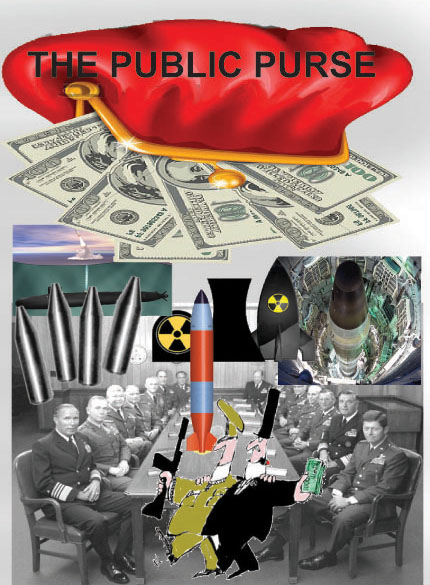
The U.S. federal debt has now passed $37 trillion and is growing at the rate of $1 trillion every five months. Interest on the debt exceeds $1 trillion annually, second only to Social Security in the federal budget. The military outlay is also close to $1 trillion, consuming nearly half of the discretionary budget.
As a sovereign nation, the United States could avoid debt altogether by simply paying for the budget deficit with Treasury-issued “Greenbacks,” as Abraham Lincoln’s government did. But I have written on that before (see here and here), so this article will focus on that other elephant in the room, the Department of Defense.
Under the Constitution, the military budget should not be paid at all, because the Pentagon has never passed an audit. Expenditures of public funds without a public accounting violate Article 1, Section 9, Clause 7of the Constitution, which provides:
“No Money shall be drawn from the Treasury, but in Consequence of Appropriations made by Law; and a regular Statement and Account of the Receipts and Expenditures of all public Money shall be published from time to time.”
The Pentagon failed its seventh financial audit in 2024, with 63% of its $4.1 trillion in assets—approximately $2.58 trillion—untracked. From 1998 to 2015, it failed to account for $21 trillion in spending.
As concerning today as the financial burden is the wielding of secret power. Pres. Dwight Eisenhower warned in his 1961 farewell address, “In the councils of government, we must guard against the acquisition of unwarranted influence, whether sought or unsought, by the military-industrial complex. The potential for the disastrous rise of misplaced power exists and will persist.”
Pres. John F. Kennedy echoed that concern, warning in 1961 that “secret societies” and excessive secrecy are “repugnant in a free and open society,” threatening democracy by withholding truth from the public. He warned that excessive concealment, even for national security, undermines democracy by denying citizens the facts needed to hold power accountable. “No expenditure is questioned, no rumor is printed, no secret is revealed,” he said. If untracked billions fund classified programs, citizens are left powerless, governed by a shadow entity answerable to no one.
Those concerns persist today. On Aug. 13, 2025, Joe Rogan interviewed U.S. Representative Anna Paulina Luna, who leads a House Oversight Committee focused on government transparency regarding various topics, including UAPs (Unidentified Anomalous Phenomena, formerly UFOs). Luna said the committee had been formed after she and two other congressmen were denied access at Eglin Air Force Base to information on UAPs provided by whistleblowers. The problem, she said, was that Congress was supposed to represent the public and be an investigative body for it, “and you have unelected people operating basically in secrecy. … I think this goes all the way back even to JFK, with how they basically have operated outside of the purview of Congress and basically… have gone rogue ….”
A Behemoth Without Oversight
The Department of Defense’s $885.7 billion budget for 2025, approved by the House of Representatives, dwarfs the military spending of China ($296 billion), Russia ($84 billion), and the next eight nations combined. Managing $4.1 trillion in assets—from aircraft carriers to secret drones—along with $4.3 trillion in liabilities (e.g. personnel costs and pensions), the federal government’s largest agency oversees a military empire spanning over 4,790 sites worldwide. Yet it operates with minimal oversight.
The Chief Financial Officers Act of 1990 mandated audits for all federal agencies, but the National Defense Authorization Act of 2018 delayed the Pentagon’s first department-wide audit to 2018 due to its unwieldy size, its decentralized systems, and its outdated software. The DOD has failed every audit since that time. In 2024, it could not account for its $824 billion FY 2024 budget, with 2,500 new audit issues identified. Of 24 reporting entities, only nine received clean opinions, while 15 received disclaimers due to insufficient data. In fact the Government Accountability Office (GAO) has flagged DoD financial management as high-risk for waste, fraud, and abuse ever since 1995.
As observed in a January 2019 article in Rolling Stone by Matt Taibbi, openly secret budgets were first legalized in 1949 with the passage of the Central Intelligence Agency Act, which exempted that newly created agency from public financial disclosure. The Act stated, “The sums made available to the Agency may be expended without regard to the provisions of law and regulations related to the expenditure of Government funds.”
The aim of the Chief Financial Officers Act of 1990 was to curb billions of dollars said to be lost each year through fraud, waste, abuse, and mismanagement of public budgets. Despite the mandated audits for all federal agencies, the DoD – the only major agency without a clean audit – has received $3.9 trillion in congressionally approved funding since 2018. “Every year that members of Congress vote to boost Pentagon spending with no strings attached,” observed federal budgeting expert Lindsay Kosgharian, “they choose to spend untold billions on weapons and war with no accountability.”
The Audit the Pentagon Act of 2023, backed by Sens. Bernie Sanders and Chuck Grassley, proposes docking 0.5–1% of budgets for audit failures, but the measure has not received a vote.
The Department of Government Efficiency (DOGE), launched with promises to strip waste, fraud, and abuse from federal agencies, has conspicuously sidestepped the Pentagon. A June 2025 article titled “Why DOGE Was Always Doomed: The Pentagon Problem,” points out that the DOGE mission was seriously hampered by the Pentagon’s exemption from auditing:
In FY 2024, total discretionary spending was about $1.6 trillion. Of that, the Pentagon alone received $842 billion. In other words, it got more funding than all other departments combined. You read that right: one (very special) department received more than all the rest put together.
Funds that are not accounted for divert resources from critical needs like troop readiness, healthcare, and infrastructure. Overbilling by contractors enriches corporations while taxpayers foot the bill. And the lack of transparency erodes public confidence, as Americans struggle with domestic priorities.
The Missing $21 Trillion: Fraud, Waste or Something Worse?
The Pentagon’s audit failures mask not just inefficiency and waste but pervasive fraud and corruption. Between 1998 and 2015, Inspector General reports show that the DoD could not account for $21 trillion in spending—65% of federal spending during that period. For perspective, the entire U.S. GDP in 2015 was $18.2 trillion. In 2023, the agency failed to document 63% of its $3.8 trillion in assets, up from 61% the prior year. A 2015 DoD report identifying $125 billion in administrative waste was suppressed to protect budget increases.
There is plenty of verified waste to support the case for mismanagement. Military contractors, who receive over half of the Pentagon’s budget, are a major culprit. The F-35 program, managed by Lockheed Martin, was reported in 2021 to be $165 billion over budget, with $220 billion in spare parts poorly tracked. A 2023 CBS News investigation found that contractors routinely overcharged by 40–50%, with some markups reaching 4,451%. A 2016 report in the Nation highlighted $640 for a toilet seat and $7,600 for a coffee pot.
It is no longer even necessary to cover up fraud and corruption by wildly inflated prices. In 2017, former HUD official Catherine Austin Fitts collaborated with Mark Skidmore, an economics professor at Michigan State University, to document the missing $21 trillion in unsupported journal voucher adjustments at the DoD and HUD. In a June 2025 article published in Fitts’ journal The Solari Report titled “Should We Care about Secrecy in Financial Reporting?,” Dr. Skidmore discussed how the government responded to the publication of his research with Fitts. Its response was to immediately eliminate the paper trail leading to its covert financial operations. In particular, “Pentagon officials turned to the Federal Accounting Standards Advisory Board (FASAB) for advice. Several months later, FASAB posted a new document (FASAB 56), which recommended that the government be allowed to misstate and move funds to conceal expenditures if it is deemed necessary to protect national security interests.”
Fitts remarked, “The White House and Congress just opened a pipeline into the back of the US Treasury, and announced to every private army, mercenary and thug in the world that we are open for business.”
Speculation Run Rampant
In a widely-viewed interview by Tucker Carlson on April 28, 2025, Fitts expressed her belief that the missing trillions had been funneled into classified projects involving advanced technologies, including massive underground bunkers to protect elites from a “near-extinction event;” and that they were using advanced energy systems and hidden transit networks possibly linked to extraterrestrial tech. She discussed “interdimensional intelligence” and a secret space program linked to a “breakaway civilization.” The latter term was coined by UFO researcher Richard Dolan and is defined by Google as “a theoretical, hidden society that operates outside of mainstream civilization with advanced technology, often linked to UFO phenomena and secret space programs.”
In a Danny Jones interview in May 2025, Fitts alluded to Deep Underground Military Bases (“DUMBs”), perhaps used for “advanced technology or off-world operations.” Existence of these bases was confirmed two decades earlier by whistleblower Philip Schneider, a U.S. government geologist and engineer involved in their construction. In his last presentation in 1995, Schneider said there were 131 of these cities connected underground by mag-lev rail, built at a cost of $17-26 billion each. According to his biographer, Schneider was assassinated in 1996 by a U.S. intelligence agency for disclosing the government cover-up of UFOs and aliens.
Too over the top? Perhaps, but the Pentagon is so secretive that the public is left to speculate. Are we dealing with a scenario like that in such Hollywood movies as the 1997 film Men in Black, in which hidden forces—human or alien—control our fate?
The Pentagon’s All-domain Anomaly Resolution Office (AARO) contends that no verifiable evidence supports extraterrestrial activity. But other prominent figures support the UFO/UAP narrative. In 2017, the New York Times exposed the Advanced Aerospace Threat Identification Program (AATIP), said to be a $22 million DoD initiative run by Luis Elizondo investigating UAPs from 2007–2012.
According to BBC News, Haim Eshed, former head of Israel’s space security program, claimed in a 2020 interview with the Yediot Aharonot newspaper that the U.S. government has an “agreement” with a “Galactic Federation” of extraterrestrials. He alleged aliens have been in contact with the U.S. and Israel, with secret underground bases where they collaborate on experiments. Eshed claimed the United States was on the verge of disclosing this under President Trump but withheld it to avoid “mass hysteria.” The claims were unverified but provocative.
In recent years, Congress has increased its focus on UAPs, with high-profile hearings in 2022, 2023, and 2024. In 2023, whistleblower David Grusch, a former intelligence officer, testified that the U.S. possesses “non-human origin” craft and “dead pilots,” based on classified briefings. On November 13, 2024, the House Oversight Committee’s hearing, “Unidentified Anomalous Phenomena: Exposing the Truth,” featured testimony from Luis Elizondo, retired Navy Rear Admiral Tim Gallaudet, journalist Michael Shellenberger, and former NASA official Michael Gold, who claimed the U.S. possesses UAP technologies and has harmed personnel in secret retrieval programs. Shellenberger alleged that a covert “Immaculate Constellation” program hides UAP data from Congress.
Some lawmakers, including Rep. Luna and Rep. Tim Burchett, continue to criticize Pentagon secrecy and to push for transparency. In May 2024, Burchett introduced the UAP Transparency Act, requiring the declassification of all UAP-related documents within 270 days. He stated:
This bill isn’t all about finding little green men or flying saucers, it’s about forcing the Pentagon and federal agencies to be transparent with the American people. I’m sick of hearing bureaucrats telling me these things don’t exist while we’ve spent millions of taxpayer dollars on studying them for decades.
Secrecy Undermines Democracy
With $21 trillion unaccounted for historically, $165 billion in F-35 overruns, and $125 billion in buried waste, the DoD’s financial mismanagement needs urgent reform. Congress is primarily responsible for overseeing the DoD budget, exercising its constitutional “power of the purse” under Article 1 of the U.S. Constitution. So why isn’t it enforcing this mandate?
The chief excuse given is the need for secrecy for security reasons, but a congressional committee could be given access to the Pentagon’s financial data in closed session in order to exercise public oversight and enforce accountability. Other factors are obviously at play, including political influence, lobbying, campaign contributions from the defense sector, and a lack of penalties for noncompliance.
To restore accountability, Congress needs to enforce the Audit the Pentagon Act, modernize DoD systems, and investigate contractors profiting from lax oversight. UAP transparency is also critical, whether to debunk myths or uncover truths.
As taxpayers footing the bill, we are entitled to know not only where our money is being spent but who is really in charge of our government. The Pentagon’s secrecy and lack of accountability could be shielding anything from contractor fraud to UAP programs and alien alliances. If there is information so secret that even our elected representatives don’t have access to it, who does have access? Is there a secret government above the government we know? Without fiscal transparency and accountability, we can no longer call ourselves a democracy, as JFK warned.
2nd September CND Webinar – From Hiroshima to Today: Jeremy Corbyn & Caroline Lucas report back

2nd September CND Webinar – From Hiroshima to Today: Jeremy Corbyn & Caroline Lucas report back – Register here.
This year, across the world, commemorations have taken place marking the 80th anniversary of the atomic bombings of Hiroshima and Nagasaki. CND Vice-Presidents Jeremy Corbyn and Caroline Lucas participated on behalf of CND in Japan to hear first-hand the powerful testimony of Hibakusha. They joined delegates from across the world to discuss the growing global nuclear dangers and how to strengthen international opposition to the escalating war drive that is accompanying the expansion and modernisation of nuclear weapons.
Indonesia Bets On Thorcon’s Molten Salt Reactor, But History Suggests Trouble Ahead.
Indonesia has none of the ingredients that historically led to nuclear success. It has no prior nuclear fleet, no experience operating reactors, no large-scale nuclear workforce, no plans to build nuclear weapons and no tradition of standardized reactor builds.
Michael Barnard, Clean Technica, 27 Aug 25
Indonesia has taken a bold and likely problematic step with the announcement of its first, early stage regulatory approval for a nuclear power project. Thorcon International, a Singapore-based developer of molten salt reactors, has received permission from Indonesia’s regulator to evaluate a site for a demonstration plant on Kelasa Island. For a country of more than 270 million people with electricity demand that is still growing rapidly, this might appear to be a turning point. Yet if one examines history, technology, and the context in which this project is being launched, the chances of it succeeding look vanishingly small.
Indonesia is the world’s largest archipelago, stretching across more than 17,000 islands, with only about 6,000 of them inhabited. This geography creates enormous challenges for the national grid, which is fragmented into multiple regional systems rather than a single interconnected backbone. Java and Sumatra host most of the country’s transmission infrastructure, while many outlying islands depend on small isolated grids. Remote communities often rely on diesel generators for electricity, which are expensive to operate and create significant local pollution…………………………………………………………….
the government has announced a target of 10 GW of nuclear capacity by 2040, marking its first commitment to nuclear power.
If delivered, these additions would lift renewables to roughly 35% of the national mix while also introducing nuclear into the system for the first time. Looking further ahead, Indonesia targets 75 GW of new renewable capacity by 2035, supported by more than 10 GW of storage, reflecting the scale of investment needed to diversify away from coal and meet climate commitments.
Nuclear power has only succeeded when certain conditions were in place. In the mid-twentieth century, large economies aligned nuclear energy programs with nuclear weapons programs. They standardized on one design, built dozens of gigawatt-scale plants in sequence, trained workforces through government-led programs, and maintained focus for decades. Those programs were not efficient by today’s standards, but they were coherent and well-resourced.
Countries that did not follow that formula, such as Canada’s stop-start approach with CANDUs or the the last couple of decades of western nuclear reactor builds, ended up with mixed results and rising costs. Even China, which has mastered megaproject delivery, is struggling with nuclear because it has spread effort across too many designs and has not locked into the necessary standardization. While nuclear advocates in the west point to China’s build out as impressive, it is years behind on targets and falling further behind. It only achieved its 2020 target in 2024, is still well under its 2% of grid capacity target for 2025 and its scheduled construction through 2030 will leave it tens of GW off that target.
Indonesia has none of the ingredients that historically led to nuclear success. It has no prior nuclear fleet, no experience operating reactors, no large-scale nuclear workforce, no plans to build nuclear weapons and no tradition of standardized reactor builds. It’s not building dozens of standard and proven GW-scale reactors, but only 10 GW in total, starting with a 500 MW unproven design, and not necessarily repeating that one solution multiple times. So far they appear to have little political opposition to nuclear, but that doesn’t mean the bipartisan support required for a two to four decade strategic national construction program. The country is signatory to the nuclear Non-Proliferation Treaty and has eliminated highly enriched uranium that might be transferable to nuclear weapons from the countyr, so there is military strategic alignment and discipline to call upon.
The choice of a molten salt reactor adds another layer of difficulty. Molten salt designs were first tested at Oak Ridge in the 1960s. They worked in the lab but ran into issues with corrosion, material embrittlement, plugging of salt lines, and complex chemistry that had to be actively managed. They never scaled beyond a few megawatts of thermal output. In recent years, startups from North America to Scandinavia have revived the concept, promising walk-away safety and lower costs. Yet not a single one has delivered a commercial plant. Thorcon itself has never built or operated a reactor, anywhere. It is proposing to build large sealed modules in shipyards and tow them to Indonesia, an approach that exists only on paper.

……………………………..Germany tried thorium in its pebble-bed reactor, and India built an entire nuclear strategy around its domestic thorium reserves, planning a three-stage cycle that would eventually rely on advanced heavy water reactors fueled with uranium-233 bred from thorium. Yet in every case, thorium stopped short of commercial deployment. The complexity of fuel handling, the need for an initial fissile inventory of uranium or plutonium, and the sheer momentum of the uranium-fueled reactor fleet kept thorium in the category of “promising but not delivered.”
Thorcon’s original vision was built on thorium’s promise. Its very name, short for “Thorium Concept,” signaled an intention to commercialize molten salt reactors running on a thorium cycle. Early designs envisioned dissolving thorium in molten fluoride salt, breeding uranium-233 in situ, and demonstrating the fuel’s long-touted advantages. But as the company moved from concept to trying to build an actual plant in Indonesia, pragmatism set in. For a first-of-a-kind power reactor, relying on thorium would mean untested chemistry, uncertain licensing pathways, and even greater risk.
Indonesia’s proposed demonstration plant is therefore designed to run on conventional low-enriched uranium fuel dissolved in molten salt, not thorium. Thorium remains a potential long-term option in the design, but the Indonesian reactor will take the easier, more familiar path to get the project off the ground. In other words, while Thorcon began as a bet on thorium, its first potential real-world deployment has been scaled back to uranium, underscoring how thorium continues to hover at the edge of nuclear power rather than forming its core.
Bent Flyvbjerg’s work on megaprojects should be a warning. He has shown repeatedly that nine out of ten large projects go over budget and over schedule, and nuclear projects are consistently among the very worst. The average nuclear build is more than 100% over budget and about a decade late. Add in the fact that this is a first-of-a-kind reactor by a company with no track record, in a country with no nuclear infrastructure, and the probability of delivering on time, on budget, and at promised cost of electricity falls close to zero. Even if the project is eventually completed, it will almost certainly take much longer and cost much more than advertised, and the benefits to Indonesia will not match the rhetoric.
The alternative paths are clearer and less risky. Indonesia sits on some of the world’s richest geothermal resources and has significant hydro potential. Solar costs continue to fall and the archipelago has ample land and rooftops for deployment. With investment in storage, interconnections, and grid modernization, these resources could supply reliable and cheap electricity without the risks of nuclear. International partnerships like the Just Energy Transition Partnership are already funneling billions into renewables and grid upgrades. Building out this system is not trivial, but it does not carry the weight of unproven technologies, uncertain regulation, and the specter of megaproject failure that Thorcon does.
……………………..A better bet would be to double down on renewables, expand storage, and build the transmission backbone to connect islands and balance supply. That path has its own challenges but rests on proven technologies already delivering results worldwide. Indonesia has made a bold gesture toward nuclear. The sober assessment is that it will not pay off. https://cleantechnica.com/2025/08/26/indonesia-bets-on-thorcons-molten-salt-reactor-but-history-suggests-trouble-ahead/
Iran parliament presses government to apply law limiting IAEA cooperation
Iran’s parliament on Tuesday urged the Foreign Ministry and Atomic
Energy Organization to fully implement existing legislation limiting
cooperation with the International Atomic Energy Agency, amid growing
pressure from Western powers and renewed nuclear talks in Geneva. In a
strongly worded statement, the National Security and Foreign Policy
Committee of Iran’s parliament described IAEA chief Rafael Grossi as “a
servant of the US and the Zionist regime,” accusing him of siding with
hostile powers and remaining silent over attacks on Iranian nuclear sites,
according to remarks published by state media.
Iran International 26th Aug 2025, https://www.iranintl.com/en/202508262134
UN inspectors back in Iran as IAEA chief gets protection over Tehran threat
The UN nuclear watchdog’s inspectors have returned to Iran after their
expulsion during a brief war with Israel and the US, IAEA chief Rafael
Grossi said Tuesday, amid reports he has been placed under 24/7 protection
following Iran’s threat to his life. “Now the first team of IAEA inspectors
is back in Iran, and we are about to restart,” International Atomic Energy
Agency (IAEA) director general Grossi said. Grossi, who was in Washington
DC for the annual meeting of the Institute of Nuclear Materials Management,
stopped short of saying there was an agreement or timeline for them to
resume their work. “When it comes to Iran, as you know, there are many
facilities. Some were attacked, some were not. So we are discussing what
kind of modalities, practical modalities, can be implemented in order to
facilitate the restart of our work there.”
Iran International 26th Aug 2025, https://www.iranintl.com/en/202508265100
Israel Bombs Gaza Hospital, Kills 5 Journalists from AP, Al Jazeera, Reuters, NBC
August 26, 2025
Transcript………………………………………………………………………………………………………………………………… https://www.democracynow.org/2025/8/25/gaza_journalists
Think Tanker Demands for AUKUS: What Australia Should do with US Submarines.

“AUKUS is only going to lead to more submarines collectively in 10, 15, 20 years, which is way beyond the window of maximum danger, which is really this decade.”
26 August 2025 Dr Binoy Kampmark, https://theaimn.net/think-tanker-demands-for-aukus-what-australia-should-do-with-us-submarines/
The moment the security pact known as AUKUS came into being, it was clear what its true intention was. Announced in September 2021, ruinous to Franco-Australian relations, and Anglospheric in inclination, the agreement between Washington, London and Canberra would project US power in the Indo-Pacific with one purpose in mind: deterring China. The fool in this whole endeavour was Australia, with a security establishment so Freudian in its anxiety it seeks an Imperial Daddy at every turn.
To avoid the pains of mature sovereignty, the successive Australian governments of Scott Morrison and Anthony Albanese have fallen for the bribe of the nuclear-powered Virginia Class SSN-774 and the promise of a bespoke AUKUS-designed nuclear–powered counterpart. These submarines may never make their way to the Royal Australian Navy. Australia is infamously bad when it comes to constructing submarines, and the US is under no obligation to furnish Canberra with the boats.
The latter point is made clear in the 2023 National Defense Authorization Act, which directs the US President to certify to the relevant congressional committees and leadership no later than 270 days prior to the transfer of vessels that this “will not degrade the United States underseas capabilities”; is consistent with the country’s foreign policy and national security interests and furthers the AUKUS partnership. Furthering the partnership would involve“sufficient submarine production and maintenance investments” to meet undersea capabilities; the provision by Australia of “appropriate funds and support for the additional capacity required to meet the requirements”; and Canberra’s “capability to host and fully operate the vessels authorized to be transferred.”
In his March confirmation hearing as Undersecretary of Defense Policy, Eldridge Colby, President Donald Trump’s chief appointee for reviewing the AUKUS pact, candidly opined that a poor production rate of submarines would place “our servicemen and women […] in a weaker position.” He had also warned that, “AUKUS is only going to lead to more submarines collectively in 10, 15, 20 years, which is way beyond the window of maximum danger, which is really this decade.”
The SSN program, as such unrealised and a pure chimera, is working wonders in distorting Australia’s defence budget. The decade to 2033-4 features a total projected budget of A$330 billion. The SSN budget of A$53-63 billion puts nuclear powered submarines at 16.1% to 19.1% more than relevant land and air domains. A report by the Strategic Analysis Australia think tank did not shy away from these implications: “It’s hard to grasp how unusual this situation is. Moreover, it’s one that will endure for decades, since the key elements of the maritime domain (SSNs and the two frigate programs) will still be in acquisition well into the 2040s. It’s quite possible that Defence itself doesn’t grasp the situation that it’s gotten into.”
Despite this fantastic asymmetry of objectives, Australia is still being asked to do more. An ongoing suspicion on the part of defence wonks in the White House, Pentagon and Congress is what Australia would do with the precious naval hardware once its navy gets them. Could Australia be relied upon to deploy them in a US-led war against China? Should the boats be placed under US naval command, reducing Australia to suitable vassal status?
Now, yet another think tanking outfit, the Washington-based Center for Strategic and International Studies (CSIS), is urging Australia to make its position clear on how it would deploy the Virginia boats. A report, authored by a former senior AUKUS advisor during the Biden administration Abraham Denmark and Charles Edel, senior advisor and CSIS Australia chair, airily proposes that Australia offers “a more concrete commitment” to the US while also being sensitive to its own sovereignty. This rather hopeless aim can be achieved through “a robust contingency planning process that incorporates Australian SSNs.” This would involve US and Australian military strategists planning to “undergo a comprehensive process of strategizing and organizing military operations to achieve specific objectives.” Such a process would provide “concrete reassurances that submarines sold to Australia would not disappear if and when needed.” It might also preserve Australian sovereignty in both developing the plan and determining its implementation during a crisis.
In addition to that gobbet of hopeless contradiction, the authors offer some further advice: that the second pillar of the AUKUS agreement, involving the development of advanced capabilities, the sharing of technology and increasing the interoperability between the armed forces of the three countries, be more sharply defined. “AUKUS nations should consider focusing on three capability areas: autonomy, long-range strike, and integrated air defense.” This great militarist splash would supposedly “increase deterrence in both Europe and the Indo-Pacific.”
In terms of examples, President Trump’s wonky Golden Dome anti-missile shield is touted as an “opportunity for Pillar II in integrated air defense.” (It would be better described as sheer science fiction, underwritten by space capitalism.) Australia was already at work with their US counterparts in developing missile defence systems that could complement the initiative. Developing improved and integrated anti-missile defences was even more urgent given the “greatly expanding rotational presence of US military forces in Australia.”
This waffling nonsense has all the finery of delusion. When it comes to sovereignty, there is nothing to speak of and Australia’s security cadres, along with most parliamentarians in the major parties, see no troubles with deferring responsibility to the US imperium. In most respects, this has already taken place. The use of such coddling terms as “joint planning” and “joint venture” only serves to conceal the dominant, rough role played by Washington, always playing the imperial paterfamilias even as it secures its own interests against other adversaries.
Is Nasa’s nuclear moon plan sheer lunacy?
Nuclear power may be essential
for a future lunar base, but Nasa’s latest announcement looks more like a
flag-planting contest than a serious mission plan.
The New World 27th Aug 2025, https://www.thenewworld.co.uk/philip-ball-nasa-nuclear-moon/
Nuclear news – but not from the nuclear-media-industrial-political complex

Some Bits of good news –
Mexico slashed its poverty rate.
Green energy approvals smash records in the UK.
The tide turns for seahorse on England’ South coast.
TOP STORIES How Will Ukraine War End? https://www.youtube.com/watch?v=U6C93pCdCHA.
Chris Hedges: Israel’s Assassination of Memory.
Europe’s nuclear power plants buckle under climate extremes.
Famine Officially Declared in Gaza After 2 Years of Near-Total Israeli Blockade. https://www.youtube.com/watch?v=R2VJOHp-OMw&t=79s
Climate. Wildfire smoke far more dangerous to health than thought, say scientists. Do heatwaves, wildfires and travel costs signal the end of the holiday abroad?
- Ditch AUKUS Pillar One: It involves Australia too much in US strategy.
- David Littleproud vows to take nuclear energy to next election and claims ‘no malice’ behind brief Coalition split. Nationals Leader David Littleproud says nuclear power policy ‘sensible’ next step.
- Billions in Israel defence contracts put Australia at risk. Sky’s ‘War Cabinet’ manufactures panic and prophecy over proof. Jillian Segal’s report turns criticism of Israel into a punishable offence.
- In Alice Springs everyone has an opinion on the Pine Gap spy base, but no-one wants to talk about what happens inside. US bases including Pine Gap saw Australia put on nuclear alert, but no-one told Gough Whitlam.
NUCLEAR ITEMS
| ATROCITIES. Children at gravest risk as full-fledged famine unfolds in Gaza. |
| CLIMATE. EDF May Cut Nuclear Output in North France as River Levels Drop. Why New Large and Small Nuclear Reactors are Not Green. Radiocarbon Dispersion around Canadian Nuclear Facilities. |
| CULTURE and ARTS. Trump Breaks Europe Over His Knee: Unprecedented Optics of White House ‘Losers’ Gathering’. |
| ECONOMICS. KHNP And Westinghouse ‘Holding Talks’ Over Nuclear JV For US And Europe. |
| ENERGY. France ‘flexes’ nuclear output as solar reshapes European energy.Data centers consume massive amounts of water – companies rarely tell the public exactly how much. German experience shows transition to renewables possible for Taiwan and the world.. |
| ENVIRONMENT. The jellyfish are the symptom.Walmart recalls possibly radioactive shrimp after public warned not to eat.The Challenge for Atlantic Salmon -the Epic Journey Begins. |
| ETHICS and RELIGION. Zionism Is What It Does. |
| EVENTS. September 13/14 – Global Network 33rd Annual Space Zoom Conference– “NATO-US prepare for war on China |
| HEALTH. The Trump Administration’s Halt on Medical Evacuations From Gaza Is a Death Sentence for Palestinian Children. Workers who developed cancer while building America’s nuclear weapons struggle to make medical claims after Trump cuts. More than 2,000 nuclear weapons have been detonated in the past 80 years: their effects still linger around the world. |
| INDIGENOUS ISSUES. LANL Silences Public and Tribal Voices While Pushing Radioactive Tritium Venting. |
| LEGAL. Albion Stupidities: Palestine Action and Anti-Terrorism Laws. |
| MEDIA. What I Saw in Ukraine: 2015-2022 – Diary of an International Observer. Atomic Bill and the Payment Due. The Media Loves “The Experts,” Until it’s Time to Count Gaza’s Dead. Western Media Manufactured Consent for Israel’s Murder of Palestinian Journalists. |
| OPPOSITION to NUCLEAR . Statements of support from international energy scholars for Taiwan’s nuclear phase-out.Angry Denver International Airport neighbors quash nuclear power idea in 48 hours flat. |
| PLUTONIUM. Trump plans to make Cold War-era plutonium available for nuclear power. |
| POLITICS. Israel approves controversial West Bank settlement plan. Taiwan nuclear plant re-opening vote fails as approval threshold missed. Taiwan votes on recalling opposition lawmakers and reviving nuclear power.Iran willing to reduce uranium enrichment to avoid British sanctions. |
| POLITICS INTERNATIONAL and DIPLOMACY. Patrick Lawrence: That Big, Beautiful Summit in Alaska . RAY McGOVERN: Trump & the Seven Dwarfs. What really happened in Alaska. Trump Says He’s Working To Arrange a Meeting Between Putin and Zelensky.French monitor: Ukraine, NATO provoked Russia in Donbas war. Ukraine’s best security guarantee is the peace NATO sabotaged.Jeffrey Sachs: The US Can End the Gaza Genocide Now. South Korea’s state-run nuclear power firm barred from North America, Europe over intellectual property dispute: Report. |
| SAFETY. Call for investigation into serious nuclear leak at Faslane.Mile High City sparks fury over plan for one of America’s busiest airports. |
| SECRETS and LIES. Why Zelensky’s main argument against peace is a lie.[SMRs] Twin Trails of Treachery Expose – by Paul McKay. Israel’s man inside the CIA betrayed the US, new files show. Revealed: The KGB plot to poison loch with radioactive waste... then blame it on American nuclear subs CND peaceniks were campaigning to ban from Britain. Never Forget The Lies They Told About Gaza: Never Forgive Them. |
| SPINBUSTER. Only Liars And Manipulators Say Gaza Isn’t Starving. https://www.youtube.com/watch?v=ZLE0KQdFRJk |
| WASTES. Treasury criticises ‘unachievable’ plan for underground nuclear waste dump in Cumbria. Fukushima nuclear plant decommissioning seen overrunning estimate. |
| WAR and CONFLICT. Israeli Military To Call Up 60,000 Reservists as It Prepares for Gaza City Ethnic Cleansing Campaign. Israelis Understand That Trump Can End The Nightmare In Gaza: Americans Should Know This Too. Everyone will gain from a peace deal for Ukraine. Zelensky should meet with Putin…to surrender. Ukraine drone hits Russian nuclear plant, sparks huge fire at Novatek’s Ust-Luga terminal . Russia blames nuclear site attack on Ukraine as Kyiv marks independence day. Downed Ukrainian Drone Causes Fire At Kursk Nuclear Power Plant. Trump ‘angry’ about Ukrainian attacks on key Russian pipeline to EU – Budapest Kiev to replace soldiers with robots – top general.Those warmongering Europeans! WAR and CONFLICT. Israeli Military To Call Up 60,000 Reservists as It Prepares for Gaza City Ethnic Cleansing Campaign. Israelis Understand That Trump Can End The Nightmare In Gaza: Americans Should Know This Too. Everyone will gain from a peace deal for Ukraine. Zelensky should meet with Putin…to surrender.Ukraine drone hits Russian nuclear plant, sparks huge fire at Novatek’s Ust-Luga terminal . Russia blames nuclear site attack on Ukraine as Kyiv marks independence day. Downed Ukrainian Drone Causes Fire At Kursk Nuclear Power Plant. Trump ‘angry’ about Ukrainian attacks on key Russian pipeline to EU – Budapest Kiev to replace soldiers with robots – top general.Those warmongering Europeans! |
| WEAPONS and WEAPONS SALES. Europe To Spend $100BN It Doesn’t Have, To Buy Weapons America Doesn’t Have, To Arm Soldiers Ukraine Now Lacks. European military-industrial output for Ukraine outpaces the US.North Korea has ‘undeclared’ ICBM base near China border, according to new report.Drone Technology and the Future of Nuclear Weapons. |
How France’s nuclear dream became a financial nightmare
Decades of neglect, spiralling costs and political denial have turned France’s once-vaunted nuclear program into a cautionary tale, writes Jean-Luc Porquet (translated by Dr Evan Jones).
By Jean-Luc Porquet | 22 August 2025, https://independentaustralia.net/politics/politics-display/how-frances-nuclear-dream-became-a-financial-nightmare,20076
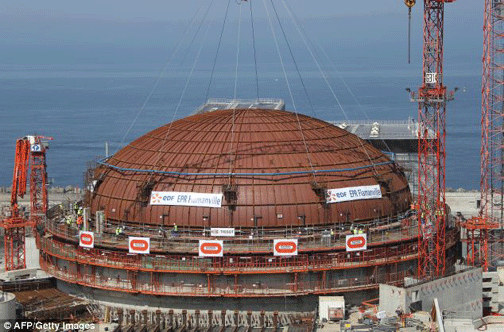
Translator’s note: The French nuclear power sector is in deep trouble technically and financially. Formally a cheap source of power, embedded costs have not been counted. There has been a dramatic loss of skills over the decades, inhibiting effective maintenance of existing plants and turning the construction of France’s then most powerful reactor at Flamanville on the Normandy coast into a nightmare.
Technological and resource challenges have escalated, including water availability in the face of climate change. The plan to bury accumulated highly radioactive waste at Bure, 250 kilometres east of Paris, remains at an impasse. And the political class lives in denial.

Meanwhile, sections of the Coalition parties cling to nuclear power as Australia’s post-coal salvation. Australia has uranium. However, regarding nuclear power prospects, there is no history, no capacities, no acceptable locations, no acceptable burial sites and no water. In short, local nuclear power adherents have no brains.
EVERYTHING WAS SUPPOSED to work to plan.
The 58 French nuclear reactors built at an accelerated pace between 1977 and 1996 were due to tranquilly finish their life after 30 years of good and faithful service. And the new super-powerful EPRs [European Pressurised Reactors], designed and built by Éléctricité de France, were to effect a seamless transition.
It was estimated that, by 2012, the first French EPR would be put into operation at Flamanville.
Kapow! Not only has its cost, initially fixed at €3.3 billion [AU$5.9 billion], multiplied by six (!), but its construction site has proved a nightmare. The EPR was connected to the grid only in 2024. And it has hardly run since (it is currently in shutdown).
An emergency patch-up job has been necessary on the aged French nuclear park so that its tired reactors can hang on for another 20 years. Total cost of this major overhaul now in progress: €100 billion [AU$180 billion].
At the moment when the urgent necessity to find €40 billion [AU$72 billion] in economies for the 2026 budget obsesses the Bayrou Government [under pressure from Brussels], Reporterre publishes on YouTube a remarkable documentary by journalist Laure Noualhat, titled Nucléaire – Comment il va ruiner la France. (See also Noulhat’s book, Le nucléaire va ruiner la France, Seuil-Reporterre, 224p.) It is noted there that, in the fairytale world that is nuclear energy, billions waltz out by the dozens. The golden rule is: “Whatever it costs!”
Other inescapable costs to come? To prolong the life of the plant at The Hague, where nuclear fuel is processed and which is at the end of its life — rough estimate: €34 billion [AU$61 billion]. To continue to dig deep at Bure, where the most dangerous nuclear waste will be buried 500 metres below ground — estimated cost: €35 billion [AU$63 billion]. To dismantle the 58 reactors, which, even patched up, will finish by being at the end of their life in ten or 20 years — cost: €50 billion. Total: €219 billion [AU$395.8 billion] to find. This is not all.
The EDF has sold an EPR to Finland for €3 billion [AU$5.4 billion] and two others to the United Kingdom for €22 billion [AU$39.7 billion]. And has promised to take care of any additional costs. Such comes in at €12 billion [AU$21.6 billion] for the former, €56 billion [AU$101 billion] for the latter. Do the maths.
Thomas Piquemal, the EDF’s chief financial officer at the time, went into meltdown. And resigned [in March 2016]. And this is not all.
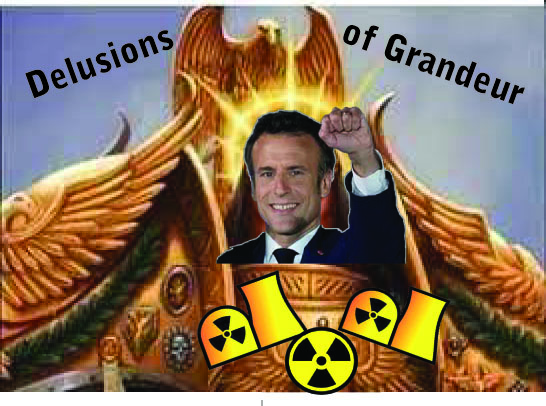
In 2022, President Macron announced that, at his demand, the EDF will launch six “new generation” EPRs [initially, then eight more to 2050]. Hand on heart, it will happen (in fact, one knows nothing about them). Estimated total price: €100 billion [AU$180.7 billion] (more or less). A former EDF Director, Philippe Huet, interviewed by Laure Noualhat, called this a “crazy gamble”.
If ever this delusional program (transparently dismissed by the Cour des comptes [equivalent to the National Audit Office] as inadvisable) sees the day, who will pay for it? Not the EDF, already indebted to the tune of €55 billion [AU$99 billion]. Nor any private investor (not mad!). Guess… https://www.youtube.com/watch?v=rjfHyhkpef8
Jean-Luc Porquet has been a journalist at Le Canard enchaîné since 1994, where this article appeared on 9 July. He writes a column on ecology and technocratic society, as well as theatre reviews. He has written a dozen books, the latest of which, Le grand procès des animaux, is a satirical fictional account of the sixth extinction in progress.
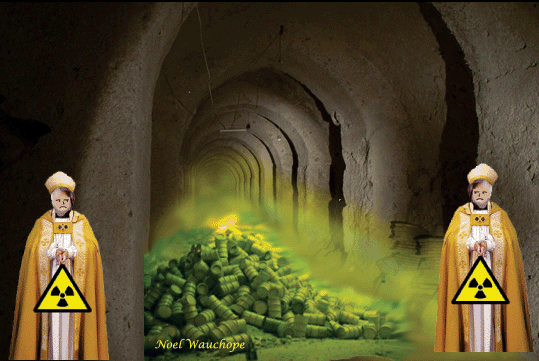
‘Nuclear Priests’ could warn future people about wastes under the Irish Sea
When Sir Keir Starmer entered No 10 last summer, it did not take long for
him to pick up where his predecessors left off on delivering more nuclear
power stations with a promise to “build, baby, build”. The Prime
Minister has vowed to “fast forward on nuclear” and so far has stuck
true to his word, with the Government taking up a larger stake in the
Sizewell C power plant in Suffolk, while loosening planning rules to allow
new small modular reactors to be built across the country.
But with the push for more nuclear power, bringing with it a steady supply of low-carbon energy, the question is inevitably asked: what do you do with all the
nuclear waste?
The answer is to dig a hole nearly the size of Wembley
Stadium 1km down beneath the Irish Sea, that could one day see the rise of
a new “atomic priesthood” and even, some have jokingly claimed, the
creation of glow in the dark cats.
But policymakers are aware that to push
ahead with this new nuclear drive, they will need to develop a stable,
long-term storage facility in which to hold not just future nuclear waste,
but all the nuclear waste the country has produced since the dawn of the
nuclear energy age in the 1950s. This is what the proposed Geological
Disposal Facility will provide.
And when they say long term, they mean long
term. “The purpose of the facility is to keep the radioactivity away from
humans and the environment so that it can’t cause harm for a sufficient
period of time – and that’s of the order of a few hundred thousand
years,” Neil Hyatt, Chief Scientific Adviser at the Nuclear Waste
Services, tells The i Paper.
iNews 24th Aug 2025, https://inews.co.uk/news/politics/nuclear-priests-glowing-cats-how-warn-future-generations-atomic-danger-3875319
Biggest nuclear tests in history: Tsar Bomba, Castle Bravo and their global impact

Edited By Kushal Deb : Aug 25, 2025, https://www.wionews.com/photos/biggest-nuclear-tests-tsar-bomba-castle-bravo-global-impact-1756122889360/1756122889362
Tsar Bomba
Tsar Bomba is the most powerful nuclear test in the history of nuclear weapons. A Soviet Tu-95 bomber dropped it from 13,000 feet, accompanied by a parachute, in Novaya Zemlya, a remote archipelago in the northern fringes of the U.S.S.R., on October 30, 1961, at around 11.32 am in Moscow time. Yielding nearly 50 megatons, it produced mushroom clouds over 40 miles high and 25 miles from end to end and equivalent to the explosion of 57 million tons of TNT. Houses within a 20km radius were completely destroyed. A 5-5.5 magnitude seismic event was felt across the world. The explosion’s shockwave circled the Earth three times and broke windows as far as 1,000 km away.
The Soviet Union was condemned unanimously by Great Britain, Sweden, and the United States. Glaciers around Novaya Zemlya were found with elevated levels of radiation because of the blast. In the following years Soviet Union and the United States signed several treaties, namely the Partial Test Ban Treaty (1963), to restrict the development of nuclear weapons. It banned nuclear weapons tests in the atmosphere, outer space, and underwater; only underground testing was allowed. Several other treaties followed, like the Outer Space Treaty (1967) prohibited placing nuclear weapons in orbit or testing them in space, Treaty on the Prohibition of Nuclear Weapons in Latin America (1967), establishing Latin America as a nuclear-weapon-free zone.
Castle Bravo
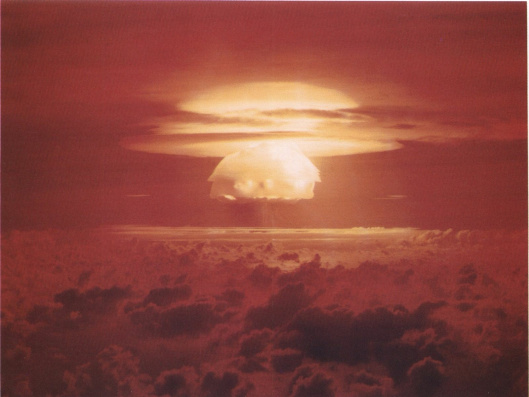
The US tested its first dry Thermonuclear device on March 1, 1954, in the Marshal Islands. Castle Bravo, with a 15 megaton yield, had produced a mushroom cloud that grew to nearly four-and-a-half miles wide and reached a height of 130,000 feet six minutes after the detonation.
Scientists have terribly miscalculated its capacity, intended to be a 5–6 megaton detonation, following the impact, radioactive fallout contaminated surrounding islands, exposing locals and U.S. personnel to dangerous radiation levels. An estimation states that 665 inhabitants of the Marshall Islands were overexposed to radiation. The fallout spread over 7,000 square miles. Europe, Australia, India, and Japan all found traces of radioactive material, starting a widespread outcry for a Nuclear Testing ban.
Castle Yanke
It was tested on May 5, 1954, at Bikini Atoll in the Marshall Islands. It was part of the Castle series tests, of which Ivy Mike and Castle Romeo were a part. Yanke contributed a yield of approximately 13–13.5 megatons, vaporised the test island, and generated a mushroom cloud affectionately estimated at 43 km in height. Although the yield of Castle Yankee was smaller than Castle Bravo, it still contributed to radioactive fallout in the nearby areas around the atoll.
Castle Romeo
Castle Romeo was tested by the US on March 26, 1954, just after the test of Castle Bravo. It yielded 11 megatons of TNT after the explosion, and the extreme red, orange, and yellow hues cloud became a popular representation of the nuclear explosion in the media. This thermonuclear test caused extensive radioactive contamination in the Pacific.
Ivy Mike
Ivy Mike was the world’s first successful hydrogen bomb test. The test marked a shift from fission-based weapons to fusion technology. It also pushed the Soviet Union to accelerate its thermonuclear program. It was also detonated in the Marshal Islands on November 1, 1952. The explosion produced 10.4 megatons of TNT. It spread across 1.8 to 3.2 miles and rose above 25 miles.
Report: Smotrich Told IDF Chief That Anyone Who Doesn’t Evacuate Gaza City Can ‘Die of Hunger or Surrender’
Israel’s Channel 12 also reported that Netanyahu has said he has Trump’s full support for the planned offensive to take over Gaza City but has limited time
by Dave DeCamp | August 24, 2025, https://news.antiwar.com/2025/08/24/report-smotrich-told-idf-chief-that-anyone-who-doesnt-evacuate-gaza-city-can-die-of-hunger-or-surrender/
Israeli Finance Minister Bezalel Smotrich has told the head of the Israeli military that anyone who remains in Gaza City after an IDF evacuation order can “die of hunger or surrender,” The Times of Israel reported on Saturday, citing a TV report from Israel’s Channel 12.
“We ordered you [to carry out] a quick operation. In my opinion, you can besiege them,” Smotrich reportedly told IDF Chief of Staff Eyal Zamir. “Whoever doesn’t evacuate, don’t let them. No water, no electricity, they can die of hunger or surrender. This is what we want and your capable [of doing it].”
The Channel 12 report said that during the same meeting, Israeli Prime Minister Benjamin Netanyahu and Strategic Affairs Minister Ron Dermer said that President Trump fully supports Israe’s plans to conquer Gaza City, which involves the forced displacement of over 1 million civilians amid a famine in the area, but that the US president wants a quick and decisive operation.
Thousands of Palestinians have fled Gaza City amid ramped-up Israeli attacks in the area, but there’s been no sign of a mass evacuation despite Israel’s orders to leave. Palestinians in Gaza City have rejected the idea of another displacement since most of them have been forced to move many times, and they don’t believe the area they’re being told to flee to will be much safer since the IDF continues to bomb the south.
The Palestinians in Gaza City are also likely aware that Israel’s plans involve the complete destruction of the city, which means they almost certainly won’t be able to return. The IDF has told the Israeli government that it will likely take months or possibly over a year to demolish the city.
The Channel 12 report said that Zamir clashed with Smotrich and Israeli National Security Minister Itamar Ben Gvir over the length of time the plan to take over Gaza City will take. Smotrich’s call to starve the remaining Palestinians to death aligns with previous comments he has made.
In April of this year, about a month after Israel imposed a total blockade on Gaza, Smotrich said Israel wouldn’t allow a “grain of wheat” to enter the Strip. Last year, Smotrich said at a conference that it may be “justified and moral” for Israel to starve two million Palestinians to death, but that the world wouldn’t allow it to happen.
“We are bringing in aid because there is no choice,” Smotrich said in August 2024. “We can’t, in the current global reality, manage a war. Nobody will let us cause 2 million civilians to die of hunger even though it might be justified and moral until our hostages are returned.”
Why has Donald Trump not spoken out about the famine in Gaza? – Inside Story
26 Aug 2025 Al Jazeera
A global hunger monitor, backed by the United Nations, has declared famine in Gaza City and the surrounding areas. The confirmation that Israel has engineered a man-made catastrophe prompted outrage from many nations, with a notable exception.
Neither the White House nor the US State Department has uttered a word in response. While Israel says it’s ‘an outright lie’, how much longer can the US remain silent? Is that silence an implicit go-ahead for the Israeli military’s large-scale assault on Gaza City and the drip-feeding of aid?
1 This Month
10 March A LIVE WEBINAR THE REAL EFFECTS OF NUCLEAR POWER
What the Industry Isn’t Telling Us
1:00 PM Mountain, 2 pm Central, 3 pm Eastern. Live on the Keepers of the Water Facebook page



18 March Webinar @ 1 PM EST: An Assessment of SMR Projects: The Case of Canada
register for the zoom:
https://us02web.zoom.us/webinar/register/WN_o8BIIOUvQ2ONJR1nta65DQ#/registration


of the week – STOP SMALL MODULAR REACTORS IN CANADA
To see nuclear-related stories in greater depth and intensity – go to https://nuclearinformation.wordpress.com
-
Archives
- March 2026 (99)
- February 2026 (268)
- January 2026 (308)
- December 2025 (358)
- November 2025 (359)
- October 2025 (376)
- September 2025 (258)
- August 2025 (319)
- July 2025 (230)
- June 2025 (348)
- May 2025 (261)
- April 2025 (305)
-
Categories
- 1
- 1 NUCLEAR ISSUES
- business and costs
- climate change
- culture and arts
- ENERGY
- environment
- health
- history
- indigenous issues
- Legal
- marketing of nuclear
- media
- opposition to nuclear
- PERSONAL STORIES
- politics
- politics international
- Religion and ethics
- safety
- secrets,lies and civil liberties
- spinbuster
- technology
- Uranium
- wastes
- weapons and war
- Women
- 2 WORLD
- ACTION
- AFRICA
- Atrocities
- AUSTRALIA
- Christina's notes
- Christina's themes
- culture and arts
- Events
- Fuk 2022
- Fuk 2023
- Fukushima 2017
- Fukushima 2018
- fukushima 2019
- Fukushima 2020
- Fukushima 2021
- general
- global warming
- Humour (God we need it)
- Nuclear
- RARE EARTHS
- Reference
- resources – print
- Resources -audiovicual
- Weekly Newsletter
- World
- World Nuclear
- YouTube
-
RSS
Entries RSS
Comments RSS
 nuclear-news