The non-corporate nuclear news -week to 4 August

Some bits of good news –Canada will protect an area larger than Germany. Timor-Leste, one of the poorest countries in the world, has eliminated malaria. India set a new record for solar and wind in first six months of the year
TOP STORIES. Hiroshima’s history lesson.
Israel’s Genocidal Intentions Have Been Obvious This Whole Time
Genocide’s hard When You’ve Got a PR War to Win.Netanyahu Is Reportedly Planning to Annex Gaza Strip, With Trump Admin’s Backing.
Trump, or Violence as Diplomacy.
Sizewell C nuclear costs could hit £100bn including financing, modelling shows -ALSO AT https://nuclear-news.net/2025/08/04/1-a-sizewell-c-nuclear-costs-could-hit-100bn-including-financing-modelling-shows/
A global call to action.
Climate. Melting glaciers threaten to wipe out European villages – is the steep cost to protect them worth it?
AUSTRALIA. Prime Minister Anthony Albanese says Israel’s denial of starvation in Gaza ‘beyond comprehension. The Moral Compass is Broken.
Senate launches inquiry into who is funding fake astroturf anti-renewables groups.
“We can do that:” Australian Energy Market Operator says the country’s power system can be run on 100 pct renewable energy. Plunging cost of solar batteries ensures renewables remain lowest cost option for Australia, CSIRO says.
Albanese government substantially expands renewable energy scheme amid 2030 target concerns.
NUCLEAR ITEMS
| ATROCITIES. ‘Designed as Death Traps’: Fmr. Green Beret Who Worked at Gaza Food Sites Reveals Rampant War Crimes. |
| CLIMATE. Russian nuclear submarine base hit by tsunami – ALSO AT https://nuclear-news.net/2025/08/02/1-b1-russian-nuclear-submarine-base-hit-by-tsunami/ |
ECONOMICS. Sizewell C will cost more than Hinkley: Is it worth it? – ALSO AT https://nuclear-news.net/2025/08/03/2-a-sizewell-c-will-cost-more-than-hinkley-is-it-worth-it/
Sizewell C | Subsidy scheme shows public exposed to up to £54.6bn of costs.
All energy costs rise but small nuclear most reactive.
Russia’s Nuclear Ambitions Face Funding Crisis.
TEPCO logs net loss in April-June on Fukushima plant cleanup.
Marketing. AtkinsRéalis eyeing U.S. market for nuclear technology push -ALSO AT https://nuclear-news.net/2025/07/31/1-b1-atkinsrealis-eyeing-u-s-market-for-nuclear-technology-push/
| EDUCATION. Sizewell C to build further education campus in Leiston.. |
| ENVIRONMENT. As plans for Sizewell C power station moves forward, those who live nearby must deal with the environmental fallout of 22,000 lost trees.Radioactive wasps discovered at South Carolina nuclear facility. Plastics, Profits and Power: How petrochemical companies are derailing the Global Plastics Treaty. Radiation dangers at “Sea Fest” in Cumbria. Plastification of our Brains: Cannot be good… – https://www.youtube.com/watch?v=wi864FymjNY |
ETHICS and RELIGION. “Release Israeli hostages? Get serious: We’ve got a genocide to complete”.
Trump ‘shocked, shocked’ Palestinians are starving in Gaza.
Time to De-Zionize the Israeli Mind.
Anti-nuclear weapons demo takes place at Faslane base.
| LEGAL. Legal trickery: Israel has changed how land ‘ownership’ works in the West Bank. Tepco ordered to pay ¥100 million in damages over 2011 disaster. |
| MEDIA. As Gaza starves, journalists sell their cameras for food.Media Largely Ignored Gaza Famine When There Was Time to Avert Mass Starvation. Physicists unleashed the power of the atom — but to what end? – book review. |
| POLITICS. Zelensky’s end goal is in sight, and so is his end. Sen. Lindsey ‘Ghoulish’ Graham compares Israeli genocide in Gaza favorably to America’s WWII atomic bombings. United States: Pro-nuclear Energy Laws Sweep Through State Legislatures. |
| POLITICS INTERNATIONAL and DIPLOMACY. Israel’s international isolation has begun. Trump Shows Strong Support for Israel as Palestinians in Gaza Starve to Death. Russia is staying quiet on Trump’s nuclear move. Never before has a US leader chosen to engage in nuclear brinkmanship of this kind. Not With a Bang, but With a Truth Social Post. Trump puts Putin on ‘Double Secret Probation’ for not ending Ukraine war.. |
| SAFETY. IAEA reports hearing explosions, sees smoke near Ukraine’s Zaporizhzhia nuclear plant.Mystery grows around state of Russian nuclear submarine base that is just 75 miles from epicentre of 8.8-magnitude megaquake.Metsamor could trigger next global nuclear emergency and Armenians denying it. |
| SECRETS and LIES. US, UK in secret talks with Ukrainian officials to ‘replace Zelensky’: Report.The CIA Built Hundreds of Covert Websites: Here’s What They Were Hiding. |
| SPINBUSTER.UK Government abandons plan to greenwash nuclear in a new taxonomy. Nuclear power drive obsesses over baseload: Do we need it? – ALSO AT https://nuclear-news.net/?s=Nuclear+power+drive+obsesses+over+baseload Abuse of Ubuntu in nuclear money grabbing. Report Slams Canada’s “Systematic Deception” Over Weapons Transfers to Israel. Small Modular Reactors: Déjà Vu All Over Again. Trump’s Fantasy Bid for the Nobel Peace Prize/ |
| TECHNOLOGY. U.S. Nuclear Energy Plans Could Proliferate Weapons. Energy firm newcleo will suspend its programme to develop lead-cooled fast reactors (LFR) in Britain -ALSO AT https://nuclear-news.net/2025/08/03/2-b1-energy-firm-newcleo-will-suspend-its-programme-to-develop-lead-cooled-fast-reactors-lfr-in-britain/ |
| URANIUM. Russia eyes Niger’s uranium mines as West African nation ditches France. Court hears Uzbek group attempted to sell nuclear bomb material uranium on black market. |
| WASTES. The Enduring Problem of Nuclear Reactor Waste.Debris removal at Fukushima nuclear plant pushed back to 2037 or later. |
| WAR and CONFLICT. Israeli Navy Seizes Second Gaza-Bound Freedom Flotilla Vessel in 2 Months.Trump Deploys Nuclear Subs Amid War of Words With Russia’s Medvedev. |
| WEAPONS and WEAPONS SALES.Canada still arming Israel despite official ban, report finds.Trump moves nuclear submarines after ex-Russia president’s tweet.French nuclear weapons, 2025.An unwanted visitor to Britain’s shores – a harbinger of death. |
Hiroshima’s history lesson

by beyondnuclearinternational, https://beyondnuclearinternational.org/2025/08/03/hiroshimas-history-lesson/
By April 1945, with the Nazi regime in a state of collapse and Japan’s defeat imminent, the threat that served as the original justification for the bomb’s development had all but vanished.
The true target of the first atomic bomb wasn’t, in fact, Tokyo, but Moscow, with the people of Hiroshima and Nagasaki sacrificed on the altar of American global imperial ambition.
Szilard emphasized that the atomic bomb wasn’t just a more powerful weapon but a fundamental transformation in the nature of warfare, an instrument of annihilation.

Oppenheimer explained, “When you see something that is technically sweet, you go ahead and do it and you argue about what to do about it only after you have had your technical success. That is the way it was with the atomic bomb.”
That climate of deference fostered a culture of complicity, where questions of social responsibility were subordinated to uncritical faith in authority.
What Can We Learn From the Birth of the Nuclear Era?
By Eric Ross, Common Dreams
In recent months, nuclear weapons have reemerged in global headlines. Nuclear-armed rivals India and Pakistan approached the brink of a full-scale war, a confrontation that could have become an extinction-level event, with the potential to claim up to 2 billion lives worldwide.
The instability of a global order structured on nuclear apartheid has also come into sharp relief in the context of the recent attacks on Iran by Israel and the United States. That system has entrenched a dangerous double standard, creating perverse incentives for the proliferation of world-destroying weaponry, already possessed by nine countries. Many of those nations use their arsenals to exercise imperial impunity, while non-nuclear states increasingly feel compelled to pursue nuclear weapons in the name of national security and survival.
Meanwhile, the largest nuclear powers show not the slightest signs of responsibility or restraint. The United States, Russia, and China are investing heavily in the “modernization” and expansion of their arsenals, fueling a renewed arms race. And that escalation comes amid growing global instability contributing to a Manichean world of antagonistic armed blocs, reminiscent of the Cold War at its worst.
The nuclear threat endangers not only global peace and security but the very continuity of the human species, not to speak of the simple survival of life on Earth. How, you might wonder, could we ever have arrived at such a precarious situation?
The current crisis coincides with the 80th anniversary of the Trinity Test, the first detonation of an atomic weapon that would soon obliterate the Japanese cities of Hiroshima and Nagasaki and so inaugurate the atomic age. So many years later, it’s worth critically reassessing the decisions that conferred on humanity such a power of self-annihilation. After all, we continue to live with the fallout of the choices made (and not made), including those of the scientists who created the bomb. That history also serves as a reminder that alternative paths were available then and that another world remains possible today.
A Tale of Two Laboratories
In the summer of 1945, scientists and technicians at Los Alamos National Laboratory in New Mexico worked feverishly to complete the construction of the atomic bomb. Meanwhile, their colleagues at the University of Chicago’s Metallurgical Laboratory mounted a final, ultimately unsuccessful effort to prevent its use.
The alarm spreading in Chicago stemmed from a sobering realization. The Manhattan Project that they had joined on the basis of a belief that they were in an existential arms race with Nazi Germany had, by then, revealed itself to be a distinctly one-sided contest. Until then, the specter of a possible German atomic bomb had conferred a sense of urgency and a veneer of moral legitimacy on what many scientists otherwise recognized as a profoundly unethical undertaking.
Prior to the fall of Berlin, Allied intelligence had already begun to cast serious doubt on Germany’s progress toward developing an atomic weapon. By April 1945, with the Nazi regime in a state of collapse and Japan’s defeat imminent, the threat that served as the original justification for the bomb’s development had all but vanished.
No longer represented as a plausible deterrent, the bomb now stood poised to become what Los Alamos Director J. Robert Oppenheimerwould describe shortly after the war as “weapons of terror, of surprise, of aggression… [used] against an essentially defeated enemy.”
For the scientists at Chicago, that new context demanded new thinking. In June 1945, a committee of physicists led by James Franck submitted a report to Secretary of War Henry Stimson warning of the profound political and ethical consequences of employing such a bomb without exhausting all other alternatives. “We believe,” the Franck Report stated, “that the use of nuclear bombs for an early, unannounced attack against Japan [would be] inadvisable.” The report instead proposed a demonstration before international observers, arguing that such a display could serve as a gesture of goodwill and might avert the need to use the bombs altogether.
One of that report’s signatories, Leo Szilard, who had been among the bomb’s earliest advocates, further sought to prevent what he had come to recognize as the catastrophic potential outcome of their creation. With Germany defeated, he felt a personal responsibility for reversing the course he had helped set in motion. Echoing concerns articulated in the Franck Report, he drafted a petition to be circulated among the scientists. While acknowledging that the bomb might offer short-term military and political advantages against Japan, he warned that its deployment would ultimately prove morally indefensible and strategically self-defeating, a position which would also be held by 6 of the 7 U.S. five-star generals and admirals of that moment.
Szilard emphasized that the atomic bomb wasn’t just a more powerful weapon but a fundamental transformation in the nature of warfare, an instrument of annihilation. He already feared Americans might come to regret that their own government had sown the seeds of global destruction by legitimizing the sudden obliteration of Japanese cities, a precedent that would render a heavily industrialized, densely populated country like the United States especially vulnerable.
Moreover, he concluded that using such weapons of unimaginable destructive power without sufficient military justification would severely undermine American credibility in future arms control efforts. He observed that the development of the bomb under conditions of extreme wartime secrecy had created an abjectly anti-democratic situation, one in which the public was denied any opportunity to deliberate on such an irrevocable and consequential decision.
As Eugene Rabinowitch, a co-author of the Franck Report (who would later co-found The Bulletin of Atomic Scientists), would note soon after, the scientists in Chicago were growing increasingly uneasy in the face of escalating secrecy: “Many scientists began to wonder: Against whom was this extreme secrecy directed? What was the sense of keeping our success secret from the Japanese? Would it have helped them to know that we had an atomic bomb ready?”
Rabinowitch concluded that the only “danger” posed by such a disclosure was that the Chicago scientists might be proven right, and Japan might surrender. “Since there was no justifiable reason to hold the bomb secret from the Japanese,” he argued, “many scientists felt that the purpose of deepened secrecy was to keep the knowledge of the bomb… from the American people.”
In other words, officials in Washington were concerned that a successful demonstration might deprive them of the coveted opportunity to use the bomb and assert their newly acquired monopoly (however temporary) on unprecedented power.
The Road to Trinity and the Cult of Oppenheimer
Seventy scientists at Chicago endorsed the Szilard Petition. By then, however, their influence on the project had distinctly diminished. Despite their early contributions, notably the achievement of the first self-sustained nuclear chain reaction in December 1942, the project’s center of gravity had shifted to Los Alamos.
Recognizing this, Szilard sought to circulate the petition among his colleagues there, too, hoping to invoke a shared sense of scientific responsibility and awaken their moral conscience in the critical weeks leading up to the first test of the weapon. Why did that effort fail? Why was there so little dissent, debate, or resistance at Los Alamos given the growing scientific opposition, bordering on revolt, that had emerged in Chicago?
One answer lies in Oppenheimer himself. In popular culture and historical scholarship, his legacy is often framed as that of a tragic figure: the reluctant architect of the atomic age, an idealist drawn into the ethically fraught task of creating a weapon of mass destruction compelled by the perceived exigencies of an existential war.
Yet the myth of him as a Promethean figure who suffered for unleashing the fundamental forces of nature onto a society unprepared to bear responsibility for it obscures the extent of his complicity. Far from being a passive participant, in the final months of the Manhattan Project, he emerged as a willing collaborator in the coordination of the coming atomic bombings of Hiroshima and Nagasaki.
When Oppenheimer and physicist Edward Teller (who would come to be known as “the father of the hydrogen bomb”) received Szilard’s petition, neither shared it. While Oppenheimer offered no response, Teller provided a striking explanation: “The things we are working on are so terrible that no amount of protesting or fiddling with politics will save our souls.” He further rejected the idea that he held any authority to influence the bomb’s use. “You may think it is a crime to continue to work,” he conceded, “but I feel that I should do the wrong thing if I tried to say how to tie the little toe of the ghost to the bottle from which we just helped it escape.”
Teller later claimed to be in “absolute agreement” with the petition, but added that “Szilard asked me to collect signatures… I felt I could not do so without first seeking Oppenheimer’s permission more directly. I did so and Oppenheimer talked me out of it, saying that we as scientists have no business meddling in political pressure of that kind… I am ashamed to say that he managed to talk me out of [it].”
Teller’s explanation was likely self-serving given his later acrimonious rift with Oppenheimer over the hydrogen bomb. Yet further evidence indicates that Oppenheimer actively sought to suppress debate and dissent. Physicist Robert Wilson recalled that upon arriving at Los Alamos in 1943, he raised concerns about the broader implications of their work and the “terrible problems” it might create, particularly given the exclusion of the Soviet Union, then an ally. The Los Alamos director, Wilson remembered, “didn’t want to talk about that sort of thing” and would instead redirect the conversation to technical matters. When Wilson helped organize a meeting to discuss the future trajectory of the project in the wake of Germany’s defeat, Oppenheimer cautioned him against it, warning that “he would get into trouble by calling such a meeting.”
The meeting nonetheless proceeded, with Oppenheimer in attendance, though his presence proved stifling. “He participated very much, dominating the meeting,” Wilson remembered. Oppenheimer pointed to the upcoming San Francisco Conference to establish the United Nations and insisted that political questions would be addressed there by those with greater expertise, implying that scientists had no role to play in such matters and ought to abstain from influencing the applications of their work.
Reflecting on his mindset at the time, Oppenheimer explained, “When you see something that is technically sweet, you go ahead and do it and you argue about what to do about it only after you have had your technical success. That is the way it was with the atomic bomb.” In a similar vein, his oft-quoted remark that “the physicists have known sin” was frequently misinterpreted. He was not referring, he insisted, to the “sin” of the destruction of Hiroshima and Nagasaki, but to pride for “intervening explicitly and heavy-handedly in the course of human history.”
When situated within this broader context of a professed commitment to scientific detachment, Oppenheimer’s behavior becomes more intelligible. In practice, however, his stated ideals stood in stark contrast to his conduct. While he claimed to reject political engagement, he ultimately intervened in precisely such a manner, using his position to advocate forcefully for the bomb’s immediate military use against Japan without prior warning. He emerged as a leading opponent of any prospective demonstration, cautioning that it would undermine the psychological impact of the bomb’s use, which could only be realized through a sudden, unannounced detonation on a relatively untouched, non-military target like the city of Hiroshima. This position stood in sharp contrast to that of the Chicago scientists, of whom only 15% supported using the bomb in such a manner.
That climate of deference fostered a culture of complicity, where questions of social responsibility were subordinated to uncritical faith in authority. Reflecting on that dynamic, physicist Rudolf Peierlsacknowledged, “I knew that Oppenheimer was on a committee and was briefing with the high-ups. I felt there were two things one could rely on: Oppenheimer to put the reasonable ideas across, and that one could trust people. After all, we are not terrorists at heart or anything… Both these statements might now be somewhat optimistic.”
Ultimately, the only member of Los Alamos to register dissent was Joseph Rotblat, who quietly resigned on ethical grounds after learning in November 1944 that there was no active Nazi atomic bomb program. His departure remained a personal act of conscience, however, rather than an effort to initiate a broader moral reckoning within the scientific community.
“Remember Your Humanity”
The legacy of Oppenheimer, a burden we all now carry, lies in his mistaking proximity to power for power itself. Rather than using his influence to restrain the bomb’s use, he exercised what authority he had to facilitate its most catastrophic outcome, entrusting its consequences to political leaders who soon revealed their recklessness. In doing so, he helped lay the groundwork for what President Dwight D. Eisenhower would, in his farewell address to Congress in 1961, warn against as “the disastrous rise of misplaced power.”
Yet we are not doomed. This history should also remind us that the development and use of nuclear weapons was not inevitable. There were those who spoke out and a different path might well have been possible. While we cannot know exactly how events would have unfolded had dissent been amplified rather than suppressed, we can raise our own voices now to demand a safer, saner future. Our collective survival may well depend on it. How much longer a world armed with nuclear weapons can endure remains uncertain. The only viable path forward lies in renewing a commitment to, as Albert Einstein and Bertrand Russell urged, “remember your humanity, and forget the rest.” With ever more nations developing increasingly powerful arsenals, one thing remains clear: As the Doomsday Clock moves ever closer to midnight, there is no time to waste.
Eric Ross is an organizer, educator, researcher, and PhD Candidate in the History Department at the University of Massachusetts Amhers
Israel’s Genocidal Intentions Have Been Obvious This Whole Time
Caitlin Johnstone, Aug 03, 2025, https://www.caitlinjohnst.one/p/israels-genocidal-intentions-have?utm_source=post-email-title&publication_id=82124&post_id=169999925&utm_campaign=email-post-title&isFreemail=true&r=1ise1&triedRedirect=true&utm_medium=email
Liberal Israelis are slowly beginning to join the rest of the world in admitting that what’s happening in Gaza is a genocide — a fact that has been clear to anyone with eyes and a basic sense of morality from the very beginning of this nightmare.
It was obvious in October 2023 that Israel intended to eliminate all Palestinians in Gaza, in part because you would never treat a population that way if you intended to leave survivors on your border. Because you’d know they’d seek revenge later on.
Call it the Inigo Montoya problem — if you kill someone’s father right in front of him, it’s a safe bet that he’s going to spend the rest of his life trying to kill you. If you intend to act in monstrous ways that fill young children with thoughts of revenge, then you need to get rid of the children, and you need to get rid of the women who will give birth to them. Otherwise you’re just creating a problem for your own children and grandchildren down the road.
The Nazis understood this. Heinrich Himmler famously said, “I did not feel I had a right to exterminate the men — i.e. kill them or have them killed — while allowing the children to grow up and take revenge upon our sons and grandsons. We had to reach the difficult decision of making this nation vanish from the face of the earth.”
The savagery of Israel’s post-October 7 onslaught was so horrific right off the bat that it was clear they didn’t intend to leave anyone alive in Gaza. It was clear they intended to kill as many people as possible and force any survivors to leave, because there’s no way they’d be acting with such sadistic bloodlust if they had any plans to leave survivors within striking distance of themselves.
And that is exactly how it has played out. They’ve intentionally turned Gaza into an uninhabitable wasteland while creating a waking nightmare of death and unfathomable suffering, and Trump and Netanyahu are openly saying that it’s not going to end until all the Palestinians have been removed one way or another.
If you’re going to rape and torture a child, you probably don’t intend to then drop them off at the nearest hospital when you are done with them, because you know the police will be at your door the next day. If you’re going to murder your enemy’s wife and kids in front of him, you probably don’t intend to leave him alive to seek revenge at a later date. Once you’ve gone all-in on perpetrating a sufficiently terrible act, you often need to do some extra killing on top of it to protect yourself from the consequences of your actions.
That’s one of the many reasons why it has always been clear that Israel’s intentions for Gaza are genocide and ethnic cleansing. Even if Israeli officials hadn’t been making openly genocidal statements, and even if genocidal sentiments hadn’t been proliferating throughout the collective consciousness of apartheid Israel for many years — hell, even if you knew absolutely nothing about Israel and Palestine and just looked at the reality on the ground in Gaza — it would still have been obvious to you that Israel did not intend to leave any of those people there. Just because of where they were located and how Israel was treating them.
So when people claim at this late date that they are coming to the reluctant conclusion that Israel is committing genocide in Gaza, I have a hard time believing them. It was obvious to anyone with a basic understanding of human nature that Israel had no intention of leaving any survivors of this mass atrocity on its border. People are just covering their own asses and trying to wash their hands of their guilt for their complicity in a 21st century holocaust over the past 22 months.
Canada still arming Israel despite official ban, report finds.
Wyatt Reed· August 1, 2025, https://thegrayzone.com/2025/08/01/canada-arming-israel-despite-ban/
In the course of a week, Canada accused Israel of violating international law, announced Ottawa will recognize a Palestinian state, and sent aid to be airlifted to Gaza. But a shocking new report makes clear that the proposed 51st state still arms Israel’s death machine.
Canada sent at least 391 shipments containing bullets, military equipment, weapons parts, aircraft components, and communication devices to Israel since late 2023, despite Ottawa’s repeated claims to have ended weapons deliveries to the apartheid state, a new report has revealed.
By sifting through data from the Israel Tax Authority, researchers at Arms Embargo Now discovered what they called “a continuous, massive pipeline of Canadian weapons flowing directly to Israel” comprising over 400,000 bullets, multiple shipments of cartridges, and a variety of parts for Israel’s fleet of F-35 fighter jets. Since mid-2024, Israel received four shipments of Doppler Velocity Sensors, which provide navigation data needed for the F-35’s target acquisition and weapons delivery systems, five shipments of lightweight composite panels used by the planes, and two shipments of Modular Product Testers, which are used to diagnose problems on Israel’s air force fleet.
Of the 391 deliveries identified, the report’s authors were able to track direct 47 shipments of military gear with detailed commercial shipping records sent by Canadian companies to Israeli companies. 38 of those shipments were sent to Israel’s biggest military firm, Elbit Systems, and its various subsidiaries.
In March 2024, the previous Canadian administration claimed to have halted all permits for arms shipments to Tel Aviv, after the legislature passed a non-binding motion declaring that “Israel must respect international humanitarian law” and that “the price of defeating Hamas cannot be the continuous suffering of all Palestinian civilians.” In the following months, then-Prime Minister Justin Trudeau insisted Canada no longer facilitated Israel’s horrors, going as far as publicly chiding one concerned Palestinian, “we’ve stopped exports of arms to Israel.”
But just before the apparent shift in policy, Ottawa greenlit a massive number of permits for Israeli-bound weapons deliveries, front-loading hundreds of orders in an apparent attempt to preemptively circumvent their own ban. Of the $30.6 million in military equipment sent to Israel in 2023 – the highest yearly total on record – $28.5 million was approved between October and December. Even today, many of those shipments continue to be fulfilled. To date, just 30 permits for military deliveries have been cancelled by Canada, which made that decision following a similar move by the UK in mid-2024 after the International Court of Justice ruled that Israel was violating international law.
“The Canadian government appears to have pursued a strategy of rushing through a record-breaking number of arms export permit approvals to Israel prior to publicly committing to pause approving any new ones,” Arm Embargo Now explained in their report. “This was then quietly undermined by a series of exceptions and loopholes,” researchers wrote, suggesting “the government’s policy shifts were… aimed at diffusing public criticism while maintaining material support.”
Other Canadian institutions to have assisted Israel’s genocidal siege include a number of its universities. A separate report published by Just Peace Advocates found that in 2023 up to $100 million went completely untaxed as it was funneled to Israeli universities from their ‘charitable’ arms in Canada. The money went to a variety of schools with strong ties to occupation forces, including Israel’s self-described “academic home of soldiers,” Bar-Ilan University, which took in around $4 million that year.
In addition, nearly $17 million was sent tax-free to Ben-Gurion University in 2023, which bragged of having “transformed itself into a back office for war” in October that year. Months later, Ben-Gurion announced the creation of two new “elite academic programs for future [Israeli military] recruits, as part of preparations for the transfer of IDF technological units to southern Israel.” The university says it works “in tandem” with the Israeli Air Force Flight School and claims to have trained around 1,000 pilots for military service.
Also receiving untaxed funds was Israel’s Weizmann Institute of Science, which has been described as “the incubator of most nuclear weapons work in Israel.” Weizmann has well-documented ties to a variety of Israeli spies implicated in efforts to steal nuclear secrets, and drew international attention after it was partially destroyed in a retaliatory Iranian airstrike on June 15.
According to Just Peace Advocates, Canadian sources delivered over $36 million to the Weizmann Institute in 2023.
A global call to action

by beyondnuclearinternational, https://beyondnuclearinternational.org/2025/08/03/a-global-call-to-action/
Trades unions and peace groups demand democracy that delivers peace and prosperity for all
A joint statement anchored by the International Trade Union Confederation, Greenpeace International, the International Peace Bureau, the International Campaign to Abolish Nuclear Weapons, Oxfam and 350.org and signed by 17 peace, justice and disarmament groups was released in anticipation of the commemoration of 80 years since atomic bombs were dropped on the Japanese cities of Hiroshima and Nagasaki.
For Democracy that Delivers Peace and Prosperity for All
As we approach the 80th anniversary of the atomic bombings of Hiroshima and Nagasaki, we, the undersigned organisations, call on governments and international institutions to reaffirm their commitment to a world free from nuclear weapons, honouring the demand of the hibakusha and 2024 Nobel Peace laureate Nihon Hidankyo, and to prioritize sustainable development over militarism.
As organisations from the peace, labour, economic justice, and climate movements, we share the belief that collective security can only be ensured through solidarity, by meeting the basic needs of all people.
The Billionaire Coup: An Existential Threat to Democracy, Peace, and Security

Unfortunately, today we face a growing threat to our collective security from the concentration of power and wealth in the hands of an unholy alliance of billionaires and far-right political forces. This billionaire coup against democracy is already capturing governments and subverting multilateral institutions. A small group of the wealthiest individuals and corporations has successfully reshaped policies, economies, and democracies to serve their interests, undermining the common good. This elite’s influence is driving the rise of authoritarian regimes, robbing the people of collective power, accelerating military build-up and climate change, and diverting resources away from human development and peacebuilding.
The economic consequences of this concentration of wealth are staggering. In 2024, the wealthiest 1% of the global population held more wealth than the bottom 95% of the world’s population combined. These extreme inequalities perpetuate a cycle of poverty, social unrest, and political instability, contributing to rising authoritarianism. The impact of this billionaire coup is felt across the globe, with governments on every continent prioritizing military expansion over social protection or sustainable development, undermining workers’ rights, and inflating the cost of living while cutting essential social programmes.
Escalating Militarism

Militarism is the natural consequence of this profit-at-all-costs political economy. Military expenditures have surged globally, with governments around the world committing $2.718 trillion to military spending in 2024, a 9.4% increase in real terms from the previous year. The weapons industry, alongside a growing network of arms traders and military contractors, increasingly dictates state priorities. As militarism takes centre stage, resources that could address the urgent challenges of climate change, poverty, and inequality are diverted into weapons systems, expanding arms races, and dangerous geopolitical standoffs.
This militarization is both fueled by and further encourages the rise of authoritarian regimes, where leaders consolidate power by warping democratic processes, curtailing civil liberties, and viciously suppressing dissent. The weakening of democratic structures at work, in society, and in global institutions undermines the ability of citizens to hold their employers and governments accountable and to demand investments in their well-being and the planet’s.
Human, Economic, and Environmental Costs
The human cost of militarism and unchecked wealth concentration is almost unimaginable. Military conflicts uproot millions, with over 100 million people worldwide currently displaced due to conflict or persecution. The economic cost is also astonishing. The Global South, in particular, bears the brunt. In 2022, low- and middle-income countries accounted for 35% of global military expenditures despite facing the greatest challenges in meeting the basic needs of their populations.
Furthermore, militarism exacerbates environmental degradation. The legacy of nuclear testing, deforestation caused by military operations, and pollution from the use of heavy weapons and mines pose significant threats to the environment. When combined and compared to countries, the world’s militaries have the fourth largest carbon footprint, following only China, the United States, and India. This increases dramatically during times of heightened conflict as we are seeing today.
A Call for Common Security and Solidarity
In response to these pressing issues, we advocate for a transformative shift in how governments conceive of security. We call for common security and solidarity, in which human development, environmental sustainability, democracy, and multilateralism take precedence over military might. Immediate action can be taken by governments this year to change course, including but not limited to:
- Universal ratification of the Treaty on the Prohibition of Nuclear Weapons (TPNW). The catastrophic potential of nuclear weapons is incompatible with the principles of international human rights and humanitarian law and poses an existential threat to humanity and the planet. We urge all nuclear-armed states to engage in full-scale disarmament processes, and for all states to reaffirm their commitment to non-proliferation.
- Adoption of progressive tax policies that ensure the wealthiest individuals and corporations pay their fair share, including support for a UN Framework Convention on International Tax Cooperation. The current global tax regime disproportionately benefits the richest, while funding for essential services is cut. Tax justice promotes social stability and reduces economic inequality. A fairer and coordinated global tax system will allow governments to reinvest in public infrastructure, social programs, a Just Transition, and poverty reduction efforts without fear of corporate retaliation.
- Implementation of living wages for all workers. Fair compensation is central to ensuring economic and social stability and protecting the rights and dignity of workers worldwide. As workers endure unprecedented industrial and technological transitions amid growing inequality, societies risk fracture and conflict. Governments must guarantee decent work, enforce labor rights, and support union organising and collective bargaining to ensure better wages and working conditions.
- Redirect military expenditures toward the urgent needs of human development, climate action, and global health, including reducing bloated defense budgets. A “peace dividend” from these modest reductions can fund investments in education, healthcare, clean energy, and poverty alleviation. Disarmament also helps to foster trust and reestablish relations between nations and peoples.
- Create a United Nations Fair Conversion mechanism, providing financial and technical support to countries transitioning from military-dependent economies to those focused on social welfare, sustainable industries, and clean energy. A key aspect of common security is ensuring that militarized economies are restructured toward peaceful and sustainable industries, with social dialogue and worker participation driving decision-making, guided by principles of fairness, justice, and democracy.
- Global expansion of social protection systems to ensure that all people have access to healthcare, education, unemployment benefits, pensions, and other essential services. Every individual, regardless of their circumstances or where they live, deserves access to basic services, social protection, and a dignified life. This includes especially those often left out of existing protections and most egregiously harmed by conflict: women, migrant workers, and those working in the informal economy who are demanding formalisation. Universal social protection is a cornerstone of democratic governance and common security, fostering equality and social cohesion.
- Integrate disarmament and sustainability into climate action plans, ensuring that military industries reduce their carbon footprints and contribute to global climate goals. Militarism exacerbates the climate crisis. The environmental costs of military activities including pollution; greenhouse gas emissions; nuclear weapons testing, production, and development; and the destruction of ecosystems, cannot be ignored. Such a Just Transition must include unions and civil society at the decision-making table.
The Time is Now
In the months ahead, many of the same governments that will commemorate 80 years since Hiroshima and Nagasaki will also send delegations to the United Nations General Assembly in New York, the 2nd World Summit on Social Development in Doha, the G20 Summit in Johannesburg, and COP 30 in Belém. At each of these, social movements will be represented and their demands articulated. It’s time for governments to listen:
- The 80th anniversary of the United Nations presents a moment for these governments to reaffirm the UN’s founding principles: peace, security, and human rights. We urge all UN member states to embrace multilateralism; democratize, reform and strengthen the UN system; prioritize sustainable development over militarism; and make tangible commitments to disarmament and social justice.
- The first World Social Summit in 30 years provides an opportunity to address the interlinked crises of poverty, inequality, and social exclusion, all worsened by war. We call for governments to adopt a new social contract that ensures economic justice and human development, addressing the root causes of instability and military conflict.
- The G20 summit in South Africa, with a focus on “Solidarity, Equality, and Sustainability” offers a critical opportunity for the world’s largest economies to align their economic priorities with the values of peace, common security through solidarity, and shared prosperity. We urge the G20 to commit to reducing military expenditures and investing in policies that foster human development and climate mitigation and adaptation.
- Hosted in the Amazon, COP30 is a key moment for governments to ensure that investments in peace and sustainability are at the heart of the global response to the climate crisis.
As we commemorate the 80th anniversary of the nuclear bombings, too many world leaders are forgetting the lessons of 1945. We call on them to learn from, not repeat, the past and build a better world where the threat of nuclear weapons is eradicated, where democracy delivers peace and prosperity for all people, and where common security is guaranteed through solidarity and sustainable development.
Find the original statement and list of signatories here.
Melting glaciers threaten to wipe out European villages – is the steep cost to protect them worth it?

Melting glaciers threaten to wipe out European villages – is the steep
cost to protect them worth it? Switzerland spends almost $500m a year on
protective structures, but a report carried out in 2007 for the Swiss
parliament suggested real protection against natural hazards could cost six
times that. Is that a worthwhile investment? Or should the country – and
residents – really consider the painful option of abandoning some of their
villages?
BBC 3rd Aug 2025,
https://www.bbc.co.uk/news/articles/cj4w9ggzxv4o
United States: Pronuclear Energy Laws Sweep Through State Legislatures
The US nuclear sector is understandably focused on leveraging Washington’s
ever-expanding portfolio of policy support for new nuclear deployments, but
what may ultimately turn out to be just as important is state-level
support.
Lawmakers in dozens of states are introducing record amounts of
legislation meant to advance nuclear projects, as governors create offices
or advisory groups meant to help stand up statewide deployments. Multiple
states are now incorporating nuclear energy into decarbonization
initiatives, working to attract deep-pocketed hyperscalers looking to build
power-hungry data centers, or both.
Energy Intelligence 1st Aug 2025,
https://www.energyintel.com/00000198-6198-db4e-a9bd-ed9ff0900001
IAEA reports hearing explosions, sees smoke near Ukraine’s Zaporizhzhia nuclear plant.
The International Atomic Energy Agency (IAEA) said on Saturday that its
team at Ukraine’s Zaporizhzhia Nuclear Power Plant (ZNPP) heard explosions
and saw smoke coming from a nearby location. The nuclear plant said one of
its auxiliary facilities was attacked today, IAEA said in a statement.
Reuters 2nd Aug 2025, https://www.reuters.com/world/europe/iaea-reports-hearing-explosions-sees-smoke-near-ukraines-zaporizhzhia-nuclear-2025-08-02/
Anti-nuclear weapons demo takes place at Faslane base
HM Naval Base Clyde is home to the Royal Navy’s four Vanguard-class submarines – HMS Vanguard, Vengeance, Victorious and Vigilant – which each carry Trident 2 D5 nuclear missiles.
Gemma Ryder Reporter, 02 Aug 2025,
https://www.dailyrecord.co.uk/news/scottish-news/anti-nuclear-weapons-demo-takes-35664128
The “No To Nuclear Weapons” gathering was organised by Justice & Peace Scotland, and brought people of all faiths together for prayer, reflection, and a public stance against nuclear arms.
Those in attendance included Most Rev William Nolan, Catholic Archbishop of Glasgow and Bishop-President of Justice & Peace Scotland; Rt Rev Rosie Frew, Moderator of the General Assembly of the Church of Scotland; and Most Rev Mark Strange, Primus of the Scottish Episcopal Church.
They were joined by members of the Quakers, the Iona Community, the United Reformed Church, and other religious groups amid growing global tensions.
The UK is preparing to upgrade and expand its nuclear weapons system and President Trump ordered two nuclear submarines to be deployed “in the appropriate regions” in response to comments by former Russian President Dmitry Medvedev on social media.
Archbishop Nolan said: “The phrase ‘never again’ gained much currency 80 years ago.
“But the actions of nuclear powers, including our own, run contrary to that.
“As the late Pope Benedict articulated, the very concept of a nuclear deterrence has instead fuelled an arms race as those on opposing sides keep seeking to outdo the other.
“We have seen this in the replacement for Trident. Deterrence itself, therefore, has increased insecurity and does nothing to build up trust which is necessary to encourage disarmament and build up peace.”
HM Naval Base Clyde — located near Helensburgh on the Gare Loch — is home to the UK’s four Vanguard-class submarines, each armed with Trident 2 D5 nuclear missiles, capable of striking targets up to 4,000 miles away.
Rt Rev Frew said: “On the 80th anniversary of the atomic bombing of Hiroshima and Nagasaki, it seems right to stand with other Christians saying ‘No’ to nuclear weapons and ‘Yes’ to peace.
“My hope and prayer is to live in a world without war or the threat of war, a world without the threat of the deployment of nuclear weapons.
“I know opinion is very divided on holding nuclear weapons but I don’t believe anyone would ever wish them to be deployed, both those who will gather outside and those who serve in HM Naval Base Clyde.
“The Church of Scotland stands in solidarity with all those who work at Faslane in the service of the United Kingdom, while praying for peace in a world where there is no threat of nuclear weapons ever being used.”
Justice & Peace Scotland said the use and threat of nuclear weapons is incompatible with Christian teaching, and called on political leaders to reject a future based on “fear and power-wielding”.
They added: “Nuclear weapons are fundamentally incompatible with this call as their existence threatens indiscriminate destruction and a future built on fear and power-wielding rather than on fraternity amongst nations.”
Metsamor could trigger next global nuclear emergency and Armenians denying it.
Metsamor could trigger next global nuclear emergency and Armenians denying
it. In recent days, several Armenian news channels (websites) have been
engaged in a smear campaign, asserting that the Azerbaijani media has
“falsely” highlighted the Metsamor nuclear power plant under the guise of
“propaganda for the country’s politics.” They claim that Armenia’s nuclear
power plant does not pose any threat to the region and that the allegations
against it are unfounded. However, Azerbaijan, Türkiye, and even Georgia
have periodically asserted that this plant presents a significant threat
and have repeatedly submitted resolutions to the International Atomic
Energy Agency addressing their concerns. In this article, we will discover
how problematic and valid the notion of posing a threat is, for Metsamor
Plant.
Azer News 2nd Aug 2025,
https://www.azernews.az/analysis/245496.html
Sizewell C nuclear costs could hit £100bn including financing, modelling shows
Total for nuclear power station project set to be billions of pounds higher
than official government estimates.
The true cost of the Sizewell C power
station in Suffolk could be tens of billions of pounds higher than official
government estimates once financing costs are factored in, according to
official modelling seen by the Financial Times.
The UK government last week
said the mostly debt-funded project would cost an estimated £38bn in real
2024 prices to build. Under the financial structure of the deal, investors
will be rewarded if the project is built for less than £40bn, and not
obliged to put in further funds if costs rise above £47.7bn — which is
considered unlikely.
But financial modelling — prepared as part of the
wider fundraising process and seen by the Financial Times — gives a range
of roughly £80bn-£100bn in nominal terms over the period of construction
for the two scenarios, once debt interest and payments to shareholders are
factored in. That would imply costs of roughly £65bn-£80bn in real 2024
terms, although the exact costs will depend on inflation rates and spending
rates across the lifetime of the project.
FT 2nd Aug 2025, https://www.ft.com/content/5f54592e-50ba-4a1e-8219-7a4eb01f74ed
Trump Deploys Nuclear Subs Amid War of Words With Russia’s Medvedev.

The US president and the former Russian president have exchanged verbal threats about possible nuclear strikes amid the wars in Iran and Ukraine.
AUG 2, 2025, https://thecradle.co/articles/trump-deploys-nuclear-subs-amid-war-of-words-with-russias-medvedev
US President Donald Trump ordered the repositioning of two nuclear submarines on 2 August in response to “highly provocative” comments made by Dmitry Medvedev, the deputy chairman of Russia’s Security Council.
“I have ordered two Nuclear Submarines to be positioned in the appropriate regions, just in case these foolish and inflammatory statements are more than just that,” Trump wrote on his Truth Social Platform on Friday.
On Thursday, Medvedev had warned that Trump should be mindful of “how dangerous” Russia’s nuclear weapons could be.
“Words are very important, and can often lead to unintended consequences, I hope this will not be one of those instances,” Trump stated.
In recent weeks, Trump has been exchanging public insults and nuclear threats with Medvedev, who is viewed as close to Russian President Vladimir Putin.
Earlier this week, Trump insulted Medvedev directly, stating, “Russia and the USA do almost no business together. Let’s keep it that way, and tell Medvedev, the failed former President of Russia, who thinks he’s still President, to watch his words. He’s entering very dangerous territory!”
Medvedev, who served as president of Russia from 2008 to 2012 and prime minister from 2012 to 2020, shot back in a post on Telegram.
“If some words from the former president of Russia trigger such a nervous reaction from the high-and-mighty president of the United States, then Russia is doing everything right and will continue to proceed along its own path,” he stated.
On 17 July, Medvedev warned that Moscow must be prepared to deliver preemptive strikes against the west if necessary.
Speaking to TASS on the 80th anniversary of the Potsdam Conference, Medvedev said, “The west’s treacherous nature and its warped sense of superiority are still evident. And we should therefore act accordingly, responding in full or even delivering preemptive strikes if need be.”
Medvedev’s comments followed a string of threatening statements made by the US president toward Moscow after announcing plans to deliver new weapons to Kiev.
A Financial Times report revealed that Trump encouraged Ukrainian President Volodymyr Zelensky during a 4 July phone call to strike deep into Russian territory. According to sources, Trump asked, “Can you hit Moscow? Can you hit St. Petersburg too?”
Zelensky allegedly responded, “Absolutely. We can if you give us the weapons.”
In the wake of the US bombing of Iran’s nuclear sites in June, Trump also responded to Medvedev allegedly suggesting that Moscow provide nuclear weapons to Tehran, a claim he later denied.
“Did I hear Former President Medvedev, from Russia, casually throwing around the ‘N word’ (Nuclear!), and saying that he and other Countries would supply Nuclear Warheads to Iran?” Trump wrote on 23 June.
Trump then delivered a veiled threat to Russia by boasting about US nuclear submarine capabilities.
“They are the most powerful and lethal weapons ever built,” he stated.
Russia’s Nuclear Ambitions Face Funding Crisis

Oil Price, By Eurasianet – Aug 02, 2025
- Russian energy entities, including Rosatom, are experiencing significant financing difficulties, raising doubts about their ability to fulfill international energy project commitments.
- Kazakhstan has decided to independently build thermal power plants originally contracted to Russia’s Inter RAO due to a lack of promised financing, and is increasingly turning to China for nuclear power plant construction.
- Rosatom is seeking government financial support to maintain its global leadership in the nuclear energy market and carry out new projects, citing limited financing options due to international sanctions.
Russian energy entities are experiencing financing woes, raising questions about whether Rosatom, Russia’s nuclear energy agency, will be able to fulfill its obligations to build Kazakhstan’s first atomic power plant.
Already, financing troubles have caused another Russian state-controlled firm, Inter RAO, to lose out on constructing three thermal power plants in Kazakhstan.
During a July 30 appearance before the Russian State Commission on Energy, Andrei Petrov, a top Rosatom official, openly acknowledged that Rosatom was seeking government support. The entity has the resources to complete ongoing work, but by 2027, it will need a financial injection to carry out new projects, Petrov indicated.
Rosatom officials have been somewhat cagey in specifying exactly what kind of support they are seeking and have shied away from specifying an amount. For example, Rosatom’s chief, Alexei Likhachev, recently stated the entity is seeking the “provision of special resources” from the government, according to a report published by the Interfax news agency.
In 2024, a Rosatom official, referring to a program to develop floating nuclear power plants, indicated that Rosatom had limited financing options due to international sanctions on Russia, and required state-subsidized low-interest loans in order for the company to maintain its industry lead in several areas. Rosatom presently enjoys a roughly 50 percent share of the global nuclear energy market, with operations even in several NATO member states, such as Turkey and Hungary.
“The only way to maintain leadership with this product [floating nuclear power plants] is to subsidize exports even more than we already are,” Interfax quoted Vladimir Aptekarev, a top official at the Rosatom subsidiary Atomenergomash JSC, as saying in 2024, citing Chinese competition.
The Russian government, given the immense burden on the state budget imposed by its war effort in Ukraine, has so far resisted pleas from energy entities for increased support. Rosatom officials have acknowledged that the lack of assistance has hindered efforts to build new types of thermal and nuclear units, known as units Shelf-M and Elena-AM.
The Russian government’s cash crunch appears to be responsible for delays in construction of three planned Kazakh thermal power plants near Kokshetau, Semey and Ust-Kamenogorsk. Inter RAO signed a contract to build the three plants at an estimated cost of about $2.7 billion, with financing to be provided by Russian state-connected institutions. But the money never materialized.
On July 31, Deputy Kazakh Prime Minister Roman Sklyar confirmed that Kazakhstan was ditching the contract with Inter RAO, adding that it would build the plants on its own, according to media reports.
“When the company [Inter RAO] took on the obligation to build these facilities, it was supposed to receive export financing at a low rate. Unfortunately, they were unable to do this, so it was decided to build them independently,” he said.
The Kazakh government’s decision to move on from Inter RAO on the thermal plant projects instantly sparks questions about the fate of Rosatom’s deal to build Kazakhstan’s first nuclear power station. ……………………… https://oilprice.com/Alternative-Energy/Nuclear-Power/Russias-Nuclear-Ambitions-Face-Funding-Crisis.html
US, UK in secret talks with Ukrainian officials to ‘replace Zelensky’: Report
Three years into the war with Russia, the Ukrainian president has experienced his fortunes turn amid heavy human losses on the battlefield and intense Russian assaults.
JUL 29, 2025, https://thecradle.co/articles/us-uk-in-secret-talks-with-ukrainian-officials-to-replace-zelensky-report
Russia’s Foreign Intelligence Service (SVR) has revealed that US and British officials recently held a meeting in the Alps with top Ukrainian officials to discuss “replacing” Ukrainian President Volodymyr Zelensky.
According to a statement made available to TASS, the meeting involved Andrey Yermak, head of the Ukrainian president’s office, Kirill Budanov, chief of the Ukrainian Defense Ministry’s Main Directorate of Intelligence, and Valery Zaluzhny, the country’s ex-commander-in-chief who is now Ukraine’s ambassador to London..
“The Americans and the British announced their decision to propose Zaluzhny to the Ukrainian presidency. Yermak and Budanov ‘snapped a salute,’ while securing promises from the Anglo-Saxons to let them keep their present positions, as well as to take their interests into account in the course of making decisions over other personnel issues,” TASS reports.
The Ukrainian participants were reportedly promised they would retain their positions and influence over future personnel appointments following Zelensky’s ouster.
The SVR said Yermak helped prepare the ground for Zaluzhny by persuading Zelensky to weaken Ukraine’s anti-corruption bodies. Zelensky signed the new law, but Ukrainian MPs said the measure has not appeared on the parliament’s official website.
According to the SVR, the secret talks with UK and US officials aim to restructure Ukraine’s ties with the west, especially the US, and have established removing Zelensky as a prerequisite for continued western support in the war with Russia, after ceasefire talks between Moscow and Kiev in Istanbul last week ended without a breakthrough.
The SVR report comes a day after US President Donald Trump shortened his 50-day deadline for a ceasefire between Russia and Ukraine to “10 or 12 days,” warning of stalled progress and approving expanded weapons shipments to Kiev, including US-made Patriot systems financed by European partners and coordinated through NATO.
Former Ukrainian prosecutor general’s adviser Andriy Telizhenko said the plan to replace Zelensky predated Donald Trump’s return to office, adding, “Once the strings are cut, the puppet must be replaced.”
Journalist Seymour Hersh wrote in The End of Zelensky? that Zaluzhny “is now being viewed as Zelensky’s most reliable successor,” citing “well-informed Washington sources” confirming the role could be offered to him.
The Enduring Problem of Nuclear Reactor Waste
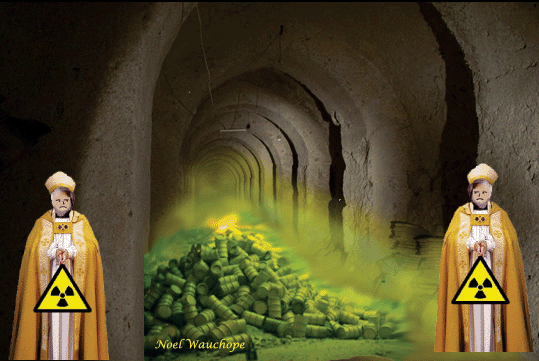
It is estimated that over the course of nuclear energy’s development in the ensuing decades, the industry produced 250,000 tons of highly toxic nuclear waste across fourteen countries worldwide without authoritatively developing a strategy for its safe storage.
July 30, 2025, By: Brian C. Black, https://nationalinterest.org/blog/energy-world/the-enduring-problem-of-nuclear-reactor-waste
The problem of nuclear reactor waste will have to be resolved as nuclear energy becomes more frequently adopted as the world’s source of power.
No one is pro nuclear waste. Simply, nuclear waste is a problem related to one method of generating electricity. The arguments against nuclear development because of the waste it generates have only intensified as we have filled in the gaps of our knowledge and learned more about its long-term toxicity. The realities of nuclear waste, simply, make us ask the question: How much do we need this energy?
In 2025, as our drive for electricity grows with planned data centers all over the world, many observers are choosing to overlook the problems of nuclear waste in order to generate more power and—at times—diminish our reliance on fossil fuels.
As we rush to reopen mothballed nuclear facilities such as Three Mile Island and to develop new ones, it is important to slow down and recall the simple fact of nuclear power: even with no accidents, nuclear power creates waste materials that remain toxic for thousands of years, and we still have no reasonable plan on what to do with them. We may choose to look the other way, but the wake of nuclear development is littered with toxic locales that remind us that any power obtained from nuclear reaction also creates waste that remains poisonous to humans for decades, if not longer.
A Relic of the Cold War?
or a few decades in the mid-1900s, the inertia of the Cold War and the belief in nuclear power’s potential fueled the rapid development of nuclear power. Reactors began to be used for electricity generation throughout the United States by the 1970s, only to see support erode after industrial accidents occurred, most noticeably at Three Mile Island, near Harrisburg, Pennsylvania, in 1978 and abroad at Chernobyl (then the Soviet Union, now Ukraine) in 1986. Many other reactors proceeded to generate power effectively and demonstrated that such accidents were an exception. While the industry faced challenges of public confidence and opinion over the final decades of the 20th century, nuclear power was often viewed internationally as a “clean” way of generating the power that might allow development to occur.
Clearly, though, the basic challenges inherent in the toxicity of the waste of a normal functioning reactor were never fully accounted for. Throughout the 1980s, for instance, efforts grew to create a repository in the American West where such spent fuel could be deposited and kept for the decades—even centuries—in which it was thought to remain toxic. The most protracted effort focused on Yucca Mountain in Nevada. The proposed Yucca Mountain Repository has remained mired in legal issues involving jurisdiction (it is located on the Western Shoshone Native American reservation) and the issue of a state’s right to determine its economic and environmental future. In short, no one wants nuclear waste in their backyard.
In retrospect, these challenges only amplified the issues that grew from the Cold War’s emphasis on energy centrality. Nuclear power spent decades as an important technology in supporting a drive for energy development that was seen as essential to both Soviet and American success, and little thought or planning went into the end-use challenges inherent in the technology. The competitive environment of the Cold War drove the rapid extraction of uranium, and the need to drive development pressed nuclear power forward even though it remained a technology with critical flaws.
Inevitable Waste Produced by Atomic Power
It is estimated that over the course of nuclear energy’s development in the ensuing decades, the industry produced 250,000 tons of highly toxic nuclear waste across fourteen countries worldwide without authoritatively developing a strategy for its safe storage. Most often, the highly radioactive material is collected and stored at inactive nuclear power plants. In the case of Chernobyl, some of the plant’s reactors still contain an enormous amount of waste that will remain dangerous for tens of thousands of years. Of course, in 2019, one entire reactor was encased in a concrete “sarcophagus” that will safely store the material for a century—a temporary band-aid to be dealt with more carefully later
However, a similar problem exists in nations that did not experience a reactor meltdown. Reports show that the “largest amount of untreated nuclear waste is at the Sellafield plant in the UK.” The plant has not generated electricity since 2003, but 100,000 employees are involved in ongoing nuclear decommissioning activities. These efforts at Sellafield are expected to last more than a century and will cost the government billions of dollars, even though it has produced no power for decades.
Well after the fact, many nations are now working to devise ways of storing nuclear waste permanently, even if they no longer wish to generate electricity with reactors. Finland, which generates approximately thirty-two percent of its electricity with five nuclear plants, is considered to have devised the first feasible plan for long-term storage of nuclear waste. The Onkalo spent nuclear fuel repository is a deep geological repository that is expected to begin operating next year. When completed, the Onkalo site will store 2,300 tons of high-level waste at a cost of approximately $3.4 billion.
Finland’s process required decades of negotiation and planning. Though it is considered experimental, the Onkalo site is based on the KBS-3 method of nuclear waste burial that was developed in Sweden. It will store nuclear waste for at least 100,000 years. And we can’t really know whether or not it can succeed. The generating technology failed to account for this inevitable outcome at its earliest stages of development. Now, nuclear waste is a problem that threatens many societies.
Conclusion: Ranking the Dangers of Energy Production
Over the last few decades, scientists have taught us a great deal about the dangers of climate change, which is caused by burning fossil fuels. Through their research findings, it has become accepted knowledge that the Earth would benefit from humans generating power in a different way. In sum, we have learned that all energy production comes with a cost, and, therefore, nuclear power has gotten another look at possibly powering the future.
Does this reality, then, lead us to choose between evils and decide to generate electricity through nuclear reactions? Possibly. But it is important that we scrutinize the technology as an energy production industry. Similar to other industrial enterprises, nuclear power generation creates hazardous and toxic waste. In the case of nuclear waste, though, it must be safely transported and interred. Technical answers and extensive investment will be essential.
The uniquely supportive, unquestioning culture of the Cold War is clearly a thing of the past. Examples of this rather blindly confident coordination between military and industrial interests are scattered across the American landscape. Some examples, such as the vast open spans of New Mexico or Idaho, might be expected; others, nestled in more populated areas, such as Pennsylvania, surprise contemporary Americans. Each of them, though, and the vast span of all of them together, reveals an era when our nation quietly took on a dramatic technological project and succeeded in applying it to power generation. To continue its use, though, we must now apply the new knowledge about nuclear waste that will allow its end-use products to be safely managed.
1 This Month
29 Jan. Thursday 7-8 p.m. Webinar – World’s Largest Nuclear Station in Port Hope, ON?
To see nuclear-related stories in greater depth and intensity – go to https://nuclearinformation.wordpress.com/



31st January – Challenging the War Machine – a DECLASSIFIED UK SUMMIT

Website of the Week
Now until to February 10, 2026 Radioactive waste storage in France: the debate is finally open! How to participate?
-
Archives
- January 2026 (283)
- December 2025 (358)
- November 2025 (359)
- October 2025 (376)
- September 2025 (258)
- August 2025 (319)
- July 2025 (230)
- June 2025 (348)
- May 2025 (261)
- April 2025 (305)
- March 2025 (319)
- February 2025 (234)
-
Categories
- 1
- 1 NUCLEAR ISSUES
- business and costs
- climate change
- culture and arts
- ENERGY
- environment
- health
- history
- indigenous issues
- Legal
- marketing of nuclear
- media
- opposition to nuclear
- PERSONAL STORIES
- politics
- politics international
- Religion and ethics
- safety
- secrets,lies and civil liberties
- spinbuster
- technology
- Uranium
- wastes
- weapons and war
- Women
- 2 WORLD
- ACTION
- AFRICA
- Atrocities
- AUSTRALIA
- Christina's notes
- Christina's themes
- culture and arts
- Events
- Fuk 2022
- Fuk 2023
- Fukushima 2017
- Fukushima 2018
- fukushima 2019
- Fukushima 2020
- Fukushima 2021
- general
- global warming
- Humour (God we need it)
- Nuclear
- RARE EARTHS
- Reference
- resources – print
- Resources -audiovicual
- Weekly Newsletter
- World
- World Nuclear
- YouTube
-
RSS
Entries RSS
Comments RSS
 nuclear-news