The jellyfish are the symptom
by beyondnuclearinternational, https://beyondnuclearinternational.org/2025/08/24/the-jellyfish-are-the-symptom/
The cure is ending the use of nuclear power, which takes an immense toll on wildlife and the environment, writes Linda Pentz Gunter
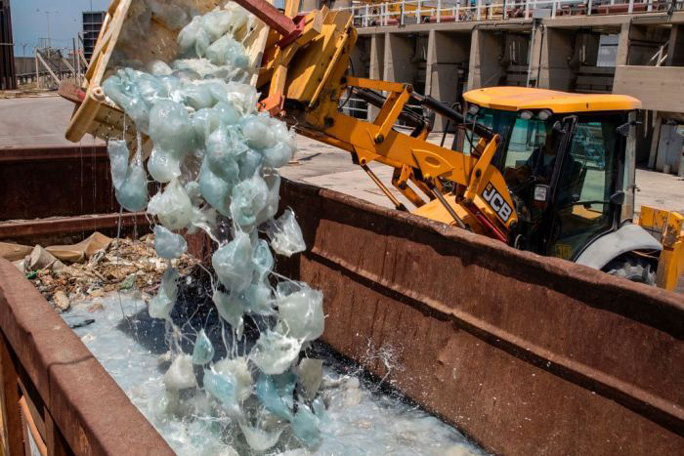
A swarm of jellyfish that recently brought four of the six reactors at the Gravelines nuclear power plant in France to a halt, made widespread headlines but, as some reports have noted, this isn’t exactly a new phenomenon. The remaining two reactors were already offline for maintenance.
As the Guardian reported, “The Torness nuclear plant in Scotland, which is also owned by EDF, was forced to shut for a week in 2021 after jellyfish clogged the seaweed filters on its water intake pipes, a decade after jellyfish shut the plant for a week in 2011.”
But Paul Gunter and I first noted the phenomenon back in 2001 when we released our investigative report, Licensed to Kill: How the nuclear power industry destroys endangered marine wildlife and ocean habitat to save money.
We learned then that jellyfish were a hazard at nuclear plants that use the once-through cooling water system — the kind that don’t use cooling towers — as they can impede the rapid flow of intake water, which then reduces the efficiency of the plant. That, in turn, reduces profits.
Swarms of jellyfish, responding to warmer waters caused by climate change, are likely to become an ever greater and more frequent hazard as waters continue to warm due to our inadequate efforts to tackle the climate crisis effectively or in time.
But why are jellyfish a problem for nuclear power plants in the first place?
The once-through cooling system draws cooling water into the plant, usually through an intake pipe and at considerable velocity, in order to first convey heat from the reactor core to the steam turbines and then to remove and dump the surplus heat from the steam circuit.
In drawing in such a high volume of cooling water and at high speed, a considerable amount of sea life is sucked in as well, a process known as entrainment. Jellyfish are by no means the only affected species.
The amount of water drawn in can be immense — as much as a million gallons a minute. Although sea creatures like jellyfish might clog up the intake system, smaller ones such as fish, fingerlings and spawn pass through the system, entrained along with the water. They are then pulverized and discharged, effectively as sediment, usually into the same body of water from which the cooling water was drawn.
The process also warms up the water source into which these hotter waters are discharged, changing the marine ecology. This is what we found at Diablo Cove during our research of marine damage caused by the Diablo Canyon nuclear power plant on the California coast. Black abalone were suffering withering syndrome due to the warmer waters and the indigenous fish species had been replaced by others who preferred the warmer water temperatures.
Along with raising the water temperature, the discharge process, which, like the water intake, happens at speed, can cloud the surrounding water by scouring the sea bed and stirring up further sediment, blocking out sunlight. The bull kelp in Diablo Cove, for example, had effectively been clear-cut due to lack of access to sunlight in order to photosynthesize, and had consequently died off. Bull kelp are an essential contributor to the health and balance of marine ecosystems.
This toll on sea life is why there is such a hue and cry about the two immense 1,630 megawatt EPR reactors being built on the English coast at Hinkley Point C. The potential fish kills there will be enormous — possibly as high as half a million fish killed or harmed per day at the plant. The two reactors will draw in at least 2.7 billion gallons of water a day, the equivalent of three Olympic size swimming pools of water per minute.
But of course EDF, the French government utility building the plant, doesn’t want to spend the extra money putting in a fish deterrent system to minimize the damage. This makes the nuclear power plant a significant predator on already threatened and struggling fish stocks, effectively trawl fishing without a license.
At the St. Lucie nuclear power plant on Florida’s east coast, the barrier nets installed to prevent larger animals such as sea turtles, seals and manatees from being entrained further along the intake canals into the plant, have to be lowered to be cleaned whenever an algae load or influx of jellyfish render them ineffective. When this happens, sea turtles pass over them anyway and drown (or, more accurately, suffocate) in the intake wells and the underwater intrusion detection system.
The sea turtle captures at the St Lucie site can be enormous. In 1995, the plant captured 933 sea turtles, not all of them alive or uninjured. In 2003 that number rose to 944. Capture numbers also exceeded 900 in 2004 and 2005. Most arrive alive, some are dead, and some are injured, most often with damage to the carapace. In our research, we found that any injuries to sea turtles captured at St. Lucie were almost always ascribed to other causes such as earlier boat strikes or shark attacks.
However, what we learned to our amazement when preparing the 2001 report was that in 1989 a human being had also been sucked into the St. Lucie intake pipe while spearfishing. When he popped up in the cooling canal, his wetsuit was shredded and his scuba tanks gored from bouncing off the barnacle-encrusted walls of the pipe. He had been terrified, naturally, and told us there was no way all the animals entrained there could survive the journey.
Nevertheless, St. Lucie is just one example where no meaningful steps have been taken to exclude turtles from entrainment, or even humans, as a second scuba diver was entrained at the plant 17 years after the first.
While the nuclear plant owners are given an annual sea turtle take allowance — the amount of turtles they are permitted to capture dead or alive — by the National Marine Fisheries Service and the Nuclear Regulatory Commission, these agencies invariably adjust the numbers upwards to accommodate the plant’s higher takes, rather than assessing the overall status of the species or demanding mitigation.
Even if an attempt is made to limit the damage, it is half-hearted at best. Once again, the St. Lucie plant exemplifies this failure. At the start of a 2006 consultation with NMFS, the idea of installing a Turtle Excluder Device (TED) was first raised. The process dragged on for 10 years and in 2016, NMFS finally issued a TED requirement. By 2019, 13 years after the idea was first mooted, plant owners Florida Power & Light had failed to deliver a functioning TED. After that, the NRC took no further action.
The recent jellyfish stories are a symptom of our ever worsening climate crisis. But they also remind us that nuclear power plants take a toll on their aquatic environments, one that is usually out of sight and out of mind, but is also contributing to the decline of important marine species. These activities should not be left unregulated and unmitigated.
Linda Pentz Gunter is the international specialist at Beyond Nuclear and writes for and edits Beyond Nuclear International. Any opinions are her own.
No comments yet.
1 This Month

Petition to revoke the licensing of the Near Surface Nuclear Disposal Facility (NSDF) at Chalk River. https://www.ourcommons.ca/petitions/en/Petition/Details?Petition=e-7247


of the week – STOP SMALL MODULAR REACTORS IN CANADA
To see nuclear-related stories in greater depth and intensity – go to https://nuclearinformation.wordpress.com
-
Archives
- March 2026 (153)
- February 2026 (268)
- January 2026 (308)
- December 2025 (358)
- November 2025 (359)
- October 2025 (376)
- September 2025 (258)
- August 2025 (319)
- July 2025 (230)
- June 2025 (348)
- May 2025 (261)
- April 2025 (305)
-
Categories
- 1
- 1 NUCLEAR ISSUES
- business and costs
- climate change
- culture and arts
- ENERGY
- environment
- health
- history
- indigenous issues
- Legal
- marketing of nuclear
- media
- opposition to nuclear
- PERSONAL STORIES
- politics
- politics international
- Religion and ethics
- safety
- secrets,lies and civil liberties
- spinbuster
- technology
- Uranium
- wastes
- weapons and war
- Women
- 2 WORLD
- ACTION
- AFRICA
- Atrocities
- AUSTRALIA
- Christina's notes
- Christina's themes
- culture and arts
- Events
- Fuk 2022
- Fuk 2023
- Fukushima 2017
- Fukushima 2018
- fukushima 2019
- Fukushima 2020
- Fukushima 2021
- general
- global warming
- Humour (God we need it)
- Nuclear
- RARE EARTHS
- Reference
- resources – print
- Resources -audiovicual
- Weekly Newsletter
- World
- World Nuclear
- YouTube
-
RSS
Entries RSS
Comments RSS
 nuclear-news
Leave a comment