Dumbing down: UK Taskforce charged with pushing nuclear deregulation .
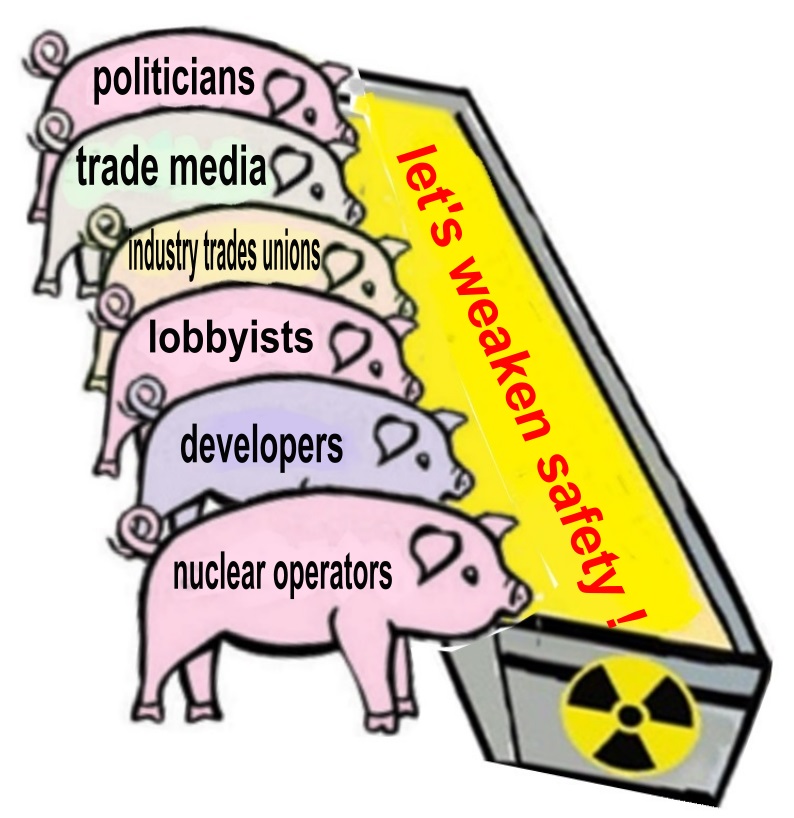
The ‘reset’ is clearly driven by the frenzied demands of nuclear operators, developers, lobbyists, industry trades unions, politicians and sections of the media who are all interested at securing new nuclear with minimal red tape.
18th August 2025, https://www.nuclearpolicy.info/news/dumbing-down-taskforce-charged-with-pushing-nuclear-deregulation/
Despite conceding that the UK has a ‘strong track record in safety, delivered within a well-respected regulatory system’, the Government-appointed Nuclear Regulatory Taskforce has just published an interim report proposing deregulation of Britain’s civil and military nuclear sectors.
The UK/Ireland Nuclear Free Local Authorities are gravely concerned that this agenda amounts to the dumbing down of regulation in order to reduce the associated costs and administrative burden on nuclear operators, and that this will inevitably compromise safety, environmental and public protection, transparency and accountability.
Deregulation in the civil nuclear sector was a direct contributory factor in the Three Mile Island accident in the United States, and the latest pivot towards nuclear deregulation in the UK worryingly mirrors the direction taken by the Trump Administration, with the President having recently dismissed the Chair of the Nuclear Regulatory Commission.
Although the remit of the NRT is supposedly to support ‘energy security and national security’ it is based upon several falsehoods.
It is assumed that civil nuclear power is necessary to meet Britain’s future energy needs and that nuclear weapons are necessary for her defence:
‘Nuclear technology is critical to the UK’s future, both for low carbon energy and for our national security’.
And it is assumed that nuclear regulation is excessive, and therefore to facilitate the expansion of nuclear power and Britain’s nuclear arsenal there is need for reform:
Such sentiments have sadly been echoed by senior politicians. The Prime Minister has called for the nuclear sector to be freed to ‘Build, Baby, Build’, and Ministers have publicly stated their desire to railroad new nuclear projects past legitimate community objections with activists opposed to Hinkley Point C and Sizewell C having been dismissively branded ‘Nimbies’. Government intends to change the law to limit the ability of campaigners to challenge project approvals through the courts and is introducing new policies that grant considerable autonomy to developers in siting new nuclear projects.
Now the Taskforce proposes measures that represent a ‘radical reset’ and a ‘once in a generation’ transformation of the regulatory landscape.
This despite that fact that the report concedes that ‘The UK nuclear sector has a strong safety record overseen by expert and independent regulators’ with many consultees emphasising ‘the high level of credibility and trust in UK regulators’, which begs the question of if it ain’ t broken, why fix it?
It is assumed that civil nuclear power is necessary to meet Britain’s future energy needs and that nuclear weapons are necessary for her defence:
‘Nuclear technology is critical to the UK’s future, both for low carbon energy and for our national security’.
And it is assumed that nuclear regulation is excessive, and therefore to facilitate the expansion of nuclear power and Britain’s nuclear arsenal there is need for reform:
‘Over time, the regulation of civil and defence nuclear programmes has become increasingly complex and bureaucratic, leading to huge delays and ballooning costs, often for marginal benefit. With the UK’s ambitious civil and defence programmes set to expand to meet energy security, net zero, and deterrent demands, a reset is needed’.
The ‘reset’ is clearly driven by the frenzied demands of nuclear operators, developers, lobbyists, industry trades unions, politicians and sections of the media who are all interested at securing new nuclear with minimal red tape.
In response to the NRT’s Call for Evidence earlier this year, these parties clearly responded by bewailing the current ‘system’ as ‘unnecessarily slow, inefficient, and costly’.
Such sentiments have sadly been echoed by senior politicians. The Prime Minister has called for the nuclear sector to be freed to ‘Build, Baby, Build’, and Ministers have publicly stated their desire to railroad new nuclear projects past legitimate community objections with activists opposed to Hinkley Point C and Sizewell C having been dismissively branded ‘Nimbies’. Government intends to change the law to limit the ability of campaigners to challenge project approvals through the courts and is introducing new policies that grant considerable autonomy to developers in siting new nuclear projects.
Now the Taskforce proposes measures that represent a ‘radical reset’ and a ‘once in a generation’ transformation of the regulatory landscape.
This despite that fact that the report concedes that ‘The UK nuclear sector has a strong safety record overseen by expert and independent regulators’ with many consultees emphasising ‘the high level of credibility and trust in UK regulators’, which begs the question of if it ain’ t broken, why fix it?
The Taskforce has said that it ‘will continue to gather evidence and views [on its initial proposals] over the Summer and will publish final recommendations in Autumn 2025.’
The interim report can be found at: https://www.gov.uk/government/publications/nuclear-regulatory-taskforce/nuclear-regulatory-taskforce-interim-report
‘Concise and evidence based’ responses to the report are invited by email to nuclearregulatorytaskforce@energysecurity.gov.uk by 8 September.
For its part, the Nuclear Free Local Authorities wish to see no watering down of Britain’s current arrangements and will be robustly outlining our objections to any changes which favour expediency and profit over safety, public health and environmental protection. We urge all those with a similar mindset to do the same.
For the NFLAs, the only points of consolation to be found in the interim report are that nuclear fusion is excluded from the NRT’s remit and that the Taskforce cannot ‘make recommendations for devolved governments in devolved areas’..For more information, please contact the NFLA Secretary Richard Outram by email to richard.outram@manchester.gov.uk
No comments yet.
1 This Month

Petition to revoke the licensing of the Near Surface Nuclear Disposal Facility (NSDF) at Chalk River. https://www.ourcommons.ca/petitions/en/Petition/Details?Petition=e-7247


of the week – STOP SMALL MODULAR REACTORS IN CANADA
To see nuclear-related stories in greater depth and intensity – go to https://nuclearinformation.wordpress.com
-
Archives
- March 2026 (153)
- February 2026 (268)
- January 2026 (308)
- December 2025 (358)
- November 2025 (359)
- October 2025 (376)
- September 2025 (258)
- August 2025 (319)
- July 2025 (230)
- June 2025 (348)
- May 2025 (261)
- April 2025 (305)
-
Categories
- 1
- 1 NUCLEAR ISSUES
- business and costs
- climate change
- culture and arts
- ENERGY
- environment
- health
- history
- indigenous issues
- Legal
- marketing of nuclear
- media
- opposition to nuclear
- PERSONAL STORIES
- politics
- politics international
- Religion and ethics
- safety
- secrets,lies and civil liberties
- spinbuster
- technology
- Uranium
- wastes
- weapons and war
- Women
- 2 WORLD
- ACTION
- AFRICA
- Atrocities
- AUSTRALIA
- Christina's notes
- Christina's themes
- culture and arts
- Events
- Fuk 2022
- Fuk 2023
- Fukushima 2017
- Fukushima 2018
- fukushima 2019
- Fukushima 2020
- Fukushima 2021
- general
- global warming
- Humour (God we need it)
- Nuclear
- RARE EARTHS
- Reference
- resources – print
- Resources -audiovicual
- Weekly Newsletter
- World
- World Nuclear
- YouTube
-
RSS
Entries RSS
Comments RSS
 nuclear-news
Leave a comment