A Second CANDU Reactor for Point Lepreau? Let’s Ponder.
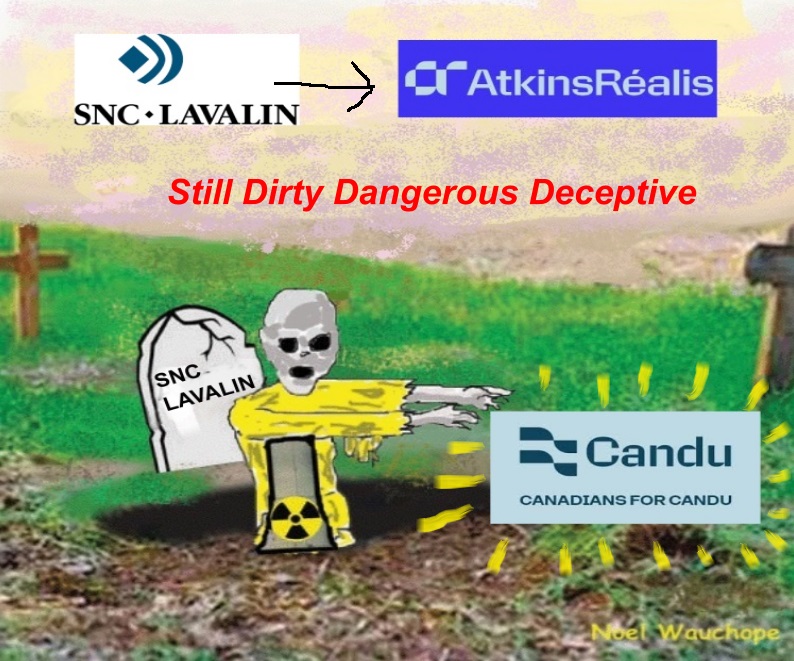
A new CANDU reactor does not exist. The current reactor at Point Lepreau is a CANDU 6, the same model as the one Hydro-Québec shut down permanently in 2012 and is now in the process of decommissioning. There are no plans to design a new CANDU 6.
August 6, 2025, Susan O’Donnell and Frank Greening, https://www.theenergymix.com/a-second-candu-reactor-for-point-lepreau-lets-ponder/
Over the summer, New Brunswick Premier Susan Holt mused to journalists about building a second CANDU reactor at the Point Lepreau nuclear site on the Bay of Fundy.
“A second CANDU is not far-fetched,” she told the Telegraph Journal. On the weekend, Holt enthused about the idea in a CBC story about the Eastern Energy Partnership pitch to Prime Minister Mark Carney.
A new CANDU reactor for New Brunswick? It’s a puzzling thought, worth pondering.
Let’s put aside for a moment that the current CANDU reactor at the Point Lepreau site is an economic nightmare, its poor performance the main reason NB Power loses money almost every year. Overspends on the original reactor and the rebuild together represent almost two-thirds of NB Power’s nearly $6-billion debt.
Let’s forget that more than 25 years ago in Ontario, the provincial utility Ontario Hydro was similarly effectively bankrupt before it was split up, leaving a $20-billion stranded debt, largely left over from its CANDU nuclear construction program. Ontario taxpayers and ratepayers were left holding the bag for that $20 billion, paying it back on their electricity bills. A recent investigation found that: “In 2050 Ontario will still be paying the debt of the nuclear program of the 1970s and 80s.”
Let’s also try to forget that the New Brunswick government gets its nuclear advice from NB Power (the utility that loses money almost every year), the same utility that in 2018 recommended the province invite two start-up companies from the United Kingdom and the United States that had never built a nuclear reactor to come to New Brunswick and, with their experimental reactor designs, start a new nuclear export industry.
It was a breathtakingly risky recommendation that can most kindly be described as “wishful thinking.” In the seven years since, despite more than $95 million to the companies from provincial and federal taxpayers, their two “advanced” designs for small modular nuclear reactors (SMRs) have failed to attract enough private sector financing and almost certainly will never be built in New Brunswick.
Finally, are we willing to ignore the fact that the Peskotomuhkati Nation never consented to the current CANDU reactor on its homeland at Point Lepreau, has made numerous interventions against plans to put the two SMRs on the site, and is highly unlikely to consent to a second CANDU?
For this ponder, let’s park all those troubling facts and focus on what we know about a potential second CANDU reactor for Point Lepreau.
A new CANDU reactor does not exist. The current reactor at Point Lepreau is a CANDU 6, the same model as the one Hydro-Québec shut down permanently in 2012 and is now in the process of decommissioning. There are no plans to design a new CANDU 6.
AtkinsRéalis (formerly SNC-Lavalin) owns the exclusive rights to design a new CANDU. The engineering firm announced in late 2023 that its new CANDU design is called Monark. So far, the CANDU Monark is a computer model, currently registered with the Canadian Nuclear Safety Commission as in a “familiarization and planning” stage with the start date for regulatory reviews “to be determined”.

Although AtkinsRéalis has released almost no technical details about its proposed design, the company did predict the CANDU Monark’s capacity factor, an important parameter for evaluating a nuclear reactor design. The capacity factor is a measure of efficiency, how often a nuclear reactor (or any other kind of power plant) operates at maximum power output over a specific period.
Predicted capacity factors require years of reactor operation to prove reliability. In 2023, the global average nuclear power plant capacity factor was 81.5%. Predicting a higher average capacity factor would mean AtkinsRéalis believes the CANDU Monark design can produce power more consistently and at a greater percentage of its potential than the average reactor.
This “new” CANDU Monark design has similar features (cooled and moderated with heavy water, similar core channels and heat transport system) to the design of the reactor at the Darlington nuclear site in Ontario, the last CANDU ordered in Canada more than 30 years ago. The lifetime average capacity factor for Darlington’s four CANDU units is 83%, in line with the global average.
Yet a paper sponsored by AtkinsRéalis at the June 2024 conference of the Canadian Nuclear Society claims the annual capacity of the CANDU Monark design is more than 95%, much higher than the global average or the actual number at Darlington.
How does AtkinsRéalis plan to boost this CANDU’s average capacity factor from 83% to 95%? The answer: more wishful thinking!
Now, back to the existing CANDU 6 reactor at Point Lepreau—which is currently, again, closed for repairs, this time for five months. After refurbishment, from the start of 2013 to the end of 2024, its capacity factor was 78%, below the global average. Last year, with a multi-month, unplanned shutdown for a generator repair, the reactor operated at 32% capacity. An investigation by CBC predicts that 2024 may be its worst operational year ever.
Earlier this year, the NB Power CEO said the root of the reactor’s problems can be traced to when the reactor was refurbished from 2008 to 2012. To save money, the plant’s supporting infrastructure was not upgraded, and now that infrastructure is breaking down.
Lack of money is a core constraint for New Brunswick’s nuclear plans. In 2024, another CBC investigation revealed a consultant report that linked the poor performance of NB Power’s nuclear reactor to the fact that since the refurbishment, the utility has not spent nearly enough to maintain it.
The basic problem is that New Brunswick lacks the capacity to operate a nuclear reactor. In addition to a financially stretched utility with a small grid, the province lacks nuclear management expertise.
When the plant reopened in 2012 after refurbishment, NB Power contracted a management team from Ontario Power Generation (OPG). Later, the utility hired a manager living outside the country. He billed the utility for travel expenses from his home to his work in New Brunswick in addition to his salary, a total that reached $1.3 million but delivered no improvement in the reactor’s performance. In 2023, NB Power said goodbye to the American and contracted OPG management again.
Across the globe [pdf], it is hard to find an electrical grid as small as NB Power’s with a nuclear reactor. The International Atomic Energy Agency recommends that: “A single power plant should represent no more than 10% of the total installed grid capacity.” NB Power’s Point Lepreau plant exceeds 15% of its grid capacity, including the energy available under power purchase agreements.
For decades, the utility has had oversized nuclear ambitions. As far back as 1972, a federal Department of Finance official warned [pdf] against subsidizing a power reactor for “a small, high-cost utility with barely enough cash flow to finance its present debt,” calling New Brunswick’s nuclear plans “the equivalent of a Volkswagen family acquiring a Cadillac as a second car.”
The nuclear industry depends on wishful thinking, plus its hubris and supreme confidence that have bamboozled generations of energy ministers and premiers into believing its overblown hype.
So, a second CANDU at Point Lepreau? The Premier would be wise to ignore the promotion and sales puff from NB Power and its nuclear industry friends and review the facts. Follow the money, or in this case, the billions the province has lost so far. A decision to build a second CANDU at Point Lepreau would be not only puzzling, but economically reckless.
Dr. Susan O’Donnell is a social scientist specializing in technology adoption and an Adjunct Research Professor and lead investigator of the CEDAR project at St. Thomas University. Dr. Frank Greening is nuclear research scientist with a PhD in Chemistry, retired from Ontario Power Generation (OPG). This story was first published by NB Media Co-op, and is republished by permission.
No comments yet.
1 This Month

of the week – Shut Down Drone Warfare!


Tell the Ukrainian Government to Drop Prosecution of Peace Activist Yurii Sheliazhenko

Petition to revoke the licensing of the Near Surface Nuclear Disposal Facility (NSDF) at Chalk River. https://www.ourcommons.ca/petitions/en/Petition/Details?Petition=e-7247
To see nuclear-related stories in greater depth and intensity – go to https://nuclearinformation.wordpress.com
-
Archives
- March 2026 (237)
- February 2026 (268)
- January 2026 (308)
- December 2025 (358)
- November 2025 (359)
- October 2025 (376)
- September 2025 (257)
- August 2025 (319)
- July 2025 (230)
- June 2025 (348)
- May 2025 (261)
- April 2025 (305)
-
Categories
- 1
- 1 NUCLEAR ISSUES
- business and costs
- climate change
- culture and arts
- ENERGY
- environment
- health
- history
- indigenous issues
- Legal
- marketing of nuclear
- media
- opposition to nuclear
- PERSONAL STORIES
- politics
- politics international
- Religion and ethics
- safety
- secrets,lies and civil liberties
- spinbuster
- technology
- Uranium
- wastes
- weapons and war
- Women
- 2 WORLD
- ACTION
- AFRICA
- Atrocities
- AUSTRALIA
- Christina's notes
- Christina's themes
- culture and arts
- Events
- Fuk 2022
- Fuk 2023
- Fukushima 2017
- Fukushima 2018
- fukushima 2019
- Fukushima 2020
- Fukushima 2021
- general
- global warming
- Humour (God we need it)
- Nuclear
- RARE EARTHS
- Reference
- resources – print
- Resources -audiovicual
- Weekly Newsletter
- World
- World Nuclear
- YouTube
-
RSS
Entries RSS
Comments RSS
 nuclear-news
Leave a comment