SEEDS OF PEACE -AUGUST 2025.

WEST SUBURBAN PEACE COALITION, Walt Zlotow, 5 Aug 25
Many top military leaders opposed atomic bombings
Every year the four day period August 6 – 9 brings to mind the Hiroshima and Nagasaki atomic bombings. This marks the 80th anniversary of those horrific acts.
I learned of the atomic bombings 74 years ago at age 6 and have been haunted by them ever since. For the first decade afterward, I swallowed whole the US fairytale that the military and political elite were unified in dropping the bombs to prevent a U.S. invasion and its estimate of a million U.S. casualties.
Few if any reputable historians buy that version today. They point to a number of top military leaders who opposed the nuclear attacks, for good reasons. Most prominent was U.S. Army Chief of Staff General George C. Marshall who argued not using the Bomb would strengthen America’s prestige and position in post war Asia. He even advocated for inviting the Russians to view its July 16, 1945 test.
Navy Secretary and later Defense Secretary James Forrestal argued the bombings would impede our post WWII relations with the Soviet Union. Fleet Admiral William Leahy, senior US military officer on active duty in WWII, called the proposed bombings “barbaric”. Assistant Secretary of War John McCloy told Truman that neither invasion nor atomic bombings were necessary. Japan would surrender if we avoided terminology ‘Unconditional Surrender’ since any surrender would amount to that without saying so. McCloy even advocated telling Japanese leaders we had the Bomb as additional incentive to quit the war.
Tho not involved in the Bomb decision process, Gen. Dwight Eisenhower was furious we dropped them, telling Secretary of War Harry Stimson shortly after the attacks “I voiced my grave misgivings, first on the basis of my belief that Japan was already defeated and that dropping the bomb was completely unnecessary, and secondly because I thought that our country should avoid shocking world opinion by the use of a weapon whose employment was, I thought, no longer mandatory as a measure to save American lives. It was my belief that Japan was, at that very moment, seeking some way to surrender with a minimum loss of “face.”
Ike, McCloy, Leahy, Forrestal, Marshall and others were right; Truman and his supporters were wrong. Eighty years on America is still the only country to explode nukes in anger. Current belligerency against maintaining nuclear agreements, routinely threatening imagined enemies with “all military options are on the table”, spending a trillion dollars to upgrade our nukes, risking nuclear war with Russia and China nu all bode ill we’ll make another 80 years nuclear attack free.
80 Years of Lies: The US Finally Admits It Knew It Didn’t Need to Bomb Hiroshima and Nagasaki.

Japan was already defeated and dropping the bomb was completely unnecessary…[it was] no longer mandatory as a measure to save American lives. It was my belief that Japan was, at this very moment, seeking a way to surrender with a minimum loss of face.” – Dwight D. Eisenhower, Supreme Allied Commander in Europe and future president
By Alan MacLeod / MintPress News, https://www.mintpressnews.com/hiroshima-nagasaki-us-nuclear-lies/290336/ August 7, 2025
As we commemorate the 80th anniversary of the Hiroshima and Nagasaki atomic bombings, the world is drifting as close to another nuclear confrontation as it has been in decades.
With Israeli and American attacks on Iranian nuclear energy sites, India and Pakistan going to war in May, and escalating violence between Russia and NATO-backed forces in Ukraine, the shadow of another nuclear war looms large over daily life.
Eighty Years Of Lies
The United States remains the only nation to have dropped an atomic bomb in anger. While the dates of August 6 and August 9, 1945, are seared into the popular conscience of all Japanese people, those days hold far less salience in American society.
When discussed at all in the U.S., this dark chapter in human history is usually presented as a necessary evil, or even a day of liberation—an event that saved hundreds of thousands of lives, prevented the need for an invasion of Japan, and ended the Second World War early. This, however, could not be further from the truth.
American generals and war planners agreed that Japan was on the point of collapse, and had, for weeks, been attempting to negotiate a surrender. The decision, then, to incinerate hundreds of thousands of Japanese civilians was one taken to project American power across the world, and to stymie the rise of the Soviet Union.
“It always appeared to us that, atomic bomb or no atomic bomb, the Japanese were already on the verge of collapse,” General Henry Arnold, Commanding General of the U.S. Army Air Forces in 1945, wrote in his 1949 memoirs.
Arnold was far from alone in this assessment. Indeed, Fleet Admiral William Leahy, the Navy’s highest-ranking officer during World War II, bitterly condemned the United States for its decision and compared his own country to the most savage regimes in world history.
As he wrote in 1950:
It is my opinion that the use of this barbarous weapon at Hiroshima and Nagasaki was of no material assistance in our war against Japan. The Japanese were already defeated and ready to surrender. My own feeling was that in being the first to use it, we had adopted an ethical standard common to the barbarians of the Dark Ages.”
By 1945, Japan had been militarily and economically exhausted. Losing key allies Italy in 1943 and Germany by May 1945, and facing the immediate prospect of an all-out Soviet invasion of Japan, the country’s leaders were frantically pursuing peace negotiations. Their only real condition appeared to be that they wished to keep as a figurehead the emperor—a position that, by some accounts, dates back more than 2,600 years.
“I am convinced,” former President Herbert Hoover wrote to his successor, Harry S. Truman, “if you, as President, will make a shortwave broadcast to the people of Japan—tell them they can have their emperor if they surrender, that it will not mean unconditional surrender except for the militarists—you’ll get a peace in Japan—you’ll have both wars over.”
Many of Truman’s closest advisors told him the same thing. “I am absolutely convinced that had we said they could keep the emperor, together with the threat of an atomic bomb, they would have accepted, and we would never have had to drop the bomb,” said John McCloy, Truman’s Assistant Secretary of War.
Nevertheless, Truman initially took an absolutist position, refusing to hear any Japanese negotiating caveats. This stance, according to General Douglas MacArthur, Commander of Allied Forces in the Pacific, actually lengthened the war. “The war might have ended weeks earlier,” he said, “If the United States had agreed, as it later did anyway, to the retention of the institution of the emperor.” Truman, however, dropped two bombs, then reversed his position on the emperor, in order to stop Japanese society from falling apart.
At that point in the war, however, the United States was emerging as the sole global superpower and enjoyed an unprecedented position of influence. The dropping of the atomic bomb on Japan underscored this; it was a power play, intended to strike fear into the hearts of world leaders, especially in the Soviet Union and China.
First Japan, Then The World
Hiroshima and Nagasaki drastically curbed the U.S.S.R.’s ambitions in Japan. Joseph Stalin’s forces had invaded and permanently annexed Sakhalin Island in 1945 and planned to occupy Hokkaido, Japan’s second-largest island. The move likely prevented the island nation from coming under the Soviet sphere of influence.
To this day, Japan remains deeply tied to the U.S., economically, politically, and militarily. There are around 60,000 U.S. troops in Japan, spread across 120 military bases.
Many in Truman’s administration wished to use the atom bomb against the Soviet Union as well. President Truman, however, worried that the destruction of Moscow would lead the Red Army to invade and destroy Western Europe as a response. As such, he decided to wait until the U.S. had enough warheads to completely destroy the U.S.S.R. and its military in one fell swoop.
War planners estimated this figure to be around 400. To that end, Truman ordered the immediate ramping up of production. Such a strike, we now know, would have caused a nuclear winter that would have permanently ended all organized life on Earth.
The decision to destroy Russia was met with stiff opposition among the American scientific community. It is now widely believed that Manhattan Project scientists, including Robert J. Oppenheimer himself, passed nuclear secrets to Moscow in an effort to speed up their nuclear project and develop a deterrent to halt this doomsday scenario. This part of history, however, was left out of the 2023 biopic movie.
By 1949, the U.S.S.R. was able to produce a credible nuclear deterrent before the U.S. had produced sufficient quantities for an all-out attack, thus ending the threat and bringing the world into the era of mutually assured destruction.
“Certainly prior to 31 December 1945, and in all probability prior to 1 November 1945, Japan would have surrendered even if the atomic bombs had not been dropped, even if Russia had not entered the war, and even if no invasion had been planned or contemplated,” concluded a 1946 report from the U.S. Strategic Bombing Survey.
Dwight D. Eisenhower, Supreme Allied Commander in Europe and future president, was of the same opinion, stating that:
Japan was already defeated and dropping the bomb was completely unnecessary…[it was] no longer mandatory as a measure to save American lives. It was my belief that Japan was, at this very moment, seeking a way to surrender with a minimum loss of face.”
Nevertheless, both Truman and Eisenhower publicly toyed with the idea of using nuclear weapons against China to stop the rise of Communism and to defend their client regime in Taiwan. It was only the development of a Chinese warhead in 1964 that led to the end of the danger, and, ultimately, the détente era of good relations between the two powers that lasted until President Obama’s Pivot to Asia.
Ultimately, then, the people of Japan were the collateral damage in a giant U.S. attempt to project its power worldwide. As Brigadier General Carer Clarke, head of U.S. intelligence on Japan wrote, “When we didn’t need to do it, and we knew we didn’t need to do it, and they knew that we knew we didn’t need to do it, we used them [Japanese citizens] as an experiment for two atomic bombs.”
Tiptoeing Closer To Armageddon
The danger of nuclear weapons is far from over. Today, Israel and the United States – two nations with atomic weaponry – attack Iranian nuclear facilities. Yet their continued, hyper-aggressive actions against their foes only suggest to other countries that, unless they too possess weapons of mass destruction, they will not be safe from attack. North Korea, a country with a conventional and nuclear deterrent, faces no such air strikes from the U.S. or its allies. These actions, therefore, will likely result in more nations pursuing nuclear ambitions.
Earlier this year, India and Pakistan (two more nuclear-armed states) came into open conflict thanks to disputes over terrorism and Jammu and Kashmir. Many influential individuals on both sides of the border were demanding their respective sides launch their nukes – a decision that could also spell the end of organized human life. Thankfully, cooler heads prevailed.
Meanwhile, the war in Ukraine continues, with NATO forces urging President Zelensky to up the ante. Earlier this month, President Trump himself reportedly encouraged the Ukrainian leader to use his Western-made weapons to strike Moscow.
It is precisely actions such as these that led the Bulletin of Atomic Scientists to move their famous Doomsday Clock to 89 seconds to midnight, the closest the world has ever been to catastrophe.
“The war in Ukraine, now in its third year, looms over the world; the conflict could become nuclear at any moment because of a rash decision or through accident or miscalculation,” they wrote in their explanation, adding that conflicts in Asia could spiral out of control into a wider war at any point, and that nuclear powers are updating and expanding their arsenals.
The Pentagon, too, is recruiting Elon Musk to help it build what it calls an American Iron Dome. While this move is couched in defensive language, such a system – if successful – would grant the U.S. the ability to launch nuclear attacks anywhere in the world without having to worry about the consequences of a similar response.
Thus, as we look back at the horrors of Hiroshima and Nagasaki 80 years ago, we must understand that not only were they entirely avoidable, but that we are now closer to a catastrophic nuclear confrontation than many people realize.
The lethal legacy of Aukus nuclear submarines will remain for millennia – and there’s no plan to deal with it.

Ben Doherty, 10 Aug 25, https://www.theguardian.com/world/2025/aug/10/the-lethal-legacy-of-aukus-nuclear-submarines-will-remain-for-millennia-and-theres-no-plan-to-deal-with-it
“None of the leaders who announced Aukus are in power any more,” he tells the Guardian. “One hundred thousand years from now, who knows what the world looks like, but Australia, whatever is here then, will still be dealing with the consequences of that high-level waste.”
Australia’s future nuclear submarines will produce highly radioactive waste, and allies in the UK and the US still don’t have a safe place to store their own.
In the cold deep waters of Rosyth Harbour lie the dormant hulks of Britain’s decommissioned nuclear submarines.
One of the shells lashed to the dock here is HMS Dreadnought, Britain’s first nuclear-powered submarine. It was commissioned in 1963, retired in 1980, and has spent decades longer tied to a harbour than it ever did in service. The spent nuclear fuel removed from its reactor remains in temporary storage.
For decades the UK has sought a solution to the nuclear waste its fleet of submarines generates. After decades of fruitless search there are “ongoing discussions” but still no place for radioactive waste to be permanently stored.
Similarly, in the US – the naval superpower which controls a vast landmass and which has run nuclear submarines since the 1950s – there is still no permanent storage for its submarines’ nuclear waste.
More than a hundred decommissioned radioactive reactors sit in an open-air pit in Washington state, on a former plutonium production site the state’s government describes as “one of the most contaminated nuclear sites in the world”.
This is what becomes of nuclear-powered submarines at the end of their comparatively short life.
A nuclear-powered submarine can expect a working life of three decades: the spent fuel of a submarine powered by highly enriched uranium can remain dangerously radioactive for millennia. Finland is building an underground waste repository to be sealed for 100,000 years.
For Australia’s proposed nuclear-powered submarine fleet there is, at present, nowhere for that radioactive spent fuel to go. As a non-nuclear country – and a party to the non-proliferation treaty – Australia has no history of, and no capacity for, managing high-level nuclear waste.
But Australia is not alone: there is no operational site anywhere on Earth for the permanent storage of high-level nuclear waste.
‘Australia shall be responsible … ’
Documents released under freedom of information laws show that, beginning in the 2050s, each of Australia’s decommissioned Aukus submarines will generate both intermediate- and high-level radioactive waste: a reactor compartment and components “roughly the size of a four-wheel drive”; and spent nuclear fuel “roughly the size of a small hatchback”.
The Australian Submarine Agency says the exact amount of high-level waste Australia will be responsible for is “classified”.
Because Australia’s submarines will run on highly enriched uranium (as opposed to low enriched uranium – which can power a submarine but cannot be used in a warhead) the waste left behind is not only toxic for millennia, it is a significant proliferation risk: highly enriched uranium can be used to make weapons.
The eight nuclear-powered submarines proposed for Australia’s navy will require roughly four tonnes of highly enriched uranium to fuel their sealed reactor units: enough for about 160 nuclear warheads on some estimates.
The spent fuel will require military-grade security to safeguard it.
The problems raised by Australia’s critics of Aukus are legion: the agreement’s $368bn cost; the lopsided nature of the pact in favour of the US; sclerotic rates of shipbuilding in the US and the UK, raising concerns that Australia’s nuclear submarines might never arrive; the loss of Australian sovereignty over those boats if they do arrive; the potential obsolescence of submarine warfare; and whether Aukus could make Australia a target in an Indo-Pacific conflict.
All are grave concerns for a middle power whose security is now more tightly bound by Aukus to an increasingly unreliable “great and powerful friend”.
But the most intractable concern is what will happen to the nuclear waste.
It is a problem that will outlive the concept of Australia as a nation-state, that will extend millennia beyond the comprehension of anybody reading these words, that will still be a problem when Australia no longer exists.
And it cannot be exported.
The Aukus agreement expressly states that dealing with the submarines’ nuclear waste is solely Australia’s responsibility.
“Australia shall be responsible for the management, disposition, storage, and disposal of any spent nuclear fuel and radioactive waste … including radioactive waste generated through submarine operations, maintenance, decommissioning, and disposal,” Article IV, subclause D of the treaty states.
As well, should anything go wrong, at any point, with Australia’s nuclear submarines, the risk is all on Australia.
Australia shall indemnify … the United States and the United Kingdom against any liability, loss, costs, damage or injury … resulting from Nuclear Risks connected with the design, manufacture, assembly, transfer, or utilization of any Material or Equipment, including Naval Nuclear Propulsion Plants,” subclause E states.
“‘Nuclear Risks’,” the treaty states, “means those risks attributable to the radioactive, toxic, explosive, or other hazardous properties of material.”
‘Decide and defend’
An emeritus professor at Griffith University’s school of environment and science, Ian Lowe, tells Guardian Australia that the government’s regime for storing low-level nuclear waste is a “shambles”. He says the government’s “decide and defend” model for choosing a permanent waste storage site has consistently failed.
“You currently have radioactive waste from Lucas Heights, from Fishermans Bend, and from nuclear medicine and research all around Australia, just stored in cupboards and filing cabinets and temporary sheds,” Lowe says.
“The commonwealth government has made three attempts to establish a national facility – it’s a repository if you’re in favour of it, it’s a waste dump if you’re opposed – and on every occasion there’s been local opposition, particularly opposition from Indigenous landowners, and on each of those three occasions … the proposal has collapsed.”
Most of Australia’s low-level and intermediate nuclear waste – much of it short-lived medical waste – is stored at the Australian Nuclear Science and Technology Organisation facility in Lucas Heights in outer Sydney. Lowe says the nuclear safety regulator, ARPANSA, does a commendable job in protecting the public but the facility was never intended to be permanent.
Australia has been searching for a permanent site for nuclear waste for nearly three decades.
Its approach – derided by Lowe as “decide and defend”: where government chooses a place to put radioactive waste and then defends the decision against community opposition – has failed in Woomera, in central South Australia, in the late 1990s, then Muckaty station in the Northern Territory, then on farmland near Kimba, again in SA.
The federal court ruled against the Kimba plan in 2023, after a challenge from the traditional owners, the Barngarla people, who had been excluded from consultation.
Lowe, the author of Long Half-Life: The Nuclear Industry in Australia, says the complexities and risks of storing high-level nuclear waste from a submarine are factors greater than the low- and intermediate-level waste Australia now manages.
“The waste from nuclear submarines is much nastier and much more intractable,” he says. “And because they use weapons-grade highly enriched uranium there is the greater security issue of needing to make sure that not only do you need to protect against that waste irradiating people and the environment, you must also ensure that malevolent actors, who have in mind a malicious use of highly enriched uranium, can’t get their hands on it.”
Australia’s decision to use highly enriched uranium to power its submarines, as opposed to low enriched uranium (reactors would need refuelling each decade), is a “classic case of kicking the can down the road and creating a problem for future generations”, Lowe argues.
“In the short term, it’s better to have highly enriched uranium and a sealed reactor that you never need to maintain during the life of the submarine. But at the end of the life of the submarine, you have a much more serious problem.”
The high-level nuclear waste from Australia’s submarines will be hazardous for “hundreds of thousands of years,” Lowe says.
“There are arguments about whether it’s 300,000 or 500,000 or 700,000 years, but we’re talking a period at least as long as humans have existed as an identifiably separate species. The time horizon for political decision makers is typically four or five years: the time horizon of what we’re talking about is four or five hundred thousand years, so there’s an obvious disconnect.”
Inside ‘Trench 94’
The US and the UK have run nuclear-powered (and nuclear-armed) submarines for decades.
In the UK, 23 nuclear submarines have been decommissioned, none have been dismantled, 10 remained nuclear-fuelled. Most are sitting in water in docks in Scotland and on England’s south-west coast.
The first submarine to be disposed of – the cold war-era HMS Swiftsure was retired from service in 1992 – will be finally dismantled in 2026. Keeping decommissioned nuclear subs afloat and secure costs the UK upwards of £30m a year.
There is still no site for permanent storage of their radioactive waste: there has been “progress and ongoing discussions”, the defence minister, Lord Coaker, told the House of Lords last year, but still no site.
The UK has about 700,000 cubic metres of toxic waste, roughly the volume of 6,000 doubledecker buses. Much of it is stored at Sellafield in Cumbria, a site described by the Office for Nuclear Regulation says as “one of the most complex and hazardous nuclear sites in the world”.
In the US, contaminated reactors from more than 100 retired submarines are stored in “Trench 94” – a massive open pit at the Hanford nuclear site in Washington state. Spent nuclear fuel is also sent to the Idaho National Laboratory and sites in South Carolina and Colorado. Hanford is designed to last 300 years but the site has a chequered history of pollution and radiation leaks. Washington state describes it as “one of the most contaminated nuclear sites in the world”.
Finland is the first country to devise a permanent solution. It is building an underground facility 450 metres below ground, buried in the bedrock of the island of Olkiluoto.
The Onkalo – Finnish for cave or cavity – facility has taken more than 40 years to build (the site was chosen by government in 1983) and has cost €1bn. It is now undergoing trials.
‘A Trojan horse’
In March 2023 Australia’s defence minister, Richard Marles, said high-level nuclear waste would be stored on “defence land, current or future”, raising the prospect that a site could be identified and then declared “defence land”. A process for establishing a site would be publicly revealed “within 12 months”, he said. That process has not been announced nor a site identified.
Australia will require a site for high-level nuclear waste from the “early 2050s”, according to the Australian Submarine Agency. Senate estimates heard last year that there have been no costings committed for the storage of spent fuel. And preparing a site for storing high-level radioactive waste for millennia will take decades.
Guardian Australia sent a series of questions to Marles’ office about the delayed process for selecting a site. A spokesperson for the Australian Submarine Agency responded, saying: “The government is committed to the highest levels of nuclear stewardship, including the safe and secure disposal of waste.
“As the Government has said, the disposal of high-level radioactive waste won’t be required until the 2050s, when Australia’s first nuclear-powered submarine is expected to be decommissioned.”
The spokesperson confirmed that Australia would be responsible for all of the spent nuclear fuel and radioactive waste generated from the Aukus submarines: it would not have responsibility for intermediate- or high-level radioactive waste – including spent fuel – from the US, UK or any other country. No permanent storage site had been identified for low-level radioactive waste, which would include waste from foreign submarines.
The government has consistently said it will engage extensively with industry, nuclear experts and affected communities to build a social licence for a permanent storage site.
But Dave Sweeney of the Australian Conservation Foundation says he has seen little evidence of genuine effort to build social licence.
The leaders who signed the Aukus deal – and those who continue to support it – have failed to comprehend the consequences beyond their political careers, he says.
“None of the leaders who announced Aukus are in power any more,” he tells the Guardian. “One hundred thousand years from now, who knows what the world looks like, but Australia, whatever is here then, will still be dealing with the consequences of that high-level waste.”
Sweeney says the “opacity” of the decision-making around the Aukus agreement itself is compounded by fears that the deal could be only the beginning of a nuclear industry expansion in Australia.
“We see this as a Trojan horse to expanding, facilitating, empowering the nuclear industry, emboldening the nuclear industry everywhere,” he says. “It is creepy, controversial, costly, contaminating, and leading to vastly decreased security and options for regional and global peace.”
Beyond the astronomical cost of the submarine deal, its the true burden would be borne by innumerable future generations.
“We are talking thousands and thousands of years: it is an invisible pervasive pollutant and contaminant and the only thing that gets rid of it is time. And with the whole Aukus deal, that’s what we’re running out of.”
To Future Generations: They Knew. They All Knew What Was Happening In Gaza.
Caitlin Johnstone, Aug 09, 2025, https://www.caitlinjohnst.one/p/to-future-generations-they-knew-they?utm_source=post-email-title&publication_id=82124&post_id=170505794&utm_campaign=email-post-title&isFreemail=true&r=1ise1&triedRedirect=true&utm_medium=email
A note to future generations for historical record:
Every pundit, politician and reporter of our time who claims they didn’t know what was happening in Gaza is lying.
They knew what was happening. They knew Israel was telling lies. They knew about everything.
They had access to the same information as all the rest of us. We watched them make excuses and ignore indisputable facts every step of the way. There was absolutely no confusion about what they were looking at. It was all right out in the open.
Don’t let them get away with saying they didn’t know. They knew. They knew the entire time. Brand them permanently with this shame, and force them to carry it with them for the rest of their lives.
I hate all genocide supporters equally, regardless of their religion. Telling me your religion is like telling me about your dreams: it’s completely uninteresting to me. If you support an active genocide you’re a bad person who deserves to be shunned and reviled, regardless of what your religion happens to be.
It’s so wild how Jewish people will just stride confidently into public discourse about Gaza while strongly emphasizing their Jewishness, as though their support for genocide is somehow special and different from any other asshole’s support for genocide. Wanting to starve civilians and mass murder children makes you a piece of shit, whether you are Jewish, Mormon, Buddhist, or atheist.
Nobody cares what religious belief systems you happen to hold in your head while you advocate massacring civilians, they care about the fact that you advocate massacring civilians. Being Jewish doesn’t give you some kind of magical immunity from being held to basic moral standards and being judged by society for supporting a mass atrocity. It’s got nothing to do with anything.
After a whistleblower on the so-called Gaza Humanitarian Foundation named Tony Aguilar shared the heartbreaking story about a boy named Amir who became one of the many Palestinians massacred by Israeli forces while trying to obtain food at an aid site, his family reported that he had been missing since that day and they hadn’t known what had happened to him. They still don’t know where his body is.
The fact that people just “go missing” in Gaza after being killed indicates Israel often buries the bodies of victims to cover up their deaths — something they’ve been caught doing before. This is one of many reasons why we can be sure that the actual death toll is much higher than the official record.
Still can’t believe Israel supporters spent days yelling “Israel isn’t starving children, it’s starving SICK children!” and thought that was an awesome argument.
Friendly periodic reminder that the “Israel bombs hospitals because the hospitals are Hamas bases” narrative was conclusively debunked when IDF soldiers were repeatedly documented entering the hospitals they attacked and destroying individual pieces of medical equipment, one by one. Hamas isn’t the target, healthcare is the target. That has been irrefutably established.
Opposing the Gaza genocide has meant being proven right about everything from the very beginning every step of the way, hating being proven right, and then having the liberals who kept yelling at you for your rightness slowly begin to acknowledge that you were right, while still finding excuses to hate you for being right anyway.
A new poll by the Israel Democracy Institute has found that only 6.7 percent of Jewish Israelis say they are “very troubled” by reports of starvation and suffering in Gaza, with 67 percent saying they are either “not at all troubled” or “not so troubled” by the news. That means those who are pretty much fine with deliberately starving children outnumber those who hold a normal attitude on the matter ten to one.
Poll after poll after poll shows that Jewish Israelis are horrible people who are quantifiably much more cruel and immoral than pretty much any other population. At a certain point you have to stop thinking the polls might be mistaken and see that the only real mistake is Israel.
Meanwhile, Ukrainian support for the war with Russia has plunged even further, with a new Gallup poll finding that just 24 percent of Ukrainians now support continuing the fight until victory. A 69 percent supermajority now say they want peace negotiations as soon as possible.
I get called a Putin-loving cryptofascist vatnik tankie Kremlin agent whenever I say this, but a majority of Ukrainians have wanted this war to end for a while now. At this point the only ones who want more war are westerners, plus some of the Ukrainians who live far away from the fighting.
We’re being told the holocaust in Gaza can’t be ended, and we’re being told the war nobody wants in Ukraine must continue. We are ruled by monsters.
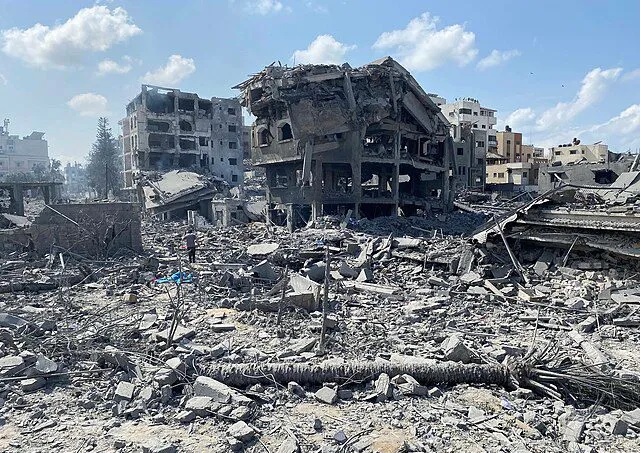
Israeli military plans to occupy Gaza City in major escalation of war
The plan will “take months, lead to the death of the hostages, the killing of many soldiers, cost tens of billions to the Israeli taxpayers, and lead to a political collapse,”
Prime Minister Benjamin Netanyahu suggested earlier that Israel’s military will ‘take control of all Gaza’.
Israel’s security cabinet has approved a plan by Israeli Prime Minister Benjamin Netanyahu for the military occupation of Gaza City, located in the north of the Palestinian enclave.
“The [Israeli military] will prepare to take control of Gaza City while providing humanitarian aid to the civilian population outside the combat zones,” Netanyahu’s office said in a statement early on Friday announcing the takeover plan.
Two Israeli government sources told the Reuters news agency that any resolution by the security cabinet would now need to be approved by the full government cabinet, which may not meet until Sunday.
Occupying Gaza City marks a major escalation by Israel in its war on the Palestinian territory and will likely result in the forced displacement of tens of thousands of exhausted and starving residents who are experiencing famine conditions as Israel continues to block humanitarian aid from entering the territory.
United Kingdom Prime Minister Keir Starmer said Israel’s plan to escalate the assault on Gaza was “wrong”.
“This action will do nothing to bring an end to this conflict or to help secure the release of the hostages. It will only bring more bloodshed,” he said in a statement.
Axios news reporter Barak Ravid, who first reported the security cabinet’s approval of the plan, quoted an unnamed Israeli official as saying the operation will involve the forced displacement of “all Palestinian civilians from Gaza City to the central camps and other areas by October 7”.
“A siege will be imposed on the Hamas militants who remain in Gaza City, and at the same time, a ground offensive will be carried out in Gaza City,” Ravid wrote on X, citing the official.
On Thursday, in advance of the security cabinet meeting, Netanyahu said Israel would “take control of all Gaza”.
In a television interview with US outlet Fox News, Netanyahu also said Israel does not want to be “a governing body” in Gaza and would hand over responsibility to an unspecified third party.
“We don’t want to keep it. We want to have a security perimeter. We don’t want to govern it,” he said.
Netanyahu’s comments followed reports in Israeli media earlier this week that the Israeli leader would imminently announce plans to fully occupy the entirety of the Gaza Strip.
Hamas said Netanyahu’s comments “represent a blatant reversal of the negotiation process and clearly expose the real motives behind his withdrawal from the last ceasefire round, despite our nearing a final agreement.”
“His plans to expand the aggression confirm beyond doubt that he seeks to abandon his own prisoners, sacrificing them to serve his personal interests and extremist ideological agenda,” the group said in a statement.
Israeli opposition leader Yair Lapid said the decision to take over Gaza City was a “disaster that will lead to many more disasters”.
The plan will “take months, lead to the death of the hostages, the killing of many soldiers, cost tens of billions to the Israeli taxpayers, and lead to a political collapse,” he wrote in a post on X.
“This is exactly what Hamas wanted: for Israel to be trapped in the field without a goal, without defining the picture of the day after, in a useless occupation that no one understands where it is leading.”
Shihab Rattansi, Al Jazeera’s correspondent in Washington, DC, said Israel’s move to occupy Gaza has been “telegraphed for several days now”.
“Donald Trump has all but greenlit whatever Benjamin Netanyahu wants to do. He said it would be up to the Israelis,” Rattansi said.
It is unclear how many people still live in Gaza City, the enclave’s largest population centre before Israel’s war on the territory that has now killed more than 61,000 Palestinians since October 2023.
Hundreds of thousands of people fled Gaza City under forced evacuation orders issued by the Israeli military in the opening weeks of the war, but many returned during a brief ceasefire at the start of this year.
A major ground operation in Gaza City could displace many thousands and further disrupt efforts to deliver food to the famine-stricken territory, where almost 200 people have now died from starvation and malnutrition.
“There is nothing left to occupy,” Gaza resident Maysaa al-Heila said on hearing of the planned takeover of the city.
“There is no Gaza left,” al-Heila told The Associated Press news agency.
Why no Hollywood movie on Nagasaki A Bombing?

Walt Zlotow, West Suburban Peace Coalition, Glen Ellyn 8 Aug 25
In the 1952 movie ‘Above and Beyond’, movie idol Robert Taylor played handsome Col. Paul Tibbetts, straight out of Central Casting, who piloted Enola Gay to drop the first atomic bomb on Hiroshima 80 years ago August 6. We all grew up in awe of Tibbetts, Enola Gay and the perfect mission which incinerated Hiroshima from the first A Bomb dropped in anger. My awe eventually turned to revulsion upon learning it was a monstrous war crime.
But who piloted what plane that dropped the second A Bomb on Nagasaki just 3 days later, August 9? The American Story has largely erased the saga of the Nagasaki mission for good reason. It was a colossal screw up that almost got the pilot court martialed; indeed, nearly detonated Fat Man over the Pacific enroute.
Trouble began early on. Paul Tibbetts, fresh from his Hiroshima success, picked his friend Charles Sweeney to pilot the drop plane ‘Bockscar’ instead of its regular pilot Fred Bock. Sweeney was unfamiliar with both combat and the plane. Preparing for takeoff, Sweeney was unable to operate the reserve tank containing 640 gallons of fuel needed to get Bockscar safely back to its Tinian takeoff point. Bock may have had the familiarity with the plane to accomplish that. Regulations required the mission be scrapped so Sweeney and crew exited Bockscar. But Tibbetts overruled them and the mission was on with insufficient fuel.
Three hours in, worse trouble. Fat Man’s red detonation lights began blinking wildly. Chief weaponeer Dick Ashworth frantically searched the blueprints and realized 2 switches had been reversed in the preflight assembly. Solving that problem, everyone relaxed till Bockscar failed to rendezvous with the second of two back up planes, one for photography and one for instruments. The instrument plane, The Big Stink, was 9,000 feet above Bockscar. Instead of pushing on to original target Kokura, Sweeney wasted 45 minutes of precious fuel trying to link up. Big Stink pilot Hoppy Hopkins broke radio silence frantically calling Tinian asking “Is Bockscar down?” Mission officials only heard “Bockscar Down” and freaked out believing Bockscar, Fat Man and the 13 member crew were in Davy Jones Locker.
Ashford was frantic that all was lost. As tension mounted between the weaponeer and the pilot, he finally persuaded Sweeney to proceed to primary target Kokura. But a smokescreen put up by Japanese defenders responding to the Hiroshima attack caused Sweeney to go around for a second and third bomb run, wasting fuel. More trouble. Flack and approaching Japanese Zeros forced Sweeney to abandon Kokura to flee 100 miles to alternate target Nagasaki.
The drop made, Sweeney made a desperate dive to avoid the mushroom cloud that nearly engulfed them. But his previous delays made the return trip to Tinian impossible. Low on fuel, Sweeney began a treacherous 450 mile flight on dwindling fuel for Okinawa. All aboard Bockscar prepared to ditch. Approaching the Okinawa airfield unable to radio the tower of their emergency, Bockscar had to drop in to a forced landing amid numerous other flights without control tower clearance. Bockscar bounced 25 feet in the air landing at 30 MPH over the maximum landing speed, nearly colliding with a row of fuel laden B-24’s. One engine quit on the approach and another upon touchdown. Thinking Bockscar was lost, airport personnel inquired who this strange plane was that descended out of the sky unannounced. ‘We just dropped an atomic bomb’ was the reply.
There were no celebrations for the crew of Bockscar. Officials considered court martialing Sweeney for his life and mission threatening delays but considered the embarrassment it would cause and decided against. Why mar the mission-perfect first nuking of civilians by Paul Tibbetts and Enola Gay?
While we’ll never get a Hollywood treatment of the Bockscar A Bomb mission, it would be a lot more exciting than ‘Above and Beyond’. An appropriate title? ‘Nearly Down and Out Over Nagasaki’.
A Second CANDU Reactor for Point Lepreau? Let’s Ponder.
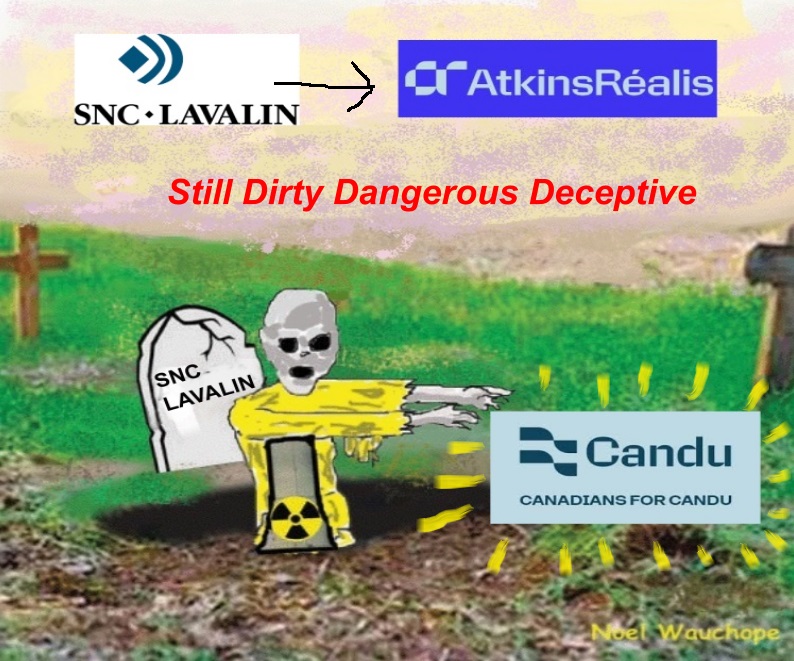
A new CANDU reactor does not exist. The current reactor at Point Lepreau is a CANDU 6, the same model as the one Hydro-Québec shut down permanently in 2012 and is now in the process of decommissioning. There are no plans to design a new CANDU 6.
August 6, 2025, Susan O’Donnell and Frank Greening, https://www.theenergymix.com/a-second-candu-reactor-for-point-lepreau-lets-ponder/
Over the summer, New Brunswick Premier Susan Holt mused to journalists about building a second CANDU reactor at the Point Lepreau nuclear site on the Bay of Fundy.
“A second CANDU is not far-fetched,” she told the Telegraph Journal. On the weekend, Holt enthused about the idea in a CBC story about the Eastern Energy Partnership pitch to Prime Minister Mark Carney.
A new CANDU reactor for New Brunswick? It’s a puzzling thought, worth pondering.
Let’s put aside for a moment that the current CANDU reactor at the Point Lepreau site is an economic nightmare, its poor performance the main reason NB Power loses money almost every year. Overspends on the original reactor and the rebuild together represent almost two-thirds of NB Power’s nearly $6-billion debt.
Let’s forget that more than 25 years ago in Ontario, the provincial utility Ontario Hydro was similarly effectively bankrupt before it was split up, leaving a $20-billion stranded debt, largely left over from its CANDU nuclear construction program. Ontario taxpayers and ratepayers were left holding the bag for that $20 billion, paying it back on their electricity bills. A recent investigation found that: “In 2050 Ontario will still be paying the debt of the nuclear program of the 1970s and 80s.”
Let’s also try to forget that the New Brunswick government gets its nuclear advice from NB Power (the utility that loses money almost every year), the same utility that in 2018 recommended the province invite two start-up companies from the United Kingdom and the United States that had never built a nuclear reactor to come to New Brunswick and, with their experimental reactor designs, start a new nuclear export industry.
It was a breathtakingly risky recommendation that can most kindly be described as “wishful thinking.” In the seven years since, despite more than $95 million to the companies from provincial and federal taxpayers, their two “advanced” designs for small modular nuclear reactors (SMRs) have failed to attract enough private sector financing and almost certainly will never be built in New Brunswick.
Finally, are we willing to ignore the fact that the Peskotomuhkati Nation never consented to the current CANDU reactor on its homeland at Point Lepreau, has made numerous interventions against plans to put the two SMRs on the site, and is highly unlikely to consent to a second CANDU?
For this ponder, let’s park all those troubling facts and focus on what we know about a potential second CANDU reactor for Point Lepreau.
A new CANDU reactor does not exist. The current reactor at Point Lepreau is a CANDU 6, the same model as the one Hydro-Québec shut down permanently in 2012 and is now in the process of decommissioning. There are no plans to design a new CANDU 6.
AtkinsRéalis (formerly SNC-Lavalin) owns the exclusive rights to design a new CANDU. The engineering firm announced in late 2023 that its new CANDU design is called Monark. So far, the CANDU Monark is a computer model, currently registered with the Canadian Nuclear Safety Commission as in a “familiarization and planning” stage with the start date for regulatory reviews “to be determined”.

Although AtkinsRéalis has released almost no technical details about its proposed design, the company did predict the CANDU Monark’s capacity factor, an important parameter for evaluating a nuclear reactor design. The capacity factor is a measure of efficiency, how often a nuclear reactor (or any other kind of power plant) operates at maximum power output over a specific period.
Predicted capacity factors require years of reactor operation to prove reliability. In 2023, the global average nuclear power plant capacity factor was 81.5%. Predicting a higher average capacity factor would mean AtkinsRéalis believes the CANDU Monark design can produce power more consistently and at a greater percentage of its potential than the average reactor.
This “new” CANDU Monark design has similar features (cooled and moderated with heavy water, similar core channels and heat transport system) to the design of the reactor at the Darlington nuclear site in Ontario, the last CANDU ordered in Canada more than 30 years ago. The lifetime average capacity factor for Darlington’s four CANDU units is 83%, in line with the global average.
Yet a paper sponsored by AtkinsRéalis at the June 2024 conference of the Canadian Nuclear Society claims the annual capacity of the CANDU Monark design is more than 95%, much higher than the global average or the actual number at Darlington.
How does AtkinsRéalis plan to boost this CANDU’s average capacity factor from 83% to 95%? The answer: more wishful thinking!
Now, back to the existing CANDU 6 reactor at Point Lepreau—which is currently, again, closed for repairs, this time for five months. After refurbishment, from the start of 2013 to the end of 2024, its capacity factor was 78%, below the global average. Last year, with a multi-month, unplanned shutdown for a generator repair, the reactor operated at 32% capacity. An investigation by CBC predicts that 2024 may be its worst operational year ever.
Earlier this year, the NB Power CEO said the root of the reactor’s problems can be traced to when the reactor was refurbished from 2008 to 2012. To save money, the plant’s supporting infrastructure was not upgraded, and now that infrastructure is breaking down.
Lack of money is a core constraint for New Brunswick’s nuclear plans. In 2024, another CBC investigation revealed a consultant report that linked the poor performance of NB Power’s nuclear reactor to the fact that since the refurbishment, the utility has not spent nearly enough to maintain it.
The basic problem is that New Brunswick lacks the capacity to operate a nuclear reactor. In addition to a financially stretched utility with a small grid, the province lacks nuclear management expertise.
When the plant reopened in 2012 after refurbishment, NB Power contracted a management team from Ontario Power Generation (OPG). Later, the utility hired a manager living outside the country. He billed the utility for travel expenses from his home to his work in New Brunswick in addition to his salary, a total that reached $1.3 million but delivered no improvement in the reactor’s performance. In 2023, NB Power said goodbye to the American and contracted OPG management again.
Across the globe [pdf], it is hard to find an electrical grid as small as NB Power’s with a nuclear reactor. The International Atomic Energy Agency recommends that: “A single power plant should represent no more than 10% of the total installed grid capacity.” NB Power’s Point Lepreau plant exceeds 15% of its grid capacity, including the energy available under power purchase agreements.
For decades, the utility has had oversized nuclear ambitions. As far back as 1972, a federal Department of Finance official warned [pdf] against subsidizing a power reactor for “a small, high-cost utility with barely enough cash flow to finance its present debt,” calling New Brunswick’s nuclear plans “the equivalent of a Volkswagen family acquiring a Cadillac as a second car.”
The nuclear industry depends on wishful thinking, plus its hubris and supreme confidence that have bamboozled generations of energy ministers and premiers into believing its overblown hype.
So, a second CANDU at Point Lepreau? The Premier would be wise to ignore the promotion and sales puff from NB Power and its nuclear industry friends and review the facts. Follow the money, or in this case, the billions the province has lost so far. A decision to build a second CANDU at Point Lepreau would be not only puzzling, but economically reckless.
Dr. Susan O’Donnell is a social scientist specializing in technology adoption and an Adjunct Research Professor and lead investigator of the CEDAR project at St. Thomas University. Dr. Frank Greening is nuclear research scientist with a PhD in Chemistry, retired from Ontario Power Generation (OPG). This story was first published by NB Media Co-op, and is republished by permission.
1,500 Killed While Seeking Aid in Gaza Since May: UN.

August 5, 2025, https://www.middleeastmonitor.com/20250804-1500-killed-while-seeking-aid-in-gaza-since-may-un/
Around 1,500 people have been killed in Gaza since May while seeking humanitarian aid, the UN said Monday, Anadolu reports.
“The Office for the Coordination of Humanitarian Affairs says that many people reportedly continue to be killed and injured, including people seeking food along the UN convoy routes and militarized distribution points. Some 1,500 people have been reportedly killed since May,” Farhan Haq, UN deputy spokesperson, told reporters.
He added that a health care worker with the Palestine Red Crescent Society was killed Sunday in an Israeli airstrike in Khan Yunus, southern Gaza.
Since May 27, a US- and Israeli-backed aid scheme in Gaza has been widely criticized as being ineffective as well as being a “death trap” for starving civilians.
Asked by Anadolu whether the UN secretary-general believes the UN’s reputation and effectiveness can be salvaged given its failure to stop Israel’s actions, including plans to expand the annexation of Palestinian land, Haq responded: “He certainly does.”
Haq said the UN’s record includes “successful diplomatic negotiations” and humanitarian aid that continues to “keep billions of people alive.” He emphasized that lack of international unity, particularly within the UN Security Council, hinders the organization’s effectiveness.
Gaza’s Government Media Office said Monday that Israel had allowed in just 674 aid trucks since July 27 – only 14% of the strip’s minimum daily requirement of 600 trucks.
It said most of the 80 trucks that entered on Sunday were looted amid what it called “a deliberately engineered climate of chaos and starvation,” accusing Israel of weaponizing hunger to undermine Palestinian resilience.
Rejecting international calls for a ceasefire, the Israeli army has pursued a brutal offensive on Gaza since Oct. 7, 2023, killing nearly 61,000 Palestinians, almost half of them women and children. The military campaign has devastated the enclave and brought it to the verge of famine.
Weekly Briefing: A tipping point for Israel’s legitimacy

Global pressure mounts as Israel chooses famine over peace
By Dave Reed August 9, 2025, https://mondoweiss.net/2025/08/weekly-briefing-a-tipping-point-for-israels-legitimacy/
Israel’s war on Gaza has never been solely about “defeating” Hamas. This week’s reporting makes that clearer than ever. If you read just one article this week, Tareq Hajjaj documents how Israel is engineering chaos in Gaza’s aid system, shooting at desperate civilians, and allowing looters to operate freely so that food does not reach starving people. Qassam Muaddi reports on leaked Israeli cabinet minutes that confirm they deliberately chose starvation as a weapon of war, rejecting a ceasefire in favor of forcing Gaza’s surrender through hunger.
This policy is not hidden. It was discussed from the very beginning, nearly two years ago, and is still openly embraced by senior Israeli figures and the majority of the Israeli population. That brazenness is finally eroding Israel’s legitimacy around the world. The International Sociological Association’s suspension of the Israeli Sociological Society is the latest sign of an expanding academic boycott. In United States politics, Bernie Sanders’s recent resolutions to block weapons sales did not pass, but they showed something important: Palestine is becoming a litmus test inside the Democratic Party, and electeds are starting to respond to the shift in the party’s base on these issues.
At the same time, the rot inside Israel’s political culture is on full display. A new poll shows that seventy-nine percent of Jewish Israelis are not troubled by the famine in Gaza. This normalization of atrocity makes it easier for Israeli leaders to escalate the suffering of the Palestinians there. Netanyahu is now ordering the army to expand the war and reoccupy the entire Strip. There are few defences of this genocidal behavior available to the pro-Israel, anti-Palestinian crowd.
Governments and institutions desperate to protect Israel’s impunity are cracking down even harder on dissent. In the United States, Columbia University’s mass suspensions of Palestine activists and PEN America’s firing of Kori Davis show how institutions are bending to political pressure. Trump’s looming overhaul of the federal workforce threatens to hardwire this repression into the government itself. These are not separate battles. They are part of the same effort to shield Israel and complicit institutions from accountability.
We are witnessing the tipping point that the movement for Palestinian liberation has labored on for decades. Israel’s legitimacy is being contested in more places and by more voices than ever. But breaking its genocide, apartheid, and occupation will depend on escalating the movement across civil society around the world.
Occupation and Slaughter: Netanyahu and Taking Over Gaza

9 August 2025 Dr Binoy Kampmark, https://theaimn.net/occupation-and-slaughter-netanyahu-and-taking-over-gaza/
To say that Israel’s Prime Minister, Benjamin Netanyahu, had lost the plot is to assume he ever had one. With a dearth of ideas as to how to come up with a “final solution” to the Palestinian problem, he has received a majority approval from his cabinet colleagues to take over Gaza City. It took a late-night meeting with the security cabinet lasting some ten hours.
A statement released on the morning of August 8 from his office mentioned a five-point plan intended to defeat Hamas and conclude the war. None of this is an improved version of what has come before: the intended disarming of Hamas, the return of all hostages, demilitarising the Gaza Strip, assuming security control of the territory and creating “an alternative civil administration that is neither Hamas nor the Palestinian Authority.”
There is also not much difference here from recent proposals made by the French President Emmanuel Macron, UK Prime Minister Sir Keir Starmer, and Canadian Prime Minister Mark Carney, with one fundamental difference: the Israelis want no current Palestinian representative authority to govern the people they so loathe. What all the proposals share is a core belief that the Palestinians be reduced to subordinate status, forever policed and monitored by watchful authorities. Their representatives are to be vetted by the Israelis and any number of international partners. Genuine sovereignty can sod off.
The Israeli military has announced that it “will prepare to take control of Gaza City while providing humanitarian aid to the civilian population outside the combat zones.” Little change then given the current model of aid distribution that features daily massacres of the desperate and the starving overseen by trigger itchy personnel from both the IDF and the obscenely named Gaza Humanitarian Foundation. OHCHR, the United Nations human rights office, claims that at least 1,373 Palestinians seeking food have been killed since May 27, 859 in proximity of the GHF’s distribution points. Another 514 have perished along the routes traversed by food convoys.
The UN Human Rights chief Volker Türk has done his best to reiterate a certain ghastly obviousness in the plan. The military takeover “runs contrary to the ruling of the International Court of Justice that Israel bring its occupation to an end as soon as possible, to the realisation of the agreed two-State solution and to the right of Palestinians to self-determination.” The takeover would entail further escalation, resulting in “more massive forced displacement, more killing, more unbearable suffering, senseless destruction and atrocity crimes.”
The IDF’s chief of staff, Lt. General Eyal Zamier, is not a fan of the plan, concerned that itwould do more to imperil the surviving Israeli hostages held in the Strip. The New York Times reports that the country’s military leadership would prefer a fresh ceasefire, with the IDF suffering from the effects of attrition from the conflict. The head of Israel’s National Security Council, Tzachi Hanegbi, is in furious agreement: such an operation would further endanger the surviving Israeli hostages. Mossad’s director, David Barnea, also adds his name to the list of sceptics.
Israeli opposition leader Yair Lapid did not shy away from excoriating the cabinet decision, something he called “a disaster” that would breed further disasters. The far-right figures of Itamar Ben–Gvir and Bezalel Smotrich had “dragged” the Prime Minister into a strategy that would lead to the death of the hostages and Israeli troops while costing billions to the Israeli taxpayer.
An announcement from Hamas proved suitably contemptuous of the latest Netanyahu gambit. “We warn the criminal occupation that this criminal adventure will cost it dearly. It will not be a walk in the park. Our people and their resistance are resilient to defeat or surrender, and Netanyahu’s plans, ambitions, and delusions will fail miserably.” The group also thought it fitting to name the United States as “fully responsible for the occupation’s crimes, due to its political cover and direct military support for its aggression.”
In a turn up for the books for those opposing Netanyahu’s blood-soaked adventurism, some of Israel’s closest allies are going beyond muttering criticism. Modest as it is, Germany has announced that weapons exports to Israel for use in the Strip had been suspended “until further notice.” (Between 2020 and 2024, the country accounted for a third of Israel’s arms imports.) A statement from German Chancellor Friedrich Merz, while acknowledging the usual proviso that Israel had “the right to defend itself against Hamas terrorism,” expressed concern that “even tougher military action by the Israeli army in the Gaza Strip” undermined prospects for releasing the hostages and pursuing negotiations for a ceasefire. Merz further warned that Israel “not take any further steps toward annexing the West Bank.”
For his part, Starmer called Israel’s “decision to further escalate its offensive in Gaza […] wrong, and we urge it to reconsider immediately. This action will do nothing to bring an end to this conflict or to help secure the release of the hostages. It will only bring more bloodshed.”
Türk, if somewhat hollowly, demands an end to the war in Gaza with a rosy vision: an arrangement where Israelis and Palestinians are “allowed to live side by side in peace.” Admirable as this aspiration is, optimistic in its transcendence, it misunderstands the currency of hate and vengeance currently traded in Netanyahu’s cabinet and swathes of the Israeli populace. This is not a matter of side by side, but above and below, living in a state of permanent conflict, suppression and suspicion.
From boots to orbits: Army develops space skills amid growing battlefield reliance on satellites

The service is launching “40 Delta” military occupational specialty to build expertise in space domain operations
by Sandra Erwin, August 6, 2025, https://spacenews.com/from-boots-to-orbits-army-develops-space-skills-amid-growing-battlefield-reliance-on-satellites/?utm_source=ActiveCampaign&utm_medium=email&utm_content=Top stories%3A NASA s commercial space station pivot%2C China tests crewed lunar lander&utm_campaign=SNTW 8%2F8%2F2025
The U.S. Army will begin recruiting soldiers for its first dedicated enlisted specialty in space operations. This is part of a broader push by the service to build organic expertise as satellites become increasingly critical to modern ground warfare….
…The initiative comes as military leaders increasingly view space capabilities as essential to ground operations, driven in part by lessons from the conflict in Ukraine, where electronic jamming, cyber threats and satellite-denied environments have become routine challenges for forces.
HUNTSVILLE, Ala. — The U.S. Army will begin recruiting soldiers for its first dedicated enlisted specialty in space operations. This is part of a broader push by the service to build organic expertise as satellites become increasingly critical to modern ground warfare.
Army officials at the Space & Missile Defense Symposium this week said the 40 Delta (40D) Space Operations Specialist military occupational specialty is moving from planning to implementation, with full operations expected by October 2026.
Lt. Gen. Sean Gainey, head of the Army’s Space and Missile Defense Command, said the service is just weeks away from the official launch of the new specialty. The goal is to “build long-term, institutional knowledge and to retain noncommissioned officers (NCOs) with space expertise,” Gainey said.
The 40D program was approved in December and will begin accepting applications early next year, with selection boards starting in May, according to Command Sergeant Major John Foley, the Army’s senior enlisted leader for space operations. Selected soldiers will receive specialized training in Colorado Springs to become space operations specialists.
The initiative comes as military leaders increasingly view space capabilities as essential to ground operations, driven in part by lessons from the conflict in Ukraine, where electronic jamming, cyber threats and satellite-denied environments have become routine challenges for forces.
Organizational structure
Beyond the new enlisted specialty, the Army is developing what it calls a “space branch” – a professional category similar to existing branches like Infantry, Armor and Artillery. Foley said the space branch would initially encompass about 1,000 enlisted soldiers and officers and would allow space professionals to advocate for programs and resources. The branch is not officially in place yet but should be coming soon, he added.
These organizational changes build on the evolution of the 1st Space Brigade and expansion of “multidomain” task forces, which Gainey identified as significant developments in Army space capabilities. These units have integrated space operations with ground maneuver formations through exercises and collaboration with special operations and cyber elements, giving soldiers hands-on experience in spectrum awareness and techniques to deceive and disrupt adversaries’ satellite use.
The Army’s own labs also have produced weapons like BADGR, a portable system that combines surveillance sensors and jamming devices for electronic attack missions. Brig. Gen. Don Brooks, deputy commander for operations at the Army Space and Missile Defense Command, said five BADGR prototypes have been delivered to Army units based on feedback from ground forces requesting specialized equipment for “electronic attack.”
A joint endeavor, not a turf war
The Army’s push to develop internal space expertise has drawn criticism from some observers who view it as creating a “mini Space Force” that could duplicate the newer service’s mission. Army leaders have pushed back against such characterizations, emphasizing their goal is to cultivate organic space competencies rather than compete with the Space Force.
Army officials argue that having soldiers on the ground who understand space-based assets and can immediately translate satellite data, communication support and threat warnings into real-time action is essential for modern warfare. They contend that waiting for external support, even from an expert service like the Space Force, is often impractical when ground units need instant solutions integrated into their tactical operations.
The Army continues to rely on the Space Force for satellite launches, advanced systems and global networks, but maintains that a land component with skilled space professionals can make the entire joint force more capable and resilient.
Gen. Stephen Whiting, head of U.S. Space Command, offered support for the Army’s approach during remarks at the symposium. “I’m gratified to see that all of our military services are understanding the criticality of space,” Whiting said. “The Army recognizes that for maneuver elements to be successful, that there needs to be soldiers who understand space.”
Whiting emphasized that the Space Force maintains its “global space mission to provide space capabilities to the entire force and also to protect and defend capabilities in the domain,” while acknowledging that “all of our services have real institutional strengths.” Rather than viewing the Army’s efforts as competitive, Whiting said, “I don’t see it as being an overlapping and competitive set of responsibilities … but I do see them being complimentary.”
“Memories that do not heal”: the legacy of uranium mining at Laguna Pueblo.

Following passage of the Radiation and Exposure and Compensation Act expansion, which includes post-1971 miners for the first time, Searchlight spoke with three tribal members whose lives were changed forever by a toxic industry.
SEARCHLIGHT NEW MEXICO, by Aviva Nathan, August 8, 2025
On July 25, I drove to the Pueblo of Laguna to speak with Loretta Anderson, Millie Chino and Vincent Rodriguez, steering members of an advocacy group called the Southwest Uranium Miners Coalition Post-71. Anderson co-founded the organization in 2014 to fight for the expansion of paid benefits — to uranium workers who entered the industry after 1971 — under the Radiation Exposure and Compensation Act (RECA), the 1990 law created to provide financial support to people exposed to radiation from atomic weapons testing as well as the milling, mining and transporting of uranium.
At Laguna, the mines deformed the hills into tiered sites of extraction that are still gray from the uranium. Infrastructure that was built for the mining still remains, now in a state of disrepair. In the wake of mining, what was once a hill collapsed into a contaminated green pond that smells like methane. (The mine in question, called Jackpile Mine, was the largest open-pit uranium mine in the world and operated both underground and open-pit areas.) Anderson’s late husband, Roy Cheresposy, was a miner. Chino lost her husband, James, another miner, in 2023. Vincent Rodriguez was also a miner.
Our conversation took place while we drove around various sites on pueblo land that were affected by mining that happened here between 1953 and 1982. It followed the recent RECA expansion that’s part of President Trump’s One Big Beautiful Bill Act, passed on July 4. This legislation, for the first time, will compensate post-1971 uranium workers, offering a one-time payment of $100,000 to New Mexico workers who meet certain criteria related to exposure and health consequences. Compensation will be overseen by the U.S. Department of Justice (DOJ); the agency has yet to release the new RECA application forms.
The urgent desire of downwinders and uranium workers to be compensated after decades of waiting has been seized upon by lawyers, home health care companies and other third parties that hope to get a slice of the pie for themselves. Already, there has been a cacophony of misinformation and rumors of unlawful solicitation. (For details on how the application process should work, see our sidebar about frequently asked questions.) Right now, it’s difficult to estimate how much will be paid in expanded compensation. Since Reca was first passed, more than $2.7 billion has been awarded.
While potential applicants are in limbo, the physical source of harm remains unattended. The Jackpile Mine, which was declared a Superfund site in 2013, is vacant, but it’s still exposed and quietly lethal. Meanwhile, members of the steering committee have expressed concern that uranium mining could begin again shortly, given the Trump administration’s eagerness to expand uranium mining, which includes efforts to fast-track the opening of mines in New Mexico. Susan Gordon, a coordinator with the Multicultural Alliance for a Safe Environment, adds that further steps are required of companies before they can start mining again in this state.
Land and memory converged as Anderson, Chino and Rodriguez spoke about the history and intimate impact of uranium mining in Laguna Pueblo. The following transcript is edited for clarity and length.
As I drove onto Laguna land, which sits around 50 miles west of Albuquerque, Anderson drove ahead of me and contextualized the landscape over the phone. I’ve added Chino’s comments from a trip on the same roads a few hours later.
Millie Chino: They used to have sheep camps along these hills, years ago before the mining started. But once it started, they couldn’t herd anymore, because of the blasting and all the production going on. Many of our people were farmers and sheepherders and cattle workers.
Lorretta Anderson: There was no acknowledgement of the harm being done by the mines. That’s the terrible part. If you look up at those hills, you can see where the gray clay is. That gray color is uranium.
That was where the mines were. Part of it, anyway. They did do a reclamation at one time, but they only put on a thin layer of dirt. They didn’t clean it up. That dirt all has to have blown away already. The people who did the reclamation are sick. They didn’t have any protective gear.
Chino: On your left, you’ll see the housing area where the supervisors of the mines and their children and families lived. We’ve been told they’re all deceased. Even their children, they died of cancers. My mom worked there as a housekeeper for one of the big shots. Both my parents passed away from radiation diseases.
Anderson: On the right, you can see the arroyo. Now it’s highly contaminated. It’s seeping down the Rio San Jose. Uranium contaminated our Mesita Dam. And there’s a little lake here that’s highly contaminated. That is a hot spot. They don’t know what to do with it. If you stop here, you will see that the horses, cattle and all the animals drink off that area where it’s highly contaminated.
Now we’re entering the village of Paguate. People here are very sick. They’re suffering and dying. The majority of our people were working at the mines. From January 1, 1972, the uranium mining industry just expanded so much, and everybody was employed there at that point. I was living in Seama Village. I live about 11 miles from the mines, down in the valley. I’m in the farthest village, actually. We have six villages in Laguna Pueblo.
We arrived at Chino’s house. In her living room, she read from a poster she’d made.
Chino: These are recollections of my childhood memories, and I’ve titled it, “Memories That Do Not Heal.” The recollections of childhood memories living in Paguate village are of pain, heartbreak and anger. Anger. Uranium mining operations began near our village in the 1950s. A frightening sound became an everyday event. A dynamite blasting happened at least twice per day. When the blasting occurred, everything vibrated. The village shook. The houses built with rock and mud were affected by the vibrations. The pictures that hung on the walls fell.
As children, we were so curious and excited by the loud explosive booms coming from the uranium mine. We figured out the blasting schedule. We gathered at the edge of the village to observe the huge billowing of dust clouds after the blast. The clouds of dust drifted over the village and settled on everything. Women dried fruit and meat outside their homes. Families ate the contaminated food, not knowing the eventual consequences. Years passed. The continued blasting caused cracks in the walls of homes. The outdoor oven walls cracked. The women could not bake bread, roast corn or cook. Today, there are no ovens to be used as they once were. They are in disrepair. As mining operations continued, miners and community members were exposed to the toxic environment.
The Jackpile Mine closed in 1982. Since then, we’ve lived with the knowledge that many community members are sick and dying from cancers. Kidney and respiratory diseases. My beloved spouse, a Vietnam veteran, parents and other relatives passed away from the uranium diseases. These are memories of my childhood growing up in the village so near to the uranium mine.
Anderson: Once you disrupt uranium — and the government knew this — you can’t do anything to stop it from contaminating people. You just open up a porthole of illnesses and diseases. And that’s what our people are suffering from right now. They don’t know how to stop the contamination. There’s nothing they can do. It’s awful. It’s headed down the Rio San Jose, which is going toward Albuquerque and Las Lunas and Belen. And they can’t stop it.
They only have given us until 2027 to file RECA claims. That’s not enough time. Right now, I’m working with over 500 living miners, trying to get them going. We have all these attorneys and home health care groups that are causing so much havoc throughout the community. I told people: Don’t answer them. Do not give out your information. The city of Grants right now is just craziness.
We had a meeting recently and went through everything — and we told everybody to hold off. Our people are calling me asking how to apply, and to get tested, but right now the Radiation Exposure Screening and Education Program at the University of New Mexico is just swamped, because so many people are trying to get tested. I’m telling everyone to get a disc and a radiology report from their doctor, and then we can have the pulmonologist from RESEP read it, so he can do a B-read, in which a diagnosis is made from looking at an X-ray, to determine if miners qualify for compensation………………………………………………………………………………………………………………………………… https://searchlightnm.org/radiation-exposure-compensation-act-expansion-trump-one-big-beautiful-bill-act-new-mexico-laguna-pueblo-uranium-miners-jackpile/?utm_source=Searchlight+New+Mexico&utm_campaign=5a9ee266ce-8%2F8%2F2025+%E2%80%93+%E2%80%9CMemories+that+do+not+heal%E2%80%9D&utm_medium=email&utm_term=0_8e05fb0467-5a9ee266ce-395610620&mc_cid=5a9ee266ce&mc_eid=a70296a261
Microsoft helping Israel spy on millions of Palestinians since 2021: Report
Israel’s notorious Unit 8200 was given access to Microsoft’s Azure cloud platform for use in storing recordings of phone calls made by Palestinian civilians
AUG 7, 2025, https://thecradle.co/articles-id/32391
Israel has been using a
Microsoft cloud platform to store massive amounts of data and intelligence on Palestinians in both the occupied West Bank and Gaza, according to a new investigation carried out by +972 Magazine, Local Call, and The Guardian.
The investigation reveals that Microsoft’s chief executive met in 2021 with the commander of Israel’s notorious Unit 8200 – the military intelligence unit involved in the pager terror attacks against Lebanon and other covert operations across the region.
Unit 8200 chief Yossi Sariel convinced Microsoft’s Satya Nadella to grant Israeli military intelligence access to a “customized and segregated area” inside the Azure cloud platform, according to The Guardian.
It then began building “a sweeping and intrusive system that collects and stores recordings of millions of mobile phone calls made each day by Palestinians in Gaza and the West Bank.”
Microsoft says its chief executive was unaware of what data would be stored on the platform. Yet the report cites a cache of leaked Microsoft documents and interviews with nearly a dozen employees of the company and of Unit 8200 – revealing the storage of everyday communications and data on the daily lives of regular Palestinian civilians.
Three Unit 8200 sources said the platform helped pave the way for many deadly airstrikes in Gaza, and Israeli army operations in the occupied West Bank.
Other sources say Tel Aviv needed Microsoft due to a lack of storage space and computing power to carry out its espionage plans.
Israel hoped to intercept, record, and store “a million calls an hour,” according to intelligence sources.
The system was designed to be placed on Microsoft servers under layers of security developed by the company with directives from Unit 8200.
According to the leaked documents, droves of sensitive information are inside the company’s data centers in Ireland and the Netherlands.
The Guardian reported earlier this year that Israel relied on Microsoft tech for its genocidal campaign against Gaza. An internal review carried out by the company claimed “no evidence” that its Artificial Intelligence (AI) systems or cloud platforms were used for harm.
“The company had held conversations with Israeli defense officials and stipulated how its technology should be used in Gaza, insisting Microsoft systems must not be employed for the identification of targets for lethal strikes,” a company source told The Guardian this week.
Unit 8200 sources confirmed, however, that “intelligence drawn from the enormous repositories of phone calls held in Azure had been used to research and identify bombing targets in Gaza.”
“When planning an airstrike on an individual located within densely populated areas where high numbers of civilians are present, officers would use the cloud-based system to examine calls made by people in the immediate vicinity,” they added.
Israel has relied heavily on western tech firms for mass surveillance and attacks on Palestinians.
In March, +972 Magazine and Local Call revealed that Unit 8200 developed a ‘Chat GPT-like’ tool programmed to compile massive collections of intercepted Palestinian communications.
The tool was trained to understand colloquial Arabic and uses large amounts of Palestinian phone calls and text messages obtained through surveillance.
“The IDF has become increasingly dependent on the likes of Microsoft, Amazon, and Google to store and analyze greater volumes of data and intelligence information for longer period,” Israeli sources told The Guardian in January this year.
Advanced facial recognition technology has also played a leading role in the forced disappearance and abduction of scores of Palestinians in Gaza by Israel.
Earlier this year, Google announced plans to acquire the Israeli cloud security startup Wiz in a $32 billion deal. The Israeli startup was founded by and consists of members of Unit 8200.
Last year, Google fired dozens of employees after they staged a series of sit-in protests across the US to oppose Project Nimbus, which aims to provide the Israeli army with advanced AI and cloud services.
Who’s Protecting the Moon?
By Nina Beety, Global Research, May 12, 2020, https://www.globalresearch.ca/who-protecting-moon/5712564
“Thank God men cannot fly, and lay waste the sky as well as the earth,” – Henry David Thoreau
The moon is in trouble. And so are we.
Bruce Gagnon:
NASA is not really looking for the ‘origins of life,’ as it tells school children today. Instead, it is laying the groundwork for a new gold rush that will drain our national treasury and enrich the big corporations that now control our government. It is beyond time for the American people to wake up to the shell game underway.[1]
Americans haven’t awoken, despite the environmental damage these projects already inflict and the peril to Earth’s future and that of other planets. That damage will dramatically escalate with the U.S. Space Force and Artemis Accords.
The moon is key to the U.S. and other countries for commercial mining, military bases to control access to Earth and space, and for launching military and commercial conquest of space. On April 6, President Trump issued an executive order directing the Secretary of State to “take all appropriate actions to encourage international support for the public and private recovery and use of resources in outer space”.
“Americans should have the right to engage in commercial exploration, recovery, and use of resources in outer space, consistent with applicable law. Outer space is a legally and physically unique domain of human activity, and the United States does not view it as a global commons.” [2]
The Artemis Accords are being drafted to establish legal justification for commercial space resource extraction, exploitation, and ownership [3] (reminiscent of the Bush administration memos by Yoo, Bybee, and Bradbury on torture). They would be an international pact for “like-minded nations”, foregoing the United Nations treaty process.
Vice President Mike Pence:
“The United States has always been a nation of restless pioneers, from those Americans who crossed the western frontier to settle in California to those who first stepped onto the Moon. We are ever striving to explore uncharted lands, reach new horizons, and venture into the unknown.
Today, we are renewing the legacy of those courageous space pioneers and all they represent. As part of our re-engagement in human space exploration, the Trump administration’s policy is to return to the moon by 2024, ensuring that the next man and the first woman on the moon will both be American astronauts. From there, we plan to put men and women on Mars.
To accomplish this next big leap, we will develop the technologies to live on the moon for months and even years. We will learn how to make use of resources that the moon has to offer. That includes mining oxygen from the lunar surface and rocks to fuel reusable landers, extracting water from the permanently shadowed craters of the south pole, and developing a new generation of nuclear-powered spacecraft that will help us fly further and faster than ever before. [4]
Former Nazi Major General Walter Dornberger, head of Hitler’s V1 and V2 program, told Congress in 1958 that America’s top space priority ought to be to “conquer, occupy, keep, and utilize space between the Earth and the Moon.”[5] The Apollo missions were the first phase — on-site assessments to gather samples, run experiments, and test human interaction with the lunar environment.
Since 1959, lunar missions and crashes by the U.S., China, Russia, Japan, India, Israel, and European Union have left over 413,000 pounds of debris and toxic substances on the formerly pristine lunar surface,[6] including 96 bags of bacteria-laden human excrement dumped by the Apollo missions.[7] Apollo also left a nuclear generator on the moon.[8]
Governments have intentionally hit the moon 22 times as part of experiments and conducted 17 other post-mission crashes. The U.S. did the majority — 16 post-mission crashes and 14 intentional strikes, including the 2009 LCROSS hit, equivalent to 1.5 tons of TNT, to blast 350 tons of rock and dust and create a six-mile-high cloud for data gathering and public relations. That mission cost $49 million, and NASA’s Ames Research celebrated with an all-night party.[9] In the 1950s, the U.S. even planned to drop an atomic bomb on the moon — Project A119 – but cancelled it as too risky.[10]
Why should the moon be protected? There are many reasons.
The moon
stabilizes Earth’s rotation- has a major role in maintaining the Earth’s magnetic field
- regulates the climate
- creates the tides
- affects plant cycles and likely affects all biology and human cycles in profound ways
- regulates the procreation of some creatures, including coral [11]
The light of the moon is essential for life, and the moon may well be a stabilizing force for every living being on the planet,
The moon is also a sovereign body with its own rights, and it belongs to no one. It is revered by Earth–based indigenous peoples and has been considered a living, sentient being by people worldwide throughout human history. The moon and earth’s self-protective systems demonstrate far more intelligence, wisdom, and life than “civilized” society understands.[12]
None of this matters to NASA, the U.S. government, other countries, and related businesses. Laser-focused on their mission objectives, with virtually no checks or public oversight, they wield the ultimate in “big toys.” The United States alone budgets millions of tax dollars every year to develop space technology for future outposts and has spent billions on the Artemis Program. For their space program, the overarching priorities are American supremacy, empire, and profit — the unflinching mandate of manifest destiny projected into space.
The United States is by far the biggest threat to space and the moon.
When you don’t initiate the boys, they burn down the village. — African saying
The 1979 United Nations Moon Treaty prohibits military bases and national appropriation of territory but only minimally protects the moon environmentally. It enshrines depredation “on the basis of equality” — “The Moon and its natural resources are the common heritage of mankind.” [13] Former astronaut Harrison Schmidt, who formed his own company to mine the moon, complained the treaty would “complicate private commercial efforts.”[14] He was not alone. The U.S. did not sign, and only 18 nations have ratified it.
“…the United States does not consider the Moon Agreement to be an effective or necessary instrument to guide nation states regarding the promotion of commercial participation in the long-term exploration, scientific discovery, and use of the Moon, Mars, or other celestial bodies. Accordingly, the Secretary of State shall object to any attempt by any other state or international organization to treat the Moon Agreement as reflecting or otherwise expressing customary international law.” [15]
Companies such as Bechtel and Bigelow Aerospace [16] are securing contracts from the FAA and other agencies to own land on the moon and mine the moon. Helium-3, used for nuclear fusion, may be worth $3 billion per metric ton, and there are millions of tons of helium-3 in the moon’s upper layer. This is one cause of the new gold rush to the moon.[17] Lunar water deposits are being assessed to see if they can provide drinking water for military and commercial bases there. Moon tourism is being pursued internationally.[18] A Japanese startup even wants to put billboards on the moon.[19]
Trump Signs Executive Order to Support Moon Mining, Tap Asteroid Resources
There are direct and immediate impacts to Earth from these space programs. They accelerate climate change and will eventually torch the climate if allowed to continue. Each fossil-fuel-burning rocket launch not only uses toxic chemicals and causes toxic fallout. They also put particulate matter and exhaust into the atmosphere, and destroy part of the ozone layer.[20]
For example, before leaving Earth’s atmosphere, each shuttle spewed thousands of pounds of metals and other chemicals into the air, including lithium, nickel, mercury [21], bismuth, manganese, aluminum, iron, and zinc. “People think of a shuttle launch as a short-term, finite event, but each launch expels a huge amount of debris into the atmosphere with the potential for long-term effects on the surrounding ecosystem. The plume contains hydrogen chloride, a strong acid. After launches, the pH of the [nearby] lagoons may plummet for a short time, rendering the water nearly as caustic as battery acid.” — John Bowden, environmental chemist at Hollings Marine Laboratory in Charleston, S.C., 2014 [22]
The Earth and its atmosphere have never experienced the sheer volume of launches planned. Dramatically worsening this are the thousands of rockets to put Wi-Fi and 5G satellites into earth orbit that began last year by Elon Musk/SpaceX and others.[23]
This is sheer insanity.
Congress continues to divert more taxpayer dollars into these extremely costly space projects — the next moon visit could cost trillions. This resource extraction from taxpayers robs cities, counties, and states of critical financial resources to solve real problems right here, especially now, while ignoring the planetary environmental cost.
Where are the environmentalists, the biologists, the ocean scientists, and consumer advocates?
We must break out of the NASA trance. Everything that is done to the moon has repercussions to Earth. “National security” is protecting Earth and the moon.
Human history with empires and invaders that subjugate and plunder is being repeated again, with an addiction to “command and control” permeating these space programs. These values and policies are opposed to life, peace, and a future. The Global Network Against Weapons & Nuclear Power in Space just sponsored a webinar on these plans “War in Space — Weaponising the final frontier”.[24]
The film “Independence Day” got it wrong, and Pogo got it right – the enemy is human. Tell children the truth: astronauts are not heroes.
Humans must repair Earth and themselves first with all available creativity and resources, and the COVID19 shutdown has worsened everything. If humans are incapable of fixing the dire messes they’ve created on Earth, incapable of stopping wars, incapable of living cooperatively with their neighbors, then they cannot go off planet or contaminate anything else.
The future is at stake. The moon must be defended. Shut NASA and these space ventures down.
Nina Beety is an investigative writer and public speaker on governmental policy, the environment, and wireless radiation hazards. She has written two reports for officials on Smart Meter problems which are on her website www.smartmeterharm.org. She lives in California.
Notes
[1] 2006. Bruce Gagnon is co-founder of Global Network Against Weapons & Nuclear Power in Space.
The AUKUS Submarine Deal is Dead

National Security Journal, By Andrew Latham, 7 Aug 25
– Key Points and Summary – The central promise of the AUKUS security pact—to provide Australia with nuclear-powered submarines—is reportedly no longer viable due to a severe crisis in the U.S. and UK defense industrial bases.
-The U.S. Navy is struggling to build and maintain its own submarine fleet and cannot spare any Virginia-class boats, while the UK’s industry has no surplus capacity to make up the shortfall.
-This leaves Australia facing a dangerous capability gap.
-As a result, Canberra is now forced to upgrade its aging Collins-class submarines and fast-track its own domestic submarine production, a process that will take over a decade.
The AUKUS Submarine Deal Looks RIP
The central element of AUKUS was always the promise to provide Australia with nuclear-powered submarines. According to the terms of the agreement, the US would provide Australia with at least three Virginia-class boats, and the UK and Australia would begin development on their own SSN-AUKUS platform. This plan is no longer viable.
The United States can’t provide the submarines; the United Kingdom can neither make up for the shortfall nor co-develop such a submarine in a reasonable timeframe; and Canberra must now face the unpleasant truth that the promises made in 2021 were more fantasy pledges than realistic commitments.
…………………..there was a tacit acknowledgement all along that a nuclear submarine program was more than a propulsion system—it was an entire industrial ecosystem. It needs an industrial base, a trained workforce, a secure supply chain, and, most critically, decades of institutional memory. AUKUS made the assumption that the United States could build Virginia-class submarines for itself and its AUKUS partners. That is no longer a reasonable assumption.
The US Navy is two boats short of its target force, it’s fielding a rate of barely 1.2 boats a year (far short of a two-per-year benchmark), and it has a chronic maintenance backlog that leaves a third of its force in port. It is unable to uprate its skilled labor pool, reactor modules, or dry dock capacity, and there is no margin in the shipyards even with billions in new money being injected into the program. Canberra had pledged US$2bn by the end of 2025 to help build up US industrial capacity. The yards at Groton and Newport News have no space to spare even for that investment. The bottleneck is a systemic one.
Admiral Daryl Caudle was frank in testimony last month. The US industrial base, he testified, would have to double its attack submarine output for America to meet its obligations under the AUKUS agreement with Australia and the United Kingdom. In April, the Pentagon initiated a 30-day review to see if it could simultaneously meet the needs of the US Navy and the Australian demand. Four months later, the review is still not public, but the answer is already clear: the US cannot do both. It cannot, even if it wanted to, turn over one or two boats to Australia, because the Navy has none to spare. Even if it did, the optics of transferring high-end submarines to another country while its own force contracts would be impossible for Congress to accept.
And the UK simply cannot provide subs in place of the promised but undeliverable American boats. The Royal Navy has already made an in-principle commitment to the SSN-AUKUS program. Still, Britain’s existing submarine program, which produces the Astute-class submarine, has suffered from years of delays, budget overruns, and production shortfalls since it was first launched. And BAE Systems, the prime contractor in the British submarine industry, has minimal spare capacity to increase the rate of production beyond its existing domestic orders. In short, there are no surplus subs—and, more importantly, no realistic possibility of any near-term export of nuclear-powered boats to Australia before the 2040s. Political will aside, industrial capacity isn’t there. The UK cannot bail out the US shortfall, and the AUKUS partnership as a viable trilateral supply chain has effectively ceased to exist. That, in turn, leaves Australia with no option but to fast-track its submarine industrial base; a process which it is already doing, quietly but steadily.
Canberra is already responding. The Collins-class submarines, at more than 20 years old, are being upgraded and their lifespan extended………………………. Australia will not be launching a domestically built nuclear submarine before the late 2030s. That is a decade away. The capability gap is real, and the risk profile is increasing.
The idea that the US could transfer a Virginia-class boat or two to make good the gap was floated early on. The politics have since moved against it. Congress is increasingly dubious about hardware transfers when the state of American readiness is already so poor. The Navy itself is against anything that would take boats from its already underpowered undersea fleet. The situation is not in flux: it is set. Washington cannot deliver what it promised. The internal Pentagon review, which has already been provided to Congress, reportedly makes that clear. The language might be diplomatic; the reality is not…………………………………………………… https://nationalsecurityjournal.org/the-aukus-submarine-deal-is-dead/
1 This Month


18 March Webinar @ 1 PM EST: An Assessment of SMR Projects: The Case of Canada
register for the zoom:
https://us02web.zoom.us/webinar/register/WN_o8BIIOUvQ2ONJR1nta65DQ#/registration


of the week – STOP SMALL MODULAR REACTORS IN CANADA
To see nuclear-related stories in greater depth and intensity – go to https://nuclearinformation.wordpress.com
-
Archives
- March 2026 (139)
- February 2026 (268)
- January 2026 (308)
- December 2025 (358)
- November 2025 (359)
- October 2025 (376)
- September 2025 (258)
- August 2025 (319)
- July 2025 (230)
- June 2025 (348)
- May 2025 (261)
- April 2025 (305)
-
Categories
- 1
- 1 NUCLEAR ISSUES
- business and costs
- climate change
- culture and arts
- ENERGY
- environment
- health
- history
- indigenous issues
- Legal
- marketing of nuclear
- media
- opposition to nuclear
- PERSONAL STORIES
- politics
- politics international
- Religion and ethics
- safety
- secrets,lies and civil liberties
- spinbuster
- technology
- Uranium
- wastes
- weapons and war
- Women
- 2 WORLD
- ACTION
- AFRICA
- Atrocities
- AUSTRALIA
- Christina's notes
- Christina's themes
- culture and arts
- Events
- Fuk 2022
- Fuk 2023
- Fukushima 2017
- Fukushima 2018
- fukushima 2019
- Fukushima 2020
- Fukushima 2021
- general
- global warming
- Humour (God we need it)
- Nuclear
- RARE EARTHS
- Reference
- resources – print
- Resources -audiovicual
- Weekly Newsletter
- World
- World Nuclear
- YouTube
-
RSS
Entries RSS
Comments RSS
 nuclear-news