The Enduring Problem of Nuclear Reactor Waste
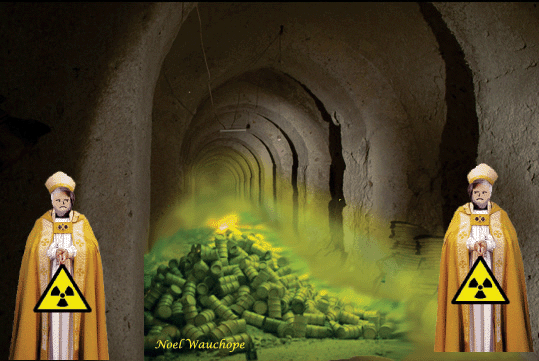
It is estimated that over the course of nuclear energy’s development in the ensuing decades, the industry produced 250,000 tons of highly toxic nuclear waste across fourteen countries worldwide without authoritatively developing a strategy for its safe storage.
July 30, 2025, By: Brian C. Black, https://nationalinterest.org/blog/energy-world/the-enduring-problem-of-nuclear-reactor-waste
The problem of nuclear reactor waste will have to be resolved as nuclear energy becomes more frequently adopted as the world’s source of power.
No one is pro nuclear waste. Simply, nuclear waste is a problem related to one method of generating electricity. The arguments against nuclear development because of the waste it generates have only intensified as we have filled in the gaps of our knowledge and learned more about its long-term toxicity. The realities of nuclear waste, simply, make us ask the question: How much do we need this energy?
In 2025, as our drive for electricity grows with planned data centers all over the world, many observers are choosing to overlook the problems of nuclear waste in order to generate more power and—at times—diminish our reliance on fossil fuels.
As we rush to reopen mothballed nuclear facilities such as Three Mile Island and to develop new ones, it is important to slow down and recall the simple fact of nuclear power: even with no accidents, nuclear power creates waste materials that remain toxic for thousands of years, and we still have no reasonable plan on what to do with them. We may choose to look the other way, but the wake of nuclear development is littered with toxic locales that remind us that any power obtained from nuclear reaction also creates waste that remains poisonous to humans for decades, if not longer.
A Relic of the Cold War?
or a few decades in the mid-1900s, the inertia of the Cold War and the belief in nuclear power’s potential fueled the rapid development of nuclear power. Reactors began to be used for electricity generation throughout the United States by the 1970s, only to see support erode after industrial accidents occurred, most noticeably at Three Mile Island, near Harrisburg, Pennsylvania, in 1978 and abroad at Chernobyl (then the Soviet Union, now Ukraine) in 1986. Many other reactors proceeded to generate power effectively and demonstrated that such accidents were an exception. While the industry faced challenges of public confidence and opinion over the final decades of the 20th century, nuclear power was often viewed internationally as a “clean” way of generating the power that might allow development to occur.
Clearly, though, the basic challenges inherent in the toxicity of the waste of a normal functioning reactor were never fully accounted for. Throughout the 1980s, for instance, efforts grew to create a repository in the American West where such spent fuel could be deposited and kept for the decades—even centuries—in which it was thought to remain toxic. The most protracted effort focused on Yucca Mountain in Nevada. The proposed Yucca Mountain Repository has remained mired in legal issues involving jurisdiction (it is located on the Western Shoshone Native American reservation) and the issue of a state’s right to determine its economic and environmental future. In short, no one wants nuclear waste in their backyard.
In retrospect, these challenges only amplified the issues that grew from the Cold War’s emphasis on energy centrality. Nuclear power spent decades as an important technology in supporting a drive for energy development that was seen as essential to both Soviet and American success, and little thought or planning went into the end-use challenges inherent in the technology. The competitive environment of the Cold War drove the rapid extraction of uranium, and the need to drive development pressed nuclear power forward even though it remained a technology with critical flaws.
Inevitable Waste Produced by Atomic Power
It is estimated that over the course of nuclear energy’s development in the ensuing decades, the industry produced 250,000 tons of highly toxic nuclear waste across fourteen countries worldwide without authoritatively developing a strategy for its safe storage. Most often, the highly radioactive material is collected and stored at inactive nuclear power plants. In the case of Chernobyl, some of the plant’s reactors still contain an enormous amount of waste that will remain dangerous for tens of thousands of years. Of course, in 2019, one entire reactor was encased in a concrete “sarcophagus” that will safely store the material for a century—a temporary band-aid to be dealt with more carefully later
However, a similar problem exists in nations that did not experience a reactor meltdown. Reports show that the “largest amount of untreated nuclear waste is at the Sellafield plant in the UK.” The plant has not generated electricity since 2003, but 100,000 employees are involved in ongoing nuclear decommissioning activities. These efforts at Sellafield are expected to last more than a century and will cost the government billions of dollars, even though it has produced no power for decades.
Well after the fact, many nations are now working to devise ways of storing nuclear waste permanently, even if they no longer wish to generate electricity with reactors. Finland, which generates approximately thirty-two percent of its electricity with five nuclear plants, is considered to have devised the first feasible plan for long-term storage of nuclear waste. The Onkalo spent nuclear fuel repository is a deep geological repository that is expected to begin operating next year. When completed, the Onkalo site will store 2,300 tons of high-level waste at a cost of approximately $3.4 billion.
Finland’s process required decades of negotiation and planning. Though it is considered experimental, the Onkalo site is based on the KBS-3 method of nuclear waste burial that was developed in Sweden. It will store nuclear waste for at least 100,000 years. And we can’t really know whether or not it can succeed. The generating technology failed to account for this inevitable outcome at its earliest stages of development. Now, nuclear waste is a problem that threatens many societies.
Conclusion: Ranking the Dangers of Energy Production
Over the last few decades, scientists have taught us a great deal about the dangers of climate change, which is caused by burning fossil fuels. Through their research findings, it has become accepted knowledge that the Earth would benefit from humans generating power in a different way. In sum, we have learned that all energy production comes with a cost, and, therefore, nuclear power has gotten another look at possibly powering the future.
Does this reality, then, lead us to choose between evils and decide to generate electricity through nuclear reactions? Possibly. But it is important that we scrutinize the technology as an energy production industry. Similar to other industrial enterprises, nuclear power generation creates hazardous and toxic waste. In the case of nuclear waste, though, it must be safely transported and interred. Technical answers and extensive investment will be essential.
The uniquely supportive, unquestioning culture of the Cold War is clearly a thing of the past. Examples of this rather blindly confident coordination between military and industrial interests are scattered across the American landscape. Some examples, such as the vast open spans of New Mexico or Idaho, might be expected; others, nestled in more populated areas, such as Pennsylvania, surprise contemporary Americans. Each of them, though, and the vast span of all of them together, reveals an era when our nation quietly took on a dramatic technological project and succeeded in applying it to power generation. To continue its use, though, we must now apply the new knowledge about nuclear waste that will allow its end-use products to be safely managed.
No comments yet.
1 This Month
To see nuclear-related stories in greater depth and intensity – go to https://nuclearinformation.wordpress.com/
Now until to February 10, 2026 Radioactive waste storage in France: the debate is finally open! How to participate?
-
Archives
- February 2026 (53)
- January 2026 (308)
- December 2025 (358)
- November 2025 (359)
- October 2025 (376)
- September 2025 (258)
- August 2025 (319)
- July 2025 (230)
- June 2025 (348)
- May 2025 (261)
- April 2025 (305)
- March 2025 (319)
-
Categories
- 1
- 1 NUCLEAR ISSUES
- business and costs
- climate change
- culture and arts
- ENERGY
- environment
- health
- history
- indigenous issues
- Legal
- marketing of nuclear
- media
- opposition to nuclear
- PERSONAL STORIES
- politics
- politics international
- Religion and ethics
- safety
- secrets,lies and civil liberties
- spinbuster
- technology
- Uranium
- wastes
- weapons and war
- Women
- 2 WORLD
- ACTION
- AFRICA
- Atrocities
- AUSTRALIA
- Christina's notes
- Christina's themes
- culture and arts
- Events
- Fuk 2022
- Fuk 2023
- Fukushima 2017
- Fukushima 2018
- fukushima 2019
- Fukushima 2020
- Fukushima 2021
- general
- global warming
- Humour (God we need it)
- Nuclear
- RARE EARTHS
- Reference
- resources – print
- Resources -audiovicual
- Weekly Newsletter
- World
- World Nuclear
- YouTube
-
RSS
Entries RSS
Comments RSS
 nuclear-news
Leave a comment