Sizewell C nuclear costs could hit £100bn including financing, modelling shows

Total for nuclear power station project set to be billions of pounds higher
than official government estimates.
The true cost of the Sizewell C power
station in Suffolk could be tens of billions of pounds higher than official
government estimates once financing costs are factored in, according to
official modelling seen by the Financial Times.
The UK government last week
said the mostly debt-funded project would cost an estimated £38bn in real
2024 prices to build. Under the financial structure of the deal, investors
will be rewarded if the project is built for less than £40bn, and not
obliged to put in further funds if costs rise above £47.7bn — which is
considered unlikely.
But financial modelling — prepared as part of the
wider fundraising process and seen by the Financial Times — gives a range
of roughly £80bn-£100bn in nominal terms over the period of construction
for the two scenarios, once debt interest and payments to shareholders are
factored in. That would imply costs of roughly £65bn-£80bn in real 2024
terms, although the exact costs will depend on inflation rates and spending
rates across the lifetime of the project.
FT 2nd Aug 2025, https://www.ft.com/content/5f54592e-50ba-4a1e-8219-7a4eb01f74ed
Trump Deploys Nuclear Subs Amid War of Words With Russia’s Medvedev.

The US president and the former Russian president have exchanged verbal threats about possible nuclear strikes amid the wars in Iran and Ukraine.
AUG 2, 2025, https://thecradle.co/articles/trump-deploys-nuclear-subs-amid-war-of-words-with-russias-medvedev
US President Donald Trump ordered the repositioning of two nuclear submarines on 2 August in response to “highly provocative” comments made by Dmitry Medvedev, the deputy chairman of Russia’s Security Council.
“I have ordered two Nuclear Submarines to be positioned in the appropriate regions, just in case these foolish and inflammatory statements are more than just that,” Trump wrote on his Truth Social Platform on Friday.
On Thursday, Medvedev had warned that Trump should be mindful of “how dangerous” Russia’s nuclear weapons could be.
“Words are very important, and can often lead to unintended consequences, I hope this will not be one of those instances,” Trump stated.
In recent weeks, Trump has been exchanging public insults and nuclear threats with Medvedev, who is viewed as close to Russian President Vladimir Putin.
Earlier this week, Trump insulted Medvedev directly, stating, “Russia and the USA do almost no business together. Let’s keep it that way, and tell Medvedev, the failed former President of Russia, who thinks he’s still President, to watch his words. He’s entering very dangerous territory!”
Medvedev, who served as president of Russia from 2008 to 2012 and prime minister from 2012 to 2020, shot back in a post on Telegram.
“If some words from the former president of Russia trigger such a nervous reaction from the high-and-mighty president of the United States, then Russia is doing everything right and will continue to proceed along its own path,” he stated.
On 17 July, Medvedev warned that Moscow must be prepared to deliver preemptive strikes against the west if necessary.
Speaking to TASS on the 80th anniversary of the Potsdam Conference, Medvedev said, “The west’s treacherous nature and its warped sense of superiority are still evident. And we should therefore act accordingly, responding in full or even delivering preemptive strikes if need be.”
Medvedev’s comments followed a string of threatening statements made by the US president toward Moscow after announcing plans to deliver new weapons to Kiev.
A Financial Times report revealed that Trump encouraged Ukrainian President Volodymyr Zelensky during a 4 July phone call to strike deep into Russian territory. According to sources, Trump asked, “Can you hit Moscow? Can you hit St. Petersburg too?”
Zelensky allegedly responded, “Absolutely. We can if you give us the weapons.”
In the wake of the US bombing of Iran’s nuclear sites in June, Trump also responded to Medvedev allegedly suggesting that Moscow provide nuclear weapons to Tehran, a claim he later denied.
“Did I hear Former President Medvedev, from Russia, casually throwing around the ‘N word’ (Nuclear!), and saying that he and other Countries would supply Nuclear Warheads to Iran?” Trump wrote on 23 June.
Trump then delivered a veiled threat to Russia by boasting about US nuclear submarine capabilities.
“They are the most powerful and lethal weapons ever built,” he stated.
Russia’s Nuclear Ambitions Face Funding Crisis

Oil Price, By Eurasianet – Aug 02, 2025
- Russian energy entities, including Rosatom, are experiencing significant financing difficulties, raising doubts about their ability to fulfill international energy project commitments.
- Kazakhstan has decided to independently build thermal power plants originally contracted to Russia’s Inter RAO due to a lack of promised financing, and is increasingly turning to China for nuclear power plant construction.
- Rosatom is seeking government financial support to maintain its global leadership in the nuclear energy market and carry out new projects, citing limited financing options due to international sanctions.
Russian energy entities are experiencing financing woes, raising questions about whether Rosatom, Russia’s nuclear energy agency, will be able to fulfill its obligations to build Kazakhstan’s first atomic power plant.
Already, financing troubles have caused another Russian state-controlled firm, Inter RAO, to lose out on constructing three thermal power plants in Kazakhstan.
During a July 30 appearance before the Russian State Commission on Energy, Andrei Petrov, a top Rosatom official, openly acknowledged that Rosatom was seeking government support. The entity has the resources to complete ongoing work, but by 2027, it will need a financial injection to carry out new projects, Petrov indicated.
Rosatom officials have been somewhat cagey in specifying exactly what kind of support they are seeking and have shied away from specifying an amount. For example, Rosatom’s chief, Alexei Likhachev, recently stated the entity is seeking the “provision of special resources” from the government, according to a report published by the Interfax news agency.
In 2024, a Rosatom official, referring to a program to develop floating nuclear power plants, indicated that Rosatom had limited financing options due to international sanctions on Russia, and required state-subsidized low-interest loans in order for the company to maintain its industry lead in several areas. Rosatom presently enjoys a roughly 50 percent share of the global nuclear energy market, with operations even in several NATO member states, such as Turkey and Hungary.
“The only way to maintain leadership with this product [floating nuclear power plants] is to subsidize exports even more than we already are,” Interfax quoted Vladimir Aptekarev, a top official at the Rosatom subsidiary Atomenergomash JSC, as saying in 2024, citing Chinese competition.
The Russian government, given the immense burden on the state budget imposed by its war effort in Ukraine, has so far resisted pleas from energy entities for increased support. Rosatom officials have acknowledged that the lack of assistance has hindered efforts to build new types of thermal and nuclear units, known as units Shelf-M and Elena-AM.
The Russian government’s cash crunch appears to be responsible for delays in construction of three planned Kazakh thermal power plants near Kokshetau, Semey and Ust-Kamenogorsk. Inter RAO signed a contract to build the three plants at an estimated cost of about $2.7 billion, with financing to be provided by Russian state-connected institutions. But the money never materialized.
On July 31, Deputy Kazakh Prime Minister Roman Sklyar confirmed that Kazakhstan was ditching the contract with Inter RAO, adding that it would build the plants on its own, according to media reports.
“When the company [Inter RAO] took on the obligation to build these facilities, it was supposed to receive export financing at a low rate. Unfortunately, they were unable to do this, so it was decided to build them independently,” he said.
The Kazakh government’s decision to move on from Inter RAO on the thermal plant projects instantly sparks questions about the fate of Rosatom’s deal to build Kazakhstan’s first nuclear power station. ……………………… https://oilprice.com/Alternative-Energy/Nuclear-Power/Russias-Nuclear-Ambitions-Face-Funding-Crisis.html
US, UK in secret talks with Ukrainian officials to ‘replace Zelensky’: Report
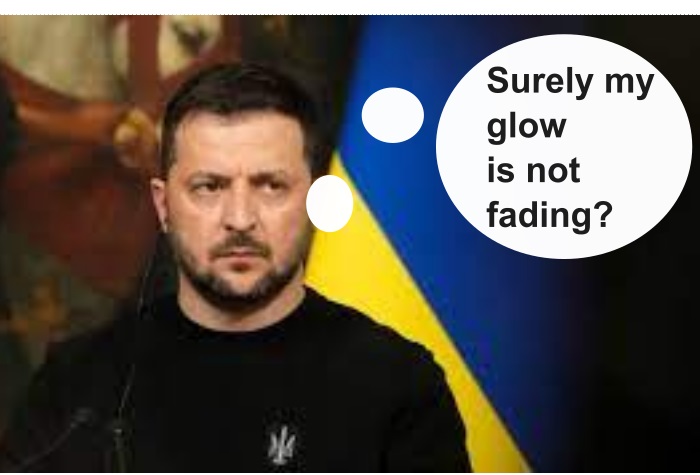
Three years into the war with Russia, the Ukrainian president has experienced his fortunes turn amid heavy human losses on the battlefield and intense Russian assaults.
JUL 29, 2025, https://thecradle.co/articles/us-uk-in-secret-talks-with-ukrainian-officials-to-replace-zelensky-report
Russia’s Foreign Intelligence Service (SVR) has revealed that US and British officials recently held a meeting in the Alps with top Ukrainian officials to discuss “replacing” Ukrainian President Volodymyr Zelensky.
According to a statement made available to TASS, the meeting involved Andrey Yermak, head of the Ukrainian president’s office, Kirill Budanov, chief of the Ukrainian Defense Ministry’s Main Directorate of Intelligence, and Valery Zaluzhny, the country’s ex-commander-in-chief who is now Ukraine’s ambassador to London..
“The Americans and the British announced their decision to propose Zaluzhny to the Ukrainian presidency. Yermak and Budanov ‘snapped a salute,’ while securing promises from the Anglo-Saxons to let them keep their present positions, as well as to take their interests into account in the course of making decisions over other personnel issues,” TASS reports.
The Ukrainian participants were reportedly promised they would retain their positions and influence over future personnel appointments following Zelensky’s ouster.
The SVR said Yermak helped prepare the ground for Zaluzhny by persuading Zelensky to weaken Ukraine’s anti-corruption bodies. Zelensky signed the new law, but Ukrainian MPs said the measure has not appeared on the parliament’s official website.
According to the SVR, the secret talks with UK and US officials aim to restructure Ukraine’s ties with the west, especially the US, and have established removing Zelensky as a prerequisite for continued western support in the war with Russia, after ceasefire talks between Moscow and Kiev in Istanbul last week ended without a breakthrough.
The SVR report comes a day after US President Donald Trump shortened his 50-day deadline for a ceasefire between Russia and Ukraine to “10 or 12 days,” warning of stalled progress and approving expanded weapons shipments to Kiev, including US-made Patriot systems financed by European partners and coordinated through NATO.
Former Ukrainian prosecutor general’s adviser Andriy Telizhenko said the plan to replace Zelensky predated Donald Trump’s return to office, adding, “Once the strings are cut, the puppet must be replaced.”
Journalist Seymour Hersh wrote in The End of Zelensky? that Zaluzhny “is now being viewed as Zelensky’s most reliable successor,” citing “well-informed Washington sources” confirming the role could be offered to him.
The Enduring Problem of Nuclear Reactor Waste
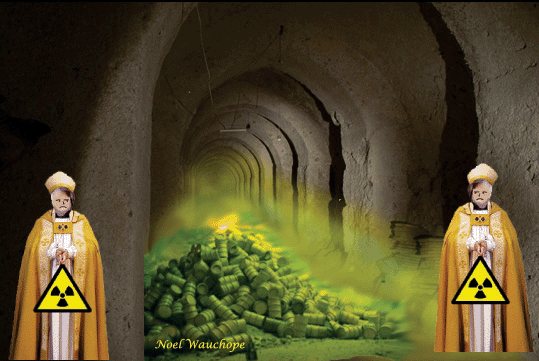
It is estimated that over the course of nuclear energy’s development in the ensuing decades, the industry produced 250,000 tons of highly toxic nuclear waste across fourteen countries worldwide without authoritatively developing a strategy for its safe storage.
July 30, 2025, By: Brian C. Black, https://nationalinterest.org/blog/energy-world/the-enduring-problem-of-nuclear-reactor-waste
The problem of nuclear reactor waste will have to be resolved as nuclear energy becomes more frequently adopted as the world’s source of power.
No one is pro nuclear waste. Simply, nuclear waste is a problem related to one method of generating electricity. The arguments against nuclear development because of the waste it generates have only intensified as we have filled in the gaps of our knowledge and learned more about its long-term toxicity. The realities of nuclear waste, simply, make us ask the question: How much do we need this energy?
In 2025, as our drive for electricity grows with planned data centers all over the world, many observers are choosing to overlook the problems of nuclear waste in order to generate more power and—at times—diminish our reliance on fossil fuels.
As we rush to reopen mothballed nuclear facilities such as Three Mile Island and to develop new ones, it is important to slow down and recall the simple fact of nuclear power: even with no accidents, nuclear power creates waste materials that remain toxic for thousands of years, and we still have no reasonable plan on what to do with them. We may choose to look the other way, but the wake of nuclear development is littered with toxic locales that remind us that any power obtained from nuclear reaction also creates waste that remains poisonous to humans for decades, if not longer.
A Relic of the Cold War?
or a few decades in the mid-1900s, the inertia of the Cold War and the belief in nuclear power’s potential fueled the rapid development of nuclear power. Reactors began to be used for electricity generation throughout the United States by the 1970s, only to see support erode after industrial accidents occurred, most noticeably at Three Mile Island, near Harrisburg, Pennsylvania, in 1978 and abroad at Chernobyl (then the Soviet Union, now Ukraine) in 1986. Many other reactors proceeded to generate power effectively and demonstrated that such accidents were an exception. While the industry faced challenges of public confidence and opinion over the final decades of the 20th century, nuclear power was often viewed internationally as a “clean” way of generating the power that might allow development to occur.
Clearly, though, the basic challenges inherent in the toxicity of the waste of a normal functioning reactor were never fully accounted for. Throughout the 1980s, for instance, efforts grew to create a repository in the American West where such spent fuel could be deposited and kept for the decades—even centuries—in which it was thought to remain toxic. The most protracted effort focused on Yucca Mountain in Nevada. The proposed Yucca Mountain Repository has remained mired in legal issues involving jurisdiction (it is located on the Western Shoshone Native American reservation) and the issue of a state’s right to determine its economic and environmental future. In short, no one wants nuclear waste in their backyard.
In retrospect, these challenges only amplified the issues that grew from the Cold War’s emphasis on energy centrality. Nuclear power spent decades as an important technology in supporting a drive for energy development that was seen as essential to both Soviet and American success, and little thought or planning went into the end-use challenges inherent in the technology. The competitive environment of the Cold War drove the rapid extraction of uranium, and the need to drive development pressed nuclear power forward even though it remained a technology with critical flaws.
Inevitable Waste Produced by Atomic Power
It is estimated that over the course of nuclear energy’s development in the ensuing decades, the industry produced 250,000 tons of highly toxic nuclear waste across fourteen countries worldwide without authoritatively developing a strategy for its safe storage. Most often, the highly radioactive material is collected and stored at inactive nuclear power plants. In the case of Chernobyl, some of the plant’s reactors still contain an enormous amount of waste that will remain dangerous for tens of thousands of years. Of course, in 2019, one entire reactor was encased in a concrete “sarcophagus” that will safely store the material for a century—a temporary band-aid to be dealt with more carefully later
However, a similar problem exists in nations that did not experience a reactor meltdown. Reports show that the “largest amount of untreated nuclear waste is at the Sellafield plant in the UK.” The plant has not generated electricity since 2003, but 100,000 employees are involved in ongoing nuclear decommissioning activities. These efforts at Sellafield are expected to last more than a century and will cost the government billions of dollars, even though it has produced no power for decades.
Well after the fact, many nations are now working to devise ways of storing nuclear waste permanently, even if they no longer wish to generate electricity with reactors. Finland, which generates approximately thirty-two percent of its electricity with five nuclear plants, is considered to have devised the first feasible plan for long-term storage of nuclear waste. The Onkalo spent nuclear fuel repository is a deep geological repository that is expected to begin operating next year. When completed, the Onkalo site will store 2,300 tons of high-level waste at a cost of approximately $3.4 billion.
Finland’s process required decades of negotiation and planning. Though it is considered experimental, the Onkalo site is based on the KBS-3 method of nuclear waste burial that was developed in Sweden. It will store nuclear waste for at least 100,000 years. And we can’t really know whether or not it can succeed. The generating technology failed to account for this inevitable outcome at its earliest stages of development. Now, nuclear waste is a problem that threatens many societies.
Conclusion: Ranking the Dangers of Energy Production
Over the last few decades, scientists have taught us a great deal about the dangers of climate change, which is caused by burning fossil fuels. Through their research findings, it has become accepted knowledge that the Earth would benefit from humans generating power in a different way. In sum, we have learned that all energy production comes with a cost, and, therefore, nuclear power has gotten another look at possibly powering the future.
Does this reality, then, lead us to choose between evils and decide to generate electricity through nuclear reactions? Possibly. But it is important that we scrutinize the technology as an energy production industry. Similar to other industrial enterprises, nuclear power generation creates hazardous and toxic waste. In the case of nuclear waste, though, it must be safely transported and interred. Technical answers and extensive investment will be essential.
The uniquely supportive, unquestioning culture of the Cold War is clearly a thing of the past. Examples of this rather blindly confident coordination between military and industrial interests are scattered across the American landscape. Some examples, such as the vast open spans of New Mexico or Idaho, might be expected; others, nestled in more populated areas, such as Pennsylvania, surprise contemporary Americans. Each of them, though, and the vast span of all of them together, reveals an era when our nation quietly took on a dramatic technological project and succeeded in applying it to power generation. To continue its use, though, we must now apply the new knowledge about nuclear waste that will allow its end-use products to be safely managed.
Australia’s Senate launches inquiry into who is funding fake astroturf anti-renewables groups.

Rachel Williamson, Jul 31, 2025, https://reneweconomy.com.au/senate-launches-inquiry-into-who-is-funding-fake-astroturf-anti-renewables-groups/?fbclid=IwY2xjawL7lhVleHRuA2FlbQIxMABicmlkETFYcTREaGZqTGVKTWZZSW15AR5cMmu1PBB20ZAr6159zOAR8q2xQnTPPQwVB8SWse9kOCEuKiGNiOnOwzpF3g_aem_zBcQMv8fwSb8s4qbxBk1uA
Australians have a right to know who is funding anti-climate campaigns and, if a new Senate inquiry can uncover those money trails, the findings could be shocking, says the Smart Energy Council’s Tim Lamacraft.
The new Senate committee was installed last night and tasked with investigating climate and energy mis- and disinformation campaigns and uncovering which foreign and local organisations are funding “astroturfing”, fake grassroots movements that are actually coordinated marketing campaigns.
“Australians have a right to know who’s really behind the clogging up of their social media feeds with anti renewables, anti climate, anti science propaganda. Rest assured, they’ll be shocked when they find out,” Lamacraft told Renew Economy.
“We saw from the last federal election campaign, where [conservative lobby group] Advance Australia had a $15 million warchest, $14 million of that was in dark money where we don’t know where it came from.

“The most important thing to do with shadowy networks like this is to shine a light. It’s extremely damaging to our democracy to allow millions of dollars from shadowy multinationals, and hidden domestic interests, to influence public policy for their personal gain, not the public.”
The inquiry, formally known as the select committee on Information Integrity on Climate Change and Energy, will also question whether Australia’s laws preventing foreign interference in national politics are strong enough to fight off internationally-funded domestic political campaigns.
That work will encompass the role of social media in building astroturf campaigns through the coordinated use of bots and trolls, messaging apps and AI to spread fake ideas and news.
It will be the first step towards finding out who is financing sophisticated anti-renewable energy campaigns and misinformation, and whose interests they truly serve, says committee chair Greens senator Peter Whish-Wilson.
“For decades, vested interests have been waging a global war of disinformation against the clean energy transition, including environmental and climate legislation, and these vested interests have recently achieved significant political success in nations such as the US,” he said in a statement.
“In the last parliament, evidence was provided to the Senate Inquiry into offshore wind industry that strategies such as establishing fake community groups – otherwise known as astroturfing – were being used in Australia to spread lies about renewable energy.
“It’s critical that parliament continues this work and now examines these interests for what they are and who they serve.”
Devastating impact of astroturfing
The inquiry comes on the back of years of sophisticated anti-climate campaigns masquerading as grassroots movements.
These seek to demonise a climate or renewable energy issue and rally support for nuclear power, a position known to be a cover for retaining a fossil fuel status quo.
Campaigns against everything from offshore wind to individual projects have polarised public opinion and are having a tangible impact.
Coordinated anti-offshore wind campaigns in 2023 peddled fears such as that offshore turbines kill whales and any in the waters around Wollongong would block out the sunrise.
As a result, the federal government reduced the Illawarra offshore wind zone by a third and pushed it 10km further offshore, while in Queensland the Stop Chalumbin Wind Farm claimed the scalp of the Wooroora Station proposal by claiming risks to the nearby world heritage rainforests.
Ark Energy, which was behind the Wooroora Station project, also scrapped the Doughboy wind project in NSW after the New England landowners involved in the project changed their minds.
Organised anti-renewables groups are weaponising NSW’s planning process by forcing projects into the Independent Planning Commission, the final arbiter of development applications if more than 50 opposing submissions are lodged during the regular planning process.
David and Goliath battles
For genuine activist groups, going up against well-funded, apparently grassroots campaigns that are peddling half truths and outright lies is “incredibly frustrating”, says Surfers for Climate CEO Joshua Kirkman.
“We simply do not have the financial resources as an advocacy group… against big forces like that which the Senate inquiry will actually find out about,” he told Renew Economy.
“I really hope this inquiry can put the spotlight on the realities of where the support for these voices in Australia comes from. I think the public have a right to know, and I think the public wants to understand how their democracy is being influenced by nefarious parties with ill-intent for the environment.”
Kirkman says climate change is a big enough problem without tactical misdirection and influence undermining the work being done.
Organisations such as Responsible Future (Illawarra Chapter) are what Kirkman is up against.
The anti-wind, pro-nuclear organisation was registered in April 2024 and claims to be funded by donations. Founder Alex O’Brien declined to comment on a series of basic questions about the organisation sent by Renew Economy last year.
Follow the money
The risks of foreign funding influencing Australian climate debates is not a conspiracy theory: the issue was raised in the Senate last year after an inquiry into offshore wind recommended the government act to stop foreign lobby groups from crowding out local community voices in public debates.
Last year, Walker published a submission which highlighted the similarities between US anti-wind campaigns and those targeting offshore wind in Australia.
He found similarities between the claims made by groups like Stop Offshore Wind, such as the same imagery and messaging in social media campaigns saying turbines kill whales, as used in campaigns overseas funded by conservative US lobby the Atlas Network.

But he was only able to guess at actual funding trails into Australia.
It’s known that deep-pocketed conservatives such as mining billionaire Gina Rinehart and the multimillion-dollar Liberal Party investment arm Cormack Foundation have been sponsors of the likes of the Institute of Public Affairs (IPA), the Centre for Independent Studies (CIS), Menzies Research Centre and the ‘campaign group’ Advance Australia, all of which have strongly campaigned against renewable energy.
Walker has linked their campaigns with those of a global network of conservative think tanks.
The CIA Built Hundreds of Covert Websites. Here’s What They Were Hiding

August 1st, 2025, Alan Macleod, https://www.mintpressnews.com/cia-secret-network-885-fake-websites/290325/
The CIA didn’t just infiltrate governments; it infiltrated the internet itself. For over a decade, Langley operated a sprawling network of covert websites that served as global spy terminals disguised as harmless blogs, news hubs, and fan pages.
Beginning in 2004, the CIA established a vast network of at least 885 websites, ranging from Johnny Carson and Star Wars fan pages to online message boards about Rastafari. Spanning 29 languages and targeting at least 36 countries directly, these websites were aimed not only at adversaries such as China, Venezuela, and Russia, but also at allied nations, including France, Italy, and Spain, showing that the United States treats its friends much like its foes.
Covert Soccer Blogs and Cracked Passwords
Gholamreza Hosseini is a former CIA informant. In 2007, the Tehran-based industrial engineer contacted the agency and offered to pass them information about Iran’s nuclear energy program. His CIA handlers showed him how to use IranianGoals.com to communicate with them. Iranian Goals was a Farsi-language website that appeared to be dedicated to local soccer news. However, what appeared to be a search bar at the bottom of the home page was actually a password field. Typing the correct word into it would trigger a login process, revealing a secret messaging interface. Each informant had their own webpage, designed specifically for them, to insulate them from others in the network.
It seemed like an ingenious idea. However, Hosseini and the other spies were soon detected, thanks to some sloppy mistakes in Washington, D.C. An Iranian double agent revealed to the authorities their unique website, and some basic detective work led to the uncovering of the entire network.
The CIA purchased the hosting space for dozens, perhaps hundreds, of these websites in bulk, often from the same internet providers, or the same server space. That meant that the IP addresses of these websites were consecutive, akin to housing each informant in adjacent properties on the same street.
Thus, if you looked at neighboring IP addresses, you would see similarly designed websites and could easily put two and two together. Even with some relatively basic online searches, Iranian authorities were able to identify dozens of CIA-run websites. From there, they simply waited to see who would access them.
Spying on Allies and Adversaries Alike
The network of websites spanned a wide range of topics. Few would guess that Rasta Direct, a website dedicated to the relatively niche religion of Rastafari, had anything to do with U.S. intelligence. The CIA also created Star Wars Web, a fan page for the sci-fi franchise, and All Johnny, a page dedicated to late-night legend Johnny Carson. Sports, gaming and news blogs, however, were the most common topics for fake websites.
These websites served as cover for informants, offering some level of plausible deniability if casually examined. Upon close inspection, however, few of these pages provided any unique content and simply rehosted news and blogs from elsewhere, linking to already available resources.
Informants in enemy nations, such as Venezuela, used sites like Noticias-Caracas and El Correo De Noticias to communicate with Langley, while Russian moles used My Online Game Source and TodaysNewsAndWeather-Ru.com, and other similar platforms.
However, a vast network of informants in allied countries, such as France, Spain and Italy, was also uncovered, using financial news, mountaineering, and running websites to pass on vital information to the CIA.
Germany was another country Washington actively targeted. In 2013, it was revealed that the U.S. had been bugging the cellphone of Chancellor Angela Merkel for over a decade, sparking a major diplomatic rift. One year later, in 2014, Germany detained one of its own intelligence officials after catching him spying for the United States.
The Collapse of the CIA’s China Network
China, however, remains a top target for the CIA. The organization maintains an extensive network of informants across the country, who, when the network was active, used platforms such as eChessNews.com and SportsNewsFinder.com to transmit information back to the United States.
But, as in Iran, Chinese authorities began to dismantle the network. Starting in late 2010, the spying network was systematically dismantled by officials, likely using similar tactics to those of the Iranians. Unlike Iran, however, China simply executed those operatives. It is believed that the CIA lost around 30 informants in the purge. The affair is considered one of the worst intelligence failures in the agency’s nearly 80-year history.
Since then, the U.S. spying network in China has been severely diminished. Earlier this year, the CIA changed tack, publicly releasing two videos encouraging disaffected Communist Party officials to spy for them in exchange for money and the prospect of a new life in America.
“As I rise within the party, I watch those above me being discarded like worn-out shoes, but now I realize that my fate was just as precarious as theirs,” the narrator says in one. “Our leaders’ failure to fulfil repeated promises of prosperity has become a well-known secret… It’s time to build my own dream,” he says in another.
The CIA instructs would-be traitors to download the Tor Browser and contact the CIA via its website. While Tor is marketed in the West as a privacy tool, a previous MintPress News investigation revealed that it was created with funding from the U.S. government by a company with ties to the CIA. Last year, Washington passed a $1.6 billion bill to finance anti-China propaganda worldwide.
Weaponizing Apps and Platforms
This is not the only time that the U.S. national security state has created fake web platforms in order to stoke regime change around the world. In 2010, USAID—a CIA front organization—secretly created the Cuban social media app, Zunzuneo.
Often described as “Cuba’s Twitter,” Zunzuneo rocketed to prominence. The app had been designed to offer a reliable and affordable service, undercutting the competition, before gaining dominance and slowly disseminating anti-government messages to the island.
Then, at a given time, Zunzuneo would urge users to join protests coordinated by the U.S. in an attempt to foment a color revolution on the island.
In an effort to hide its ownership of the project, the U.S. government held a secret meeting with Twitter founder Jack Dorsey to encourage him to take it over. It is unclear to what extent, if at all, Dorsey contributed to the project, as he has declined to comment on the matter. In 2012, Zunzuneo was abruptly shut down.
Infiltrating Journalism and Big Tech
While the 885 fake websites were not established to influence public opinion, today, the U.S. government sponsors thousands of journalists worldwide for precisely this purpose. Earlier this year, the Trump administration’s decision to pause funding to USAID inadvertently exposed a network of more than 6,200 reporters working at nearly 1,000 news outlets or journalism organizations who were all quietly paid to promote pro-U.S. messaging in their countries.
Oksana Romanyuk, director of the Ukrainian Institute for Mass Information, warned that nearly 90% of her country’s media outlets rely on funding from USAID to survive. A survey of 20 leading media organizations in Belarus revealed that 60% of their budget came from Washington. In Iran, more than 30 anti-government groups came together for a crisis response meeting, while in Cuba and Nicaragua, anti-government press resorted to soliciting donations from readers.
The CIA has also successfully infiltrated the largest and most popular social media networks, giving the agency substantial control over what the world sees (and does not see) in their news feeds.
Facebook has hired dozens of former CIA officials to run its most sensitive operations. Perhaps the most notable of these individuals is Aaron Berman.
As the platform’s senior misinformation manager, Berman ultimately has the final say over what content is promoted and what is demoted or deleted from Facebook. Yet, until 2019, Berman was a high-ranking CIA officer, responsible for writing the president’s daily security brief. It was at that time that he jumped ship from Langley to Facebook, despite appearing to have little relevant professional experience.
Google, if anything, is even more saturated with former spies.
A MintPress News investigation revealed that dozens of former CIA agents hold top jobs at the Silicon Valley giant. Among these is Jacqueline Lopour, who spent more than ten years at the agency working on Middle East affairs before being recruited to become Google’s senior Intelligence, Trust, and Safety manager. The role gives her considerable influence on the direction of the company. This form of state censorship is how the agency prefers to shape the internet today.
The CIA continues to maintain a vast worldwide network of informants. Today, they use custom-built apps such as Tor or Signal to communicate. If they are caught by their own countries, they will likely be left to their fate, like Hosseini was. Being a spy or a stool pigeon for the CIA is as perilous as ever.
Mystery grows around state of Russian nuclear submarine base that is just 75 miles from epicentre of 8.8-magnitude megaquake
A colossal 8.8-magnitude earthquake rocked Russia’s far eastern Kamchatka
Peninsula early yesterday morning – raising serious questions about the
condition of Russia’s key nuclear submarine bases, located alarmingly close
to the epicentre. The quake, tied for the sixth strongest in recorded
history, struck just 75 miles from Avacha Bay, where some of the Russian
Navy’s most strategic nuclear assets, including Borei and Delta-class
ballistic missile submarines, are based. Though Russian authorities are
insisting the situation is under control, with ‘no reported fatalities or
serious injuries’, military analysts and international observers are
sounding the alarm over the potential impact on these high-security naval
installations.
Mail 31st July 2025, https://www.dailymail.co.uk/news/article-14956551/Russian-nuclear-submarine-base-earthquake.html
Court hears Uzbek group attempted to sell nuclear bomb material uranium on black market
An Uzbek court has convicted a group of individuals who sought to sell 120
grams of natural uranium, the heavy metal element required in the making of
a nuclear bomb. While the amount they were attempting to sell, at a price
of $2,000 per gram, would only make up a tiny fraction of the uranium
volume a nuclear bomb maker would need for enrichment, national security
officials the world over are wary of such black market sales reaching a
frequency that would enable terrorist, or other malign actors, to source
the volume of material needed for an atomic weapon from an assortment of
sellers.
Intellinews 29th July 2025, https://www.intellinews.com/court-hears-uzbek-group-attempted-to-sell-nuclear-bomb-material-uranium-on-black-market-393499/
Tepco ordered to pay ¥100 million in damages over 2011 disaster
Japan Times 30th July 2025
The Tokyo District Court ordered Tokyo Electric Power Company Holdings on Wednesday to pay about ¥100 million ($675,000) in damages over the 2011 accident at its Fukushima No. 1 nuclear power plant.
Presiding Judge Masahiko Abe ordered the payment mainly as compensation for damage to property and consolation money for life during evacuation while dismissing the claim against the state.
In the lawsuit, Katsutaka Idogawa, 79, former mayor of Futaba, a town in Fukushima Prefecture, blamed the central government and Tepco for their inadequate handling of the accident, arguing that it led to his exposure to radiation…………………………. (Subscribers only) https://www.japantimes.co.jp/news/2025/07/30/japan/crime-legal/tepco-ordered-to-pay-damages-nuclear-disaster/
Israel’s international isolation has begun.
U.S. and global politics surrounding Israel are shifting rapidly as the world recoils in horror at Israel’s starvation of Gaza. Here are several lessons the left should take note of.
By Philip Weiss August 1, 2025 , https://mondoweiss.net/2025/08/israels-international-isolation-has-begun/
We’ve never lived through such rapid change in the politics of Israel as we are now. Two nights ago more than half of Democratic senators – 27– voted to block some arms sales to Israel. A day before that, the UK and Canada said they will recognize a Palestinian state at the U.N, echoing France’s recent statement.
These are steps that advocates for Palestinians thought might be years away. But today the world is shocked by Israel’s starvation of Gaza, and the mainstream press is at last reporting the charge of genocide.
Israel’s international isolation has begun.
These political changes were driven by the street. For years, Israel’s favorability has been sliding in global opinion and in the U.S. among Democratic voters. But party leaders defied the shift — and then Zohran Mamdani won the NY primary for mayor last month, in a groundswell that overwhelmed Cuomo’s $25 million in negative ads. A poll shows that nearly four of five Democrats in NY say Israel is committing a genocide. And Trump’s base is catching up. “My people are starting to hate Israel,” Trump reportedly warned a “Jewish donor”.
There are several lessons the left should recognize.
Pressure works
We always said that the way to stop Israeli war crimes is for western nations to sanction or abandon Israel. The change in official tone proves the point. Israel is now seeking to moderate its brutality, and reports from Israel say that some Israelis are ashamed by the front-page coverage of starvation. The west could have ended the occupation a long time ago.
Our media failed us
When the reckoning on genocide comes, it will include all the voices who explained away children buried in rubble by American bombs. Liberal voices in the Times, on the cables and NPR acted like Gaza was normal—then the people arose.
“Truthfully, it goes back decades,” Donald Johnson writes. “Israel has been an apartheid state for a long time, even by liberal Zionist standards. Jimmy Carter was right about apartheid in 2006 and the press didn’t want to listen.” (In fact, Carter was pilloried by Wolf Blitzer and Terry Gross and ostracized from the Democratic Party.)
The Israel lobby is exposed
Biden and Harris and Blinken and Power did nothing to stop a genocide, just sent more bombs—why? Democrats for years embraced the illegal settlement project, and Obama insisted on “undivided Jerusalem” language in the Democratic platform in 2012–why? Dem leadership in NY has failed to endorse Mamdani weeks after his victory—why?
There is only one factor that keeps leading Democrats “allegiant” to Israel, as James Carville phrased it, and that is the pro-Israel forces inside the Party, embodied by DMFI and AIPAC and the big donors.
The good news is that the corruption is now obvious. “Support for blocking bombs to Israel, recognizing Israel’s genocide in Gaza, and holding Israel accountable for its violations of the law is not simply the opinion of the majority of Democratic voters, it is the vast, vast majority, and any Democrat who stands with AIPAC instead of their own voters is running the real risk of getting voted out of office,” says Margaret DeReus of IMEU.
While former Obama aide Tommy Vietor said on his podcast that the Dems’ policy of hugging Netanyahu is a failure, he pleads guilty, and — “there is no going back to a pre-October 7 Democratic Party”.
For years the lobby claimed that the U.S. was on Israel’s side because Israel served the American interest, and anti-Israel activists claimed that if Americans only knew they would abandon Israel. The anti-Israel activists were right. There is no American interest in racial oppression. There is no American interest in arming a country that bombs one neighbor after another creating instability across the world.
The liberal Zionist branch of the lobby is also vulnerable. For over a year it has denied that there is a genocide– as it has denied apartheid and ethnic cleansing and war crimes in years past. The liberal Zionists served a vital function for the lobby, keeping progressive Democrats on board. To that end, they have fostered delusions — that real pressure on Israel is bad policy and antisemitic, and that Israel is a “democratic Jewish state.”
Today the liberal Zionists are scrambling to get ahead of the shifting Democratic politics of the issue, but they ought to be challenged. For instance, J.J. Goldberg says Americans should sympathize with Israelis’ “fear at the prospect of accepting a new structure of full equality and integration, as though a century of Palestinian anger will just go away”. There were similar fears in the Jim Crow south and South Africa.
The Jewish community is in turmoil and it should be
The American Jewish community is the most reactionary force in the Democratic Party on Israeli apartheid. Leading Jewish organizations sought to kneecap any politician who stepped out of line. These politics among the most liberal highly educated voting bloc in the U.S. should have produced an internal Jewish crisis a long time ago. Yes, horror over Israeli actions generated Jewish Voice For Peace and IfNotNow 10 and 20 years ago, but today is a revolutionary moment. As Arielle Angel writes, “The Gaza genocide has made plain what many leftist Jews have long feared: that virtually the entire enterprise of Judaism—and nearly every organization charged with stewarding it—is infected with a voracious rot.” (This rot sadly extends to Bernie Sanders, the leading moral voice for Democrats, whose refusal to call a genocide a genocide surely reflects his youth volunteering at an Israeli kibbutz.)
It’s understandable that many Americans are so afraid of the antisemitism label that they won’t call out Jewish organizations’ role in oppressing Palestinians. But Jews can do so freely—and young Jews must take down the pro-genocide establishment.
The root cause of the Israel/Palestine conflict is Zionism
An ideology that grants Jews greater rights to land and to civil freedoms is inherently hateful and will always produce the sort of revolt we saw on October 7 (horrific war crimes against civilians took place in Algeria and South Africa too).
It is great that European politicians are finally trying to give Palestinians sovereignty. The effort is way too late, but it demonstrates the truth that political freedom is all that will guarantee security in the land.
The recognition and denunciation of Zionism must accelerate. Zionism might have made sense 100 years ago (or even 80) as a liberation from European persecution. But over and over as they gained power, Zionists took the wrong path. They chose ethnic cleansing, occupation, and apartheid. They chose disdain for their neighbors in favor of superpower politics. They bragged of their “villa in the jungle” – a racist fantasy of Jewish supremacy that even liberal Zionists like J Street promoted.
Can Israel be reformed? I don’t know. But Zionism cannot be. Know it by its fruits. It is apartheid genocide and famine, and the American people have awakened.
1 This Month


Tell the Ukrainian Government to Drop Prosecution of Peace Activist Yurii Sheliazhenko

Petition to revoke the licensing of the Near Surface Nuclear Disposal Facility (NSDF) at Chalk River. https://www.ourcommons.ca/petitions/en/Petition/Details?Petition=e-7247


of the week – STOP SMALL MODULAR REACTORS IN CANADA
To see nuclear-related stories in greater depth and intensity – go to https://nuclearinformation.wordpress.com
-
Archives
- March 2026 (204)
- February 2026 (268)
- January 2026 (308)
- December 2025 (358)
- November 2025 (359)
- October 2025 (376)
- September 2025 (258)
- August 2025 (319)
- July 2025 (230)
- June 2025 (348)
- May 2025 (261)
- April 2025 (305)
-
Categories
- 1
- 1 NUCLEAR ISSUES
- business and costs
- climate change
- culture and arts
- ENERGY
- environment
- health
- history
- indigenous issues
- Legal
- marketing of nuclear
- media
- opposition to nuclear
- PERSONAL STORIES
- politics
- politics international
- Religion and ethics
- safety
- secrets,lies and civil liberties
- spinbuster
- technology
- Uranium
- wastes
- weapons and war
- Women
- 2 WORLD
- ACTION
- AFRICA
- Atrocities
- AUSTRALIA
- Christina's notes
- Christina's themes
- culture and arts
- Events
- Fuk 2022
- Fuk 2023
- Fukushima 2017
- Fukushima 2018
- fukushima 2019
- Fukushima 2020
- Fukushima 2021
- general
- global warming
- Humour (God we need it)
- Nuclear
- RARE EARTHS
- Reference
- resources – print
- Resources -audiovicual
- Weekly Newsletter
- World
- World Nuclear
- YouTube
-
RSS
Entries RSS
Comments RSS
 nuclear-news