Genocide’s Hard When You’ve Got a PR War to Win.

Israel is inviting over 500 delegations of social media influencers to tour Israel and learn the right message to spread to their millions of followers because Israel realizes it is losing the PR war.
For Israel this is the hard part: completing a genocide while making it look like you are not completing a genocide. In an age of mobile telephone cameras and wireless transmission of images from virtually anywhere by anyone, genocide while few are looking is a thing of the past.
Israel’s quest to cleanse Gaza of Palestinians through expulsion or extermination keeps getting interrupted for photo ops of aid airlifts or a few aid trucks to satisfy feigned Western grievance, writes Joe Lauria.
Joe Lauria, Consortium News, July 28, 2025, https://consortiumnews.com/2025/07/28/genocides-hard-when-you-have-to-win-the-pr-war-too/
Winning the public relations war is proving to be a lot more difficult for Israel than the genocide against the Palestinian people.
As the conscience of Western publics pushes their governments to stop supporting Israel’s historic crimes, U.S. and European governments are forced to make displays of scolding Israel.
But that act is getting old. The money and guns keep flowing as the killing and starvation keeps growing.
Western allies want Israel to make a gesture that it still has a shred of humanity left. At various junctures during the slaughter, U.S. and European governments have disingenuously leveled criticism of Israel’s treatment of Palestinian civilians to keep their own populations at bay.
For instance, during the last U.S. presidential campaign, with a large number of Democrats condemning Israel for their actions, Joe Biden and then Kamala Harris had to issue criticism of Israel while insincerely repeating that they were working “tirelessly” for a ceasefire.
This was fake because if the Biden or now Trump administrations really want to stop the killing they can do it almost immediately: tell Israel no more guns and money if the killing doesn’t stop.
The German authorities, who seem to relish the opportunity to enforce a new genocide, could do the same, as Germany is Israel’s second largest arms supplier after the U.S.
Losing on the PR Front
Whenever Western governments start feeling the heat they tell Israel to cool it for a while and stage some kind of show of humanitarian aid.
Israel usually complies because they are fighting two wars: one of ethnic cleansing and/or extermination of the Palestinians, and the other a public relations war with the Western public, particularly its youth.
As Consortium News reported last week, Israel is inviting over 500 delegations of social media influencers to tour Israel and learn the right message to spread to their millions of followers because Israel realizes it is losing the PR war.
The daily Haaretz reported:
“Foreign Ministry officials say the tour delivers significant media, advocacy, and diplomatic benefits – and represents a strategic shift, as traditional outreach is no longer sufficient to shape public opinion. … We’re working with influencers, sometimes with delegations of influencers. Their networks have huge followings, and their messages are more effective than if they came directly from the ministry.”
On Friday, Britain, France and Germany issued a joint statement saying the Gaza “humanitarian catastrophe must end now.” They said Israel must “immediately lift restrictions on the flow of aid.”
“The humanitarian catastrophe that we are witnessing in Gaza must end now,” the joint statement says. “Withholding essential humanitarian assistance to the civilian population is unacceptable.”
Italy separately said, “We can no longer accept carnage and famine.” Barack Obama chimed in too, also on Friday. On Monday, Donald Trump said: “There is real starvation in Gaza — you can’t fake that.”
France said it would recognize the State of Palestine, a step too far for Britain, Germany and Italy, and which the U.S. condemned.
These leaders’ consciences would be shocked if they indeed have a conscience. They’ve seen reports like this one from the BBC confirming that desperately starving people have been shot and killed as they try to reach the only food aid distribution points by the Israeli forces and private U.S. contractors.
And yet they keep sending 2,000 lbs. bombs and F-35 spare parts.
Nevertheless, Israel realizes it must win the PR war fought not against the Western leaders who back them, but against the Western public. (Western leaders are engaged in their own PR war with their people.) Thus on Sunday Israel announced it would begin an airlift of food into Gaza.
It’s surely part of a genocidal plan to occasionally respond to this criticism, hold some fire and make a big show of letting in aid before resuming the gruesome task. It sure makes finishing a genocide more difficult.
The Hard Part
For Israel this is the hard part: completing a genocide while making it look like you are not completing a genocide. In an age of mobile telephone cameras and wireless transmission of images from virtually anywhere by anyone, genocide while few are looking is a thing of the past.
One way to mislead the public is to kill at a pace intended to fool them into thinking there is more or less routine combat going on in Gaza and an unfortunate number of civilians are just being killed in the crossfire. (There was an uproar over the Australian Broadcasting Corporation last week ignorantly reporting the deliberate murder of unarmed, starving civilians at the aid distribution points as having died in “the crossfire.”)
So Israel needs to keep the official daily death toll in Gaza to around 100. Don’t start wiping out entire encampments, killing thousands a day. Make it look more or less like a normal war. Leave doubt in people’s minds. Netanyahu did say this would take a very long time.
Israeli Defense Minister Israel Katz openly says the plan is to concentrate the entire 2 million plus population of Gaza in a camp in the south to ready them for expulsion. And if Egypt and others refuse to take them? The rate of killing in this concentration camp may well explode if Western governments keep tolerating this evil.
But for now, the rate of killing allows a propagandist like Bret Stephens to argue in The New York Times that it can’t be genocide because the killing is too slow. He actually wrote this:
“If the Israeli government’s intentions and actions are truly genocidal — if it is so malevolent that it is committed to the annihilation of Gazans — why hasn’t it been more methodical and vastly more deadly? Why not, say, hundreds of thousands of deaths, as opposed to the nearly 60,000 that Gaza’s Hamas-run Health Ministry, which does not distinguish between combatant and civilian deaths, has cited so far in nearly two years of war? It’s not that Israel lacks the capacity to have meted vastly greater destruction than what it has inflicted so far.”
Quick, somebody show the Genocide Convention to Stephens. It defines genocide in black and white:
(d) Imposing measures intended to prevent births within the group; (e) Forcibly transferring children of the group to another group.”
“In the present Convention, genocide means any of the following acts committed with intent to destroy, in whole or in part, a national, ethnical, racial or religious group, as such:
(a) Killing members of the group;
(b) Causing serious bodily or mental harm to members of the group;
(c) Deliberately inflicting on the group conditions of life calculated to bring about its physical destruction in whole or in part;
Stephens falls prey to a common misconception of genocide, namely that it depends on the number of people killed. Acts must be “committed with intent to destroy, in whole or in part.”
The hardest part of proving genocide is intent. Israeli leaders have provided folders full of statements of genocidal intent. It was then followed by actions that systematically destroyed the conditions of life for the Palestinians of Gaza.
One by one they wiped out the infrastructure of Palestinian culture and civilization: schools, universities, mosques, churches, museums, theaters, libraries, hospitals and incalculable residential buildings, while people were still living in them. There has been a wholesale assassination of journalists, artists, academics and doctors — and an imposed starvation.
This is textbook genocide.
The Big Lie sent out from Israel, parroted almost word-for-word by the likes of Stephens and Alan Dershowitz, Israel-defender supremo, and by an Israeli zealot who appeared on Piers Morgan’s show last, week with piercing, fanatical eyes is this: This is war, unfortunately civilians get killed and there is no army in the world that takes greater care to avoid civilian casualties than Israel’s, none.
The zealot with Morgan went a step further to say he was “proud” of the conduct of the IDF in Gaza, to which Haaretz columnist Gideon Levy, also on the panel, said, “I’m sorry, only Nazis spoke like that.”
There is also a Big Truth. If Western governments and media repeated it and more crucially acted upon it, it would cause Israel to lose both wars: public relations and the elimination of the Palestinian people.
The world is waiting.
Nuclear power drive obsesses over baseload: Do we need it?

Lately there has been a mounting noise on behalf of more nuclear power in
Scotland, pleas for John Swinney to do a u-turn on his ruling out of new
nuclear reactors.
Calls for Scotland to embrace nuclear have been greeted
with a certain amount of enthusiasm in some quarters, including many SNP
voters. But what troubles me, in the current debate, is that all too often
it feels like we are stuck in an old vision of the grid – and one of the
terms that suggests this is ‘baseload’.
Baseload is defined as the
minimum amount of electricity required by a grid to meet the continuous
demand for power over a day. Currently, it’s mostly used to refer to the
generating capacity that we need to always be there if the wind stops and
the sun doesn’t shine. Britain Remade, for instance, talks about nuclear
in terms of “clean, reliable baseload power”.
But what if nuclear is actually a technology that does not suit a modern renewable grid? What if wind and nuclear are not good bedfellows and, as a baseload, new plants
will only make our electricity more expensive?
In a recent Substack, David Toke, author of Energy Revolutions: Profiteering versus Democracy, described the “accepted truth” in the media that new nuclear power is
needed because there is no other practical or cheaper way to balance
fluctuating wind and solar power, as “demonstrably false”.
He said it
“runs counter to the way that the UK electricity grid is going to be
balanced anyway” – which, he noted, is by gas engines and turbines
“that are hardly ever used”. Simple gas fired power plants, he said,
are many times cheaper per MW compared to nuclear power plant.
Toke advocated for a system balanced by more batteries and other storage as well
as gas turbines or engines which will proved “capacity” rather than
generate much energy. He has a strong point. Of course, the problem with
gas, is that it is, famously, a fossil fuel and produces greenhouse gas
emissions.
However, if, as Toke says, that gas is an increasingly small
percentage of electricity generation, about handling the moments when
demand is not met by wind and solar, the 5% predicted by the UK
Government’s Clean Power 2030 Action Plan, to be what we require, perhaps
that’s no big deal. It’s a bigger deal, though, if the gas power
station emissions required to balance the grid are, as another Substack
write calculated recently more like 19 percent.
Interestingly, Toke, whose
main criticisms of nuclear are its high cost of electricity generation and
lack of grid balancing flexibility, also noted that if we are thinking
about the financial costs of reducing emissions we might be better off
spending our money in other ways. For instance: “setting up a scheme to
pay £15000 each to 500,000 residents not on the gas grid to switch to heat
pumps will likely save as much carbon as Sizewell C is likely to
save”.
But it seems to me the question is not whether nuclear power is
simply right or wrong, but what its place is within the kind of modern grid
we are developing, a grid which faces transmission challenges between
Scotland, already producing more energy than it uses, and elsewhere, and
whether the costs are worth it. Too often those that argue for nuclear sell
it via the concept ‘baseload’.
But you only have to do a quick scan of
the internet to see it is brimming also with articles about how baseload is
extinct or outdated. These critics point out that what the grid actually
needs is more flexible sources, both of storage and power. One of the
problems is that traditional nuclear power stations tend to be all on or
all off. Torness, for instance, has either one or both of its reactors,
either at full or zero capacity.
That kind of inflexibility in nuclear
plants has already led to constraint payments being made to wind farms,
which have been switched off because there was too little demand even as
the nuclear power stations kept producing. In 2020 energy consultants
Cornwall Insight estimated the quantity in MWh of constraints that could
have been avoided had nuclear power plants in Scotland been shut during two
recent years. It found that, in 2017, 94 per cent worth of windfarm output
that had been turned off (constrained) could have been generated had
nuclear power plant not been operating.
Herald 29th July 2025, https://www.heraldscotland.com/opinion/25350226.nuclear-power-drive-obsesses-baseload-need/
U.S. Nuclear Energy Plans Could Proliferate Weapons
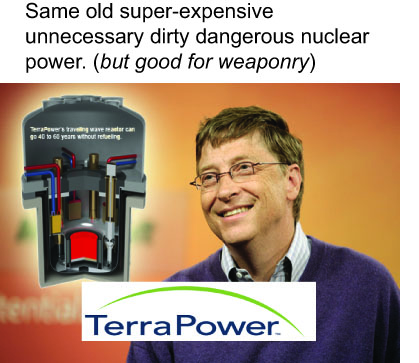
All of these companies also claim their plutonium extraction would utilize new technologies that are “proliferation resistant”—but that, too, is bunk.
The White House has now fully embraced bomb-prone nuclear fuel technology. This should stop before an arms race, atomic terrorism or even nuclear war results
Scientific American, By Alan J. Kuperman, 30 July 25
Recent events in Iran demonstrate that dropping “bunker buster” bombs on nuclear plants is not an ideal, or even necessarily effective, way to prevent proliferation. It is far preferable to prevent the spread of nuclear-weapon-usable technologies in the first place.
A simplistic way to achieve that might be to halt the worldwide growth of nuclear power. Public approval of nuclear energy, however, is actually growing in the U.S., and the White House recently announced policies to quadruple American nuclear power by 2050 while also promoting nuclear exports. This surge of support is somewhat surprising, considering that new reactors not only pose radiation risks from nuclear waste and potential accidents but also produce electricity that costs considerably more than solar or wind power (which can be similarly reliable when complemented by batteries). But nuclear power plants are touted for other attributes, including their small footprint, constant output, infrequent refueling, low carbon emissions and ability to produce heat for manufacturing. If customers decide this justifies the higher cost—and are willing to wait about a decade for new reactors—then nuclear energy has a future.
That leaves only one other way to stop the spread of dangerous atomic technology – by prudently limiting nuclear energy to the “bomb-resistant” type, which entirely avoids weapons-usable material by disposing of it as waste, rather than the “bomb-prone” variety that creates proliferation risks by purifying and recycling nuclear explosives.
Regrettably, however, the White House recently directed government officials to facilitate the bomb-prone version in a set of executive orders in May. That decision needs to be reversed before it inadvertently triggers an arms race, atomic terrorism or even nuclear war. As Iran has highlighted, ostensibly peaceful nuclear technology can be misused for a weapons program. That is why, from now on, the U.S. should support only bomb-resistant reactors and nuclear fuel.
Most Americans probably don’t realize that nuclear reactors originally were invented not for electricity or research but to produce a new substance, plutonium, for nuclear weapons such as the one dropped on Nagasaki. Every nuclear reactor produces plutonium (or its equivalent), which can be extracted from the irradiated fuel to make bombs.
This raises three crucial questions about the resulting plutonium: How much of it is produced? What is its quality? And will it be extracted from the irradiated fuel, making it potentially available for weapons?
Bomb-resistant nuclear energy—the only type now deployed in the U.S.—produces less plutonium, which is of lower quality and does not need to be extracted from the irradiated fuel. By contrast, bomb-prone nuclear energy produces more plutonium, which is of higher quality and must be extracted to maintain the fuel cycle.
Of course, a declared facility to extract plutonium in a country lacking nuclear weapons could be monitored, but history shows that international inspectors would stand little chance of detecting—let alone blocking—diversion for bombs. That is why the U.S. made bipartisan decisions in the 1970s to abandon bomb-prone nuclear energy, aiming to establish a responsible precedent for other countries.
In light of today’s growing concerns about nuclear weapons proliferation in East Asia, the Middle East and lately even Europe, one might assume that U.S. industry and government would promote only bomb-resistant nuclear energy—but that is not so. A growing number of venture capitalists and politicians are aggressively supporting technologies to commercialize plutonium fuel. They are doing so despite the security, safety and economic downsides that have doomed previous such efforts. These past failures are evidenced by the fact that of the more than 30 countries with nuclear energy today, including many which previously attempted or considered recycling plutonium, only one (France) still does so on a substantial scale—at considerable financial loss. However, if the U.S. government continues subsidizing nuclear technologies without regard to proliferation risk, then the plutonium entrepreneurs will keep hopping on that gravy train. Eventually, they even may find willing customers for their pricey, bomb-prone technology—but mainly among countries willing to pay a premium for a nuclear-weapon option.

The most egregious proposal has come from start-up Oklo, a company originally spearheaded by venture capitalist Sam Altman (who stepped down as chairman in April). It is pursuing “fast” reactors that can produce larger amounts of higher-quality plutonium, and it has declared the intention to extract plutonium for recycling into fresh fuel. Oklo even says it plans to export this proliferation-prone technology “on a global scale.” The Biden administration and Congress, despite the obvious dangers of dispersing nuclear weapons-usable plutonium around the world, chose to subsidize the company as part of a wholesale push for new nuclear energy. Then the Trump administration picked as secretary of energy an industrialist named Chris Wright, who actually was on Oklo’s board of directors until his confirmation. In 2024, Wright and his wife also made contributions to a fundraising committee for Trump’s presidential campaign totaling about $458,000, along with contributions to the Republication National Committee of about $289,000. In the first quarter of 2025, Oklo increased its lobbying expenditures by 500 percent compared to the same period last year.
Biden also gave nearly $2 billion to TerraPower, a nuclear energy venture founded by billionaire Bill Gates, for a similar but larger “fast” reactor that also is touted for export. Experts say this inevitably would entail far greater plutonium extraction, even though the company denies any intention to do so. The U.S. Department of Energy also has funded the American branch of Terrestrial Energy, which seeks to build exotic “molten salt” reactors that use liquid rather than solid nuclear fuel. Such fuel must be processed regularly, thereby complicating inspections and creating more opportunities to divert plutonium for bombs.
Most baffling are proposals for large “reprocessing” plants to extract huge amounts of plutonium from irradiated fuel without plausible justification. The company SHINE Technologies, with technical assistance from a firm named Orano, is planning a U.S. pilot plant to process 100 metric tons of spent fuel each year. This would result in the annual extraction of about a metric ton of plutonium—enough for 100 nuclear weapons. SHINE claims the plutonium is valuable to recycle as reactor fuel, but the U.K. recently decided to dispose as waste its entire 140-metric-ton stockpile of civilian plutonium because no one wanted it as fuel. The U.S. similarly has been working to dispose of at least 34 metric tons of undesired plutonium as waste.
Officials from five previous U.S. presidential administrations, and other experts including me, protested in an April 2024 letter to then president Biden that SHINE’s plan would increase “risks of proliferation and nuclear terrorism.” Despite this, President Trump recently issued an executive order in May that directed U.S. officials to approve “privately-funded nuclear fuel recycling, reprocessing, and reactor fuel fabrication technologies … [for] commercial power reactors.” Even more troubling, a separate order directed the government to provide weapons-grade plutonium—retired from our arsenal—directly to private industry as “fuel for advanced nuclear technologies,” which would jump-start bomb-prone nuclear energy before assessing the risks.
SHINE and a similar company, Curio, claim their facilities would slash the country’s radioactive waste stockpile. But realistically, they could barely dent its growth of 2,000 metric tons annually. They also propose to extract valuable radioactive isotopes for medical and space application, but these materials already are available elsewhere at less expense or are needed in such tiny amounts that they require processing only hundreds of kilograms of irradiated fuel annually, not the proposed hundreds of metric tons, which is a thousand times more.
All of these companies also claim their plutonium extraction would utilize new technologies that are “proliferation resistant”—but that, too, is bunk. As far back as 2009, six U.S. national laboratories concluded that, “there is minimal additional proliferation resistance to be found by introducing … [such] processing technologies when considering the potential for diversion, misuse, and breakout scenarios.”………………… https://www.scientificamerican.com/article/u-s-nuclear-energy-policy-could-accelerate-weapons-proliferation/
Media Largely Ignored Gaza Famine When There Was Time to Avert Mass Starvation
Julie Hollar, Fair, July 29, 2025
- “Child Dies of Malnutrition as Starvation in Gaza Grows” (CNN, 7/21/25)
- “More Than 100 Aid Groups Warn of Starvation in Gaza as Israeli Strikes Kill 29, Officials Say” (AP, 7/23/25)
- “No Formula, No Food: Mothers and Babies Starve Together in Gaza” (NBC, 7/25/25)
- “Five-Month-Old Baby Dies in Mother’s Arms in Gaza, a New Victim of Escalating Starvation Crisis” (CNN, 7/26/25)
- “Gaza’s Children Are Looking Through Trash to Avoid Starving” (New York, 7/28/25)
This media coverage is urgent and necessary—and criminally late.
Devastatingly late to care
Since the October 7 attacks, Israel has severely restricted humanitarian aid to the Gaza Strip, using starvation of civilians as a tool of war, a war crime for which Israeli Prime Minister Benjamin Netanyahu and Foreign Minister Yoav Gallant have been charged by the International Criminal Court. Gallant proclaimed a “complete siege” of Gaza on October 9, 2023: “There will be no electricity, no food, no fuel, everything is closed.”
Aid groups warned of famine conditions in parts of Gaza as early as December 2023. By April 2024, USAID administrator Samantha Power (CNN, 4/11/24) found it “likely that parts of Gaza, and particularly northern Gaza, are already experiencing famine.”………………………………………………………………………………
July 29, 2025
Media Largely Ignored Gaza Famine When There Was Time to Avert Mass Starvation
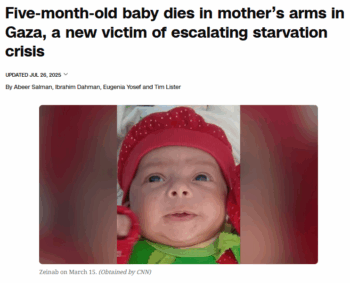
Even as media report more regularly on starvation in Gaza, coverage still tends to obscure responsibility—as with this CNN headline (7/26/25) blaming the baby’s death on the “starvation crisis” rather than on the US-backed Israeli government.
The headlines are increasingly dire.
- “Child Dies of Malnutrition as Starvation in Gaza Grows” (CNN, 7/21/25)
- “More Than 100 Aid Groups Warn of Starvation in Gaza as Israeli Strikes Kill 29, Officials Say” (AP, 7/23/25)
- “No Formula, No Food: Mothers and Babies Starve Together in Gaza” (NBC, 7/25/25)
- “Five-Month-Old Baby Dies in Mother’s Arms in Gaza, a New Victim of Escalating Starvation Crisis” (CNN, 7/26/25)
- “Gaza’s Children Are Looking Through Trash to Avoid Starving” (New York, 7/28/25)
This media coverage is urgent and necessary—and criminally late.
Devastatingly late to care

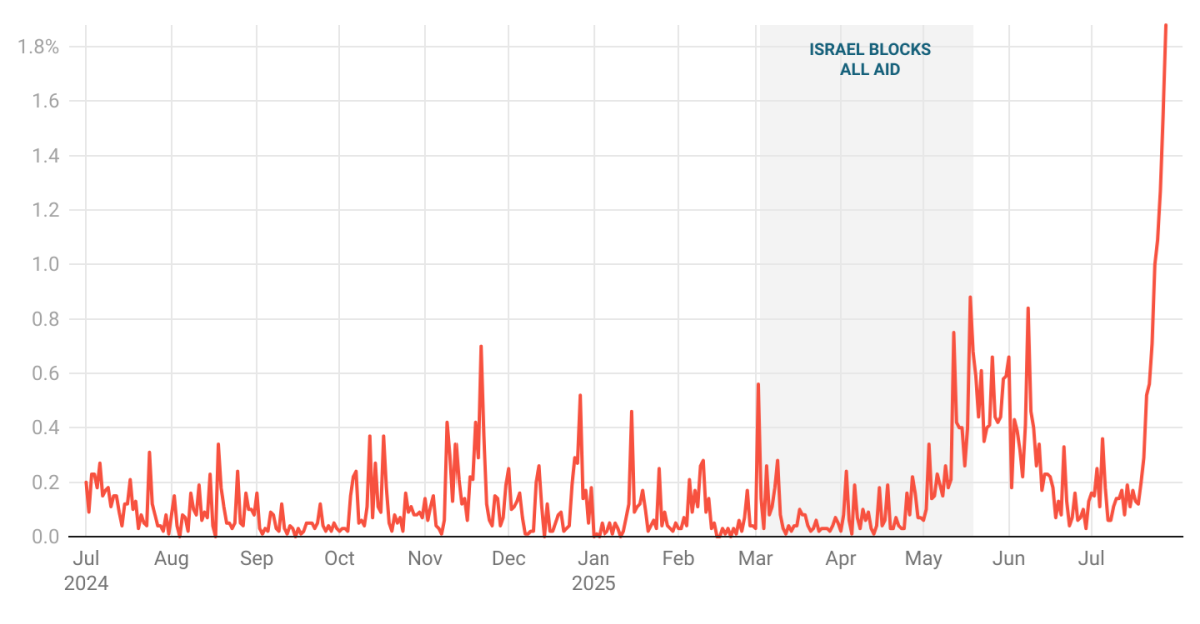
An informative Wall Street Journal chart (7/27/25) shows the complete cutoff of food into Gaza at the beginning of 2025—a genocidal policy decision by Israel that was not accompanied by increased coverage in US media of famine in the Strip.
Since the October 7 attacks, Israel has severely restricted humanitarian aid to the Gaza Strip, using starvation of civilians as a tool of war, a war crime for which Israeli Prime Minister Benjamin Netanyahu and Foreign Minister Yoav Gallant have been charged by the International Criminal Court. Gallant proclaimed a “complete siege” of Gaza on October 9, 2023: “There will be no electricity, no food, no fuel, everything is closed.”
Aid groups warned of famine conditions in parts of Gaza as early as December 2023. By April 2024, USAID administrator Samantha Power (CNN, 4/11/24) found it “likely that parts of Gaza, and particularly northern Gaza, are already experiencing famine.”
A modest increase in food aid was allowed into the Strip during a ceasefire in early 2025. But on March 2, 2025, Netanyahu announced a complete blockade on the occupied territory. Israeli National Security Minister Itamar Ben-Gvir declared that there was “no reason for a gram of food or aid to enter Gaza.”
After more than two months of a total blockade, Israel on May 19 began allowing in a trickle of aid through US/Israeli “Gaza Humanitarian Foundation” (GHF) centers (FAIR.org, 6/6/25)—while targeting with snipers those who came for it—but it is not anywhere near enough, and the population in Gaza is now on the brink of mass death, experts warn. According to UNICEF (7/27/25):
The entire population of over 2 million people in Gaza is severely food insecure. One out of every three people has not eaten for days, and 80% of all reported deaths by starvation are children.
According to the Gaza Health Ministry, at least 147 Gazans have died from malnutrition since the start of Israel’s post–October 7 assault. Most have been in the past few weeks.
Mainstream politicians are finally starting to speak out—even Donald Trump has acknowledged “real starvation” in Gaza—but as critical observers have pointed out, it is devastatingly late to begin to profess concern. Jack Mirkinson’s Discourse Blog (7/28/25) quoted Refugees International president Jeremy Konyndyk:
I fear that starvation in Gaza has now passed the tipping point and we are going to see mass-scale starvation mortality…. Once a famine gathers momentum, the effort required to contain it increases exponentially. It would now take an overwhelmingly large aid operation to reverse the coming wave of mortality, and it would take months.
And there are long-term, permanent health consequences to famine, even when lives are saved (NPR, 7/29/25). Mirkinson lambasted leaders like Cory Booker and Hillary Clinton for failing to speak up before now: “It is too late for them to wash the blood from their hands.”
Major US media, likewise, bear a share of responsibility for the hunger-related deaths in Gaza. The conditions of famine have been out in the open for well over a year, and yet it was considered barely newsworthy in US news media.
A MediaCloud search of online US news reports mentioning “Gaza” and either “famine” or “starvation” shows that since Netanyahu’s March 2 announcement of a total blockade—which could only mean rapidly increasing famine conditions—there was a brief blip of media attention, and then even less news coverage than usual for the rest of March and April. Media attention rose modestly in May, at a time when the world body that classifies famines announced in May that one in five people in Gaza were “likely to face starvation between May 11 and September 30″—in other words, that flooding Gaza with aid was of the highest urgency.
But as aid continued to be held up, and Gazans were shot by Israeli snipers when attempting to retrieve the little offered them, that coverage eventually dwindled, until the current spike that began on July 21.
FAIR (e.g., 3/22/24, 4/25/25, 5/16/25, 5/16/25) has repeatedly criticized US media for coverage that largely absolves Israel of responsibility for its policy of forced starvation—what Human Rights Watch (5/15/25) called “a tool of extermination”—implemented with the backing of the US government.
The current headlines reveal that the coverage still largely diverts attention from Israeli (let alone US) responsibility, but it’s a positive development that major US news media are beginning to devote serious coverage to the issue. Imagine how different this all could have looked had they given it the attention it has warranted, and the accountability it has demanded, when alarms were first raised. https://fair.org/home/media-largely-ignored-gaza-famine-when-there-was-time-to-avert-mass-starvation/
Trump moves nuclear submarines after ex-Russia president’s tweet
Andrew Roth Guardian, 2 Aug 25
Order comes after president’s anger at tweet from Dmitry Medvedev which called Trump’s threat to sanction Russia over Ukraine a ‘step towards war’.
Donald Trump has said that he has deployed nuclear-capable submarines to the “appropriate regions” in response to a threatening tweet by Russia’s former president Dmitry Medvedev, suggesting that he would be ready to launch a nuclear strike as tensions rise over the war in Ukraine.
In a post on Truth Social on Friday, Trump wrote that he had decided to reposition the nuclear submarines because of “highly provocative statements” by Medvedev, noting he was now the deputy chairman of Russia’s security council.
Medvedev had earlier said that Trump’s threats to sanction Russia and a recent ultimatum were “a threat and a step towards war”.
“I have ordered two Nuclear Submarines to be positioned in the appropriate regions, just in case these foolish and inflammatory statements are more than just that,” Trump responded. “Words are very important, and can often lead to unintended consequences, I hope this will not be one of those instances.”
He did not specify whether he was referring to nuclear-powered or nuclear-armed submarines.
Asked later by reporters why he ordered the submarine movement, Trump said: “A threat was made by a former president of Russia and we’re going to protect our people.”…………………………………………………………………………………….. https://www.theguardian.com/us-news/2025/aug/01/trump-nuclear-submarines-russia-ukraine
Sizewell C to build further education campus in Leiston.

Education and employment leaders have hailed new plans for an education campus in Leiston as a “landmark moment”.
The education campus will include College on the Coast, a new permanent further education college delivered in partnership with Suffolk New College, that will provide technical, vocational, and academic pathways aligned to the workforce needs of the new nuclear power plant and the wider energy, infrastructure and engineering sectors.
Sizewell C announced further details of the centre, which will include a post-16 college, at a well-attended public exhibition in July.
A planning application for the College on the Coast and Apprentice Hub, on the eastern edge of Leiston, will be submitted in the coming months. ………..
East Anglian Daily Times 31st July 2025, https://www.eadt.co.uk/news/25353049.sizewell-c-build-education-campus-leiston/
Small Modular Reactors: Déjà Vu All Over Again
Arnie Gundersen, August 1, 2025, https://www.counterpunch.org/2025/08/01/small-modular-reactors-deja-vu-all-over-again/
Storm clouds began to form in America’s Atoms for Peace construction program during the late 1950s. Clear-headed analysts identified many pitfalls in constructing commercial atomic power reactors that continue now, 70 years later. This February 10, 1958, opinion piece in Time Magazinewas not just prescient for the failure of the Atoms for Peace program, but also applies to the Small Modular Reactor (SMR) marketing ploy in 2025:
“Industry Asks More Government Help to Speed Program”
… to many U.S. businessmen, a stronger atomic defense is only one side of the coin… they insist that commercial nuclear power must be sped up, or else the U.S. will fall far behind other nations.
The main argument is over how much help the U.S. Government should give private industry. AEC’s [Atomic Energy Commission]position is that nuclear power for peaceful purposes should be largely a private venture, with AEC supplying only limited funds.
Originally, businessmen supported the idea, lest nuclear energy grow into a giant public-power program. Now their position has changed. Even the stoutest private power men feel that the program needs a strong infusion of Government aid because commercial nuclear power is so new, so complex, and so costly that private companies cannot carry the burden alone. …“There isn’t a reactor manufacturer in the U.S. who doesn’t favor Government assistance to get them over the hump.”
The big hump is the fact that conventional U.S. power is so cheap—and nuclear power so expensive—that the U.S. itself has no pressing domestic need for a crash program. … U.S. industry is learning, to its sorrow, that there is a vast gulf between atomic power in the lab and in commercial quantities. Costs have shot up to the point where they discourage even the richest companies… Even the biggest companies find the going rough…. G.E., like the others, thinks that if it could build three big plants in a row, it could learn enough to produce competitive power. But G.E. has no plans at the moment. As one reactor builder says: “Private industry has found that there is no money in atomic energy and no prospect of making any money”… For U.S. consumers, the lag in the commercial nuclear program is no great worry…the U.S. can afford to wait…. There is little doubt among nuclear experts that the U.S. must push ahead much faster than AEC Chairman Strauss is willing to go…. But until nuclear power becomes competitive with present power, he wants the Federal Government to make cash contributions to pay most of the difference between nuclear-and conventional-power construction costs… “The only way our country can achieve competitive nuclear power is through the building of a series of full-scale plants …. Our program must be accelerated.” [1][Emphasis Added]
Several themes from the 1958 Time Magazine opinion piece are identical to today’s unfounded marketing ploys announced by SMR manufacturers and supporters.
First, SMR corporations appeal to nationalistic pride by asserting that the U.S. will fall far behind other nations.
Second, the financial demands by today’s SMR investors and manufacturers are almost identical to those made during the 1950s that emphasized the need for Government subsidies. “There isn’t a reactor manufacturer in the U.S. who does not favor Government assistance to get them over the hump.”
Third, there is an unfounded belief that repeatedly building the same design will somehow reduce costs. “G.E., like the others, thinks that if it could build three big plants in a row, it could learn enough to produce competitive power.”
Forth, the Small Modular Reactor vendors are creating a sense of urgency, pushing nuclear regulators faster than necessary.
“There is little doubt among nuclear experts that the U.S. must push ahead much faster than AEC Chairman Strauss is willing to go…The only way our country can achieve competitive nuclear power is through the building of a series of full-scale plants …Our program must be accelerated.”
Fifth, much less expensive and proven technologies are available to produce electricity, so there is no reason to develop a new, untested, cost-prohibitive SMR nuclear technology. “For U.S. consumers, the lag in the commercial nuclear program is no great worry… the U.S. can afford to wait. …But until nuclear power becomes competitive with present power, he wants the Federal Government to make cash contributions to pay most of the difference between nuclear and conventional-power construction costs”
Following the 1958 Time Magazine Opinion, the business-friendly Forbes Magazine published an excellent one-sentence summary 30 years later pronouncing the utter failure of every single U.S. atomic construction project. By 1985, the economic debacle of building nuclear plants had reached the front cover of Forbes Magazine.
The failure of the U.S. nuclear power program ranks as the largest managerial disaster in business history, a disaster on a monumental scale.[2]
Forbes was one of the first major business magazines to identify the adverse economic implications associated with nuclear power. As a financial magazine, it was a nuclear agnostic, conceptually neither in favor of nor against nuclear, it had no dog in the nuclear fight! It was following the money. In the intervening 40 years since the prescient Forbes cover story, nuclear remains much more costly than renewable alternatives.
The financial and schedule collapse of every nuclear project ever proposed in the U.S. during the last 60 years has been well-documented in thousands of mainstream media articles, in academia, assessments by financial analysts, Statehouses, and, of course, in Congress, before Federal Agencies, and in review by Environmental watchdogs and community nonprofits. Yet in 2025, policymakers and politicians remain enthralled with yet another of the nuclear industry’s latest marketing ploy disguised this time as the Small Modular Reactor.
To rephrase Yogi Berra, Building Small Modular Reactors appears to be “Déjà vu all over again”.
NOTES
1. February 10, 1958, Time Magazine ↑
2. Forbes Magazine, Cover Story, February 1985 ↑
Arnie Gundersen is the Chief Engineer, board member, and resident “science guy” at the Fairewinds Energy Education NGO. Since the catastrophe at Fukushima, Arnie focuses his energy worldwide on the migration of radioactive microparticles. During his multiple trips to Japan, Arnie has met and trained community-volunteer citizen-scientists to study the migration of radioactive microparticles from Fukushima in two co-authored peer-reviewed scientific articles.
Trump’s Fantasy Bid for the Nobel Peace Prize

1 August 2025 Michael Taylor, https://theaimn.net/trumps-fantasy-bid-for-the-nobel-peace-prize/
In what may go down as one of the most surreal moments of Donald Trump’s second presidency, White House Press Secretary Karoline Leavitt stood before the press corps and delivered a speech so dripping with delusion that it would have made even the most seasoned propagandist blush.
With a straight face and a tone of practiced reverence, she read from a statement that claimed:
“The President has now ended conflicts between Thailand and Cambodia, Israel and Iran, Rwanda and the Democratic Republic of the Congo, India and Pakistan, Serbia and Kosovo, and Egypt and Ethiopia. This means President Trump has brokered, on average, about one peace deal or ceasefire per month during his six months in office. It is well past time that President Trump was awarded the Nobel Peace Prize.”
The language bore all his hallmarks: self-congratulation, historical revisionism, and the casual rewriting of reality. If you closed your eyes, you could practically hear Trump dictating it himself, likely from a golf cart: “No president has ever done more for peace… The world is calmer because of President Trump.”
Meanwhile, America burns.
Cities across the country remain divided and anxious. Violent crime is rising in some areas. Racial tensions have intensified under his inflammatory rhetoric. Migrants are being plucked off the streets and separated from their families under legally murky executive actions. The economy, battered by trade wars and broken promises, limps along. The climate crisis – arguably the greatest threat to long-term peace – continues to be denied by the administration altogether.
And yet, here we are, talking about a Nobel Peace Prize.
It’s not that Americans don’t value peace. It’s that they can see through a bad sales pitch. The spectacle was not only cringeworthy, it was offensive. Offensive to genuine peacemakers. Offensive to Americans living pay to pay. Offensive to veterans of actual wars.
To be clear, this isn’t the first time Trump has floated his Nobel ambitions. He’s been obsessed with the prize since taking office the first time. He has tweeted about it. Endlessly. He rages that Obama – a lesser president than himself – has one in his trophy cabinet while his own cupboard is bare. But now, with his second term spiraling and his political capital shrinking, the pursuit of a symbolic trophy has become a sad distraction – a transparent bid for legacy over substance.
This press conference wasn’t about peace. It was about ego. It was about shifting the narrative from legal troubles and legislative failures to a grandiose alternate reality where Donald Trump is not just a divisive figure but a global peacemaker.
The Nobel Peace Prize stands for something: diplomacy, de-escalation, justice. Not manufactured press releases. Not fantasies of greatness. And certainly not a list of imaginary accomplishments recited by a spokesperson who knows better, but has clearly chosen not to care.
Russian nuclear submarine base hit by tsunami.
Waves triggered by 8.8 magnitude earthquake damaged base that houses Pacific Fleet
Russia’s far east nuclear submarine base appears to have been damaged by
the tsunami that swept the country’s Pacific coast on Wednesday,
according to satellite imagery obtained by The Telegraph. The waves,
triggered by an 8.8 magnitude earthquake, hit the Rybachiy base in
Kamchatka peninsula, which houses most of the nuclear submarines in
Russia’s Pacific Fleet. A section of one pier has bent away from its
original position, possibly indicating that it was detached from its
moorings, images taken by the Umbra Space satellite on Thursday morning
have revealed.
It does not appear that a submarine was moored alongside at
the time of impact and experts said damage to the structure alone would
have little military significance. However, questions were raised about
whether the tsunami caused any further harm to the base, which was thought
to have been hit within 15 minutes of the earthquake.
Telegraph 1st Aug 2025, https://www.telegraph.co.uk/world-news/2025/08/01/russian-nuclear-submarine-base-earthquake-satellite/
‘Designed as Death Traps’: Fmr. Green Beret Who Worked at Gaza Food Sites Reveals Rampant War Crimes.
July 30, 2025 democracynow!,
As more than 1,000 Palestinians have been killed seeking aid at militarized aid distribution sites run by the U.S.- and Israel-backed Gaza Humanitarian Foundation, a former GHF security contractor tells Democracy Now! he saw U.S. mercenaries and Israeli forces commit war crimes by indiscriminately shooting at starving Palestinians waiting for aid. “What I witnessed in Gaza, I can only describe as a dystopian, post-apocalyptic wasteland,” says Anthony Aguilar, a retired U.S. soldier who worked as a subcontractor with UG Solutions in the Gaza Humanitarian Foundation aid delivery operation. “We, the United States, are complicit. We are involved, hand in hand, in the atrocities and the genocide that is currently undergoing in Gaza.”
Transcript……………………………………………………………………….
Radiation dangers at “Sea Fest” in Cumbria
Campaigners have sent a letter to Cumbria Wildlife Trust urging them to
inform families of the dangers at “Sea Fest” on 2nd August. Radiation
Free Lakeland have been writing to the wildlife charity for many years and
even taken direct action at the Sand Sculpture events on St Bees Beach
producing their own sand sculpture of “The Scream” and presenting
Cumbria Wildlife Trust with a “Blinky” statue.
The letter asks that
Cumbria Wildlife Trust inform families of the risks of encountering
radioactive particles whilst spending hours digging sand sculptures.
Campaigners point to Sellafield’s own recent Particles in the Environment
Reports which outline alpha and beta rich finds one of which is Cesium-137
with an activity of 1.23 ± 0.25 MBq “the 2nd highest Cs-137 activity
measured in any find since the programme (of monitoring and retrieval)
began”. Also stated by Sellafield: “Alpha-rich particle find rates at
Sellafield beach and Northern Beaches appear higher than those measured in
recent years” as reported in Sellafield Particles in the Environment
Update (1-Jan to 1-April 2025).
Radiation Free Lakeland 1st Aug 2025, https://mariannewildart.wordpress.com/2025/08/01/cumbria-wildlife-trust-sand-castle-event-where-alpha-rich-particle-find-rates-at-sellafield-beach-and-northern-beaches-appear-higher-than-those-measured-in-recent-years/
1 This Month

of the week – Shut Down Drone Warfare!


Tell the Ukrainian Government to Drop Prosecution of Peace Activist Yurii Sheliazhenko

Petition to revoke the licensing of the Near Surface Nuclear Disposal Facility (NSDF) at Chalk River. https://www.ourcommons.ca/petitions/en/Petition/Details?Petition=e-7247
To see nuclear-related stories in greater depth and intensity – go to https://nuclearinformation.wordpress.com
-
Archives
- April 2026 (44)
- March 2026 (251)
- February 2026 (268)
- January 2026 (308)
- December 2025 (358)
- November 2025 (359)
- October 2025 (376)
- September 2025 (257)
- August 2025 (319)
- July 2025 (230)
- June 2025 (348)
- May 2025 (261)
-
Categories
- 1
- 1 NUCLEAR ISSUES
- business and costs
- climate change
- culture and arts
- ENERGY
- environment
- health
- history
- indigenous issues
- Legal
- marketing of nuclear
- media
- opposition to nuclear
- PERSONAL STORIES
- politics
- politics international
- Religion and ethics
- safety
- secrets,lies and civil liberties
- spinbuster
- technology
- Uranium
- wastes
- weapons and war
- Women
- 2 WORLD
- ACTION
- AFRICA
- Atrocities
- AUSTRALIA
- Christina's notes
- Christina's themes
- culture and arts
- Events
- Fuk 2022
- Fuk 2023
- Fukushima 2017
- Fukushima 2018
- fukushima 2019
- Fukushima 2020
- Fukushima 2021
- general
- global warming
- Humour (God we need it)
- Nuclear
- RARE EARTHS
- Reference
- resources – print
- Resources -audiovicual
- Weekly Newsletter
- World
- World Nuclear
- YouTube
-
RSS
Entries RSS
Comments RSS
 nuclear-news